
GitHub SEO Strategy: Backlinks & Authority Building
Use GitHub for SEO backlinks and developer authority. Showcase projects, create documentation, and earn high-quality links through open source contributions.
 Maya Krishnan
Great code often dies in obscurity not because it lacks quality, but because it lacks visibility. For software companies, SaaS startups, and individual developers, GitHub is not just a version control warehouse—it is a primary search engine for technical solutions. When a developer searches for "React authentication library" or "Python web scraper," they often start on GitHub or Google. If your repository isn't optimized to capture that intent, you lose potential users, contributors, and valuable organic traffic.
This is where GitHub SEO (Search Engine Optimization) transforms your repository from a silent archive into a discoverable asset. It functions similarly to traditional website optimization but with unique ranking factors specific to the developer ecosystem. By treating your GitHub profile and repositories as content marketing channels, you build a powerful engine for brand authority and referral traffic.
This guide breaks down the mechanics of GitHub SEO, explaining how to optimize your repositories for internal and external search, earn high-quality backlinks, and leverage documentation for brand growth. We will also examine how AI-driven tools, such as Digispot AI, can streamline this process by auditing your documentation and identifying keyword opportunities.
Key Takeaways
- Treat your repo like a landing page. The repository name is your title tag, the "About" section is your meta description, and the
README.mdis your body content—optimize each with front-loaded keywords. - Max out your metadata. Use hyphenated, keyword-led repo names, a punchy value-prop description with an off-platform URL, and all 20 topic slots mixing broad and narrow tags.
- Invest in the README first. A thorough README with strict H1/H2 hierarchy, keywords in the first 100 words, and rich media is the single highest-leverage SEO asset in your repository.
- Engineer engagement and freshness. Frequent releases, enabled Discussions, and clear contribution CTAs generate the stars, UGC, and timestamp signals that GitHub's algorithm rewards.
- Build real backlinks off-platform. Awesome lists, package-manager listings (NPM, PyPI, RubyGems), and targeted Stack Overflow answers earn authoritative links and highly qualified referral traffic.
Defining GitHub SEO Mechanics
GitHub SEO is the strategic process of optimizing repository metadata, documentation, and engagement signals to improve visibility in three distinct areas:
- GitHub's Internal Search: Using the platform's native algorithm to rank for topic and code queries.
- External Search Engines (Google/Bing): Ensuring repositories and GitHub Pages index correctly for broader technical queries.
- AI Search (AEO): Optimizing code and documentation so LLMs like ChatGPT, Claude, and GitHub Copilot recommend your solution.
When you optimize a repository, you are essentially performing on-page SEO. Your repository name acts as the Title Tag, your description as the Meta Description, and your README.md as the main body content. Aligning these elements with user search intent ensures your hard work connects with the developers who need it most.
The Strategic Value of GitHub Optimization
Why invest resources in optimizing a code repository? The return on investment extends far beyond vanity metrics like star counts. A well-executed GitHub strategy drives tangible business value.
1. Dominating Niche Technical SERPs
GitHub repositories possess incredibly high domain authority. Google trusts GitHub.com implicitly. This means a well-optimized README.md can often outrank established competitor blogs for specific technical keywords. If your main website struggles to rank for competitive terms like "open source CRM," your GitHub repository might capture that spot much faster due to the platform's inherent trust flow.
2. The Flywheel of Engagement Signals
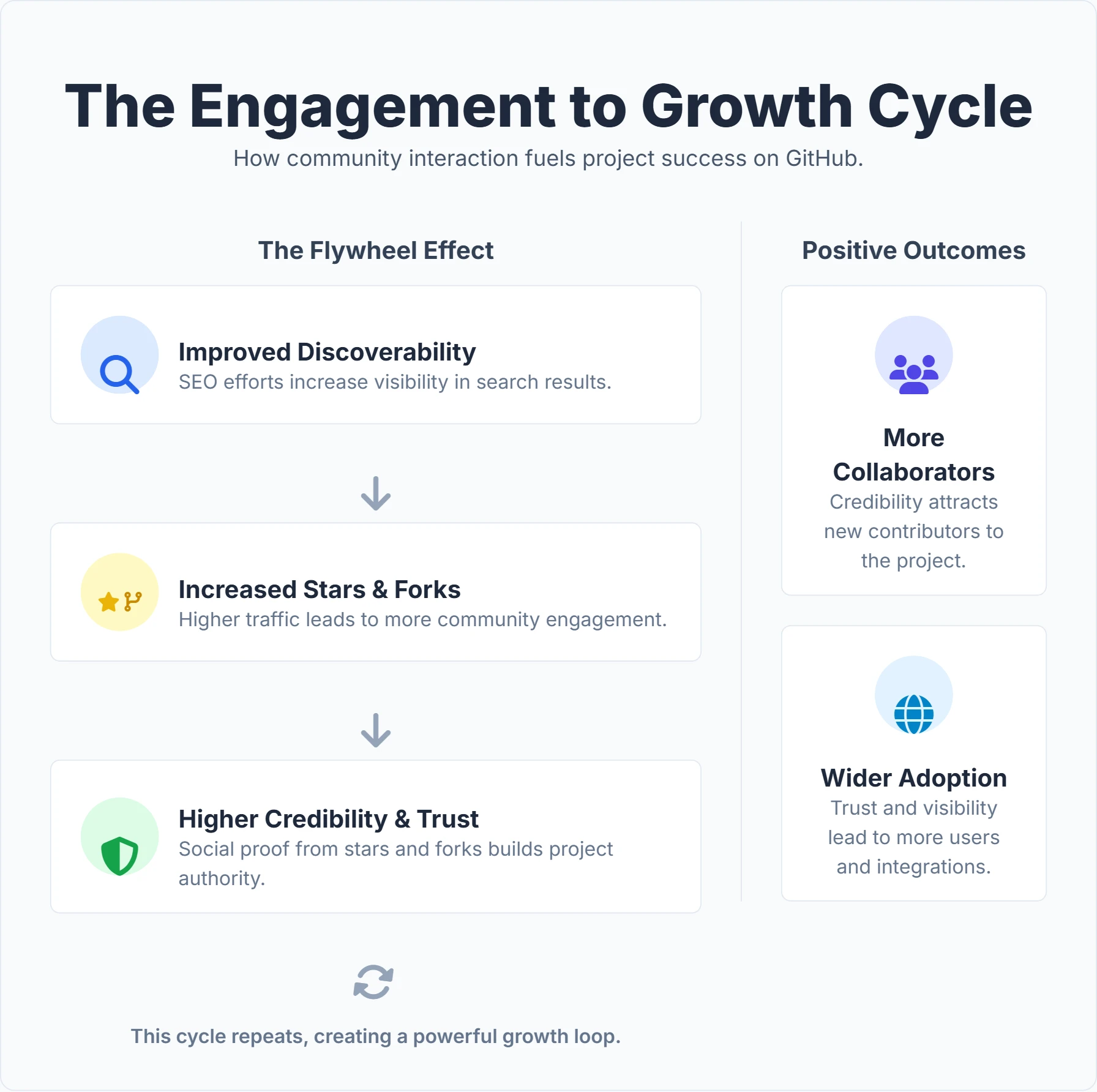
GitHub's algorithm weighs engagement heavily. Stars, forks, and watchers act as social proof and ranking signals. By making your project discoverable through SEO, you increase the likelihood of organic discovery. This leads to more stars, which in turn improves your rankings further—a positive feedback loop that cements your project as the industry standard.
3. Recruitment and Talent Acquisition
For companies, an active, visible GitHub presence is a recruitment magnet. Top-tier developers want to work on projects that are widely used and respected. A polished profile with well-documented, popular repositories signals technical competence and a healthy engineering culture.
4. Direct Lead Generation
Every visitor to your repository is a qualified lead. They are developers or technical decision-makers looking for a solution you provide. By including clear links to your commercial product or website in your profile and READMEs, you create a high-intent referral channel that costs nothing to maintain.
Core Implementation Strategy: The 7 Pillars of GitHub SEO
Optimizing your GitHub presence requires a systematic approach. You cannot simply stuff keywords into your code comments and expect results. You must balance technical accuracy with search engine accessibility.
1. Repository Naming Conventions
Your repository name is the weightiest ranking factor. It appears in the URL, the breadcrumbs, and the heading of the page.
- Hyphenation Matters: Google reads
my-awesome-toolas "my awesome tool." It readsmyawesometoolas a single, unintelligible string. Always use hyphens to separate words. - Front-Load Keywords: Place the most critical descriptor at the start. If you built a scraper in Python,
python-web-scraperis superior toscraper-tool-python. - Technology + Function: A strong naming formula is
[Language]-[Function]or[Tech-Stack]-[Solution]. Examples:react-admin-dashboard,go-microservices-template,kubernetes-monitoring-agent.
2. The "About" Section: Your Meta Description
The "About" section on the right sidebar of your repository acts as your meta description in Google search results and your snippet in GitHub search.
- Integrate Links: You can add a website URL directly in the About section. Ensure this points to your landing page or documentation site to drive traffic off-platform.
- Keyword Density: You have limited space. Avoid fluff. Instead of "A really cool project I made," use "Lightweight, zero-dependency JSON parser for Node.js."
- Social Preview: When your repo is shared on social media or Slack, this description appears. Make it punchy to encourage clicks.
3. Topic Tagging Taxonomy
GitHub Topics function like LSI (Latent Semantic Indexing) keywords. They help GitHub connect your repository with related concepts.
- Broad and Narrow Tags: Use a mix. If you have a React library, use broad tags like
javascriptandweb-development, but also specific ones likereact-component,ui-library, andfrontend. - The "Awesome" Ecosystem: Tagging your project with
awesome-list(if applicable) or submitting it to relevant "Awesome" lists can generate massive visibility. - Max Out the Limit: You have 20 slots. Use them all. If you are struggling to find relevant topics, look at what the top-ranking repositories in your niche are using.
Table 1: Key Metadata Optimization Checklist
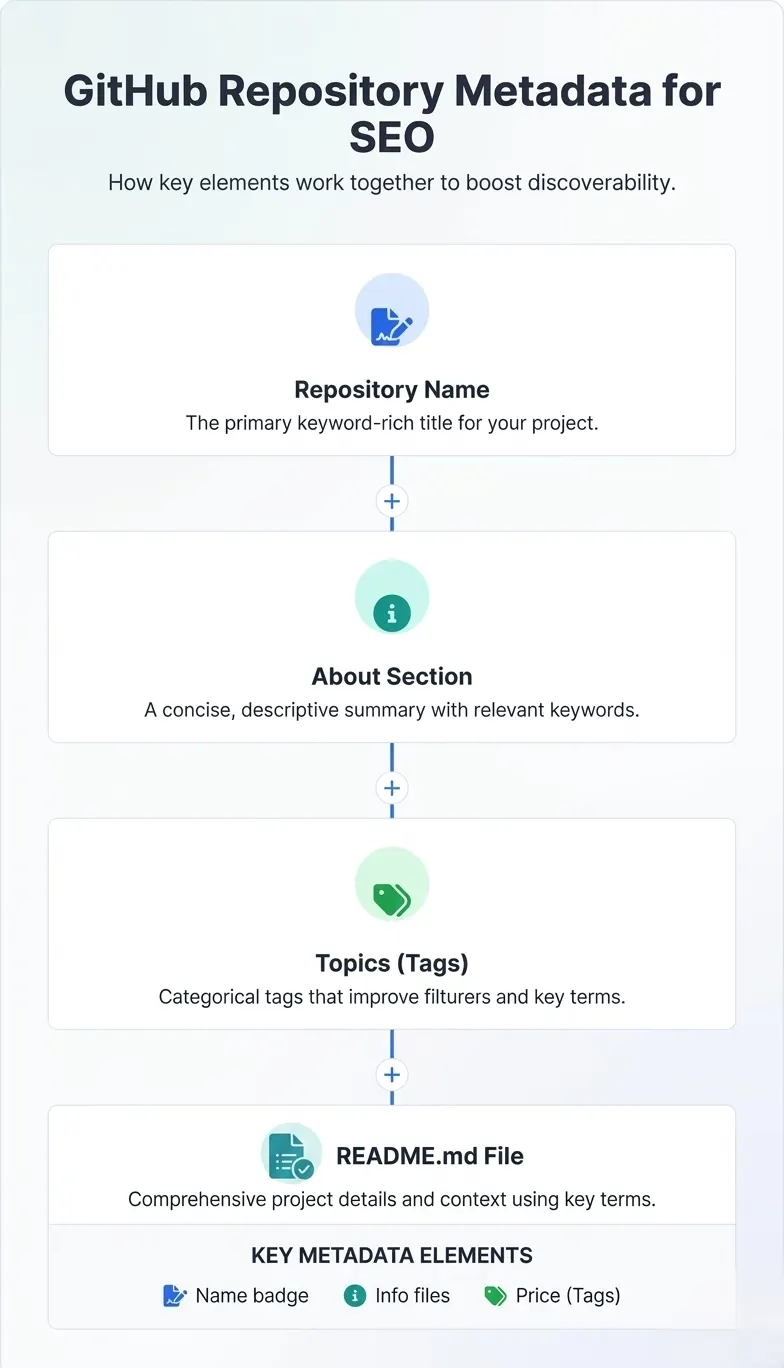
| Element | Description | Best Practices |
|---|---|---|
| Repository Name | Primary URL and page title identifier. | Use hyphens, lead with primary keywords, keep it under 30 chars if possible. |
| About Section | Search snippet and social preview description. | Include the main value prop and tech stack. Add a direct URL to your demo or site. |
| Topics (Tags) | Categorization for internal discovery. | Use all 20 slots. Mix language tags (python) with function tags (machine-learning). |
4. The README.md: Your Content Powerhouse
The README.md is the single most important file for SEO. Search engines treat it as the main content of the page. A thin README tells Google your page has "low quality" content. A robust README signals authority.
- Header Hierarchy: Use H1, H2, and H3 tags strictly. Your H1 should be the project name (or close variant). H2s should target secondary keywords like "Installation," "Usage," and "Configuration."
- Keyword Placement: Include your primary keyword in the first 100 words. Search engines weigh the introduction heavily.
- Rich Media: Google cannot "watch" a GIF, but it knows when users dwell on a page to watch one. High dwell time signals quality. Include screenshots, architecture diagrams, and demo GIFs.
- Internal Linking: Link to other files in your repo (e.g.,
docs/api.md). This helps crawlers index your entire file structure. Learn more about effective internal linking strategies to distribute authority across your repository ecosystem. - Table of Contents: For longer READMEs, a clickable Table of Contents improves user experience and can generate "Jump to" links in Google SERPs.
Pro Tip: Treat your README like a sales landing page. State the problem, offer the solution, show social proof (badges/stars), and provide a clear Call to Action (CTA).
5. GitHub Pages: Technical SEO Control
For serious projects, relying solely on the repo interface isn't enough. GitHub Pages allows you to host a static website directly from your repository. This gives you full control over technical SEO.
- Custom Domain: Moving from
username.github.io/projecttodocs.yourbrand.combuilds authority for your own domain. - Sitemaps and Robots.txt: When using a static site generator like Jekyll (GitHub's default), you can generate XML sitemaps. This ensures Google crawls every page of your documentation, not just the homepage.
- Canonical Tags: If you cross-post content from your main blog to your GitHub Wiki or Pages, use canonical tags to prevent duplicate content issues.
- Schema Markup: You can inject JSON-LD schema into Jekyll templates. Adding
SoftwareApplicationschema helps Google understand your project is a software tool, potentially earning rich snippets. If you are new to markup, our advanced schema markup guide walks through implementing and validating these tags.
Digispot AI helps you validate these technical elements. You can use the platform to audit your GitHub Pages site just like any other URL, checking for broken links, missing meta tags, and schema validation errors.

6. Engagement Engineering
Engagement signals (Stars, Forks, Watchers) are the "backlinks" of the internal GitHub ecosystem. You cannot fake them effectively, but you can engineer environments that encourage them.
- The "Contribute" CTA: Don't just ask for stars. Ask for contributions. "Found a bug? Open an issue!" Interaction counts.
- Release Notes: Publish frequent releases. Each release creates a new URL and timestamp update, signaling to search engines that the project is "fresh" and active.
- Discussions Tab: Enable GitHub Discussions. This generates user-generated content (UGC) which is full of long-tail keywords. When users ask questions, they often use the exact phrasing other searchers use on Google.
7. Off-Page Promotion & Backlinks
Backlinks remain a critical ranking factor for Google, and GitHub is one channel within the broader discipline of link building in SEO. GitHub repositories can earn massive authority if promoted correctly. If you want to audit what you already have before chasing new links, start with a backlink profile analysis to see which referring domains actually point at your repos.
- The "Awesome" List Strategy: "Awesome Lists" are curated lists of resources on GitHub (e.g., "Awesome Python"). Getting your repo listed on a popular Awesome list creates a high-authority backlink from within GitHub itself.
- Package Managers: If your project is a library, publish it to NPM, PyPI, or RubyGems. These directories rank highly and provide authoritative backlinks to your repo. For a broader playbook on sourcing these links, see our guide to free high-quality backlinks.
- Stack Overflow: Monitor Stack Overflow for questions your tool solves. Answer helpfuly and link to your repo as a solution. This drives highly targeted traffic. For more on building authority through Q&A platforms, read about Quora backlinks strategies.
Optimizing for the AI Era (AEO)
Search is evolving. Developers increasingly ask ChatGPT, Claude, or GitHub Copilot for solutions rather than searching keywords. This is Answer Engine Optimization (AEO).
To ensure AI recommends your library:
- Clear Documentation: AI models are trained on code and text. If your README clearly explains what your code does and how to use it, the AI understands it better.
- Contextual Examples: Provide varied code snippets. AI models look for patterns. If you show how your tool integrates with popular frameworks, the AI is more likely to suggest it in those contexts.
- Semantic Clarity: Avoid jargon where simple terms work. AI correlates concepts. If you describe your tool as a "data ingestion engine," also use simpler terms like "import data" to capture broader semantic associations. Cover the full vocabulary developers actually type—this is where mapping long-tail keyword variations pays off, because a Copilot or ChatGPT prompt like "parse csv without pandas" rarely matches your polished marketing phrasing.
- Structured, Answerable Sections: LLMs extract answers best from self-contained blocks. Break your README into short, question-shaped H2s ("How do I install it?", "Does it support TypeScript?") followed by a direct one-to-two-sentence answer and a code sample. This mirrors the FAQ pattern that answer engines quote verbatim, and it doubles as scannable on-page structure for human readers.
- Machine-Readable Metadata: Ship a clear
package.json,LICENSE, and consistent version tags. AI models and package indexes lean on this structured metadata to judge whether a project is maintained and safe to recommend. Reinforcing it with structured data and schema on your GitHub Pages docs gives Google's AI Overviews the same explicit signals.
This shift requires a new approach to content. Learn more about building an SEO strategy for the AI era to keep your documentation ahead of the curve.
Accelerating Results with Digispot AI
Manual optimization of repositories and documentation sites is time-consuming. Digispot AI streamlines this by bringing enterprise-grade SEO tools to the developer workflow.
Audit Your Documentation Site: If you host documentation on GitHub Pages, technical errors can kill your rankings. Is your theme mobile-friendly? Are your images optimized? Digispot AI runs a 300+ point check on your documentation site, identifying issues like slow load times or missing alt text that might be holding you back.
Keyword Discovery for READMEs: Writing a README is hard; writing an SEO-optimized one is harder. Use Digispot's Opportunity Finder to identify the exact questions developers are asking about your technology. You might find that while you are targeting "image compression," your audience is searching for "reduce png size nodejs." Pivoting your H1 and H2 tags to match these terms can double your traffic.
Instant On-Page Analysis: You don't need to leave your browser to check your optimization. The Digispot AI Chrome Extension allows you to audit any GitHub repository or documentation page instantly.
- Check Meta Tags: See exactly how your repo appears to search engines.
- Visualize Schema: Verify if your documentation schema is valid.
- Analyze Headings: Ensure your README heading structure is logical and keyword-rich.
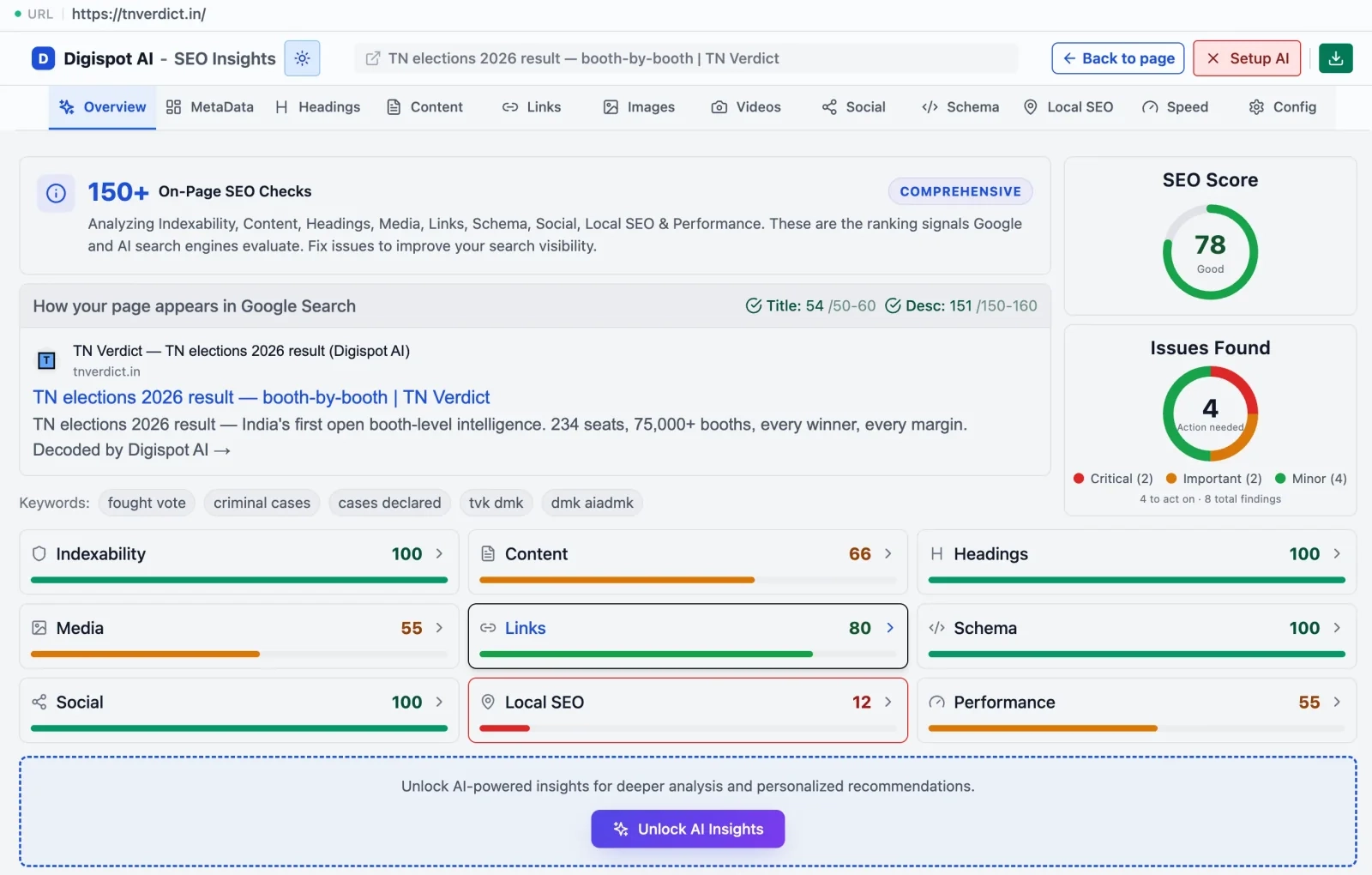
For quick checks on specific pages, you can also use our free On-Page SEO Analysis tool.
Audit Your Repo Backlinks with the Digispot AI SEO Spider
Backlinks are what push a repository, docs site, or GitHub Pages project up the rankings, but developer links are notoriously fragile. Blog tutorials get archived, npm registry pages change slugs, and Stack Overflow answers link to renamed branches. The Digispot AI SEO Spider is a desktop crawler and auditor built to keep that link equity intact — "the only SEO crawler your AI agent can run." Its Link Insights view maps every referring domain pointing at your repos and documentation, so you can see which developer pages hold the most authority, spot lost or broken backlinks, and prioritize reclamation by traffic-at-risk rather than raw counts.
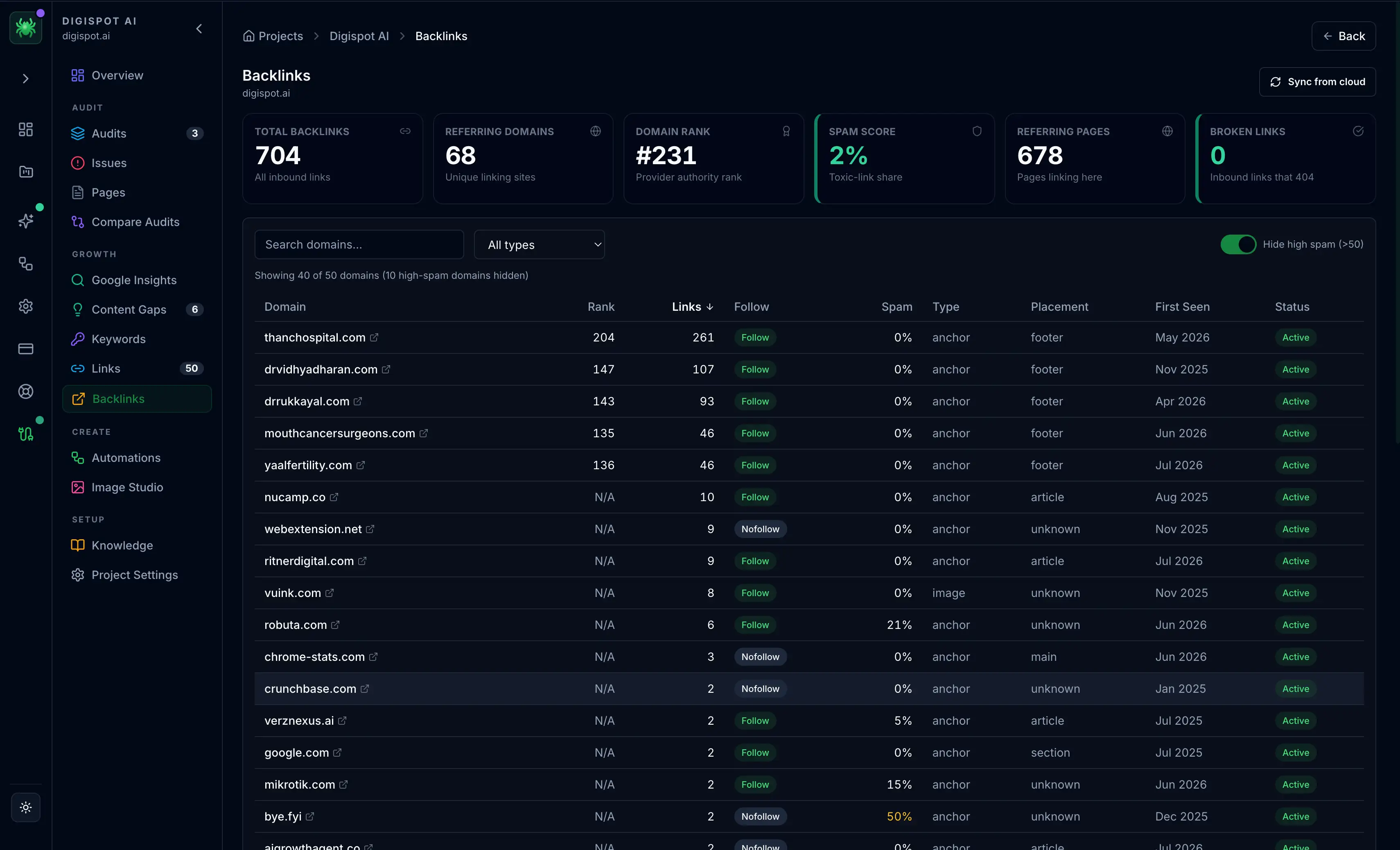
Because the Spider renders pages in a real browser like Googlebot and runs 300+ SEO/AEO checks per page, it audits sprawling GitHub Pages documentation sites at scale, then syncs GSC and GA4 to tie each link to actual sessions. It even ships an MCP server, so an AI agent in Claude or Cursor can run the crawl and apply fixes for you. Plans start at $14/mo.
Business Outcomes: The ROI of Developer SEO
Implementing these strategies transforms your GitHub presence from a storage locker into a marketing asset.
- Authority Building: High-ranking repositories establish you as a thought leader. When a CTO searches for a solution and sees your code ranking #1, trust is established before they even visit your website.
- Cost-Efficient Traffic: Organic traffic from GitHub and Google is free. Unlike paid ads on developer newsletters, a well-ranked repo generates leads indefinitely.
- Ecosystem Growth: Open source projects live or die by their community. SEO brings the people; the code makes them stay.
Table 2: Benefits of Effective GitHub SEO
| Benefit | Description |
|---|---|
| Increased Discoverability | Projects are easier to find within GitHub's search and external search engines like Google. |
| Higher Engagement | Attracts more stars, watchers, and forks, signaling project quality and relevance. |
| More Collaborators | Opens doors for skilled developers to contribute to your open-source projects. |
| Enhanced Branding | Builds a stronger personal or company reputation as a technical leader and innovator. |
| Organic Traffic Growth | Drives consistent, quality traffic to your repositories and associated project pages without paid ads. |
| Lead Generation | For businesses, increased visibility can translate directly into new business leads and opportunities. |
| Resource Efficiency | Reduces the need for manual promotional efforts and saves costs associated with advertising. |
Conclusion: Start Optimizing Your Code Reputation
GitHub is a meritocracy, but it is not a telepathic one. The best code in the world offers zero value if no one can find it. By applying standard SEO principles—keyword optimization, structural clarity, and authority building—to your repositories, you bridge the gap between your solution and the developers who need it.
Start small. Audit your most important repository today. Rename it for clarity, flesh out the README.md with the questions your users are actually asking, and tag it properly. These small tweaks compound over time into a massive competitive advantage.
Ready to take the guesswork out of your strategy? Try Digispot AI for comprehensive website audits and actionable recommendations that help you rank higher on Google, GitHub, and beyond. Whether you are an individual contributor or managing enterprise documentation, the right data makes all the difference.
Related deep-dives
Continue with these closely related guides:
- g2 platform seo — G2 Platform SEO: Boost Rankings with Backlinks & Reviews
References
- Crawl Budget Management For Large Sites | Google Search Central
- Google Search Console
- Robots.txt Introduction and Guide | Google Search Central
- Improve your page speed and crawl efficiency | Google Search Central
- Digispot AI - FREE On Page SEO Audit Tool
- Digispot AI - FREE Chrome Extension for SEO Insights
- How to reduce Google's crawl rate (for emergencies) | Google Search Central
Audit any page in seconds
300+ SEO checks including Core Web Vitals, schema markup, meta tags, and AI readiness — trusted by 1000+ SEO experts and marketers.
Frequently Asked Questions
Here are some of our most commonly asked questions. If you need more help, feel free to reach out to us.
Written by
Maya Krishnan
Digital growth expert
Maya is a seasoned expert in web development, SEO, and digital strategy, dedicated to helping businesses achieve sustainable growth online. With a blend of technical expertise and strategic insight, she specializes in creating optimized web solutions, enhancing user experiences, and driving data-driven results. A trusted voice in the industry, Maya simplifies complex digital concepts through her writing, empowering readers with actionable strategies to thrive in the ever-evolving digital landscape.