
SEO Prompt LibraryCopy-Paste Prompts for Any AI Tool
35 curated prompts for ChatGPT, Claude, and Gemini — covering on-page SEO, technical SEO, keyword research, content strategy, schema markup, local SEO, link building, and AI search optimization. Copy any prompt, or use them with real audit data via the Chrome Extension's built-in AI Chat.
On-Page SEO
Prompts for on-page audits, content quality, meta tags, Core Web Vitals, E-E-A-T signals, and featured snippet optimization.
Full On-Page SEO Audit
Act as a senior technical SEO consultant. Perform a comprehensive on-page SEO audit for [URL].

(If you can't access the URL, I'll paste the page source below:)
[PASTE PAGE SOURCE HERE]

Analyze the following:
1. Title tag — length (pixel width, not just characters), keyword placement, uniqueness
2. Meta description — length, call-to-action, keyword usage
3. Heading hierarchy — H1 uniqueness, H2-H6 structure and nesting
4. Content quality — word count, readability, keyword density
5. Image optimization — alt text, file sizes, lazy loading, modern formats (WebP/AVIF)
6. Internal linking — anchor text relevance, link depth, orphan page risk
7. URL structure — length, keywords, parameters
8. Mobile-friendliness — viewport, font sizes, tap targets

For each issue found, provide: severity (critical/warning/info), what's wrong, and how to fix it.
Content Quality Assessment
Evaluate the content quality of this page for SEO. Target keyword: [KEYWORD].

[PASTE YOUR PAGE CONTENT HERE]

Assess:
1. Search intent alignment — does the content match what users expect for the target keyword?
2. E-E-A-T signals — experience, expertise, authoritativeness, trustworthiness indicators
3. Content depth — topical coverage compared to what top-ranking pages typically include
4. Readability — sentence length, paragraph structure, use of subheadings
5. Freshness signals — dates, references to current data
6. Unique value — what does this page offer that a generic article wouldn't?

Rate each factor: Strong / Adequate / Weak / Missing. For each "Weak" or "Missing," give 2-3 specific improvements.
Meta Tags Optimization
Optimize the title tags and meta descriptions for these pages. Target keyword is shown for each:

Page 1: [URL] — Target: [KEYWORD]
Page 2: [URL] — Target: [KEYWORD]
Page 3: [URL] — Target: [KEYWORD]

For each page, write:
1. Title tag (50-60 characters, keyword near front, compelling — note: Google truncates by pixel width, so avoid wide characters like M, W, uppercase)
2. Meta description (140-155 characters, includes keyword naturally, has CTA)
3. H1 tag (matches search intent, slightly different from title)

Rules: no keyword stuffing, include brand name where appropriate, use power words for CTR, ensure each title is unique across the site.
Page Speed & Core Web Vitals
Here's my PageSpeed Insights report for [URL]:

[PASTE YOUR PAGESPEED INSIGHTS RESULTS — or the Lab Data / Diagnostics section]

Prioritize the fixes by expected impact on Core Web Vitals:
1. LCP — what's causing slow main content load? Identify the specific element.
2. CLS — which elements are shifting and why? Check for images without dimensions, dynamically injected content, web fonts.
3. INP — what JavaScript is blocking interactivity? Look at long tasks and event handlers.
4. Render-blocking resources — which specific CSS/JS files delay first paint?
5. Third-party script impact — analytics, ads, widgets contributing to load time.

For each issue: specific fix, estimated difficulty (quick/moderate/complex), and expected improvement. Which fixes can I ship this week vs. need a sprint?
E-E-A-T Page Assessment
Evaluate this page for Google's E-E-A-T signals (Experience, Expertise, Authoritativeness, Trustworthiness):

[PASTE YOUR PAGE CONTENT]

For each E-E-A-T factor, assess what's present and what's missing:

1. Experience — Does the content show first-hand experience? (personal anecdotes, original photos, "I tested this" statements, case studies with results)
2. Expertise — Does the author demonstrate subject knowledge? (technical depth, correct terminology, nuanced takes vs. surface-level content)
3. Authoritativeness — Are there trust signals? (author bio with credentials, cited sources, links from reputable sites, brand mentions)
4. Trustworthiness — Does the page feel reliable? (clear contact info, privacy policy, accurate claims, updated dates, HTTPS)

Rate each factor: Strong / Adequate / Weak / Missing.
For each "Weak" or "Missing" factor, give 2-3 specific things to add to the page.
Featured Snippet Optimization
Optimize this content to win the featured snippet for [KEYWORD].

Current featured snippet (if visible in search results): [PASTE THE CURRENT FEATURED SNIPPET TEXT]

My content: [PASTE YOUR CONTENT]

Analyze and suggest:
1. What snippet format does Google currently use for this query? (paragraph, numbered list, bulleted list, table)
2. Does my content directly answer the query in 40-60 words near the top of the relevant section?
3. Is the answer structured in the format Google prefers for this query type?
4. What H2 or H3 header should immediately precede the answer paragraph?
5. Are there supporting details (steps, examples, data) that strengthen snippet eligibility?
6. How can I restructure to beat the current snippet holder without sacrificing the rest of the content?

Rewrite only the snippet-targeted section — keep the rest of the content intact.
These Prompts Work. They Work Better with Real Data.
AI gives general advice because it can't see your site. The Digispot AI Chrome Extension audits any page in your real browser, then feeds the results directly into AI — so every answer is grounded in your actual page data.
Run the Extension
Visit any page and click the Digispot AI icon. A full SEO audit runs instantly in your browser — indexability, content, headings, schema, links, speed, and more.
Chat with Your Audit
Open the built-in AI Chat. Your full audit report is already in context. Ask questions, get fix recommendations, and drill into specific issues — all grounded in real page data.
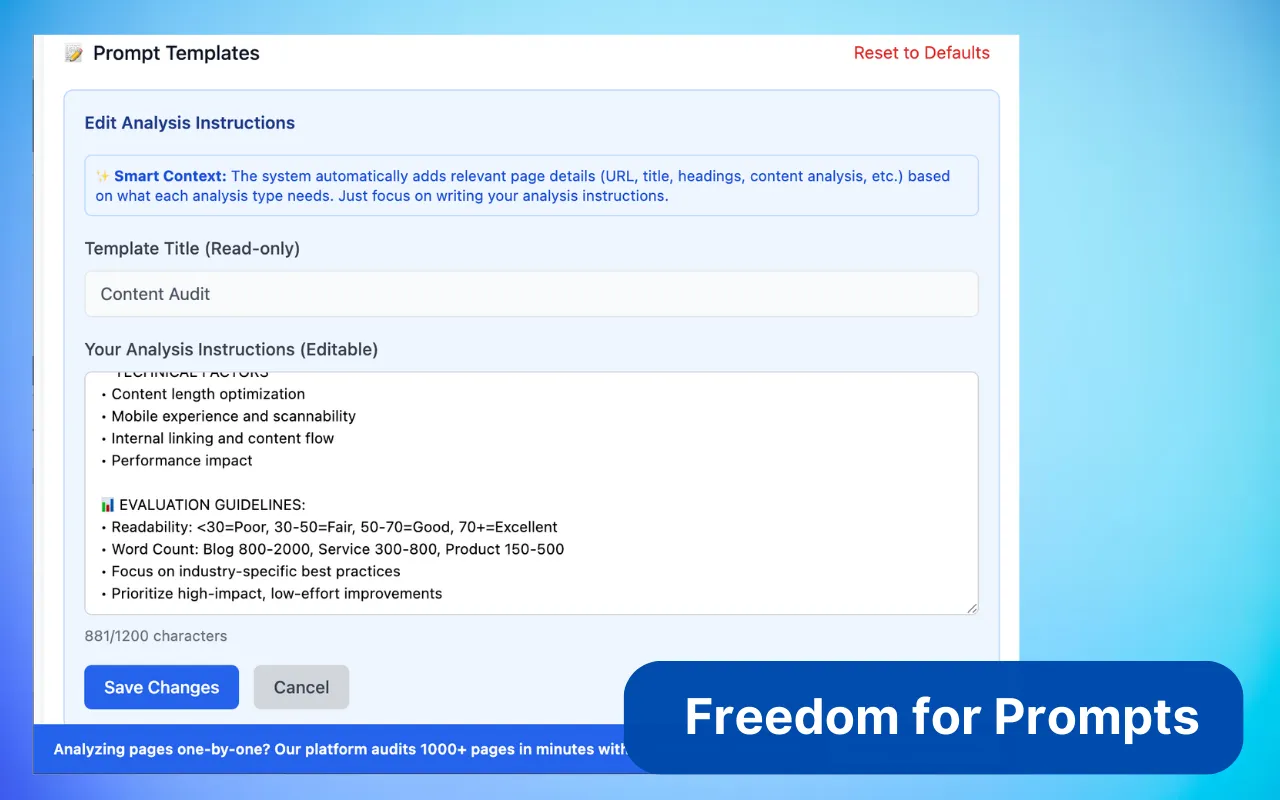
Customize Your Prompts
Edit the built-in prompt templates to match your workflow. Add your own evaluation criteria, industry-specific checks, or agency reporting format. The system auto-injects page data.
AI Chat with Audit Context
Ask "What are the top SEO issues?" and get answers based on your actual page — not AI guesswork. Full audit report is automatically included as context.
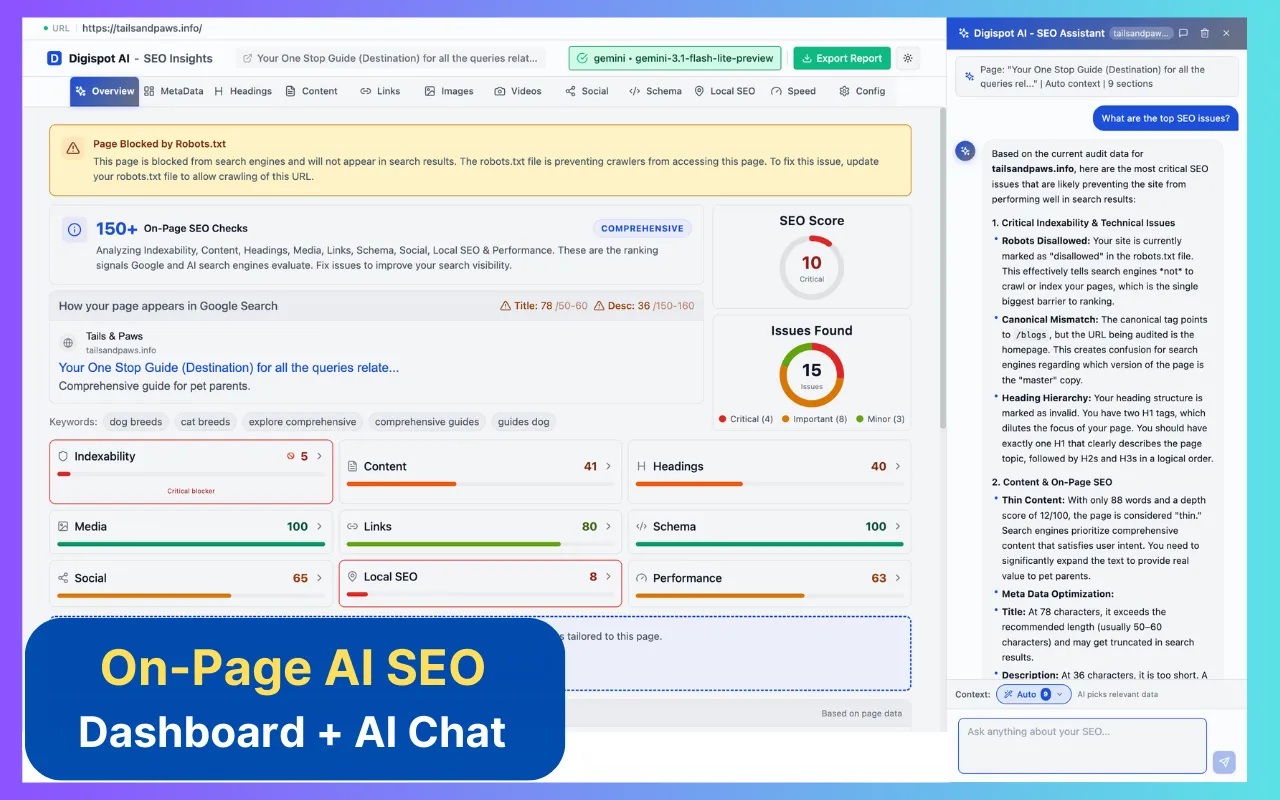
Customizable Prompt Templates
Edit analysis instructions for any check type. Add your own evaluation criteria, industry benchmarks, or agency formatting. The system auto-injects real page data.
Works with ChatGPT, Claude, Gemini & DeepSeek · Try the Chrome Extension
Where AI Prompts Hit Their Limits
AI tools are powerful for SEO strategy, content planning, and generating structured data. But there are specific tasks where they need help from real tools — and knowing the boundary makes you more effective with both.
Rendering & Access
AI can process HTML you paste, but it typically can't render JavaScript-heavy single-page apps, measure real load times, or access sites behind WAFs. For JS-rendered content, you need browser-based tools that execute JavaScript like Googlebot does.
Live Data
AI models don't have access to your Google Search Console data, real rankings, or traffic trends. Prompts that need actual performance data work best when you export from your tools and paste the data in — which is why many prompts here include paste-your-data patterns.
Site-Wide Patterns
AI analyzes what you give it, one page at a time. Catching duplicate titles across 500 pages, finding orphan pages, or mapping internal link equity across a full site requires crawling tools. AI is great for strategy; tools handle scale.
Choosing the Right AI Model for SEO Tasks
Not all models are equal for SEO work. The right choice depends on task complexity, context window needs, and response speed.
| Model | Input Context | Max Output | Speed | Best SEO Use |
|---|---|---|---|---|
GPT-5ChatGPT | 128K tokens | 128K tokens | Fast | Complex strategy, content planning, multi-step reasoning |
GPT-5 MiniChatGPT | 128K tokens | 128K tokens | Very fast | Content writing, meta tag optimization, keyword research |
GPT-4.1ChatGPT | 1M tokens | 32K tokens | Fast | Bulk tasks — title tag rewrites, alt text generation, classifications |
Claude Sonnet 4.6Claude | 200K tokens | 64K tokens | Fast | Schema markup (JSON-LD), technical analysis, structured output |
Claude Haiku 4.5Claude | 200K tokens | 64K tokens | Very fast | Quick classifications, content tagging, bulk URL analysis |
Gemini 2.5 ProGemini | 1M tokens | 65K tokens | Moderate | Large-scale content audits, entire sitemap analysis, long documents |
Gemini 2.5 FlashGemini | 1M tokens | 65K tokens | Very fast | High-volume processing, quick content checks, cost-efficient bulk work |
DeepSeek ChatDeepSeek | 128K tokens | 8K tokens | Fast | Budget-friendly SEO analysis, content optimization, general tasks |
DeepSeek ReasonerDeepSeek | 128K tokens | 64K tokens | Moderate | Complex technical SEO problems, multi-step audit interpretation |
Context window matters for SEO
A typical webpage is 2K-8K tokens. An entire site audit report can be 50K+. For analyzing multiple competitor pages simultaneously or processing large sitemaps, models with 200K-1M context windows (Claude, Gemini) handle the data without truncation. Smaller context = lost information = incomplete analysis.
Match model tier to task complexity
For bulk operations — generating alt text, rewriting meta descriptions, classifying pages — use faster, lighter models (GPT-5 Mini, Gemini 2.5 Flash, Claude Haiku 4.5, DeepSeek Chat). Reserve larger models (GPT-5, Claude Sonnet 4.6, Gemini 2.5 Pro) for complex strategy work where quality per response matters more than throughput.
Structured output varies by model
For JSON-LD schema generation, Claude models tend to produce consistently valid JSON with fewer syntax errors. GPT-5 and GPT-4.1 are strong at following complex output format instructions. If you need strict JSON every time, Claude's structured output mode or GPT's JSON mode reduce parsing failures.
Latency vs. quality trade-off
Interactive use (chatting with an AI about your SEO strategy) needs fast responses — GPT-5 Mini, Claude Haiku 4.5, and Gemini 2.5 Flash respond in 1-3 seconds. Batch processing (auditing 500 URLs overnight) can tolerate slower, more capable models. Match model tier to whether you need speed or depth.
Frequently Asked Questions
Here are some of our most commonly asked questions. If you need more help, feel free to reach out to us.
Get Real Data Behind These Prompts
Start with these prompts for strategy and planning. For real-time audits grounded in actual page data, the Chrome Extension runs a full SEO audit in your browser and feeds the results directly into AI Chat — so every answer reflects your real site, not generic advice.
Used by 1000+ SEO professionals and agencies.
No credit card required · No account needed for extension