E-E-A-T SEO Guide: Experience & Expertise
Master Google's E-E-A-T framework for SEO success. Build Experience, Expertise, Authoritativeness, and Trustworthiness to rank higher in competitive niches.
 Maya Krishnan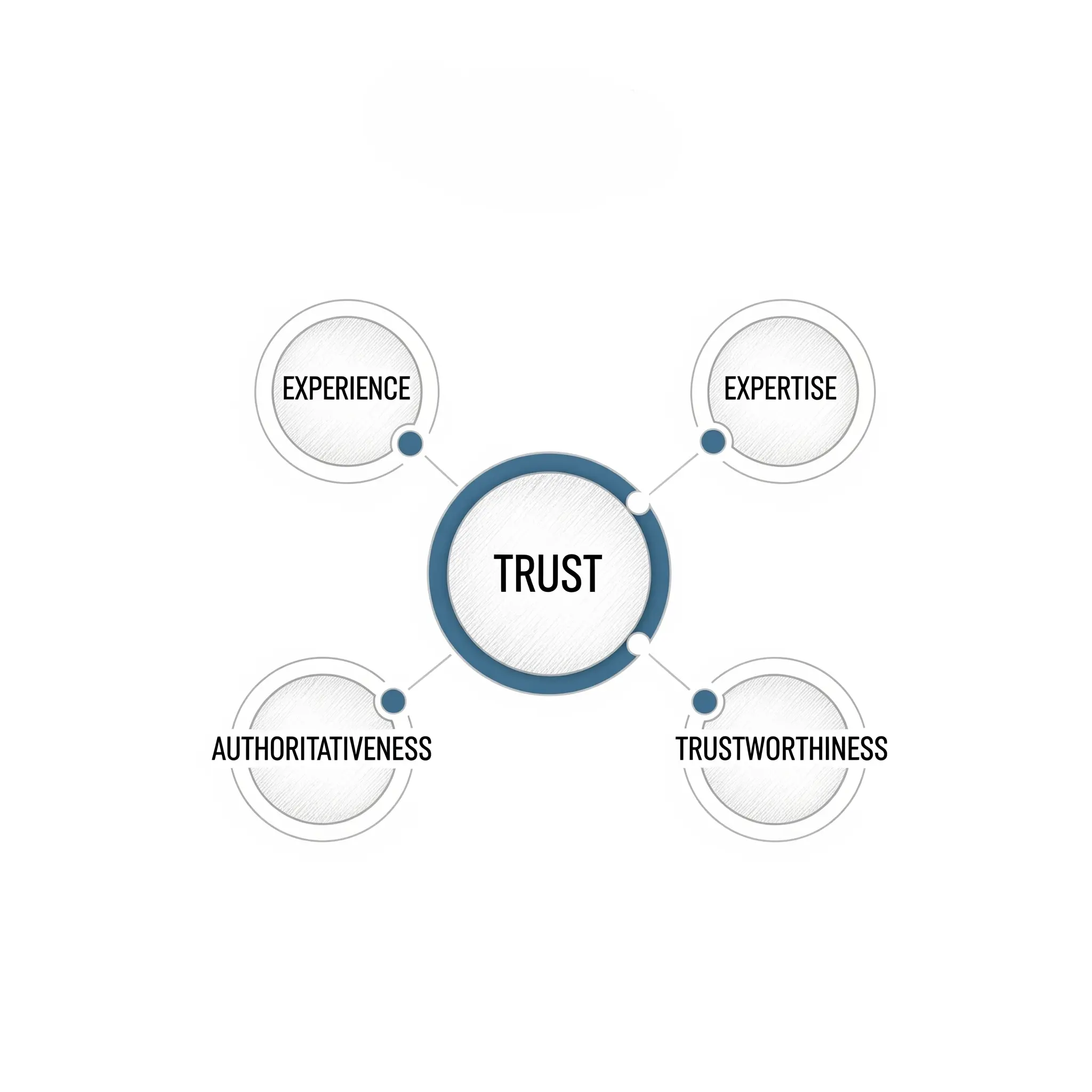
Ranking high in search results used to be a game of keywords and backlinks. If you optimized your meta tags and secured enough inbound links, you could dominate the front page. That era is over. Today, Google's algorithms function more like a reputation management engine than a simple keyword matcher. At the center of this evolution is one critical acronym: E-E-A-T.
E-E-A-T stands for Experience, Expertise, Authoritativeness, and Trustworthiness. It is the yardstick Google uses to measure the credibility of your content and your brand.
With the explosion of generative AI, the barrier to creating content has dropped to zero. The internet is flooded with generic, derivative articles. To filter this noise, Google—and newer AI engines like ChatGPT and Perplexity—rely heavily on E-E-A-T signals to distinguish between mass-produced fluff and valuable, human-centric insights. For modern content strategists, understanding these principles isn't optional; it is the difference between ranking #1 and disappearing from the index entirely.
This guide provides a practical blueprint for E-E-A-T. We will move beyond the definitions and explore specific technical implementations, schema strategies, and content workflows you can execute immediately to prove your value to search engines.
Chapter 1: Deconstructing E-E-A-T - What Does It All Mean?
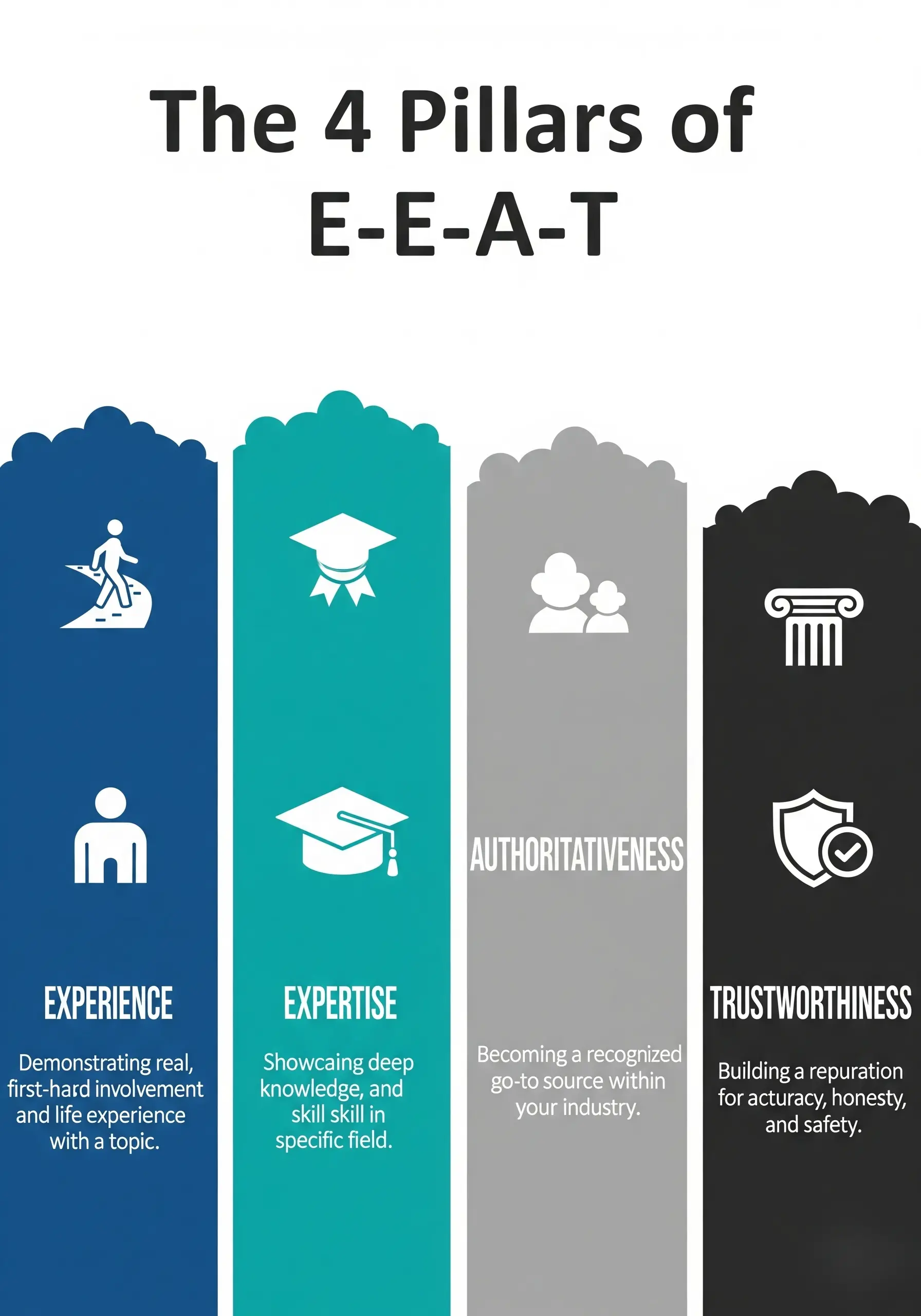
Google employs thousands of human Quality Raters who evaluate search results based on the Search Quality Rater Guidelines (QRG). Their feedback trains the algorithms to recognize quality at scale. E-E-A-T is the core framework these raters use. While it is not a direct ranking factor like page speed or HTTPS, it determines the "weight" Google gives to your content.
Here is how the four pillars function in a live SEO environment:
| Core Element | Description |
|---|---|
| Experience | The content creator's first-hand, real-world experience with the topic. It answers: "Did they actually do this?" |
| Expertise | The author's level of knowledge, skill, and formal qualifications. It answers: "Do they have the education or credentials to teach this?" |
| Authoritativeness | The reputation of the creator or website among peers. It answers: "Do other experts cite this source?" |
| Trustworthiness | The foundation of the framework. It covers accuracy, honesty, technical security, and business transparency. |
Experience: The New "E" on the Block
In December 2022, Google updated its guidelines to add "Experience," acknowledging a crucial nuance in content quality: sometimes, formal education matters less than life experience.
The Difference Between Experience and Expertise
It is vital to distinguish between these two "E"s to optimize correctly:
- Expertise is theoretical or professional. A financial advisor has expertise in saving money because they are certified and studied economics.
- Experience is practical and personal. A single parent who successfully saved $10,000 in a year on a minimum wage salary has experience in saving money.
Google values both, but for different queries. If a user searches "how does tax law work," they want an Expert (lawyer). If they search "what is it like to survive an IRS audit," they want Experience (someone who went through it).
Demonstrating Experience Tactically:
- Visual Evidence: Don't just describe a software interface; show screenshots of your specific configuration. Don't just list travel tips; post a selfie at the location with a timestamp.
- Personal Narrative: Use "I" statements. Describe challenges you faced and mistakes you made. AI rarely discusses its own mistakes because it doesn't make them in the physical world.
- Original Data: Share data from your own experiments or case studies rather than citing industry averages.
Expertise: Showcasing Your Knowledge
Expertise remains the standard for informational content, particularly in technical fields. This is about depth of coverage and verifiable credentials. When you publish content, you are claiming to be a teacher. Google wants to verify your teaching credentials.
How to demonstrate Expertise:
- Structured Author Data: Use specific Schema.org markup to connect your authors to their credentials (more on this in Chapter 3).
- Topical Depth: An expert doesn't just scratch the surface. They cover edge cases, exceptions, and advanced applications.
- Citations: Experts know who the other experts are. Linking to high-quality external sources (research papers, government data) paradoxically increases your own perceived expertise.
Authoritativeness: Becoming a Go-To Source
Authority is relative. You might be an authority on "SaaS SEO" but have zero authority on "Vegan Recipes." Google measures this largely through the graph of the web—who is talking about you?
How to build Authoritativeness:
- Backlink Profile: Links from relevant, high-authority sites in your niche act as "votes of confidence."
- Topic Clusters: Publishing 50 high-quality articles on a narrow topic builds more authority than 50 articles on 50 different topics. This is often called "Topical Authority."
- Mentions: Even unlinked mentions of your brand or authors in news outlets and industry forums contribute to your authority score.
Trustworthiness: The Foundation of E-E-A-T
Trust is the most critical component. The Quality Rater Guidelines explicitly state that a website with low trustworthiness cannot have high E-E-A-T, regardless of how expert the author is. If users cannot trust you, your expertise is irrelevant.
How to build Trustworthiness:
- Monetization Transparency: If you use affiliate links, disclose them clearly. If content is sponsored, label it.
- Customer Support Accessibility: A generic contact form is often insufficient. Real businesses have physical addresses, phone numbers, and specific support emails.
- Technical Security: Beyond just HTTPS, ensure your site is free of intrusive interstitials and malware. You can check for technical trust signals using our free On-Page SEO Analysis tool.
Chapter 2: The "Why" - Why E-E-A-T is a Game-Changer for SEO
Many site owners ignore E-E-A-T because they can't see it in their analytics dashboard. There is no "E-E-A-T Score" in Google Search Console. However, ignoring it is a strategic error that leads to gradual traffic decay.
Aligning with Google's Core Mission
Google's business model depends on users trusting its results. If users click a medical article that gives bad advice, or a product review that is clearly a paid advertisement in disguise, they lose trust in Google. E-E-A-T is Google's mechanism for risk management. By optimizing for E-E-A-T, you align your business goals with Google's survival strategy.
The Critical Role of E-E-A-T in YMYL Topics
"Your Money or Your Life" (YMYL) refers to topics that could impact a person's future happiness, health, financial stability, or safety. Examples include:
- News and Current Events: International affairs, business, politics.
- Civics and Law: Voting, government agencies, legal advice.
- Finance: Investments, taxes, retirement planning, loans.
- Health: Medical advice, drugs, hospitals, emergency preparedness.
- Shopping: Researching major purchases (cars, real estate).
For YMYL pages, the bar for E-E-A-T is incredibly high. A blog post about "best sneakers" requires moderate E-E-A-T. A blog post about "symptoms of heart attack" requires the highest level of medical expertise and consensus. If you operate in a YMYL niche, treating E-E-A-T as an afterthought is one of the common SEO mistakes that can tank your rankings during a core update.
Building a Sustainable, Long-Term SEO Strategy
In the past, SEOs often looked for "loopholes"—keyword stuffing, private blog networks (PBNs), or link exchanges. These tactics are fragile. An algorithm update can wipe them out overnight.
E-E-A-T represents a defensive moat. It is difficult to fake genuine experience and authority. By investing in these areas, you are insulating your site against volatility. Even as AI search engines evolve, they are prioritizing sources with established trust.
Chapter 3: The "How" - Practical Strategies to Build and Demonstrate E-E-A-T
Now that we've covered the "what" and the "why," let's look at the "how." These are not abstract concepts; they are actionable steps you can implement this week.
Leverage Experts and First-Hand Experience
The most direct way to boost E-E-A-T is to involve people who truly know the subject.
- Robust Author Bios: "Written by Admin" is a trust killer. Every post needs an author. The bio page should not just be a list of posts; it should be a resume. Link to their LinkedIn, list their degrees, and mention their years of experience.
- Review Methodology: If you write reviews, explain how you tested the product. Did you buy it? Rent it? How many hours did you use it? What criteria did you use? This transparency proves Experience.
- Subject Matter Expert (SME) Interviews: If you lack the expertise internally, interview someone who has it. A writer can create a high-E-E-A-T article by interviewing a PhD and quoting them extensively. This borrows the authority of the interviewee.
Create High-Quality, People-First Content
Content quality is the primary evidence of your E-E-A-T.
- Information Gain: Google has filed patents regarding "Information Gain Scores." This measures whether your content adds something new to the search index or just repeats what the top 10 results say. To rank, you must add a unique angle, new data, or a better explanation.
- Comprehensive Coverage: Short, thin content rarely signals expertise. However, length isn't the goal—completeness is. Address the "People Also Ask" questions and anticipate the user's next step.
- Freshness: Outdated content signals a lack of care. Implement a content audit schedule to update statistics, dates, and advice. You can use our free Chrome extension to quickly check the "Last Modified" headers of your pages and your competitors'.
Build a Positive Brand Reputation
Your off-page reputation confirms your on-page claims.
- Review Management: Actively encourage reviews on third-party platforms like Trustpilot, Google Business Profile, and G2. Google reads these to verify your Trustworthiness.
- Crisis Management: If you receive negative press or bad reviews, respond professionally. A thoughtful response to a complaint often builds more trust than a perfect 5-star record (which can look fake).
- Community Engagement: Participate in industry podcasts, webinars, and forums. When users search for your brand name + "reddit" or "forum," they should find genuine discussions, not a void.
On-Page and Off-Page E-E-A-T Signals
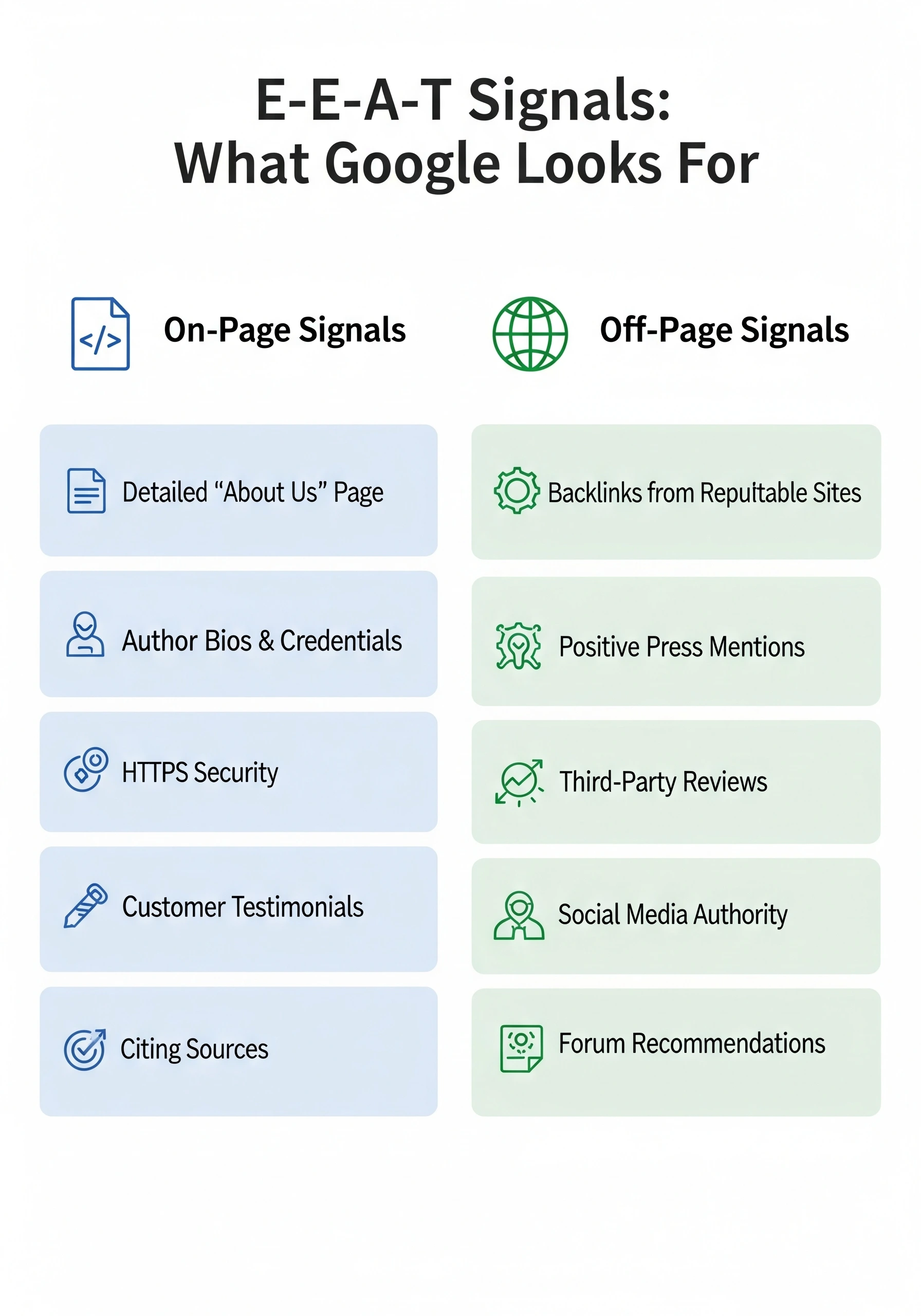
E-E-A-T is demonstrated through a holistic combination of signals. You cannot optimize one and ignore the others.
| Signal Type | Examples |
|---|---|
| On-Page Signals |
|
| Off-Page Signals |
|
Technical E-E-A-T: The Power of Schema Markup
One of the most powerful, underutilized ways to communicate E-E-A-T is through structured data. You can explicitly tell Google who wrote an article and why they are qualified using Person schema.
Key properties to include in your author schema:
knowsAbout: Links to Wikipedia pages or entities the author is an expert in.alumniOf: The university they attended.sameAs: Links to their LinkedIn, Twitter, and other profiles.jobTitle: Their official role.
Don't leave Google guessing. Use the free Schema Markup Generator to create valid Person and Organization schema that explicitly connects the dots between your content and your credentials.
Chapter 4: E-E-A-T in the Age of AI
The rise of Large Language Models (LLMs) has made E-E-A-T more important than ever. As the web floods with AI-generated text, human experience is the new premium currency.
Google's Stance on AI-Generated Content
Google has clarified its stance: they reward high-quality content however it is produced. Automation is acceptable for things like sports scores or weather forecasts. However, using AI to generate YMYL advice without human oversight is a violation of their spam policies.
If you use AI, you must ensure the output is fact-checked and reviewed. Blindly publishing AI drafts is the fastest way to destroy your Trustworthiness score.
How to Use AI Responsibly
AI should be an assistant, not the author. Here is how to integrate tools like digispot.ai into an E-E-A-T friendly workflow:
- Ideation and Structure: Use AI to find content gaps and structure your outlines based on semantic entities.
- Drafting vs. Polishing: Let AI draft the "what" (definitions, basic facts), but have a human write the "so what" (analysis, opinion, experience).
- The "Human Sandwich": Start with human insight/strategy, use AI for expansion, and finish with human editing and fact-checking.
For a deeper dive into how technical performance interacts with user trust, review our guide on Core Web Vitals. A slow, broken site destroys trust before the user reads a single word.
Chapter 5: Auditing Your Website for E-E-A-T
Improving E-E-A-T is an iterative process. You need to benchmark where you are today.
E-E-A-T Audit Checklist
Use this checklist to identify gaps in your credibility profile. Digispot AI can help you identify and fix these issues automatically with AI-powered audits analyzing 300+ ranking factors.
Experience:
- Does the content contain unique media (photos/video) created by you?
- Are anecdotal examples ("When I tried this...") used to illustrate points?
- Do product reviews prove possession and testing of the item?
Expertise:
- Do author bylines link to full bio pages?
- Does the bio page list specific credentials (degrees, awards, history)?
- Is the content free of factual errors and basic consensus mistakes?
- Do you link out to primary sources rather than secondary blogs?
Authoritativeness:
- Does the site have a "Press" or "Media" page showcasing mentions?
- Are you earning links from other experts in your specific niche?
- Is the site focused on a specific topic cluster, or is it too broad?
Trustworthiness:
- Is the "About Us" page comprehensive, listing real team members?
- are Terms of Service, Privacy Policy, and Refund Policy clearly accessible?
- Is the site running on HTTPS with no mixed content errors?
- Are ads clearly distinguished from main content?
If you are unsure where to start, try our free On-Page SEO Analysis tool to audit any URL instantly for technical trust signals.
Conclusion
E-E-A-T is not just a checklist; it is a mindset. It forces you to ask the hard questions: Why should users trust us? Why are we the best source for this answer?
In a digital ecosystem increasingly dominated by AI answers and zero-click searches, your brand's reputation is your only true asset. By systematically building Experience, Expertise, Authoritativeness, and Trustworthiness, you future-proof your SEO strategy against algorithm updates and platform shifts.
Ready to improve your search visibility? Try Digispot AI for comprehensive website audits and actionable recommendations that go beyond keywords to build lasting authority.
References
- Google Search Central. Creating helpful, reliable, people-first content
- Google Search Central. SEO Starter Guide: The Basics
- Digispot AI - FREE Chrome Extension
- Digispot AI - FREE On Page SEO Audit Tool
- Digispot AI - FREE Schema Markup Visualizer
- Digispot AI - FREE Schema Markup Generator
Related deep-dives
Continue with these closely related guides:
- personalization seo — Personalization SEO: Dynamic Content & Rankings
- importance of cdn — Importance of CDN in SEO: Boosting Website Speed & Rankings
- power of user-generated content — The Power of User-Generated Content (UGC) for SEO
- medical content trust — Medical Content Trust: Building Authority in Healthcare SEO
- heading hierarchy seo — Heading Hierarchy SEO: Structure H1-H6 Tags Right
- jewelry seo — Jewelry SEO: Rank Higher & Sell More Online
Audit any page in seconds
300+ SEO checks including Core Web Vitals, schema markup, meta tags, and AI readiness — trusted by 1000+ SEO experts and marketers.
Frequently Asked Questions
Here are some of our most commonly asked questions. If you need more help, feel free to reach out to us.
Written by
Maya Krishnan
Digital growth expert
Maya is a seasoned expert in web development, SEO, and digital strategy, dedicated to helping businesses achieve sustainable growth online. With a blend of technical expertise and strategic insight, she specializes in creating optimized web solutions, enhancing user experiences, and driving data-driven results. A trusted voice in the industry, Maya simplifies complex digital concepts through her writing, empowering readers with actionable strategies to thrive in the ever-evolving digital landscape.