On-Page SEO Best Practices: Optimize Every Element
Master on-page SEO with proven best practices. Optimize titles, meta descriptions, headers, content, images, and internal links for maximum search visibility.
 Maya Krishnan
Why do some websites consistently dominate the top spots in search results while others struggle on page two? The answer often lies in the precision of their On-Page SEO. It is the most controllable and reliable method to signal relevance to search engines and quality to users.
Think of your website as a library. Technical SEO is the architecture of the building, but On-Page SEO is how you write, title, and organize the books so people can actually find them. Without it, even the most beautifully designed website remains invisible. This guide breaks down the specific, actionable changes that turn underperforming pages into traffic-generating assets.
What is On-Page SEO?
On-Page SEO (also known as on-site SEO) refers to the practice of optimizing elements directly on your website to improve search rankings and attract organic traffic. Unlike off-page SEO, which involves external signals like backlinks and social mentions, on-page factors are entirely within your control.
When Google or Bing "crawls" your page, their bots analyze the HTML source code and the rendered content to determine three things:
- Relevance: Does this content answer a specific search query?
- Authority: Is the content trustworthy and expertly written?
- Experience: Is the page fast, accessible, and easy to navigate?
Effective On-Page SEO provides clear, unambiguous answers to these questions. It is the foundation of any successful digital strategy. Platforms like Digispot AI analyze over 200 ranking factors to ensure your pages don't just look good to humans, but speak the native language of search algorithms—including the new wave of AI-powered search engines like ChatGPT and Google's AI Overviews.
Why On-Page SEO Matters: Unlock Business Growth
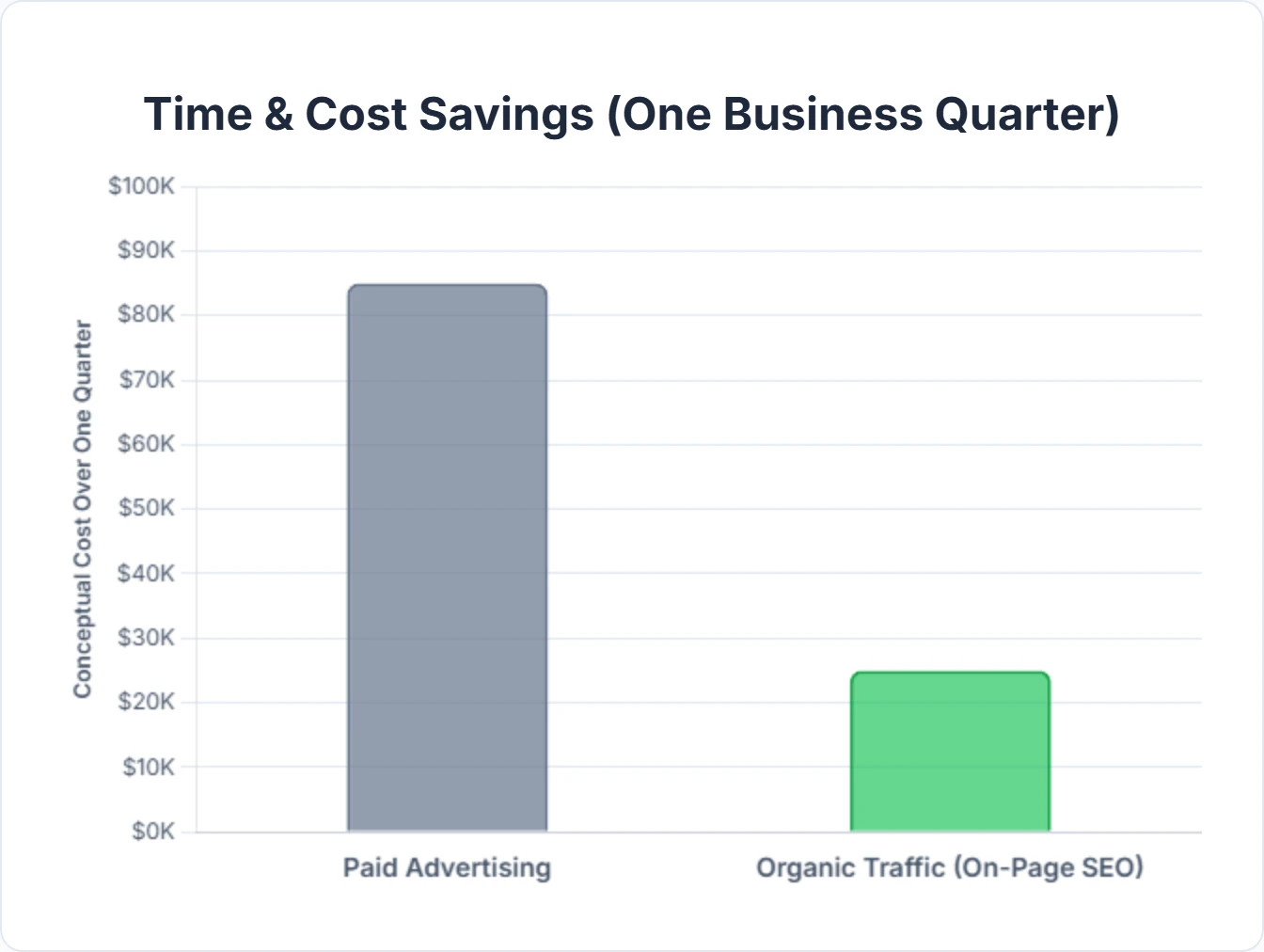
Many site owners treat SEO as a checklist of technical tasks. However, it is a strategic revenue driver. The impact of on-page optimization compounds over time, delivering results that paid advertising cannot match in terms of ROI.
| Benefit | Description |
|---|---|
| Improved Business Visibility | When your pages rank higher in search results, more people see them. This direct increase in visibility means your brand becomes more recognizable and reaches a wider audience who are actively looking for what you offer. |
| Increase in Traffic & Leads | Higher rankings translate directly into more organic traffic. This isn't just any traffic; it's qualified traffic – people who are already interested in the topics your pages cover. More relevant visitors naturally lead to a higher potential for conversions, whether that's sales, inquiries, or newsletter sign-ups. |
| Enhanced User Experience | Many on-page SEO practices, such as optimizing page speed, improving content readability, and ensuring mobile responsiveness, directly contribute to a better experience for your website visitors. Happy users are more likely to stay longer, engage with your content, and return in the future. |
| Time and Cost Savings | Organic traffic, generated through effective on-page SEO, is essentially "free." While it requires an initial investment of time and effort, it reduces reliance on paid advertising, which can be costly and stop delivering results the moment your budget runs out. It's a sustainable, long-term strategy. |
| Building Authority & Trust | Websites that consistently rank well for relevant keywords are often perceived as more credible and authoritative by users. When you provide high-quality, well-optimized content, you establish your business as an expert in its field, fostering trust with your audience. |
| Competitive Advantage | In today's crowded online marketplace, even small on-page optimizations can give you an edge. By outperforming competitors in search rankings, you capture their potential audience and solidify your position in the industry. |
Mastering On-Page SEO: The Essential Pillars
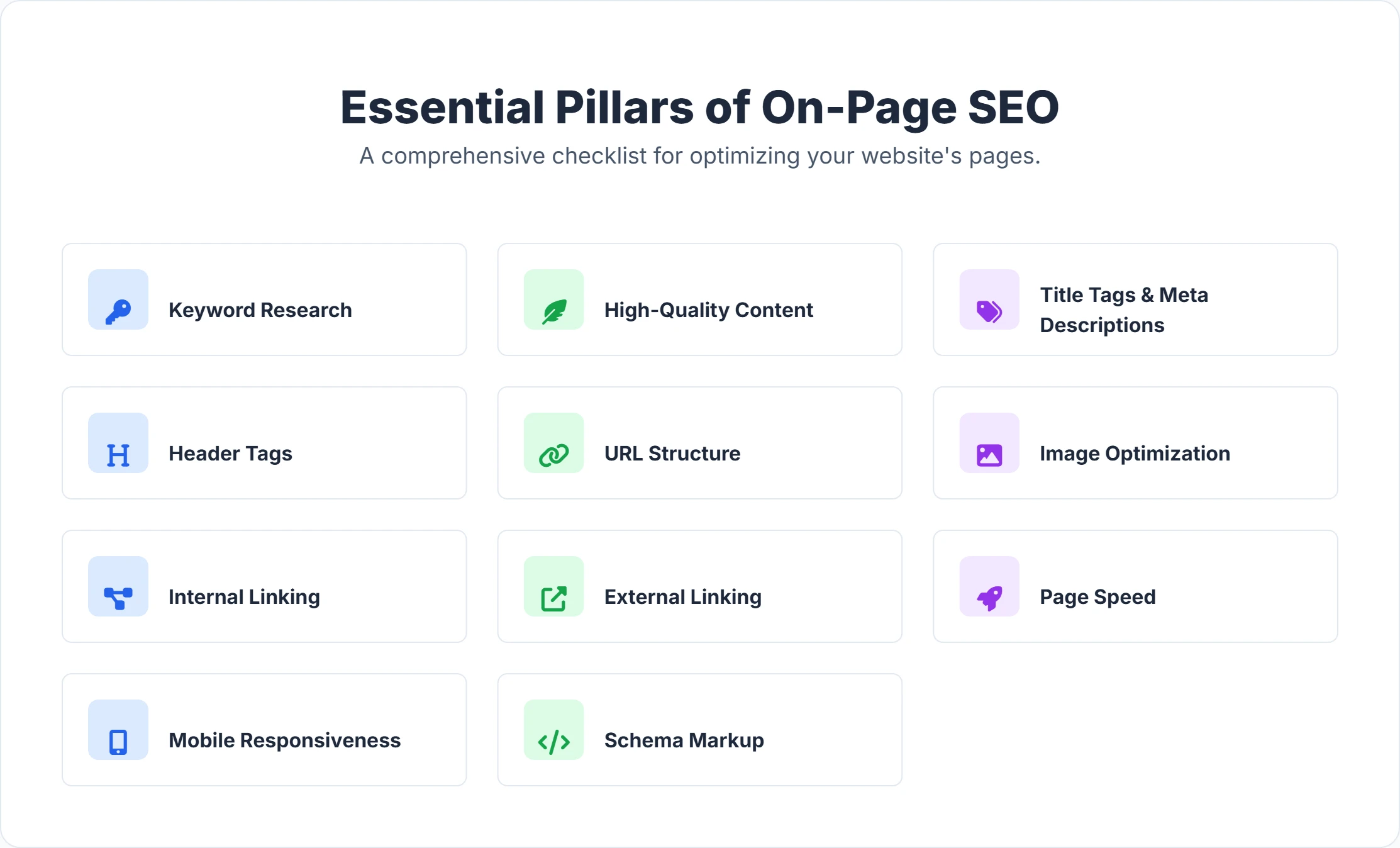
Understanding the theory is helpful, but execution is what drives rankings. These eleven pillars form the core of a modern optimization strategy.
1. Smart Keyword Research: Understanding Search Intent
Before writing a single sentence, you must know what words your customers use and why they use them. This is the difference between guessing and strategic keyword research.
Keywords fall into different categories of intent:
- Informational: Users want to learn ("what is on-page seo").
- Commercial: Users are investigating options ("best seo tools 2026").
- Transactional: Users are ready to buy ("buy digispot ai subscription").
Use tools to identify keywords with a balance of search volume and competition. However, prioritize relevance over volume. Ranking for a high-volume keyword that brings the wrong traffic is a waste of server resources.
Focus on one primary keyword per page and 3-5 related secondary keywords. This helps you stay focused without diluting your page's topical authority. Avoid keyword stuffing at all costs. Modern search engines use Natural Language Processing (NLP) and can detect unnatural repetition instantly, often penalizing sites for it.
2. High-Quality Content: Engaging Your Audience
Content is the vehicle for your keywords. Without substantive content, optimization is just optimizing a vacuum. Google's "Helpful Content System" explicitly rewards content written for people first, not search engines.
Your content needs to demonstrate E-E-A-T (Experience, Expertise, Authoritativeness, and Trustworthiness). To deepen your understanding of these signals, read our E-E-A-T SEO guide.
- Be Comprehensive: Don't just answer the immediate question; anticipate the follow-up questions.
- Structure: Use short paragraphs (2-3 sentences). Large walls of text cause users to bounce.
- LSI Keywords: Latent Semantic Indexing (LSI) keywords are conceptually related terms. If you are writing about "coffee," LSI terms might be "beans," "brewing," "barista," and "roast." These confirm to Google that your content is deeply relevant to the topic.
For businesses scaling content production, Digispot AI's Content Studio can help generate outlines that ensure you cover all necessary semantic entities, giving you a structural advantage before you even start writing.
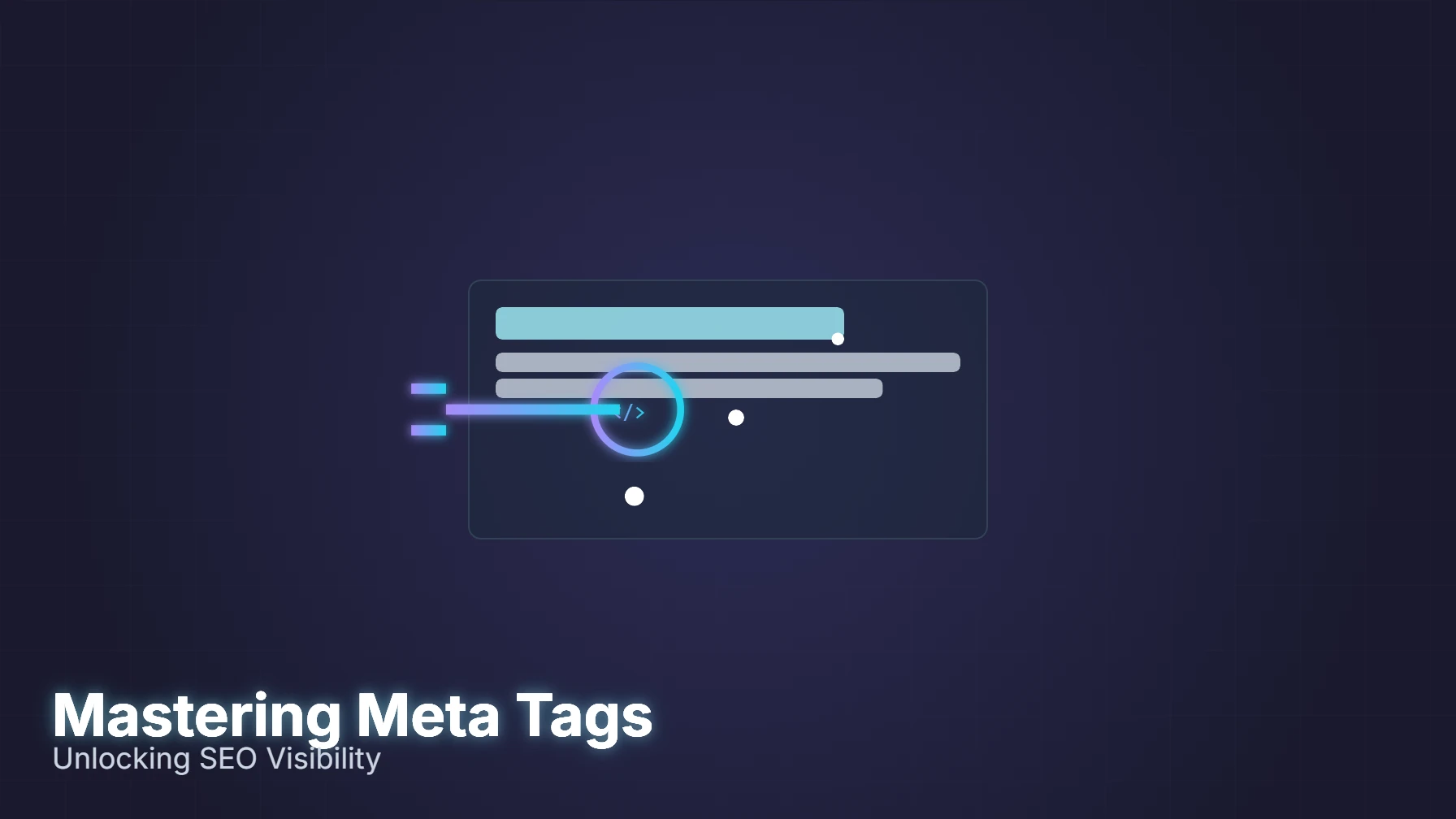
3. Optimize Title Tags and Meta Descriptions for Clicks
Your title tag and meta description are your storefront window in the search results (SERPs). If they are dull or confusing, users will walk right past you to a competitor, regardless of how good your content is.
Title Tag (<title>):
This is a direct ranking factor.
- Format: Primary Keyword | Benefit/Hook | Brand Name
- Length: Keep it under 60 characters (or 580 pixels) to prevent truncation.
- Uniqueness: Every page must have a unique title. Duplicate titles confuse search engines about which page to rank.
- Example:
On-Page SEO Checklist: 15 Steps to Higher Rankings | Digispot
Meta Description (<meta name="description">):
While not a direct ranking signal, it heavily influences Click-Through Rate (CTR). A higher CTR can indirectly boost rankings.
- Length: 150-160 characters.
- Strategy: Treat this as ad copy. Summarize the value proposition and include a clear Call to Action (CTA).
- Example:
Master on-page SEO with our proven guide. Learn how to optimize titles, headers, and images to boost Google rankings. Start your audit today!
4. Header Tags: Structuring Content for Readability
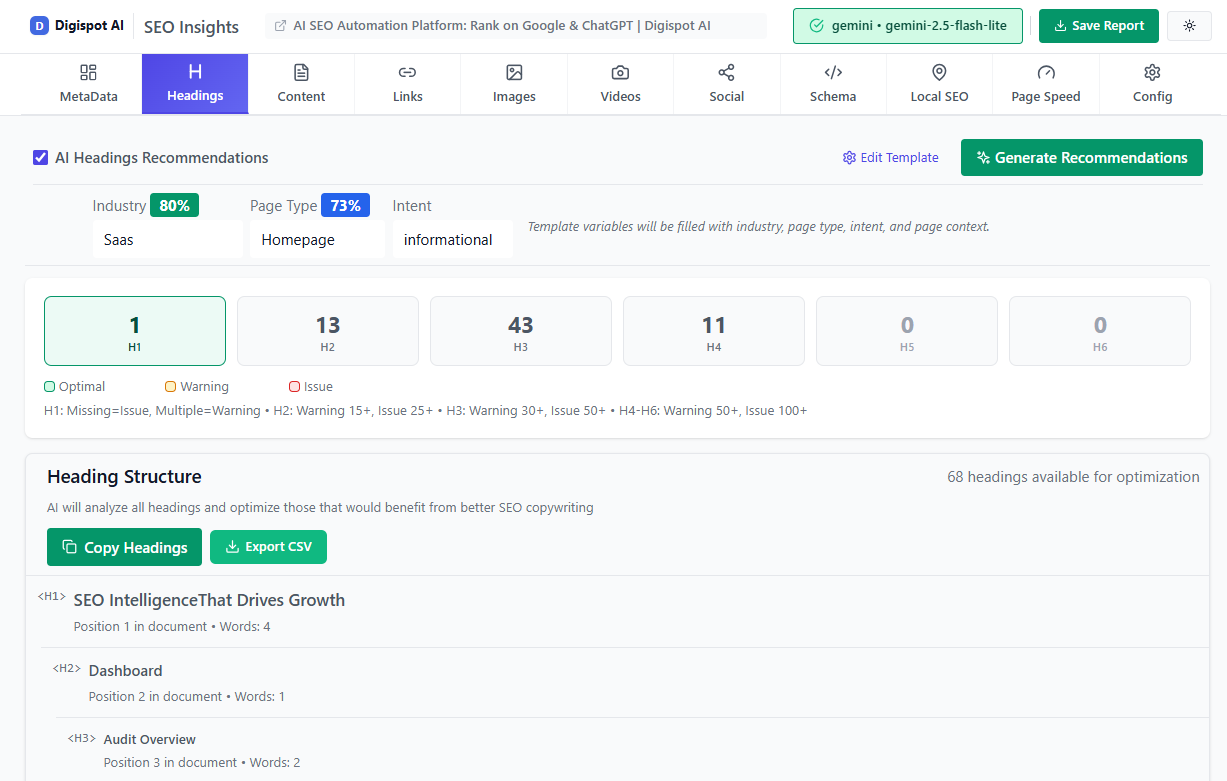
Header tags (<h1>, <h2>, <h3>) provide a skeletal structure for your content. They help users scan the page and help bots understand the hierarchy of information.
- H1 Tag: The main headline. There should be strictly one H1 per page, and it must include your primary keyword.
- H2 Tags: These mark the main sections of your article. Think of them as chapter titles. Include secondary keywords here naturally.
- H3-H6 Tags: These divide H2 sections into specific sub-topics.
Proper heading structure is also critical for accessibility. Screen readers use headers to navigate content for visually impaired users. Search engines favor accessible websites.
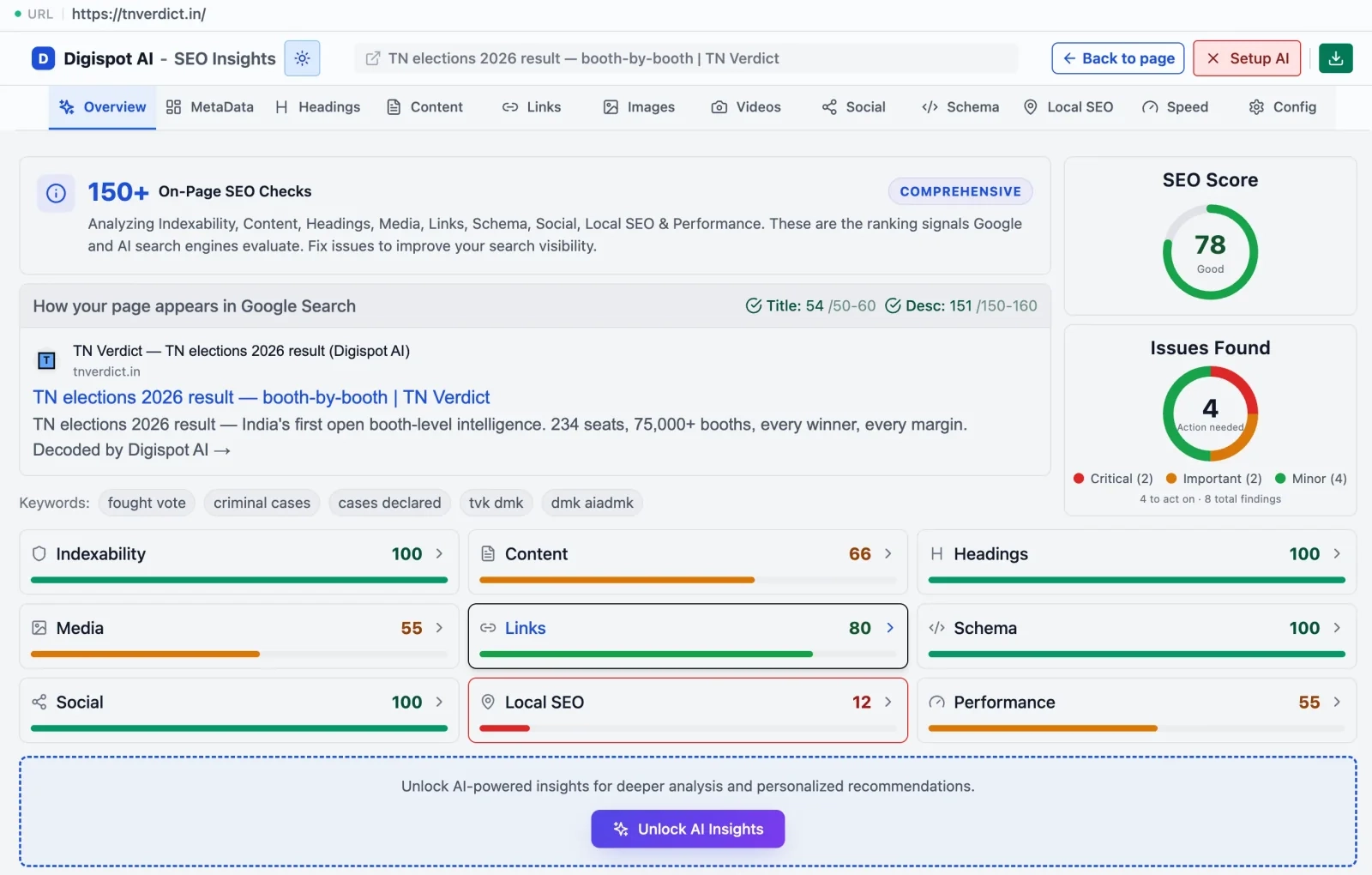
Turn invisible SEO data into clear visuals with our Free Chrome extension.
5. Clean URL Structure: Making it User-Friendly
Your URL (Uniform Resource Locator) should be a clear indicator of page content. Avoid the default gibberish that some CMS platforms generate (e.g., domain.com/?p=123).
Best Practices for URLs:
- Keep it Short: Shorter URLs tend to rank better.
- Use Hyphens: Google reads hyphens as spaces. It does not recognize underscores or spaces efficiently.
- Include Keywords: Place the primary keyword in the slug.
- Avoid Dates: Don't use
/2025/09/post-nameunless it's a news article. Dates make "evergreen" content look outdated in the future. - Example:
digispot.ai/blog/on-page-seo-best-practices
6. Image Optimization: Boosting Page Speed
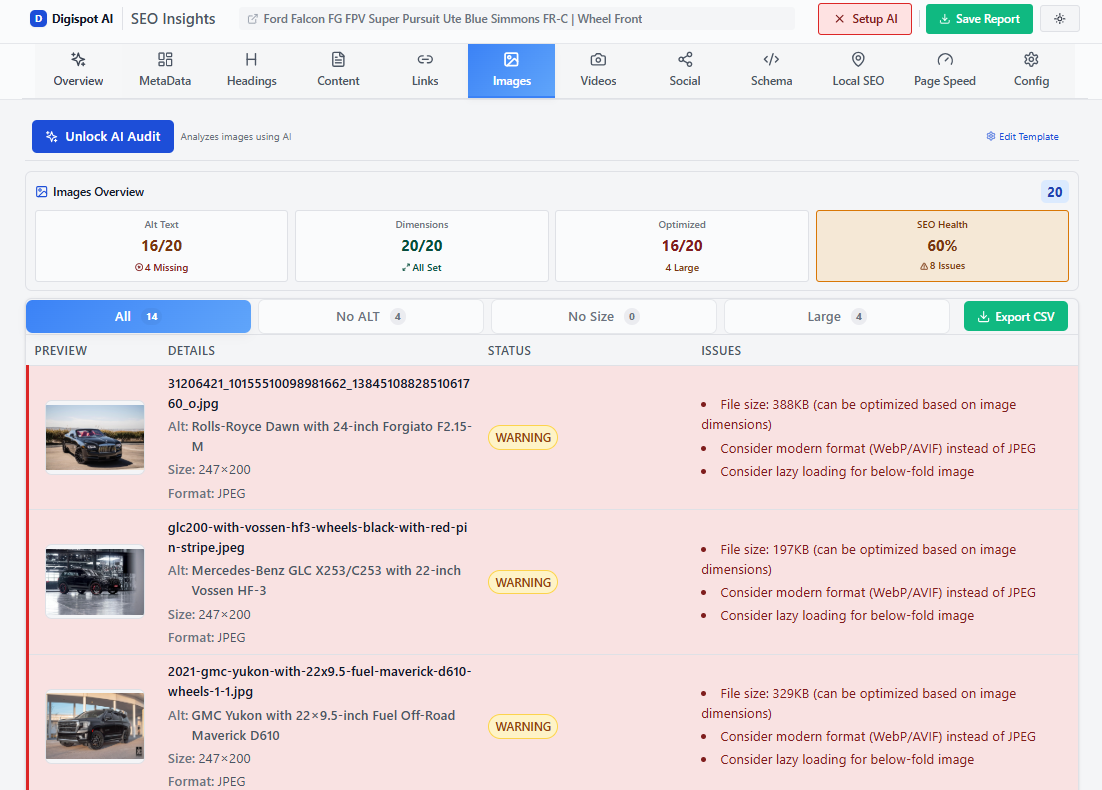
Images are vital for engagement, but they are often the heaviest elements on a page. Unoptimized images are a leading cause of slow load times, which kills rankings.
Optimization Checklist:
- Alt Text: This is mandatory for accessibility and SEO. Describe the image specifically. If you are showing a chart of SEO growth, use
alt="Line graph showing 50% organic traffic growth after SEO audit". - File Format: Move away from heavy PNGs or JPEGs where possible. Use next-gen formats like WebP or AVIF, which offer superior compression with no quality loss.
- File Names:
IMG_0988.jpgtells Google nothing.on-page-seo-audit-tool.jpgprovides context. - Dimensions: Always specify
widthandheightattributes to prevent Cumulative Layout Shift (CLS), a core metric in Google's user experience evaluation.
7. Strategic Internal Linking: Guiding Users
Internal links are the nerves of your website. They connect your content, pass authority (Link Juice), and help Google discover new pages.
The Topic Cluster Strategy: Create a "Pillar Page" (like this guide) that covers a broad topic. Then, link out to specific "Cluster Pages" that explain sub-topics in detail. Conversely, link those cluster pages back to the pillar.
Anchor Text Matters: The clickable text (anchor text) tells Google what the linked page is about.
- Bad: "Click here"
- Good: "Learn more about common SEO mistakes"
This strategy keeps users on your site longer, reducing bounce rates and signaling to Google that your site is a comprehensive resource.
8. Judicious External Linking: Building Credibility
Linking to other websites might seem counterintuitive, but it actually builds trust. It shows you have done your research and are citing credible sources.
- Cite Authority: Link to reputable sites (.gov, .edu, major industry publications) to back up statistics or claims.
- Manage Link Juice: If you are linking to a competitor or a site you are unsure about, use the
rel="nofollow"attribute. - Relevance: Only link out when it adds genuine value to the user's journey.
9. Blazing Fast Page Speed: Improving User Experience
Speed is not just a luxury; it is a confirmed ranking factor. Google's Core Web Vitals (CWV) metrics specifically measure the user experience related to loading speed, interactivity, and visual stability.
- LCP (Largest Contentful Paint): How fast the main content loads.
- INP (Interaction to Next Paint): How quickly the page responds to a click.
- CLS (Cumulative Layout Shift): Visual stability.
To improve these, leverage browser caching, use a Content Delivery Network (CDN), and minify your CSS and JavaScript files. For a deeper dive into technical performance, review our Core Web Vitals guide.
Get instant SEO insights on any page, including speed checks, with our free Chrome extension.
10. Mobile Responsiveness: Essential for All Users
We live in a mobile-first world. Google now predominantly uses the mobile version of your site for indexing and ranking. If your site looks great on desktop but breaks on an iPhone, you will struggle to rank.
Mobile Optimization Tips:
- Viewport Configuration: Ensure your meta viewport tag is set correctly.
- Touch Targets: Buttons and links must be large enough to be tapped with a thumb without zooming.
- Readable Fonts: Text should be legible (at least 16px) without horizontal scrolling.
Digispot AI's auditing capabilities evaluate your website's performance specifically on mobile viewports to ensure you aren't losing 60%+ of your potential traffic.
11. Harnessing Schema Markup: Structured Data
Schema markup is code (vocabulary) that you put on your website to help search engines return more informative results for users. It translates your content into a format machines understand instantly.
For example, if you have a "Reviews" page, Schema tells Google explicitly: "This number '4.8' is a rating out of 5." This allows Google to display star ratings directly in the search results (Rich Snippets), which can increase CTR by up to 30%.
Common Schema types include:
- Article: For blog posts and news.
- Product: For e-commerce items (price, availability).
- FAQ: For Q&A sections.
- LocalBusiness: For address and opening hours.
Use the free Schema Markup Generator to create valid JSON-LD structured data in minutes without needing a developer. You can also validate existing schema on any page with our Schema Markup Checker.
Auditing Your On-Page SEO: The Continuous Cycle
Optimization is a cycle, not a finish line. The web evolves, competitors update their content, and links break. Regular audits are the only way to maintain your position.
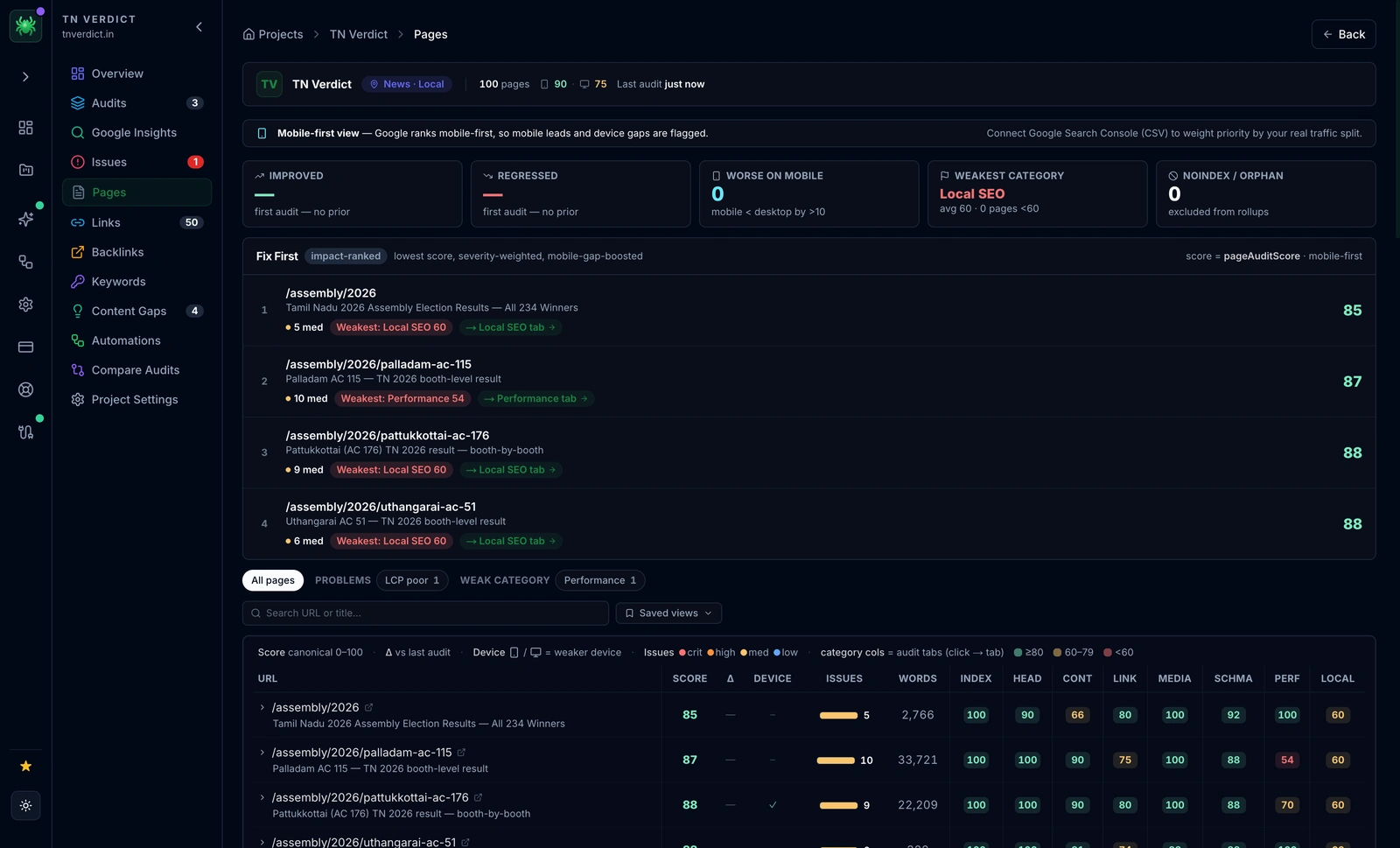
A comprehensive audit should look for:
- Broken Links (404s): These frustrate users and waste crawl budget.
- Duplicate Content: Ensures unique value across pages.
- Orphan Pages: Pages that have no internal links pointing to them.
- Missing Alt Tags: Accessibility gaps.
Digispot AI can help you identify and fix these issues automatically with AI-powered audits analyzing 300+ ranking factors. Rather than manually checking every page, you can get a site-wide health score and a prioritized list of fixes.
For a manual approach to get started, you can follow our comprehensive SEO audit checklist.
Integrating with Analytics: Tracking Performance
You cannot improve what you do not measure. Your on-page efforts must be validated by data.
Google Search Console (GSC): This is your primary feedback loop with Google. Monitor the "Performance" tab to see which queries are driving impressions. If a page has high impressions but low clicks, your Title Tag or Meta Description likely needs optimization.
Google Analytics 4 (GA4): Use GA4 to track user behavior after they land on your site. Look at engagement rates and event conversions. If users land on a page and leave immediately (high bounce rate), your content may not be matching the search intent, or the page load speed might be too slow.
The Digispot AI platform integrates directly with GSC and GA4, overlaying this data with our AI insights to give you a clearer picture of why traffic is moving up or down.
Opportunity Finding: Unearthing Hidden SEO Gems
Even a well-optimized site has gaps. An "opportunity finder" mindset helps you expand your footprint.
- Content Decay: Identify posts that used to rank well but have dropped. These are prime candidates for a "refresh"—updating facts, adding new sections, and changing the "Last Updated" date.
- Content Gaps: Look at what your competitors are ranking for that you are not. Is there a sub-topic they cover that you missed?
- Zero-Search Volume Keywords: Don't ignore hyper-specific queries. While tools show "0" volume, these often represent highly motivated buyers asking specific questions.
Digispot AI includes an "opportunity finder" feature that automates this competitive analysis, highlighting exactly where you can gain an edge with minimal effort.
The Human Touch in On-Page SEO: Beyond Algorithms
While we discuss algorithms, bots, and ranking factors, never forget that the end user is a human being. Search engines are increasingly sophisticated at detecting "soulless" content written solely to rank.
Use tools to handle the data analysis, the technical audits, and the schema generation. But when it comes to the voice, the storytelling, and the empathy in your content, rely on human creativity.
Successful SEO strategies in the AI era combine the efficiency of platforms like Digispot AI with human oversight. Use AI to find the insights, but use your brand's unique perspective to connect with the reader.
Master On-Page SEO: Your Next Steps
On-page SEO is the most accessible lever you can pull to improve your digital performance. It requires attention to detail—from the technical structure of your URLs to the emotional hook in your introduction. By systematically optimizing every element discussed in this guide, you build a resilient foundation that withstands algorithm updates and drives sustainable growth.
Don't let your valuable content sit unseen. Start by auditing your most important pages today with our free on-page SEO checker — get a 10-point audit of any URL in seconds, no signup required.
Ready to improve your search visibility? Try Digispot AI for comprehensive website audits and actionable recommendations that take the guesswork out of optimization. You can also preview how your pages appear in search results using our meta tag preview tool.
Related deep-dives
Continue with these closely related guides:
- api documentation seo — API Documentation SEO: Developer Docs Guide
- duckduckgo seo — DuckDuckGo SEO: How to Optimize for Privacy-Focused Search
- digispot ai chrome extension — Digispot AI Chrome Extension: Free On-Page SEO & SERP Auditor
References
- Google Search Console
- Creating Helpful, Reliable, People-First Content | Google Search Central
- Control your title links in search results | Google Search Central
- Intro to How Structured Data Markup Works | Google Search Central
- Mobile-first Indexing Best Practices | Google Search Central
- On Page Analysis - SEO and Content Analysis Tool | AI-Powered SEO Platform | Digispot AI
- Digispot AI - SEO Insights - Chrome Web Store
Audit any page in seconds
300+ SEO checks including Core Web Vitals, schema markup, meta tags, and AI readiness — trusted by 1000+ SEO experts and marketers.
Frequently Asked Questions
Here are some of our most commonly asked questions. If you need more help, feel free to reach out to us.
Written by
Maya Krishnan
Digital growth expert
Maya is a seasoned expert in web development, SEO, and digital strategy, dedicated to helping businesses achieve sustainable growth online. With a blend of technical expertise and strategic insight, she specializes in creating optimized web solutions, enhancing user experiences, and driving data-driven results. A trusted voice in the industry, Maya simplifies complex digital concepts through her writing, empowering readers with actionable strategies to thrive in the ever-evolving digital landscape.