DuckDuckGo SEO: How to Optimize for Privacy-Focused Search
Optimize your website for DuckDuckGo's privacy-focused search engine. Learn unique ranking factors and strategies to capture alternative search engine traffic.
 Maya Krishnan
For years, the world of online visibility has revolved almost exclusively around Google. Its sheer dominance has shaped how businesses approach Search Engine Optimization (SEO), making it the primary battleground for online attention. However, a significant shift is underway in the digital landscape. A growing global awareness of data privacy, coupled with a desire for unfiltered search results, is pushing an alternative into the spotlight: DuckDuckGo. This makes DuckDuckGo SEO far more than a niche strategy; it's rapidly becoming an indispensable component of a comprehensive and forward-thinking digital presence.
This comprehensive guide will unravel the intricacies of DuckDuckGo SEO, exploring what sets it apart, how its unique ranking mechanisms function, and the tangible benefits of optimizing for this privacy-centric platform. Furthermore, we'll delve into how advanced AI-powered tools, like the Digispot AI platform and its powerful free Chrome extension, can equip your business to not only understand but also master the nuances of DuckDuckGo SEO, ensuring your website effectively reaches a discerning, privacy-aware audience.
What is DuckDuckGo SEO? Unpacking the Privacy-First Search Engine
What exactly is DuckDuckGo? At its core, DuckDuckGo is a search engine with a straightforward yet profound mission: "no tracking, no ad targeting". Founded in 2008, it has steadily grown in popularity, especially among users who are increasingly uncomfortable with the extensive data collection practices of other major search engines. Unlike its counterparts that meticulously track user behavior, search history, and personal information to deliver personalized results and targeted advertisements, DuckDuckGo offers a truly private search experience.
This commitment to privacy means that when you search on DuckDuckGo, your queries are not used to build a personal profile, nor are your results filtered through a "filter bubble" of past preferences. Every user conducting the same search query sees the exact same results, ensuring a neutral and unbiased information retrieval experience. This stark difference fundamentally reshapes the approach to SEO.
How DuckDuckGo is Different from Google: A Paradigm Shift in Search
While both Google and DuckDuckGo aim to provide relevant information, their underlying philosophies diverge significantly. Understanding these differences is the first step in crafting an effective DuckDuckGo SEO strategy.
- Privacy vs. Personalization: Google thrives on personalization, using your location, search history, and other data to tailor search results and ads. DuckDuckGo, conversely, blocks trackers and ensures that your searches are anonymous, offering unpersonalized results. This means that for DuckDuckGo, relevance is paramount, not presumed user intent based on past behavior.
- Ad Model: Google's business model heavily relies on targeted advertising, where ads are displayed based on your detailed user profile. DuckDuckGo, while also showing ads, bases them solely on the keywords in your current search query, never on your browsing history or personal data. This results in a cleaner, less intrusive ad experience.
- "Filter Bubbles" vs. Unbiased Results: Google's personalization can lead to "filter bubbles," where users are primarily shown information that aligns with their perceived interests, potentially limiting exposure to diverse viewpoints. DuckDuckGo, by not tracking users, provides consistent results for everyone, fostering a more objective search environment.
- Unique Features: Instant Answers and !Bangs: DuckDuckGo boasts features like "Instant Answers" (snippets providing direct answers at the top of results, similar to Google's featured snippets but often more concise and privacy-focused) and "!Bangs" (shortcuts to search directly on specific websites). These features emphasize speed and direct information access.
To illustrate these core distinctions, consider the following table:
Table: Google vs. DuckDuckGo: Key Differences
| Feature/Aspect | DuckDuckGo | |
|---|---|---|
| User Data Tracking | Extensive (search history, location, personal data) | None (privacy-focused) |
| Search Results | Personalized, can create "filter bubbles" | Unbiased, consistent for all users |
| Advertising | Targeted, based on user profiles and history | Keyword-based, non-tracking |
| Monetization | Primarily targeted advertising, other services | Keyword-based ads, affiliate links, partnerships |
| Instant Answers | "Featured Snippets," often from its own index | "Instant Answers," drawn from 400+ sources including community sites |
| Unique Features | Google Maps integration, rich snippets, Discover, personalized feeds | !Bangs, Privacy-focused browser extension/app |
| Market Share | Dominant (over 86%) | Growing (approx. 0.6-2.5% global, higher in some regions) |
How Does DuckDuckGo Rank Websites? Understanding the Algorithm
Given its unique approach, how does DuckDuckGo actually determine what to show in its search results? While specific algorithms are proprietary, like any search engine, DuckDuckGo relies on a combination of factors to deliver relevant and authoritative results. The key difference lies in its data sourcing and how it values universal SEO best practices over personalized signals.
The Multi-Source Approach: Unlike Google, which primarily relies on its own vast index, DuckDuckGo aggregates its search results from over 400 sources. These sources include:
- Other Search Engines: A significant portion of its results comes from major search engines like Bing and Yahoo. This is crucial, as optimizing for Bing can directly benefit your DuckDuckGo visibility.
- Crowdsourced Sites: Platforms like Wikipedia, Stack Overflow, and others contribute to its "Instant Answers" and knowledge graph.
- Its Own Web Crawler (DuckDuckBot): DuckDuckGo also has its own bot, DuckDuckBot, which crawls and indexes websites.
- Direct Partnerships: It partners with services like Apple Maps for local searches and Tripadvisor for certain listings.
This multi-source strategy means that good SEO practices for other search engines will generally benefit your DuckDuckGo ranking. However, there are nuances.
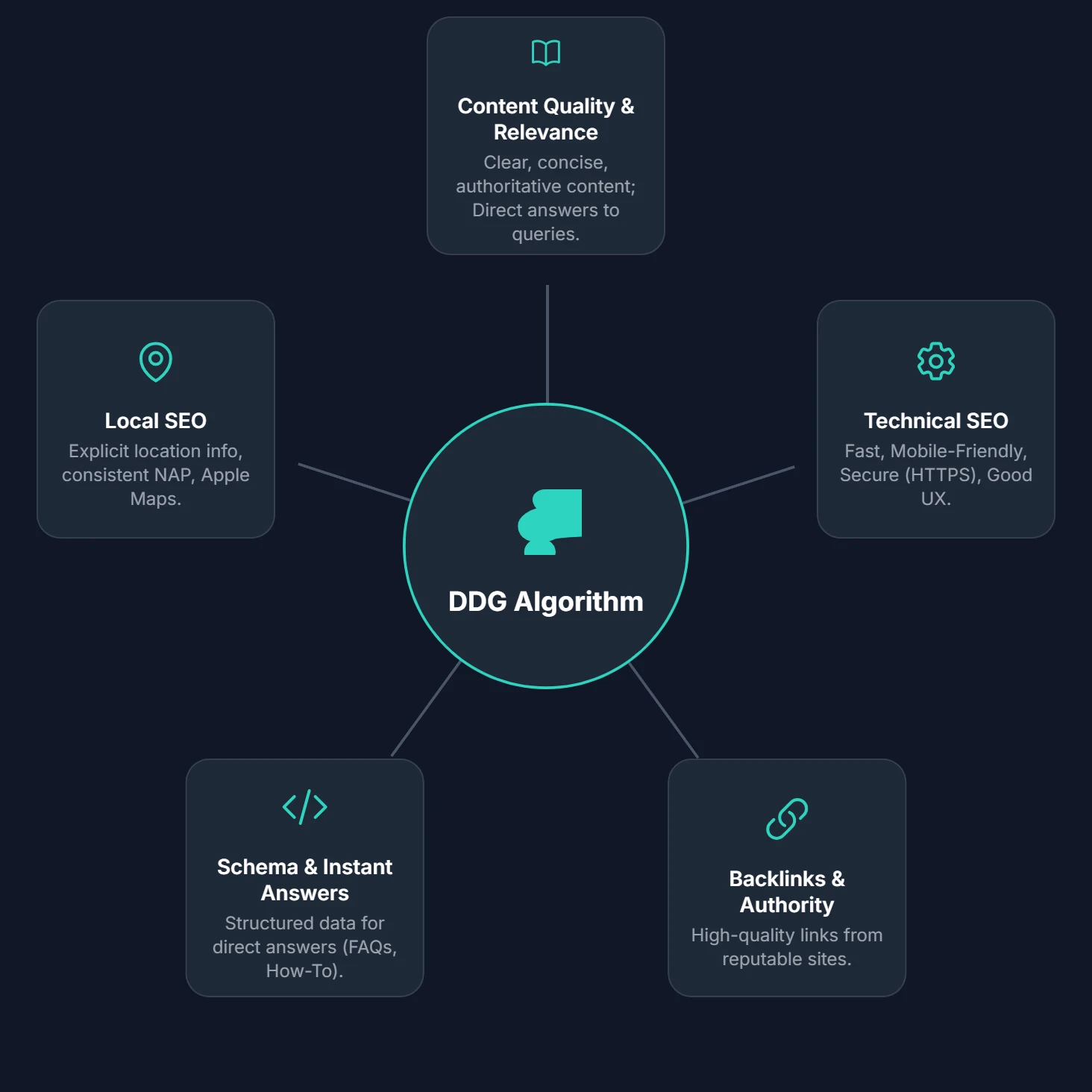
Core Ranking Factors (with a DuckDuckGo Lens):
- Content Quality and Relevance: This is paramount. DuckDuckGo prioritizes high-quality, authoritative, and information-rich content that directly answers user queries. Since there's no personalization, the content itself must be universally relevant and useful.
- How to optimize: Focus on creating clear, concise, and comprehensive content. Target keywords naturally, and ensure your content directly addresses potential questions users might have.
- Technical SEO: A technically sound website is fundamental for any search engine, and DuckDuckGo is no exception. This includes:
- Site Structure and User Experience (UX): A well-organized, easy-to-navigate website is crucial. DuckDuckGo values sites that offer a good user experience, including quick load times and intuitive design.
- Mobile-Friendliness: With a significant portion of DuckDuckGo's traffic coming from mobile devices, a responsive and mobile-optimized website is essential.
- Page Speed: Faster loading times improve user experience and are a known ranking factor.
- SSL Encryption: Secure data transmission (HTTPS) is a universal best practice and contributes to trustworthiness.
- How to optimize: Regularly audit your website for technical issues. Ensure quick loading times, especially on mobile, and a clear, logical site architecture.
- Backlinks and Authority: While DuckDuckGo doesn't reveal much about its backlink algorithm, it does state that "the best way to get good rankings (in pretty much all search engines) is to get links from high quality sites". High-quality backlinks from reputable and relevant sources signal authority and trustworthiness.
- How to optimize: Focus on earning natural, high-quality backlinks through valuable content creation, outreach, and digital PR.
- Schema Markup & Instant Answers: This is where DuckDuckGo SEO truly shines uniquely. DuckDuckGo's "Instant Answers" are snippets displayed at the top of search results, providing direct answers to queries. Optimizing for these "position zero" results can significantly increase visibility. Schema markup (structured data) provides search engines with additional context about your content, making it easier for DuckDuckGo to extract direct answers.
- How to optimize: Implement schema markup for various content types, such as FAQs, How-To guides, recipes, products, and local businesses. Structure your content to provide clear, concise answers to common questions.
- Local SEO (with a DuckDuckGo Nuance): Since DuckDuckGo doesn't track user location, businesses need to explicitly include location information to rank for local searches.
- How to optimize: Incorporate hyperlocal keywords (e.g., "bakery in [city name]"), maintain consistent Name, Address, Phone (NAP) information across all online directories, and consider adding your business to Apple Maps, which DuckDuckGo partners with.
Why Optimize for DuckDuckGo? The Undeniable Benefits for Businesses
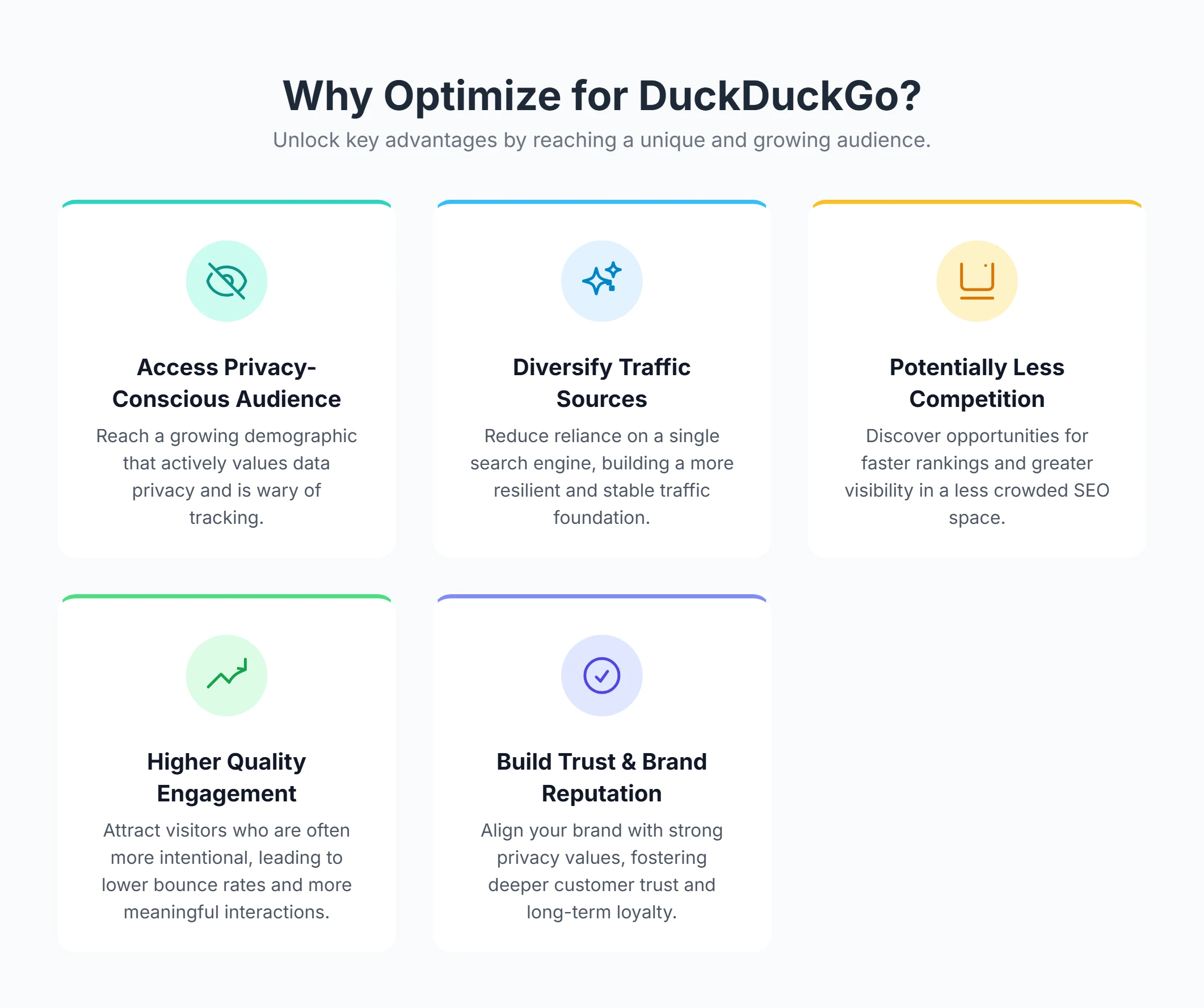
You might be thinking, "Google dominates, why bother with DuckDuckGo?" The answer lies in strategic diversification and tapping into a rapidly growing, distinct audience segment.
- Accessing a Growing, Privacy-Conscious Audience: The concern for online privacy is on a steady rise, and DuckDuckGo is directly addressing this need. Millions of users actively choose DuckDuckGo for its commitment to privacy. By optimizing for DuckDuckGo, you're reaching a demographic that values privacy, often tech-savvy, and potentially more engaged with content that aligns with these values. This represents a significant, often underserved, market segment that other search engines might not capture for you.
- Diversifying Traffic Sources: Relying solely on one search engine, no matter how dominant, can be risky. Algorithm updates can drastically impact your visibility overnight. By optimizing for DuckDuckGo, you create another robust channel for organic traffic, reducing your dependence on a single platform and building a more resilient online presence. This ensures that even if one source fluctuates, your overall visibility remains strong.
- Potentially Less Competition: While DuckDuckGo's market share is smaller than Google's, this can actually work to your advantage. Many businesses still overlook DuckDuckGo SEO, focusing exclusively on Google. This creates a less competitive landscape where your well-optimized content has a higher chance of ranking prominently and quickly. It's an opportunity to gain an early mover advantage in a growing space.
- Higher Quality Engagement: Anecdotal evidence and some reports suggest that DuckDuckGo users tend to exhibit lower bounce rates and spend more time on sites, indicating higher quality engagement. This could be attributed to the unpersonalized search results, meaning users are actively seeking information and are more likely to find exactly what they're looking for when they click through. This translates to more valuable leads and conversions for your business.
- Building Trust and Brand Reputation: Aligning your SEO efforts with a privacy-focused platform like DuckDuckGo can enhance your brand's reputation. It signals to your audience that your business understands and respects their privacy concerns, fostering trust and loyalty in an era where data security is paramount.
How Digispot AI Can Elevate Your DuckDuckGo SEO Strategy
Optimizing for DuckDuckGo, while sharing common ground with traditional SEO, requires a nuanced approach, especially concerning data sourcing, privacy implications, and the emphasis on direct, unbiased answers. This is where a sophisticated platform like Digispot AI becomes an indispensable asset. Digispot AI is designed to automate and streamline SEO best practices, providing the accuracy and scale needed to operate effectively across various search engines, including DuckDuckGo.
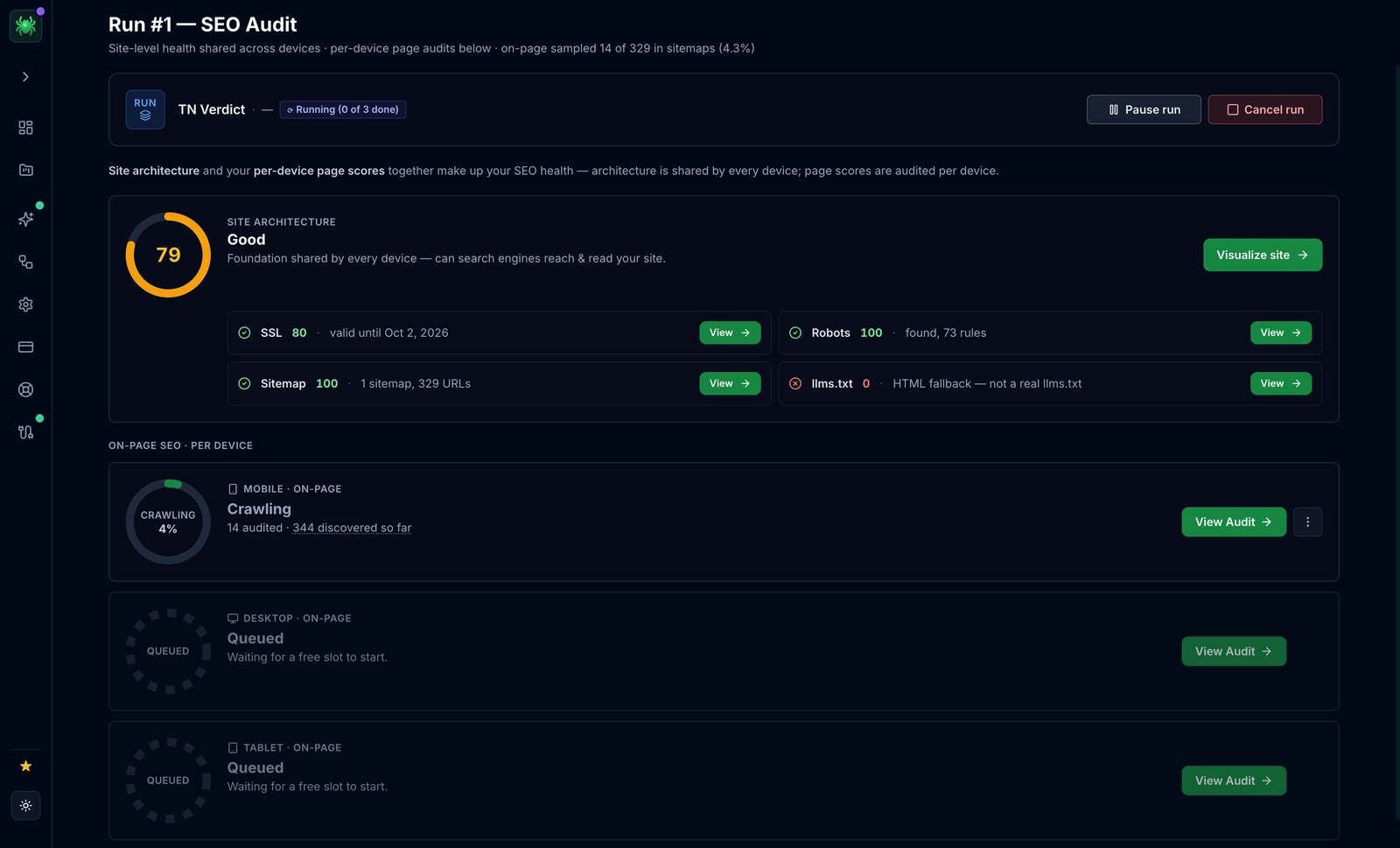
1. Comprehensive Website Auditing (Mobile & Desktop):
- What it does: Digispot AI performs extensive website audits, covering over 200 technical checks across content, performance, technical SEO, local SEO, and schema markup. It meticulously analyzes your site in both mobile and desktop modes, identifying issues that could hinder your ranking.
- How it helps DuckDuckGo SEO: While DuckDuckGo doesn't track users, it highly values a robust and user-friendly website. Factors like mobile-friendliness, page speed, and clean code are universally crucial for user experience and crawling efficiency, which DuckDuckGo considers heavily. For instance, Digispot AI can precisely spot issues like oversized images or slow-loading JavaScript that might degrade your site's performance, which in turn impacts how DuckDuckGo's crawlers (like DuckDuckBot) perceive your site and how users interact with it. By proactively identifying and helping you solve these fundamental problems, Digispot AI ensures your website presents its best self to DuckDuckGo, contributing to better visibility and user engagement.
2. Seamless Integration with Google Search Console & Google Analytics:
- What it does: Digispot AI integrates directly with Google Search Console (GSC) and Google Analytics (GA), providing a centralized dashboard for tracking and improving your website's performance. This allows you to monitor rankings, traffic, and engagement metrics in real time.
- How it helps DuckDuckGo SEO: While DuckDuckGo doesn't provide direct data to GSC or GA, the insights gleaned from these integrations are invaluable for overall site health, which directly benefits DuckDuckGo SEO. For example, by analyzing keyword performance and user behavior trends from GSC/GA data through Digispot AI's dashboards, you can identify high-performing content or keywords that resonate with a broad audience. You can then adapt this content, making it more concise and direct-answer oriented, specifically for DuckDuckGo's Instant Answers. This strategic cross-platform insight helps you understand universal user needs, which is key for DuckDuckGo's unpersonalized results.
3. Opportunity Finder & Content Studio:
- What it does: Digispot AI's "Opportunity Finder" helps you spot content gaps and high-potential keywords, while its "Content Studio" leverages AI agents to generate SEO-optimized content.
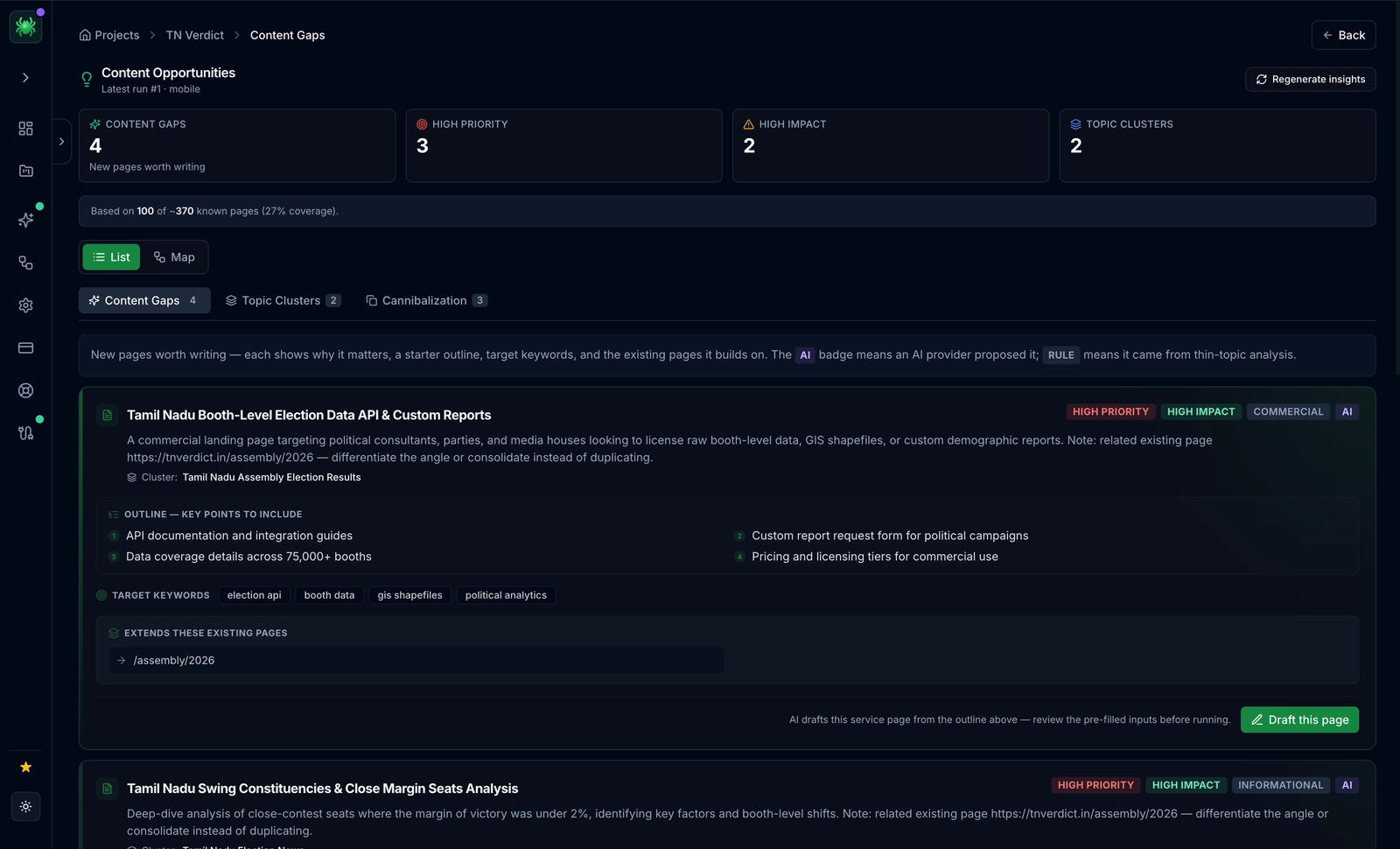
- How it helps DuckDuckGo SEO: This feature is particularly powerful for DuckDuckGo optimization. Privacy-conscious users often conduct more specific, long-tail searches. The Opportunity Finder can help you identify these niche queries and content gaps where you can provide definitive, direct answers. Then, Digispot AI's Content Studio can assist in crafting highly relevant, concise, and authoritative content, perfectly suited for DuckDuckGo's emphasis on Instant Answers and direct information retrieval. Imagine using the Content Studio to generate a comprehensive "How-To" guide that is structured perfectly for an Instant Answer box on DuckDuckGo, addressing a user's exact query immediately.
4. Analysis of 300+ Ranking Factors:
- What it covers: Digispot AI's platform provides a holistic analysis across 300+ ranking factors, including content relevance, technical SEO infrastructure, page performance (Core Web Vitals), local SEO elements, schema markup, brand presence, and social media readiness. It even compares LLMbot (AI search crawler simulation) vs. Googlebot results to identify content gaps for both traditional and AI-driven search engines.
- How it helps DuckDuckGo SEO: This comprehensive approach ensures that every aspect of your website is optimized, directly benefiting DuckDuckGo's multi-source indexing and ranking principles. For instance, if Digispot AI flags a critical technical issue like broken internal links or unoptimized images, fixing these not only improves your Google ranking but also enhances user experience and crawlability for DuckDuckGo's DuckDuckBot. By continuously monitoring and providing actionable recommendations across this vast array of factors, Digispot AI empowers your business to maintain peak performance, making your site more appealing and discoverable to DuckDuckGo users.
Empowering Your Browser: The Digispot AI Free Community Chrome Extension
Beyond the powerful cloud platform, Digispot AI also offers an invaluable tool that brings immediate SEO insights directly to your fingertips: the Digispot AI Free Community Chrome Extension. This AI-powered extension acts as your on-demand SEO assistant, helping you audit any webpage in your browser, powered by popular LLM models.
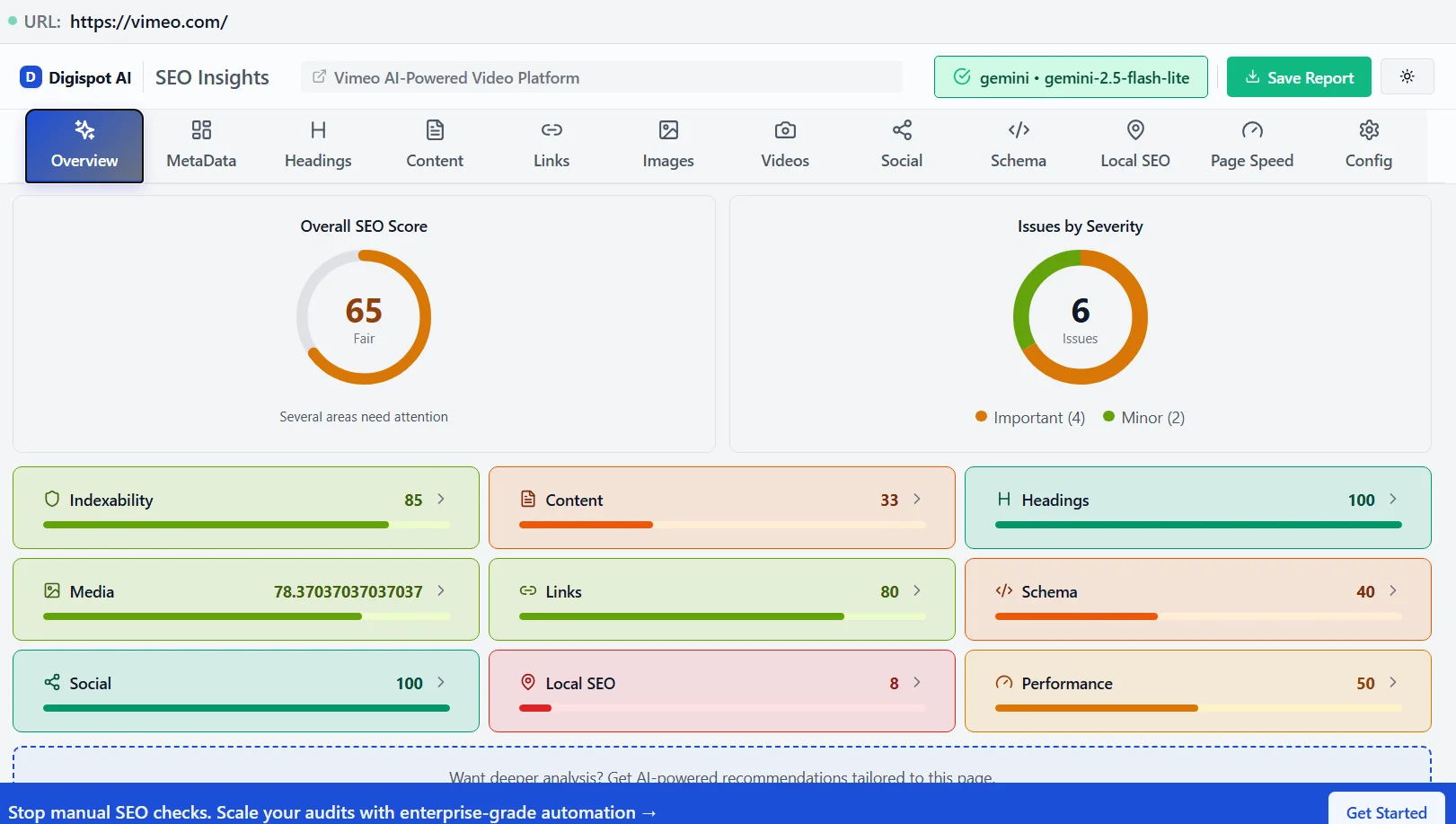
Turn invisible SEO data into clear visuals with our Free Chrome extension
How this free extension helps specifically with DuckDuckGo SEO:
- Instant On-Page SEO Audits: With a single click, the extension provides immediate analysis of a page's content, headings, and keyword relevance. For DuckDuckGo, which values clear and direct information, knowing if your on-page elements are precisely aligned with your target keywords is crucial. The extension gives you a quick snapshot of what's working and what needs refinement to appeal to DuckDuckGo's direct search approach.
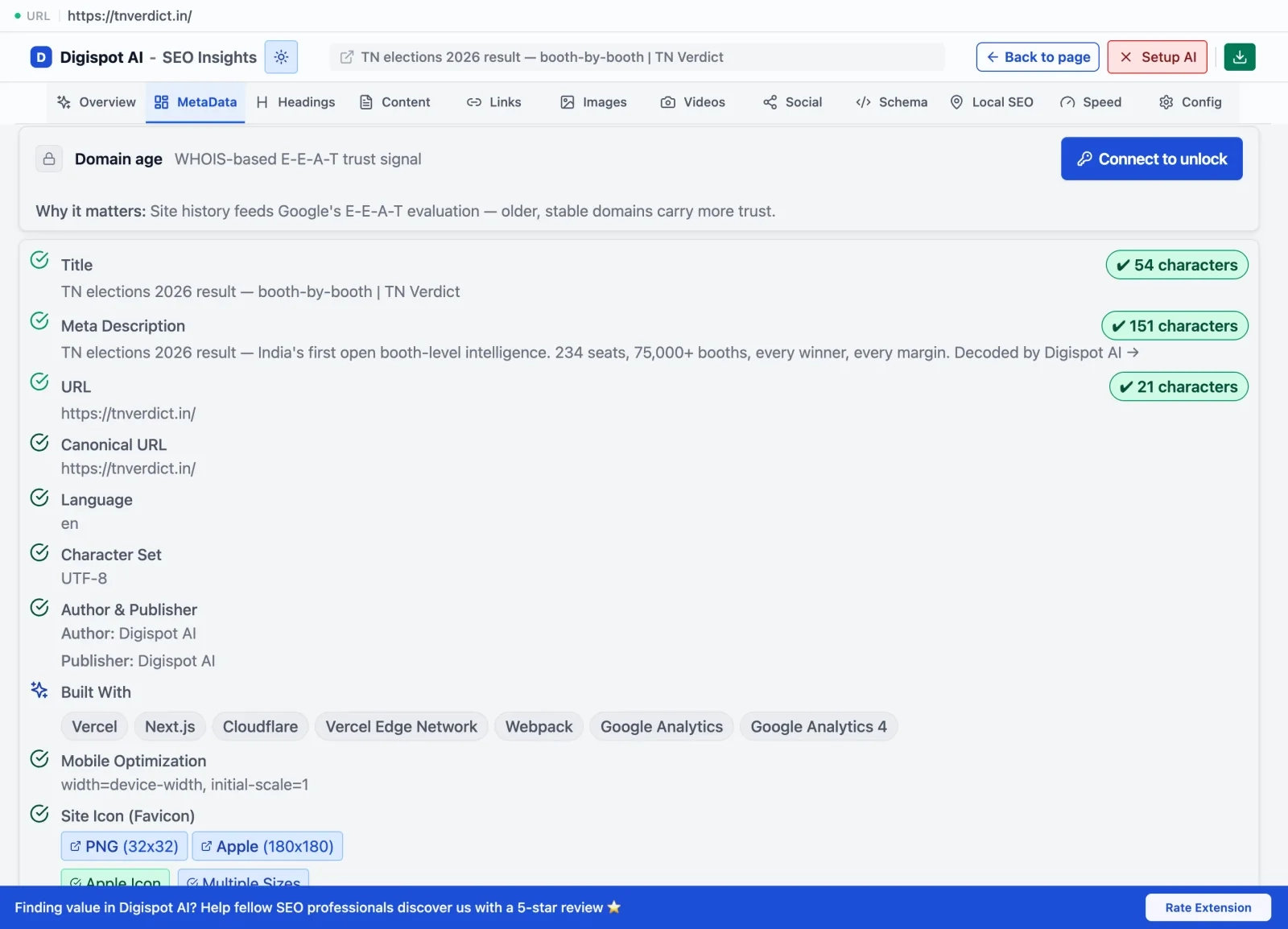
- Schema Markup Validation & Visualization: This is arguably one of the most powerful features for DuckDuckGo SEO. DuckDuckGo heavily relies on structured data to populate its "Instant Answers". The Digispot AI Chrome Extension allows you to:
- Validate Schema Markup: Quickly check if your structured data is correctly implemented and free of errors.
- Visualize Schema Markup: See how search engines interpret your schema markup through intuitive list, entity mapping, and graph views. This visual representation is incredibly helpful. For example, if you've implemented "HowTo" schema for a guide on your site, the extension can show you exactly how DuckDuckGo might see and potentially use that data for an Instant Answer, helping you fine-tune it for maximum impact.
- Detection of Critical Issues: The extension quickly identifies common SEO pitfalls like missing image alt text, oversized images, and broken links. These issues, while seemingly minor, can significantly impact user experience and crawlability, which are vital for DuckDuckGo's ranking considerations. By providing real-time alerts, the extension empowers you to fix these issues immediately, ensuring a smoother experience for both users and DuckDuckBot.
- AI-Powered Recommendations: Leveraging advanced LLM models, the extension provides intelligent suggestions for keyword relevance scoring, content optimization, and heading improvements. This means you get AI-driven insights directly in your browser. For instance, if you're writing a piece of content, the AI might suggest a more precise heading or keyword phrase that would be more likely to trigger an Instant Answer on DuckDuckGo, given its direct query-matching focus.
- Page Speed Audit Integration: The extension even allows you to submit page speed audits to Google directly from Chrome. While a Google tool, improved page speed universally benefits all search engines, including DuckDuckGo, by providing a better user experience and aiding efficient crawling.
This free, community-powered tool democratizes access to powerful SEO insights, allowing businesses and individuals to quickly audit and improve their web pages with AI-driven recommendations, making DuckDuckGo optimization more accessible than ever.
Practical Steps for DuckDuckGo SEO (and How Digispot AI Fits In)
Now that we understand the "what" and "how" of DuckDuckGo SEO, let's look at actionable steps and how Digispot AI can seamlessly integrate into your workflow.
1. Prioritize High-Quality, Direct-Answer Content:
- What to do: Focus on creating content that is clear, concise, authoritative, and directly answers potential user questions. Think about informational queries that DuckDuckGo users, often privacy-focused, might type in.
- How Digispot AI helps: Digispot AI's Content Studio is an invaluable resource here. Utilize its AI agents to draft and refine content that is structured for immediate answers. The Opportunity Finder can also help you pinpoint long-tail keywords and specific questions that are underserved, allowing you to create targeted content that DuckDuckGo's Instant Answers feature would favor.
2. Implement Schema Markup Meticulously:
- What to do: For content that provides direct information (e.g., FAQs, how-to guides, definitions), ensure you're using appropriate schema markup (structured data) to give DuckDuckGo the context it needs to feature your content in Instant Answers.
- How Digispot AI helps: The Digispot AI Chrome Extension is your best friend for this. Its Schema Markup Validation & Visualization feature allows you to instantly check if your structured data is correctly implemented and visually see how search engines interpret it. This feedback loop is critical for ensuring your schema is optimized for DuckDuckGo's data extraction. The platform also includes a Schema Markup Generator.
3. Optimize for Local Search Explicitly:
- What to do: Since DuckDuckGo doesn't rely on user location tracking, you must explicitly include location information in your content, meta tags, and site structure. Ensure consistent Name, Address, Phone (NAP) details across all online directories, and consider listing your business on Apple Maps.
- How Digispot AI helps: Digispot AI's comprehensive audit includes specific checks for local SEO factors. It can highlight opportunities to integrate hyperlocal keywords naturally into your content and identify inconsistencies in your NAP information, ensuring your business is easily discoverable by DuckDuckGo users searching for local solutions.
4. Ensure Stellar Technical SEO & User Experience:
- What to do: A fast, mobile-friendly, and easy-to-navigate website is fundamental for any search engine. Prioritize page speed, responsive design, clear site architecture, and secure (HTTPS) connections.
- How Digispot AI helps: The Digispot AI platform's 300+ technical checks are designed to identify issues across infrastructure, optimization, and performance (including Core Web Vitals). It helps you pinpoint API delays, SSL issues, JavaScript inefficiencies, and unoptimized images. Furthermore, the Digispot AI Chrome Extension provides immediate on-page audits, including page speed insights, helping you detect and address problems with slow-loading pages instantly.
5. Build Authoritative Backlinks:
- What to do: Focus on acquiring high-quality backlinks from reputable and relevant websites in your niche. This signals authority and trustworthiness to all search engines, including DuckDuckGo.
- How Digispot AI helps: While Digispot AI doesn't directly build backlinks, its focus on creating high-quality, SEO-optimized content through its Content Studio and identifying opportunities naturally positions your website to earn these valuable links. A site that consistently publishes valuable, well-researched content, identified and refined using Digispot AI's tools, is more likely to attract natural backlinks.
6. Regularly Audit and Refine:
- What to do: SEO is an ongoing process. Regular monitoring and adaptation to algorithm updates are essential for maintaining visibility.
- How Digispot AI helps: The Digispot AI platform offers performance monitoring with real-time tracking of rankings, traffic, and engagement metrics. More importantly, it provides actionable insights and data-driven recommendations, distilling complex SEO best practices into easy-to-follow solutions. This continuous feedback loop allows you to operate at scale with accuracy, making proactive adjustments to your DuckDuckGo SEO strategy based on concrete data.
Conclusion: Embracing a Holistic SEO Future
The digital landscape is undeniably dynamic, and the rise of privacy-focused search engines like DuckDuckGo signifies a crucial shift in user priorities. For businesses, this isn't just a trend; it's an opportunity to diversify their organic traffic, reach a highly engaged audience, and reinforce their commitment to user privacy.
By understanding the distinct mechanics of DuckDuckGo SEO – its reliance on broad relevance, technical excellence, clear content, and structured data over personalized user profiles – you can unlock significant new avenues for visibility. Tools like the Digispot AI cloud platform and its free community Chrome extension are specifically engineered to simplify this journey. From comprehensive, 300+-factor website audits that identify subtle issues in both mobile and desktop environments, to AI-powered content creation and schema markup validation, Digispot AI brings all SEO best practices into an automated, user-friendly model. It empowers you to spot opportunities, generate SEO-optimized content, and track performance with precision, ultimately improving business visibility, increasing traffic and leads, and generating significant time and cost savings.
In an era where search is evolving beyond a single dominant player, a holistic SEO strategy that embraces platforms like DuckDuckGo, supported by intelligent AI-powered solutions, is no longer optional. It's the pathway to sustained online success and a deeper connection with a more discerning audience.
Related deep-dives
Continue with these closely related guides:
- keyword mapping — Master Keyword Mapping: The Strategic Blueprint for Higher Rankings
- google discover optimization — Google Discover Optimization: The 2025 Strategy Guide for Publishers
- to fix keyword — How to Fix Keyword Cannibalization SEO: A Step-by-Step Guide for 2026
References
- DuckDuckGo Privacy Policy
- DuckDuckGo Help Pages - About Instant Answers
- DuckDuckGo Help Pages - How DuckDuckGo Gets Its Results
- Google Search Central - About structured data (General structured data information relevant to all search engines)
- Google Search Central - Mobile-friendly test (General mobile-friendliness information)
- Google Search Central - Understand Core Web Vitals (General page performance information)
- Digispot AI Official Website
- Digispot AI - FREE On Page SEO Audit Tool
- Digispot AI - FREE Chrome Extension for SEO Insights
Audit any page in seconds
300+ SEO checks including Core Web Vitals, schema markup, meta tags, and AI readiness — trusted by 1000+ SEO experts and marketers.
Frequently Asked Questions
Here are some of our most commonly asked questions. If you need more help, feel free to reach out to us.
Written by
Maya Krishnan
Digital growth expert
Maya is a seasoned expert in web development, SEO, and digital strategy, dedicated to helping businesses achieve sustainable growth online. With a blend of technical expertise and strategic insight, she specializes in creating optimized web solutions, enhancing user experiences, and driving data-driven results. A trusted voice in the industry, Maya simplifies complex digital concepts through her writing, empowering readers with actionable strategies to thrive in the ever-evolving digital landscape.