Fintech SEO Strategies: Mastering YMYL & E-E-A-T in 2026
Master fintech SEO with our expert guide on YMYL standards, E-E-A-T signals, and advanced technical strategies to rank secure financial content in 2026.
 Maya Krishnan
Trust is the currency of the internet, but in fintech, it is quite literally the product. Unlike a recipe blog or a fashion site, a financial website asks users to make decisions that impact their retirement, their savings, and their livelihood.
Google understands this high-stakes environment perfectly. That is why they classify the financial sector as "Your Money or Your Life" (YMYL).
Ranking a fintech website isn't just about keywords anymore. It is about proving to search algorithms—and AI models—that you are safer, smarter, and more reliable than the competition. A single technical error or a vague author bio can de-index a page that was driving thousands of leads yesterday.
In this guide, we break down the specific, high-level strategies required to dominate fintech SEO. We will move beyond basic optimization and look at how to engineer trust, leverage semantic entities, and prepare your infrastructure for the next generation of search.
Key Takeaways
- Treat E-E-A-T as a product requirement, not a checklist. Credential every article with a named, qualified author and an expert reviewer byline before it ships.
- Win on entities, not just keywords. Cover the full set of related concepts (APY, FDIC, fees, compounding) that Google expects in a trustworthy financial document.
- Deploy finance-specific schema. Use FinancialProduct, ExchangeRateSpecification, and a rich Organization
sameAsgraph to corroborate identity and trigger rich results. - Make speed a trust signal. Reserve space for disclaimers and lazy-load calculators so Core Web Vitals stay green in competitive YMYL SERPs.
- Earn links and audit relentlessly. Use original data for digital PR, never buy links, and run weekly-to-quarterly audits since a broken link is a compliance risk.
The YMYL Framework: Why Google Treats You Differently
Google’s Search Quality Evaluator Guidelines are explicit: pages that impact financial stability require the highest level of E-E-A-T (Experience, Expertise, Authoritativeness, and Trustworthiness).
For a standard blog, a "good" article might be enough. For fintech, "good" is often invisible.
The Algorithm of Trust
Google’s algorithms look for specific signals that separate legitimate financial institutions from potential scams. These signals aren't just in your content; they are embedded in your code, your external references, and your user experience.
If your site covers topics like:
- Investment advice
- Tax planning
- Banking services
- Loans or credit cards
- Insurance
You are under a microscope. Google's algorithms will aggressively filter out content that lacks clear attribution or presents consensus-defying advice without substantial evidence.
Mastering E-E-A-T for Financial Sites
E-E-A-T is not a single ranking factor, but a combination of signals. In 2026, the "Experience" component has gained massive weight. Users (and Google) don't just want to know the theory of a credit card; they want to hear from someone who has swiped it.
1. Expertise: Credentialing Content
Your content cannot be anonymous. Every piece of advice needs a face and a qualification attached to it.
- Author Bios: These must be exhaustive. Include degrees, certifications (CPA, CFA, CFP), and links to LinkedIn profiles.
- Expert Reviewers: If your writer isn't a certified financial planner, hire one to review the content. Add a "Medically Reviewed By" equivalent for finance: "Financially Reviewed by [Name], CFA."
2. Experience: Demonstrating Usage
How do you prove experience in a digital article?
- Original Imagery: Don't use stock photos of people shaking hands. Use screenshots of the investment dashboard you are reviewing.
- First-Hand Data: Instead of quoting average interest rates, share data from your own platform or user surveys.
- Case Studies: Detail specific scenarios where a strategy worked or failed.
For a deeper dive into structuring these signals, read our guide on implementing E-E-A-T for SEO.
3. Authority: The Citation Game
Authority is relative. You might be an authority on "crypto wallets" but have zero authority on "mortgage refinancing." Stick to your lane initially. Build topical authority in one vertical before expanding.
The mechanics of building that authority are concrete. First, achieve topical depth: publish a cluster of interlinked pages covering every sub-question of your chosen vertical, from the pillar term down to the long-tail edge cases. A single "best savings account" page cannot outrank a competitor who owns fifty pages on high-yield savings, CD ladders, and FDIC coverage limits. Second, cite the primary source, not a secondary blog—link directly to the SEC, the IRS, the FDIC, or the CFPB rather than a summary of them. Google can tell the difference, and grounding your claims in semantic entities that the algorithm already trusts transfers authority to your page. Third, earn corroboration from outside: when regulators, financial journalists, and comparison sites reference you by name, Google reads that consensus as external validation of your expertise.
4. Trustworthiness: Transparency
This is the most critical element for YMYL.
- HTTPS is mandatory.
- Contact Info: Have a physical address and phone number in the footer.
- Privacy Policy: It must be accessible and easy to read.
- Advertising Disclosure: If you use affiliate links, disclose them at the top of the content, not buried in the footer.
Technical SEO: Security and Performance
In fintech, a slow site feels like an insecure site. Users equate speed with technical competence. If your login page lags, users assume your security is also lax.
Core Web Vitals as a Trust Signal
Google has confirmed that page experience signals are a tie-breaker. In highly competitive financial SERPs, you cannot afford to lose on technicals.
Key focus areas for fintech:
- LCP (Largest Contentful Paint): Ensure your charts and data widgets load instantly. Lazy load heavy financial calculators only after the main content is visible.
- CLS (Cumulative Layout Shift): Financial disclaimers loading late and pushing content down is a common CLS killer. Reserve space for these elements in your CSS.
Digispot AI helps you monitor these metrics specifically for fintech use cases, ensuring your data visualizations don't hurt your rankings. Learn more about optimizing these metrics in our Core Web Vitals guide.
HTTPS and Security Headers
Beyond just having an SSL certificate, fintech sites should implement HSTS (HTTP Strict Transport Security) headers. This tells browsers to always use a secure connection, preventing downgrade attacks. Google notices these advanced security configurations.
Semantic SEO and Entity Optimization
Search engines have moved from keyword matching to entity understanding. They understand that "NASDAQ" is an entity related to "Stocks," "New York," and "Trading."
To rank for "best savings account," you must cover the related entities that Google expects to see in a high-quality document:
- Interest rates (APY)
- FDIC insurance
- Minimum balance fees
- Withdrawal limits
- Compounding frequency
Creating a Knowledge Graph
You need to connect these dots for the search engine. Don't just mention "FDIC"; explain its relationship to the bank you are reviewing.
Use tools to identify the entities your competitors are using. If the top-ranking sites all discuss "inflation protection" in their savings guides and you don't, you have a content gap.
If you aren't sure which entities you are missing, try our free On-Page SEO Analysis tool. It breaks down the semantic structure of any URL instantly.
Advanced Schema Markup for Finance
Structured data is your direct line of communication with search engine bots. For fintech, generic schema isn't enough. You need specific financial types to trigger rich snippets and AI overviews. If you are new to structured data, start with our advanced schema markup guide and then layer the financial types below on top.
Must-Have Schema Types
1. FinancialProduct Use this for credit cards, loans, or bank accounts. It allows you to specify interest rates, fees, and eligibility requirements directly in the code.
{
  "@context": "https://schema.org",
  "@type": "FinancialProduct",
  "name": "Gold Rewards Credit Card",
  "feesAndCommissionsSpecification": "No annual fee",
  "interestRate": "19.99",
  "annualPercentageRate": "19.99"
}
2. ExchangeRateSpecification If you deal with crypto or forex, this schema is essential for getting your data into Google's direct answer boxes.
3. Organization (with extensive sameAs)
Don't just list your name. Use the sameAs property to link to your Crunchbase, Bloomberg profile, LinkedIn, and regulatory filings. This corroborates your identity.
4. FAQPage Financial topics are question-heavy. Marking up your FAQs increases the chance of appearing in "People Also Ask" boxes, which dominates real estate in financial SERPs.
You don't need to write this code by hand. Use the free Schema Markup Generator to build valid JSON-LD for financial products in minutes.
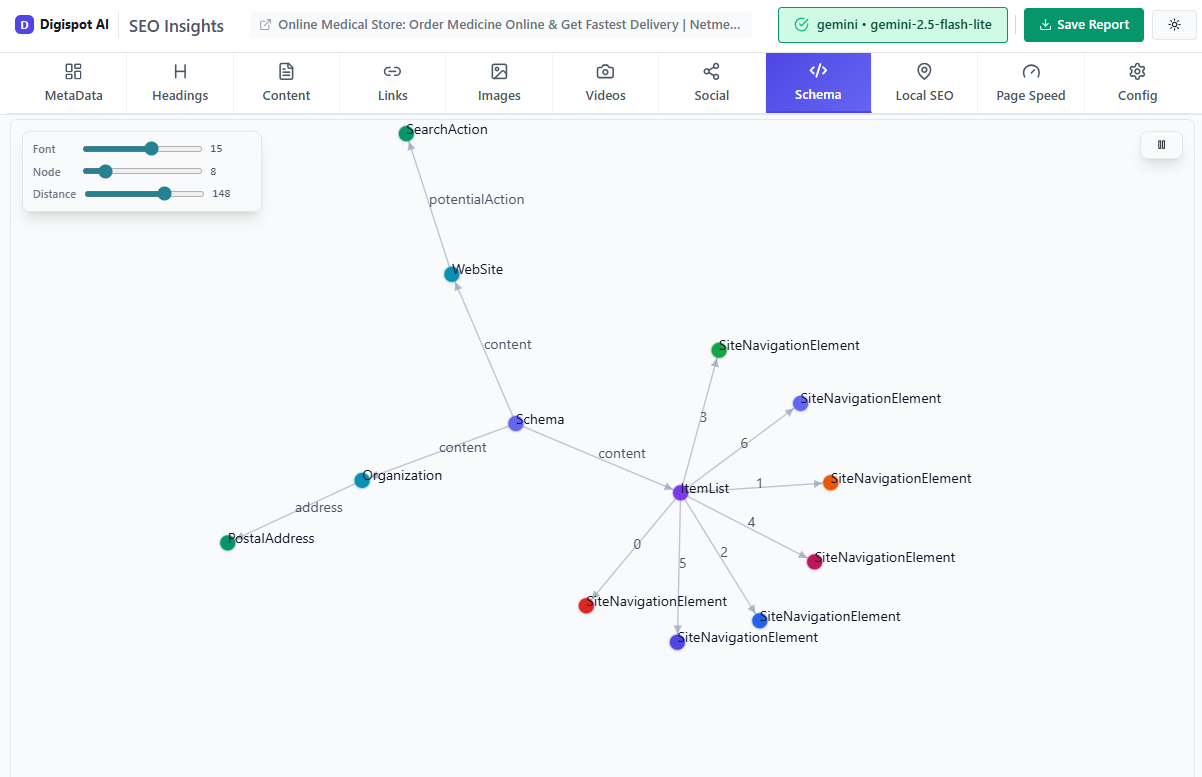
Turn invisible SEO data into clear visuals with our Free Chrome extension.
Content Strategy: Beyond "What is X?"
The "What is Bitcoin" keyword is saturated. The real opportunity in fintech SEO lies in specific, problem-solving queries and comparison intent.
The "Versus" Strategy
Fintech users are constantly comparing options. "Robinhood vs. Coinbase," "Roth IRA vs. Traditional IRA." These queries have high conversion intent.
Create dedicated comparison pages. Use comparison tables (HTML tables, not images) so Google can scrape the data for feature snippets.
Calculator and Tool Magnets
One of the most effective ways to build backlinks naturally is by creating high-utility tools.
- Mortgage Calculator
- Retirement Planner
- Currency Converter
These pages attract links because they are useful references. Once they rank, funnel that link equity to your commercial pages using strategic internal linking.
Regulatory Compliance Content
Don't hide from regulations; use them. Create content that explains complex regulations (like SEC rules or tax codes) in plain English. This positions you as an interpreter of authority, a strong trust signal.
Link Building in a Regulated Industry
You cannot buy links in fintech without risking a penalty. The scrutiny is too high. You need to earn them.
Digital PR and Data Journalism
Fintech companies sit on a goldmine of data. Anonymize your user data to find trends.
- "Millennials are saving 20% less than Gen Z"
- "Crypto adoption highest in these 5 states"
Publish these reports and pitch them to financial journalists. These links from news sites (DR 80+) are worth 100x more than a guest post on a small blog.
Unlinked Mentions
Monitor your brand name and the names of your executives. If a news outlet mentions your CEO but doesn't link, reach out and ask for the attribution. It is the lowest-hanging fruit in off-page SEO.
Optimizing for AI Search (AEO)
Users are increasingly asking Claude, ChatGPT, and Perplexity for financial advice. This is Answer Engine Optimization (AEO).
To appear in these AI answers:
- Direct Answers: Start sections with direct answers to the heading question. Lead with a single, self-contained sentence a model can lift verbatim—"A Roth IRA is funded with after-tax dollars, so qualified withdrawals in retirement are tax-free"—before expanding into nuance. The extractable answer is what gets quoted.
- Data formatting: Use bullet points, definition lists, and comparison tables. LLMs parse structured text far more reliably than dense paragraphs, and a clean table of fees or rates is easy to summarize accurately.
- Citations: Ensure your brand is cited on other authoritative sites. AI models rely on consensus across high-trust sources, so a claim repeated across regulator pages, established news outlets, and your own site is far more likely to surface than an uncorroborated assertion. Winning the classic featured snippet is a strong leading indicator that your phrasing is also AI-friendly.
For a deeper playbook on structuring pages for generative engines, see our answer engine optimization guide.
Digispot AI tracks your visibility across these AI platforms, giving you insight into this "shadow traffic" that traditional analytics miss.
The Audit Routine: Vigilance is Key
In fintech, a broken link isn't just an error; it's a compliance risk. If you link to a product that no longer exists or a regulation that has changed, you lose trust.
You need a rigorous audit schedule.
- Weekly: Check for 404s and broken external links.
- Monthly: Review content accuracy against current market rates.
- Quarterly: Full technical audit (Schema, Core Web Vitals, Indexability). Work through a structured SEO audit checklist so nothing slips between reviews.
Digispot AI can help you identify and fix these issues automatically with AI-powered audits analyzing 300+ ranking factors, ensuring your site remains compliant and performant.
Conclusion: Start Improving Your Fintech SEO Today
Fintech SEO is a marathon, not a sprint. It requires a relentless focus on quality, accuracy, and technical excellence. By prioritizing E-E-A-T, leveraging advanced schema, and monitoring your technical health, you can build a fortress around your rankings that competitors cannot easily breach.
Don't leave your visibility to chance. The financial landscape changes too fast for outdated strategies.
Ready to improve your search visibility? Try Digispot AI for comprehensive website audits and actionable recommendations that keep you ahead of the algorithm.
Related deep-dives
Continue with these closely related guides:
- importance of cdn — Importance of CDN in SEO: Boosting Website Speed & Rankings
- programmatic seo with ai — Programmatic SEO Guide with AI: Scale Organic Traffic Without Spam
References
- Google Search Central: Creating Helpful, Reliable, People-First Content
- Google Quality Rater Guidelines (Section 3.2 - YMYL)
- Schema.org: FinancialProduct Documentation
- Digispot AI Chrome Extension
- Google Search Central: Structured Data General Guidelines
- Moz: The State of Fintech SEO
- Search Engine Journal: E-E-A-T and YMYL
Audit any page in seconds
300+ SEO checks including Core Web Vitals, schema markup, meta tags, and AI readiness — trusted by 1000+ SEO experts and marketers.
Frequently Asked Questions
Here are some of our most commonly asked questions. If you need more help, feel free to reach out to us.
Written by
Maya Krishnan
Digital growth expert
Maya is a seasoned expert in web development, SEO, and digital strategy, dedicated to helping businesses achieve sustainable growth online. With a blend of technical expertise and strategic insight, she specializes in creating optimized web solutions, enhancing user experiences, and driving data-driven results. A trusted voice in the industry, Maya simplifies complex digital concepts through her writing, empowering readers with actionable strategies to thrive in the ever-evolving digital landscape.