
Programmatic SEO with AI: Scale Traffic Without Spam
Master programmatic SEO with AI to build thousands of quality pages. Learn the strategy, data architecture, and quality control to win search.
 Maya Krishnan
Building 5,000 landing pages manually is a fool's errand. It takes years, costs a fortune, and by the time you finish, the search landscape has changed.
Yet, companies like TripAdvisor, Zapier, and Canva dominate search results with millions of pages targeting specific intent—"Best hotels in [City]," "Integrate [App A] with [App B]," " [Event] Flyer Templates."
They didn't write these one by one. They used Programmatic SEO (pSEO).
Until recently, pSEO was reserved for engineering-heavy teams. The content was often rigid—simple "mad libs" style text that offered little value beyond the data points.
AI has changed the physics of this strategy.
By combining structured databases with Large Language Models (LLMs), you can now generate thousands of pages where every section is contextually unique, helpful, and highly optimized. This guide breaks down exactly how to execute a modern programmatic SEO strategy that drives traffic, not penalties.
What is Programmatic SEO?
Programmatic SEO is the practice of creating landing pages at scale by modifying a standard template with variables from a database.
Instead of writing a unique article for "Best CRM for Real Estate Agents" and another for "Best CRM for Dentists," you create one robust template: "Best CRM for {{Industry}}."
You then connect this template to a database containing specific pain points, features, and terminology for every industry you want to target.
The Evolution: From "Mail Merge" to AI Intelligence
Old School pSEO (The "Spam" Risk):
- Method: Find and replace.
- Result: "Real Estate Agents need a CRM. This CRM is great for Real Estate Agents because it helps Real Estate Agents save time."
- Google's Reaction: Soft 404s, "Crawled - currently not indexed," or manual penalties for thin content.
Modern AI pSEO (The Digispot Way):
- Method: Structured data + LLM contextualization.
- Result: "Real Estate Agents face unique challenges with property tracking. Our CRM offers MLS integration specifically designed for high-volume brokerages."
- Google's Reaction: High relevance, strong user engagement, sustained rankings.
Digispot AI can help you identify and fix quality issues automatically with AI-powered audits analyzing 300+ ranking factors, ensuring your programmatic pages meet these modern standards.
Step 1: Identifying the "Golden Pattern"
Programmatic SEO fails when you target the wrong keywords. You are looking for a repeatable search intent.
The searcher's goal must be identical across all variations, even if the specifics change.
Common Winning Patterns
| Pattern Type | Structure | Example |
|---|---|---|
| Geo-Modified | [Service] in [City] | "Emergency Plumber in Austin" |
| Integration | Connect [App A] to [App B] | "Connect Slack to Google Sheets" |
| Vs/Alternatives | [Competitor] Alternatives | "Best Mailchimp Alternatives" |
| Calculators | [Topic] Calculator | "Mortgage Calculator for Texas" |
| Vertical Specific | Best [Software] for [Role] | "Best Accounting Software for Freelancers" |
Validating the Opportunity
Before building a database of 10,000 rows, validate the pattern.
- Check Volume: Are people actually searching for "Best CRM for Dog Walkers"?
- Check SERP Overlap: Google one variation (e.g., "...for Real Estate") and another ("...for Dentists"). If the top results are completely different (blogs vs. product pages), the intent might vary too much for a single template.
Use the free Chrome extension to analyze the current top-ranking pages for your target pattern. Look at their word count and structure—this is your baseline.
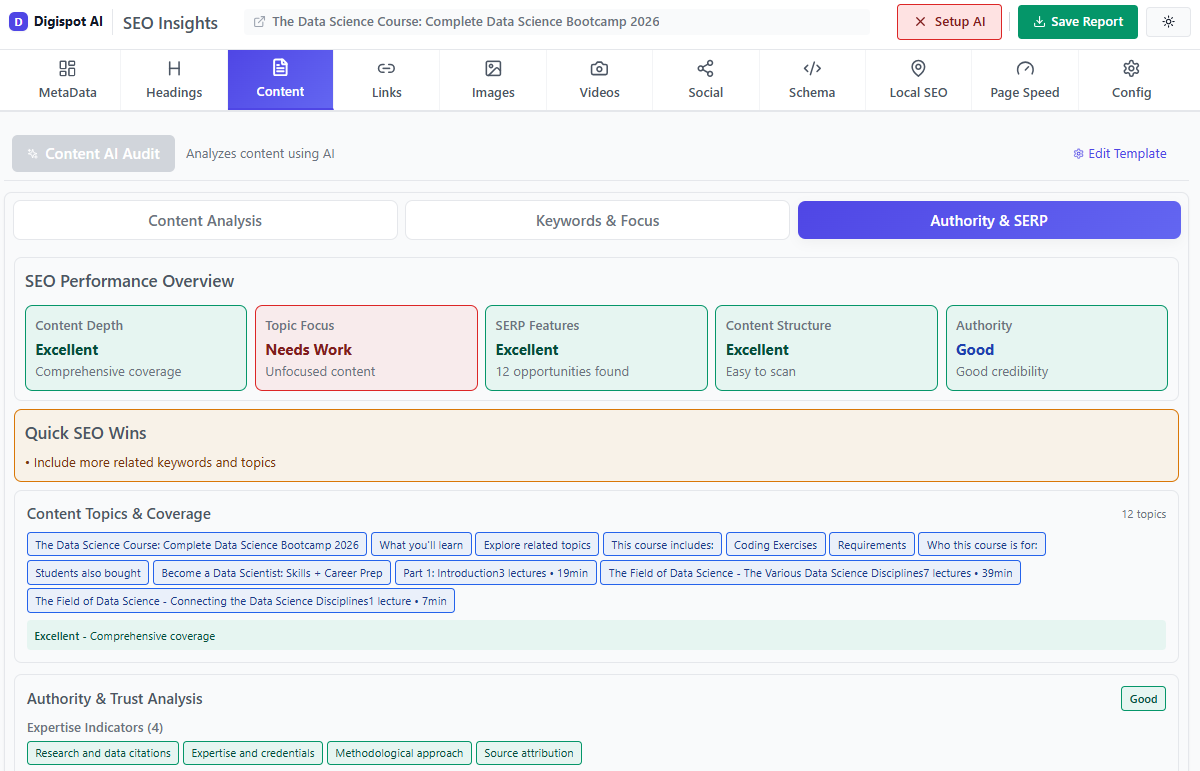
Turn invisible SEO data into clear visuals with our Free Chrome extension.
Step 2: The Data Architecture (The Brain)
The success of your campaign relies 80% on your database and 20% on the writing. AI cannot hallucinate facts and expect to rank; it needs a structured source of truth.
You need a database (Airtable, Google Sheets, or SQL) with columns that feed your AI prompts.
Example Database Structure: "Best CRM for {{Industry}}"
Don't just have a column for {{Industry}}. Enriched columns are required for AI to write good content.
- Primary Key: Real Estate
- Pain_Point_1: "Tracking open house leads"
- Pain_Point_2: "Managing MLS feed integration"
- Jargon_List: "Escrow, closing costs, broker split"
- Competitor_Tool: "LionDesk"
- Use_Case_Example: "Sending automated follow-ups after a viewing."
Expert Tip: Use AI to build the database, not just the final page. You can run a script to ask GPT-4: "List top 3 pain points for {{Industry}} regarding CRM software" and save the output to your database.
Step 3: Integrating AI for Content Generation
This is where we move from "mail merge" to "intelligence." You will use the data columns to prompt an LLM.
The Prompt Engineering Strategy
Avoid generating the entire article in one shot. It creates generic fluff. Instead, generate section by section.
Bad Prompt: "Write a blog post about CRM for Real Estate agents."
Programmatic Prompt:
"Write a paragraph about why {{Industry}} professionals struggle with {{Pain_Point_1}}. Use the term {{Jargon_List}} naturally. Explain how our feature addresses this better than {{Competitor_Tool}}."
Multi-LLM Approach
Different models excel at different tasks. This is a core philosophy at Digispot AI, and you should apply it to your pSEO strategy:
- GPT-4o / Claude 3.5 Sonnet: Best for creative introductions and nuanced reasoning.
- DeepSeek / Gemini: often faster and cheaper for summarizing data points or generating FAQs.
Step 4: Technical Implementation & Schema
Programmatic SEO requires a robust technical foundation. If you publish 5,000 pages with slow load times or broken schema, you will burn your crawl budget instantly.
Platform Selection
- WordPress: Use plugins like WP All Import. Good for content sites.
- Webflow: CMS Collections are powerful but have limits (10k items). Great for design.
- Next.js / Headless: The most scalable. Generates static HTML files.
Structured Data (Schema)
This is non-negotiable. Programmatic pages often target "entity" searches. You must explain to search engines exactly what the page is about using JSON-LD.
If you are building "Review" pages, you need Product and Review schema. If you are building "Local" pages, you need LocalBusiness schema.
Use the free Schema Markup Generator to create valid structured data templates that you can inject variables into dynamically.
Learn more about implementing complex schemas in our Advanced Schema Markup Guide.
Step 5: Managing Crawl Budget & Indexing
The biggest killer of pSEO campaigns is index bloat. If you dump 10,000 pages on a site that previously had 50, Google will likely ignore 9,000 of them.
The "Drip" Strategy
Do not publish all at once.
- Batch 1: Publish 50 pages.
- Wait: Wait for indexing and initial impressions.
- Audit: Are they being crawled? Are they ranking?
- Scale: If successful, ramp up to 100/week, then 500/week.
Internal Linking Architecture
Orphan pages (pages with no internal links) will die. Your programmatic pages must be linked from category pages or HTML sitemaps.
- Hub Pages: Create a "Browse by Industry" page linking to all CRM pages.
- Cross-Linking: On the "Real Estate CRM" page, add a sidebar: "Related: CRM for Mortgage Brokers."
For a deeper dive on how to structure this to satisfy Google bots, read our Crawl Budget Optimization Guide.
Step 6: Quality Control & Automated Auditing
This is where Digispot AI becomes your safety net. When you produce content programmatically, errors happen programmatically. One broken variable can ruin 1,000 pages.
What to Audit:
- Thin Content: Did the AI fail and write only 100 words for some rows?
- Duplicate Content: Are the "Plumber in Austin" and "Plumber in Dallas" pages 95% identical? (Aim for <60% similarity).
- Broken Variables: Look for pages containing "undefined" or "
{{City}}".
Ready to improve your search visibility? Try Digispot AI for comprehensive website audits. Our platform can crawl your programmatic folder specifically to identify patterns of failure across thousands of URLs.
Common Pitfalls to Avoid
1. The "Doorway Page" Trap
Google defines doorway pages as poor-quality pages created solely to funnel traffic. To avoid this, every programmatic page must offer unique value.
- Bad: A page with generic text and a "Buy Now" button.
- Good: A page with local pricing, specific reviews, and curated data relevant to that specific variable.
2. Cannibalization
If you create "Best CRM for Small Business" and "Best CRM for Startups," you might compete with yourself. Ensure your variables are distinct enough. Check our Content Gap Analysis Guide to understand how to map distinct keywords to distinct URLs.
3. Ignoring E-E-A-T
Programmatic content often lacks "Experience." To counter this, include:
- Real user reviews in your database.
- Author bylines from industry experts.
- Verified data points (pricing, specs).
Review our E-E-A-T SEO Guide to learn how to layer trust signals onto automated content.
Measuring Success & AEO
In the age of AI Search (ChatGPT, Perplexity, Google AI Overviews), your programmatic pages need to be optimized for answers, not just clicks.
AEO (Answer Engine Optimization) for pSEO:
- Q&A Format: Ensure your template includes direct answers to "How much does [Service] cost in [City]?"
- Data Tables: AI models love structured tables. Include comparison tables in your template.
- Facts > Fluff: Keep sentences under 20 words. State facts clearly.
Digispot AI monitors your visibility in these AI platforms, giving you an edge that traditional rank trackers miss.
Start Building Your SEO Moat
Programmatic SEO with AI is the most efficient way to capture the "long tail" of search demand. It transforms SEO from a content writing challenge into a data engineering challenge.
By focusing on high-quality data, robust templates, and continuous auditing, you can build an asset that generates traffic for years.
Your Action Plan:
- Identify a high-value pattern.
- Build a test database of 10 rows.
- Design a template and generate content.
- Audit with Digispot AI's On-Page Tool.
- Scale to 1,000+ pages.
Don't let manual writing bottlenecks hold back your growth. Start architecting your traffic today.
Related deep-dives
Continue with these closely related guides:
- iot seo — IoT SEO: Connected Technology Optimization
- fintech seo strategies — Fintech SEO Strategies: Mastering YMYL & E-E-A-T in 2026
References
Audit any page in seconds
300+ SEO checks including Core Web Vitals, schema markup, meta tags, and AI readiness — trusted by 1000+ SEO experts and marketers.
Frequently Asked Questions
Here are some of our most commonly asked questions. If you need more help, feel free to reach out to us.
Written by
Maya Krishnan
Digital growth expert
Maya is a seasoned expert in web development, SEO, and digital strategy, dedicated to helping businesses achieve sustainable growth online. With a blend of technical expertise and strategic insight, she specializes in creating optimized web solutions, enhancing user experiences, and driving data-driven results. A trusted voice in the industry, Maya simplifies complex digital concepts through her writing, empowering readers with actionable strategies to thrive in the ever-evolving digital landscape.