Content Gap Analysis: Find SEO Opportunities
Master content gap analysis for SEO success. Identify missing content, outperform competitors, and create pages that rank.
 Maya Krishnan
Producing content for digital marketing is a common practice, yet simply creating it isn't enough to secure prominent rankings or truly capture an audience's attention. You might be publishing weekly, but if your content doesn't align with what users are actually searching for, you are shouting into the void. Many businesses struggle to meet every user need, missing massive opportunities for growth on Google and other AI-powered search engines.
This challenge highlights the crucial role of Content Gap Analysis (CGA). It is the strategic process of identifying precisely what is absent from your current content efforts and transforming those overlooked areas into powerful opportunities for traffic and revenue.
But what exactly defines a 'content gap'? Is it just a missing keyword, or is it something more fundamental about how you answer user questions? More importantly, how can discovering these missing pieces revolutionize your online visibility? This guide serves as your comprehensive blueprint for mastering content gap analysis, ensuring no potential customer slips through the cracks.
Key Takeaways
- A content gap is more than a missing keyword. It covers missing topics, thin coverage, wrong formats, intent mismatches, and technical barriers — audit for all five, not just terms you don't rank for.
- Start with your own inventory before studying rivals. Grouping existing pages by topic cluster often reveals gaps (and keyword cannibalization) without ever opening a competitor's site.
- Map every gap to the buyer journey. If most of your content is awareness-stage, you are attracting traffic but failing to convert it — deliberately build consideration and decision assets.
- Prioritize with an Impact/Effort matrix. Ship high-impact, low-effort quick wins first (updating a thin page, adding schema) before committing to large "ultimate guide" projects.
- Fill gaps for AI search, not just Google. Comprehensive, entity-rich, well-structured content is what answer engines synthesize and cite, so depth and completeness compound your visibility.
I. What is Content Gap Analysis and Why Does it Matter for SEO?
Imagine your website as a library. You want it to be the definitive resource for anyone seeking information in your niche. If a user walks in looking for a specific book on "advanced technical SEO," and you don't have it—or your version is a single-page pamphlet from 2018—they won't wait around. They will leave and visit the library across the street. In the digital world, that means they go directly to your competitor.
Content Gap Analysis (CGA) is the systematic process of finding these "missing books." It involves identifying topics, keywords, and specific questions that your target audience is actively searching for, but which your website doesn't sufficiently cover or optimize for. It is a data-driven review of your existing content compared to what your audience truly needs and what your market rivals are already providing.
Beyond Keywords: The Strategic Shift
This analysis isn't just about spotting high-volume keywords you aren't ranking for. While keywords are the signals, the gap is often about the user journey.
- Topical Authority: Search engines reward sites that cover a topic exhaustively. If you sell coffee makers but don't have content about "how to clean a coffee maker" or "best grind size for drip coffee," search engines may view your site as less authoritative than a competitor who covers the entire ecosystem of coffee brewing.
- AI and AEO (Answer Engine Optimization): In an era where AI is increasingly shaping search results (think ChatGPT, Google AI Overviews, and Perplexity), comprehensive content is non-negotiable. AI engines act as synthesis machines; they look for complete answers. If your site offers the most thorough, structured information, you are more likely to be the source they cite.
Traditional keyword research might tell you what people search for. Content Gap Analysis goes deeper, uncovering why they are searching and what specific information they are not finding on your site. By filling these voids, you establish your brand as a credible, helpful authority. This proactive approach ensures your content strategy isn't just about volume, but about strategic value and effectiveness.
II. The "Why": Benefits of Bridging Your Content Gaps
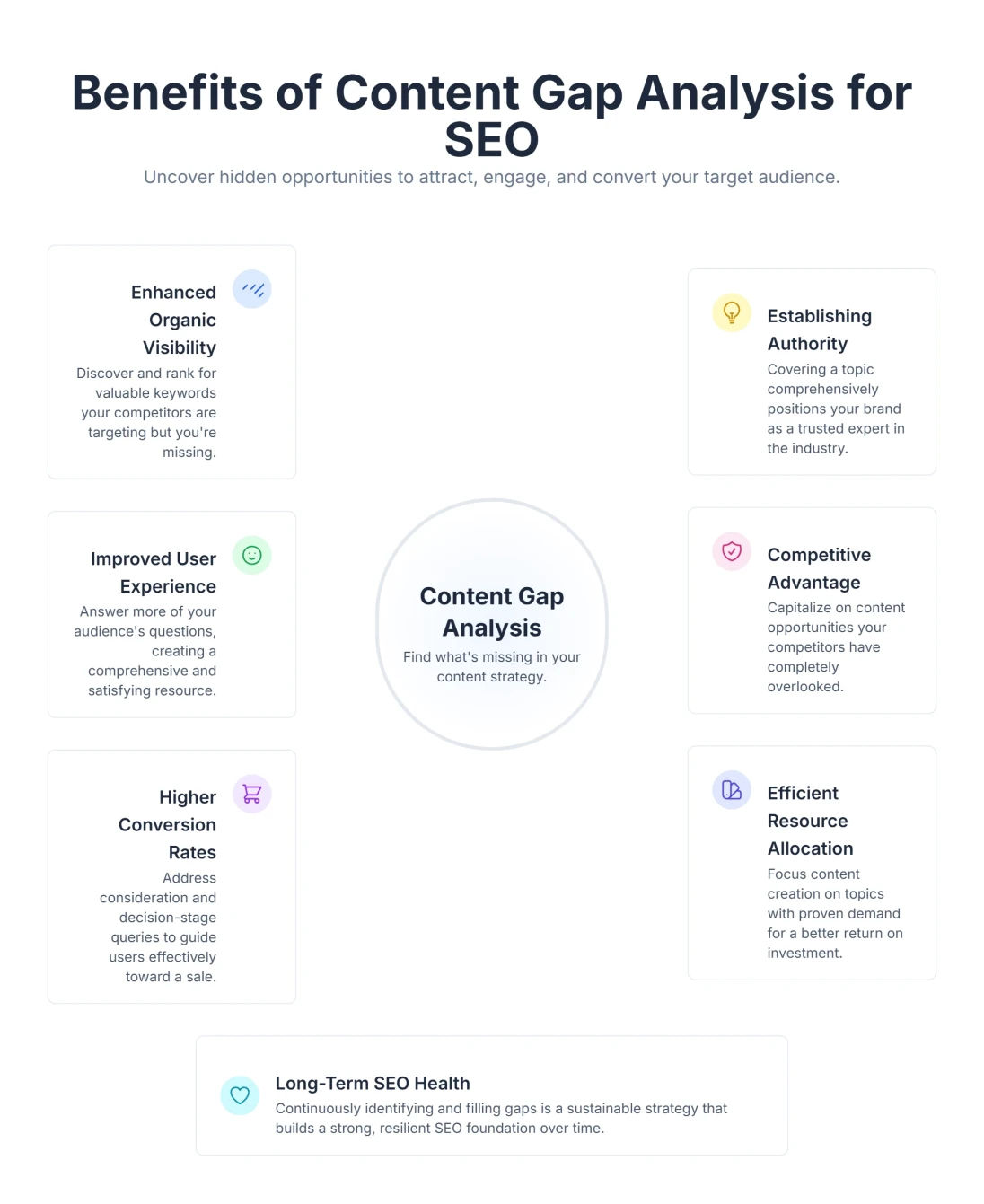
Conducting a thorough Content Gap Analysis offers a multitude of benefits that directly translate into improved SEO performance, stronger audience engagement, and tangible business growth. It is an investment that pays dividends by optimizing your digital footprint.
Here is why addressing your content gaps is crucial for your long-term success:
1. Enhanced Organic Visibility
The most immediate benefit is traffic. By identifying missing keywords and topics, you create new avenues for your website to appear in search results. This expands your reach beyond your core terms. When you cover a topic more comprehensively than your competitors, Google recognizes your site as a valuable node in the information graph. This rewards you not just with rankings for the new keywords, but often lifts the rankings of your existing pages due to increased domain authority.
2. Improved User Experience and Dwell Time
Modern SEO is deeply intertwined with user experience (UX). When users land on your site, they expect a complete solution. If they have to return to Google to find a definition or a related step you missed, that is a negative signal (pogo-sticking) to search engines. CGA helps you anticipate these needs. By providing a "one-stop-shop" experience, you increase time on page and reduce bounce rates, signaling to algorithms that your content satisfies user intent.
3. Higher Conversion Rates
Content is a powerful sales tool, but only if it maps to the right intent. A common mistake is having plenty of "what is" (awareness) content but zero "best X for Y" (consideration) content. By mapping gaps to the buyer's journey, you can create targeted assets that nudge users toward a purchase. For instance, if you identify a gap for a "product comparison" guide, filling it captures users who are ready to buy but haven't decided on a vendor yet.
4. Establishing Authority (E-E-A-T)
Google's E-E-A-T (Experience, Expertise, Authoritativeness, Trustworthiness) framework emphasizes the importance of being a reliable source. You cannot be an authority if you have gaping holes in your content coverage. Consistently providing in-depth, accurate information across a broad range of related topics builds trust. It tells both users and search crawlers that you are the expert in your field. If you're unsure which signals reviewers actually weigh, our primer on what E-E-A-T is in SEO breaks down the experience and trust markers worth auditing alongside your content gaps.
5. Competitive Advantage
Content Gap Analysis is inherently competitive intelligence. It involves dissecting your rivals' strengths to find opportunities they might be missing or under-serving. Perhaps they rank for a topic but their content is outdated, hard to read, or lacks mobile optimization. By strategically filling these gaps with better content, you can "steal" their traffic and position your brand as the superior choice.
6. Efficient Resource Allocation
Without a clear map of your gaps, content teams often waste time creating content based on hunches or "what we feel like writing." This leads to redundancy and low-impact pages. CGA provides a prioritized list of high-value targets. It ensures every hour spent writing is focused on a topic with proven demand and strategic importance, saving significant time and budget.
7. Long-Term SEO Health
SEO is not a sprint; it is a marathon. Regularly performing content gap analysis ensures your strategy remains agile. Search trends change—new technologies emerge, user behaviors shift, and competitors adapt. This iterative refinement process protects your site from becoming obsolete and contributes to sustained organic growth.
For a deeper dive into maintaining high standards across your new content, review our guide on content quality SEO standards.
III. The "How": A Step-by-Step Guide to Performing Content Gap Analysis
Performing a content gap analysis might seem daunting, but by breaking it down into manageable steps, you can systematically uncover opportunities. This workflow moves from high-level strategy to granular execution.
Step 1: Define Your Target Audience and Business Goals
Before opening any tool, you need to recalibrate your understanding of who you are serving.
- Refine Your Personas: Go beyond "Marketing Manager, aged 30-45." What are their specific daily struggles? Do they prefer video tutorials or whitepapers? Knowing this helps you identify format gaps, not just keyword gaps.
- Clarify Business Goals: Are you trying to drive awareness for a new product feature, or are you trying to reduce customer support tickets?
- Goal: Lead Gen. Focus on gaps in "comparison" and "best of" keywords.
- Goal: Brand Awareness. Focus on gaps in high-volume informational queries.
- Goal: Support Reduction. Focus on gaps in "how-to" and troubleshooting content.
Step 2: Inventory Your Existing Content
To find what is missing, you must know what you have. This involves a comprehensive audit.
- Map Your URL Structure: Crawl your site to get a complete list of indexable URLs.
- Analyze Performance Metrics: Use Google Search Console (GSC) and Google Analytics (GA4) to see which pages are delivering. Look for pages with high impressions but low clicks (bad CTR could indicate a content gap in the meta data or title). Look for high bounce rates (content might not match intent).
- Pro Tip: Group your content by topic clusters. If you see you have 50 articles on "SEO basics" but only 2 on "Technical SEO," you have effectively identified a topical gap without even looking at a competitor. This grouping exercise also surfaces the opposite problem—several pages competing for the same term. If you spot overlap, resolve it using our guide on how to fix keyword cannibalization before writing anything new, since consolidating existing pages is often the faster win.
- How Digispot AI Helps: Manually mapping URLs is tedious. Digispot AI integrates directly with GSC and GA4, providing a unified dashboard to review existing content performance. It automatically flags underperforming pages, saving you hours of spreadsheet work.
Step 3: Identify Your Competitors (Direct & Indirect)
Your content gaps often live where your competitors are thriving. You need to look at two types of competitors:
- Direct Business Competitors: These sell the same product as you. (e.g., If you sell CRM software, HubSpot is a direct competitor).
- SERP Competitors: These are sites that rank for your target keywords but don't sell your product. (e.g., TechCrunch, Wikipedia, or industry blogs).
- Action: Choose 2-3 direct competitors and 1-2 SERP competitors. If you only look at business rivals, you might miss the high-traffic informational queries that publishers dominate.
To pick the right names, don't rely on gut feel about who your rivals are. Search your 10-15 most important target keywords and note which domains appear repeatedly across the first page—those are your true SERP competitors, even if you'd never consider them business rivals. Our guide on how to analyze competitor SEO walks through vetting each candidate so you compare against sites you can realistically outrank rather than authority giants like Wikipedia that will skew your gap list.
Step 4: Conduct In-Depth Keyword Research and User Intent Analysis
This step is about unearthing the terms your audience uses.
- Expand Beyond Head Terms: Don't just look for "running shoes." Look for "best running shoes for flat feet" or "how long do running shoes last." These long-tail variations often represent specific user needs that generic content misses, and they usually convert better because the searcher's need is more precise. Our guide on targeting long-tail keywords explains how to cluster these variations so one comprehensive page can rank for dozens of related queries.
- Analyze User Intent: For every keyword, determine the "why."
- Informational: "What is..." (Gap: Blog posts, glossaries)
- Navigational: "Login page" (Gap: Site structure issues)
- Commercial: "Best tool for..." (Gap: Comparison pages, reviews)
- Transactional: "Buy..." (Gap: Product pages, pricing info)
A common mistake is trying to rank a product page for an informational query. If the SERP is full of "How-to" guides, a sales page will never rank. That is a Content Type Gap. When in doubt, let the current SERP dictate the format—see our breakdown of how to optimize for search intent to read those signals correctly before you brief a single word.
Step 5: Map Content to the Buyer Journey
The buyer's journey is the path a user takes from realizing they have a problem to buying your solution. Your content ecosystem must support every step.
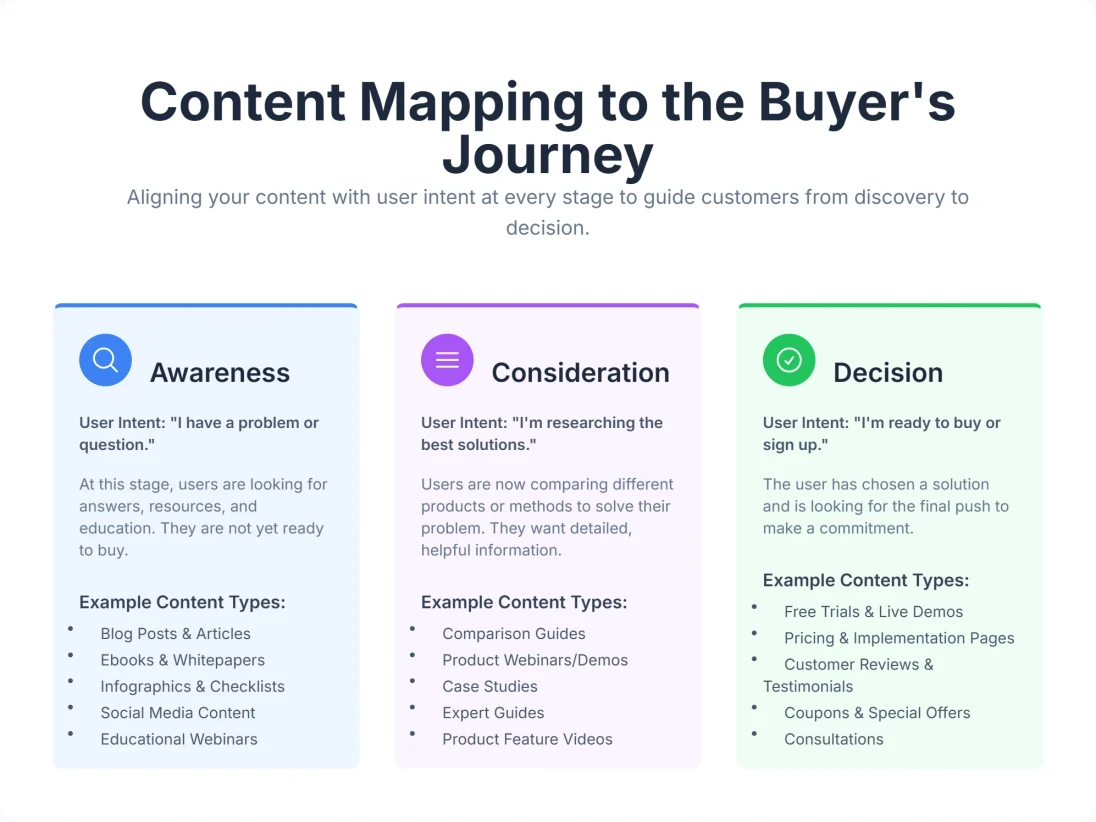
Table: Buyer Journey Stages and Corresponding Content Types
| Buyer Journey Stage | User Intent | Content Examples |
|---|---|---|
| Awareness | "What is...?" "How does...?" "Why...?" | Blog posts, educational articles, guides, infographics, videos, definitional content |
| Consideration | "Best...?" "Comparison of..." "Pros and Cons..." | Comparison articles, whitepapers, expert guides, webinars, solution-focused content, reviews |
| Decision | "Pricing" "Demo" "Buy" "Review" | Case studies, testimonials, product pages, pricing pages, free trials, demo requests |
Analysis Tip: Tag your existing content by stage. If 90% of your content is Awareness, you have a massive gap in Consideration and Decision content. You are attracting traffic but failing to convert it.
Step 6: Compare Your Content Against Competitors and User Intent
This is the core analysis phase. You are looking for specific disparities.
- The "Keyword Gap" View: Use a tool to see a Venn diagram of keywords.
- Circle A (Competitor): Ranks for "AI content writing tools".
- Circle B (You): Do not rank.
- Opportunity: Create a page about "AI content writing tools."
- The "Content Quality" View: Visit the competitor's page.
- Word Count: Is their guide 3,000 words while yours is 500? (Depth Gap)
- Visuals: Do they use custom diagrams and video walkthroughs? (Format Gap)
- Freshness: Was their article updated last week while yours is from 2021? (Recency Gap)
- Structure: Do they use FAQ schema and a Table of Contents? (Technical Gap)
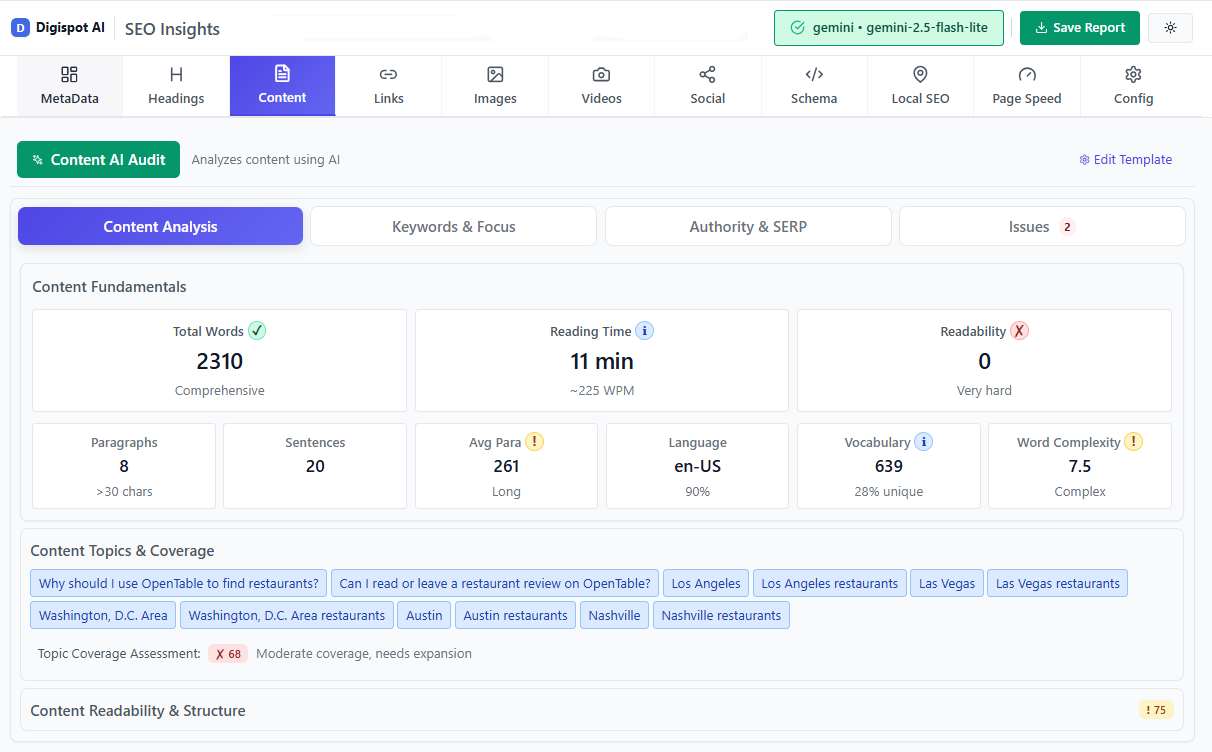
How Digispot AI Helps: Instead of manually checking 50 competitors, Digispot AI's "Opportunity Finder" automates this. It analyzes your site against rivals across hundreds of ranking factors, instantly highlighting not just keyword gaps, but quality gaps. It might tell you, "Competitors ranking for this term typically have 12 images and a video; you have 0."
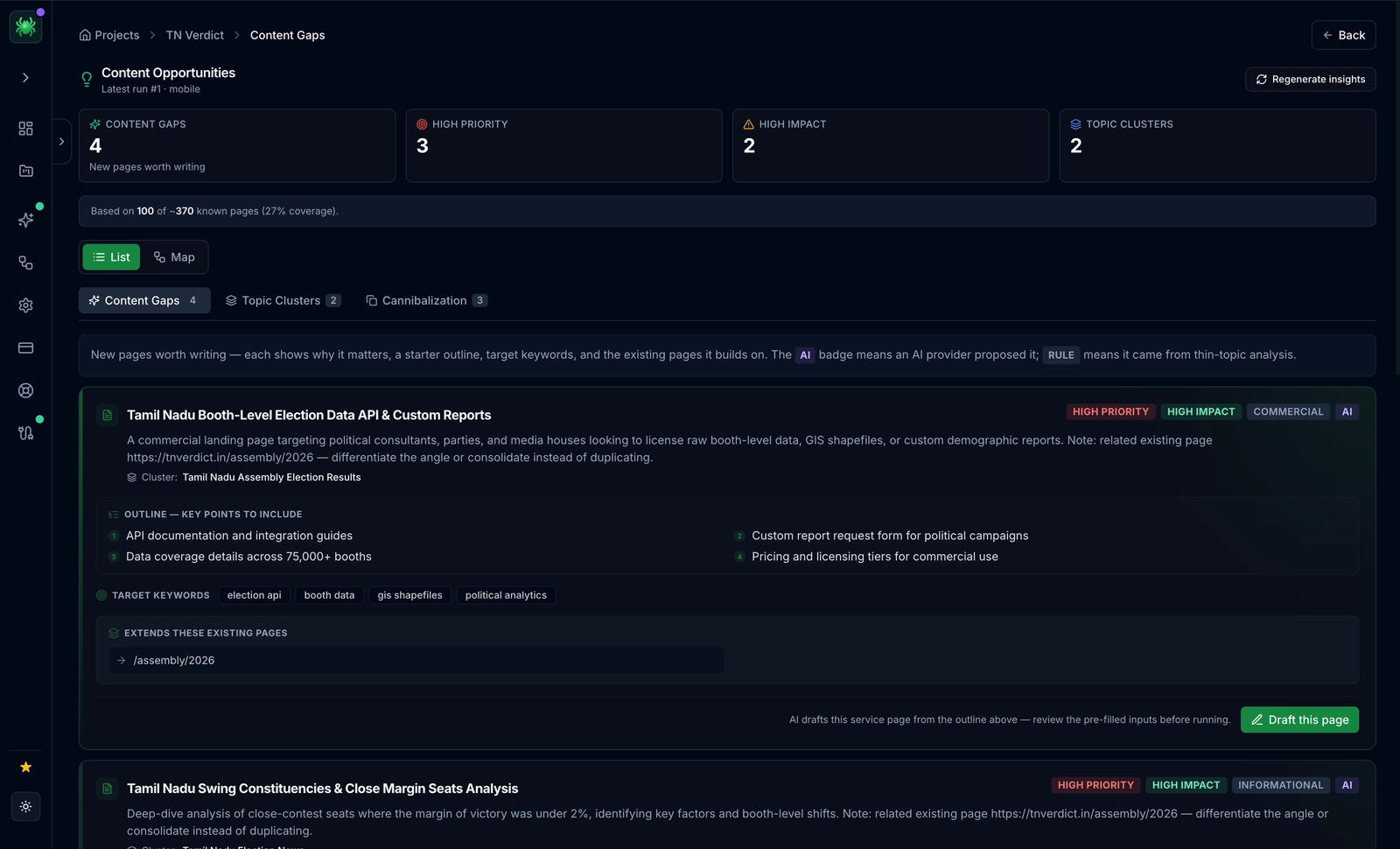
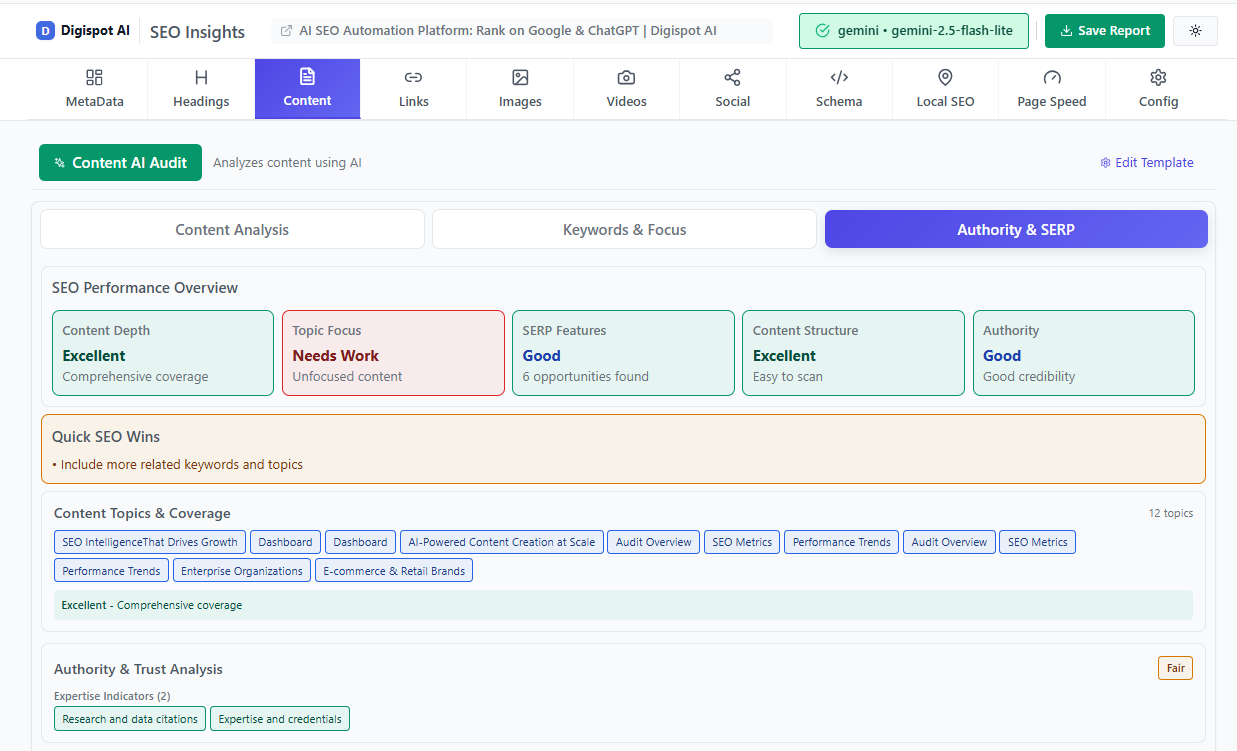
Turn invisible SEO data into clear visuals with our Free Chrome extension.
Step 7: Prioritize Content Gaps
You cannot fill every gap at once. Prioritization ensures ROI.
- The Impact/Effort Matrix:
- Quadrant 1: High Impact, Low Effort (Quick Wins). Example: Updating an existing post with a missing paragraph or adding a schema markup. Do this first.
- Quadrant 2: High Impact, High Effort (Strategic Projects). Example: Creating a new "Ultimate Guide" or a free tool. Schedule these for the next quarter.
- Quadrant 3: Low Impact, Low Effort (Fillers). Example: Short definitions. Delegate these if resources allow.
- Quadrant 4: Low Impact, High Effort (Distractions). Ignore these.
Prioritize keywords with decent search volume but low keyword difficulty (KD) first. These give you momentum.
Step 8: Develop a Content Plan to Fill the Gaps
Turn your list into an editorial calendar.
- Brief Creation: Don't just say "write about X." Create a detailed brief including target word count, primary/secondary keywords, required headings, and internal linking targets.
- Format Selection: Decide if this gap is best filled by a blog, a video, a tool, or a downloadable PDF.
- Internal Linking Strategy: Plan where you will link from to give this new page authority. Check out our guide on internal linking strategies to maximize this effect.
- How Digispot AI Helps: Digispot AI's "Content Studio" uses advanced AI agents to generate SEO-optimized content drafts based on your identified gaps. It ensures the new content is structured correctly, includes relevant entities, and meets the depth requirements to rank.
Step 9: Implement, Monitor, and Refine
Publishing is just the beginning.
- Optimize On-Page: Ensure titles, meta descriptions, and alt tags are perfect.
- Technical Check: Ensure the new page loads fast and is mobile-friendly. You can verify this instantly with our free On-Page SEO Analysis tool.
- Monitor: Watch GSC for impressions. It usually takes 3-6 months to see full impact, but leading indicators like impressions should rise sooner.
- Iterate: If a page doesn't rank after 3 months, re-audit it. Did you miss a sub-topic? Is the intent wrong? Refine and republish.
IV. Advanced Considerations and How Technology Empowers CGA
The landscape of search is constantly evolving. A basic keyword gap analysis is no longer enough. To truly excel, your strategy must incorporate advanced technical and AI considerations.
The Role of AI in Search Engines (AEO)
AI search engines (like SearchGPT or Google's Gemini) don't just match keywords; they "read" for understanding. They look for consensus and comprehensiveness.
- Contextual Gaps: An AI might notice that while you define "SEO," you don't explain "how SEO impacts revenue." A competitor who connects these dots will be favored in AI summaries.
- Entity Coverage: AI thinks in "entities" (concepts), not just strings of text. If you write about "Tesla," you must also mention "Elon Musk," "EVs," "Superchargers," etc. Missing these related entities creates a semantic gap. To understand how to optimize for this, read our article on AI content SEO.
Understanding Schema Markup
Schema markup is the language you use to explain your content to search engines.
- The Hidden Gap: Often, you and a competitor have similar content, but they have "Review" schema implemented, giving them star ratings in search results. Their CTR is double yours. This is a technical gap.
- Action: Implement schema for Articles, FAQs, Products, and Breadcrumbs.
- CTA: Use the free Schema Markup Generator to create valid structured data in minutes without writing code.
Technical SEO and Page Performance
A content gap analysis often reveals that your content exists, but it is invisible due to technical debt.
- Crawlability: If Google can't find your page because of poor internal linking or
noindextags, that is an "accessibility gap." - Core Web Vitals: If your page takes 5 seconds to load and your competitor's takes 1 second, Google may rank them higher even if your content is slightly better. Speed is a tie-breaker. Learn more about optimizing for Core Web Vitals.
- How Digispot AI Helps: The platform audits your site in both mobile and desktop modes. It identifies performance bottlenecks like slow server response times or unoptimized images that could be undermining your content efforts.
Local SEO Gaps
For businesses with a physical presence, "near me" searches are the battleground.
- Local Intent: Are you missing pages for specific service areas? If you serve "New York" but only have a generic "USA" page, you have a massive local content gap.
- GMB Optimization: Your Google Business Profile is a piece of content. Is it as complete as your competitor's? Do they have more photos or Q&A filled out? Compare category selection, service listings, hours, and the volume and recency of reviews—each of these is a mini content gap that influences local pack visibility.
- Solution: Create location-specific landing pages that feature local keywords, local testimonials, and embedded maps. Avoid the common mistake of spinning up near-identical pages for every city with only the place name swapped—search engines treat that as thin, duplicative content. Instead, differentiate each page with genuinely local detail: neighborhood or service-area references, staff or projects tied to that location, local FAQs, and directions or parking notes. Keep your name, address, and phone number identical across every page and directory, since inconsistent citations quietly undermine local rankings.
These advanced considerations highlight that Content Gap Analysis is a holistic strategy. It embraces technical excellence and an understanding of how modern algorithms interpret value.
V. Your Ally in Content Gap Analysis: The Digispot AI Edge
Successfully identifying and filling content gaps can be a complex endeavor involving massive datasets and hours of manual checking. When you aim for a comprehensive strategy that covers over 200 ranking factors—from content quality and schema to technical SEO and page performance—you need automation.
This is where Digispot AI transforms the process. We designed our platform to act as an extension of your SEO team, simplifying the intricate aspects of ranking on Google and AI platforms.
How Digispot AI Accelerates Your Content Gap Strategy:
- Proactive Opportunity Finder: Most tools ask you to input competitors manually. Digispot AI's "Opportunity Finder" does the heavy lifting for you. It scans your niche to identify where rivals are outranking you, highlighting specific keyword and topic gaps that represent high-potential revenue. It prioritizes these opportunities based on difficulty and potential traffic, giving you a ready-made roadmap.
- Comprehensive Website Auditing: A content gap is often exacerbated by technical flaws. Digispot AI audits your website in dual modes—mobile and desktop. It uncovers the "invisible" gaps: slow loading speeds, broken links, or mobile usability issues that prevent your content from ranking. This ensures that when you do write new content, it has a solid technical foundation to stand on.
- Seamless Integration for Performance Tracking: By integrating directly with Google Search Console and Google Analytics, Digispot AI removes data silos. You can track the impact of your gap-filling efforts in real-time. Did that new blog post regarding "enterprise SEO" improve your impressions? You will know immediately without switching tabs.
- AI-Powered Content Studio: Identifying a gap is step one; filling it is step two. Our "Content Studio" uses advanced AI agents to assist in generating content. But unlike generic AI writers, ours is built on SEO logic. It ensures your new content addresses the identified gaps effectively, covers required entities, and is optimized for over 200 ranking factors from day one.
- Holistic Ranking Factor Analysis: We don't just look at keywords. We analyze content quality, technical SEO architecture, local SEO relevance, and page performance. This holistic view prevents the tunnel vision that often leads to failed SEO campaigns.
- Free Community Chrome Extension: For quick, on-the-go insights, use our free Chrome extension. It allows you to audit any web page directly in your browser. You can instantly peek at a competitor's header structure, meta data, and schema markup while browsing their site. It is the perfect tool for the "research" phase of your gap analysis.
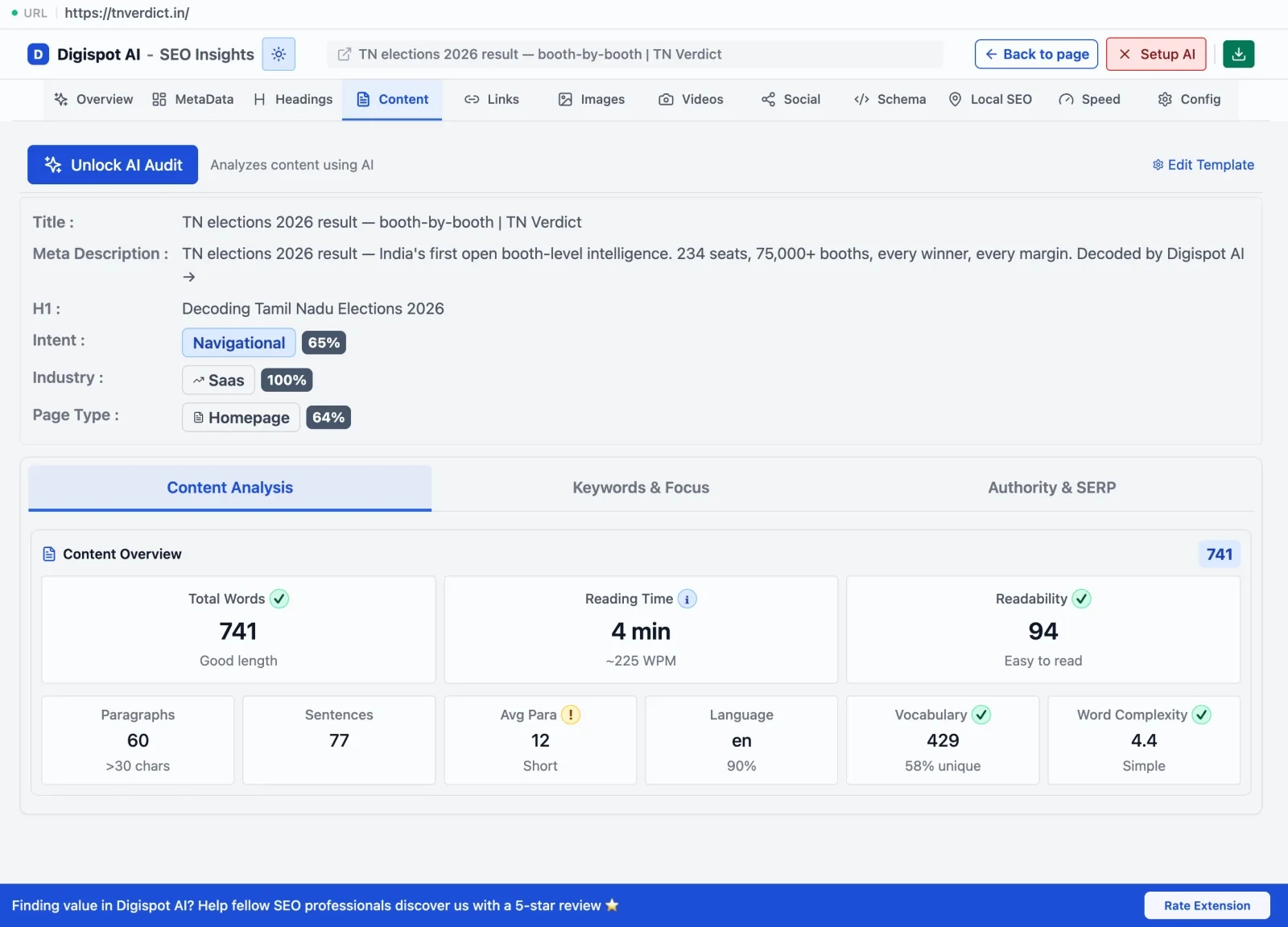
Digispot AI helps you move from "guessing" to "knowing," automating the tedious parts of SEO so you can focus on strategy and creativity.
VI. Conclusion: Bridging for Success
Content Gap Analysis is not merely an SEO tactic; it is the backbone of a user-centric digital strategy. In a world where information is abundant, the winners are those who provide the most complete, accessible, and relevant answers. By systematically identifying the missing pieces in your content library, you do more than just improve rankings—you build a resilient brand that users trust.
This process of discovery and refinement allows you to:
- Capture traffic you are currently handing to competitors.
- Serve your audience at every stage of their buying journey.
- Future-proof your site against AI search evolution and algorithm updates.
Don't let valuable opportunities slip through the cracks. Start your audit today. Look at your competitors, listen to your audience, and use the data to build a bridge between what users want and what you provide.
Ready to improve your search visibility? Stop manual guessing. Try Digispot AI today for comprehensive website audits, automated opportunity detection, and actionable recommendations that drive real growth.
Related deep-dives
Continue with these closely related guides:
- saas seo- blueprint — SaaS SEO-A Blueprint for Sustainable Growth
- keyword search volume — Keyword Search Volume: Target the Right SEO Terms
References
- Google Search Console
- Google Analytics
- Understand user intent to better serve searchers | Google Search Central
- Understand E-E-A-T in Google Search | Google Search Central
- Schema.org - Schema.org
- Introduce structured data to Google Search | Google Search Central
- Core Web Vitals | Google Search Central
- Mobile-first indexing (MFI) | Google Search Central
- Local SEO for businesses with a physical location | Google Search Central
- Digispot AI Platform
- Digispot AI - FREE On Page SEO Audit Tool
- Digispot AI - FREE Chrome Extension for SEO Insights
Audit any page in seconds
300+ SEO checks including Core Web Vitals, schema markup, meta tags, and AI readiness — trusted by 1000+ SEO experts and marketers.
Frequently Asked Questions
Here are some of our most commonly asked questions. If you need more help, feel free to reach out to us.
Written by
Maya Krishnan
Digital growth expert
Maya is a seasoned expert in web development, SEO, and digital strategy, dedicated to helping businesses achieve sustainable growth online. With a blend of technical expertise and strategic insight, she specializes in creating optimized web solutions, enhancing user experiences, and driving data-driven results. A trusted voice in the industry, Maya simplifies complex digital concepts through her writing, empowering readers with actionable strategies to thrive in the ever-evolving digital landscape.