
The Power of User-Generated Content (UGC) for SEO
Leverage user-generated content for SEO success. Build community, earn authentic reviews, and scale content production through customer contributions.
 Maya Krishnan
Marketing has a trust problem. Consumers have grown skeptical of polished ad copy and corporate messaging. Instead, they turn to a source they trust implicitly: other humans. This shift has elevated User-Generated Content (UGC) from a nice-to-have social tactic to a critical pillar of organic search performance.
From detailed product reviews and unboxing videos to forum discussions and Q&A threads, UGC acts as the digital equivalent of word-of-mouth recommendations. But its value extends far beyond social proof. For SEO professionals, UGC is a scalable engine for content production, keyword expansion, and relevance signaling that search engines like Google prioritize.
By strategically harnessing the content your customers create, you fuel your SEO efforts with a constant stream of fresh, authoritative material. This guide explores the mechanical relationship between UGC and search algorithms, explaining how to optimize this user-driven asset to dominate search rankings.
Defining User-Generated Content (UGC) in SEO Terms
User-Generated Content refers to any content—text, images, videos, audio—created and published by unpaid contributors rather than the brand itself. These contributors are customers, fans, or community members who share their experiences and opinions.
Common forms include:
- Product Reviews: Text and star ratings on e-commerce pages.
- Visual Content: Instagram photos or TikTok videos featuring your product.
- Video Tutorials: Unboxing or "how-to" videos on YouTube.
- Forum Discussions: Threads on Reddit or proprietary community boards.
- Q&A Sections: Customer questions answered by the brand or other users.
From a technical SEO perspective, UGC represents "unique content." It differentiates your pages from competitors who might be using the same manufacturer descriptions. It adds depth, context, and semantic richness that search bots crawl and index to understand the true value of your offering.
Why UGC Supercharges Search Performance
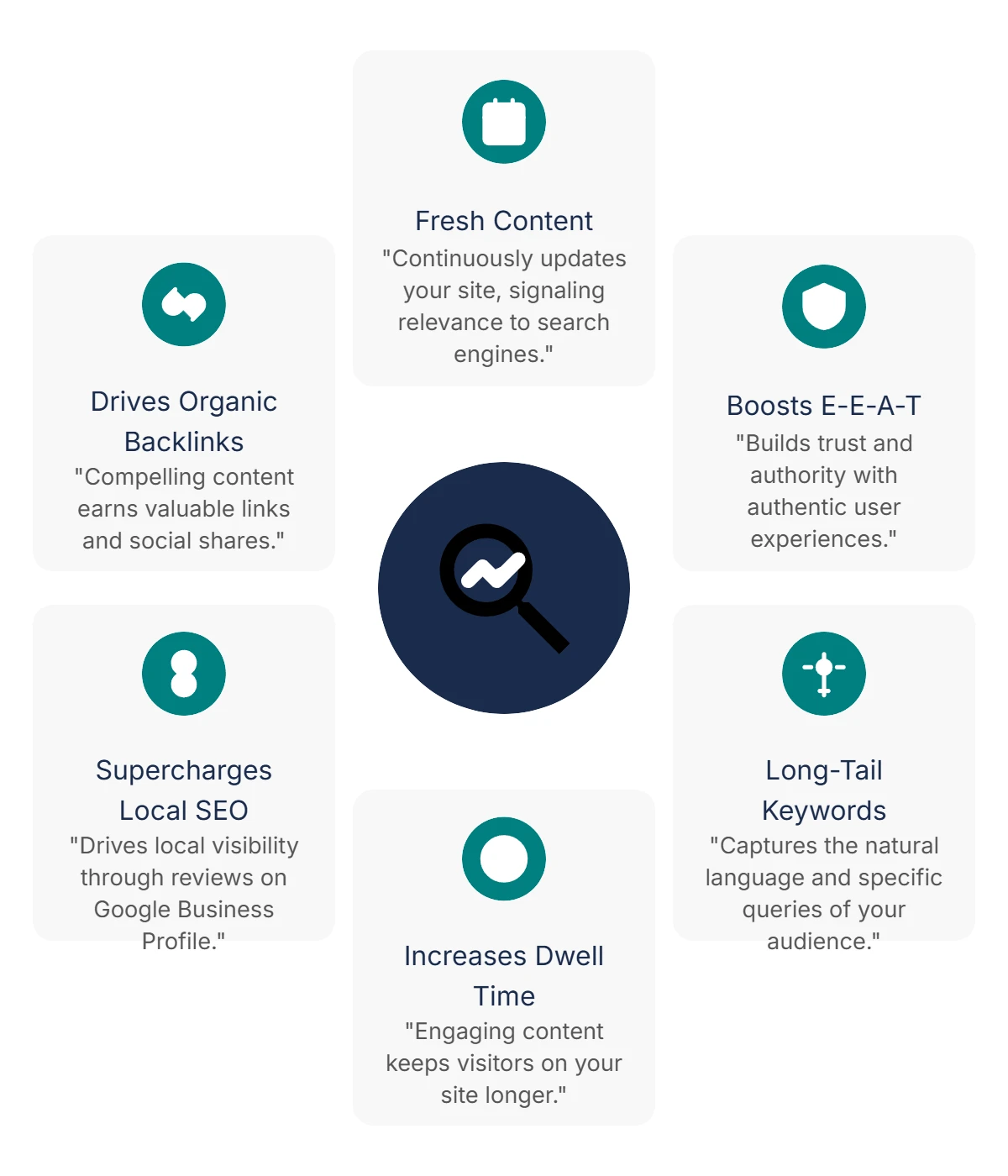
Integrating UGC isn't just about conversion rates; it directly impacts ranking factors. Search engines reward websites that demonstrate expertise and helpfulness. UGC provides this at scale.
Here is why search algorithms favor pages rich in user content:
1. Solves the Content Freshness Challenge
Search engines operate on a "Query Deserves Freshness" (QDF) model for many topics. They favor sites that are frequently updated. Maintaining a static product page or service description can lead to "stale" signals over time.
UGC solves this automatically. Every new review, comment, or question updates the page's content. This prompts search bots to crawl your site more frequently, increasing the likelihood of ranking changes and indexation of new keywords.
2. Validates E-E-A-T Signals
Google's E-E-A-T guidelines (Experience, Expertise, Authoritativeness, and Trustworthiness) place a heavy premium on "Experience." Who has more experience with a product than the person who uses it daily?
- Experience: A review detailing how a hiking boot performed in rainy conditions demonstrates first-hand experience.
- Trust: A mix of positive and constructive negative reviews signals authenticity. A 5.0 rating with no text looks suspicious; a 4.7 with detailed feedback looks real.
- Expertise: In technical niches, user answers in forums often display deep subject matter expertise, signaling to Google that your domain is a hub of knowledge.
3. Unlocks Long-Tail Keyword Opportunities
Your marketing team writes in "brand voice." Your customers write in "natural language." There is often a gap between the two.
You might optimize for "ergonomic office chair," but a user might write, "best chair for lower back pain after sitting all day." That review just optimized your page for a highly specific, high-intent long-tail keyword. By analyzing UGC, you can discover hundreds of semantic variations and phrasing nuances you never would have guessed, expanding your keyword footprint significantly.
4. Increases Dwell Time and Engagement
Engagement metrics (often correlated with Core Web Vitals and user signals) matter. When visitors spend time reading reviews, browsing customer photo galleries, or watching video testimonials, their "time on page" increases.
This high dwell time signals to search engines that the result was helpful and relevant. Conversely, if users bounce immediately because they don't see social proof, your rankings can suffer. To ensure these rich media elements don't slow down your site, consult our Core Web Vitals SEO guide for optimization tips.
5. Dominates Local SEO
For brick-and-mortar businesses, reviews are the lifeblood of local visibility. The volume, frequency, and sentiment of reviews on your Google Business Profile are primary ranking factors for the Local Pack (the map results). A steady stream of fresh reviews signals to Google that your business is active, popular, and relevant to the local area.
6. Earns Organic Backlinks
High-quality UGC can become a link magnet. A viral customer video, an in-depth user case study, or a vibrant forum discussion can attract links from other blogs and media outlets. These natural backlinks are the strongest authority signals you can send to Google.
High-Impact UGC Types for Ranking Success
Not all user content carries the same SEO weight. Prioritize these formats to maximize organic visibility.
| Type of UGC | Primary SEO Benefit(s) | Optimization Strategy |
|---|---|---|
| Customer Reviews & Ratings | Freshness, Long-Tail Keywords, CTR (Rich Snippets) | Implement Review and AggregateRating schema to display stars in SERPs. |
| Q&A Sections | Zero-Click Searches, PAA (People Also Ask) Targeting | Mark up with FAQPage schema. Address common "how-to" and "compatibility" questions. |
| User Visuals (Images/Video) | Engagement, Image Search Traffic, Bounce Rate Reduction | Lazy-load assets to protect page speed. Add alt text describing the user context (e.g., "Customer wearing blue jacket size M"). |
| Community Forums | Topical Authority, Keyword Depth, User Retention | Create clear categories. Ensure threads are crawlable HTML, not hidden behind logins. |
| Testimonials & Case Studies | Trust Signals, Conversion Rate, Link Building | Dedicate landing pages to deep-dive stories. Optimize headers for "Company Name Review" queries. |
Building a Winning UGC SEO Strategy
Success requires more than just hoping users will post. You need a systematic approach to collection, moderation, and technical optimization.
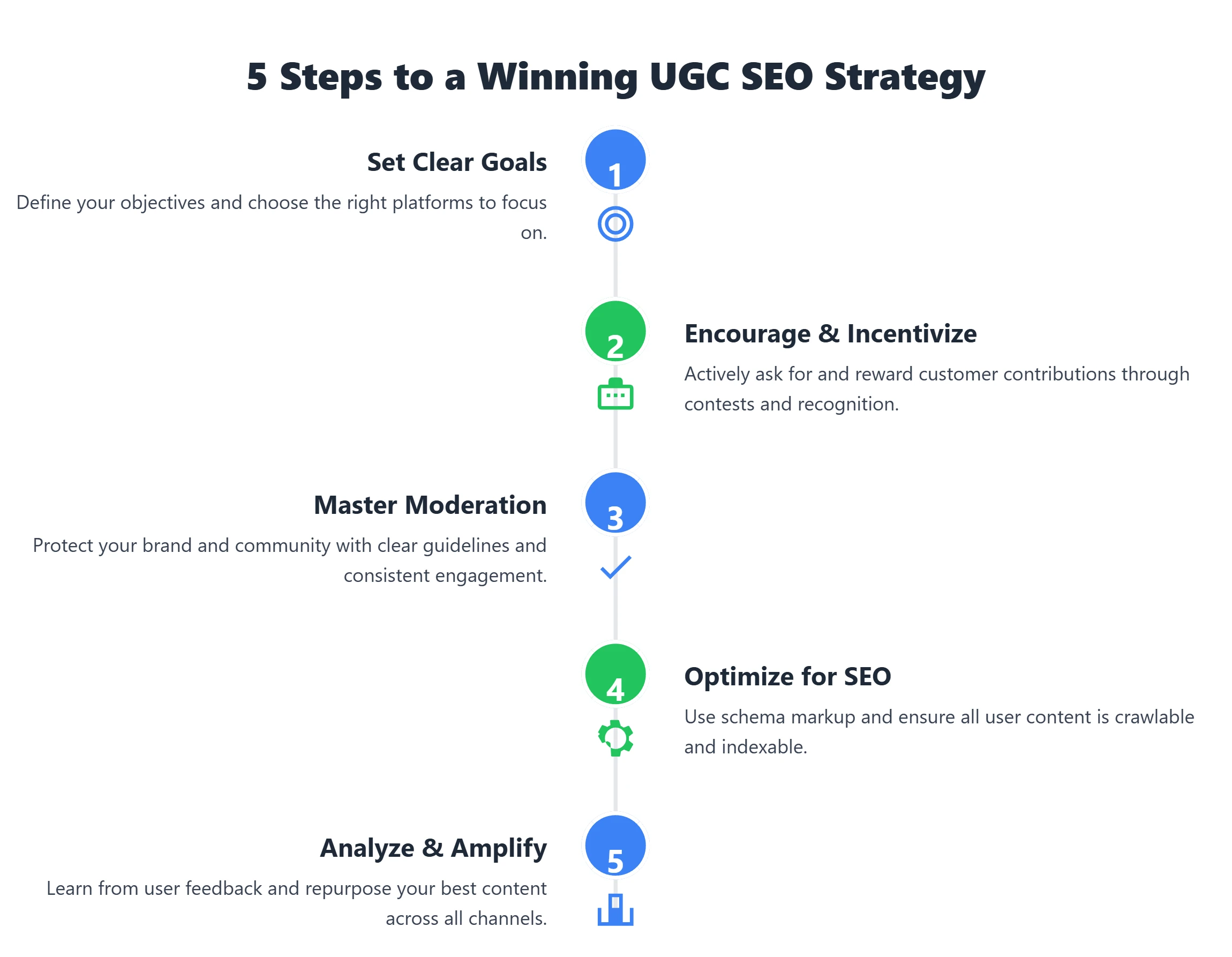
Step 1: Define Goals and Select Platforms
Determine where UGC will live and what purpose it serves.
- E-commerce: Focus on product page reviews to boost conversion and long-tail ranking. See our e-commerce SEO guide for placement strategies.
- SaaS/Service: Prioritize third-party platforms (G2, Capterra) for authority, and detailed case studies for your site.
- Local Biz: Focus 80% of effort on Google Maps/Business Profile reviews.
Step 2: Actively Engineer Contributions
Friction is the enemy of UGC. Make it effortless for customers to contribute.
- Automated Email Flows: Trigger a review request email 7-14 days after product delivery. Timing is key—ask when excitement is highest.
- Incentivize (Carefully): Offer loyalty points or small discounts for leaving a review. Note: Never buy reviews or incentivize only positive ones; this violates FTC guidelines and platform policies.
- Hashtag Campaigns: Create a branded hashtag (e.g., #MyBrandStyle) to aggregate social content. Use tools to pull this feed onto your site.
- Gamification: Introduce "Top Contributor" badges or leaderboards for forum participants to encourage frequent engagement.
Step 3: Implement Intelligent Moderation
Unmoderated UGC is a liability. Spam, profanity, or irrelevant links can hurt your SEO and brand reputation.
- Guidelines: Publish clear community standards.
- Hybrid Moderation: Use AI tools to filter obvious spam/toxicity instantly, then have humans review the flagged items.
- Reply Strategy: Respond to negative reviews. This adds more unique content to the page and shows search engines (and users) that the business is responsive. Avoid generic copy-paste responses.
- PII Protection: Automatically redact phone numbers, addresses, or email addresses to protect user privacy.
Step 4: Technical Optimization (The "SEO" in UGC)
This is where many brands fail. If Google can't read your UGC, it doesn't count.
- Schema Markup is Mandatory: You must wrap reviews in structured data. This allows Google to show "Rich Snippets" (star ratings, price, availability) in search results. Rich snippets can increase Click-Through Rate (CTR) by up to 30%.
- Action: Use the free Schema Markup Generator to create valid JSON-LD code for your reviews.
- Server-Side vs. Client-Side: Ensure your reviews are rendered in the HTML (Server-Side Rendering). If reviews are loaded via JavaScript (Client-Side Rendering) after the page loads, Googlebot might see them, but it's less reliable.
- Check: View the "Page Source" (Ctrl+U) of your product page. Search for a review text. If it's not there, it's hidden in JS, and you may have an indexing issue.
- Pagination: If you have 500 reviews, don't load them all on one page (slow load time). Don't hide them in an infinite scroll that bots can't trigger. Use SEO-friendly pagination (e.g.,
?page=2) withrel="next"andrel="prev"tags. - Crawlability: Ensure UGC widgets aren't using iframes that block search engine access.
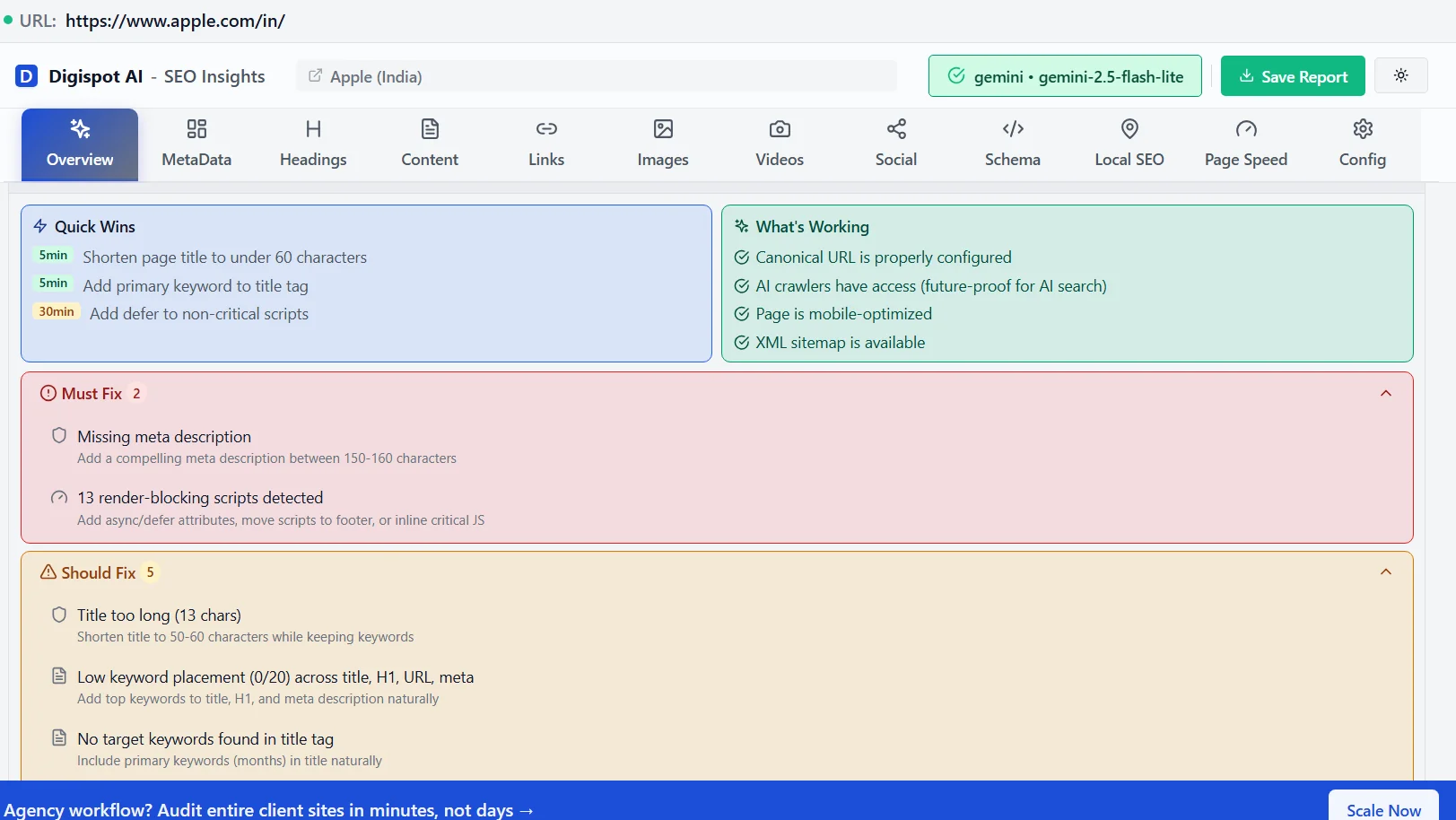
Pro Tip: Not sure if your schema is working? Get instant SEO insights on any page with our free Chrome extension.
Step 5: Analyze and Iterate
Treat UGC as a dataset, not just content.
- Sentiment Analysis: Use tools to detect rising negative sentiment around specific features (e.g., "zipper breaks"). This is product intelligence.
- Keyword Mining: Identify phrases that appear frequently in reviews but aren't in your main description. Add these to your H2s, H3s, or meta descriptions.
- Gap Analysis: If users keep asking the same question in Q&A, write a dedicated blog post or add it to the main FAQ. Digispot AI can help you automate this analysis, scanning thousands of pages to identify content gaps and optimization opportunities based on actual user data.
Navigating Legal and Ethical Boundaries
While UGC is powerful, it carries legal weight. Ignorance of copyright law is not a valid defense.
- Implicit vs. Explicit Consent: Reposting an Instagram photo to your website usually requires explicit permission, even if you were tagged. Send a DM asking, "Love this shot! Can we feature it on our site?"
- Rights Management: For high-value assets (like video testimonials used in ads), have the user sign a simple digital release form.
- DMCA Compliance: If you host a forum or allow unmoderated uploads, you must have a registered DMCA agent and a clear takedown policy to protect yourself from liability for what users post.
- Transparency: If you use sponsored influencers, ensure they disclose the partnership (e.g., #ad, #sponsored) to comply with FTC regulations.
Start Leveraging Your Community Today
User-generated content is the bridge between technical SEO and authentic brand building. It satisfies the search algorithms' hunger for fresh, relevant, authoritative content while giving potential customers the social proof they need to convert.
Don't let this valuable asset go to waste. Audit your current site to ensure reviews are indexable, implement the correct schema markup, and start actively encouraging your community to share their stories.
Ready to see how your current UGC strategy is impacting your SEO? Try the free On-Page SEO Analysis tool to audit any URL instantly, or use Digispot AI for a comprehensive site-level audit that identifies missing schema, thin content, and opportunities to better leverage your user's voice.
References
- Google Search Central - Creating helpful, reliable, people-first content
- BrightLocal - Local Consumer Review Survey
- Google Business Profile Help - How to improve your local ranking on Google
- World Wide Web Consortium (W3C) - Tips for Safe UGC
- Google Search Central - Review snippet structured data
- Digispot AI - FREE Schema Markup Generator
- Digispot AI - FREE Schema Markup Visualizer
- Digispot AI - FREE On Page SEO Audit Tool
- Digispot AI - FREE Chrome Extension for SEO Insights
- U.S. Copyright Office - More Information on Fair Use
- U.S. Copyright Office - The Digital Millennium Copyright Act (DMCA)
- Federal Trade Commission - Endorsements, Testimonials, and Reviews
Audit any page in seconds
300+ SEO checks including Core Web Vitals, schema markup, meta tags, and AI readiness — trusted by 1000+ SEO experts and marketers.
Frequently Asked Questions
Here are some of our most commonly asked questions. If you need more help, feel free to reach out to us.
Written by
Maya Krishnan
Digital growth expert
Maya is a seasoned expert in web development, SEO, and digital strategy, dedicated to helping businesses achieve sustainable growth online. With a blend of technical expertise and strategic insight, she specializes in creating optimized web solutions, enhancing user experiences, and driving data-driven results. A trusted voice in the industry, Maya simplifies complex digital concepts through her writing, empowering readers with actionable strategies to thrive in the ever-evolving digital landscape.