Digital Marketing Channels: SEO, PPC & Strategy Guide
Explore digital marketing channels including SEO, PPC, and social media. Learn how each drives results for your strategy.
 Maya Krishnan
Your customers are online right now, searching for solutions you provide. But are they finding you, or your competitors?
Navigating the digital landscape is no longer optional—it is the primary battlefield for business growth. From the first informational search on Google or Perplexity to the final purchase click, specific channels influence every step of the consumer journey. The challenge isn't finding a channel; it's selecting the right mix to maximize your return on investment (ROI) without burning through your budget.
This guide breaks down the fundamental digital marketing channels, explains the mechanics behind why they work, and provides a strategic framework for harnessing their power to achieve specific business objectives.
Key Takeaways
- No single channel wins alone. SEO, PPC, social, content, and email work as interconnected gears—content feeds search, search feeds email, and paid data sharpens your organic strategy.
- Start with a "Core 2," then scale. Pick one channel for demand generation and one for retention, prove the ROI, and expand only into channels you can realistically sustain.
- Match channels to intent and goals. Use PPC and paid social when you need sales now; invest in SEO and content when you want lower acquisition costs that compound over time.
- Measure outcomes, not vanity metrics. Track CAC, ROAS, organic traffic value, and conversions—a million views mean nothing if they never turn into revenue.
- Build for AI search, not just Google. Solid technical SEO and structured data prepare your content to be cited across AI answer engines like ChatGPT, Perplexity, and Google AI Overviews.
What is Digital Marketing, and Why Does it Matter?
Digital marketing refers to any marketing effort that utilizes an electronic device or the internet. It shifts the focus from traditional "interruption" marketing (like billboards or cold calls) to "intent-based" marketing, where you connect with prospective customers precisely when they are looking for you.
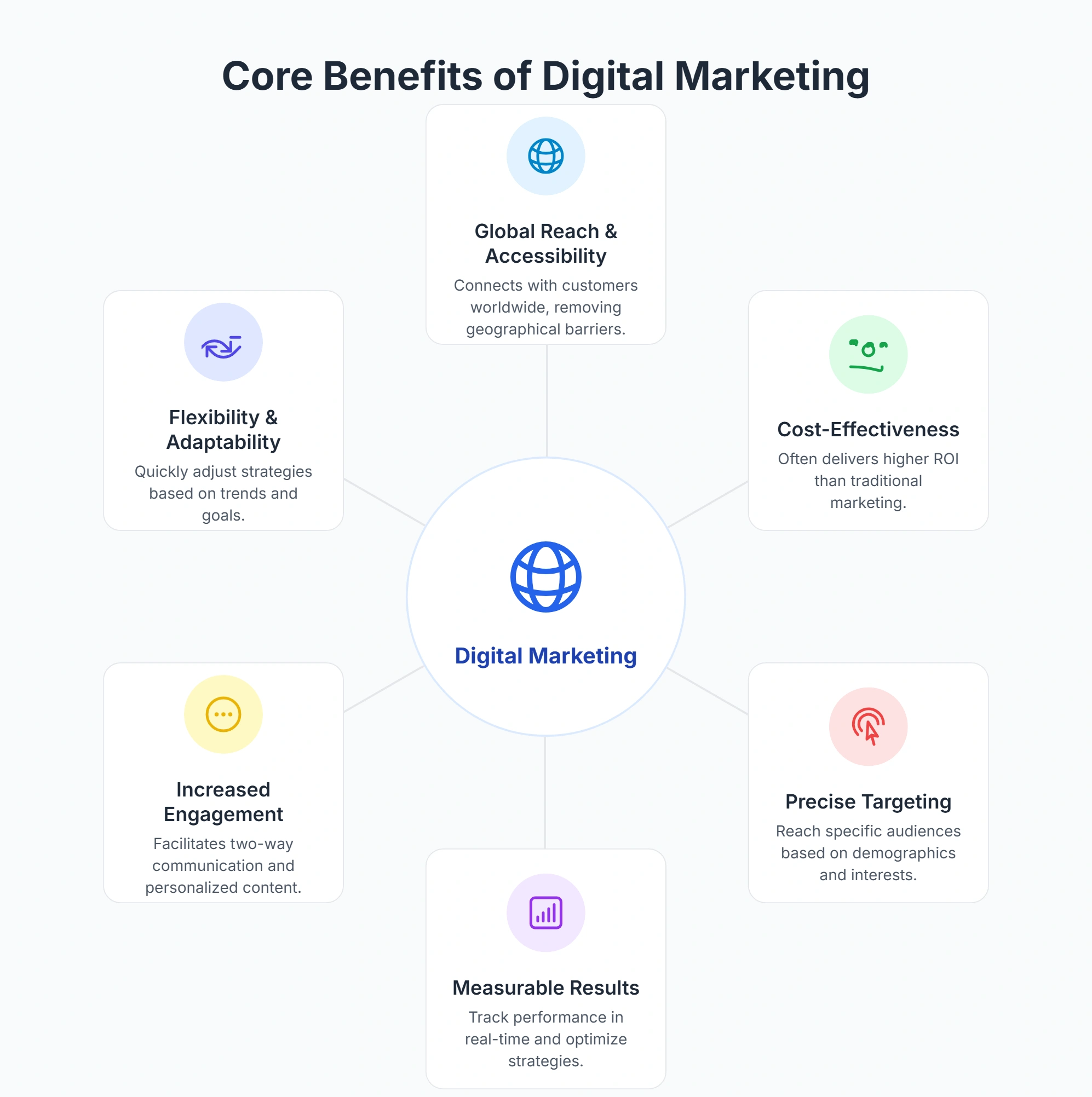
Why is this shift critical? The advantages go beyond simple visibility:
- Global Reach with Local Precision: You can reach an international audience or target a specific zip code. A local bakery can dominate neighborhood search results, while a SaaS platform can compete globally.
- Cost-Effectiveness & Scalability: Unlike print ads with fixed costs, digital channels allow you to start small. You can run a PPC campaign for $10 a day or scale an SEO strategy organically.
- Hyper-Precise Targeting: You aren't shouting into the void. Digital marketing allows you to target users based on specific demographics, purchase history, interests, and even real-time behavior.
- Data-Driven Accountability: Every click, view, and conversion is tracked. You know exactly which dollar yielded a return. This eliminates the guesswork associated with traditional media.
- Two-Way Engagement: Digital channels turn marketing into a conversation. You can answer questions, address concerns, and build community, which significantly increases customer lifetime value (CLV).
- Agility: If a campaign isn't working, you can pivot instantly. This flexibility is vital for adapting to market trends or algorithm updates.
Now, let's break down the specific channels that drive these results.
Understanding Different Digital Marketing Channels
Effective digital strategy rarely relies on a single channel. Instead, it uses a combination of these channels to create an ecosystem where traffic flows from awareness to conversion.
1. Search Engine Optimization (SEO) & AEO
What is SEO? Search Engine Optimization (SEO) is the practice of optimizing your digital presence to rank higher in organic (unpaid) search results. While traditionally focused on Google, modern SEO also encompasses Answer Engine Optimization (AEO)—optimizing for AI platforms like ChatGPT, Claude, and Google's AI Overviews.
How does SEO work? It is not just about sprinkling keywords into text. It requires a holistic approach to prove to search algorithms that you are the best answer for a user's query.
- Keyword & Entity Research: Moving beyond simple phrases to understand the intent behind a search. You need to identify what problems your users are trying to solve—start with a solid keyword research process and map each term to the right search intent.
- On-Page Optimization: This involves structuring content so both humans and bots understand it. It includes optimizing title tags, headers, and internal linking. Learn more about on-page SEO best practices to ensure every page on your site is working hard for you.
- Technical SEO: This is the foundation. If search engines can't crawl your site, you won't rank. It involves optimizing site architecture, mobile-friendliness, and Core Web Vitals (speed and stability). A single technical error can block thousands of pages from the index.
- Off-Page SEO: Building authority through high-quality backlinks. These act as "votes of confidence" from other reputable websites.
- Schema Markup: This is code that helps search engines understand the context of your data (e.g., distinguishing a review rating from a phone number). Digispot AI specializes in visualizing and generating this code to help you win "rich snippets" in search results.
The Digispot Advantage: Manually checking hundreds of pages for SEO errors is impossible. Get instant SEO insights on any page with our free Chrome extension, which analyzes over 150 ranking factors in seconds.
Benefits of SEO:
| Benefit | Description |
|---|---|
| Sustainable Traffic | Unlike ads, organic traffic doesn't stop when you stop paying. It compounds over time. |
| High Intent | Visitors from search are actively looking for solutions, leading to higher conversion rates. |
| Brand Authority | Ranking #1 signals to users that you are a market leader. |
| Cost Efficiency | While it requires time investment, the cost-per-acquisition (CPA) of SEO is often lower than paid channels in the long run. |
| AEO Readiness | Good technical SEO prepares your content to be cited by AI search engines. |
2. Search Engine Marketing (SEM) / Pay-Per-Click (PPC)
What is SEM/PPC? While SEO is a marathon, SEM is a sprint. It involves buying visibility on search engine results pages (SERPs). The most common model is Pay-Per-Click (PPC), where you bid on keywords and pay only when a user clicks your ad.
How does SEM/PPC work? It's an auction system, but the highest bidder doesn't always win. Platforms like Google Ads use a "Quality Score"—a combination of your bid amount, ad relevance, and landing page experience.
- Strategy Tip: Use PPC to test keywords. If a keyword converts well in paid search, it is a prime candidate for your long-term SEO strategy.
- Retargeting: PPC allows you to show ads to people who visited your site but didn't buy, keeping your brand top-of-mind.
Benefits of SEM/PPC:
| Benefit | Description |
|---|---|
| Instant Visibility | You can appear at the top of page one within hours of launching a campaign. |
| Laser Targeting | Target by location, device, time of day, and even specific audiences. |
| Data Collection | Gather rapid data on which headlines and keywords drive conversions. |
| Budget Control | Set strict daily caps so you never overspend. |
| Flexibility | Turn campaigns on or off instantly based on inventory or seasonality. |
3. Social Media Marketing (SMM)
What is SMM? Social Media Marketing builds brand equity on platforms where your users spend their leisure time. It includes Facebook, Instagram, LinkedIn, X (Twitter), TikTok, and Pinterest. It is essential for humanizing your brand.
How does SMM work? SMM operates on three levels:
- Organic: Posting content to your feed. Reach here is often limited by algorithms but essential for community maintenance.
- Paid: precise ad targeting based on user interests, job titles (LinkedIn), or behaviors.
- Community Management: actively replying to comments and DMs to build trust.
Strategic Nuance: B2B companies often see better ROI from LinkedIn thought leadership, while B2C lifestyle brands thrive on Instagram and TikTok.
Benefits of SMM:
| Benefit | Description |
|---|---|
| Brand Humanization | Allows you to show personality and values behind the corporate logo. |
| Social Proof | Likes, shares, and comments act as testimonials to new customers. |
| Customer Service | Many users prefer resolving issues via Twitter or DM rather than phone calls. |
| Viral Potential | High-quality content can reach millions organically if it resonates. |
| Traffic Diversification | Reduces reliance on search engines for site traffic. |
4. Content Marketing
What is Content Marketing? Content marketing is the engine that powers SEO and Social Media. It is the creation of valuable assets—blogs, whitepapers, videos, podcasts—that attract an audience.
How does Content Marketing work? It works by establishing Topical Authority. Search engines reward sites that cover a topic comprehensively.
- The Hub and Spoke Model: Create a central "hub" page covering a broad topic, then link out to specific "spoke" pages that dive into details. Read more about implementing a hub and spoke strategy to dominate niche keywords.
- Link Magnetism: High-quality data studies or unique guides attract backlinks naturally, which boosts your overall domain authority. Pair this with a deliberate internal linking strategy so the equity you earn flows to the pages you most want to rank.
Benefits of Content Marketing:
| Benefit | Description |
|---|---|
| Builds Trust (E-E-A-T) | Demonstrates Experience, Expertise, Authority, and Trustworthiness to Google. |
| Supports the Funnel | Creates content for every stage: Awareness (blog), Consideration (comparison guide), Decision (case study). |
| Long-Term Asset | A single evergreen article can drive traffic for years. |
| Feed for Other Channels | One blog post can become a newsletter, three tweets, and a LinkedIn carousel. |
| Educates Customers | Informed customers are often happier and stay longer. |
5. Email Marketing
What is Email Marketing? Email is the only channel where you "own" the audience. Unlike social media, where algorithms can bury your posts, email lands directly in a user's inbox. It is crucial for retention and maximizing Customer Lifetime Value (LTV).
How does Email Marketing work? The key is segmentation. Blasting the same message to everyone leads to unsubscribes.
- Welcome Flows: Automated sequences that nurture new subscribers.
- Abandoned Cart Emails: Recovering lost sales by reminding users what they left behind.
- Newsletters: providing consistent value to keep your brand top-of-mind.
Benefits of Email Marketing:
| Benefit | Description |
|---|---|
| Highest ROI | Direct access to an interested audience creates high conversion rates ($36-$42 per $1 spent). |
| Ownership | You are not at the mercy of platform algorithm changes. |
| Automation | Set up flows once, and they generate revenue in the background. |
| Personalization | Use data to recommend products based on past purchases. |
| Retention | It is cheaper to retain an existing customer via email than acquire a new one via ads. |
6. Affiliate Marketing
What is Affiliate Marketing? This is performance-based marketing where third-party partners (affiliates) promote your product and earn a commission only when a sale is made. It essentially outsources your sales team.
How does Affiliate Marketing work? You provide unique tracking links to bloggers, influencers, or comparison sites, and a cookie or coupon code attributes each resulting sale back to the partner who drove it.
- Commission Models: Most programs pay a percentage of the sale (common in ecommerce) or a flat fee per lead or signup (common in SaaS). Choose the model that protects your margins while still motivating partners.
- Recruitment Channels: Partners come from affiliate networks, direct outreach to niche creators, and review sites that already rank for buying-intent keywords. Prioritize partners whose audience overlaps your ideal customer rather than chasing raw reach.
- SEO Note: Be careful with affiliate programs. If you have too many low-quality affiliates linking to you, it can look spammy—Google expects affiliate links to be tagged with
rel="sponsored". Ensure your program attracts reputable partners, and pair it with a broader plan for building a healthy backlink profile so paid links never dominate your link mix.
Benefits of Affiliate Marketing:
| Benefit | Description |
|---|---|
| Low Risk | You only pay for actual results (CPA model). |
| Scalability | Leverage the audiences of thousands of marketers simultaneously. |
| Trust Transfer | audiences trust the recommendation of the affiliate they follow. |
| SEO Boost (Indirect) | High-quality reviews from affiliates can dominate search results for "[Your Brand] review" keywords. |
7. Influencer Marketing
What is Influencer Marketing? Influencer marketing leverages the credibility of individuals with dedicated followings. It differs from celebrity endorsements because influencers are viewed as experts or peers within a specific niche.
How does Influencer Marketing work? It works on authenticity. Micro-influencers (10k-50k followers) often have higher engagement rates than mega-stars because their audience genuinely trusts their specific advice.
- Vetting Partners: Look past follower counts to engagement quality, audience demographics, and whether past sponsored posts felt genuine. A creator whose values align with your brand converts better than a larger account with a mismatched audience.
- Deal Structures: Collaborations range from one-off sponsored posts and affiliate-style revenue shares to ambassador programs that run for months. Longer relationships tend to build more trust with the audience than a single promotional burst.
- Repurposing Rights: Negotiate usage rights up front so you can reuse the creator's content in your own ads, user-generated content strategy, and landing pages—stretching the value of every collaboration.
- Strategy: Combine influencer marketing with SEO by asking influencers to post reviews on their blogs (providing a backlink) in addition to social posts.
Benefits of Influencer Marketing:
| Benefit | Description |
|---|---|
| Bypass Ad Blockers | Reach audiences who ignore traditional display ads. |
| Content Creation | Influencers create high-quality content you can repurpose for your own channels. |
| Niche Penetration | Rapidly build awareness in very specific communities. |
| Social Proof | Seeing real people use your product builds confidence. |
8. Video Marketing
What is Video Marketing? Video is the preferred content format for the majority of internet users. YouTube is the world's second-largest search engine, making video marketing a dual play for both engagement and search visibility.
How does Video Marketing work?
- Educational Content: "How-to" videos target users in the research phase.
- Video SEO: Just like web pages, videos need optimization (titles, descriptions, tags, and captions) to rank in Google Video search and YouTube.
- Short-Form: TikTok and YouTube Shorts allow for high viral potential with lower production costs.
Benefits of Video Marketing:
| Benefit | Description |
|---|---|
| Information Retention | Viewers retain 95% of a message via video compared to 10% via text. |
| SEO Ranking | Google often places video snippets at the absolute top of search results (Position Zero). |
| Conversion Boost | Product videos on landing pages can increase conversions by 80%. |
| Cross-Platform | Embed YouTube videos in blogs to increase dwell time (a positive SEO signal). |
9. Mobile Marketing
What is Mobile Marketing? With Google operating on "Mobile-First Indexing," your mobile site is effectively your only site in the eyes of the search engine. Mobile marketing targets users on smartphones through apps, SMS, and responsive design.
How does Mobile Marketing work?
- Responsive Design: Your site must load instantly and function perfectly on a touchscreen.
- Local SEO: Mobile searches often have local intent ("near me"). Optimizing for this captures high-intent foot traffic.
- SMS Marketing: High open rates (98%) make this excellent for flash sales, but it requires strict permission management.
Benefits of Mobile Marketing:
| Benefit | Description |
|---|---|
| Capture "Micro-Moments" | Reach users exactly when they have an impulse to buy or learn. |
| Location-Based Targeting | Geofencing allows you to advertise to users within a specific physical radius. |
| App Engagement | Push notifications drive re-engagement effectively. |
| Search Necessity | Mobile optimization is a prerequisite for ranking on Google today. |
How to Choose the Right Digital Marketing Channels
You cannot—and should not—be everywhere at once. Diluting your efforts across too many channels usually leads to mediocre results in all of them. Use this framework to prioritize:
- Analyze Your Audience's "Digital Hangouts": If you sell B2B enterprise software, your audience is on LinkedIn and reading industry blogs (SEO), not dancing on TikTok. If you sell fashion, Instagram and Influencers are non-negotiable.
- Align with Business Goals:
- Need sales tomorrow? Use PPC and Social Ads.
- Need lower acquisition costs next year? Invest heavily in SEO and Content.
- Need to increase repeat purchases? Focus on Email and Community management.
- Assess Resource Reality: Video marketing requires production skills. SEO requires technical knowledge and patience. PPC requires budget. Be honest about your internal capabilities. Many businesses fail because they choose channels they cannot sustain.
- Check Competitor Gaps: Are your competitors ignoring a channel? If they are all fighting on Google Ads (driving up costs), perhaps you can win on organic SEO or by starting a podcast. Use tools to see where their traffic comes from.
- The "Test and Scale" Methodology: Start with a "Core 2" approach—pick one channel for demand generation (like Social or SEO) and one for retention (like Email). Master those, measure the ROI, and then expand.
Measuring Success: The Role of Data and AI
The beauty of digital marketing is measurability, but "vanity metrics" can be misleading. A million views mean nothing if they don't lead to revenue.
Key Performance Indicators (KPIs) that actually matter:
- CAC (Customer Acquisition Cost): How much did you spend to get one customer?
- ROAS (Return on Ad Spend): For every $1 spent on ads, how much revenue came back?
- Organic Traffic Value: How much would you have to pay in PPC to get the same traffic your SEO brings in for free?
- Engagement Rate: Are people actually interacting with your content, or just scrolling past?
How to track effectively:
- Google Analytics 4 (GA4): The standard for tracking user behavior across your site.
- Google Search Console (GSC): Essential for monitoring organic search performance and technical health.
- Digispot AI: Integrates GSC and GA4 data to give you actionable insights rather than just raw numbers.
Warning: Avoid the trap of "Zero-Click" ignorance. Many users now get their answers directly on Google or AI platforms without clicking your link. You need strategies to measure brand lift even when clicks don't happen. Learn more about navigating zero-click searches.
The Power of AI in Digital Marketing: Working Smarter, Not Harder
Artificial Intelligence has moved beyond a buzzword—it is now the infrastructure of modern marketing. It allows small teams to compete with enterprise giants by automating analysis and execution.
How AI Revolutionizes Your Digital Marketing:
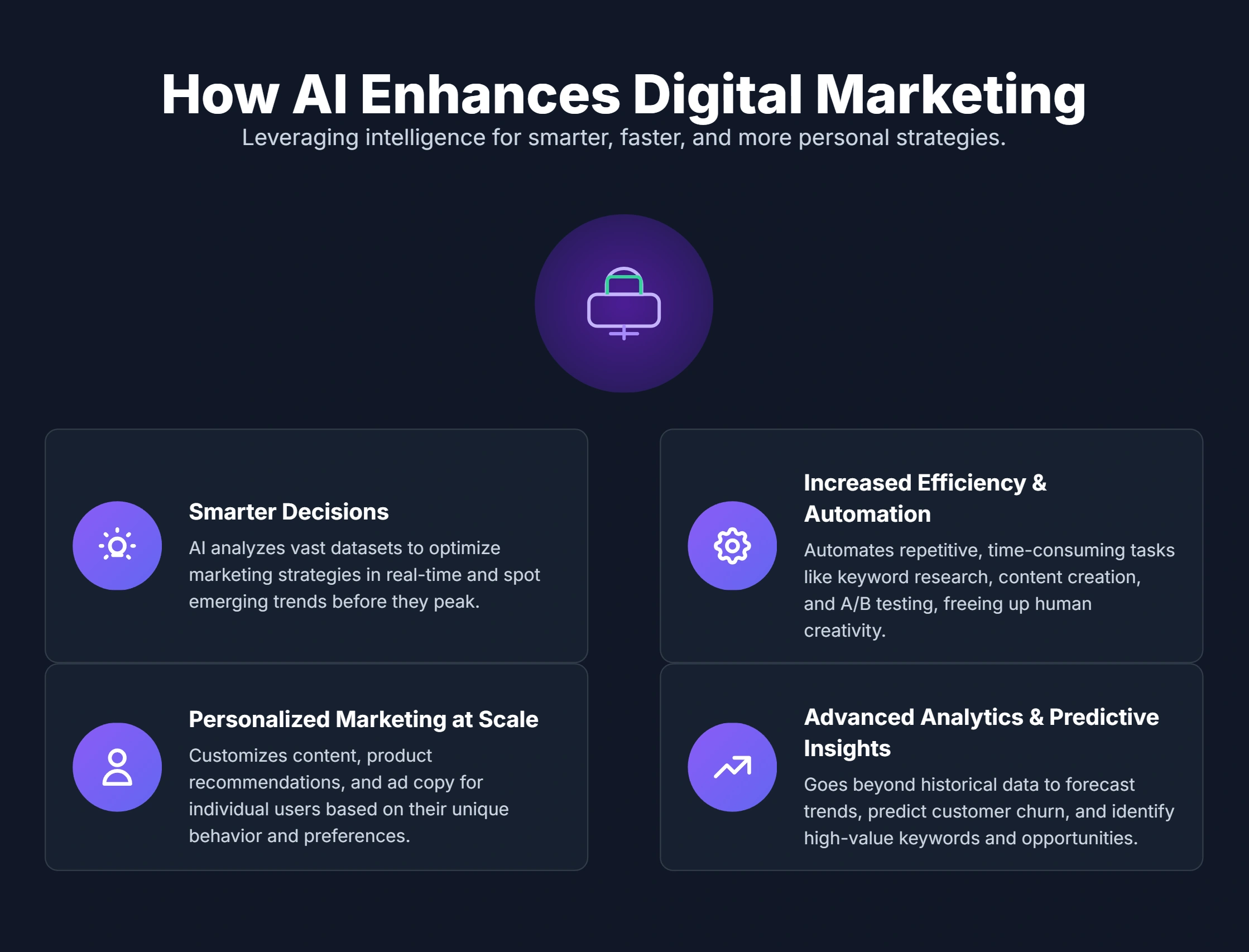
- Predictive Analytics: AI doesn't just report what happened; it predicts what will happen. It can forecast keyword trends, allowing you to create content before a topic peaks.
- Content Operations at Scale: AI accelerates the research and drafting phases of content marketing. It can analyze the top 10 ranking pages for a keyword and tell you exactly what subtopics you are missing.
- Hyper-Personalization: AI engines can dynamically change website content or email subject lines based on individual user behavior in real-time.
- Automated Technical Audits: In the past, finding technical SEO errors required manual crawling. Now, AI agents can continuously monitor your site for issues like broken links or slow load times.
Introducing Digispot AI: Your Intelligent SEO Co-Pilot
The Digispot AI cloud platform is designed to bring all SEO best practices into an automated and user-friendly model, allowing you to operate at scale with accuracy. It transforms your website's SEO, helping businesses rank better not just on Google, but also on emerging AI search engines and platforms like ChatGPT, Google AI Summary, and Perplexity.
What Digispot AI can do for your digital marketing channels:
- Comprehensive Audits and Issue Identification: Digispot AI acts like a virtual SEO expert, auditing your website in both mobile and desktop modes. It performs 300+ technical checks covering content, performance (including Core Web Vitals), and SEO best practices. This helps you identify and fix issues that are holding back your search rankings. Digispot AI can help you identify and fix these issues automatically, saving hours of manual labor.
- Deep Content Analysis: The platform analyzes your content like Google and Large Language Models (LLMs) do, looking at headings, intent, entities, and providing detailed natural language analysis. Its AI Agent powered actions assist with content analysis and writing, ensuring your content is SEO-optimized.
- Opportunity Finder & Content Studio: Digispot AI helps you spot high-value content opportunities. Its agentic AI writer can research competitor content automatically to generate rich, SEO-optimized content with one click.
- Integration with Google Tools: It integrates seamlessly with Google Search Console and Google Analytics, providing a unified analysis of your data to uncover ranking opportunities and track performance.
- Smart Prioritization: Digispot AI doesn't just find problems; it prioritizes them based on impact. It helps you understand which fix will move the needle the most. For a full breakdown of what to look for, review our SEO audit checklist.
Leveraging the Free Digispot AI Community Chrome Extension:
For quick, on-the-go insights, the free Digispot AI SEO Insights Chrome Extension is a powerful tool for anyone managing a website. It is like having an AI-powered SEO assistant directly in your browser.
How the extension supports your channel optimization:
- Instant On-Page SEO Audits: Get immediate content analysis with keyword relevance scoring and AI-powered recommendations for keywords, content, tech, and local SEO. Try the free On-Page SEO Analysis tool to see this in action on any URL.
- Schema Markup Mastery: Visualize your schema markup and validate structured data in real-time with error highlighting. This is crucial for how AI search engines interpret your content. Use the free Schema Markup Generator to create valid structured data in minutes.
- Image SEO Automation: Detect missing alt text and get AI-generated suggestions to improve your image SEO effortlessly.
- Competitor Intelligence: Perform one-click competitor page analysis, identify content gaps, and reverse engineer competitor keyword strategies.
- Social Media Metadata Optimization: Validate Open Graph and Twitter cards and preview how your pages appear on social media, ensuring your content looks click-worthy for optimal sharing across platforms.
- Local SEO Specific Checks: The extension also includes Google Name Address Phone number checks, Google Business/Maps checks, and local SEO schema markup analysis.
- Page Performance Audits: Review your page performance scores for web and mobile, and even submit page speed audits to Google directly using the extension.
By leveraging tools that incorporate AI, like the Digispot AI platform and its Chrome extension, you can gain a significant edge in improving your business visibility, increasing traffic and business leads, and achieving significant time and cost savings in your digital marketing efforts.
Conclusion: A Holistic Approach to Digital Marketing Success
The era of siloed marketing is over. You cannot run SEO in a vacuum, ignore social media, or treat email as an afterthought. The most successful businesses understand that these digital marketing channels are interconnected gears in a larger engine.
Your content feeds your SEO and social media. Your SEO captures the traffic that your email marketing nurtures. Your data from PPC informs your long-term organic strategy.
To succeed, you must adopt a holistic mindset. Start by ensuring your technical foundation is solid—search engines cannot rank what they cannot understand. Then, layer on high-quality content that serves user intent, and amplify it through social and paid channels.
Don't let technical complexities slow you down. Ready to improve your search visibility? Try Digispot AI for comprehensive website audits and actionable recommendations that bridge the gap between traditional SEO and the future of AI search. By combining human creativity with AI-driven insights, you can build a digital presence that is resilient, visible, and profitable.
References
Audit any page in seconds
300+ SEO checks including Core Web Vitals, schema markup, meta tags, and AI readiness — trusted by 1000+ SEO experts and marketers.
Frequently Asked Questions
Here are some of our most commonly asked questions. If you need more help, feel free to reach out to us.
Written by
Maya Krishnan
Digital growth expert
Maya is a seasoned expert in web development, SEO, and digital strategy, dedicated to helping businesses achieve sustainable growth online. With a blend of technical expertise and strategic insight, she specializes in creating optimized web solutions, enhancing user experiences, and driving data-driven results. A trusted voice in the industry, Maya simplifies complex digital concepts through her writing, empowering readers with actionable strategies to thrive in the ever-evolving digital landscape.