
Long-Tail Keywords SEO: Target High-Intent Searches
Leverage long-tail keywords for targeted SEO traffic. Learn research techniques, content optimization, and conversion strategies for high-intent search queries.
 Maya Krishnan
Building a vibrant online presence often feels like searching for a needle in a haystack. Thousands of businesses vie for the same eyeballs, and you might feel your efforts are vanishing into the void. You pour resources into SEO, yet your traffic remains stagnant. What if the path to visibility wasn't about shouting the loudest for popular terms, but whispering the right words to the right people?
The secret often lies away from the high-volume chaos of "head terms." It resides in the hidden gems of search: long-tail keywords. (If you're just getting started, our keyword research guide for beginners lays the groundwork these tactics build on.) These highly specific phrases are not just SEO tactics; they are direct lines to revenue. They guide genuinely interested visitors—those with their wallets out or their problems clearly defined—straight to your digital doorstep.
Search engines are evolving rapidly. With the integration of sophisticated AI models like Google's Gemini and OpenAI's GPT series, the way people search is fundamentally changing. Queries are becoming conversational, specific, and nuanced. Long-tail keywords are perfectly poised to meet this demand. Mastering them means building a robust foundation for sustainable growth, driving not just "hits," but valuable business leads.
What Exactly Are Long-Tail Keywords?
At its core, a long-tail keyword is a highly specific search phrase, typically consisting of three or more words. Think of them as the detailed questions or statements people type—or speak—into search engines when they know precisely what they want.
While individual long-tail keywords might generate lower search volumes compared to their shorter, generic counterparts, their collective power is immense. In fact, they make up the vast majority of all online searches.
The "Long Tail" Concept Explained
The term "long-tail" comes from the statistical concept of the distribution curve. Imagine a graph where the vertical axis represents search volume (popularity) and the horizontal axis represents the number of unique keywords.
- ** The Head:** A small number of very popular, generic keywords (like "shoes") sit at the "head" of this curve. They boast millions of searches but also impossible competition.
- The Body: Slightly more specific phrases (like "running shoes") sit in the middle.
- The Tail: As you move far to the right, keywords become longer and more specific (e.g., "women's trail running shoes for overpronation"). Individual volume drops, but the number of these unique queries is massive.
These numerous, less common phrases, when aggregated, account for a vast majority of total search traffic. They are the "long tail."
To grasp the distinction, consider this comparison between short-tail (or "head") keywords and long-tail keywords:
| Feature | Short-Tail Keywords | Long-Tail Keywords |
|---|---|---|
| Length | 1-2 words (e.g., "shoes") | 3+ words (e.g., "waterproof hiking shoes for women for winter") |
| Search Volume | High | Low (individually) but high (collectively) |
| Competition | Very High (Dominated by giants) | Low to Moderate (Open for niche players) |
| User Intent | Broad, exploratory, vague | Specific, commercial, or transactional |
| Conversion Rate | Lower (Window shoppers) | Higher (Ready to buy) |
| Example | "coffee maker" | "best single-serve coffee maker with frother for small kitchen" |
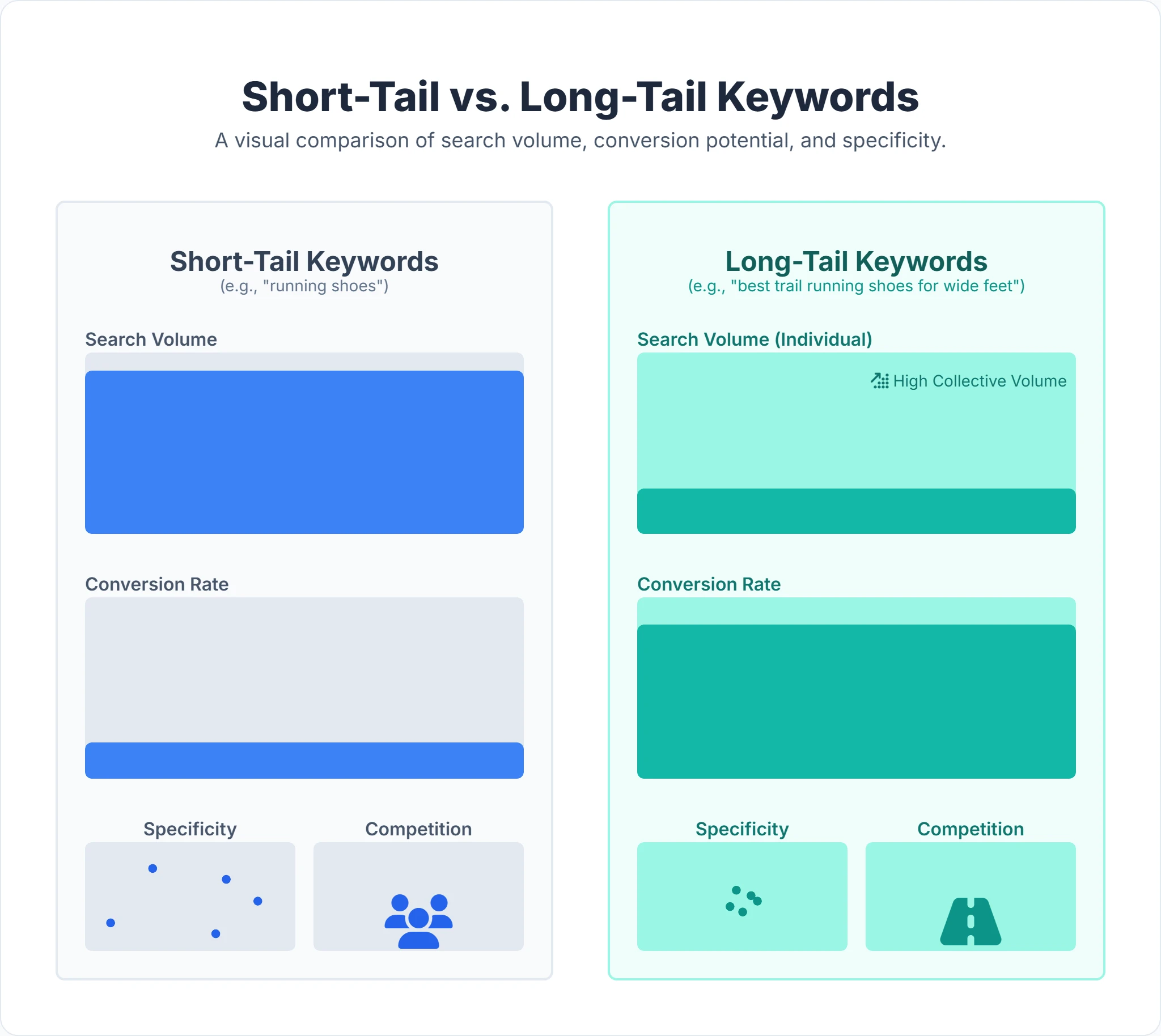
Understanding this fundamental difference is the first step towards unlocking a powerful SEO strategy. While competitors fight over the "head" keywords with massive budgets, the "tail" is where truly qualified visitors reside.
Why Long-Tail Keywords Are Your Secret Weapon
Ignoring long-tail keywords means leaving significant revenue on the table. This is not merely a tactic; it is a strategic alignment with modern user behavior. Especially with the rise of Answer Engine Optimization (AEO), being specific is the only way to win.
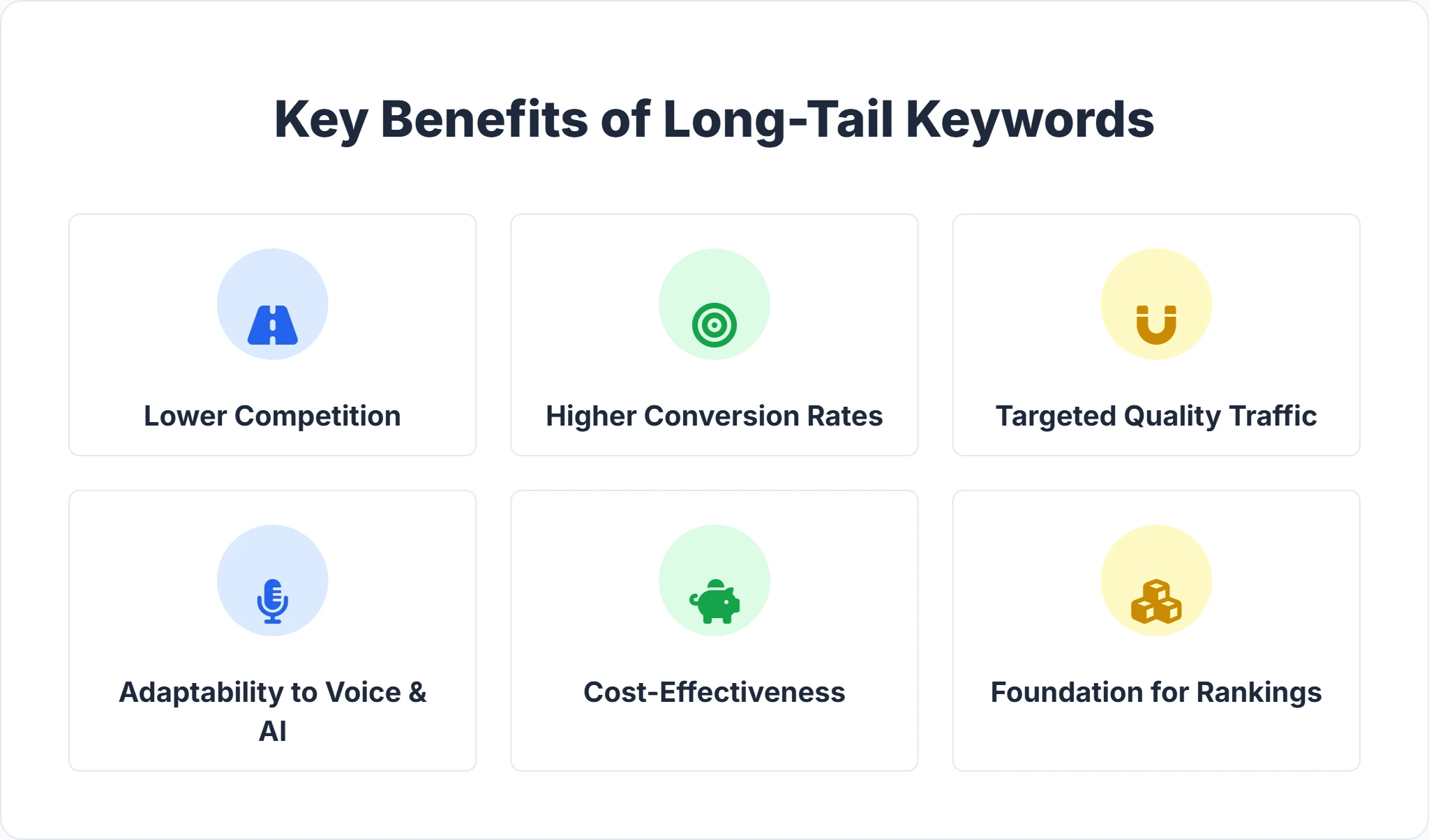
1. Lower Competition, Easier Ranking
The most immediate advantage is the reduced barrier to entry. Since these phrases are highly specific, fewer websites actively optimize for them. This creates a fertile ground for businesses, particularly smaller or newer ones, to carve out a niche.
Consider the sheer volume of content optimized for "digital marketing." Competing there requires millions in budget and years of authority. Now compare that to "how to measure ROI of social media campaigns for B2B startups." The latter presents a far less crowded playing field. You can realistically rank on Page 1 for this term within weeks, not years.
2. Higher Conversion Rates
Long-tail keywords are not just about getting more traffic; they are about getting better traffic. Visitors who use highly specific queries are typically much further along in their buying cycle.
- Awareness Stage: "Laptop" (User is just looking at what exists).
- Consideration Stage: "Best gaming laptops 2026" (User is comparing options).
- Decision Stage (Long-Tail): "Alienware x16 vs Razer Blade 16 benchmark test" (User is ready to buy).
When your content matches that specific decision-stage query, you solve an immediate problem. This leads to significantly higher conversion rates. Data consistently shows that long-tail traffic converts at 2-3x the rate of head-term traffic.
3. Adaptability to Voice and AI Search
The rise of voice-activated assistants (Siri, Alexa) and AI-powered search engines (Google AI Overviews, ChatGPT) has profoundly impacted search behavior. We don't speak in keywords; we speak in sentences.
- Typed Search: "Italian restaurant Boston"
- Voice/AI Search: "Where can I find an authentic Italian restaurant in North End Boston that's open right now?"
AI engines are designed to understand context and intent. They synthesize information to answer complex prompts. Content optimized with long-tail keywords that mimics this natural language is far more likely to be cited by AI models. This is crucial for Answer Engine Optimization (AEO).
4. Targeted, Quality Traffic
By focusing on long-tail keywords, you attract an audience that is genuinely interested in your specific offer. This reduces bounce rates and increases "dwell time"—the amount of time a user spends reading your page.
High engagement signals to Google that your site provides value. If a user lands on your page and finds exactly the specific answer they needed, they stay. This positive user behavior loops back to improve your overall domain authority, eventually helping you rank for broader terms too.
5. Cost-Effectiveness (Even for PPC)
While primarily an organic SEO strategy, the benefits extend to paid advertising. In Google Ads, highly specific keywords often have lower competition, which translates to lower Costs Per Click (CPC). Furthermore, because your landing page is highly relevant to the specific search, your Quality Score goes up, further reducing your ad spend.
How to Uncover Your Niche: Finding Long-Tail Keywords
Identifying effective long-tail keywords requires a blend of human empathy and strategic tooling. You must think like your customer. What keeps them up at night? What specific words do they use to describe their problems?
Brainstorming & User Persona
Start by stepping away from the software and looking at your customer. Create detailed user personas.
- The "W" Framework: Ask Who, What, When, Where, Why, and How.
- Instead of "CRM software," ask: "What is the best CRM software for a small real estate agency?"
- Problem-Solution Mapping: List every feature of your product and map it to a specific problem.
- Feature: "24-hour battery."
- Long-tail keyword: "wireless headphones with 24 hour battery life for travel."
Google's Own Tools: Your Free Goldmine
Google provides incredible real-time data on what people are actually searching for.
- Google Autocomplete: Open an incognito window and type your main keyword. Do not hit enter. Look at the predictions. These are high-volume long-tail searches.
- "People Also Ask" (PAA): These boxes are a treasure trove of question-based long-tail keywords. Click on a question, and Google will load more. This infinite scroll can give you dozens of blog post ideas.
- Related Searches: Scroll to the absolute bottom of the SERP. The "Searches related to..." section shows you semantically related long-tail phrases that users try when their first search fails.
Mining Communities for "Voice of Customer"
Real people ask real questions in places like Reddit, Quora, and industry forums. These platforms are invaluable for discovering the exact vernacular of your audience.
- Reddit Search Trick: Go to Google and search
site:reddit.com "keyword". Read the thread titles.- Example: You might find a thread titled "How do I fix my washing machine that stops mid-cycle?" – That is a perfect long-tail keyword for an appliance repair blog.
- Quora Questions: Look for questions with many followers but few good answers. These are content gaps waiting to be filled.
Competitor Analysis with Intelligence
What are your rivals ranking for that you aren't? Analyzing their keyword profile can reveal long-tail opportunities they have validated for you.
Tools like Digispot AI simplify this significantly. With features like "one-click competitor page analysis" and "content gap identification," you can scan a competitor's high-performing article and instantly see the long-tail variations driving their traffic. You can then create a piece of content that answers those specific queries better than they do.
Leveraging AI for Keyword Research
Artificial intelligence has changed the speed of research. AI tools can analyze vast datasets to spot patterns human researchers miss.
- Generate Variants: Ask an AI agent: "Give me 20 long-tail keyword variations for 'dog food' targeting owners of senior dogs with sensitive stomachs."
- Intent Classification: AI can help you sort keywords by intent (informational vs. transactional), ensuring you don't waste time writing sales copy for an informational query.
Digispot AI includes a "Content opportunity finder" that automates this. It helps you identify high-value topics and the specific long-tail questions driving them, ensuring your content meets actual market demand rather than just guessing.
Strategic Implementation: The Topic Cluster Model
Finding keywords is step one. Organizing them is step two. You should not just write random articles for every long-tail keyword you find. This leads to a disorganized site structure.
Instead, use the Topic Cluster model.
- Pillar Page: Create a comprehensive guide targeting a broad short-tail keyword (e.g., "SEO Guide").
- Cluster Content: Create separate articles for your long-tail keywords (e.g., "Long-Tail Keywords for SEO," "On-Page SEO Checklist," "Technical SEO Audit").
- Internal Linking: Link all cluster articles back to the pillar page, and link the pillar page to the clusters.
This structure tells Google that you are an authority on the entire topic. The long-tail articles capture specific traffic and funnel "link juice" up to your main pillar page, helping it rank for the competitive head term over time.
How to Use Long-Tail Keywords for Maximum Impact
Once you have your keywords and your cluster strategy, it's time to create the content. This is where "optimization" happens.
Crafting Content Around Intent
Every piece of content must answer the specific user question. If the long-tail keyword is "how to tie a windsor knot," the user wants a clear video or step-by-step image guide. They do not want 500 words on the history of the Windsor family.
Action: Before writing, Google your long-tail keyword. Look at the top 3 results. Are they listicles? Videos? Product pages? Match that format.
On-Page SEO Essentials
Strategic placement is crucial for search engines to understand relevance. For a deep dive, you can check our guide on on-page SEO best practices.
- Title Tags: This is the strongest signal. Include the long-tail phrase as early as possible. Keep it under 60 characters so it doesn't get cut off.
- Meta Descriptions: While not a direct ranking factor, this drives clicks. Write a compelling summary that includes the keyword.
- Headings (H1, H2, H3): Your H1 must contain the primary long-tail keyword. Use H2s for secondary long-tail variations. This structure helps AI bots parse your content.
- First 100 Words: explicitly state the problem and the keyword early in the introduction. This confirms to the user (and Google) they are in the right place.
- URL Structure: Keep it clean.
site.com/blog/long-tail-keywords-seois better thansite.com/blog/category/post-id-123.
The Power of Schema Markup
Schema markup (structured data) is code that helps search engines understand the type of content you have. It is essential for capturing Rich Snippets (like star ratings, recipe cards, or FAQ boxes) in search results.
For long-tail questions, FAQ Schema is incredibly powerful. By marking up your questions and answers, you can occupy more real estate on the search results page.
- Voice Search Connection: When a voice assistant answers a question, it often reads from the "featured snippet" or schema-marked content.
- Implementation: You don't need to be a coder. The Digispot AI Schema Markup Generator allows you to create this code in minutes.
Once implemented, use the Digispot AI Schema Visualizer to validate that your structured data is error-free. Correct implementation is a strong E-E-A-T signal.
Content Studio & AI Agents
Scaling content production for dozens of long-tail keywords is difficult manually. This is where AI-driven workflows assist.
A "Content Studio" approach involves using AI agents to research, outline, and draft content based on your keyword data. Digispot AI offers a specialized environment where "AI agents" can generate SEO-optimized drafts that already adhere to best practices for heading structure and keyword density. This allows you to focus on adding expert insights and unique value rather than formatting basics.
Avoiding Keyword Cannibalization
A common mistake with long-tail SEO is cannibalization. This happens when you write two articles that are too similar, and they compete against each other for the same ranking.
- Example: Article A: "How to bake a cake" vs. Article B: "Guide to baking cakes."
- Solution: If the intent is the same, merge them into one comprehensive guide. Only create a new URL if the user intent is distinctly different.
You can learn more about avoiding these traps in our article on common SEO mistakes.
Measuring the Success of Your Long-Tail SEO Strategy
You cannot improve what you do not measure. Long-tail SEO is a cumulative game; you are looking for aggregate growth across many pages rather than a single viral hit.
Key Metrics to Monitor
- Organic Traffic Growth: Look at the trend line over 3-6 months. Are you seeing steady growth?
- Keyword Coverage: Use tools to see how many keywords your site ranks for. A healthy long-tail strategy results in a massive increase in the total number of ranking keywords.
- Conversion Rate: Compare the conversion rate of landing pages optimized for long-tail vs. generic pages.
- Engagement Metrics: Check "Average Engagement Time" in GA4. Long-tail visitors should stay longer.
Tools for Tracking Performance
- Google Search Console (GSC): This is non-negotiable. GSC gives you the raw data.
- Pro Tip: Use the "Regular Expression" filter in GSC performance reports to find queries with more than 3 words. This isolates your long-tail performance.
- Google Analytics 4 (GA4): Connect your conversions to specific landing pages to calculate ROI.
Connecting these data streams is vital. Digispot AI integrates deeply with GSC and GA4, providing a "unified analysis" dashboard. Instead of jumping between tabs, you can see your traffic, rankings, and technical health in one view. This allows you to "monitor clicks, impressions, CTR, and position changes" specifically for your long-tail clusters.
Auditing and Technical Health
Even the best keywords won't rank if your site has technical errors. Slow load times, broken links, or mobile usability issues will tank your long-tail efforts.
Regular audits are mandatory. You need to check for Core Web Vitals compliance and mobile responsiveness.
Digispot AI automates this with "300+ deep audit checks at every page level." It scans for technical bottlenecks that might be preventing your long-tail content from being indexed properly. If you are unsure where your site stands right now, try the free On-Page SEO Analysis tool for an instant checkup.
Digispot AI: Your Smart Companion in the Long-Tail Journey
Navigating the complexities of SEO, especially with the strategic nuances of long-tail keywords and the rapid advancements in AI search, can be overwhelming. This is where an intelligent AI SEO platform becomes an indispensable partner.
Digispot AI is designed specifically to help businesses thrive in the era of Generative Engine Optimization (GEO) and AEO. It moves beyond basic keyword counting to understand the semantic relationships between topics.
What Digispot AI brings to your long-tail SEO efforts:
- Intelligent Website Auditing: The platform audits your entire website in both mobile and desktop modes. It identifies issues across "300+ ranking factors including content, tech SEO, local SEO and page performances." It doesn't just list problems; it helps you solve them.
- Opportunity Finder: The "opportunity finder" scans your niche to find high-value topics you are missing. It acts as a radar for long-tail demand.
- Content Studio with AI Agents: Once you find a keyword, the Content Studio helps you execute. It uses AI agents to generate outlines and drafts that are pre-optimized for search intent, saving you hours of writing time.
- Schema Markup Mastery: As discussed, schema is vital for AI visibility. Digispot AI includes "interactive structured data visualization" and "real-time validation," ensuring your code is perfect.
The Free Digispot AI Community Chrome Extension
For those who want immediate insights while browsing, the Digispot AI Chrome extension is a game-changer.
- Instant Audits: Audit any page you visit in one click. See its metadata, headers, and keyword density instantly.
- Competitor X-Ray: Use it on competitor sites to see exactly how they structured their long-tail content and what schema markup they are using.
- AI Recommendations: Get "AI-powered recommendations" for improvements on the fly, powered by advanced LLM models.
This extension empowers you to make data-driven decisions without leaving your browser, making it the perfect companion for your research phase.
Business Outcomes: What You Can Expect
By systematically integrating long-tail keywords into your SEO strategy, particularly with the assistance of a platform like Digispot AI, you can expect significant positive business outcomes:
- Dominance in Niche Markets: By targeting specific terms, you become the "big fish in a small pond." You establish authority in specific verticals before expanding.
- Higher Quality Leads: The traffic you get is pre-qualified. These are people actively seeking solutions, leading to shorter sales cycles.
- Defensibility: A site ranking for 1,000 long-tail keywords is much more stable than a site relying on 2 or 3 head terms. If you lose one ranking, your business doesn't collapse.
- Efficiency: Automated auditing and AI-assisted content creation significantly reduce the man-hours required to maintain an SEO strategy.
Start Improving Your Traffic Today
The journey to superior online visibility is not about tricking the algorithm; it is about serving the user. Long-tail keywords are the mechanism by which you serve users best. They allow you to provide specific answers to specific problems.
As search engines evolve into answer engines, the importance of detailed, high-intent content will only grow. Those who stick to broad, generic keywords will find themselves drowning in noise, while those who embrace the specificity of the long tail will build lasting connections with their audience.
Don't let your best customers scroll past you. Start observing how they search. Craft content that speaks directly to their needs. And use the right tools to scale your efforts.
Ready to uncover the hidden opportunities on your website? Try Digispot AI today for comprehensive website audits and actionable recommendations that turn searchers into customers.
Related deep-dives
Continue with these closely related guides:
- mobile app seo — Mobile App SEO: App Store & Search Optimization
- keyword research for seo — Keyword Research for SEO: How to Find and Target the Right Keywords in 2026
References
Audit any page in seconds
300+ SEO checks including Core Web Vitals, schema markup, meta tags, and AI readiness — trusted by 1000+ SEO experts and marketers.
Frequently Asked Questions
Here are some of our most commonly asked questions. If you need more help, feel free to reach out to us.
Written by
Maya Krishnan
Digital growth expert
Maya is a seasoned expert in web development, SEO, and digital strategy, dedicated to helping businesses achieve sustainable growth online. With a blend of technical expertise and strategic insight, she specializes in creating optimized web solutions, enhancing user experiences, and driving data-driven results. A trusted voice in the industry, Maya simplifies complex digital concepts through her writing, empowering readers with actionable strategies to thrive in the ever-evolving digital landscape.