
Keyword Research for SEO: Find and Target the Right Keywords
Master keyword analysis in SEO. Learn how to map search intent, target topic clusters, find striking-distance wins, and scale rankings with Digispot AI.
 Maya Krishnan
To build a sustainable digital presence, modern marketing teams must look beyond raw traffic numbers and focus on capturing high-value user intent. Mastering keyword analysis in SEO is the key to transforming search engines into predictable growth channels. By aligning your content strategy with real search workflows, you can stop guessing what your audience wants and start building a high-converting search footprint.
Table of Contents
- Why Keyword Analysis is the Foundation of Search Strategy
- Types of Keywords: Head Terms, Long-Tail, and Topic Clusters
- The Role of Search Intent in Keyword Analysis
- How to Do Keyword Analysis Step-by-Step
- Using Digispot AI's Keyword Research Module
- Common Keyword Analysis Mistakes to Avoid
- Tracking Keyword Rankings Over Time
Why Keyword Analysis is the Foundation of Search Strategy
Many marketing teams treat SEO as a reactive game of chasing individual ranking positions. In reality, keyword analysis is the strategic blueprint for your entire content operation. It builds directly on the fundamentals covered in our keyword research guide for beginners, taking you from finding terms to analyzing which ones deserve investment. It uncovers what your potential customers are looking for, the specific terminology they use to describe their pain points, and the exact path they take before making a purchasing decision.
Modern search algorithms evaluate topical depth, not just keyword frequency. Targeting exact-match keywords in isolation is no longer enough. Comprehensive keyword analysis lets you build a structured content framework that addresses the complete customer journey — signaling topical authority to search engines while solving real user problems.
Moving Beyond Vanity Search Volume
Relying solely on high search volume is one of the quickest ways to waste an editorial budget. A keyword with 50,000 monthly searches looks impressive on a report, but if it brings unqualified traffic that bounces immediately, it contributes nothing to revenue.
True keyword analysis shifts focus from vanity metrics to business value. By analyzing queries through the lens of conversion potential, you can identify lower-volume, highly targeted terms that attract ready-to-buy prospects.
Types of Keywords: Head Terms, Long-Tail, and Topic Clusters
Understanding keyword types — and when to target each — prevents one of the most common beginner mistakes: spending months chasing head terms while ignoring the long-tail where real conversions happen.
[Head Term: "SEO"]  ←  High Volume, Low Intent, Extreme Competition
       ▲
[Sub-topic: "Keyword Analysis in SEO"]  ←  Moderate Volume, Commercial Intent
       ▲
[Long-Tail: "how to do keyword analysis for a B2B SaaS"]  ←  Low Volume, High Intent, Low Competition
The Power of Long-Tail Keywords
Head terms are broad, high-volume keywords that carry intense competition and vague intent. Long-tail keywords are longer, more specific phrases. While they have lower individual search volumes, they collectively account for the majority of all search traffic — and they convert significantly better because the user has already progressed past broad exploration and is looking for a specific solution.
Why Topic Clusters Win in Modern SEO
Search engines don't rank pages solely on individual keyword optimization — they evaluate how thoroughly a site covers a broader subject. The hub-and-spoke model (topic clustering) is the right response: a central pillar page targeting a broad head term, linked to multiple supporting sub-pages targeting related long-tail keywords. This structure signals comprehensive topical authority, boosting rankings across the entire cluster.
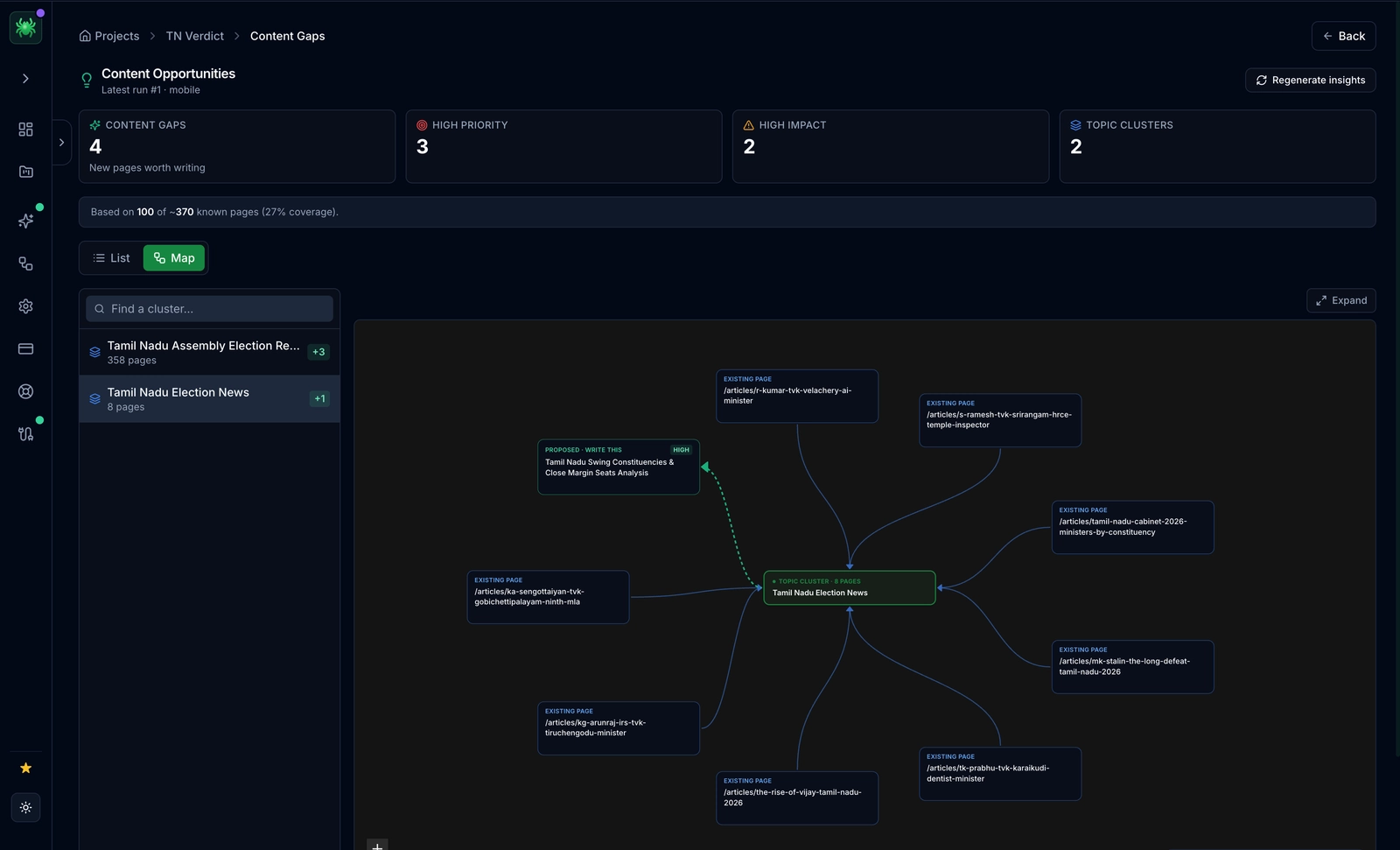 Digispot AI's content map groups your keyword universe into pillar topics and supporting clusters — making it easy to spot gaps in coverage before they cost you authority.
The Role of Search Intent in Keyword Analysis
Search intent is the primary goal a user has when entering a query. If your content doesn't match that intent, no amount of technical optimization or backlink acquisition will sustain rankings long-term.
| Search Intent | User Goal | Example Query | Ideal Page Type |
|---|---|---|---|
| Informational | Learn something | "how to do keyword analysis in seo" | Blog post / guide |
| Navigational | Find a specific site | "Digispot AI login" | Login / homepage |
| Commercial | Research options | "best seo platforms for agencies" | Comparison / listicle |
| Transactional | Make a purchase | "Digispot AI pricing" | Pricing / signup page |
Mapping Keywords to the Funnel
- Top of Funnel (TOFU): Informational searches — users are learning, not buying yet.
- Middle of Funnel (MOFU): Commercial searches — users compare solutions, read reviews.
- Bottom of Funnel (BOFU): Transactional searches — users are ready to sign up or buy.
Balance high-volume informational terms with high-converting transactional queries. A content calendar that's 100% informational captures traffic but converts little; one that's 100% transactional reaches only people already in-market.
How Intent Affects CTR
When your search listing aligns with intent, organic CTR increases. If a user searches for "buy automated seo audit software" and finds a 5,000-word history of search engines, they immediately return to the SERP. That bounce signal tells the algorithm your page is irrelevant — hurting both CTR and rankings.
How to Do Keyword Analysis Step-by-Step
Step 1: Brainstorm Seed Keywords  →  core offerings + customer pain points
         ↓
Step 2: Competitor Gap Analysis  →  keywords rivals rank for that you don't
         ↓
Step 3: GSC Striking-Distance Audit  →  find pos 8–20 quick wins
         ↓
Step 4: Topic Cluster Mapping  →  group into pillar + spoke structure
         ↓
Step 5: Prioritize  →  volume × difficulty × intent value
1. Brainstorm Seed Keywords
List your core products, services, and the pain points your target audience describes in sales calls and support tickets. These broad terms form the foundation for deeper keyword expansion.
2. Conduct a Competitor Keyword Gap Analysis
Identify your direct organic competitors and analyze which keywords they rank for that your site currently misses. This immediately surfaces content opportunities your competitors are already capitalizing on.
3. Extract Striking-Distance Quick Wins from GSC
One of the fastest ways to grow organic traffic is to target keywords your site already ranks for in positions 8–20. With minor on-page optimizations — title refresh, internal link additions, or content depth improvements — these pages can climb to page one and deliver immediate traffic gains without publishing new content.
4. Map to Topic Clusters
Group your keyword list into pillar topics and supporting sub-topics. Assign each keyword to a specific page (or a new page that needs to be created). The rule: one keyword-intent per page-target unit. Never create two separate pages for the same target keyword and intent — that's how cannibalization starts.
5. Prioritize by Business Value
Score each keyword by: business value (how closely it aligns with your product) × volume ÷ ranking difficulty. Striking-distance GSC keywords almost always top this list — they combine proven search volume with existing page authority.
Using Digispot AI's Keyword Research Module
Legacy SEO workflows require switching between multiple platforms, exporting spreadsheets, and manually grouping keywords. Digispot AI integrates GSC, GA4, and backlink data into a single workspace, automating most of this process.
Legacy Workflow:   [Ahrefs] → CSV Export → Excel → Manual Cluster → GSC → Asana
Digispot Workflow: [─────────── Single Digispot AI Workspace ───────────]
Navigating Digispot's Keyword Opportunity Lanes
Digispot AI automatically categorizes your keyword universe into five actionable Opportunity Lanes:
- Improve: Striking-distance keywords (pos 8–20) needing minor on-page adjustments to reach page one.
- Expand: Semantic variations to add to existing content to capture broader queries in a topic you already own.
- New: High-value keywords with no covering page on your site — your content creation queue.
- Optimize: High-ranking pages with declining CTR or outdated content needing a refresh cycle.
- Defend: Top-ranking terms to monitor for competitor activity or algorithm-driven drops.
The Covered / Improve / Create Content States
Every target keyword in Digispot is mapped to a real-time content state:
- Covered: Targeted by an active, high-performing page — defend it.
- Improve: Page exists but underperforms — refresh title, add content depth, build internal links.
- Create: No covering page exists — automatically added to your content calendar as a new draft task.
This replaces the need for Ahrefs Keywords Explorer and Semrush Keyword Magic Tool as separate tools — keyword analysis, content planning, and rank tracking all live in the same workspace.
 Digispot AI's opportunity lanes map your entire keyword universe to actionable states — so your team always knows whether to improve an existing page, expand a topic, or create something new.
Common Keyword Analysis Mistakes to Avoid
Keyword Cannibalization
Cannibalization occurs when multiple pages target the same keyword and intent. Search engines are forced to choose which page is more relevant — and often split authority between both, lowering rankings for each.
Cannibalization (Bad):   [Page A: "SEO Guide"] ←─ both target "SEO guide" ─→ [Page B: "SEO Tips"]
Clustered (Correct):     [Pillar: "SEO Guide"] ←── internal link ──── [Sub-page: "On-Page SEO Tips"]
Ignoring Intent Alignment
Never select a keyword without checking its live SERP. If the top ten results are all comparison tables, attempting to rank with an informational blog post will fail regardless of how well-optimized the page is. Always match your content format to what search engines are already rewarding.
Targeting Keywords Without Tracking
Keyword analysis is not a one-time task. Search volumes shift, competitors publish new content, and algorithm updates reshuffle rankings. Set up monthly rank tracking so you know which keywords are climbing, stalling, or being cannibalized by new content.
Tracking Keyword Rankings Over Time
Organic Share of Voice
Organic Share of Voice (SoV) measures your brand's total search visibility across a keyword set relative to competitors. Instead of tracking isolated keyword positions, SoV weights each term by its search volume — giving you a clearer picture of market presence over time.
Integrating GSC with Digispot for Live Tracking
Google Search Console provides valuable historical data but lacks real-time actionable insights. By integrating GSC with Digispot AI, you combine search query data with live keyword tracking, backlink monitoring, and automated crawl workflows — giving your team a real-time view of ranking changes and traffic shifts as they happen.
Start mapping your keyword universe today with the free SEO Insights Chrome extension for on-page keyword checks, or try the full Digispot keyword research platform with a free 7-day trial.
Related deep-dives
Continue with these closely related guides:
- long-tail keywords seo — Long-Tail Keywords SEO: Target High-Intent Searches
- search intent seo — Search Intent SEO: Optimize for User Intent
- top 10 seo tools — Top 10 SEO Tools in 2026: Essential Software Guide
Audit any page in seconds
300+ SEO checks including Core Web Vitals, schema markup, meta tags, and AI readiness — trusted by 1000+ SEO experts and marketers.
Frequently Asked Questions
Here are some of our most commonly asked questions. If you need more help, feel free to reach out to us.
Written by
Maya Krishnan
Digital growth expert
Maya is a seasoned expert in web development, SEO, and digital strategy, dedicated to helping businesses achieve sustainable growth online. With a blend of technical expertise and strategic insight, she specializes in creating optimized web solutions, enhancing user experiences, and driving data-driven results. A trusted voice in the industry, Maya simplifies complex digital concepts through her writing, empowering readers with actionable strategies to thrive in the ever-evolving digital landscape.