Keyword Search Volume: Target the Right SEO Terms
Use keyword search volume to drive SEO strategy. Balance volume with competition, spot opportunities, and prioritize content for maximum traffic.
 Maya Krishnan
Imagine spending weeks crafting the perfect article, designing custom graphics, and promoting it on social media, only to hear crickets. This "ghost town" scenario is the nightmare of every content marketer and business owner. The culprit is rarely the quality of writing; it’s usually a misalignment with audience demand.
For any business aiming to rank higher on Google and emerging AI search engines like ChatGPT or Perplexity, one metric consistently stands as the bedrock of success: keyword search volume. But looking at a raw number doesn't tell the whole story. What actually drives that volume? How accurate is the data? And most importantly, how do you balance high traffic potential against fierce competition?
This guide demystifies keyword search volume, moving beyond basic definitions to practical application. We will explore how to use this metric to build a content roadmap that drives revenue, not just vanity metrics, and how modern AI platforms like Digispot AI can amplify your search engine optimization efforts.
What is Keyword Search Volume? A Basic Understanding
At its core, keyword search volume represents the average number of times a specific keyword or phrase is typed into a search engine within a defined period, typically calculated as a monthly average over the last 12 months.
Think of a search engine as a massive digital polling station. Search volume tells you how many people are voting for a specific topic with their attention. For instance, if the keyword "enterprise SEO software" has a search volume of 2,500 per month, it means roughly 2,500 queries are performed for that exact term monthly.
However, it is critical to understand the nuances of this metric:
- It’s an Average: If a keyword has 100,000 searches in December (holiday season) and 10,000 in July, the reported "monthly volume" might be around 55,000. Relying solely on the average can be misleading for seasonal businesses.
- It’s Exact Match (Usually): Most tools report volume for the exact phrase. "Buy running shoes" and "Running shoes buy" may have different data profiles depending on the tool you use.
- It’s Not Click Volume: Just because 50,000 people search for "weather NYC" doesn't mean 50,000 people click a result. Many get their answer directly on the results page (Zero-Click Searches).
Key Takeaway: Keyword search volume quantifies demand for specific information or products/services. It is a directional indicator of market size, not a guarantee of traffic.
How Keyword Search Volume Directly Impacts Your SEO Strategy
The utility of keyword search volume extends far beyond a simple feasibility check. It acts as a strategic compass that guides your entire digital marketing ecosystem, from on-page SEO best practices to technical architecture.
1. Identifying High-Demand Topics: The Foundation of Relevant Content
By revealing what your target audience is actively searching for, search volume empowers you to create content that directly addresses their needs. This eliminates the guesswork often associated with content calendars.
For example, a SaaS company might assume their audience wants to read about "software efficiency theories." However, keyword research might reveal that the audience is actually searching for "how to automate excel reports" (Volume: 12,000/mo) or "best workflow automation tools" (Volume: 8,500/mo).
Creating content around these high-volume terms positions you as a valuable resource exactly where demand exists. Without this data, you risk investing resources into topics no one is looking for, resulting in wasted effort and poor ROI.
2. Prioritizing Content Creation: Maximizing Your SEO Investment
Every business has limited resources—time, budget, and manpower. Search volume provides the data needed to triage your efforts.
Ask yourself: Should you spend 20 hours writing a whitepaper for a keyword searched 50 times a month, or a comprehensive guide for a keyword searched 5,000 times a month? While the 50-search keyword might be valuable (if the intent is highly transactional), generally, you want to build a foundation of traffic-driving content first.
Prioritizing content based on volume ensures your site gains momentum. As you capture traffic from medium-to-high volume terms, your domain authority grows, making it easier to rank for other terms later.
3. Understanding User Intent: The "Why" Behind the Search
While search volume tells you "how many," analyzing the query alongside the volume offers clues about "why." Understanding the nuance of search intent optimization is crucial for converting traffic into business value.
Consider the volume and intent relationship:
- "Sneakers" (Volume: 1M+): Broad, navigational, or informational intent. Users are browsing. Hard to convert directly.
- "Best running sneakers for flat feet" (Volume: 15,000): Commercial investigation intent. The user is comparing options. High value for affiliate sites or brands.
- "Buy Nike Pegasus 40 size 10" (Volume: 500): Transactional intent. The user is ready to purchase.
High-volume terms are often informational (top of the funnel), while lower-volume, longer phrases are often transactional (bottom of the funnel). A balanced strategy targets both: high-volume terms to fill your funnel, and low-volume terms to generate sales.
4. Competitive Analysis: Outmaneuvering Your Rivals
By examining the keywords your competitors rank for and their associated search volumes, you gain clear tactical insights. This is often called a "Keyword Gap Analysis."
If a competitor is dominating a high-volume keyword like "CRM software," and their domain authority is similar to yours, you might decide to challenge them head-on. However, if they are an industry giant, the smarter play is to find "shoulder niches"—related keywords with decent volume where the giant is weak or absent.
Tools that analyze competitor keyword rankings, combined with search volume data, paint a clear picture of the battleground. Digispot AI excels here by not just showing volume, but analyzing the weakness of the current top-ranking pages using AI.
5. Long-Tail Keyword Opportunities: Precision Targeting
While high-volume keywords are attractive "vanity metrics," they often come with fierce competition. This is where long-tail keywords shine. These are longer, more specific phrases (e.g., "best budget noise-cancelling headphones for travel").
Individually, they have low search volumes. However, collectively, long-tail searches make up about 70% of all web traffic. The "long tail" is where the conversion magic happens.
Why target low-volume keywords?
- Higher Conversion: Users are specific because they know what they want.
- Lower Competition: Giants often ignore terms with under 200 searches/month.
- Faster Ranking: You can often rank for these terms in weeks rather than months.
Digispot AI's Opportunity Finder is specifically designed to identify these precise, high-intent keywords that your competitors overlook, helping you spot opportunities for targeted content that yields real business leads.
Benefits of Leveraging Keyword Search Volume for Your Business
Strategically incorporating keyword search volume into your SEO efforts translates into a cascade of benefits for your business metrics.
- Increased Organic Traffic: This is the direct correlation. Targeting terms with substantial search volume increases your total addressable audience. If you rank #1 for a term with 1,000 searches, you might get 300 visitors. If you rank #1 for a term with 10,000 searches, that jumps to 3,000 visitors.
- Improved Conversions and Leads: It isn't just about eyes on the page; it’s about the right eyes. By filtering keywords by volume and intent, you attract visitors who are actively seeking your solution. This improves lead quality and reduces the burden on your sales team.
- Enhanced Brand Visibility: Consistent ranking for a range of relevant keywords—from broad industry terms to specific questions—creates the "Mere Exposure Effect." Users begin to see your brand as the definitive authority in the space because you appear for every query they type.
- Better Resource Allocation: Understanding search volume prevents you from chasing "ghost" keywords. It enables you to make informed decisions about where to invest your link-building and technical SEO budgets.
- Staying Ahead of Trends: Monitoring volume trends acts as an early warning system. A rising search volume for "AI writing detection" signals a new market need. A dropping volume for "MP3 players" signals a dying market.
Types of Keyword Search Volume and What They Mean
To effectively use search volume, we categorize keywords based on their volume, which usually correlates inversely with competition and conversion rate.
| Keyword Volume Category | Description | Characteristics | Pros | Cons |
|---|---|---|---|---|
| High Search Volume (Head Terms) | Broad, generic terms (e.g., "shoes," "marketing," "insurance") | Thousands to millions of searches/month. High competition. Often broad or ambiguous user intent. | High potential for massive traffic. Establishes broad brand authority. | Extremely difficult to rank for. Requires significant resources and time. Often lower conversion. |
| Medium Search Volume (Chunky Middle) | More specific, yet still popular terms (e.g., "men's running shoes," "digital marketing strategy") | Hundreds to thousands of searches/month. Moderate competition. More defined user intent. | Good balance of traffic potential and achievable rankings. Higher conversion rates than high-volume. | Still requires substantial effort. May need careful differentiation. |
| Low Search Volume (Long-Tail) | Highly specific phrases (e.g., "waterproof running shoes for trail running," "local SEO tips for small business in NYC") | Dozens to hundreds of searches/month. Lower competition. Very specific user intent. | Easier to rank for. High conversion rates (users know what they want). Attracts highly qualified leads. | Low individual traffic. Requires creation of many pieces of content to accumulate significant traffic. |
How to Effectively Use Keyword Search Volume in Your SEO Workflow
Integrating search volume analysis into your daily SEO operations requires a systematic approach. Randomly picking high-volume words will lead to frustration. Here is a proven workflow:
Step 1: Discovery via Keyword Research Tools Start with seed keywords—broad terms that define your business. Input these into research tools. While Google's Keyword Planner is free, it often groups volumes into broad ranges (e.g., "1k-10k"). Professional tools provide granular data. Platforms like Digispot AI integrate data from multiple sources to give you a more accurate baseline.
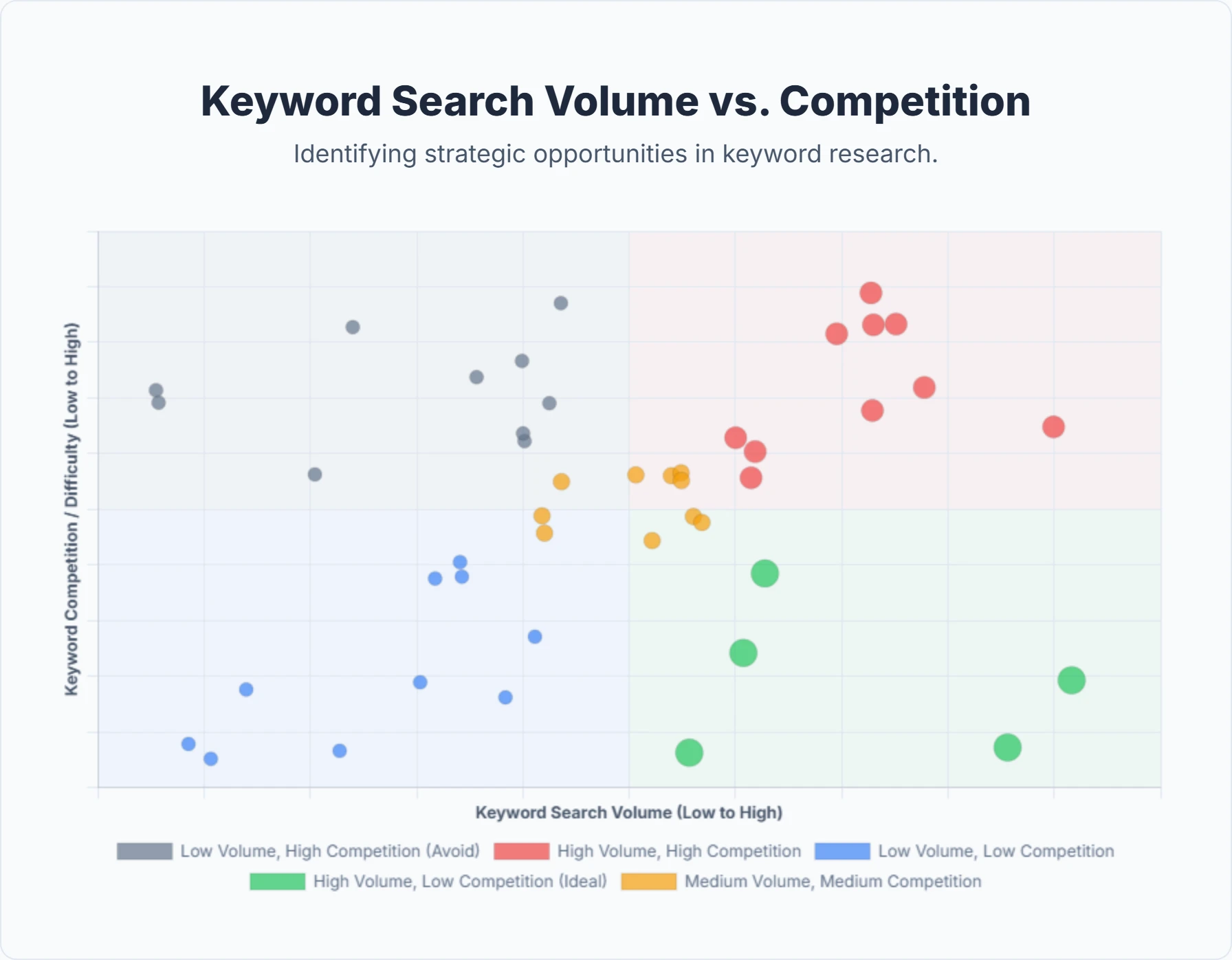
Step 2: Analyzing Volume vs. Difficulty (KD) Once you have a list, look at the Keyword Difficulty (KD) score alongside the volume. The "Sweet Spot" for most growing sites is Medium Volume + Low/Medium Difficulty.
- New Website: Target KD 0-30.
- Established Website: Target KD 30-60.
- Authority Website: Target KD 60+.
Step 3: Grouping Keywords for Content Clusters Don't write one post for one keyword. Search engines now favor semantic search and topical authority. Group related keywords together.
- Main Keyword: "SEO Audit" (High Volume) -> Pillar Page
- Supporting Keywords: "How to do an SEO audit," "SEO audit checklist," "Best SEO audit tools" (Medium/Low Volume) -> Cluster Articles
This structure passes link equity between pages and helps you rank for the high-volume term by proving you are an expert on the entire topic.
Step 4: Content Creation and Optimization Draft content that answers the query comprehensively. Ensure your target keywords are naturally integrated into titles, headings (H1, H2), and the first 100 words. However, avoid "keyword stuffing." Google's BERT and newer AI algorithms understand natural language. If it sounds robotic, rewrite it.
Tip: Use the free On-Page SEO Analysis tool to audit your draft against the target keyword before you hit publish.
Step 5: Monitoring and Adjusting SEO is an iterative process. Use Google Search Console to see which queries are actually driving impressions. Sometimes, you will rank for high-volume keywords you didn't even target intentionally. If you see high impressions but low clicks for a keyword, it means you're ranking but your title tag isn't compelling—an easy win to fix.
Beyond Raw Numbers: The Nuances of Keyword Volume
Treating search volume as a static number is a rookie mistake. To truly master this metric, you must look at the context surrounding the data.
The Myth of "Zero Volume" Keywords
Many tools show "0 searches/month" for hyper-specific queries. Do not ignore these. Data tools rely on clickstream data, which often misses the "long tail" of unique searches. If a keyword is relevant to your business and suggests high intent (e.g., "pricing for Digispot enterprise plan"), create the content. These pages often bring in the highest-paying customers, even if the tools say nobody is searching.
Seasonality and Trends
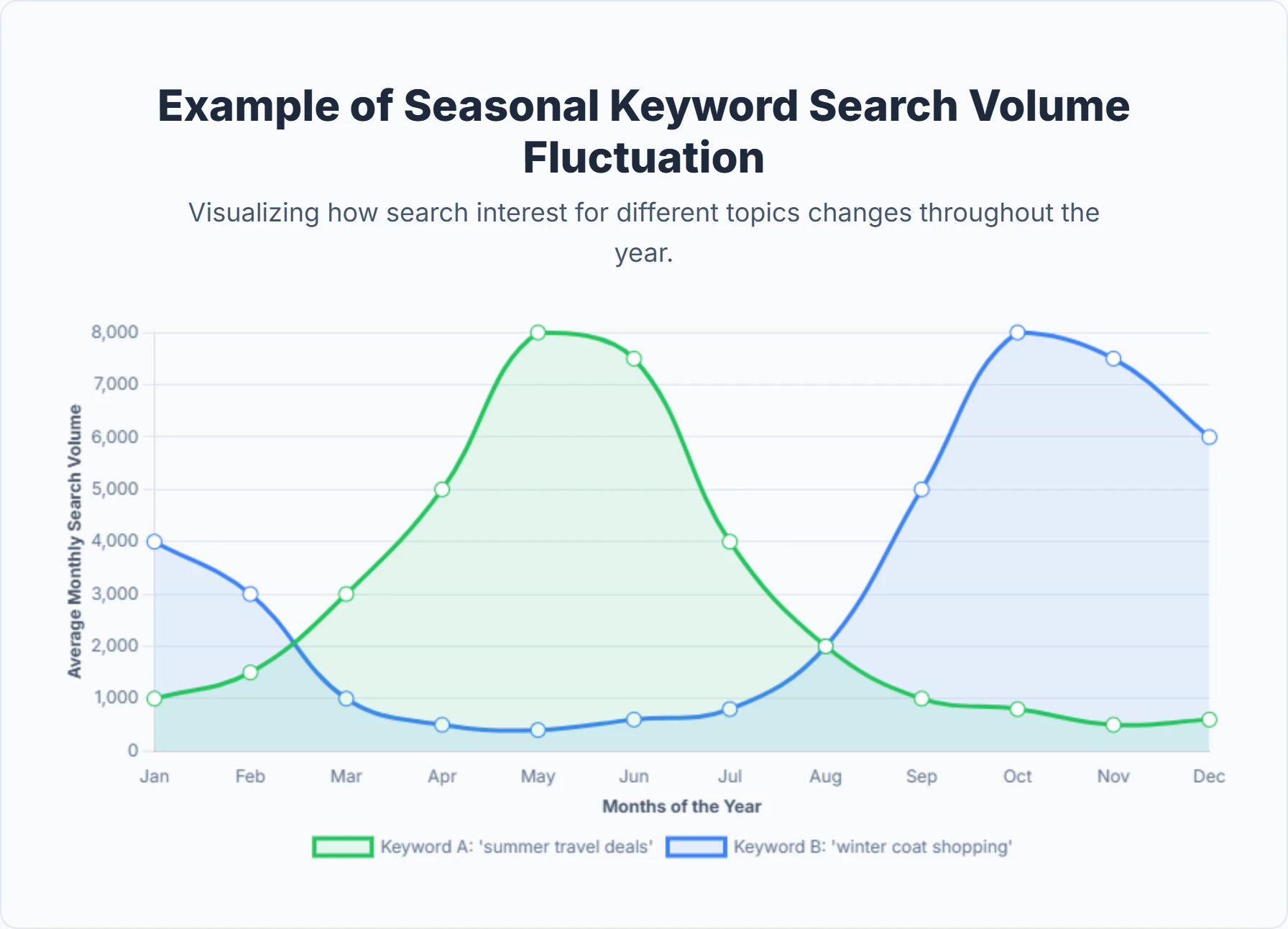
"Christmas gifts" has massive volume annually, but zero utility in July. Conversely, "tax software" peaks in Q1.
- Action: Use Google Trends to overlay against your volume data. If a keyword is trending downward year-over-year (e.g., "DVD player"), high volume might be a lagging indicator of a dying industry.
- Action: Plan your content calendar 3 months ahead of the seasonal peak. Publish "Best Halloween Costumes" in July/August to give Google time to index and rank it before October.
Geographical Variations (Local SEO)
Search volume is location-dependent. "Snow removal services" has high volume in Minneapolis but near zero in Miami. If you are a local business, ensure your keyword research is geo-specific. Digispot AI allows you to toggle between global and local search volumes to ensure you aren't optimizing for traffic you can't serve.
The Impact of "Zero-Click" Searches
With the rise of AI Overviews (Google SGE) and featured snippets, many high-volume queries no longer result in clicks.
- Informational queries like "How old is Obama" or "What is the capital of France" have high volume but massive "Zero-Click" rates because Google answers them directly.
- Strategy: Focus on "Complex" or "N-S-N" (No Simple Answer) queries where AI cannot easily summarize the answer, requiring the user to click through to your deep-dive content. Learn more about adapting to zero-click searches.
Digispot AI: Your Partner in Decoding Keyword Search Volume
Mastering keyword search volume requires processing massive amounts of data. Doing this manually via spreadsheets is slow and prone to error. Digispot AI acts as your intelligence engine, automating the heavy lifting so you can focus on strategy.
- Automated Website Audits, Mobile & Desktop: Before targeting high-volume keywords, you must ensure your technical foundation is solid. Digispot AI identifies issues like slow load times or broken links that could penalize you. Digispot AI can help you identify and fix these issues automatically with AI-powered audits analyzing 300+ ranking factors.
- Integration with Google Search Console & Analytics: Digispot AI doesn't just give you third-party estimates; it integrates with your actual GSC data. This allows you to see the reality of your search volume—how many impressions you are actually getting versus the theoretical market size.
- Opportunity Finder: This proprietary tool goes beyond basic lists. It uses predictive AI to spot "Low Difficulty, High Opportunity" keywords. It looks for terms where the current top-ranking pages are weak, thin, or outdated, giving you a clear path to the top of the results.
- Content Studio with AI Agents: Once you pick a keyword, Digispot AI's Content Studio assists in generation. Unlike basic writers, it uses a Multi-LLM approach (GPT-4, Claude 3.5, Gemini) to ensure the content is nuanced, accurate, and optimized for both readers and search engines.
- Schema Markup Generator: To stand out in high-volume search results, you need rich snippets (stars, prices, FAQs). Use the free Schema Markup Generator to create valid structured data in minutes, increasing your Click-Through Rate (CTR) even in competitive SERPs.
Digispot AI's Free Community Chrome Extension: Your Instant SEO Companion
For marketers who need insights while browsing competitors or their own sites, Digispot AI offers a robust browser add-on.
- On-the-Fly Page Audits: Navigate to a competitor's article that is ranking for your target high-volume keyword. Click the extension. Instantly see their word count, heading structure, and meta tags. Reverse-engineer their success in seconds. Get instant SEO insights on any page with our free Chrome extension.
- Powered by Popular LLM Models: The extension leverages advanced AI to provide semantic analysis. It doesn't just count keywords; it suggests related topics and entities you might be missing, helping you improve your content's comprehensive score.
- Schema Markup Detection: Quickly see if your competitors are using Product, Article, or FAQ schema. If they aren't, that is a prime opportunity for you to implement it and steal visual real estate on the search results page.
Business Outcomes with Smart Keyword Strategies
When you move from "guessing" to "data-driven targeting" using search volume, the impact on the bottom line is measurable.
- Improving Business Visibility: By targeting the "Head" terms with pillar content, you build brand recall. Even if users don't click immediately, they see your name associated with the industry.
- Increase in Traffic and Business Leads: By targeting "Long-Tail" terms with transactional intent, you capture users ready to buy. This traffic converts at a much higher rate (often 3-5% vs. the industry average of 1%).
- Time and Cost Savings: AI tools reduce the time spent on research by 80%. Instead of spending 10 hours sorting Excel sheets, you spend 10 minutes analyzing Digispot AI dashboards, allowing you to redeploy that time into content creation and promotion.
Conclusion: Master Your Keywords, Master Your SEO
Understanding how keyword search volume helps is not just an SEO tactic; it's a fundamental principle of market research. It is the practice of listening to the digital questions your customers are asking and answering them better than anyone else.
However, volume is just the starting point. The true magic lies in balancing volume with intent, competition, and technical execution. By combining diligent research with the power of intelligent platforms like Digispot AI, you can transform raw data into a sustainable engine for organic growth.
Don't let your content disappear into the void. Start using search volume strategically today. Ready to improve your search visibility? Try Digispot AI for comprehensive website audits and actionable recommendations that turn search volume into revenue.
References
- Why Search Volume Matters in SEO: Everything You Need to Know - AIContentfy
- Understanding Keyword Search Volume - A Guide - SEO Hacker
- What Is User Intent? It's Your Key to Boosting Rankings, Leads, and Conversions
- Search Intent and SEO: How to Optimize for User Goals - Backlinko
- Intro to How Structured Data Markup Works | Google Search Central | Documentation
- Schema Markup Testing Tool | Google Search Central
- About Search Console - Google Help
- How Google Analytics works
- Digispot AI - FREE On Page SEO Audit Tool
- Digispot AI - FREE Chrome Extension for SEO Insights
Audit any page in seconds
300+ SEO checks including Core Web Vitals, schema markup, meta tags, and AI readiness — trusted by 1000+ SEO experts and marketers.
Frequently Asked Questions
Here are some of our most commonly asked questions. If you need more help, feel free to reach out to us.
Written by
Maya Krishnan
Digital growth expert
Maya is a seasoned expert in web development, SEO, and digital strategy, dedicated to helping businesses achieve sustainable growth online. With a blend of technical expertise and strategic insight, she specializes in creating optimized web solutions, enhancing user experiences, and driving data-driven results. A trusted voice in the industry, Maya simplifies complex digital concepts through her writing, empowering readers with actionable strategies to thrive in the ever-evolving digital landscape.