Semantic Search SEO: Optimize for Intent & Context
Master semantic search SEO for modern Google algorithms. Optimize for user intent, topic relevance, and contextual understanding to rank for related queries.
 Maya Krishnan
Did you know that over 70% of online searches are now conversational or long-tail queries? This statistic fundamentally shifts how we must approach digital visibility. The internet has evolved far beyond a digital filing cabinet where matching a specific word on a page to a word in a search bar was the gold standard. Today, search engines strive to understand not just what words you type, but what you truly mean. This shift is powered by semantic search, a revolutionary approach that is transforming how businesses connect with their audiences.
If you have ever wondered why Google seems to magically know exactly what you are looking for—even when your query is vague or contains typos—you have witnessed semantic search in action. It represents the transition from simple string matching to deep contextual understanding, making the web a far more intuitive ecosystem. For businesses aiming to stand out in a saturated market, embracing semantic SEO is no longer just a competitive advantage; it is an absolute necessity. By optimizing for intent and context, you can improve your search engine rankings, capture highly qualified traffic, and future-proof your brand against algorithmic volatility.
What Exactly is Semantic Search SEO?
To understand semantic search, imagine asking a close friend for directions to "the best Italian restaurant nearby." Your friend doesn't mentally scan a database for the exact words "best," "Italian," "restaurant," and "nearby" in isolation. Instead, they instantly process your intent: you are likely hungry, you want high-quality food, and you need it to be within a reasonable distance. They might consider context clues—do you prefer quiet places? Is it lunchtime or dinner? Do you have dietary restrictions?
Semantic search SEO is the practice of optimizing content to satisfy this depth of understanding. It focuses on the meaning behind queries rather than just the keywords themselves. This involves a multi-layered analysis of:
- Context: What is the surrounding situation? This includes location, search history, and recent search patterns.
- User Intent: Why is the user performing this search? Are they looking to buy, to learn, or to navigate to a specific page?
- Relationships between entities: How do different concepts relate? For instance, understanding that "Einstein" is a "physicist" associated with the "theory of relativity" and "Nobel Prize."
- Nuance and Ambiguity: Deciphering phrases that could have multiple meanings based on syntax (e.g., "crane" the bird vs. "crane" the construction machinery).
Instead of matching keywords on a page, semantic search analyzes the entire document, recognizing entities, attributes, and their connections. This allows search engines to deliver results that are contextually accurate even if the exact search terms don't appear on the page. If you are struggling to align your current content with these principles, Digispot AI can help you identify intent gaps and semantic disconnects automatically.
A Quick Look: Semantic Search vs. Traditional Keyword Search
| Feature | Traditional Keyword Search | Semantic Search |
|---|---|---|
| Focus | Matching exact strings or closely related keywords | Understanding meaning, context, and user intent |
| Query Interpretation | Literal interpretation of words | Contextual interpretation, considering synonyms and entities |
| Result Relevance | Often imprecise if keywords are ambiguous | Highly relevant, even for complex or conversational queries |
| Content Strategy | Keyword density, repetition, single-keyword focus | Comprehensive topical authority, answering questions, natural language |
| Impact on SEO | Susceptible to manipulation (keyword stuffing) | Rewards high-quality, authoritative expertise (E-E-A-T) |
How Does Semantic Search Work Under the Hood?
The "magic" of semantic search is actually a sophisticated interplay of cutting-edge technologies. Understanding these mechanisms helps you create content that speaks the same language as the algorithms.
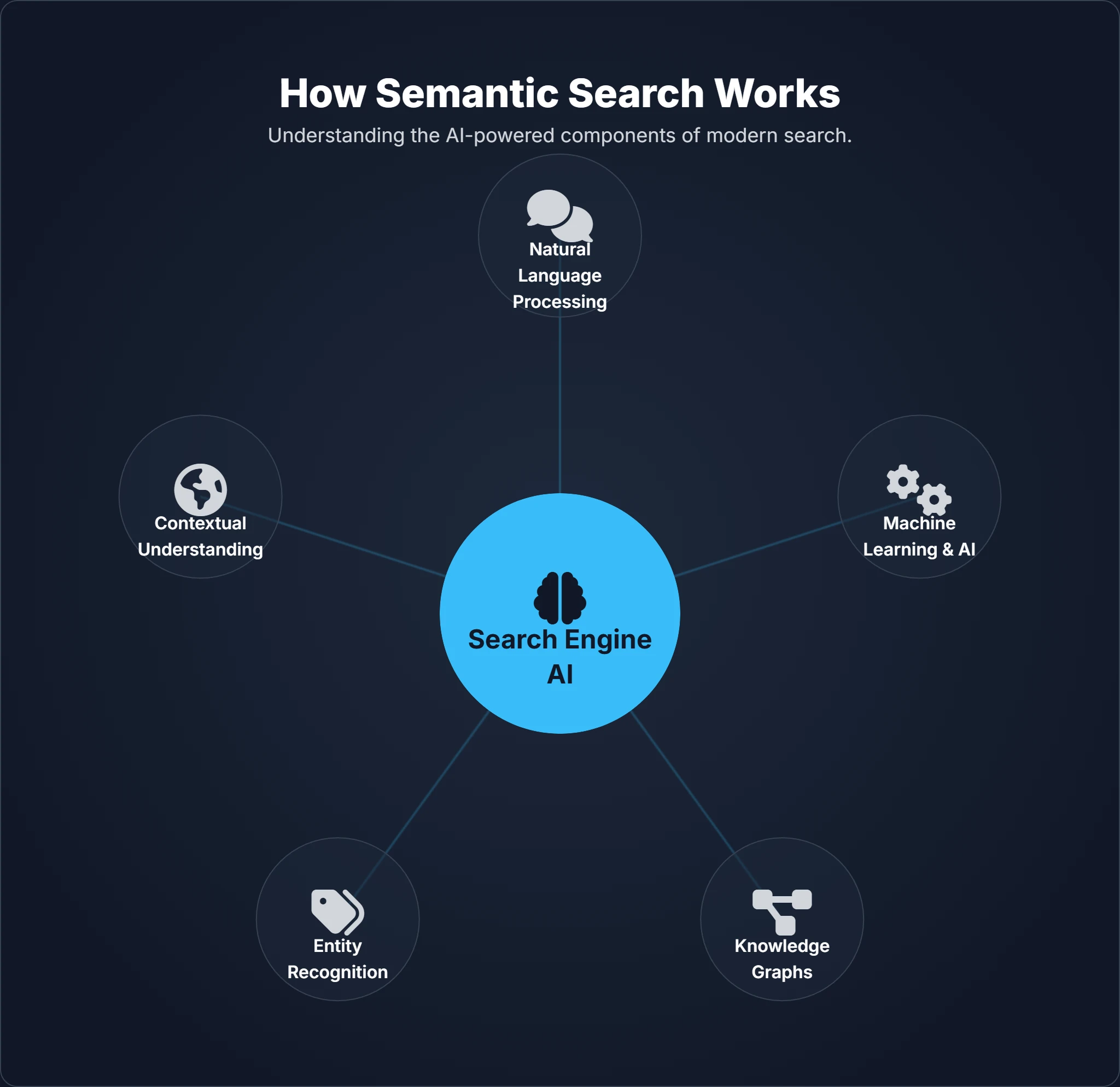
1. Natural Language Processing (NLP)
At the foundation lies NLP, the branch of AI that enables computers to understand, interpret, and generate human language. NLP helps search engines break down a query into grammatical components, identifying the subject, verb, and object. It allows Google to understand that in the query "how to fix a flat tire," the user is looking for a process, not just a definition of a tire.
2. The Evolution of Algorithms: Hummingbird, RankBrain, BERT, and MUM
Google has rolled out several updates to refine semantic understanding:
- Hummingbird (2013): The first major overhaul that focused on the meaning of the whole query rather than individual words.
- RankBrain (2015): A machine learning system that helps Google process search results and provide more relevant answers for never-before-seen queries.
- BERT (2019): Bidirectional Encoder Representations from Transformers helps Google understand the nuance of words in searches and how they relate to the words that come before and after them. It’s crucial for understanding prepositions like "to" or "for" which can change the entire meaning of a query.
- MUM (Multitask Unified Model): 1,000 times more powerful than BERT, MUM can understand information across text and images, and in the future, video and audio.
3. Knowledge Graphs and Entity Recognition
Think of a knowledge graph as a massive, interconnected web of data. Google's Knowledge Graph stores billions of facts about entities—distinct people, places, organizations, and concepts. When you search for "Eiffel Tower," the search engine doesn't just look for the text string. It identifies the entity "Eiffel Tower," pulls its attributes (height, location, architect), and understands its relationship to other entities (Paris, France, Gustave Eiffel).
This is why entity-based SEO is critical. You want search engines to recognize your brand and products as distinct entities. To understand more about the technical foundations of how search engines index this information, read our guide on how Google search works.
4. Contextual Understanding
Semantic search considers the user's immediate environment. A search for "coffee shop" yields different results at 8 AM in New York versus 3 PM in London. It also looks at search chains; if you search for "who is the prime minister of the UK" and then search "how old is he," Google understands "he" refers to the Prime Minister identified in the previous search.
The Undeniable Benefits of Embracing Semantic SEO
Aligning your strategy with semantic principles offers a multitude of advantages that go beyond simple rankings.
- Increased Relevance and User Satisfaction: When you optimize for meaning, you attract users who are genuinely looking for what you offer. This alignment reduces bounce rates and increases "dwell time"—a signal to Google that your content is valuable.
- Dominance in Rich Snippets & "People Also Ask": Semantic search powers the "position zero" results. By structuring content to answer specific questions directly and succinctly, you increase your chances of appearing in Featured Snippets, which can capture a significant portion of clicks before a user even scrolls.
- Future-Proofing Against AI Changes: As search engines integrate more AI (like Google's Search Generative Experience), they rely heavily on semantic understanding. Content that is structurally sound and semantically rich will be the source material for these AI-generated answers. To turn that foundation into citations, pair this with our complete AEO guide.
- Improved Voice Search Performance: Voice queries are conversational. "Where can I buy a cheap waterproof camera near me?" is a semantic query. Optimizing for natural language ensures you capture this growing segment of search traffic.
- Broader Reach via Long-Tail Traffic: By covering a topic comprehensively (topical authority), you naturally rank for hundreds of long-tail variations you might not have explicitly targeted. This aggregate traffic often exceeds the volume of single "head terms."
- Better Content Strategy: Shifting to a semantic mindset forces you to create higher quality content. You stop churning out thin, keyword-stuffed articles and start building robust resources that establish real thought leadership.
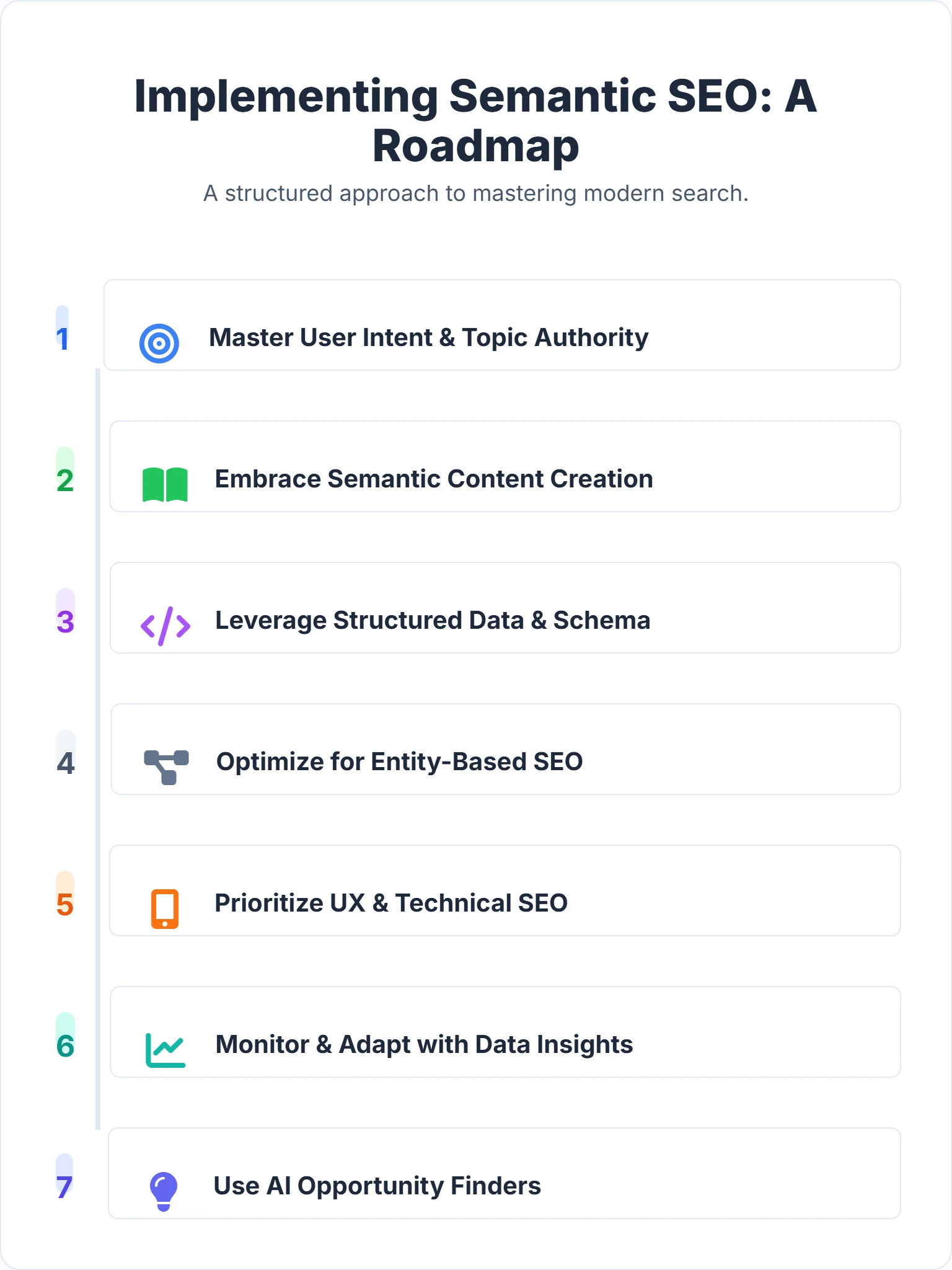
Implementing Semantic SEO: Your Roadmap to Success
Transitioning to a semantic SEO strategy requires a holistic approach. It is less about "tricking" the algorithm and more about communicating clearly with it.
1. Master User Intent and Topic Authority
The cornerstone of semantic SEO is understanding why a user is searching. Search intent is generally categorized into four types:
- Informational: The user wants to learn (e.g., "what is semantic seo," "how does photosynthesis work").
- Navigational: The user wants to find a specific page (e.g., "Digispot AI login," "Facebook home").
- Transactional: The user is ready to buy (e.g., "buy SEO software," "subscribe to newsletter").
- Commercial Investigation: The user is researching options (e.g., "best SEO tools 2026," "Digispot vs competitors").
Your content must explicitly match one of these intents. If a user searches "best running shoes," they want a list comparison (Commercial Investigation), not the history of shoemaking (Informational) or a product page for a single shoe (Transactional). Misaligning intent is the #1 reason for ranking failures. Learn how to map your keywords effectively in our guide to search intent optimization.
Actionable Tip: Before writing, Google your target keyword. Analyze the top 3 results. Are they guides, product pages, or tools? Mimic the format but improve the content.
2. Embrace Semantic Content Creation and Clustering
Move away from the "one keyword, one page" model. Adopt the Topic Cluster (Hub and Spoke) model:
- Pillar Page (Hub): A comprehensive guide covering a broad topic (e.g., "Digital Marketing"). It defines the core concepts and links out to sub-topics.
- Cluster Pages (Spokes): In-depth articles on specific sub-topics (e.g., "Email Marketing," "Social Media Strategy," "SEO Basics"). These link back to the Pillar Page.
This interlinking structure tells search engines, "We are experts on this entire subject matter," boosting your Topical Authority.
Content Writing Tips:
- Use LSI Keywords (Latent Semantic Indexing): These are conceptually related terms. If writing about "cold brew coffee," natural related terms are "steeping," "acidity," "grind size," and "concentration."
- Answer Questions Directly: Use tools like AnswerThePublic or the "People Also Ask" section in Google to find real user questions. Dedicate H2 or H3 sections to answering them.
- Natural Language: Write as you speak. Avoid stilted, keyword-heavy sentences. Modern algorithms can detect "over-optimization" and may penalize it.
3. Leverage Structured Data and Schema Markup
Schema markup is the vocabulary of semantic SEO. It is code (JSON-LD) added to your website that explicitly tells search engines what your content is, not just what it says.
For example, without schema, "Avatar" is just a word. With schema, you can tell Google "Avatar" is a Movie directed by James Cameron with a Rating of 4.8.
Critical Schema Types for Semantic SEO:
- Organization/LocalBusiness: Establishes your brand entity.
- Article/BlogPosting: Helps Google understand content type, author, and publish dates.
- FAQPage: excellent for capturing rich snippets for Q&A content.
- Product: Essential for e-commerce to display price and availability.
- BreadcrumbList: Helps search engines understand site structure.
Why Schema Matters: It disambiguates your content. If you have a page about "Jaguar," schema tells Google if you mean the animal (biological entity) or the car (brand entity).
Digispot AI and Schema Markup: Implementing schema manually can be error-prone. A platform like Digispot AI simplifies this by offering tools to audit your existing implementation. Our free Chrome extension allows you to instantly view the schema on any page you visit, helping you spot errors or spy on competitors' structured data strategies.
4. Optimize for Entity-Based SEO
Keywords are for pages; entities are for knowledge graphs. To optimize for entities:
- Brand Association: Consistently link your brand name with your core industry topics.
- SameAs Property: Use the "SameAs" schema tag to link your website to your other verified profiles (Wikipedia, Crunchbase, LinkedIn, Twitter). This confirms your identity.
- Link to Authority: When mentioning a concept, link to a definitive source (like a high-authority industry study or Wikipedia). This creates a "trust path" for the crawler.
For a deeper dive into how this connects with your broader strategy, check out our insights on on-page SEO best practices.
5. Prioritize User Experience (UX) and Technical SEO
Semantic signals are useless if Google cannot crawl your site. Technical health is the vehicle that delivers your semantic content.
- Mobile-First Indexing: Google predominantly uses the mobile version of your site for ranking. Ensure your mobile UX is flawless.
- Core Web Vitals: Speed and visual stability are ranking factors. A slow site increases bounce rate, signaling to Google that the result was not relevant.
- Crawl Depth: Ensure important pages are no more than 3 clicks away from the homepage.
- Internal Linking: Use descriptive anchor text. Instead of "click here," use "learn more about internal linking strategies." This provides semantic context to the target page.
Digispot AI for Foundational SEO: You can manually check these factors, or you can automate the process. Digispot AI analyzes over 200 ranking factors, including mobile usability and technical errors. By running a comprehensive audit, you ensure your semantic efforts aren't being blocked by technical debt. Before you start, review our SEO audit checklist for 2026 to ensure you cover all bases.
6. Monitor and Adapt with Data Insights
Semantic SEO is iterative. You must track how users interact with your content.
- Google Search Console (GSC): Look at the "Performance" report. Filter by query. Are you ranking for questions? Are you seeing impressions for keywords you didn't explicitly target? (This is a good sign of semantic success).
- Engagement Metrics: Use Google Analytics to monitor "Time on Page" and "Pages per Session." High engagement usually correlates with satisfying user intent.
- Refine Content: If a page ranks for a keyword but has a high bounce rate, you likely missed the intent. Re-write the intro or restructure the page to answer the user's need faster.
Digispot AI's Performance Tracking: Digispot AI integrates seamlessly with Google Search Console and Google Analytics, providing a unified dashboard. It helps you visualize the correlation between your semantic optimizations and actual traffic growth, allowing for data-driven decisions.
7. Content Studio and Opportunity Finder: The Semantic Edge
To truly dominate, you need to produce high-quality, relevant content consistently and identify gaps where you can outperform competitors.
- Opportunity Finder: Semantic search thrives on discovering new, unanswered questions. An "Opportunity Finder" tool analyzes the search landscape to pinpoint "content gaps"—topics your competitors are missing or answering poorly. These are your easiest wins.
- Content Studio with AI Agents: Writing comprehensive semantic content takes time. AI agents can assist by:
- Topic Research: Identifying sub-topics and related entities.
- Outline Generation: Structuring headers to cover the topic depth.
- Drafting: Creating initial drafts that naturally incorporate synonyms.
- Optimization: Suggesting schema and internal links.
Digispot AI's Solution: Digispot AI brings these capabilities together. Our Opportunity Finder spots the semantic gaps, and our Content Studio helps you fill them. This empowers you to create content that ranks well and resonates with user intent.
Common Semantic SEO Mistakes to Avoid
Even experienced SEOs can stumble when shifting from keyword-based to semantic strategies. Here are common pitfalls:
- Keyword Stuffing in the AI Era: Using the same word 50 times doesn't help; it hurts. It signals low quality to modern algorithms. Focus on topic coverage, not keyword density.
- Neglecting the "People Also Ask" Section: Ignoring these questions means you are missing the most direct insight into user intent available.
- Thin Content: Writing 300 words on a complex topic like "Cryptocurrency Taxation" is insufficient. Semantic search favors depth. If you can't cover it fully, don't publish it.
- Ignoring Zero-Click Searches: Sometimes users want the answer on the SERP (Search Engine Results Page). If you don't structure your content to provide a concise answer (for a featured snippet), you might lose the visibility entirely. Learn more about adapting to this trend in our guide to zero-click searches and SEO strategy.
- Cannibalization: Creating multiple pages that target the exact same intent confuses search engines. If you have five articles about "Best Running Shoes," Google won't know which one to rank. Consolidate them into one authoritative guide.
Measuring Your Semantic SEO Success
How do you quantify "meaning"? While abstract, semantic success leaves data footprints:
- Increased Organic Traffic: The most obvious metric. Growth here proves your content is visible.
- Growth in Long-Tail Impressions: Check GSC. Are you appearing for longer, more specific queries? This confirms Google understands the depth of your content.
- Featured Snippet Acquisition: Winning these spots is the ultimate badge of semantic honor. It means Google trusts your answer enough to display it directly.
- Higher Click-Through Rate (CTR): When your title and description match intent (not just keywords), users are more likely to click.
- Conversions: Ultimately, better intent matching leads to better leads. If traffic goes up but conversions stay flat, you might be attracting the wrong audience.
The Future of Search: Ever More Semantic, Ever More Intelligent
We are moving toward a web where search engines act less like librarians and more like research assistants. As we look ahead:
- Hyper-Personalized Results: Search will tailor results to your history. A search for "Java" by a programmer will show coding tutorials; the same search by a traveler will show coffee shops or Indonesian travel guides.
- Multimodal Search: You will be able to search using a combination of text, voice, images, and video. "Show me a video of how to fix this (image of a broken part)."
- Proactive Information: AI will anticipate needs. Your phone might suggest a traffic-free route before you even ask, based on your calendar and habits.
- Complex Query Synthesis: Search engines will answer multi-layered questions like, "Plan a 3-day trip to Tokyo for a family of four with a vegetarian diet and a budget of $2000."
For businesses, the race will be won by those who deeply understand their audience's intent and can provide the most comprehensive answers. Digispot AI helps you stay ahead of this curve by automating the complex analysis required to compete in this new era.
Conclusion: Aligning with Meaning for Digital Success
The shift to semantic search represents a fundamental maturation of the internet. It is a move away from mechanical keyword manipulation toward genuine value creation. By embracing the principles of semantic SEO—understanding user intent, creating comprehensive content clusters, leveraging structured data, and ensuring a robust technical foundation—your business can unlock unparalleled visibility.
Remember, the goal isn't just to rank for words; it is to be the definitive answer for your audience's questions. This builds trust, authority, and loyalty—assets that no algorithm update can take away.
Tools and platforms that automate best practices, like Digispot AI, bring all SEO disciplines into a unified, user-friendly workflow. This allows you to operate at scale with precision, saving time while maximizing impact. By focusing on true understanding, you are not just optimizing for today's search engines; you are future-proofing your digital presence for the intelligent web of tomorrow.
If you are ready to stop guessing and start ranking with precision, it's time to upgrade your toolkit. Try Digispot AI today to audit your site, discover semantic opportunities, and optimize your content for the future of search.
Related deep-dives
Continue with these closely related guides:
- educational seo — Educational SEO: Schools & eLearning Rankings
- chat seo — Chat SEO: Conversational AI & Search Impact
- featured snippet seo — Featured Snippet SEO: Win Position Zero on Google
- ai crawlers & seo — AI Crawlers & SEO: Why Your Website Must Evolve Now
- keyword research for beginners — Keyword Research for Beginners: The 2026 Guide to Ranking Everywhere
- perplexity seo — Perplexity SEO: How to Optimize for Perplexity AI Search (2026 Guide)
References
- What Is Semantic Search? How It Impacts SEO | Ahrefs
- Semantic Search: What It Is & Why It Matters for SEO Today | Search Engine Journal
- How Google's Knowledge Graph works | Google Search Central
- Knowledge Graph (Google) | Wikipedia
- Schema.org - Schemas
- Intro to structured data | Google Search Central
- Structured data gallery | Google Search Central
- Evaluating page experience for a better web | Google Search Central Blog
- Page experience: a Google ranking factor | Yoast
- Building Topic Clusters for SEO | Neil Patel
- Digispot AI - FREE On Page SEO Audit Tool
- Digispot AI - FREE Chrome Extension for SEO Insights
Audit any page in seconds
300+ SEO checks including Core Web Vitals, schema markup, meta tags, and AI readiness — trusted by 1000+ SEO experts and marketers.
Frequently Asked Questions
Here are some of our most commonly asked questions. If you need more help, feel free to reach out to us.
Written by
Maya Krishnan
Digital growth expert
Maya is a seasoned expert in web development, SEO, and digital strategy, dedicated to helping businesses achieve sustainable growth online. With a blend of technical expertise and strategic insight, she specializes in creating optimized web solutions, enhancing user experiences, and driving data-driven results. A trusted voice in the industry, Maya simplifies complex digital concepts through her writing, empowering readers with actionable strategies to thrive in the ever-evolving digital landscape.