Chat SEO: Conversational AI & Search Impact
Learn how chatbots and live chat affect SEO. Implement conversational AI without harming crawlability or Core Web Vitals.
 Maya Krishnan
Standing out online feels like a heavier lift every single day. The digital environment evolves rapidly, and relying solely on traditional keyword placement often isn't enough to secure top rankings. We are witnessing a massive shift driven by artificial intelligence, where smarter AI search engines and voice assistants are fundamentally reshaping how people discover information. This emergence creates a new optimization frontier: Chatbot SEO.
This guide pulls back the curtain on Chatbot SEO. We won't just define it; we will explore the mechanical benefits it brings to your site's infrastructure and user signals. More importantly, you will learn exactly how to harness this power to ensure your website becomes an indispensable resource for both your human audience and the sophisticated AI algorithms crawling your content.
Key Takeaways
- Chatbot SEO works in two directions: optimize with on-site chat to improve engagement signals, and optimize for external answer engines so they can parse and cite your content.
- Mirror chatbot answers in indexable HTML. Standard chat widgets live in the Shadow DOM and are not reliably crawled, so keep the same information in static FAQ pages or a knowledge base.
- Guard your Core Web Vitals. Load chat scripts with
deferorasyncso they never block LCP or INP, and confirm the widget does not trigger an intrusive-interstitial penalty on mobile. - Treat transcripts as keyword research. Real conversation logs reveal long-tail, question-based queries and content gaps that traditional tools miss.
- Wrap Q&A content in schema. FAQPage, HowTo, and Q&A structured data make your answers eligible for rich results and AI Overviews.
What Exactly is Chatbot SEO?
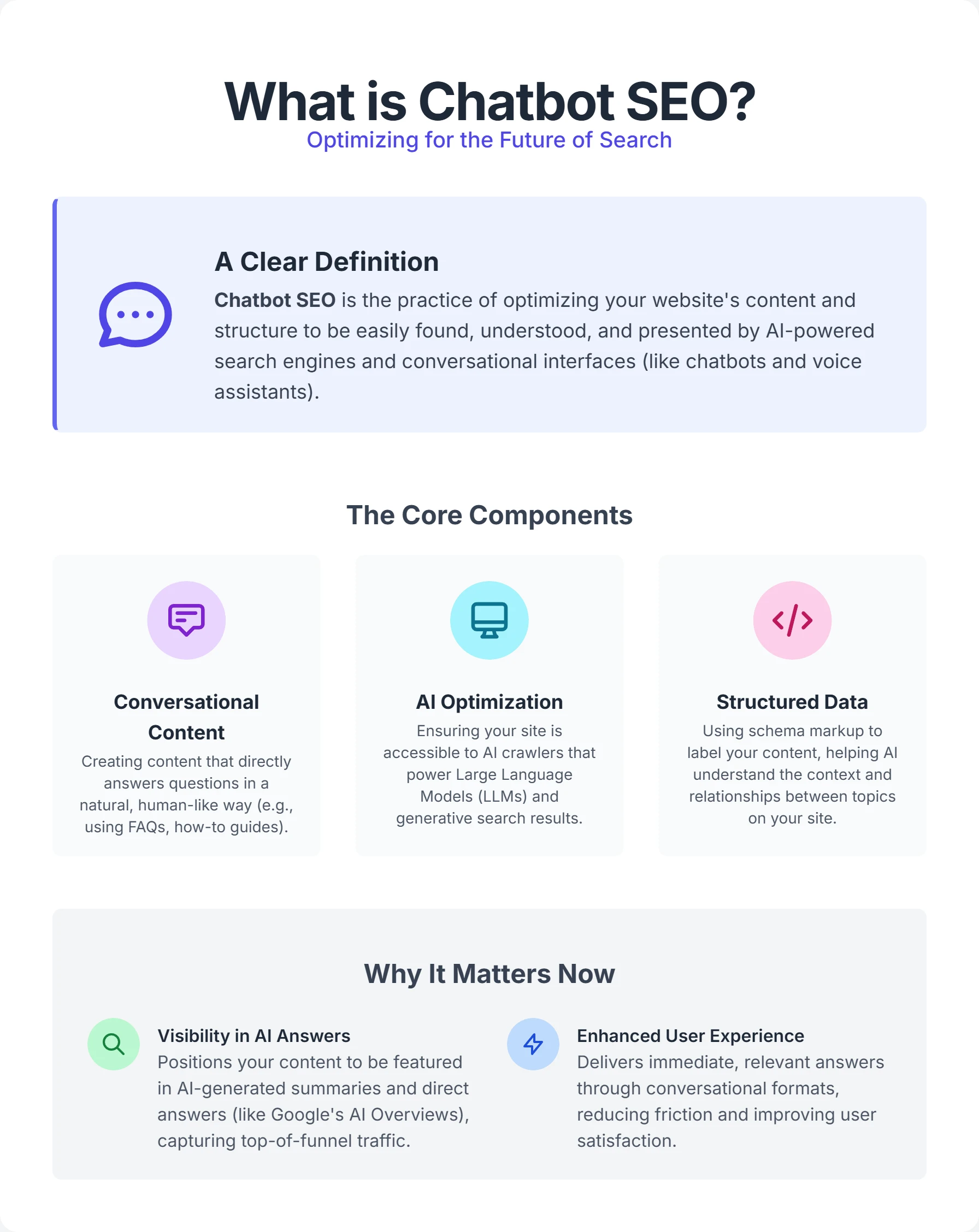
At its core, Chatbot SEO is the strategic optimization of your website's conversational interfaces and underlying content to enhance visibility in search engine results. It serves two distinct but connected purposes:
- Optimizing with Chatbots: Using on-site chat tools to improve user engagement signals (like dwell time and interaction rates) which Google uses as ranking factors.
- Optimizing for Chatbots (AEO): Structuring your content so that external AI engines (like ChatGPT, Gemini, or Google's AI Overviews) can easily parse, understand, and cite your material as the source of truth. Our complete AEO guide walks through this side in full.
It is about blending the conversational prowess of AI with the structured demands of technical SEO. In an era where search is becoming increasingly conversational—think semantic search rather than just keyword matching—optimizing for chatbots means preparing for the future of search. It acknowledges that users are not just typing "best shoes" anymore; they are asking, "What are the best running shoes for flat feet under $100?" and expecting a precise, synthesized answer.
Why is Chatbot SEO Crucial for Your Business?
Integrating a chatbot and optimizing it for SEO offers benefits that extend far beyond customer support. It is a strategic infrastructure play that can dramatically improve your organic performance.
Here is a detailed breakdown of the key advantages:
| Benefit | How Chatbot SEO Helps |
|---|---|
| Enhanced User Experience (UX) | Chatbots provide immediate, personalized responses, guiding users swiftly to the information they need. This reduces frustration and creates a seamless browsing experience. Google’s algorithms heavily weight UX signals; a helpful site ranks higher. |
| Improved Dwell Time & Reduced Bounce Rate | By engaging users with real-time answers, chatbots keep visitors on your site longer. If a user lands on a page and immediately engages with a bot to find a specific answer, that counts as interaction rather than a bounce. These are critical signals that tell search engines your page satisfies user intent. |
| Better Keyword Targeting & Discovery | Chatbots capture the exact language users speak. While keyword tools give you estimates, chatbot logs give you reality. You uncover long-tail questions and conversational phrases that traditional research often misses, allowing you to target niche queries with high conversion potential. |
| Streamlined Content Optimization | Chatbots highlight exactly where your content is failing. If users constantly ask a question your site doesn't answer, you have identified a content gap. This feedback loop allows you to generate highly relevant articles and FAQs that directly address user needs. |
| Support for Voice Search Optimization | Voice search queries are inherently conversational. Because chatbots utilize Natural Language Processing (NLP), optimizing your content for them naturally optimizes it for voice search devices like Alexa and Siri, which rely on similar linguistic patterns. |
| Increased Conversions and Leads | Chatbots facilitate the conversion process by answering pre-purchase questions instantly. They can guide users through sales funnels and provide personalized product recommendations, turning passive visitors into active leads before they have a chance to click away to a competitor. |
| Valuable Data & Analytics | Every interaction generates first-party data. In a world moving away from third-party cookies, understanding user intent through direct conversation logs is gold. This data reveals navigation paths and pain points you can use to refine your broader SEO strategy. |
| Automated On-Page SEO Support | Advanced chatbots can assist with technical elements, such as suggesting internal links to users. This improves site navigation and helps distribute "link equity" across your pages, boosting the authority of deeper content. |
The Core Pillars of Chatbot SEO: How to Optimize
To effectively implement Chatbot SEO, you need a multi-faceted approach. You cannot simply install a plugin and hope for the best. You must address content structure, technical delivery, and performance metrics.
1. Content Optimization: Speaking the Language of AI
When it comes to chatbots and Answer Engine Optimization (AEO), content must be structured for machine comprehension. Your content needs to be not only informative but also easily retrievable by the large language models (LLMs) that power these bots.
- Understand User Intent: The goal is to answer what a user really wants. If a user asks "best phone," the intent is ambiguous. Do they mean for photography, gaming, or budget? Your chatbot—and the content it draws from—must be designed to clarify these nuances. Search intent optimization is critical here; you need content that addresses informational, navigational, and transactional queries distinctively. Platforms like Digispot AI can analyze user queries when integrated with Google Search Console, helping you identify these specific intent patterns.
- Natural Language Processing (NLP) Focus: Write responses that sound human. Avoid corporate jargon. Google's BERT and MUM algorithms are designed to understand natural language. If your content reads like a keyword-stuffed list, AI agents will struggle to summarize it for users.
- Q&A and FAQ Structuring: Organize your website content into clear question-and-answer formats. This is the format chatbots "think" in. Create a comprehensive FAQ section that directly feeds into your chatbot's knowledge base.
- Concise and Direct Answers: This is known as the "BLUF" method (Bottom Line Up Front). Chatbots need to deliver quick answers. Ensure the first sentence of your paragraphs directly answers the core question. You can elaborate afterwards, but the snippet must be extractable.
2. Technical SEO: Structuring for Search Engines
Your chatbot's content must be technically accessible. If a search engine cannot crawl the answers your bot provides, that content effectively doesn't exist for SEO purposes.
-
Schema Markup (Structured Data): This is the backbone of Chatbot SEO. Implementing schema markup acts as a translator for search engines. It explicitly tells the crawler "This text is a question" and "This text is the answer."
- FAQPage Schema: Essential for your Frequently Asked Questions pages.
- HowTo Schema: Perfect for step-by-step guides referenced by the bot.
- Q&A Schema: Use this for user-generated questions and answers.
- Organization Schema: To solidify your brand entity graph.
By using these, you increase the chances of your content appearing in Rich Results and "People Also Ask" boxes.
Pro Tip: Use the free Schema Markup Generator to create valid structured data code in minutes without needing a developer.
-
Handling the "Shadow DOM": Many chatbots exist in what's called the Shadow DOM—a separate part of the HTML structure that standard crawlers might not index by default. If your chatbot contains unique content that isn't available elsewhere on the page, Google might miss it. Ensure that any critical information provided by the bot is also present in the static HTML of the page or an indexable Knowledge Base.
-
Internal Linking: While your chatbot guides users, it should also suggest internal links to relevant deep pages. This improves site navigation and helps distribute authority throughout your domain. Learn more about effective internal linking strategies to ensure your bot is guiding users to your most valuable pages.
3. Local SEO Integration: Chatbots for Local Discoverability
For businesses with physical locations, chatbots are a secret weapon for Local SEO. They can surface the exact location data that "near me" searchers and voice assistants demand, and they keep that data consistent with what you publish elsewhere.
- Location-Specific Queries: Train your chatbot to answer "near me" style questions. It should know your exact business hours, address, parking notes, and landmark-based directions. Crucially, the name, address, and phone number your bot returns must match your website and directory listings verbatim—NAP consistency is what lets search engines trust your entity, and a chatbot that quotes an outdated address quietly undermines it.
- Local Event Information: If you host local events, your chatbot can provide details and handle RSVPs, increasing local engagement signals. Pair this with an indexable events page so the same information is crawlable, not locked inside the chat interface.
- Review Generation: After a successful resolution, program your chatbot to ask for a review on Google Business Profile. A steady stream of fresh, positive reviews is a top ranking factor for local search, so treat the post-resolution moment as your best window to ask for more Google reviews while satisfaction is high. Route the request only after the bot confirms the issue is solved—asking too early produces lower ratings.
4. Page Performance: Speed and Responsiveness
A slow website kills SEO rankings. Chatbot scripts can be heavy, often relying on large JavaScript bundles that delay page rendering.
- Loading Speed & Core Web Vitals: You must ensure your chatbot script doesn't negatively impact your Interaction to Next Paint (INP) or Largest Contentful Paint (LCP) scores.
- Asynchronous Loading: Load your chatbot script utilizing the
deferorasyncattributes. This ensures the visual elements of your page load first, and the chatbot loads in the background, preventing it from blocking the main thread. - Mobile Responsiveness: Google uses mobile-first indexing. If your chatbot covers the entire screen on a mobile device or makes the "X" button hard to click, Google may penalize your page for "Intrusive Interstitials."
Need a check-up? Digispot AI can help you identify if your chatbot is hurting your Core Web Vitals with automated performance audits.
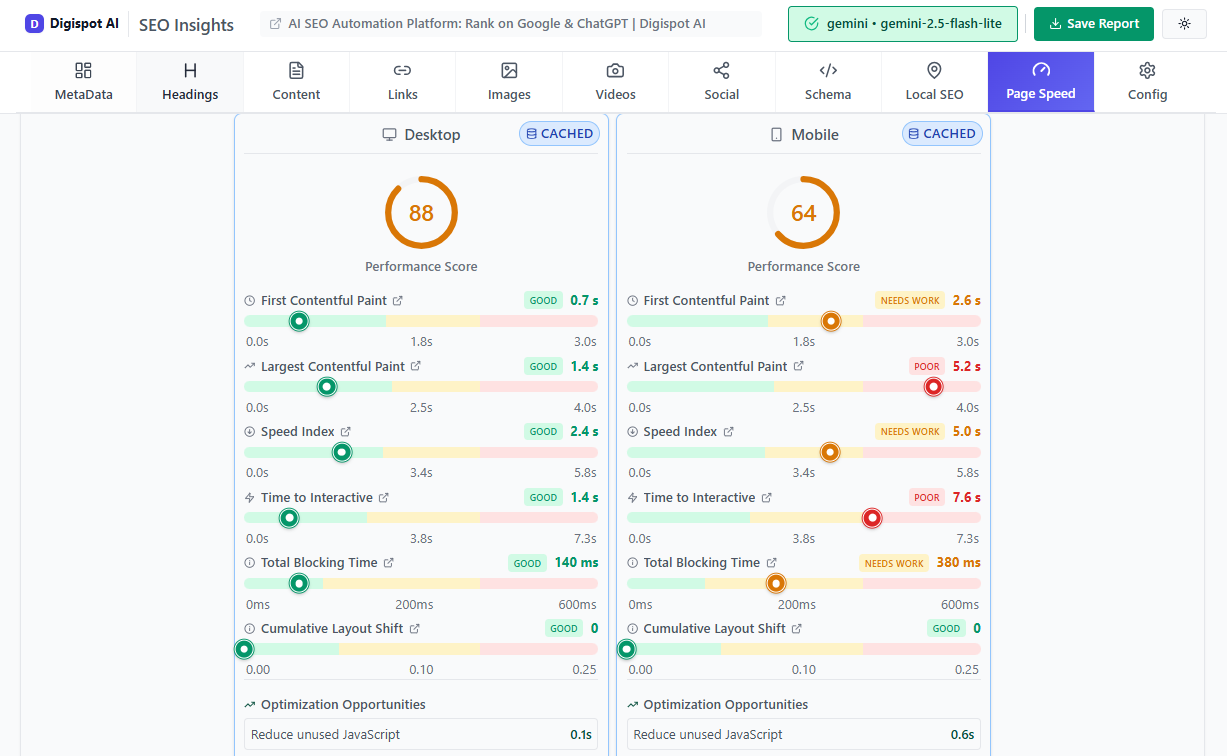
Audit any webpage instantly and uncover hidden SEO insights with our Free Chrome extension.
How to Implement a Chatbot SEO Strategy: A Step-by-Step Approach
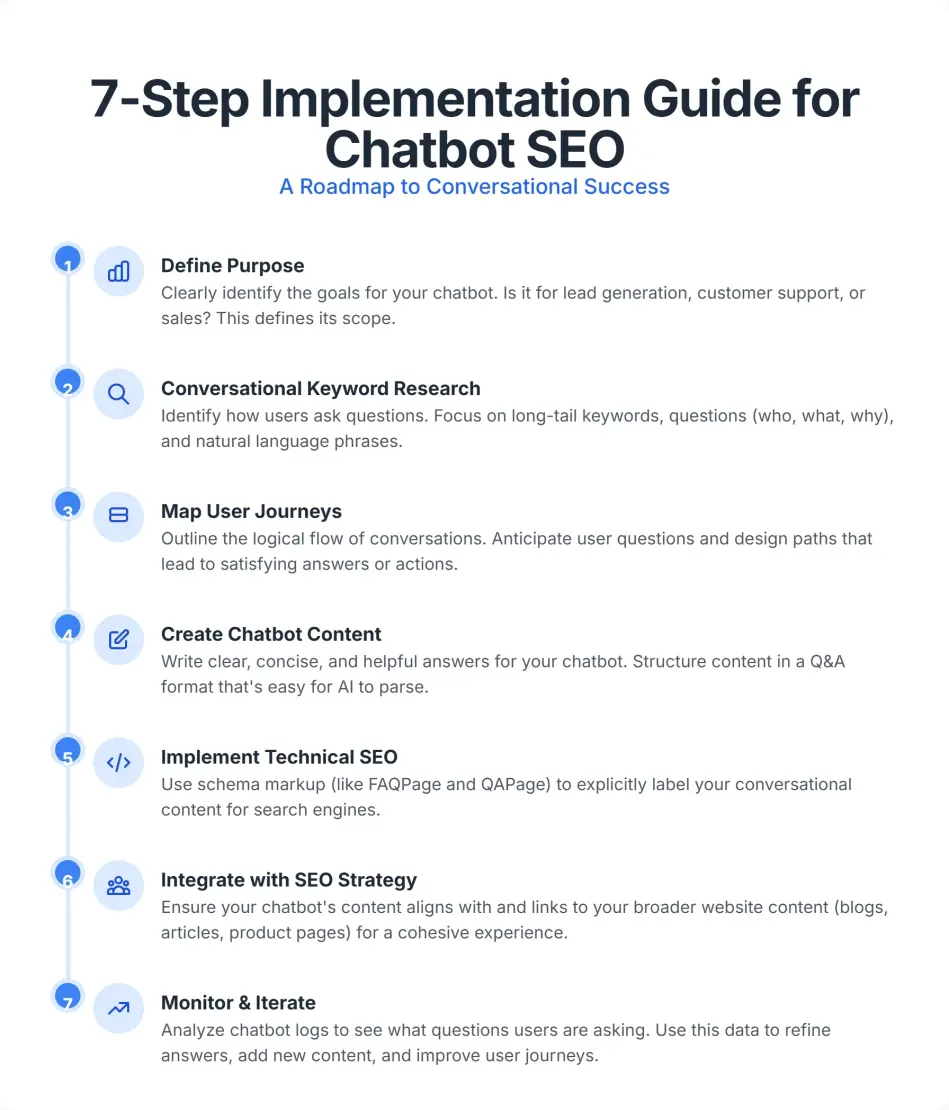
Now that we understand the mechanics, let's look at the practical execution of integrating Chatbot SEO into your digital strategy.
Step 1: Define Your Chatbot's Purpose and Scope
Before writing a single line of script, determine the primary function. Is it for customer service, lead generation, or content navigation? If your goal is SEO, your chatbot should prioritize content discovery—helping users find articles, guides, and products that reside on your site.
Step 2: Conduct Conversational Keyword Research
Traditional keyword research focuses on typed shortcuts like "SEO audit tool." For chatbots, you need to optimize for spoken language like "How do I run a comprehensive SEO audit on my website?"
- Long-Tail and Conversational Keywords: People use natural, complete sentences when interacting with bots. These map directly to long-tail keyword targeting, where lower competition and clearer intent make each query easier to win.
- Question-Based Queries: Focus heavily on the 5 W's (Who, What, Where, When, Why) and How.
- Analyze Existing User Data: Use Google Search Console to find question-based queries you already rank for. You can use Regex filters in GSC (like
\b(who|what|where|when|why|how)\b) to filter your performance report specifically for questions. This is a goldmine for understanding user intent. - Competitor Analysis: Interact with your competitors' chatbots. See what questions they prioritize and how they structure their answers.
Step 3: Map User Journeys and Intents
Anticipate the paths users take. If a user asks about "pricing," they are likely in a decision-making phase. Your chatbot should provide the price but also offer a comparison guide or a case study—content that reinforces the value proposition. Design the flow to keep them engaged with your site's content, reducing bounce rates.
Step 4: Create and Optimize Chatbot Content
Develop the scripts your chatbot will use based on your research.
- Craft Clear, Concise Responses: Ensure answers are direct.
- Incorporate SEO Keywords Naturally: Integrate your identified conversational keywords into the chatbot's script, but prioritize flow. If it sounds robotic, rewrite it.
- Maintain Brand Voice: Your chatbot is an extension of your brand personality. Consistency builds trust (E-E-A-T).
Step 5: Implement Technical SEO for Chatbots
This is where you bridge the gap between the bot and the crawler.
- Structured Data Implementation: As discussed, wrap your Q&A content in schema. If your chatbot answers questions about your return policy, ensure your actual Return Policy page has FAQPage schema reflecting those exact questions.
- XML Sitemaps: If your chatbot generates dynamic URLs for conversation threads (like a forum), ensure valuable threads are indexable and included in your XML sitemap. However, be careful not to index low-quality or duplicate conversations.
- Mobile-First Design: Test your chatbot rigorously on mobile. Does it block content? Is it easy to close? These UX factors directly impact your mobile rankings.
Step 6: Integrate with Your Overall SEO Strategy
Chatbot SEO isn't a silo; it's an amplifier.
- Content Strategy Alignment: If your chatbot is constantly answering a question you don't have a blog post for, write that blog post immediately.
- Link Building: A helpful chatbot tool can be a "linkable asset." If your bot provides unique utility (like a customized ROI calculator), other sites are more likely to link to it.
- Zero-Click Optimization: By optimizing for chatbots, you are often optimizing for zero-click searches—where the user gets the answer directly on the SERP. While this might reduce click-through rate, it massively builds brand authority.
Step 7: Monitor, Analyze, and Iterate
Optimization is an ongoing process.
- Track Performance Metrics: Use Google Analytics 4 (GA4) to create events for chatbot interactions. Correlate these events with session duration and conversion rates.
- Analyze Chatbot Transcripts: Reviewing logs is the best way to find "failed" searches—queries your bot couldn't answer. These are your next content topics.
- Utilize AI for Insights: Platforms like Digispot AI offer "Opportunity Finder" features that analyze your data to spot untapped SEO opportunities.
The Role of AI Platforms in Supercharging Your Chatbot SEO
Executing this strategy manually can be complex, especially for large websites. Dedicated AI SEO platforms streamline the heavy lifting.
Platforms like Digispot AI are designed to automate the optimization of your website for both traditional and AI-driven search engines. Here’s how such a platform empowers your Chatbot SEO efforts:
- Comprehensive Website Auditing: Digispot AI analyzes over 200 ranking factors, including technical SEO and page performance. It identifies heavy scripts or render-blocking resources that could be caused by unoptimized chatbots, ensuring your site speed remains competitive.
- Intelligent Issue Detection: If your schema markup is broken, search engines won't understand your content. Digispot AI detects syntax errors in your structured data, ensuring your FAQs and Q&As are eligible for rich snippets.
- Data-Driven Performance Tracking: By integrating with Google Search Console, the platform helps you visualize which question-based queries are driving traffic, allowing you to feed this data back into your chatbot scripts.
- AI-Powered Content Creation: Digispot AI’s "Content Studio" uses AI agents to generate SEO-optimized content drafts. You can use this to quickly produce the human-friendly Q&A content that chatbots rely on.
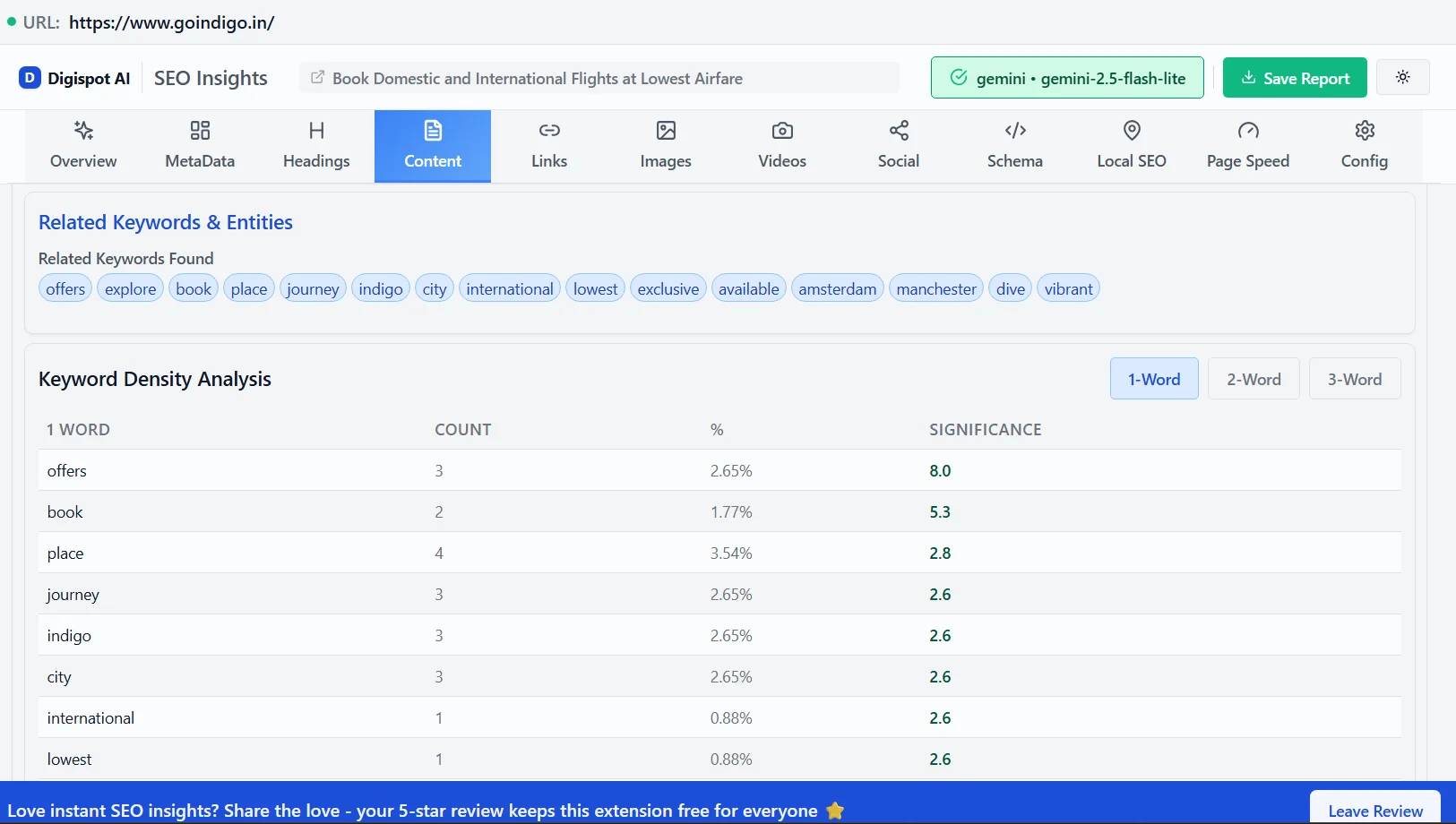
- Real-time On-Page Audits: For immediate insights, the Digispot AI free community Chrome extension allows you to audit any page directly in your browser. You can instantly check if a page has the correct schema markup to support your chatbot strategy.
Try it now: Get instant SEO insights on any page with our free Chrome extension.
Mastering "Magic Keywords" for Human-Friendly Chatbot SEO Content
Incorporating "magic keywords" naturally into your content makes it highly discoverable by conversational search queries. These align with the "Micro-Moments" behavior model defined by Google (I-want-to-know, I-want-to-do moments).
Here is how to weave them into your content strategy:
- "What" (Definition Intent):
- Usage: "What is Chatbot SEO?" or "What are Core Web Vitals?"
- Strategy: Start sections with clear definitions. This increases the chance of being picked up as a Featured Snippet or an AI Overview answer.
- "How" (Process Intent):
- Usage: "How do chatbots enhance user experience?" or "How to implement FAQ schema."
- Strategy: Use numbered lists or bullet points immediately following these headings. Bots love structured lists.
- "Why" (Reasoning Intent):
- Usage: "Why is conversational AI crucial?"
- Strategy: Use "because" or "due to" early in the answer to provide clear logical connection for the AI to parse.
- "Benefits" (Transactional/Commercial Intent):
- Usage: "The Benefits of Integrating Chatbots for SEO."
- Strategy: Use comparison tables (like the one in this article) to present data clearly.
By consciously structuring your content around these prompts, you align your text with the basics of how Google works—matching content to specific user needs.
Business Outcomes: The Real-World Impact of Chatbot SEO
Ultimately, the goal of any SEO strategy is to drive revenue. What happens when you get this right?
- Dominating the "Position Zero": By optimizing for questions, your content is more likely to win Google Featured Snippets and appear in AI Overviews. This prime real estate establishes you as the market authority before a user even clicks a link.
- Higher Quality Leads: Users who interact with chatbots often have higher intent. They are actively seeking solutions. By optimizing this path, you nurture these leads automatically, resulting in a higher conversion rate from organic traffic.
- Operational Efficiency: An SEO-optimized chatbot acts as a first line of defense for support. It deflects common repetitive questions (which you identified via keyword research), allowing your human team to focus on complex, high-value issues. This saves operational costs while improving customer satisfaction.
Start Improving Your Conversational Search Visibility Today
Chatbot SEO is not a fleeting trend; it is the necessary evolution of search. As search engines transform into "Answer Engines," the ability for your content to be understood and conversed by AI is critical. By strategically optimizing your chatbot interactions and the content they rely on, you safeguard your visibility against future algorithm updates.
From understanding user intent to leveraging technical schema markup, every step you take builds a more resilient, intelligent digital presence. Don't wait for your competitors to dominate the conversational space.
Ready to improve your search visibility? Try Digispot AI for comprehensive website audits and actionable recommendations that get your site ready for the AI era.
References
- Understand how Google Search works
- Schema Markup: Structured Data for Search Engines
- FAQPage Structured Data
- HowTo Structured Data
- Q&A Structured Data
- Mobile-first indexing
- Page experience signals
- Core Web Vitals
- Google Search Console
- Google Analytics
- Digispot AI - AI SEO Platform
- Digispot AI - FREE On Page SEO Audit Tool
- Digispot AI - FREE Chrome Extension for SEO Insights
Audit any page in seconds
300+ SEO checks including Core Web Vitals, schema markup, meta tags, and AI readiness — trusted by 1000+ SEO experts and marketers.
Frequently Asked Questions
Here are some of our most commonly asked questions. If you need more help, feel free to reach out to us.
Written by
Maya Krishnan
Digital growth expert
Maya is a seasoned expert in web development, SEO, and digital strategy, dedicated to helping businesses achieve sustainable growth online. With a blend of technical expertise and strategic insight, she specializes in creating optimized web solutions, enhancing user experiences, and driving data-driven results. A trusted voice in the industry, Maya simplifies complex digital concepts through her writing, empowering readers with actionable strategies to thrive in the ever-evolving digital landscape.