Featured Snippet SEO: Win Position Zero on Google
Master featured snippet SEO to capture position zero. Learn content structuring, question targeting, and optimization for SERP visibility.
 Maya Krishnan
Winning the battle for online attention requires more than just making it to the first page of Google. Approximately 30% of Google searches now result in a featured snippet, effectively pushing the traditional "number one" organic result down the page. While earning a top spot is an achievement, the true power player in modern Search Engine Results Pages (SERPs) is "position zero."
These prominent information boxes appear right at the top of search results, offering unmatched visibility and a significant strategic advantage over competitors who might rank higher organically but lack the snippet structure. But what mechanisms drive these snippets? How do they function within the context of Answer Engine Optimization (AEO)? And most importantly, how can you engineer your content to claim this coveted real estate?
This comprehensive guide will demystify the mechanics of featured snippets, explaining their immense benefits and walking you through granular strategies to optimize your content. We will explore how modern AI SEO platforms, like Digispot AI, and essential browser extensions can streamline your journey to snippet dominance, transforming your content from a simple search result into the definitive answer.
What Exactly Are Featured Snippets? Understanding Position Zero
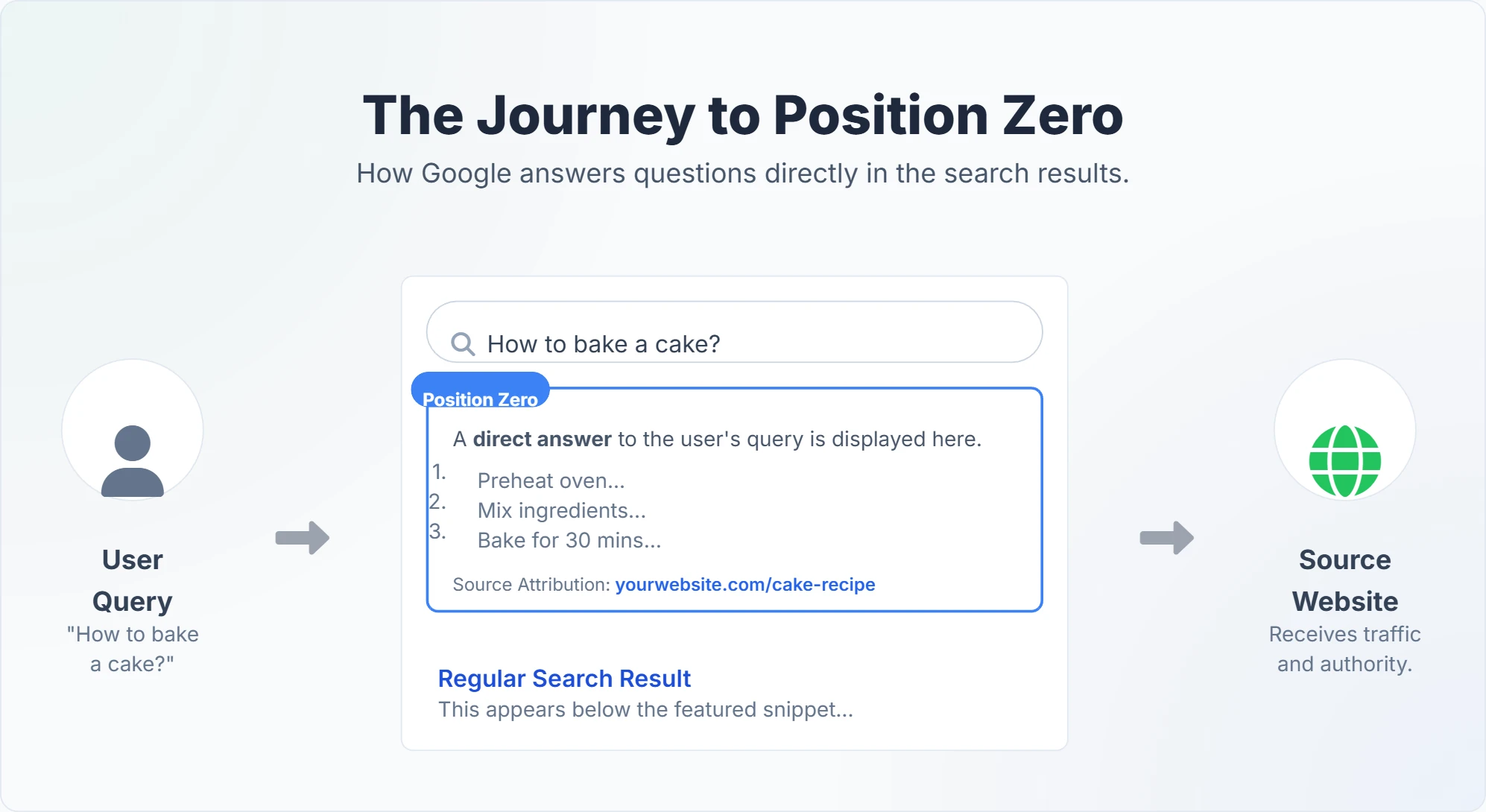
Imagine a user asks a specific question on Google, such as "how to optimize images for web." Before they even scroll to the first blue link, they see a box containing a concise, direct answer extracted from a webpage. That is a featured snippet. Google's algorithms programmatically pull these snippets from web pages they deem the most relevant, authoritative, and structurally sound to answer the query.
These snippets effectively award your content a "position zero" ranking. This is Google's method of enhancing user experience by reducing friction—providing immediate satisfaction for informational queries. This evolution marks a shift from Google functioning purely as a search engine (finding links) to an answer engine (providing solutions).
The Mechanics of Selection
Google does not manually curate these results. Instead, automated systems determine if a page would make a good featured snippet to highlight for a specific search request. The algorithm looks for:
- Relevance: Does the text directly address the query intent?
- Structure: Is the answer easy to parse (e.g., inside an
<ol>,<ul>, or concise<p>tag)? - Authority: Does the domain have sufficient trust signals?
Interestingly, you do not need to rank #1 organically to win the snippet. Pages ranking anywhere from position #1 to #5 (and occasionally lower on page 1) are eligible to jump the queue and take position zero. If you are struggling to identify which of your pages are striking distance candidates, Digispot AI can automatically analyze your keyword rankings to pinpoint these opportunities.
Key Characteristics of Featured Snippets:
- Prominent Placement: They occupy the largest pixel area above the fold on mobile and desktop.
- Concise Answer: They prioritize brevity and factual accuracy.
- Source Attribution: They always include a title, URL, and often a thumbnail image linking to the source.
- Voice Search Fuel: Digital assistants like Siri and Google Assistant often read the featured snippet aloud as the definitive answer.
The Different Flavors of Featured Snippets: Knowing Your Options
Google presents featured snippets in various formats, each triggered by specific types of intent. Understanding these formats is not just academic; it dictates how you write and code your HTML.
Table 1: Common Types of Featured Snippets and Their Characteristics
| Snippet Type | Description | Best Use Cases | Optimization Focus |
|---|---|---|---|
| Paragraph | The most common type (approx. 70%), displaying a short block of text (40-60 words) that directly answers a question. | "What is SEO?", "Why do dogs bark?", "Definitions", "Explainers" | Clear, concise answer in a paragraph (<p>) tag, immediately following a heading (<h2> or <h3>) that matches the query. |
| Numbered List | Presents information in a step-by-step format, ideal for instructions, recipes, or rankings. | "How to tie a shoelace", "Top 5 SEO tips", "Steps to bake a cake", "DIY guides" | Use <h1> through <h3> for the title, followed immediately by an <ol> tag. Ensure list items are concise. |
| Bulleted List | Displays a list of items or features without a specific order, used for non-sequential data. | "Benefits of exercise", "Ingredients for pizza dough", "Features of iPhone 15", "Checklists" | Use <ul> tags. Great for listicles where ranking order doesn't matter. |
| Table | Shows data in a structured tabular format. Google scrapes rows and columns to present a clean comparison. | "Smartphone specs comparison", "Tax brackets 2026", "Nutritional values", "Pricing tables" | Well-structured HTML <table> tags with clear <th> (headers) and <tr> (rows). Avoid complex merged cells. |
| Video | A YouTube video (often with a timestamp) that visually answers the query. | "How to change a tire", "Product reviews", "Fitness tutorials" | Voiceover clarity, accurate video descriptions, and chapters/timestamps in the video description. |
To illustrate, if a user searches "How to bake a chocolate cake," a numbered list snippet detailing the steps would be ideal. Conversely, for "What are the benefits of meditation?", a bulleted list highlighting the advantages would be more appropriate. Understanding these nuances allows you to tailor your content for optimal snippet capture.
The "Double-Feature" Phenomenon
Occasionally, Google displays a "double snippet," pulling text from one site and an image from another. This usually happens when the text-heavy site lacks high-quality, relevant imagery. To avoid sharing your position zero glory, ensure your content includes optimized images with relevant file names and alt text near your target answer paragraph.
Why Pursue Featured Snippets? The Undeniable Benefits
Securing a featured snippet isn't just about vanity metrics; it delivers tangible, significant benefits for your website's performance and your brand's bottom line.
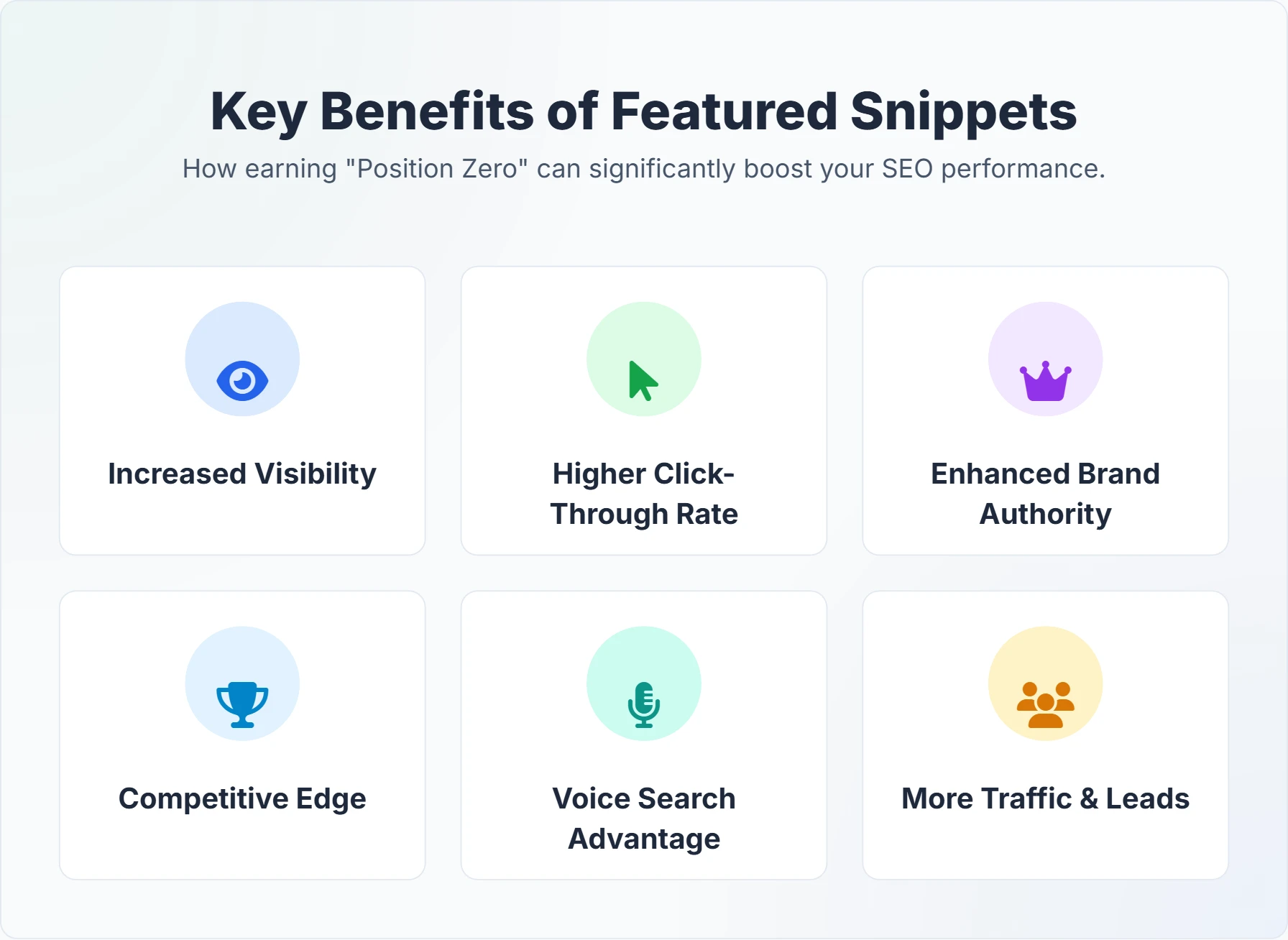
- Massive Boost in Visibility & SERP Real Estate: As "position zero," featured snippets dominate the search results page. Your brand becomes the very first thing users see. On mobile devices, a featured snippet often takes up the entire initial viewport, forcing users to scroll past your answer to see any competitor. This is a defensive moat against competition.
- Increased Click-Through Rate (CTR): A common myth is that snippets "steal" clicks because the user gets the answer immediately. While this can happen for simple queries (e.g., "What is the capital of France?"), for complex topics, studies show snippets often increase CTR. Users view the snippet as a preview; if the answer is high-quality, they click through to read the full context.
- Enhanced Brand Authority and Trust: Being chosen by Google for a featured snippet is an implicit endorsement. It signals that your website is the most trusted, authoritative source on that specific topic. This "halo effect" improves brand perception even if the user doesn't click immediately.
- Stealing the Competitive Edge: If your competitor holds a featured snippet for a high-volume keyword, they are capturing the lion's share of attention. By optimizing for and winning that snippet, you effectively flip the script, demoting them to a standard organic listing while you take the prime spot.
- Voice Search Advantage: With the proliferation of smart speakers, featured snippets are the lifeblood of voice search. When a user asks Alexa or Google Home a question, the device doesn't read out ten blue links—it reads the featured snippet. Optimizing for snippets is the most direct path to relevance in the voice search era.
- Improved Organic Traffic and Lead Quality: Users who click through from a featured snippet are often highly qualified—they have a specific problem and your site has already demonstrated it has the solution. This aligns closely with zero-click search strategies where the goal is brand dissemination as much as traffic.
Consider a local law firm aiming to increase clients. By securing a featured snippet for "What to do after a car accident," they establish immediate expertise. A user in a high-stress situation sees their step-by-step guide at position zero, trusts the authority, and is far more likely to call that firm than one buried in position #4.
How to Optimize for Featured Snippets: Your Step-by-Step Guide
Optimizing for featured snippets requires a strategic shift in how you write and format content. It is less about "creative writing" and more about "structured communication." Here is the blueprint for winning position zero.
1. Identify Snippet Opportunities with "Magic Keywords"
You cannot target a snippet if you don't know the question. Keyword research for snippets differs from standard volume research; you are looking for intent.
- Target Question-Based Queries: Use tools to filter keyword lists for interrogatives: Who, What, Where, When, Why, and How.
- Look for "Implied" Questions: Not all snippet queries are questions. "Best SEO tools" implies "What are the best SEO tools?" "Price of iPhone 15" implies "How much does the iPhone 15 cost?"
- Trigger Words: Include words that signal a specific format:
- Paragraph triggers: Definition, Meaning, Explain, What is.
- List triggers: Best, Top, Steps, Process, Checklist, Instructions.
- Table triggers: Comparison, Vs, Pricing, Rates, Specs, Schedule.
- Leverage "People Also Ask" (PAA): The PAA box in Google search results is a goldmine. These are the exact questions Google associates with your main topic. If you answer these better than the current ranking page, you can win the snippet.
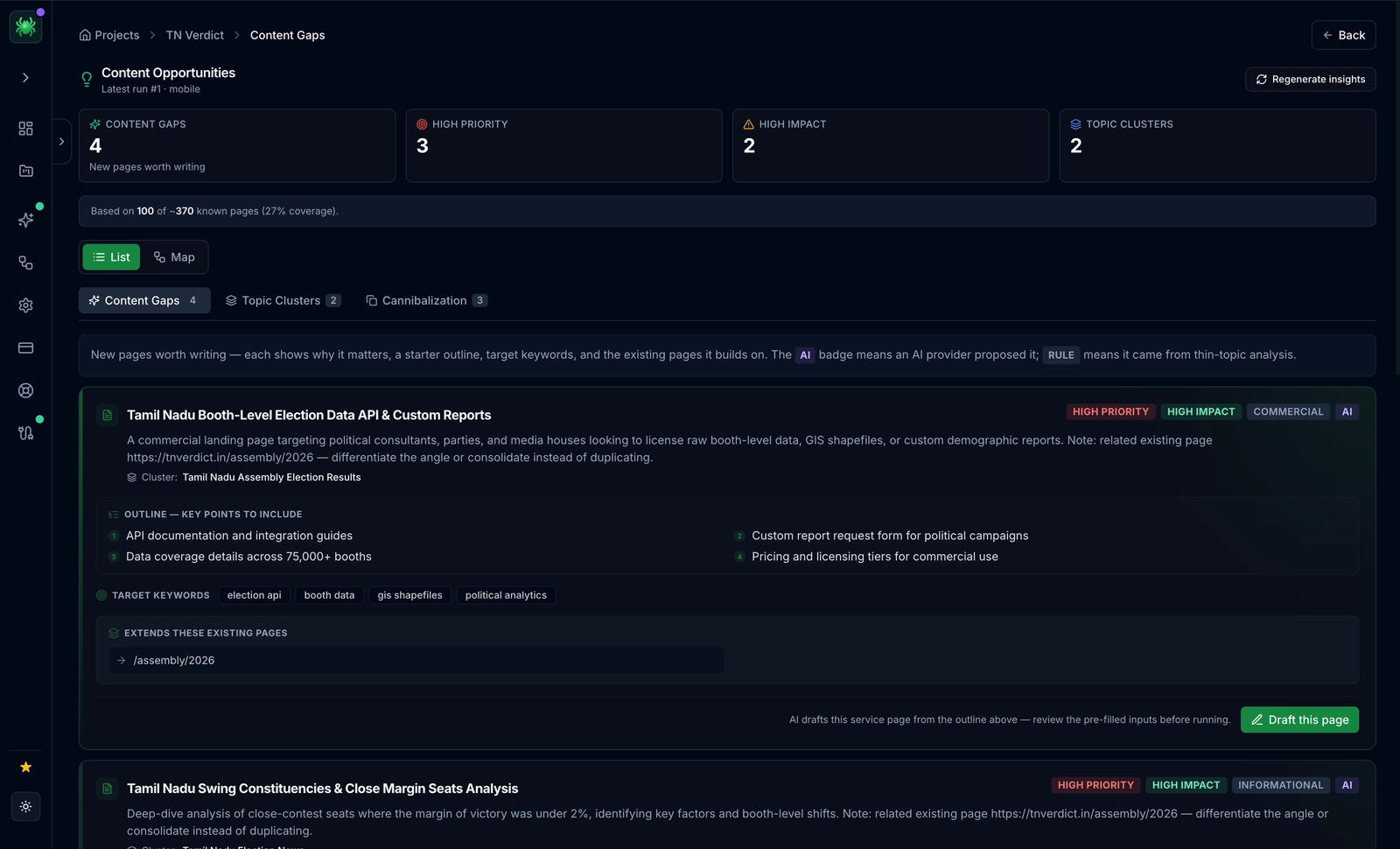
- Use Digispot AI: An AI SEO platform like Digispot AI automates this. Its "Opportunity Finder" analyzes search trends and competitor snippets to spot "low-hanging fruit"—keywords where you already rank on page 1 but don't yet have the snippet.
2. Structure Content with the "Inverted Pyramid"
Journalists use the inverted pyramid style: most important info first, details later. This is exactly what Google's bot needs.
- The Snippet Block: Immediately after your H2 or H3 heading (e.g.,
<h2>How to Clean White Sneakers</h2>), provide the direct answer. Do not fluff. Do not say, "Cleaning sneakers is important because..." Start with "To clean white sneakers, mix baking soda and vinegar..." - Optimal Word Count:
- Paragraphs: 40 to 60 words. This is the "sweet spot" size for the snippet box.
- Lists: 5 to 8 items ideally. If you have more, Google might show a "More items..." link, which increases CTR.
- Formatting Matters:
- Bold key phrases within your answer paragraph to draw the user's (and bot's) eye.
- Ensure your HTML hierarchy is clean. Don't skip from H2 to H4.
- Keep sentences short (under 20 words) and readability high (aim for an 8th-grade reading level).
For further guidance on structuring high-quality pages, review our guide on on-page SEO best practices.
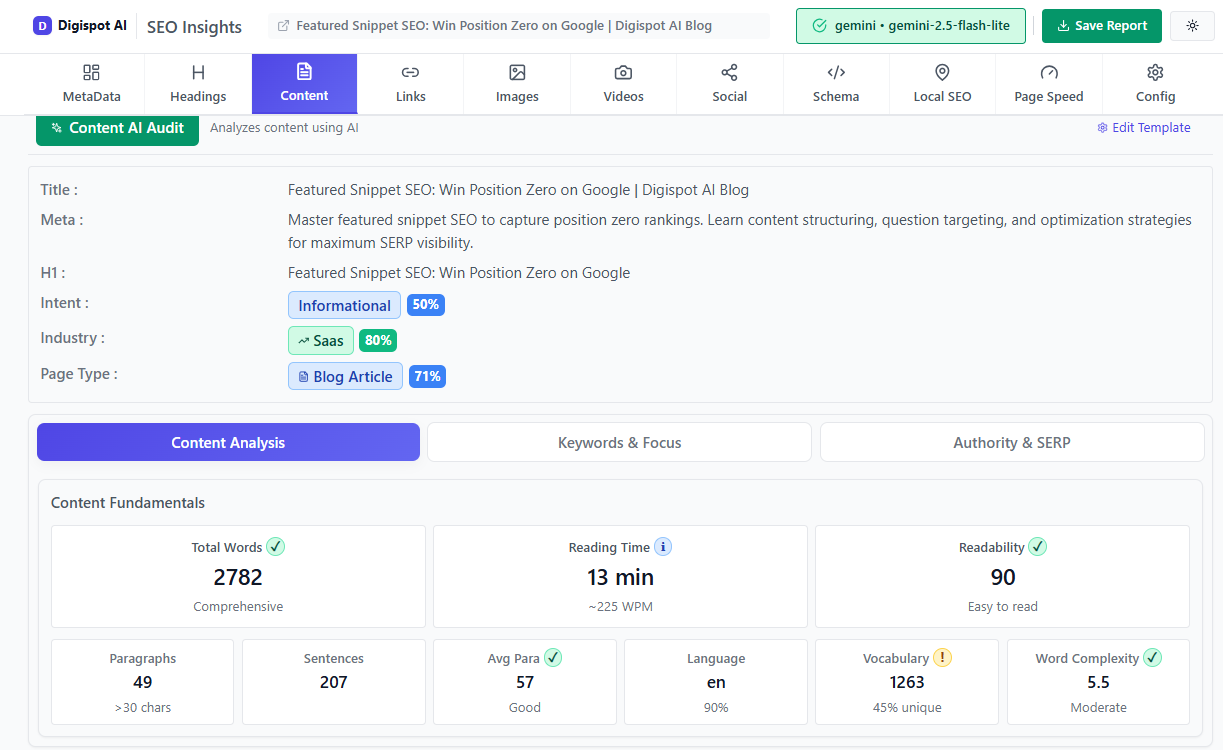
Turn invisible SEO data into clear visuals with our Free Chrome extension.
3. Creating the Content: Practical Examples
Generating high-quality, snippet-optimized content can be time-consuming. However, structure is non-negotiable.
Example: Targeting a "Definition" Snippet
- Bad: "Many people wonder about AEO. It is a new concept that is changing SEO..." (Too much fluff).
- Good: "Answer Engine Optimization (AEO) is the practice of optimizing content to provide direct answers to user queries, primarily for AI-driven search engines and voice assistants. Unlike traditional SEO, which focuses on rankings, AEO focuses on being the single definitive answer."
Example: Targeting a "Table" Snippet Instead of writing "Plan A costs $10 and Plan B costs $20," create a table:
- Use
<th>tags for "Plan Name," "Price," and "Features." - Keep data concise.
- Digispot AI's Content Studio utilizes AI agents to help you generate these structures automatically. It ensures your content addresses the identified opportunities with the exact HTML formatting Google prefers.
4. Technical SEO: Laying the Foundation for Snippet Success
Even the best answer won't win position zero if Google struggles to crawl or render your page.
-
Schema Markup (Structured Data):
- While Google says Schema isn't a direct ranking factor for snippets, it helps disambiguate content.
- FAQPage Schema: Perfect for Q&A pages.
- HowTo Schema: Explicitly tells Google "This is a step-by-step guide," making it easier to parse into a numbered list snippet.
- Implementation: Use the Schema Markup Generator to create valid JSON-LD code without needing a developer.
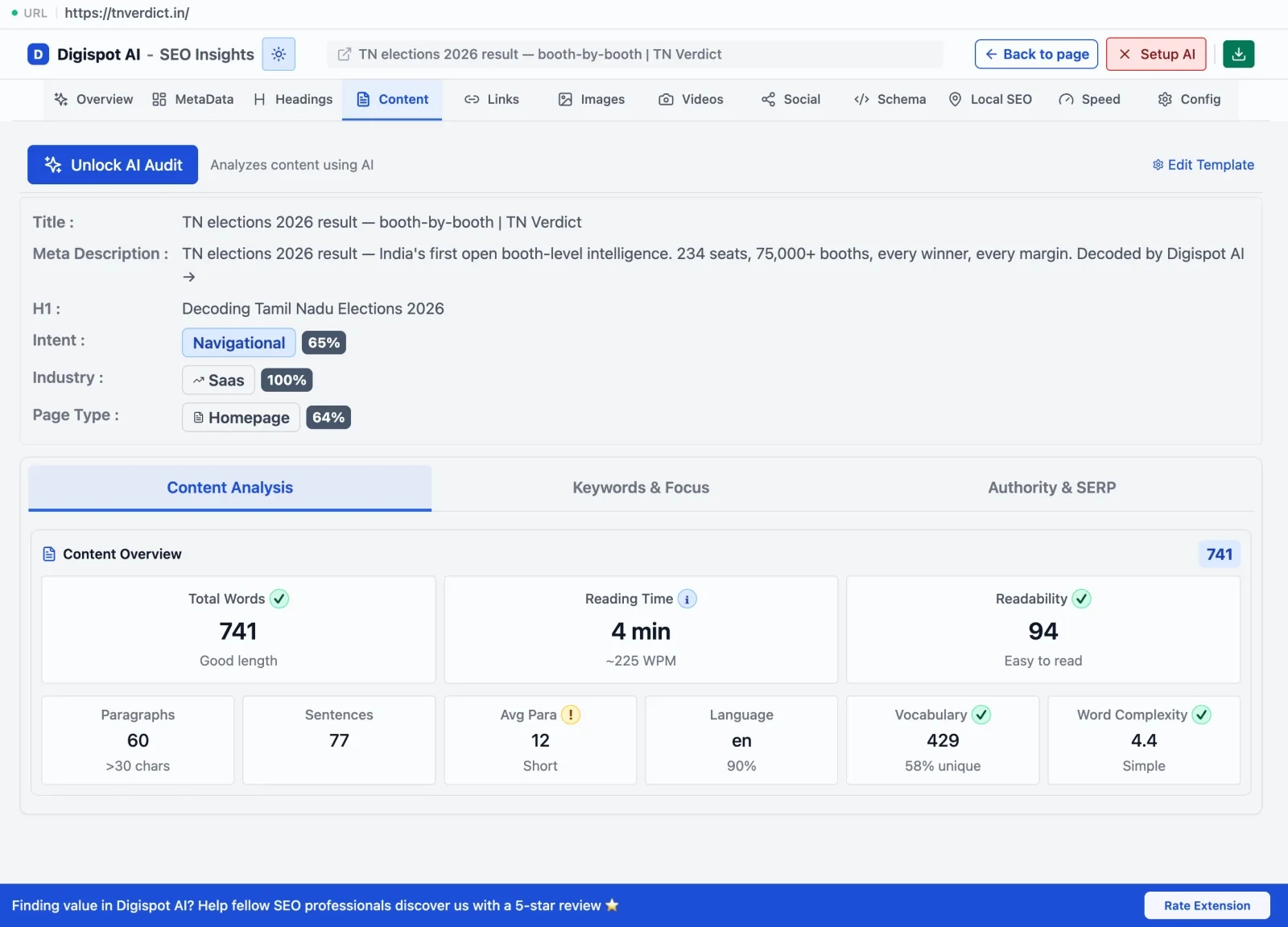
- Validation: The Digispot AI free community Chrome extension allows you to audit your page right in the browser. You can visualize the schema to ensure Google sees exactly what you intended.
-
Page Speed and Core Web Vitals:
- Snippets are about speed—getting the user the answer fast. If your page is slow, Google is less likely to feature it.
- Ensure your Largest Contentful Paint (LCP) is under 2.5 seconds.
- Read more about optimizing speed in our Core Web Vitals SEO guide.
-
Mobile-Friendliness:
- Google uses mobile-first indexing. If your table cuts off on mobile screens or your font is too small, you will lose the snippet eligibility.
- Digispot AI helps by auditing websites in both mobile and desktop modes, identifying layout shifts or render-blocking resources that could hinder your snippet chances.
Digispot AI: Your Ally in the Featured Snippet Journey
While the principles of featured snippet optimization remain consistent, the tools and technologies available today can significantly simplify and accelerate your efforts. Manual analysis of SERPs is impossible at scale. Digispot AI is designed to empower businesses in this competitive landscape.
- Comprehensive Auditing: Digispot AI helps you understand your website's health by auditing it in both mobile and desktop modes. It scrutinizes over 300+ ranking factors. Why does this matter for snippets? Because snippets are often the tie-breaker between two great pages. The technically superior page (better speed, cleaner code) often wins.
- Opportunity Finder: The platform’s "Opportunity Finder" is your sniper rifle for position zero. It scans your existing rankings to find keywords where you rank #2-#10 and a snippet exists. These are your "striking distance" keywords. A few tweaks to content structure on these pages can often capture the snippet within days.
- Content Studio for Snippet Optimization: With its AI agents, Digispot AI's "Content Studio" assists in generating SEO-optimized content that is naturally structured to appeal to Google's snippet algorithms. It can rewrite a fluffy paragraph into a concise, snippet-winning definition in seconds.
- Performance Tracking: Seamless integration with Google Search Console and Google Analytics means you can track the impact of your snippet optimizations. You can see if your CTR improves after winning a snippet or if you need to adjust your strategy.
- Free Community Chrome Extension: For on-the-go analysis, the Digispot AI free community Chrome extension is a powerful tool. It allows you to audit individual web pages directly in your browser. Crucially for snippets, it helps with competitor analysis. You can view the headers and schema of the current snippet holder to reverse-engineer their success. "Get instant SEO insights on any page with our free Chrome extension."
By automating many aspects of SEO and bringing together best practices in a user-friendly model, Digispot AI can help your business operate at scale with accuracy. This automation frees you to focus on strategy rather than manual formatting.
Common Mistakes to Avoid When Chasing Snippets
The path to position zero is riddled with potential errors. In my experience auditing hundreds of sites, these are the most common reasons pages fail to capture snippets despite good rankings.
- The "Teaser" Approach: Some writers intentionally withhold the answer to force a click (e.g., "To find out the price, click here"). Google hates this. The algorithm wants to satisfy the user on the SERP. If you don't give the answer, Google will pick a competitor who does.
- Keyword Stuffing: Overloading your snippet text with keywords makes it read unnaturally. Google's NLP (Natural Language Processing) models are advanced enough to detect "spammy" phrasing. Write for humans first. See our guide on common SEO mistakes for more pitfalls to avoid.
- Formatting as an Image: Never put your data table or list inside an image file (JPEG/PNG). Google cannot read text inside images reliably for snippets. Always use HTML text.
- Lack of Header Association: Placing your answer paragraph too far away from the H2/H3 question header confuses the bot. The answer should immediately follow the question.
- Ignoring Local Context: For local businesses, ensure your snippets include location-specific details if relevant.
- Expecting Permanence: A snippet is borrowed, not owned. Google updates its algorithm thousands of times a year. A snippet you win today could be lost tomorrow if a competitor optimizes better. This is why continuous monitoring with Digispot AI is essential.
I once worked with a client in the financial sector who had excellent, deep-dive articles but zero snippets. The issue? Their intros were 300 words long before answering the core question. By simply adding a 50-word summary definition at the very top of their articles (the "BLUF" or Bottom Line Up Front method), they captured 15 snippets in under a month, driving a 20% lift in organic traffic.
Conclusion: Your Path to Featured Snippet Dominance
Featured snippets represent a golden opportunity in modern SEO. They are the bridge between traditional search and the future of Answer Engine Optimization. By understanding the mechanics of "position zero," targeting question-based queries, and rigidly structuring your content, you can significantly boost your online visibility.
Remember, the goal is not just to rank, but to inform. Craft content that directly answers questions using "magic keywords," structure your information clearly with headings, lists, and tables, and ensure your website's technical foundation is solid.
Start Your Position Zero Strategy Today:
- Audit: Use the free On-Page SEO Analysis tool to check your current content structure.
- Identify: Find the questions your audience is asking using PAA boxes and keyword research.
- Optimize: Rewrite your definitions to be under 60 words and format your steps into clear lists.
- Monitor: Track your wins and losses to refine your approach.
By focusing on delivering value to users in a clear, concise, and structured manner, you're not just optimizing for Google; you're creating a superior experience for your audience. Take the first step and try Digispot AI to identify areas for improvement and start optimizing your content for featured snippets.
References
- Featured snippets and your website | Google Search Central
- How Search works | Google Search Central
- Understand how structured data works | Google Search Central
- About schema.org markup for Search features | Google Search Central
- Core Web Vitals | Google Search Central
- Mobile-friendly pages | Google Search Central
- Google Search Console
- Google Analytics
- Digispot AI - FREE On Page SEO Audit Tool
- Digispot AI - FREE Chrome Extension for SEO Insights
Audit any page in seconds
300+ SEO checks including Core Web Vitals, schema markup, meta tags, and AI readiness — trusted by 1000+ SEO experts and marketers.
Frequently Asked Questions
Here are some of our most commonly asked questions. If you need more help, feel free to reach out to us.
Written by
Maya Krishnan
Digital growth expert
Maya is a seasoned expert in web development, SEO, and digital strategy, dedicated to helping businesses achieve sustainable growth online. With a blend of technical expertise and strategic insight, she specializes in creating optimized web solutions, enhancing user experiences, and driving data-driven results. A trusted voice in the industry, Maya simplifies complex digital concepts through her writing, empowering readers with actionable strategies to thrive in the ever-evolving digital landscape.