How AI-Generated Content Impacts SEO in 2026
Discover how AI-generated content impacts SEO rankings in 2026. Learn Google's stance, optimization best practices, and quality guidelines for success.
 Maya Krishnan
Ranking on the first page of Google used to be a straightforward math problem. You counted keywords, built backlinks, and watched your traffic grow. But the rules have changed fundamentally. We are now in the era of Answer Engine Optimization (AEO), where search engines don't just list links—they generate answers.
The introduction of Google's AI Overviews, Search Generative Experience (SGE), and competitors like Perplexity and ChatGPT has transformed how users find information. They aren't looking for ten blue links anymore. They want immediate, accurate solutions. If your content isn't optimized for these large language models (LLMs), you risk becoming invisible, regardless of your traditional domain authority.
This shift has created a dual challenge. First, you must produce content that satisfies these sophisticated AI algorithms. Second, you must maintain the human connection that converts readers into customers. Stuffing keywords is obsolete. The new standard requires creating semantic richness, demonstrating clear expertise, and structuring data so machines can parse it effortlessly.
That is where AI-powered content SEO becomes critical. This guide breaks down exactly how this methodology works in 2026. We will examine the mechanics of AI search, how to leverage tools effectively, and how platforms like Digispot AI help you automate complex optimization tasks without sacrificing quality.
Key Takeaways
- Google judges quality, not authorship. AI-generated content can rank when it is fact-checked, adds unique insight, and satisfies search intent—use AI to draft, but let a human own accuracy and voice.
- Optimize for answers, not just links. Structure pages to be cited by AI Overviews, Perplexity, and ChatGPT: answer the core question early, add depth, and mark up entities with schema.
- Let data pick your topics. Use AI to find semantic clusters, content gaps, and underserved "People Also Ask" questions instead of guessing your editorial calendar.
- Always add the "E" in E-E-A-T. Weave in first-hand experience, original data, and expert quotes—signals no model can invent—to survive Google's unhelpful-content filtering.
- Treat SEO as a loop. Audit, publish, then measure AEO visibility and conversions through GSC and GA4, and iterate on what actually drives leads.
What is AI Content SEO?
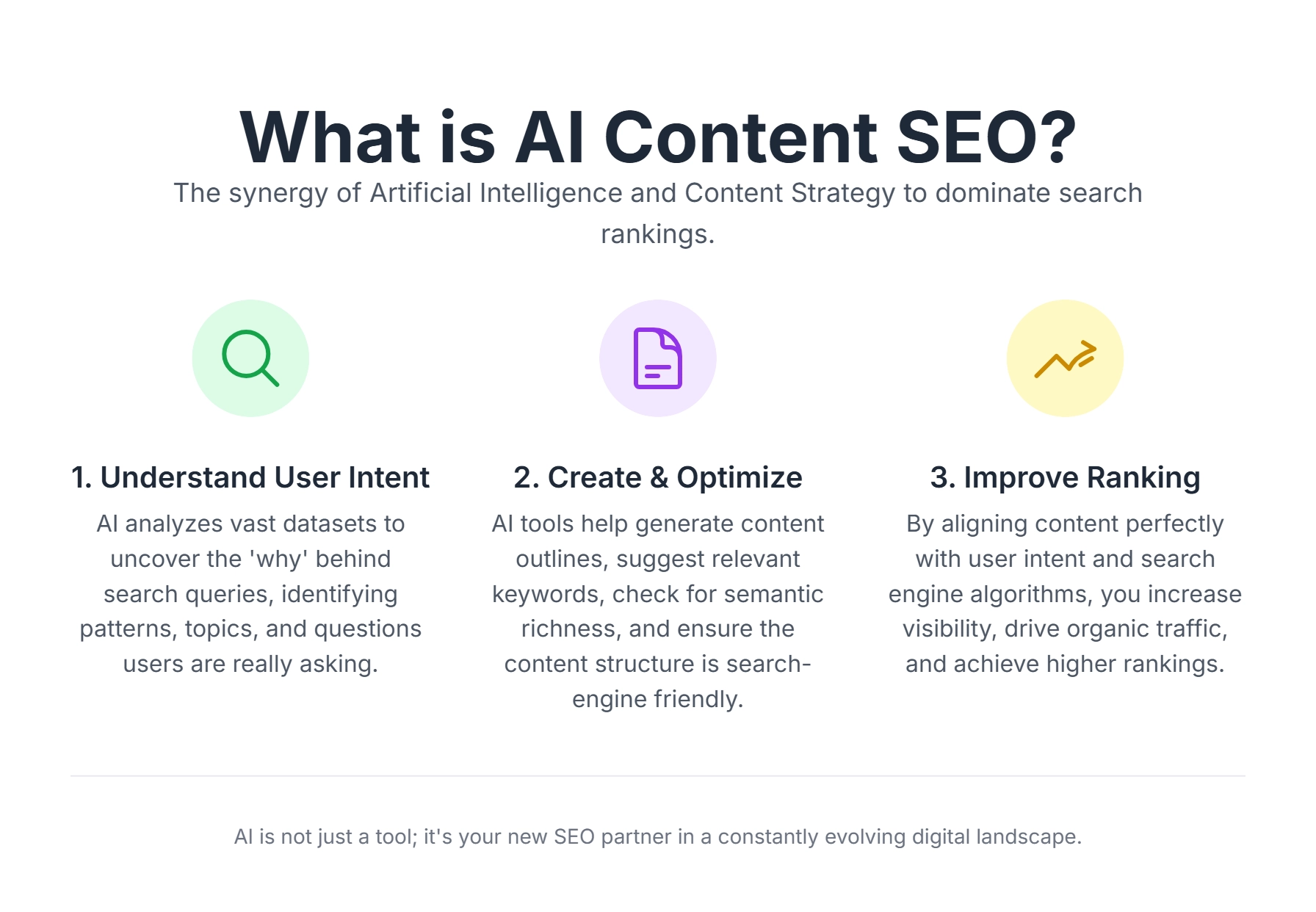
AI content SEO is the strategic fusion of artificial intelligence technologies with traditional search engine optimization principles. It goes beyond simple automation. It involves using Machine Learning (ML), Natural Language Processing (NLP), and Generative AI to analyze, create, and optimize web content for maximum visibility in both traditional search engines (like Google) and AI-powered answer engines (like ChatGPT or Claude).
In the past, SEO was about matching queries to keywords. Today, it is about matching intent to context. Modern algorithms, including Google’s MUM (Multitask Unified Model) and Gemini-powered core updates, read content similarly to how humans do. They look for nuance, depth, and "Information Gain"—the unique value your specific page adds to the overall web.
The Shift from SEO to AEO
Understanding AI Content SEO requires acknowledging the rise of AEO (Answer Engine Optimization). While SEO focuses on ranking a URL, AEO focuses on becoming the cited source for an AI-generated answer.
When a user asks, "What is the best CRM for small business?", an AI search engine synthesizes an answer from multiple trusted sources. To be one of those sources, your content must:
- Be factually dense and accurate.
- Use structured data (Schema) to define entities clearly.
- Answer specific questions concisely (often in the first paragraph).
- Demonstrate clear E-E-A-T (Experience, Expertise, Authoritativeness, Trustworthiness).
AI Content SEO is the workflow you use to achieve these standards at scale.
Consider a practical example. A user asks Perplexity, "How do I speed up a slow WordPress site?" The engine doesn't return ten links—it drafts a step-by-step answer and cites two or three pages. To be one of those citations, your article needs a crisp, self-contained answer near the top (for example, a short numbered list: compress images, enable caching, remove render-blocking scripts, upgrade hosting), each step expanded below, and HowTo or FAQPage schema wrapping the content so the model can extract discrete steps. A 3,000-word essay that buries the answer in paragraph twelve rarely gets cited, even if it ranks. For a full playbook on this citation-first mindset, see our answer engine optimization guide and the deeper walkthrough on optimizing content for LLMs.
The Foundation: How AI Enhances Your Content & SEO Efforts
Integrating AI into your workflow doesn't mean letting a robot run your marketing department. It means equipping your human experts with a supercomputer. We can categorize AI's role into two distinct powerhouses: Creative Augmentation and Technical Optimization.
How AI Assists in Content Creation
Producing high-quality content consistently is the biggest bottleneck for marketing teams. AI alleviates this pressure by handling the heavy lifting of data processing and structural organization.
- Brainstorming and Semantic Clustering: Humans are limited by their own biases and memory. AI can analyze millions of search queries instantly to find semantic clusters—groups of related topics that establish topical authority. Instead of just writing about "running shoes," AI helps you map out necessary sub-topics like "pronation," "heel drop," and "trail vs. road," ensuring your coverage is comprehensive enough to satisfy Google's topical depth requirements.
- Outline and Draft Generation: Blank page syndrome is a productivity killer. AI agents can generate detailed outlines based on the top-ranking results for your target query. This ensures you hit every intent signal required to rank before you even write a sentence.
- Content Expansion and Repurposing: A single webinar transcript can be a goldmine. AI tools can ingest that transcript and output a blog post, a LinkedIn carousel text, five Twitter threads, and a newsletter intro. This ensures your message remains consistent across all channels without tripling your workload.
- Grammar, Style, and Tone Enforcement: Beyond basic spell-checking, modern AI writing assistants can be trained on your specific brand voice. They ensure consistency whether you are writing a technical whitepaper or a casual Instagram caption, correcting awkward phrasing that might confuse readers or search algorithms.
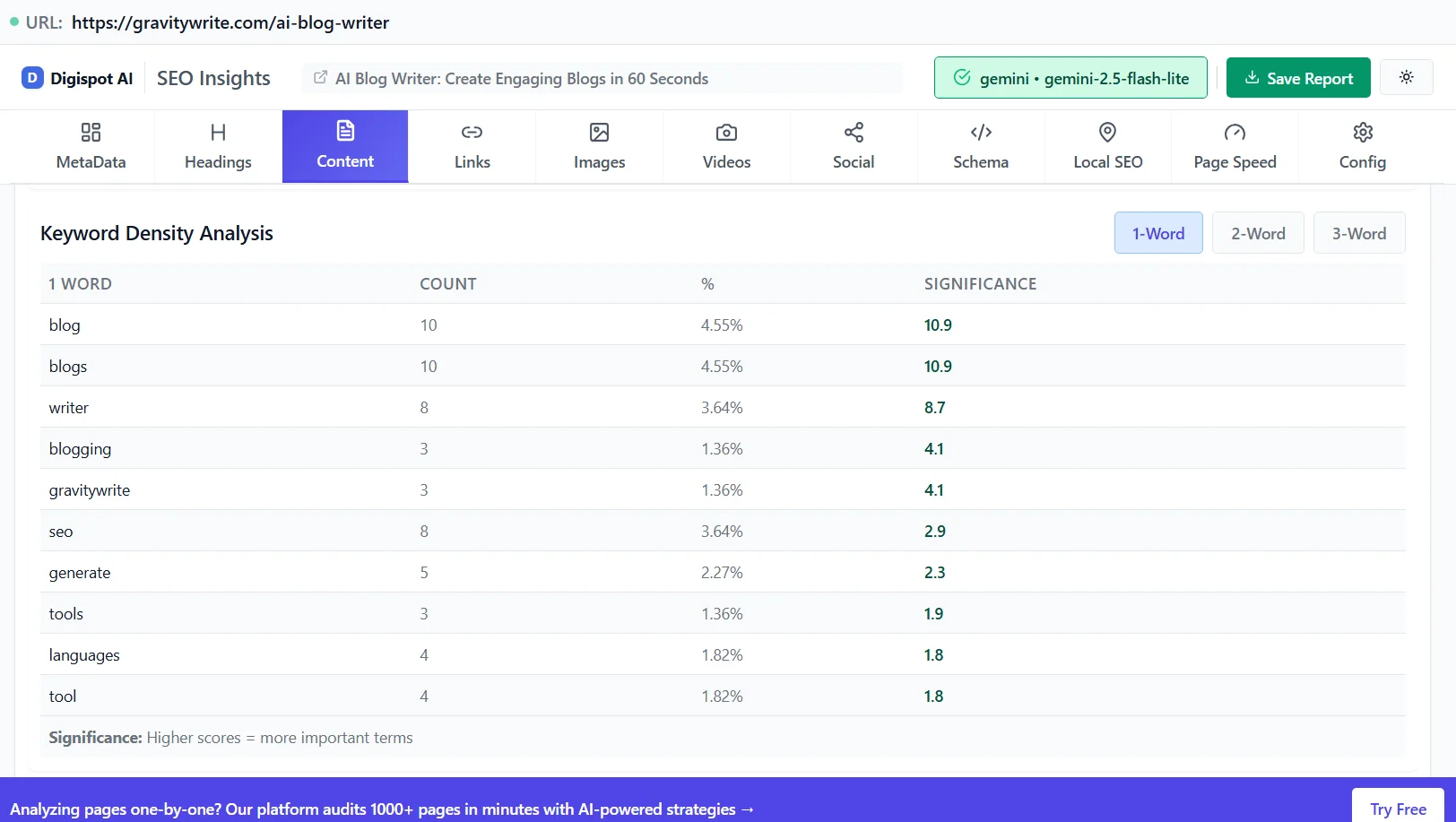
How AI Assists in SEO Optimization
This is where AI transitions from a writing assistant to a data scientist. SEO involves processing more data than any human can handle manually.
- Advanced Keyword Research & Intent Mapping: Traditional tools give you search volume. AI tools analyze the intent behind the volume. They can distinguish whether a user searching for "CRM software" wants a definition, a comparison table, or a "buy now" page. This prevents you from optimizing the wrong type of content for a keyword—a discipline we cover in depth in our guide to optimizing for search intent.
- Competitive Analysis at Scale: You might read the top 3 results. AI can analyze the top 50. It identifies patterns: average word count, common questions answered, schema types used, and image density. This reveals the "table stakes" for ranking and highlights opportunities to outperform competitors.
- Content Gap Analysis: This is crucial for authority. AI compares your site's content graph against your competitors to find "entity gaps." If every competitor mentions "schema markup" in their SEO guide and you don't, AI flags this as a critical omission that is hurting your rankings. See our step-by-step walkthrough on content gap analysis to run this yourself.
- Technical SEO Auditing: Modern sites are complex. AI crawlers can simulate search engine behavior to detect issues across thousands of pages instantly. From broken JavaScript rendering to circular redirects, AI tools spot technical debt before it impacts your revenue. Digispot AI excels here by checking 300+ ranking factors simultaneously.
- Schema Markup Generation: Writing JSON-LD code manually is error-prone. AI can parse your content, understand that it is a "Recipe" or a "SoftwareApplication," and generate valid, error-free schema markup. This code is the language answer engines speak.
- Predictive Analytics: Instead of just reporting what happened, AI uses historical data to predict what will happen. It can forecast traffic trends, alerting you to update seasonal content weeks before the surge occurs.
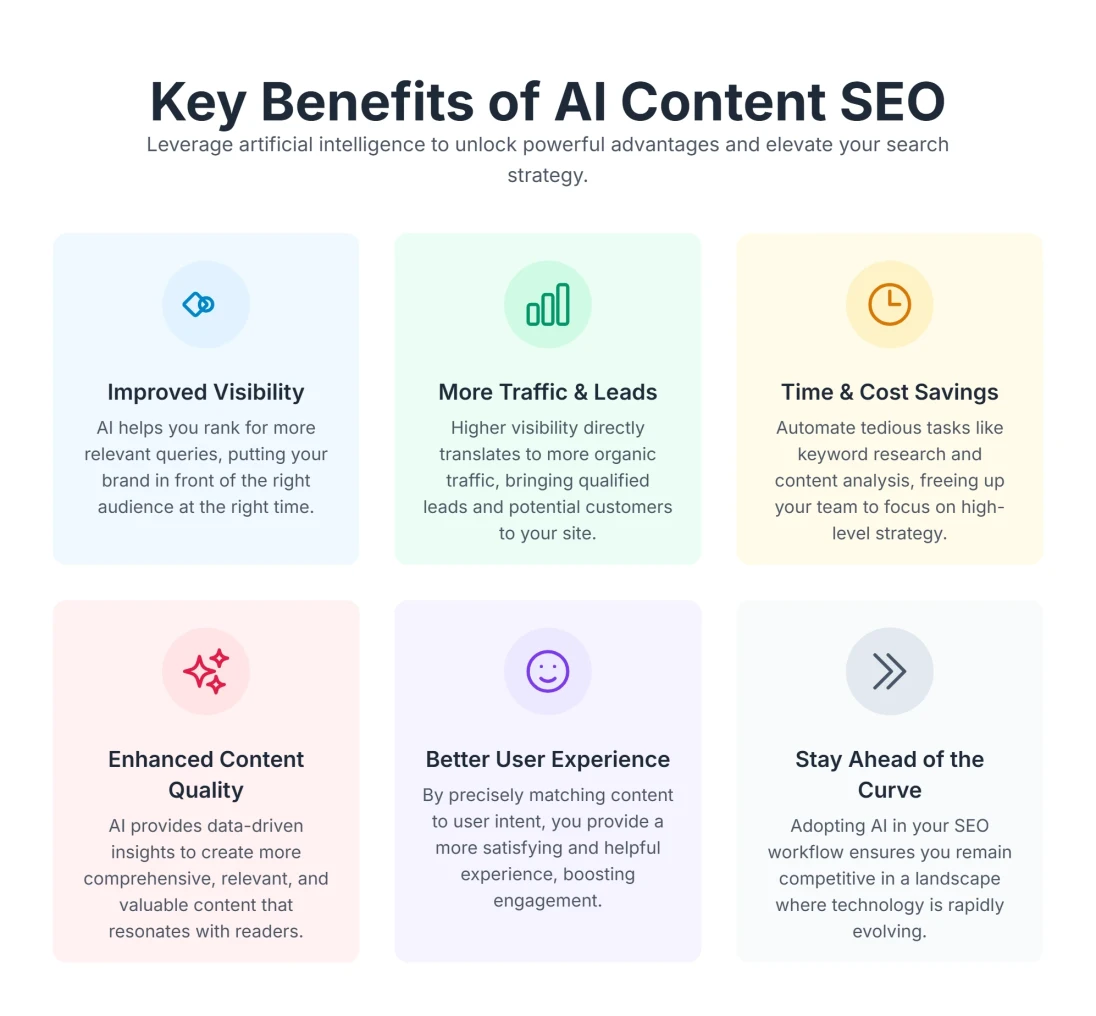
The Tangible Benefits of Embracing AI Content SEO
Adopting an AI-first approach to SEO isn't just about efficiency; it is about survival and growth in a competitive market. The businesses that integrate these tools effectively see compounding returns.
| Benefit | Description |
|---|---|
| Improving Business Visibility | AI deciphers complex algorithm updates faster than humans. By aligning your content with semantic understanding, you rank for more long-tail keywords and appear in AI Overviews, increasing total organic impressions. |
| Increase in Traffic and Business Leads | Better intent matching means the traffic you get is more relevant. Users land on your page and find exactly what they need, reducing bounce rates and increasing the likelihood of conversion. |
| Time and Cost Savings | Automating the research and outlining phase cuts content production time by 40-60%. This reduces the cost per piece of content and allows your team to publish more frequently without burnout. |
| Enhanced Content Quality and Relevance | Data-backed content is inherently higher quality. AI ensures you address all user questions and sub-topics, making your page the most comprehensive resource on the web for that query. |
| Improved User Experience (UX) | Technical SEO is part of UX. AI tools that detect slow loading times or mobile usability errors help you create a frictionless experience. Google rewards sites that users enjoy navigating. |
| Future-Proofing Your Strategy | As search evolves into conversation, AI tools adapt. Using an AI-powered platform ensures your structured data and content formats evolve alongside Google's SGE and other answer engines. |
Navigating the Challenges of AI Content SEO
While the advantages are powerful, the path is not without pitfalls. Misusing AI can lead to penalties, loss of trust, and wasted resources. You must be aware of these risks to mitigate them.
- The "Grey Goo" of Generic Content: If everyone uses the same AI prompt to write an article, the internet floods with identical, average content. Search engines are aggressively filtering out this "unhelpful content." To win, you must inject unique data, personal anecdotes, and contrarian viewpoints that an AI model cannot invent.
- Hallucinations and Accuracy: AI models are predictors, not truth-tellers. They can confidently state facts that are completely false or invent citations that do not exist. Publishing unverified AI content destroys user trust and signals low quality to Google. Human fact-checking is mandatory.
- E-E-A-T Compliance: Google requires Experience, Expertise, Authoritativeness, and Trustworthiness. An AI has no life experience. It has never used your product or solved a client's problem. You must weave real-world expertise into AI drafts to satisfy these quality rater guidelines. For a deeper dive into building trust signals, read our E-E-A-T SEO Guide.
- Over-Reliance on Tools: Tools are navigational aids, not the captain. Relying solely on software without understanding the why behind SEO strategies leads to tactical errors. You still need a strategist to interpret the data.
- Lack of Emotional Resonance: AI struggles with empathy, humor, and storytelling. In B2B marketing, emotional connection is often the differentiator. Content that feels robotic fails to build the brand affinity necessary for long-term loyalty.
The winning formula is AI-Assisted, Human-Led. Use AI to gather the bricks, but let a human architect build the house.
Leveraging AI for SEO Success: A Practical Approach with Digispot AI
To overcome these challenges and execute a modern SEO strategy, you need a centralized platform. Piecing together ten different tools for auditing, writing, and tracking is inefficient and creates data silos.
Effective AI SEO requires an integrated ecosystem. You need a platform that connects the dots between a technical error, a content gap, and a drop in rankings.
- Comprehensive Auditing: You need deep scans that go beyond surface-level tags. You need to know if your Core Web Vitals are failing in specific geographic regions or if your render-blocking resources are affecting mobile indexing.
- Seamless Integration: Your SEO data cannot live in a vacuum. It must correlate with your traffic and conversion data from Google Analytics and Search Console.
- Opportunity Discovery: You need proactive alerts. The system should tell you, "Your competitor just published an article on X, and you are losing traffic. Create content on X to recover."
- Content Generation with Guardrails: You need AI writing tools that are specifically tuned for SEO—tools that understand semantic keywords and structure, not just creative writing.
- Schema Markup Management: As the language of AEO, managing structured data should be automated, not a manual coding task.
This is the philosophy behind Digispot AI. We built a platform specifically for the AEO era, combining multi-LLM power with rigorous SEO logic.
How Digispot AI Helps: Key Capabilities
Digispot AI is designed to be your specialized SEO analyst:
- Deep Website Audits (Mobile & Desktop): We don't just check if your site loads; we analyze how it loads for search bots. Our platform scans 300+ ranking factors, including complex JavaScript rendering issues and "orphan pages" that waste your crawl budget. Learn more about what to look for in our SEO Audit Checklist 2026.
- Unified Data Intelligence: By integrating with Google Search Console (GSC) and GA4, Digispot AI correlates your technical health with your actual performance. We can show you exactly which technical error caused a specific drop in impressions for a specific keyword cluster.
- Opportunity Finder: This feature utilizes predictive AI to analyze search trends. It identifies "low-hanging fruit"—keywords where you have high authority but low content coverage. It essentially builds your content calendar for you based on ROI potential.
- Content Studio with AI Agents: Our Content Studio isn't a generic chatbot. It uses specialized agents (Researcher, Outliner, Drafter, Optimizer). The Researcher agent browses the live web for current facts, ensuring your content isn't outdated. The Optimizer agent checks your draft against semantic entities to ensure maximum relevance.
- Schema Markup Support: We demystify structured data. Digispot AI detects existing schema, validates it against Google's latest rich result guidelines, and visualizes it so you can see exactly how search engines perceive your page entities.
- Automated Best Practices: The platform constantly updates its recommendations based on the latest Google algorithm changes. You don't need to read every patent; the tool adjusts its advice automatically.
The Power of the Free Digispot AI Community Chrome Extension
You don't always need to log into a dashboard to get answers. For quick checks while browsing, the Digispot AI Chrome Extension puts expert analysis in your browser toolbar.
What does it do?
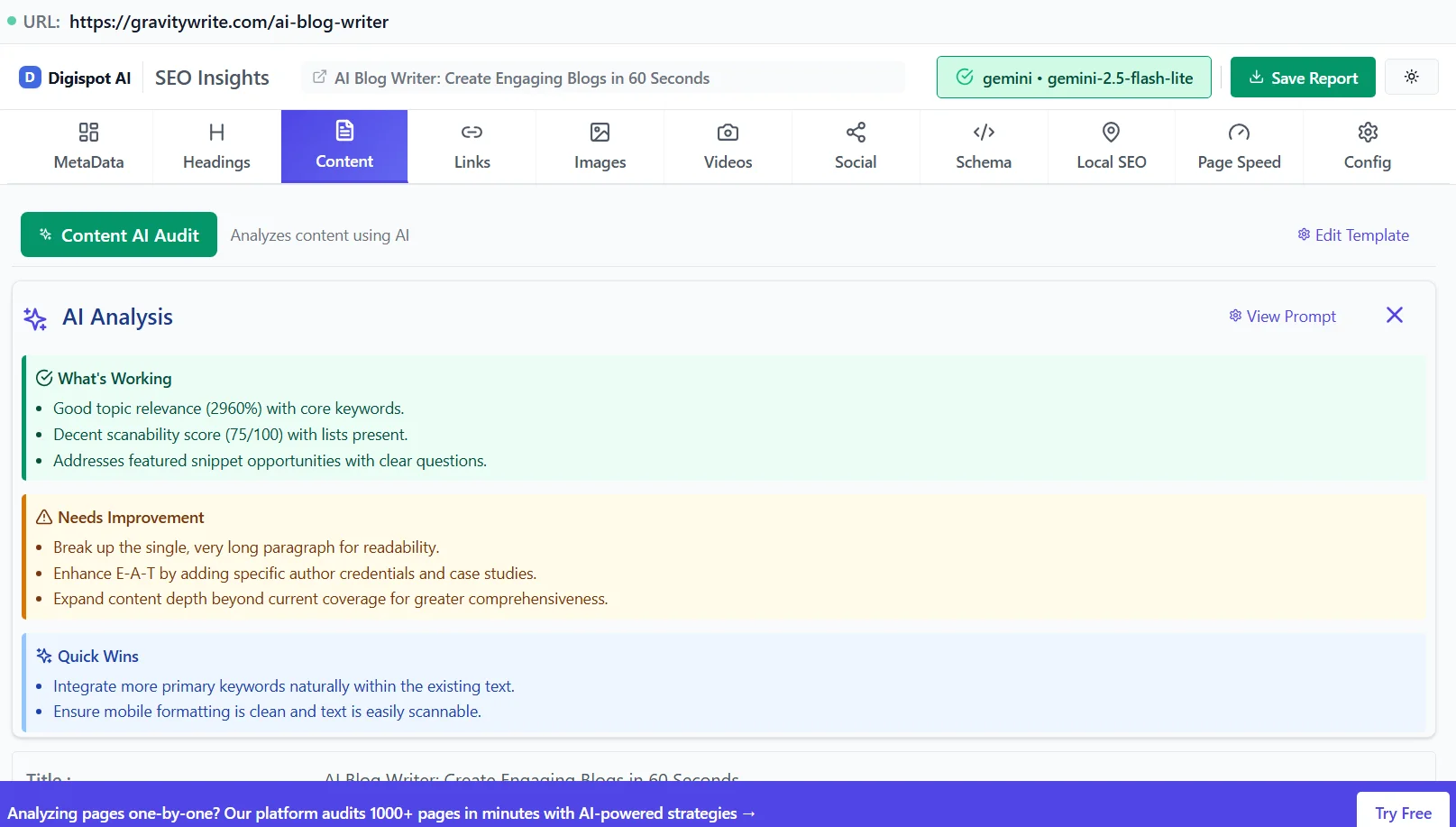
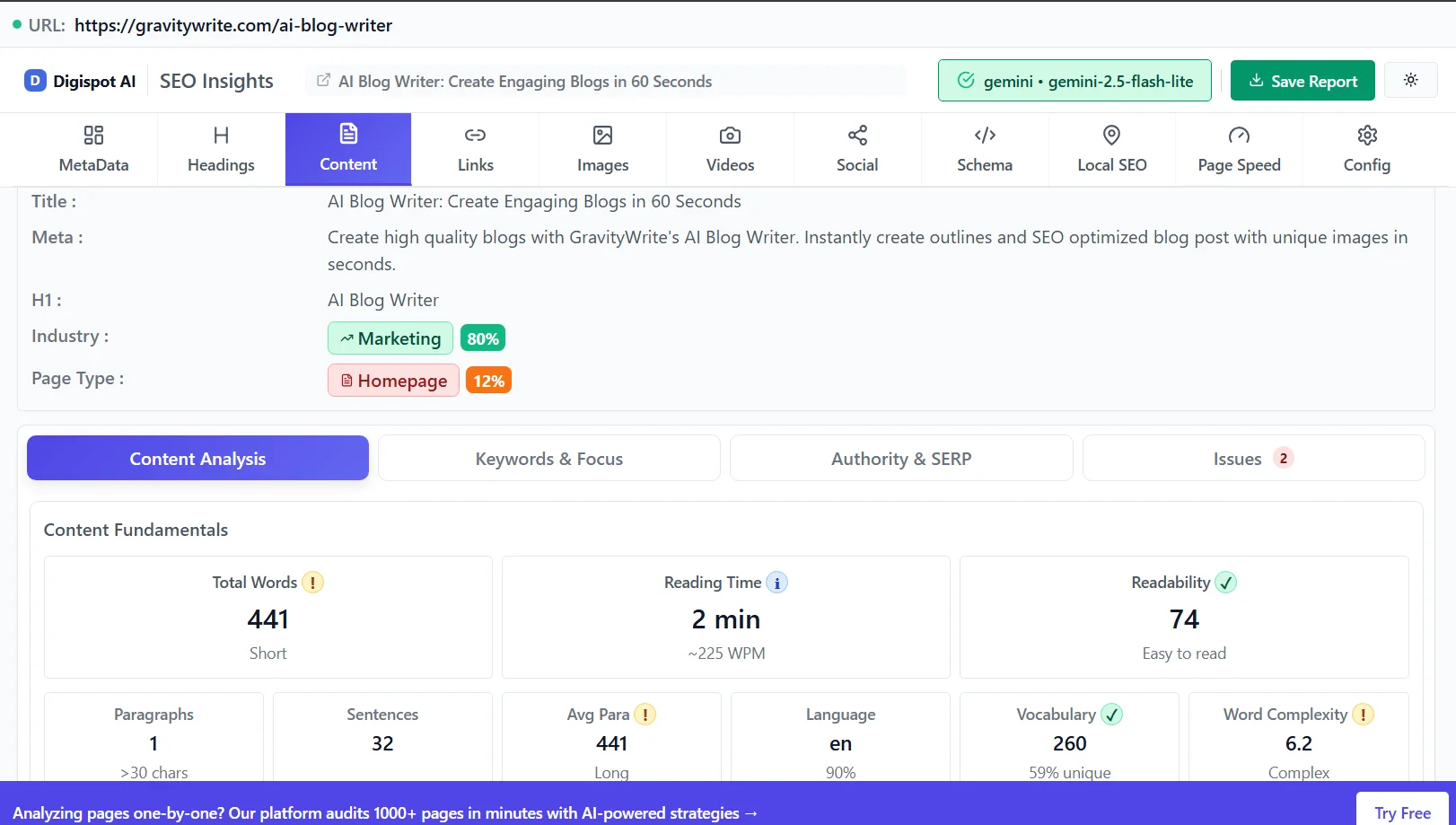
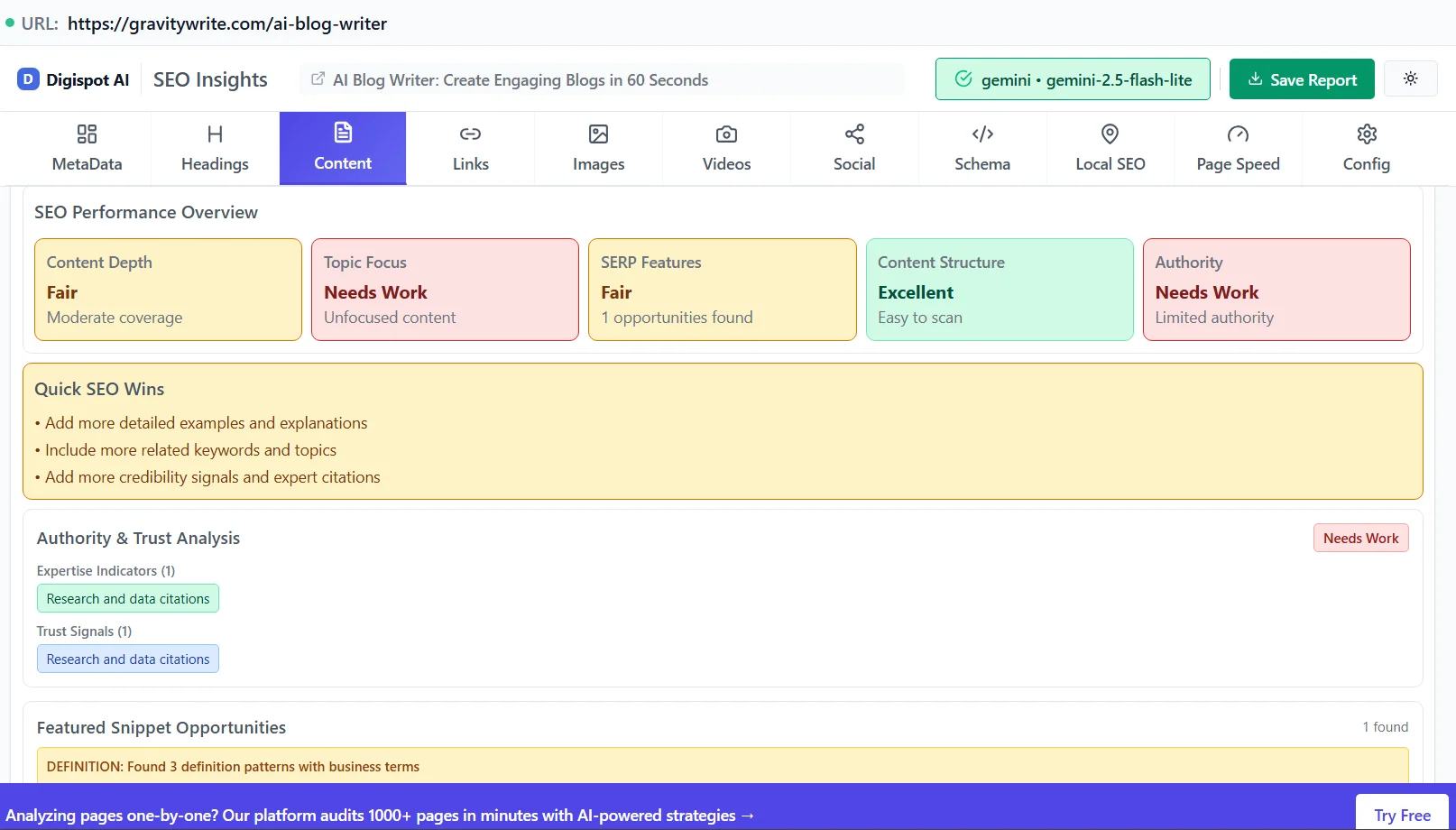
- Instant On-Page Audits: Navigate to any URL (yours or a competitor's) and get an immediate health score, identifying missing meta tags, header structure issues, or image alt text gaps.
- Schema Visualization: This is a favorite among technical SEOs. One click reveals the JSON-LD schema on the page in a human-readable format. You can instantly see if a competitor is using
FAQPageorProductschema to capture rich snippets. - LLM-Powered Insights: Ask the extension questions about the page you are viewing, such as "Summarize the main entities on this page" or "Suggest three missing sub-topics for this article."
A Step-by-Step Guide to Implementing AI Content SEO
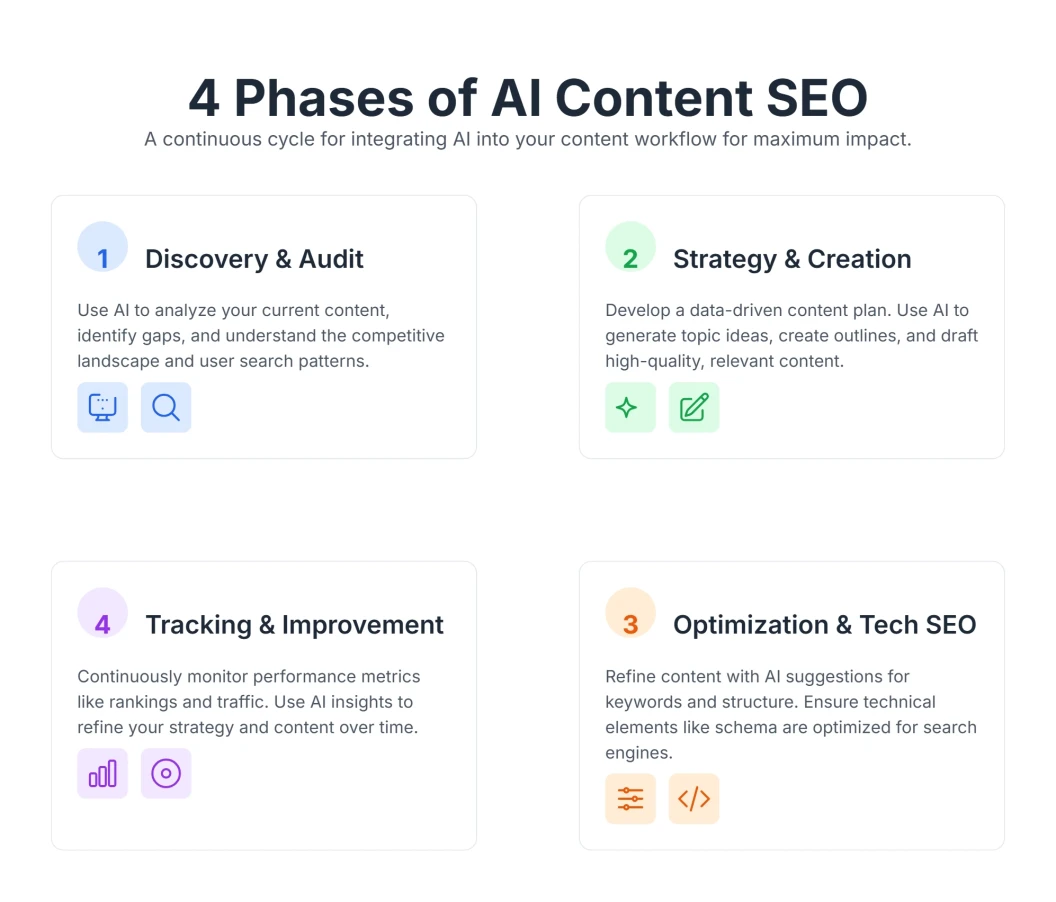
The theory is clear. Now let's move to execution. Here is a four-phase workflow to transform your SEO strategy using AI, featuring practical examples with Digispot AI.
Phase 1: Discovery & Audit – Understanding Your Current Landscape
You cannot optimize what you do not understand. The first step is a diagnostic deep dive.
- Execute a Technical Crawl: Use an AI-powered crawler to map your entire site architecture.
- Action: Run a full site audit. Look for "zombie pages"—pages with no traffic and low value. AI helps identify these candidates for pruning or merging.
- Digispot Example: "Digispot AI excels here by providing detailed audits for both mobile and desktop views. It analyzes your site across 300+ ranking factors, helping you spot critical issues related to content quality, technical SEO errors (like crawlability or indexing problems), and local SEO nuances."
- Analyze Core Web Vitals: Speed affects rankings. Use AI to pinpoint exactly which script or image is delaying your Largest Contentful Paint (LCP).
- Resource: For a detailed breakdown of these metrics, refer to our Core Web Vitals Guide.
- Competitor Gap Analysis: Identify the keywords your competitors rank for that you do not.
- Digispot Example: "Digispot AI's data-driven insights, when combined with your competitive research, can inform opportunities identified by its 'Opportunity Finder' that might stem from analyzing what your rivals miss."
Phase 2: Content Strategy & Creation – Building Your SEO Powerhouse
Stop guessing what to write. Let data dictate your editorial calendar.
- Identify High-Impact Topics: Use AI to find "Information Gaps" in the market. Look for questions in "People Also Ask" boxes that have poor answers in current search results.
- Digispot Example: "Digispot AI's 'Opportunity Finder' is designed to pinpoint high-potential keywords. If you sell coffee equipment, it might suggest 'manual espresso lever maintenance' as an underserved topic where you can easily dominate."
- Draft with Semantic Intelligence: Don't just write; engineer the content. Use AI to generate an outline that covers all related entities (e.g., if writing about "Coffee," you must mention "Beans," "Roast," "Brewing," "Grind").
- Digispot Example: "With insights from the 'Opportunity Finder,' Digispot AI's 'Content Studio' uses sophisticated AI agents to generate outlines. It ensures you naturally incorporate target keywords and semantic variants, improving your chances of ranking in AI search engines."
- Humanize and Verify: This is the most critical step. Take the AI draft and inject your brand's unique voice. Add quotes from your internal experts, case studies from your clients, and original data. This adds the "Experience" to E-E-A-T.
Phase 3: Optimization & Technical SEO – Ensuring Search Engine Readability
Great content is useless if Google can't parse it. Phase 3 focuses on translation—translating your content into machine-readable formats.
- On-Page Optimization: Optimize title tags for click-through rates (CTR) and headers for skimming. Ensure your primary entity is clear in the H1.
- Digispot Example: "The platform's audits highlight areas for on-page SEO improvements, ensuring your content is readable and engaging. Digispot AI assists in integrating crucial elements like schema markup, which is paramount for boosting visibility."
- Implement Structured Data (Schema): This is non-negotiable for AEO. You need to explicitly tell Google, "This is a Product, it costs $50, and it has 4 stars."
- Digispot Example: "As AI search engines rely on understanding entities, accurate schema is vital. Digispot AI's tools, including the Schema Markup Generator, support the creation and visualization of this data, ensuring your content is 'AI-ready' for rich snippets."
- Optimize for Internal Linking: AI can suggest internal links based on semantic relevance, helping you distribute "link juice" to important pages. Watch for the common edge case: a brand-new pillar page with zero inbound internal links is effectively an orphan to crawlers, so link to it from three to five existing high-authority articles using descriptive anchor text (not "click here"). Our internal linking strategy guide breaks down how to build these clusters.
- Digispot Example: "Use the tool to identify orphan pages and find relevant anchor text opportunities within your existing content library."
Phase 4: Tracking & Improvement – Measuring Success and Adapting
SEO is a loop, not a line. You must measure, learn, and iterate.
- Monitor AEO Visibility: Traditional rank tracking is not enough. You need to know if you are being cited in AI answers.
- Digispot Example: "Digispot AI offers seamless integration with Google Search Console and Analytics. This connection tracks metrics from keyword rankings to user behavior, enabling you to refine your strategies based on real engagement data."
- Continuous Health Monitoring: The web changes. Links break. Competitors update their pages. You need a watchdog.
- Digispot Example: "By centralizing data, Digispot AI provides a dashboard for continuous monitoring. This enables you to proactively identify subtle shifts in user behavior or algorithm updates, allowing for real-time adjustments."
- Refine Based on Conversion: Traffic is vanity; revenue is sanity. Use your analytics integration to see which AI-optimized pages are actually driving leads, and double down on those topics.
The Future of SEO: AI as Your Co-Pilot
The trajectory is clear: search is becoming more predictive, conversational, and visual. In the near future, we will see the rise of "Agentic SEO," where personal AI agents perform searches and transactions on behalf of users. Optimizing for this future means your data must be structured perfectly.
However, the core of SEO remains unchanged: Helping users achieve their goals.
AI is not here to replace the SEO professional. It is here to replace the drudgery of SEO. It serves as an incredibly powerful co-pilot, handling the data analysis, the technical audits, and the structural foundations. This frees up your human experts to do what machines cannot: create strategy, build relationships, and tell compelling stories.
The businesses that succeed in 2026 will be those that master this synergy. They will use Digispot AI to handle the machine logic, while their teams focus on human connection.
Start Improving Your Search Visibility Today
In the ever-evolving world of search, AI content SEO is not just a competitive advantage; it's a fundamental requirement. By understanding how AEO works and leveraging the efficiency of AI, you can increase traffic, save costs, and future-proof your digital presence.
Don't let the technical complexity hold you back. While challenges regarding originality and accuracy are real, a balanced approach using the right tools mitigates these risks effectively.
Ready to take action?
- Audit Instantly: Use the free On-Page SEO Analysis tool to see where your key pages stand right now.
- Get the Extension: Install the free Chrome extension to visualize schema and analyze competitors on the fly.
- Scale Up: Try Digispot AI for comprehensive, site-level audits and automated content opportunities.
Embrace AI as your strategic partner, and unlock a new era of digital success for your business.
Related deep-dives
Continue with these closely related guides:
- featured snippet seo — Featured Snippet SEO: Win Position Zero on Google
- perplexity seo — Perplexity SEO: How to Optimize for Perplexity AI Search (2026 Guide)
References
- Google Search Console
- Google Analytics
- Understand how structured data works | Google Search Central
- Optimize for mobile-first indexing | Google Search Central
- Core Web Vitals and Page Experience | Google Search Central
- An introduction to Google's ranking systems | Google Search Central
- Digispot AI - FREE On Page SEO Audit Tool
- Digispot AI - FREE Chrome Extension for SEO Insights
- Digispot AI Official Website
Audit any page in seconds
300+ SEO checks including Core Web Vitals, schema markup, meta tags, and AI readiness — trusted by 1000+ SEO experts and marketers.
Frequently Asked Questions
Here are some of our most commonly asked questions. If you need more help, feel free to reach out to us.
Written by
Maya Krishnan
Digital growth expert
Maya is a seasoned expert in web development, SEO, and digital strategy, dedicated to helping businesses achieve sustainable growth online. With a blend of technical expertise and strategic insight, she specializes in creating optimized web solutions, enhancing user experiences, and driving data-driven results. A trusted voice in the industry, Maya simplifies complex digital concepts through her writing, empowering readers with actionable strategies to thrive in the ever-evolving digital landscape.