How to Optimize Content for LLMs: A GEO Guide
Master Generative Engine Optimization (GEO). Learn how to rank in ChatGPT, Perplexity, and Google AI Overviews by optimizing content for Large Language Models.
 Maya Krishnan
Search is no longer just about ten blue links.
For two decades, you optimized for a crawler that matched keywords to an index. Now, you must optimize for a neural network that reads, understands, and synthesizes information.
Users are asking ChatGPT, Perplexity, and Claude for answers, not just lists of websites. Google's AI Overviews (formerly SGE) now dominate the top of the SERP, pushing traditional organic results further down.
If your content isn't optimized for Large Language Models (LLMs), you aren't just losing traffic—you are becoming invisible.
This guide covers the mechanics of LLM SEO (also known as Generative Engine Optimization or GEO). You will learn how to structure data, build semantic authority, and ensure your brand becomes the cited source in the age of AI search.
Key Takeaways
- Answer first, explain second. Lead every section with a direct, quotable fact so LLMs can extract and attribute it to you without guessing.
- Optimize for entities, not just keywords. Cover the full topic and its related concepts so models understand where your page sits in their vector space.
- Structured data is your clearest signal. Valid Article, FAQPage, and Organization schema tells the model exactly what your content is and who wrote it.
- Trust wins citations. Clear authorship, original data, and E-E-A-T signals make LLMs more likely to cite you over the pages that merely reference your work.
- Keep the bots in and the pages fast. Allow AI crawlers in robots.txt, ensure content renders without JavaScript, and load quickly so you survive the retrieval phase.
The Shift from SEO to GEO
Traditional SEO creates a map for a library. You want your book (website) to be on the most accessible shelf (Page 1) when someone asks for a specific topic.
LLM SEO is different. The AI is the librarian. It reads every book, summarizes the information, and gives the user a direct answer. It only mentions your book if it served as a primary source for that specific fact.
To win in this environment, you must move beyond "matching keywords." You need to understand Retrieval-Augmented Generation (RAG). This shift is why a dedicated discipline, Generative Engine Optimization (GEO), has emerged alongside traditional search work — and why the broader complete AEO guide treats structure and authority as first-class ranking signals.
How RAG Works
Most AI search engines (like Perplexity or Bing Chat) use RAG.
- Retrieval: The AI searches the live web for relevant documents (similar to traditional SEO).
- Generation: The LLM reads those documents, extracts facts, and writes a new answer.
If your on-page SEO best practices are weak, the AI won't find you in step one. But even if it finds you, it might ignore you in step two if your content is unstructured, vague, or opinion-heavy.
1. Structure Content for Machine Readability
LLMs are sophisticated, but they prefer simplicity when extracting facts. Complex sentence structures, metaphors, and buried ledes confuse the model's ability to attribute specific claims to you.
The Inverted Pyramid is Mandatory
Journalists have used this for decades: put the most critical information at the very top.
For LLM optimization, every section of your post should follow this pattern:
- Direct Answer: State the fact, definition, or core concept immediately.
- Context/Nuance: Explain the "why" or "how."
- Evidence: Provide data, examples, or citations.
Example:
- Bad: "When thinking about crawl budgets, it is important to remember that many factors come into play..."
- Good: "Crawl budget is the number of pages a search engine bot visits on your site within a specific timeframe. It is determined by crawl rate limit and crawl demand."
Use "Subject-Verb-Object" Syntax
LLMs parse text by analyzing the relationship between words (tokens). Simple sentence structures reduce ambiguity. When defining terms or stating facts, keep the subject and the action close together.
HTML Hierarchy as a Knowledge Graph
Your heading tags (H1, H2, H3) are not just formatting. They are the skeleton of your argument.
AI models use your headings to understand the hierarchy of information.
- H1: The primary entity (Topic).
- H2: Attributes or sub-topics of that entity.
- H3: Specific details or examples.
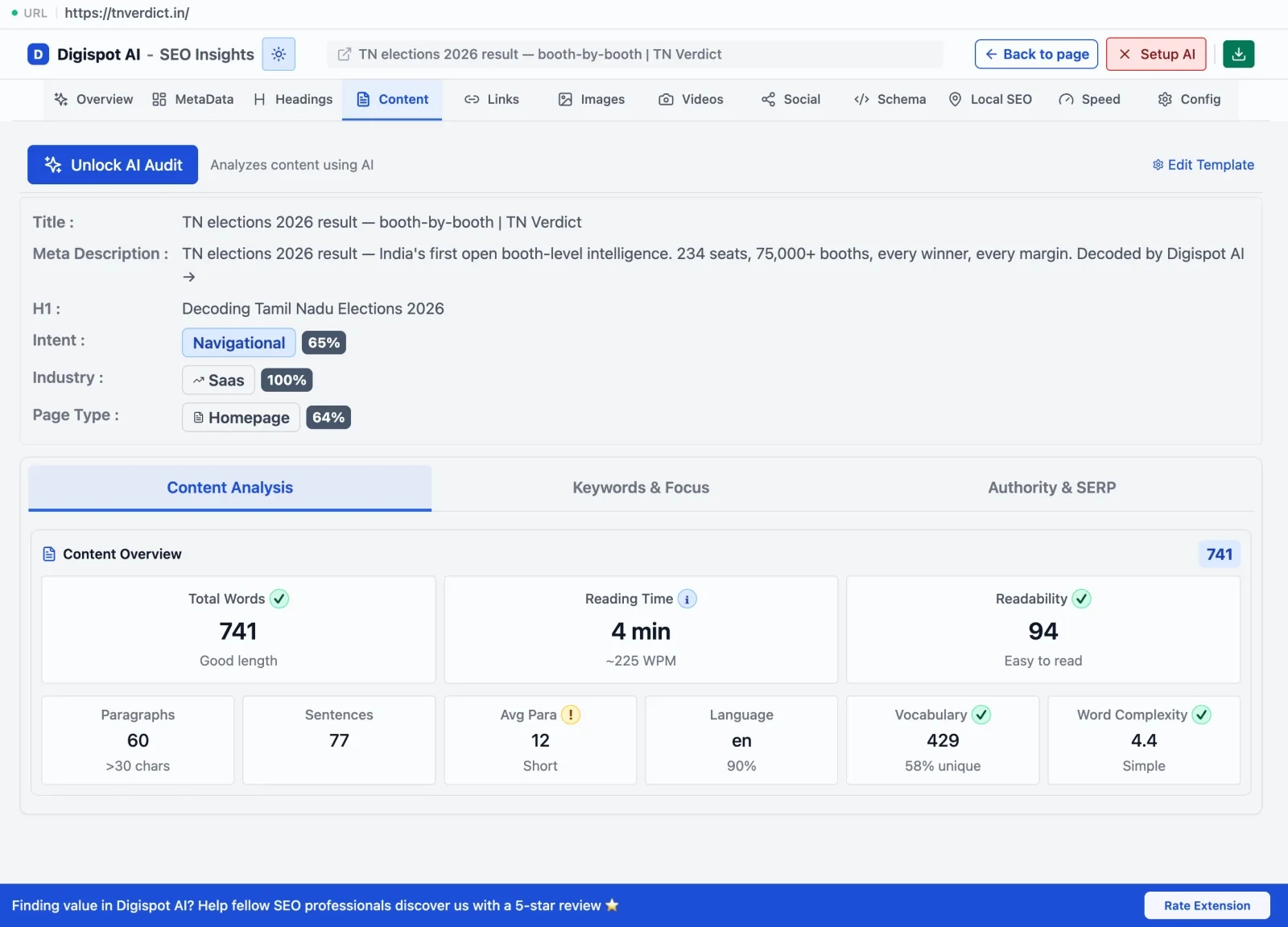
Digispot AI helps you identify and fix hierarchy issues automatically with AI-powered audits, ensuring your heading structure maps perfectly to what LLMs expect.
2. Optimize for Entities, Not Just Keywords
Keywords are strings of text. Entities are concepts.
Google and LLMs understand that "Steve Jobs," "Apple," and "iPhone" are semantically related entities. They don't need the exact keyword "Steve Jobs phone" to make the connection.
Vector Space and Semantic Proximity
LLMs map words in a high-dimensional vector space. Words with similar meanings or contexts are located close together mathematically. This is the same principle behind semantic search, where relevance is measured by meaning rather than exact string matches.
To optimize for this:
- Cover the Whole Topic: Don't just answer one question. Cover related entities. If you write about "Sourdough Bread," you must discuss "wild yeast," "fermentation," "hydration levels," and "scoring."
- Contextual Linking: Use internal linking strategies to connect related pages. This reinforces the semantic relationship between topics on your site.
- Disambiguation: Be explicit. If you are writing about "Python" (the code), mention libraries, syntax, and development early to distinguish it from "Python" (the snake).
See Your Site as a Knowledge Graph
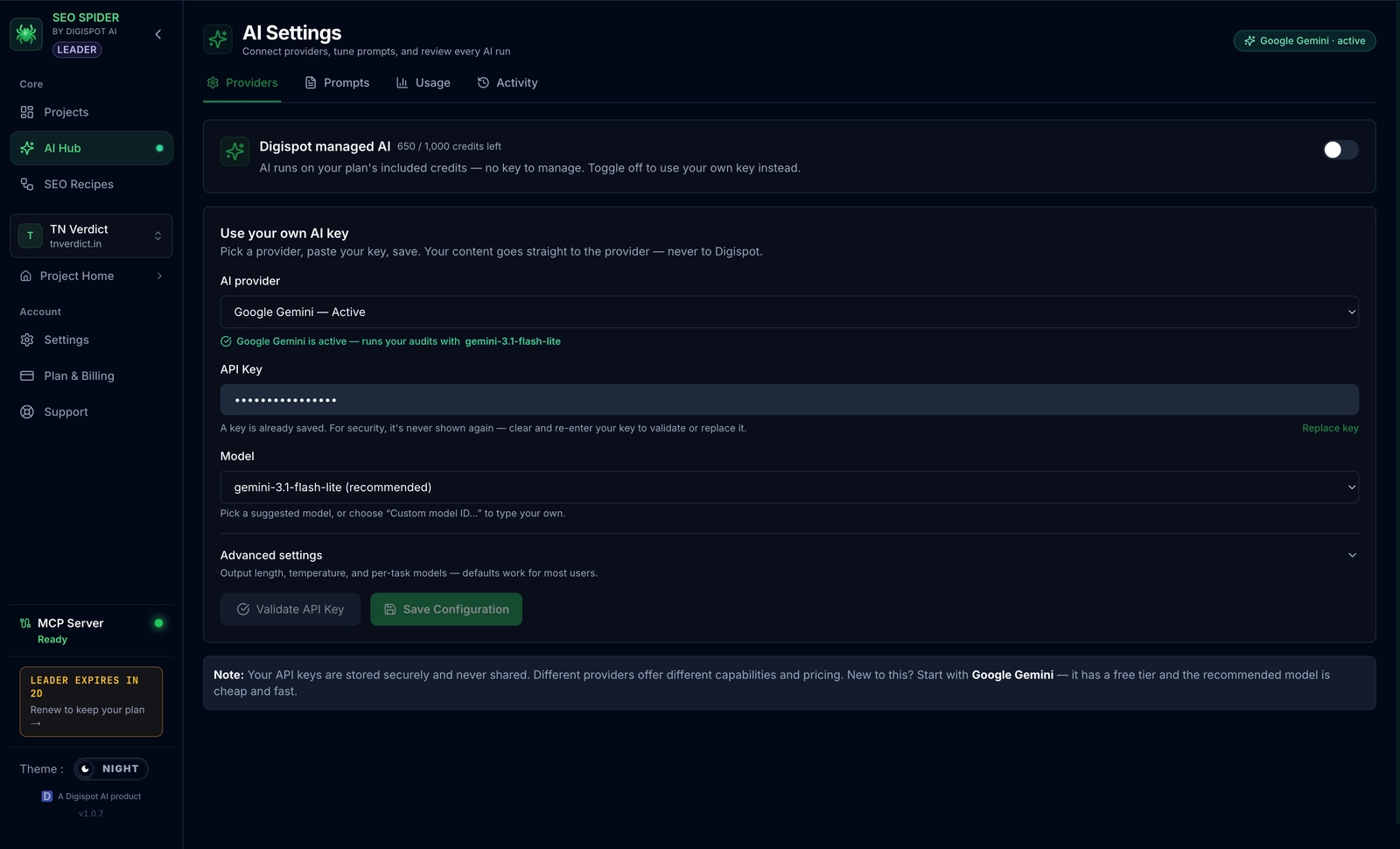
You can only optimize the entities you can see. Digispot AI Spider turns each crawl into a knowledge graph — your pages, topics, and entity hubs connected in one map, along with the keywords, search queries, and competitors around them.
It is served to AI agents over MCP as a single compact brief, so an assistant like Claude or Cursor reads your site's real entity relationships instead of inferring them from raw page text. That is the same entity clarity you are working to give the LLMs that cite you, applied to your own site first — and because the graph is built from data the crawl already produced, it costs no extra AI tokens to generate.
3. The Power of Structured Data (Schema)
If content is the flesh, Schema markup is the DNA.
Structured data creates a machine-readable layer that tells the AI exactly what your content is. This is the single most effective way to communicate with an LLM.
Essential Schema Types for GEO
- Article/BlogPosting: Defines the content, author, and dates.
- FAQPage: Feeds directly into question-answer algorithms.
- Organization: Establishes brand authority and knowledge graph presence.
- Product: Critical for e-commerce to display price, availability, and reviews in AI snapshots.
- Dataset: If you publish original statistics, this helps AI extract your numbers.
Implementation Tip: You don't need to be a coder. Use the free Schema Markup Generator to create valid JSON-LD structured data in minutes.
4. Citation Authority and E-E-A-T
LLMs are trained to minimize "hallucinations" (making things up). To do this, they prioritize sources that exhibit high trust signals. This aligns perfectly with Google's E-E-A-T (Experience, Expertise, Authoritativeness, Trust).
Authorship Matters More Than Ever
AI models look for the source of information. An anonymous blog post has less weight than one written by a recognized expert.
- Create detailed author bio pages.
- Link to the author's social profiles (LinkedIn/Twitter).
- Demonstrate "Experience" by using phrases like "In our testing..." or "We analyzed..."
Be the Primary Source
The biggest winners in the era of AI search are the creators of original data.
- Conduct surveys and publish the results.
- Run experiments and document the methodology.
- Coin new terms or frameworks.
If you are the primary source of a statistic, the AI is more likely to cite you than the ten other blogs that merely referenced your data.
5. Formatting for "Snackability"
AI models often extract snippets to construct an answer. You want your content to be "copy-paste" ready.
Lists and Tables
LLMs love structure. Whenever you are comparing items, explaining steps, or listing features, use an HTML list or table.
Example Table for LLM Readability:
| Feature | Traditional SEO | LLM SEO (GEO) |
|---|---|---|
| Goal | Rank on Page 1 | Be the cited answer |
| Target | Search Crawler | Neural Network |
| Key Metric | Clicks / CTR | Share of Voice / Citations |
| Content Style | Comprehensive Guide | Direct, Fact-Based |
Tables provide a structured data format that is easy for an AI to parse and render in a generated response.
Quote-Worthy Soundbites
Include sentences specifically designed to be quoted. These should be definitive statements that summarize a section.
- "Speed is not just a metric; it is a prerequisite for visibility."
- "Without structured data, your content is guessing; with it, you are defining."
Highlight these takeaways visually in your post.
6. Technical SEO is Still the Foundation
You cannot optimize for an AI that cannot find you.
While the "optimization" part has changed, the technical delivery remains the same. Crawl budget optimization ensures that bots can access your content efficiently.
Core Web Vitals and Speed
AI models prioritize user experience. If an AI refers a user to your site, it expects the page to load instantly. Slow sites are often deprecated in the retrieval phase.
Renderability
Many modern sites rely heavily on JavaScript. If an LLM crawler (like GPTBot or ClaudeBot) cannot render your JavaScript, your content does not exist to them.
- Use Server-Side Rendering (SSR) or Static Site Generation (SSG) where possible.
- Check your meta tags. Learn more about meta tags optimization to ensure you aren't accidentally blocking bots.
Get instant SEO insights on any page with our free Chrome extension. It checks renderability and core technical factors in seconds.
7. Optimizing for Different Platforms
Not all AI engines work the same way.
Google AI Overviews (SGE)
- Source: Heavily reliant on Google's existing index.
- Strategy: Strong traditional SEO + Schema + Direct Answers.
- Nuance: Favors content that matches the search intent of the query exactly.
Overviews pull from pages that already rank in the top results, so classic ranking signals still gate your eligibility. The extraction layer then prefers short, self-contained passages that answer the query in one or two sentences. Structure each section so a single paragraph could stand alone as the answer, and pair it with FAQ and HowTo schema. A dedicated Google AI Overviews SEO strategy walks through the passage-level formatting that earns inclusion.
ChatGPT (SearchGPT) / Bing
- Source: Bing index + Partner data.
- Strategy: Conversational tone + Clear entity relationships.
- Nuance: Bing is excellent at finding specific facts and data points within tables.
Because SearchGPT leans on the Bing index, being indexed and healthy in Bing Webmaster Tools is a prerequisite. The model rewards content phrased the way people actually ask questions, so mirror conversational query patterns in your headings. Facts embedded in tables and definition lists are especially easy for it to lift, since the structure removes ambiguity about which value maps to which label.
Perplexity
- Source: Real-time web index.
- Strategy: Academic citations + Recent data.
- Nuance: Perplexity acts like a research assistant. It loves content that cites its sources. Include a bibliography or external links to high-authority sites in your content.
Perplexity attaches numbered citations to nearly every claim, so pages that demonstrate their own sourcing are treated as more credible retrieval candidates. Publish a visible references section, link out to primary sources, and timestamp your content, because recency strongly influences which documents it surfaces. Treating your article like a research paper — claim, evidence, citation — aligns directly with how the engine builds its answers.
8. Measuring Success in the AI Era
How do you know if you are winning if there are no "rankings"?
Share of Model (SoM)
Instead of "Share of Voice," we track "Share of Model." This measures how often your brand is mentioned when a user asks an AI relevant questions.
- Prompt Engineering Tests: regularly prompt major LLMs with questions relevant to your industry (e.g., "What is the best SEO tool for agencies?"). Record how often you appear.
Referral Traffic from AI
Check your analytics for referrers like bing.com, perplexity.ai, and chatgpt.com.
Brand Mentions
Use tools to track unlinked brand mentions. As AI answers often mention a brand without linking, monitoring text mentions becomes a KPI for awareness.
9. Common Mistakes to Avoid
"Fluff" Content
Old SEO advice said to write 3,000 words to cover everything. AI hates fluff. If you repeat the same point three times to increase word count, the AI detects low information density and de-prioritizes the content.
Blocking AI Bots
Some webmasters block GPTBot via robots.txt to prevent their content from being used to train models. However, this also prevents you from appearing in live search results powered by those models. Be careful not to make yourself invisible; see how to optimize for AI crawlers without accidentally locking them out.
Ignoring Search Intent
Even in AI, intent is king. Search intent optimization ensures you are answering the actual question the user asked, not just matching keywords.
Checklist: Your LLM SEO Action Plan
- Audit Your Entities: Ensure your brand and core topics are clearly defined and linked.
- Implement Schema: Use the Schema Markup Generator on every core page.
- Restructure Content: Apply the Inverted Pyramid. Answer first, explain second.
- Add Data: Embed tables and lists for machine readability.
- Verify Access: Ensure your
robots.txtallows AI crawlers for search platforms (e.g.,Google-Extended). - Test Rendering: Use the Digispot Chrome Extension to see what the bot sees.
Start Improving Your AI Visibility Today
The transition to LLM-driven search is not a trend; it is the new infrastructure of the web. By focusing on facts, structure, and authority, you future-proof your SEO strategy against algorithm updates and platform shifts.
Don't guess how AI views your website. Try Digispot AI for comprehensive website audits and actionable recommendations. Our multi-LLM engine analyzes your site through the eyes of GPT-4, Claude, and Gemini to ensure you dominate the answer engine results.
References
Audit any page in seconds
300+ SEO checks including Core Web Vitals, schema markup, meta tags, and AI readiness — trusted by 1000+ SEO experts and marketers.
Frequently Asked Questions
Here are some of our most commonly asked questions. If you need more help, feel free to reach out to us.
Written by
Maya Krishnan
Digital growth expert
Maya is a seasoned expert in web development, SEO, and digital strategy, dedicated to helping businesses achieve sustainable growth online. With a blend of technical expertise and strategic insight, she specializes in creating optimized web solutions, enhancing user experiences, and driving data-driven results. A trusted voice in the industry, Maya simplifies complex digital concepts through her writing, empowering readers with actionable strategies to thrive in the ever-evolving digital landscape.