Google AI Overviews Optimization: 2026 SEO Strategy
Master the shift from SEO to AEO. Learn how to rank in Google AI Overviews (SGE) using entity optimization, structured data, and answer-engine strategies.
 Maya Krishnan
Search has evolved from a directory of links to a direct answering machine. Google's deployment of AI Overviews (formerly SGE) signifies the biggest shift in information retrieval since the introduction of the Knowledge Graph. For SEO professionals, this isn't just a layout change; it is a fundamental alteration of how we must structure data for machine understanding.
The goalpost has moved. You are no longer just fighting for a spot in the top ten blue links. You are competing to be the source material for the AI's answer. This requires a pivot from traditional Search Engine Optimization (SEO) to Answer Engine Optimization (AEO).
If your content isn't optimized for Retrieval-Augmented Generation (RAG)—the process Google uses to fetch and summarize data—you risk becoming invisible in the modern SERP. This guide details the specific mechanics of optimizing for AI Overviews and how to secure your place as a cited authority.
Key Takeaways
- Optimize for retrieval, not just ranking. AI Overviews are built by pulling high-confidence "chunks" from the index, so structure content so a single passage can answer a query on its own.
- Answer first, elaborate second. Lead each section with a direct, 40–60 word answer immediately after a descriptive heading, then expand with evidence and edge cases.
- Treat Schema as mandatory. Valid
FAQPage,Article,HowTo, andOrganizationJSON-LD hand structured meaning to the LLM and increase the odds of being cited. - Build entity density. Cover the related concepts an expert would naturally mention so your page reads as comprehensive against competitors.
- Measure citations, not just position. Watch impressions-vs-clicks gaps, brand search volume, and which queries trigger overviews rather than relying on classic rank tracking alone.
The Mechanics of AI Overviews
To optimize for AI Overviews, you must understand how they are generated. Google does not "write" these answers from scratch in real-time imagination. It uses a process called RAG.
- Retrieval: When a query is entered, the system identifies relevant "chunks" of information from its index.
- Augmentation: It feeds these high-confidence chunks into the LLM (Large Language Model).
- Generation: The LLM synthesizes these chunks into a coherent summary, citing the sources it used.
Your objective is to ensure your content is identified as a "high-confidence chunk." If your content is buried in unstructured text or lacks semantic clarity, the retrieval system skips it.
Digispot AI helps you reverse-engineer this process. By analyzing which ranking factors are triggering AI snapshots in your niche, our platform allows you to align your content strategy with the specific requirements of Google's Gemini models.
Structuring Content for Machine Readability
The human reader appreciates narrative flow. The AI reader demands structural logic. To satisfy both, you need to adopt an "Answer-First" methodology.
The Inverse Pyramid for AEO
Journalists use the inverse pyramid to put the most critical news at the top. You must do the same for SEO.
When targeting a specific keyword or query:
- State the answer immediately: The first paragraph should directly answer the user's intent without preamble.
- Provide supporting evidence: Follow up with data, statistics, or expert quotes.
- Expand on nuances: Use the rest of the content to cover edge cases, examples, and detailed explanations.
Avoid "buried ledes" where the actual answer appears after 500 words of introduction. Google’s extraction algorithms heavily weight the content appearing immediately after a relevant heading.
Heading Structure and HTML Tags
Your heading hierarchy (H1, H2, H3) serves as the skeleton for the AI's understanding of your topic.
- H1: The main entity/topic.
- H2: The primary sub-topics or questions related to the entity.
- H3: Specific details or actionable steps.
Don't use vague headings like "Getting Started." Use descriptive, keyword-rich headings like "How to Configure XML Sitemaps." This helps the AI map specific text blocks to specific user intents.
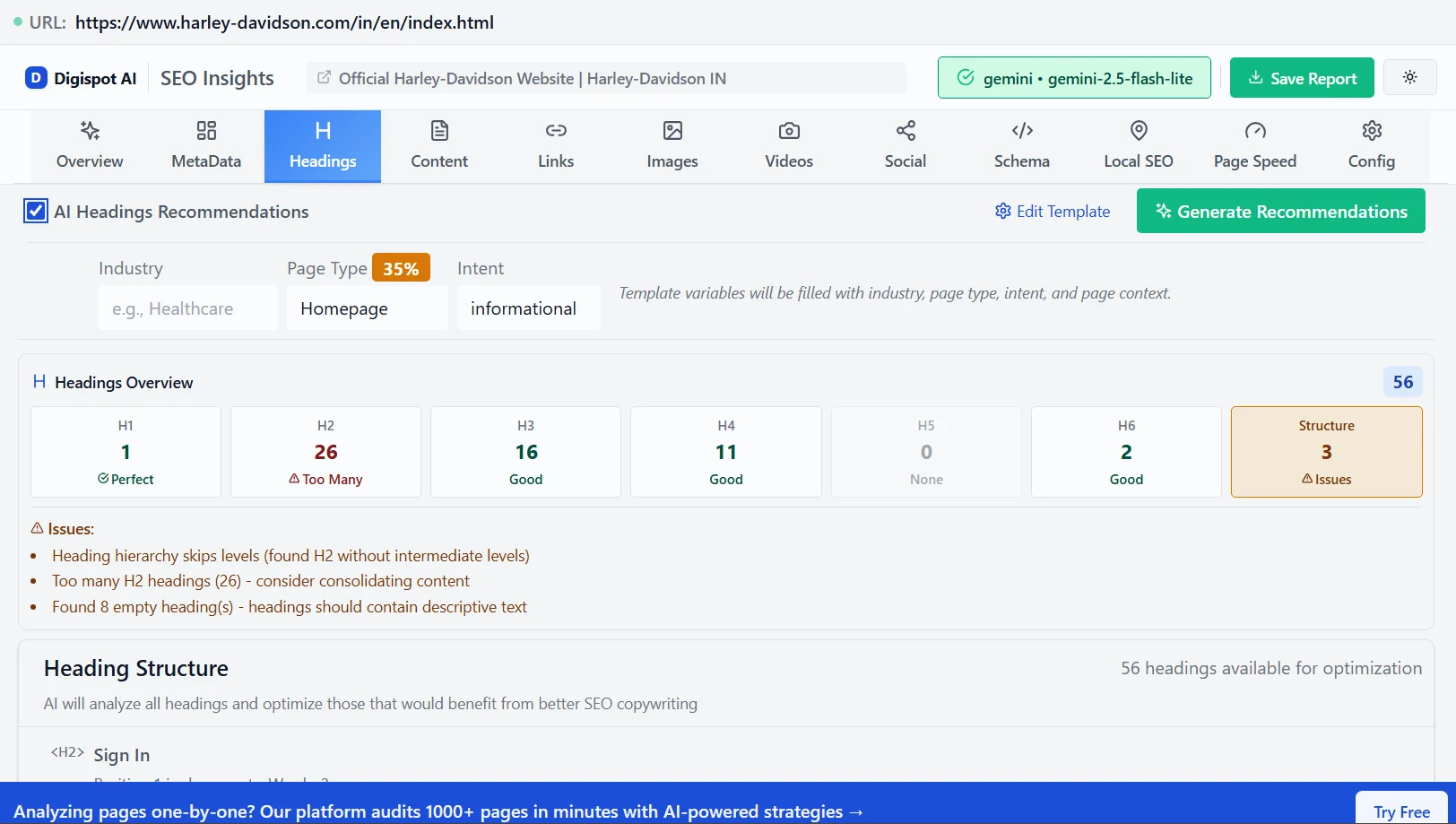
You can check if your heading structure is optimized for search intent by analyzing the top-ranking results in AI snapshots. If the AI overview breaks a process into five steps, your content should likely mirror that structure.
Entity Optimization: Beyond Keywords
Google’s AI doesn't think in strings of text; it thinks in entities (concepts, people, places, things) and the relationships between them. This is the foundation of the Knowledge Graph and of semantic search.
If you write about "Apple," Google needs to know if you mean the fruit or the technology company. You establish this through Entity Co-occurrence.
Building an Entity-Dense Profile
To establish authority on a topic, your content must include related attributes and entities that an expert would naturally mention.
Example:
- Topic: "Technical SEO Audit"
- Primary Entity: Technical SEO
- Related Attributes (LSI): Crawl budget, JavaScript rendering, canonical tags, core web vitals, status codes.
If your article on "Technical SEO" fails to mention "crawl budget," the AI may deem your content less comprehensive than a competitor's.
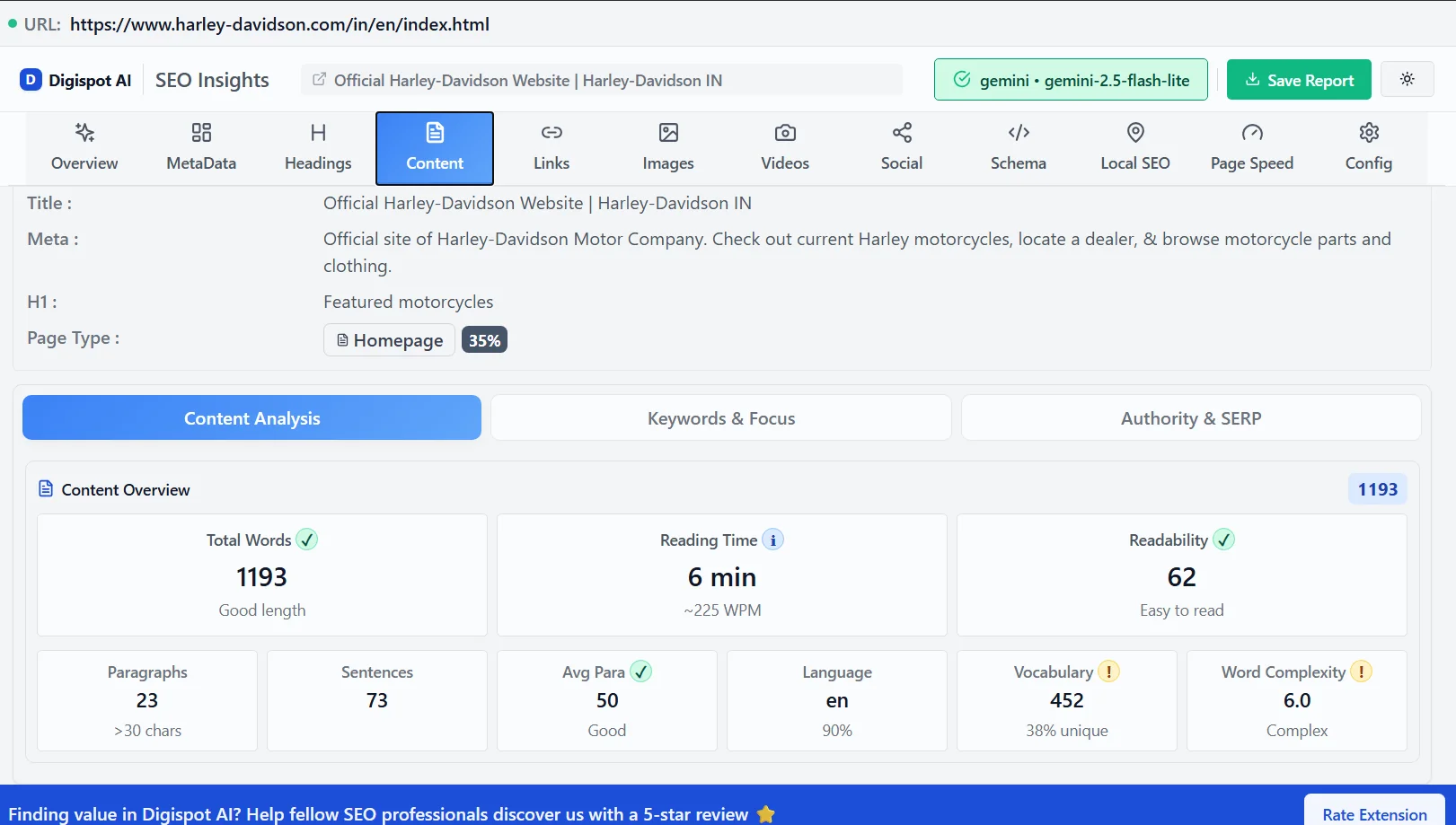
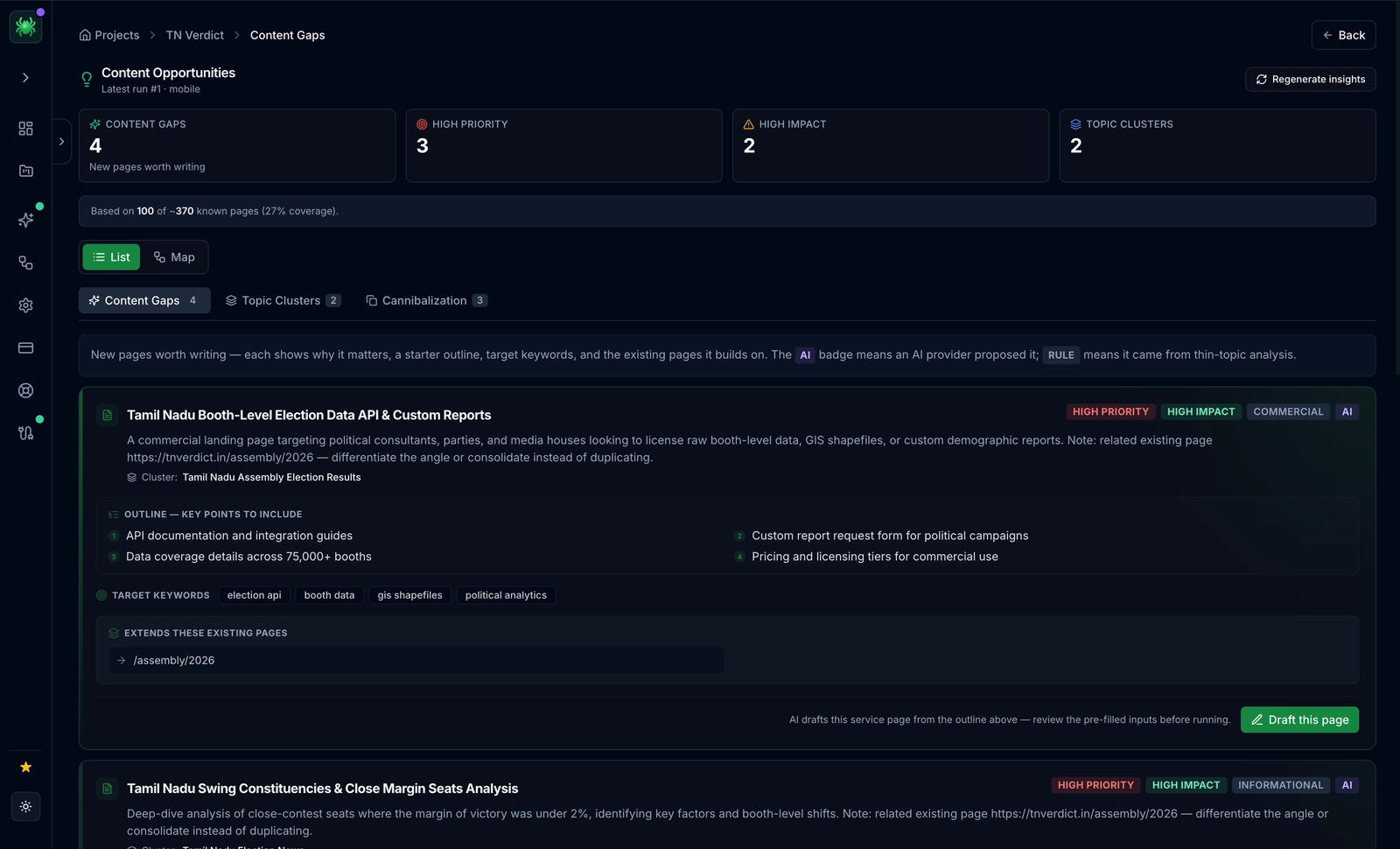
Digispot AI analyzes top-performing content to identify the "semantic gaps" in your writing—entities that competitors discuss but you missed. Filling these gaps is often the fastest way to trigger inclusion in an AI Overview.
Technical Foundation: Schema Markup
If content structure is the skeleton, Schema markup is the nervous system. It explicitly tells the search engine what your content is, not just what it says.
For AI Overviews, Schema is not optional. It reduces ambiguity. When you wrap your content in Article, FAQPage, or HowTo schema, you are essentially hand-delivering structured data to the LLM.
Priority Schema Types for AEO
- FAQPage: Explicitly pairs questions with answers. This is the easiest way to get fed directly into a Q&A-style AI snapshot, and it overlaps heavily with the tactics that win Google featured snippets.
- Article/NewsArticle: Define the author, publish date, and publisher (critical for E-E-A-T).
- Organization: Connect your brand to your social profiles and logo, helping the AI associate your brand with specific topics.
- HowTo: Breaks processes into steps, which aligns perfectly with how AI summarizes instructional queries.
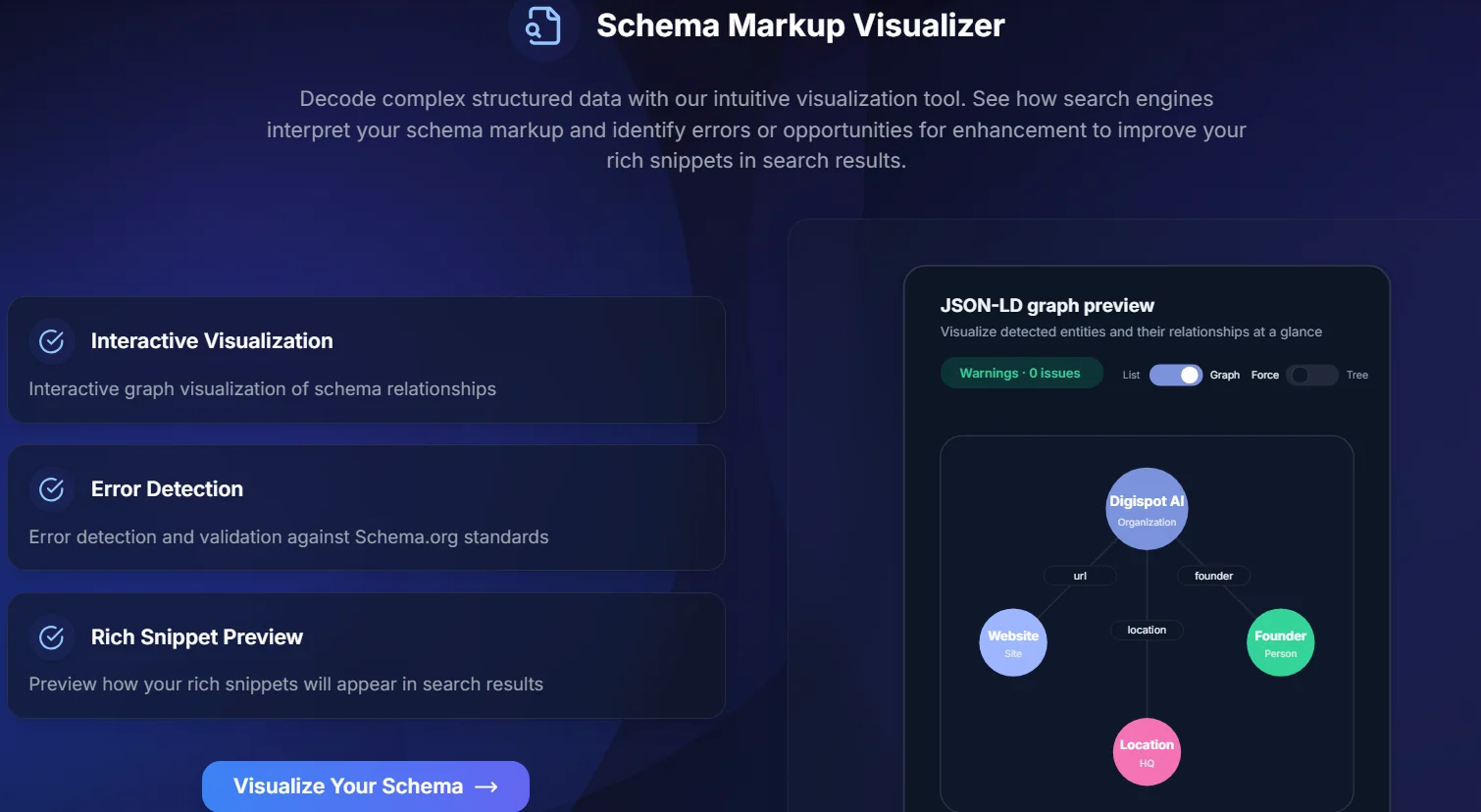
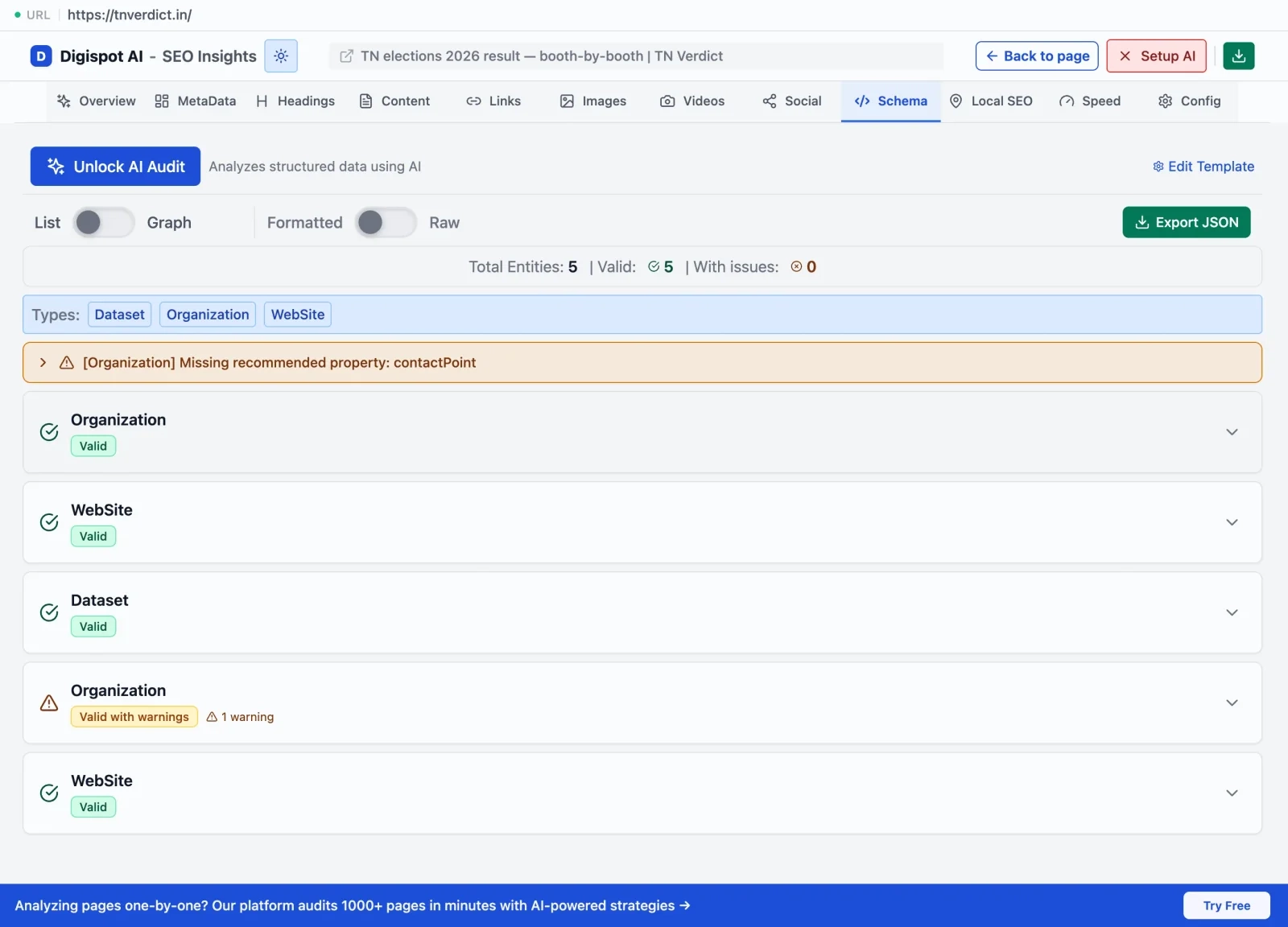
Use the free Schema Markup Generator to create valid JSON-LD code for your pages. Once generated, validate it using the Schema Markup Visualizer to ensure there are no syntax errors that would prevent Google from parsing it.
Code Snippet: FAQ Schema Example
<script type="application/ld+json">
{
  "@context": "https://schema.org",
  "@type": "FAQPage",
  "mainEntity": [{
    "@type": "Question",
    "name": "How do I optimize for Google AI Overviews?",
    "acceptedAnswer": {
      "@type": "Answer",
      "text": "Optimize for Google AI Overviews by structuring content with direct answers, using Schema markup, and focusing on high-authority entity coverage."
    }
  }]
}
</script>
Implementing this code allows the AI to extract the question and answer pair without needing to parse the visual HTML layout of your page.
E-E-A-T as a Trust Filter
Large Language Models are prone to "hallucinations" (making things up). To mitigate this, Google aggressively filters sources based on E-E-A-T (Experience, Expertise, Authoritativeness, and Trustworthiness).
The AI is programmed to cite "consensus" sources—domains that have historically provided accurate information on a specific topic.
Demonstrating Experience and Expertise
- Author By-lines: Every piece of content should have a clear author with a bio linking to their credentials (LinkedIn, other publications).
- First-Person Narrative: Use "I" and "we" when discussing tests or results. Phrases like "In our testing..." or "When we implemented this..." signal unique Experience that an AI cannot generate on its own.
- Citations: cite primary sources. A page that links to high-authority research is viewed as more trustworthy than one that exists in a vacuum.
If you are struggling to establish authority, start by conducting a crawl budget optimization audit to ensure Google is actually indexing your most authoritative pages and not wasting resources on low-value content.
Multimodal Optimization
AI Overviews are not text-only. They frequently include carousels of images, videos, and local map packs. To maximize real estate, you must optimize your visual assets.
Image Optimization for AI
Google uses computer vision to understand image content.
- Alt Text: Be descriptive. Instead of "SEO chart," use "Line graph showing organic traffic growth after implementing FAQ schema."
- Context: Place images immediately next to the relevant text.
- File Names:
google-ai-overview-optimization-graph.webpis superior toIMG_8834.jpg.
Video SEO
Videos are often cited in "How-to" queries. To get your video featured in an AI snapshot:
- Use Clip Markup or Key Moments in YouTube descriptions so Google can deep-link to the exact moment that answers a query rather than the video's start.
- Provide a full transcript on the page embedding the video. Transcripts turn spoken content into indexable, extractable text, which is what the retrieval step actually reads—audio alone cannot be chunked.
- Ensure the video title matches the H1 intent of the page, and add
VideoObjectschema with a description, upload date, and thumbnail so the video is eligible for the visual carousel inside an overview. - Chapter your video with timestamped headings that mirror the sub-questions in the surrounding article, giving Google discrete segments it can cite independently.
Get instant SEO insights on your current image and video assets with our free Chrome extension. It highlights missing alt text and schema gaps in seconds.
The Zero-Click Reality and Opportunity
A major concern with AI Overviews is the rise of zero-click searches. If Google answers the question, why would the user click?
While simple informational queries (e.g., "What is the capital of France?") will lose traffic, complex queries offer a different opportunity. Users engaging with AI Overviews are often in a research mindset. If your brand is the cited source of the answer, you gain:
- Brand Imprint: The user sees your name as the authority.
- Qualified Traffic: Users who do click are looking for deep-dive information, meaning they are lower in the funnel and more likely to convert.
You must optimize your meta tags to encourage clicks even when the answer is provided. Your title tag should promise value beyond the summary—case studies, templates, or unique data that the AI summary cannot replicate.
Try the free Meta Preview tool to test how your snippet appears and ensure your "hook" is compelling enough to drive a click from the AI overview.
Measuring Success in an AI World
Traditional rank tracking is becoming less effective. Being "Position 1" means little if an AI Overview pushes you down the page. You need to track Pixel Height and AEO Visibility.
Key Metrics to Watch
- Impressions: A spike in impressions with flat clicks often indicates your content is appearing in AI snapshots or featured snippets.
- Brand Search Volume: As you become a cited source, searches for your brand name should increase.
- Engagement Rate: Traffic from AI sources tends to be more engaged. If bounce rates drop, your AEO strategy is working.
Digispot AI provides specialized AEO tracking, allowing you to monitor which keywords trigger AI Overviews and whether your domain is being cited in the response.
Strategies for Different Search Intents
Not all AI Overviews are the same. Google alters the format based on intent.
Informational Intent
- Goal: Be the definition.
- Tactic: concise definitions (40-60 words) immediately following an H2. Use bullet points for lists.
Commercial Intent
- Goal: Be the comparison.
- Tactic: Use comparison tables (HTML
<table>tags). clearly list pros, cons, and pricing. AI models love structured tabular data for comparison queries.
Transactional Intent
- Goal: Validate the purchase.
- Tactic: Focus on trust signals. Reviews schema, return policies, and clear shipping data help the AI recommend your product as a safe choice.
Learn more about mapping these strategies in our guide to search intent optimization.
Future-Proofing for Multi-LLM Search
Google is not the only player. Users are increasingly searching directly in ChatGPT, Claude, and Perplexity. These "Answer Engines" function similarly to Google's SGE but have different biases.
- ChatGPT/Bing: Heavily reliant on Bing's index. Technical SEO basics (sitemaps, robots.txt) are crucial here—if Bing cannot crawl and index the page, ChatGPT's search mode will not surface it. Confirm the page is present in Bing Webmaster Tools before assuming it is eligible for citation.
- Perplexity: Prioritizes academic and highly-cited sources. Use valid references and outbound links to reputable sites to increase your citation score. Perplexity tends to synthesize several sources per answer, so a page with a tightly scoped, well-referenced passage on a narrow sub-question can earn a citation even when it does not rank first in classic search.
- Claude and Gemini: Both weight clarity of structure and self-contained passages heavily. Content broken into labelled steps, definitions, and comparison tables is easier for these models to extract and attribute than dense narrative prose.
A practical safeguard is to write each key passage so it makes sense when lifted out of the page entirely. Answer engines rarely quote a full article; they extract the smallest span that resolves the query, so context-dependent sentences ("as mentioned above") tend to be skipped. The same content structure that helps large language models parse your writing benefits every engine at once, which is why a single well-structured page usually performs across the whole ecosystem rather than needing per-platform rewrites. For a deeper treatment of optimizing beyond a single engine, see our guide to generative engine optimization.
Digispot AI's multi-LLM engine analyzes your site against the criteria of GPT-4, Claude, and Gemini simultaneously, ensuring you are optimized for the entire search ecosystem, not just Google.
Start Improving Your AEO Strategy Today
The shift to AI Overviews is not the death of SEO; it is the maturation of it. The days of tricking algorithms with keyword stuffing are over. The era of providing technically structured, high-authority answers has begun.
To win in 2026, focus on being the best answer, not just the best link.
Ready to improve your search visibility across Google and AI platforms? Try Digispot AI for comprehensive website audits, entity analysis, and actionable recommendations that bridge the gap between traditional SEO and the future of search.
References
Audit any page in seconds
300+ SEO checks including Core Web Vitals, schema markup, meta tags, and AI readiness — trusted by 1000+ SEO experts and marketers.
Frequently Asked Questions
Here are some of our most commonly asked questions. If you need more help, feel free to reach out to us.
Written by
Maya Krishnan
Digital growth expert
Maya is a seasoned expert in web development, SEO, and digital strategy, dedicated to helping businesses achieve sustainable growth online. With a blend of technical expertise and strategic insight, she specializes in creating optimized web solutions, enhancing user experiences, and driving data-driven results. A trusted voice in the industry, Maya simplifies complex digital concepts through her writing, empowering readers with actionable strategies to thrive in the ever-evolving digital landscape.