B2B Enterprise SEO Strategy: The 2026 Scale Framework
Master enterprise SEO with our comprehensive framework. Learn to manage technical scale, optimize for AI search engines, and secure executive buy-in.
 Maya Krishnan
You have thousands of pages, a complex legacy tech stack, and a legal team that reviews every meta description. Welcome to B2B enterprise SEO.
Strategies that work for small businesses fail at the enterprise level. You cannot manually optimize every title tag when you have 50,000 URLs. You cannot implement changes overnight when development sprints are booked three months out.
Enterprise SEO is less about "optimizing" and more about governance, scalability, and technical architecture. Furthermore, the game has changed. You aren't just fighting for ten blue links on Google anymore; you are competing for citations in ChatGPT, Perplexity, and Google AI Overviews.
This guide outlines a strategic framework for managing SEO at scale, securing executive buy-in, and future-proofing your brand for the AI era.
Key Takeaways
- Governance beats tactics. At enterprise scale, systematic processes and cross-team alignment matter more than one-off optimizations.
- Protect your crawl budget. Use log analysis,
robots.txtrules, and canonical tags to keep bots focused on money pages, not faceted-navigation noise. - Structure content into hubs and spokes. Topic clusters and automated internal linking signal comprehensive, semantic authority.
- Optimize for AI answers (AEO). Build an entity-first strategy, deploy rich structured data, and write in a direct, answer-led format so LLMs cite you.
- Speak the C-suite's language. Map SEO to pipeline, CAC, and share of voice to unlock budget and developer resources.
The Core Challenge: Scale vs. Agility
The primary differentiator in enterprise SEO is the magnitude of impact. A small technical error on a template can deindex 10,000 pages instantly. Conversely, a strategic adjustment to internal linking logic can lift visibility across the entire domain.
Successful enterprise strategy rests on three pillars:
- Technical Health: Ensuring bots can crawl and index millions of assets efficiently.
- Content Architecture: Organizing vast amounts of information so it satisfies user intent.
- Organizational Alignment: Breaking down silos between product, marketing, and engineering.
If you ignore the organizational component, the best technical audit in the world will sit in a Jira backlog for two years.
Technical SEO: Managing the Beast
At the enterprise level, technical SEO focuses heavily on crawl budget management and indexation control. Google does not have infinite resources; if your site wastes crawl budget on low-value parameters, your money pages won't get indexed.
Crawl Budget and Log Analysis
You must know exactly how search bots interact with your server. Log file analysis is non-negotiable. It reveals:
- Wasted Crawl: Bots spending time on faceted navigation (e.g.,
?color=blue&size=large). - Orphaned Pages: High-value content that bots rarely visit because of poor linking.
- Status Code Errors: High volumes of 4xx or 5xx errors that signal a low-quality site to Google.
Actionable Tactic: configure your robots.txt to block aggressive parameter crawling. Use the noindex tag for internal search results and tag pages that offer no unique value.
Digispot AI can help you identify and fix these issues automatically with AI-powered audits analyzing 300+ ranking factors, specifically looking for crawl traps common in large architectures.
Handling JavaScript and Rendering
Most modern B2B enterprise sites rely heavily on JavaScript frameworks (React, Angular, Vue). If you rely solely on client-side rendering (CSR), you risk search engines failing to see your content or experiencing significant delays in indexing.
Best Practice: Move toward Server-Side Rendering (SSR) or Static Site Generation (SSG) for public-facing marketing pages. If that isn't feasible, implement Dynamic Rendering to serve a static HTML version to bots while users get the JS version — our JavaScript dynamic rendering SEO guide walks through the implementation details and pitfalls.
Faceted Navigation Management
For B2B marketplaces or SaaS directories, faceted navigation is a massive SEO risk. It creates near-infinite URL variations.
- Canonical Tags: Ensure all filtered pages point back to the main category page unless the filter changes the intent significantly (e.g., "CRM Software" vs. "CRM Software for Healthcare").
- Robots Directives: Block combinations of two or more filters from being crawled.
- Consistent Parameter Order: Enforce a canonical parameter sequence at the application layer so
?size=large&color=blueand?color=blue&size=largedon't resolve to two indexable URLs for the same result set. - Crawlable vs. Filterable: Decide which single-facet pages have genuine search demand (and should stay indexable with self-referencing canonicals) versus filters that exist purely for on-site UX (which should be delivered via non-crawlable mechanisms such as POST requests, JavaScript-only interactions, or
rel="nofollow"links).
The goal is a deliberate map of every URL state a facet can produce, then a rule for each: index, canonicalize, or block. For a deeper breakdown of the trade-offs, see our guide on SEO for faceted navigation.
Architecture and Internal Linking
When you have thousands of pages, site structure is your most powerful tool for indicating relevance to search engines. A flat architecture dilutes authority; a deep architecture buries content.
The Hub and Spoke Model
Organize your content into distinct topic clusters. A "Hub" (Pillar) page targets a high-volume head term (e.g., "Cybersecurity Solutions"). "Spoke" pages target long-tail variations (e.g., "Cloud Security for Finance," "Ransomware Protection").
This structure establishes semantic authority. Google understands that your site covers the topic comprehensively.
Learn more about implementing hub and spoke strategies to maximize your topical authority.
Automated Internal Linking
You cannot manually build internal links at enterprise scale. You need systematic logic.
- Breadcrumbs: Ensure every page has valid Schema markup for breadcrumbs.
- Related Content Modules: Use logic-based rules (e.g., matching tags or categories) to automatically link to relevant articles at the bottom of posts.
- Menu Structure: Your primary navigation should link to your most profitable Hub pages.
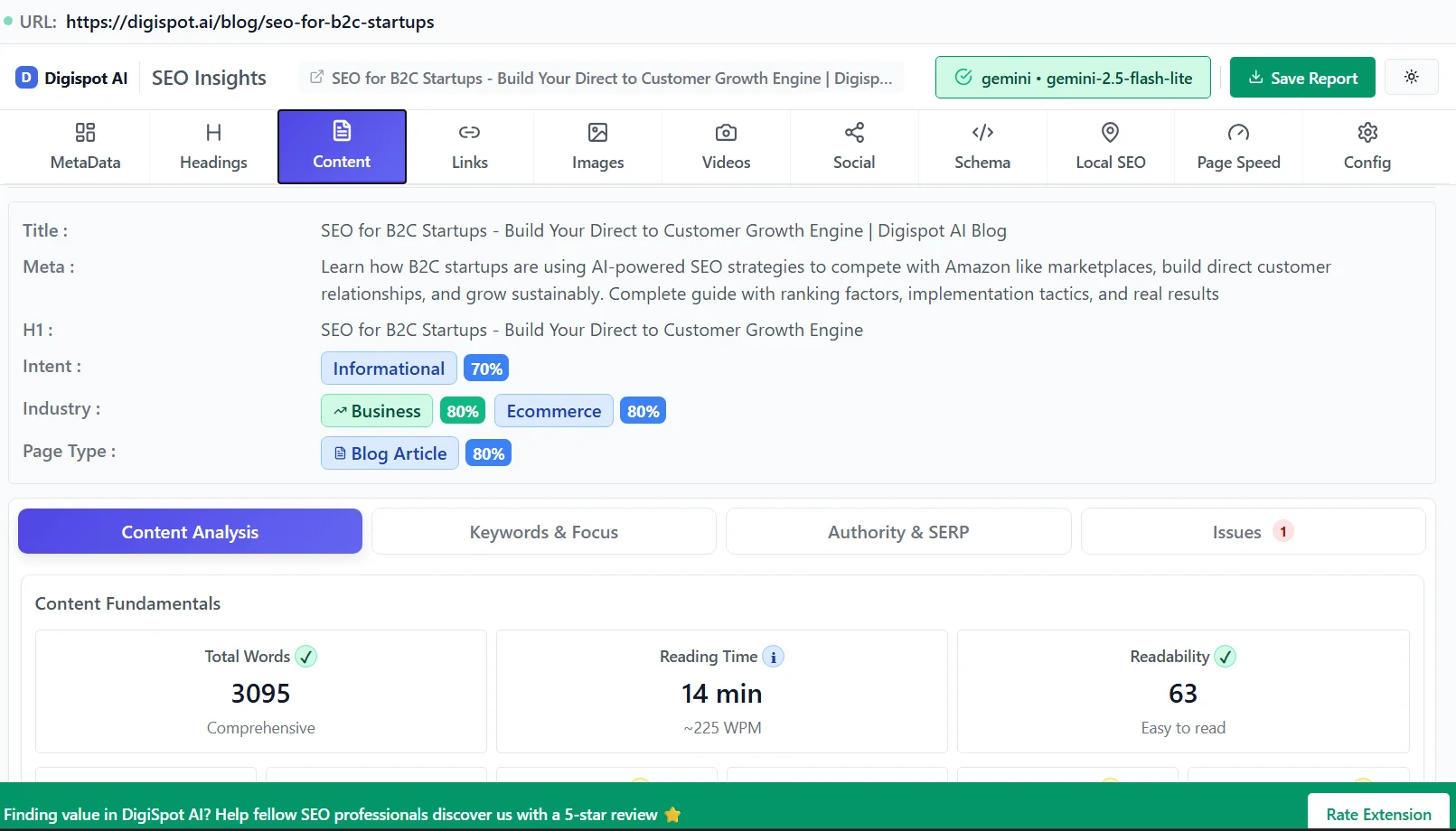
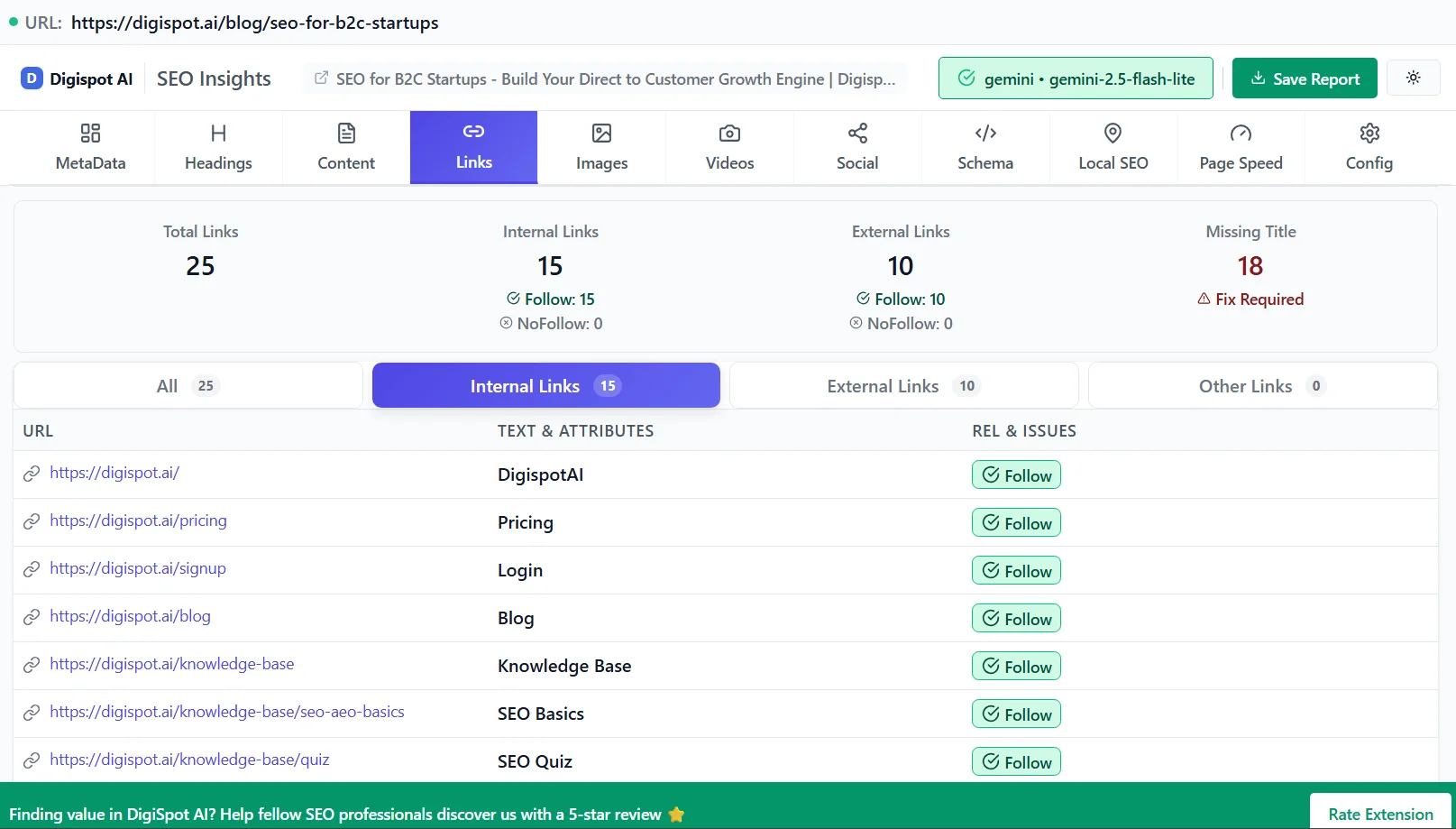
Check your current linking structure instantly. Get instant SEO insights on any page with our free Chrome extension.
Optimizing for AI Search (AEO)
This is where the future of B2B SEO lies. Decision-makers are using LLMs like ChatGPT and Claude to research vendors. These platforms don't just "search" the web; they "understand" entities.
Entity-First Strategy
LLMs function by connecting entities (Concepts, Brands, People) in a vector space. To rank in AI overviews, Digispot AI must be clearly associated with "SEO Platform," "Audit Tool," and "Enterprise Software."
- Define Your Entities: Clearly state what your company is and does on your About page and Homepage.
- Contextual Co-occurrence: Discuss your brand alongside industry-standard terms. If you sell ERP software, your content must consistently discuss "supply chain," "finance module," and "inventory management."
Structured Data (Schema Markup)
Schema is the language of entities. It disambiguates your content for machines. Standard "Article" schema isn't enough.
- Organization Schema: Nest your social profiles, logo, and contact info.
- Product Schema: crucial for B2B SaaS. Include pricing (if public), ratings, and application categories.
- FAQ Schema: Directly feeds into AI answers.
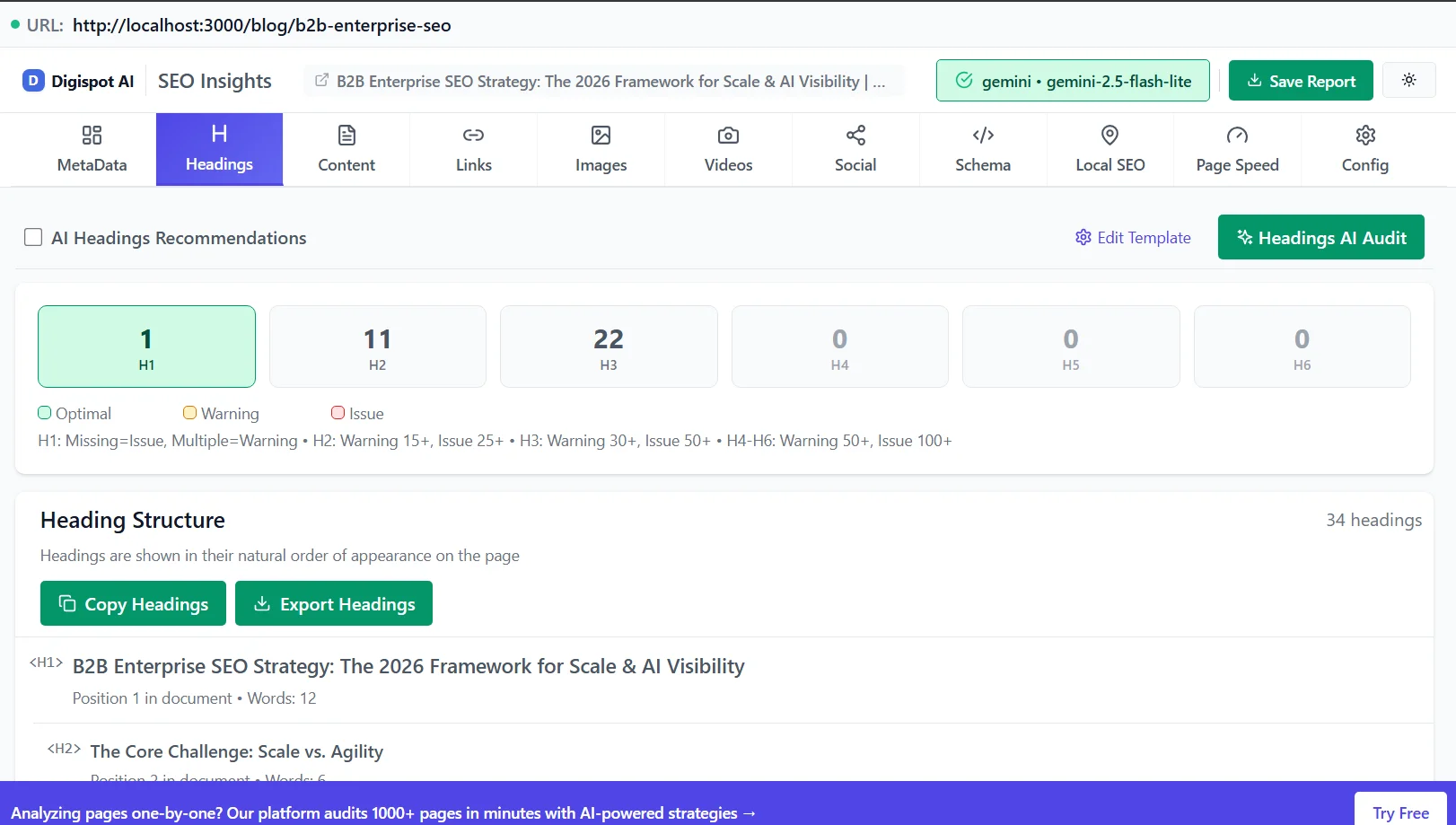
Use the free Schema Markup Generator to create valid structured data in minutes without writing code.
The "Answer" Format
AI platforms prefer content that directly answers questions. Adopt the "BLUF" (Bottom Line Up Front) writing style.
- Start sections with direct definitions.
- Use bullet points for lists (LLMs digest lists easily).
- Avoid fluff. AI models are trained to penalize verbose, low-information text.
Programmatic SEO for B2B
Programmatic SEO involves creating large volumes of landing pages using a database and templates. For B2B, this often manifests as:
- Integration Pages: "Digispot AI integration with Salesforce," "Digispot AI integration with HubSpot."
- Competitor Comparison Pages: "Digispot vs Semrush," "Digispot vs Ahrefs."
- Template Libraries: "Free SEO Audit Template," "Free Content Calendar Template."
The Risk: Creating thousands of "thin content" pages that get penalized. The Solution: ensure every programmatic page has unique data points. Don't just swap the keyword. Dynamically inject unique descriptions, feature sets, and user reviews specific to that integration or competitor. Our guide to programmatic SEO covers how to build these templates without tripping thin-content filters.
Content Governance and Decay
Enterprise sites suffer from "content rot." Thousands of blog posts written in 2018 that are now inaccurate, dragging down your site-wide quality score.
The Content Audit Matrix
Run a quarterly audit classifying pages into four buckets:
- Keep/Monitor: High traffic, high conversion.
- Update: Good topic, declining traffic. Needs a refresh.
- Consolidate: Three articles covering the same topic. Merge them into one "Ultimate Guide" and 301 redirect the others.
- Prune (Delete): Outdated news, sunsetted products, or thin content. 410 (Gone) these pages.
For a structured approach to cleanup, review our SEO audit checklist for 2026.
Off-Page: Digital PR and Unlinked Mentions
Traditional link building (guest posting) doesn't scale well for enterprise brands. Instead, leverage your brand's existing gravity.
Reclaiming Unlinked Mentions
Your brand is likely mentioned daily in industry news, forums, and partner blogs. Often, these mentions do not link back to you.
- Use a monitoring tool to find mentions of "Digispot AI."
- Reach out to the editor: "Thanks for mentioning us. Could you update that to a clickable link so your readers can find the resource?"
- This has a high success rate because the editor has already validated your brand.
Operationalize this so it scales without a dedicated team:
- Set standing alerts for your brand name, product names, key executives, and proprietary data assets, and route new mentions into a shared queue for triage.
- Prioritize by authority and context. A passive mention on a high-authority industry publication is worth far more outreach effort than a link on a low-traffic aggregator. Score each mention before you spend outreach cycles.
- Suggest the exact anchor and destination in your outreach so the editor's job is a one-click edit — point contextual mentions to the most relevant resource page, not just the homepage.
- Feed reclaimed links back into your internal linking so equity flows from the newly linked page to related hubs. Pair this with the tactics in our internal linking strategy for SEO guide, and audit your existing profile with a structured backlink analysis to spot recurring publishers worth a partnership.
Data-Led Digital PR
B2B enterprises possess proprietary data. Publish annual "State of the Industry" reports.
- If you are a cybersecurity firm, publish data on "Ransomware Trends in 2026."
- Journalists need data to cite. They will link to your report as the source of truth.
- This generates high-authority links from Tier 1 publications (Forbes, TechCrunch, WSJ) that you cannot buy.
Securing Executive Buy-In
The biggest bottleneck in enterprise SEO is not Google; it's the CFO.
To get budget and dev resources, you must map SEO metrics to business outcomes.
- Bad Metric: "We increased organic traffic by 15%."
- Good Metric: "Organic search contributed $2.4M to the pipeline this quarter, reducing our average CAC by 10%."
Forecasting
Build a model showing the "Cost of Inaction."
- "If we fix these Core Web Vitals issues, we project a 5% lift in conversion, worth $500k/year."
- "If we do nothing, our competitor X will overtake us in share of voice by Q3."
Conclusion: Build a Moat with Strategy
B2B enterprise SEO is a long game. It requires shifting from tactical "fixing" to strategic "building." By establishing a solid technical infrastructure, adopting an entity-first content strategy, and preparing for the AI search revolution, you build a defensive moat around your organic visibility.
Don't let legacy tech and organizational silos paralyze your growth. Start by auditing your current standing.
Ready to improve your search visibility? Try Digispot AI for comprehensive website audits, AEO tracking, and actionable recommendations that bridge the gap between technical data and revenue.
Related deep-dives
Continue with these closely related guides:
- voice search seo — Voice Search SEO: The Complete Optimization Guide for 2026
References
Audit any page in seconds
300+ SEO checks including Core Web Vitals, schema markup, meta tags, and AI readiness — trusted by 1000+ SEO experts and marketers.
Frequently Asked Questions
Here are some of our most commonly asked questions. If you need more help, feel free to reach out to us.
Written by
Maya Krishnan
Digital growth expert
Maya is a seasoned expert in web development, SEO, and digital strategy, dedicated to helping businesses achieve sustainable growth online. With a blend of technical expertise and strategic insight, she specializes in creating optimized web solutions, enhancing user experiences, and driving data-driven results. A trusted voice in the industry, Maya simplifies complex digital concepts through her writing, empowering readers with actionable strategies to thrive in the ever-evolving digital landscape.