What Is SEO? The Complete Search Engine Optimization Guide
Learn how search engine optimization works in 2026. Master the four pillars of SEO — including AI search optimization — and start ranking with Digispot AI.
 Maya Krishnan
In the rapidly shifting digital landscape of 2026, understanding how to position your business in front of active searchers is the single most critical factor for sustainable growth. Implementing a modern strategy for search engine optimization ensures your brand remains visible not just on traditional search engine results pages, but also across the emerging ecosystem of AI-driven answer engines.
This guide is the central hub for all SEO topics on digispot.ai — a reference you can return to at any stage of your SEO journey.
Table of Contents
- What is SEO and How Does It Work?
- Why SEO Matters for Business Growth
- The 4 Pillars of Modern SEO
- Technical SEO: Crawlability, Speed, and Site Structure
- On-Page SEO: Content and HTML Elements
- Off-Page SEO: Authority and Backlinks
- AEO and AI Search: The Fourth Pillar
- How to Start with SEO: A 5-Step Beginner Framework
- How Long Does SEO Take?
- SEO Tools You Need
What is SEO and How Does It Work?
At its core, search engine optimization is the strategic process of refining your website's technical architecture, content relevance, and online authority so its pages are easily discovered, indexed, and highly ranked by search engines. Rather than buying ad placements, you earn organic visibility by demonstrating to search algorithms that your website provides the best answer to a user's query.
The Three Phases of Search
To understand how optimization works, you must understand the three fundamental phases of how search engines process information:
- Crawling: Search engines deploy automated bots that follow links from page to page, discovering new and updated content across the web.
- Indexing: Once a crawler discovers a page, the search engine parses its structure and content, then stores it in a massive global database. If a page is not in the index, it cannot appear in search results.
- Ranking: When a user types a query, the search engine evaluates thousands of indexed pages in milliseconds, displaying them in descending order of relevance and quality.
How AI Search is Changing Step 3
In 2026, the ranking phase is no longer a matter of simply matching keywords in a user's query to words on a webpage. Modern search engines use machine learning and natural language processing to interpret the underlying intent of a search — not just its literal wording.
AI answer engines (Google SGE, ChatGPT Search, Perplexity) take this further: they skip the list of links entirely and synthesize a single, direct answer from multiple sources. If your content isn't structured for AI extraction, you're invisible to this growing segment of searches.
Why SEO Matters for Business Growth
For growing businesses, organic search is one of the most reliable channels for customer acquisition. Unlike paid campaigns that stop delivering results the moment your budget runs out, SEO provides a compounding return on investment.
Organic Traffic vs. Paid Advertising
Paid advertising is a transaction — you pay for every click, and costs rise as competition increases. SEO functions like a financial investment: the content and technical optimizations you implement today continue to attract targeted traffic month after month, year after year, without a direct cost per visit.
Brand Authority and Trust
Securing top organic positions acts as a powerful trust signal. Users have developed a natural bias toward organic listings over paid ads — they recognize that organic rankings are earned through merit. Statistically, the top organic result on Google captures over 30% of all search clicks, with CTR dropping sharply for lower positions.
SEO also captures users at every stage of the marketing funnel:
- Top of Funnel (TOFU): Educational blog posts answering broad informational queries.
- Middle of Funnel (MOFU): Comparison guides, product roundups, and case studies.
- Bottom of Funnel (BOFU): Transactional landing pages optimized for high-intent keywords.
The 4 Pillars of Modern SEO
To build a sustainable strategy, you cannot rely on a single tactic. Successful SEO requires a balanced approach across four distinct pillars.
┌─────────────────────────────────────────────────────────────┐
│              THE 4 PILLARS OF MODERN SEO                    │
├──────────────┬──────────────┬──────────────┬────────────────┤
│  TECHNICAL   │   ON-PAGE    │   OFF-PAGE   │   AEO & AI     │
│  Crawlability│  HTML, Meta  │  Backlinks,  │ Conversational │
│  Speed, CWV  │ Content, UX  │  Digital PR  │ LLM Citations  │
└──────────────┴──────────────┴──────────────┴────────────────┘
The first three pillars are the classic framework. The fourth — AEO and AI Search Optimization — is the 2026 addition that separates sites still visible in tomorrow's search from those that are not.
Technical SEO: Crawlability, Speed, and Site Structure
Technical SEO is the foundation upon which all your content and authority-building efforts rest. If search engines cannot crawl your website efficiently, even exceptional content will fail to rank.
Core Web Vitals and Mobile Usability
Google uses page experience as a key ranking factor, measured through Core Web Vitals:
- Largest Contentful Paint (LCP): The main content should load within 2.5 seconds.
- Interaction to Next Paint (INP): Measures page responsiveness to user inputs. Target under 200ms.
- Cumulative Layout Shift (CLS): Measures visual stability during load. Keep below 0.1.
With mobile-first indexing, search engines evaluate and rank your site based on its mobile performance. Responsive design and touch-friendly navigation are mandatory, not optional.
Real-Browser Rendering for Modern Sites
Many modern websites use JavaScript frameworks (React, Angular, Next.js). Traditional crawlers built on cURL requests can't execute JavaScript, so they see blank pages. This means JS-rendered content, lazy-loaded images, and dynamic schema all go unaudited.
Digispot AI's SEO Spider uses real Chromium rendering to crawl pages exactly as Googlebot does — and exactly as an LLM bot does — catching the rendering issues that basic crawlers miss entirely. See our guide on React SEO for JS-specific strategies.
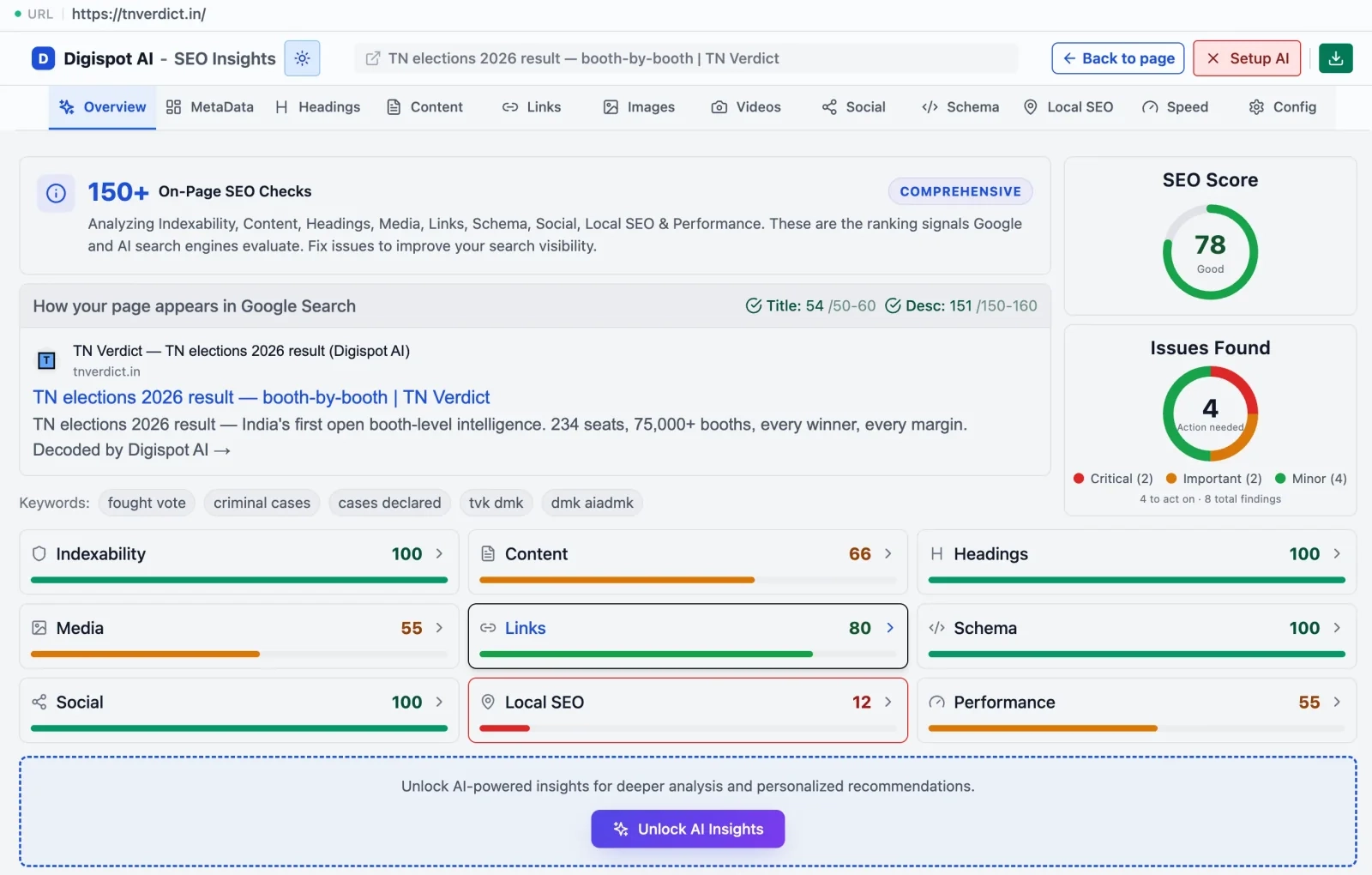 The free Chrome extension runs a full technical and on-page audit on any live URL — covering metadata, headings, schema, Core Web Vitals, and more in a single panel.
On-Page SEO: Content and HTML Elements
On-page optimization makes your individual web pages highly relevant and understandable to both crawlers and human readers.
Essential HTML Tags
- Title Tags: Should contain your primary keyword near the beginning, under 60 characters.
- Meta Descriptions: A 120–155 character summary that improves CTR even though it's not a direct ranking factor.
- Heading Tags (H1–H3): One H1 per page stating the main topic; H2/H3 for logical sub-sections.
Content Quality and Keyword Placement
Search engines prioritize comprehensive, high-quality content that demonstrates expertise and depth. Place your primary keyword naturally within the first 100 words, in at least one H2, and throughout the body where it fits naturally — not forced repetition.
Every piece of content should directly address a specific search intent. The free SEO Insights Chrome extension analyzes 150+ on-page elements in real time as you browse or write, making on-page checks instant.
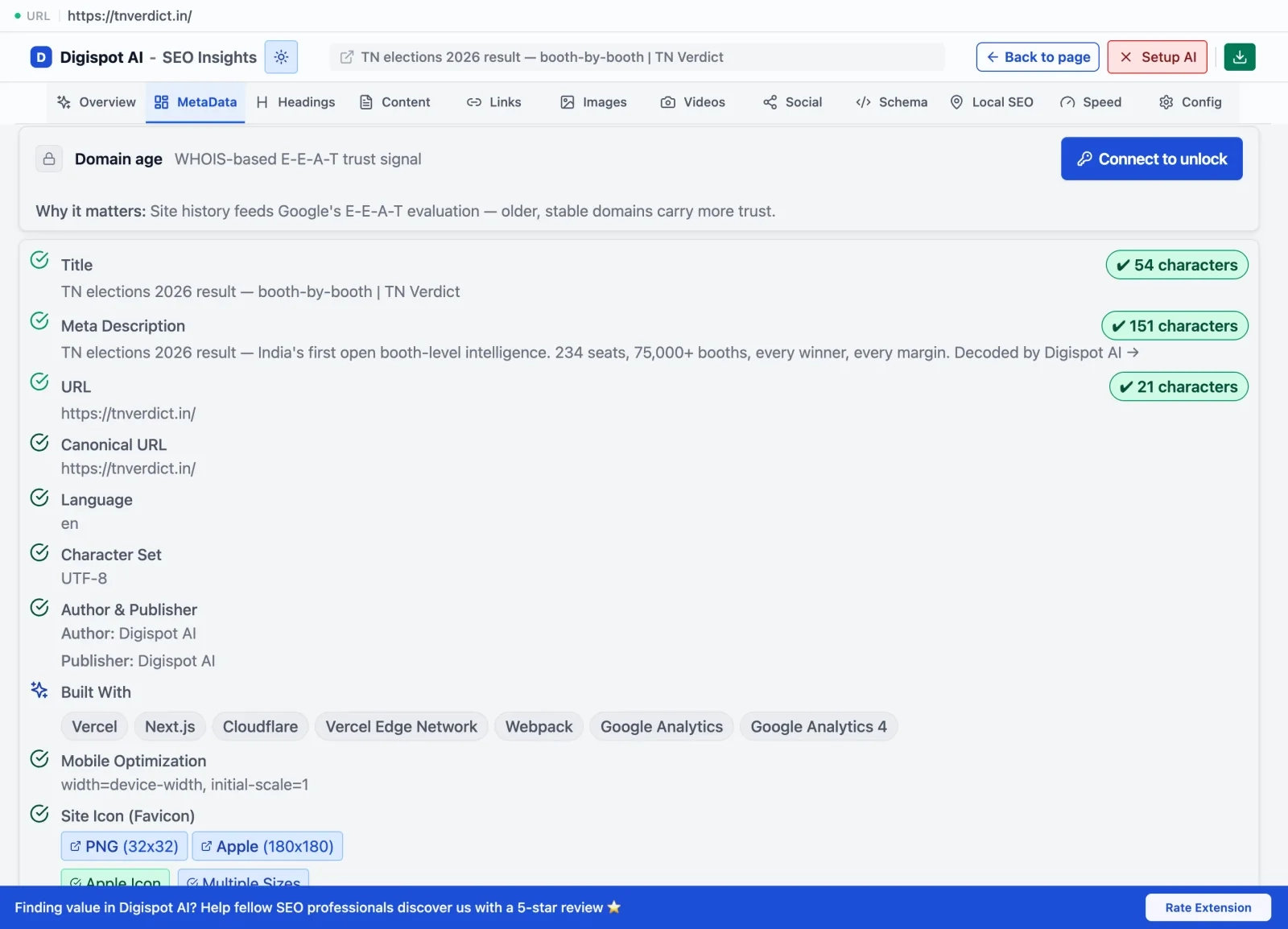 The Chrome extension's metadata panel shows your title tag length, meta description, canonical URL, and any missing or over-limit issues — on any page, in real time.
Off-Page SEO: Authority and Backlinks
While technical health and optimized content set the stage, off-page signals determine how high your website can rank for competitive terms.
Why Backlinks Remain Critical
Search engines view backlinks as third-party votes of confidence. When an authoritative, relevant website links to your content, it passes trust and link equity to your site. A strong backlink profile signals to algorithms that your site is a trusted resource in your industry.
White-Hat Link Building Strategies
- Linkable assets: Original research, data studies, comprehensive guides, or free tools that writers naturally want to cite.
- Digital PR: Expert commentary and unique insights pitched to journalists and industry publications.
- Guest publishing: High-quality articles on reputable blogs in your niche, with a contextual link back to your content.
Never buy links or participate in link exchange networks. These tactics violate search engine guidelines and lead to algorithmic penalties that are painful to recover from.
AEO and AI Search: The Fourth Pillar
The emergence of conversational AI engines has changed how users look for information. ChatGPT, Perplexity, and Google's AI Overviews don't return a list of links — they synthesize a single answer from multiple sources and cite the ones they trust.
To remain visible in this paradigm, businesses must expand their SEO strategy to include Answer Engine Optimization (AEO).
Optimizing for ChatGPT, Perplexity, and SGE
To be cited in AI-generated responses, your content needs:
- Clear Q&A formatting (FAQ blocks)
- Concise, direct answer sentences at the top of each section
- Complete structured data (FAQPage, Article, Organization, HowTo schema)
- Consistent brand citations across high-authority directories and industry wikis
Read our full AEO guide and our practical AI search optimization playbook for the complete workflow.
LLMBot vs. Googlebot Rendering
LLMs use specialized crawlers (GPTBot, OAI-SearchBot, PerplexityBot) that evaluate websites differently from Googlebot. Digispot AI is the only SEO platform that runs side-by-side audits comparing how Googlebot and LLM crawlers render your pages — surfacing content and schema gaps that traditional crawlers miss entirely.
Traditional Crawling (Googlebot)  ──► Indexes HTML ──► Ranks by link authority
AI Search Crawling (LLMBot)      ──► Parses data ──► Synthesizes & cites sources
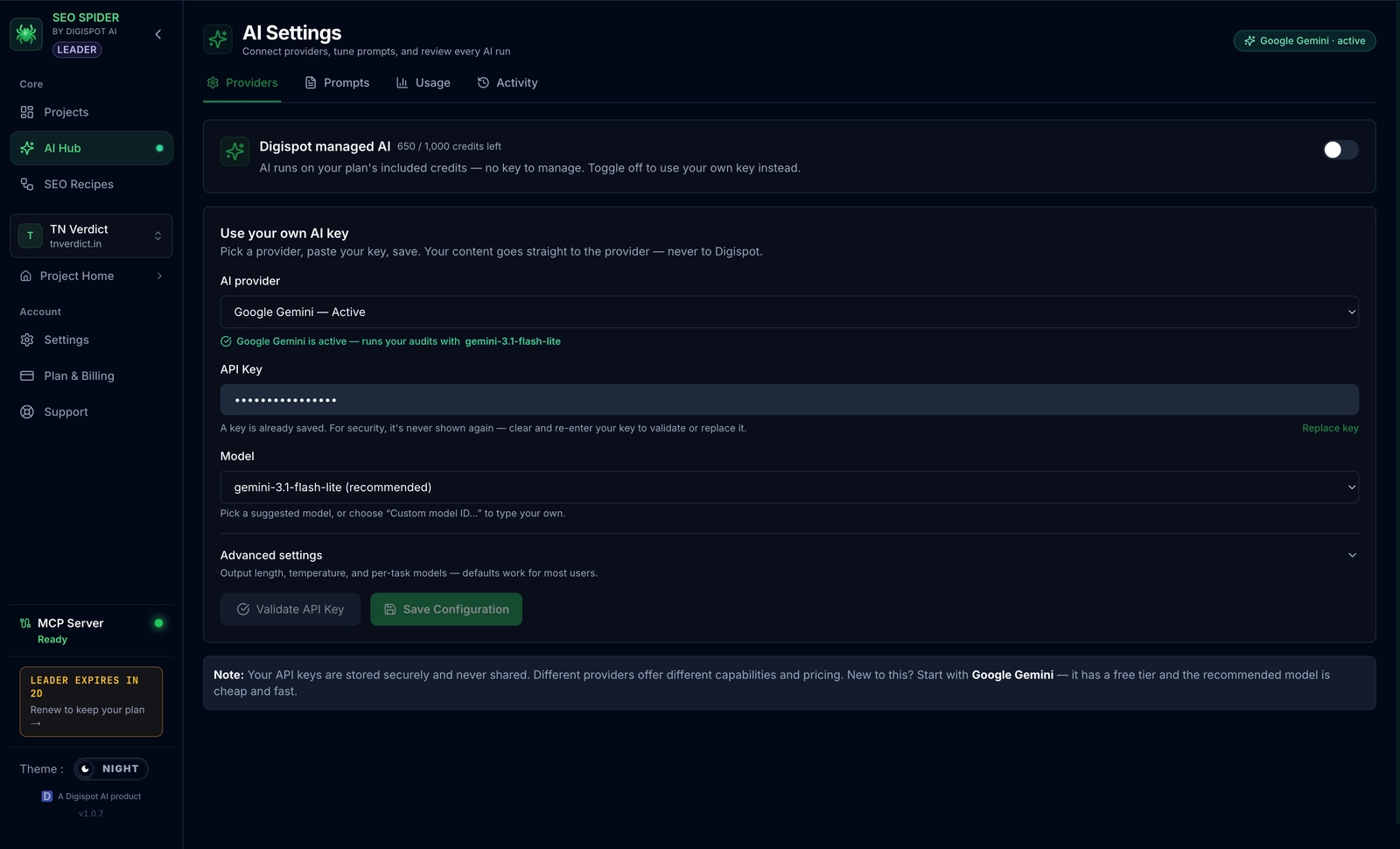 Digispot AI is the only SEO platform that runs side-by-side Googlebot vs. LLMBot audits — letting AI agents like Claude query the comparison data and generate fixes automatically via the built-in MCP server.
How to Start with SEO: A 5-Step Beginner Framework
- Audit your site's technical health. Use a crawler to identify broken links, indexing errors, and slow-loading pages before anything else.
- Do keyword research. Identify the search terms your target audience uses, balancing search volume, relevance, and keyword difficulty.
- Create optimized content. Write comprehensive, high-quality content that directly answers the search intent behind your target keywords.
- Build authority. Implement a digital outreach strategy to earn high-quality backlinks and brand citations from trusted industry sites.
- Track, analyze, and iterate. Monitor performance using GSC and analytics tools. Understand what's working and refine your strategy continuously.
Recommended tool at each step:
- Step 1 → Digispot AI SEO Spider (free 7-day trial)
- Step 2 → Digispot AI keyword research module + GSC
- Step 3 → Digispot AI Content Studio + free Chrome extension
- Step 4 → Digispot AI Backlinks module
- Step 5 → Digispot AI Cloud Platform (GSC + GA4 unified dashboard)
How Long Does SEO Take?
SEO is a long-term investment, not a quick fix. Realistic benchmarks:
- 3–6 months: Early signals — increased keyword impressions, minor ranking improvements.
- 6–12 months: Measurable organic traffic growth on targeted keywords.
- 12+ months: Competitive rankings and compounding authority for high-volume terms.
Factors that affect the timeline:
| Factor | Impact |
|---|---|
| Competitive landscape | Highly competitive industries take longer |
| Domain age and authority | Newer domains take longer to build trust |
| Technical health | Resolving major technical issues can unlock rapid improvement |
| Content consistency | Regular, high-quality publishing accelerates your footprint |
SEO Tools You Need
For most growing teams, a complete SEO toolkit covers four areas:
| Need | Tool |
|---|---|
| Site crawling & technical audit | Digispot AI SEO Spider |
| Keyword research & rank tracking | Digispot AI Cloud Platform |
| Backlinks analysis | Digispot AI Backlinks module |
| Search performance data | Google Search Console (GSC) |
Digispot AI consolidates all four — plus AEO/LLM readiness checks, AI-agent integration via MCP, and GA4 behavioral data — into a single platform. The free Chrome extension is the no-cost starting point; the SEO Spider starts at $14/mo for the full crawler.
Where to go next:
- Complete SEO Audit Checklist — the step-by-step audit walkthrough
- Answer Engine Optimization Guide — deep dive on AEO
- What is Link Building in SEO — the backlinks playbook
- Keyword Research Guide — finding and targeting keywords
Related deep-dives
Continue with these closely related guides:
- deepseek search optimization — DeepSeek Search Optimization: The Complete AEO Guide for 2026
Audit any page in seconds
300+ SEO checks including Core Web Vitals, schema markup, meta tags, and AI readiness — trusted by 1000+ SEO experts and marketers.
Frequently Asked Questions
Here are some of our most commonly asked questions. If you need more help, feel free to reach out to us.
Written by
Maya Krishnan
Digital growth expert
Maya is a seasoned expert in web development, SEO, and digital strategy, dedicated to helping businesses achieve sustainable growth online. With a blend of technical expertise and strategic insight, she specializes in creating optimized web solutions, enhancing user experiences, and driving data-driven results. A trusted voice in the industry, Maya simplifies complex digital concepts through her writing, empowering readers with actionable strategies to thrive in the ever-evolving digital landscape.