Answer Engine Optimization (AEO): Complete 2026 Guide
Master Answer Engine Optimization (AEO) to rank in Google AI Overviews, ChatGPT, Perplexity, and Claude. Turn visibility into direct answers.
 Maya Krishnan
Search is no longer just about ten blue links. With the rise of Google's AI Overviews, ChatGPT's Search, and Perplexity, users are getting direct answers without clicking a single result.
If your content isn't optimized to feed these AI models, you are invisible to a massive segment of modern searchers.
This shift defines Answer Engine Optimization (AEO).
AEO isn't just a buzzword; it is a fundamental mechanical shift in how we structure data for the web. Traditional SEO focused on proving relevance to an indexer. AEO focuses on proving authority and clarity to a Large Language Model (LLM).
In this guide, you will learn exactly how to adapt your strategy to dominate AI-generated results, ensuring your brand remains the primary source of truth in the era of generative search.
Key Takeaways
- AEO optimizes for citation, not clicks. Your goal is to be the single source an AI synthesizes its answer from — not just to rank in a list of links.
- Retrieval works on chunks, so format answer-first. AI systems pull small, self-contained chunks; put the direct answer in the first sentence under a question-phrased heading.
- Structured data is non-negotiable. FAQPage, Article, Organization, and HowTo schema translate your content into the machine-readable units answer engines cite.
- Fix the technical layer first. Unblock AI crawlers in
robots.txt, publish anllms.txt, and make sure content renders without JavaScript — visibility is usually lost here before content quality matters. - Measure citations and AI referrals, not just rank. Track brand share of voice in AI answers and referral traffic from sources like ChatGPT and Perplexity.
The Mechanic Shift: From Indexing to Synthesis
To succeed in AEO, you must understand how AI search engines function differently from traditional search engines.
Traditional Search (Google Classic):
- Crawls the web.
- Indexes content based on keywords and backlinks.
- Retrieves a list of relevant links.
- User does the work of synthesizing information.
Answer Engines (AI Overviews, Perplexity, ChatGPT):
- Crawls (or retrieves) content.
- Understands intent and context via LLMs.
- Synthesizes information from multiple sources.
- Presents a single, conversational answer.
The AI is the intermediary. It reads your content so the user doesn't have to. If your content is unstructured, vague, or buried in fluff, the AI will ignore it in favor of a source that is easier to parse.
The Rise of Retrieval-Augmented Generation (RAG)
Most AI search tools use a process called Retrieval-Augmented Generation (RAG). They don't just rely on pre-training data; they fetch live data from the web to answer a query.
Your goal is to be the piece of data the RAG system retrieves.
How retrieval actually works (and why structure wins). A RAG system doesn't read your page top to bottom the way a human does. It splits your content into small chunks (typically a few hundred tokens each), converts every chunk into a vector, and — at query time — pulls back only the handful of chunks whose meaning is closest to the question. The model then writes its answer from those chunks alone. If the answer to a question isn't cleanly contained in a single retrievable chunk, you don't get cited.
Here's the same fact structured two ways:
| ❌ Buried in prose | ✅ Self-contained chunk |
|---|---|
| "There are a number of factors that influence how long an SEO audit takes, and depending on the size of the site and what you're looking at, it can vary quite a bit from one project to the next…" | How long does an SEO audit take? A standard audit takes 2–4 hours for a site under 500 pages, and 1–2 days for larger sites, depending on crawl depth and the number of issues found. |
The second version survives chunking: the question and its complete answer sit together, so retrieval returns one clean, quotable unit. This is why "answer-first" formatting and FAQ schema matter so much — they align your content with the unit AI actually retrieves, not the page as a whole.
Digispot AI helps you analyze how easily these RAG systems can parse your content. If an LLM struggles to identify your entities or main points, you lose the citation.
Core Pillars of Answer Engine Optimization
AEO requires a stricter adherence to technical excellence than traditional SEO. While Google might forgive messy code if the content is good, an LLM often views messy code as "noise" and discards it.
1. Structure and Schema: Speaking the AI's Language
LLMs love structure. Structured data (Schema.org) translates your human-readable content into machine-readable JSON-LD code. This removes ambiguity.
For example, without schema, an AI might guess that "Apple" refers to the fruit or the company based on context words. With Schema, you explicitly tell the engine: "@type": "Corporation", "name": "Apple".
Essential Schema for AEO:
- FAQPage: Directly feeds Q&A formats.
- Article/NewsArticle: Establishes authorship and dates (crucial for freshness).
- Organization/LocalBusiness: Solidifies your brand entity.
- HowTo: Perfect for step-by-step AI answers.
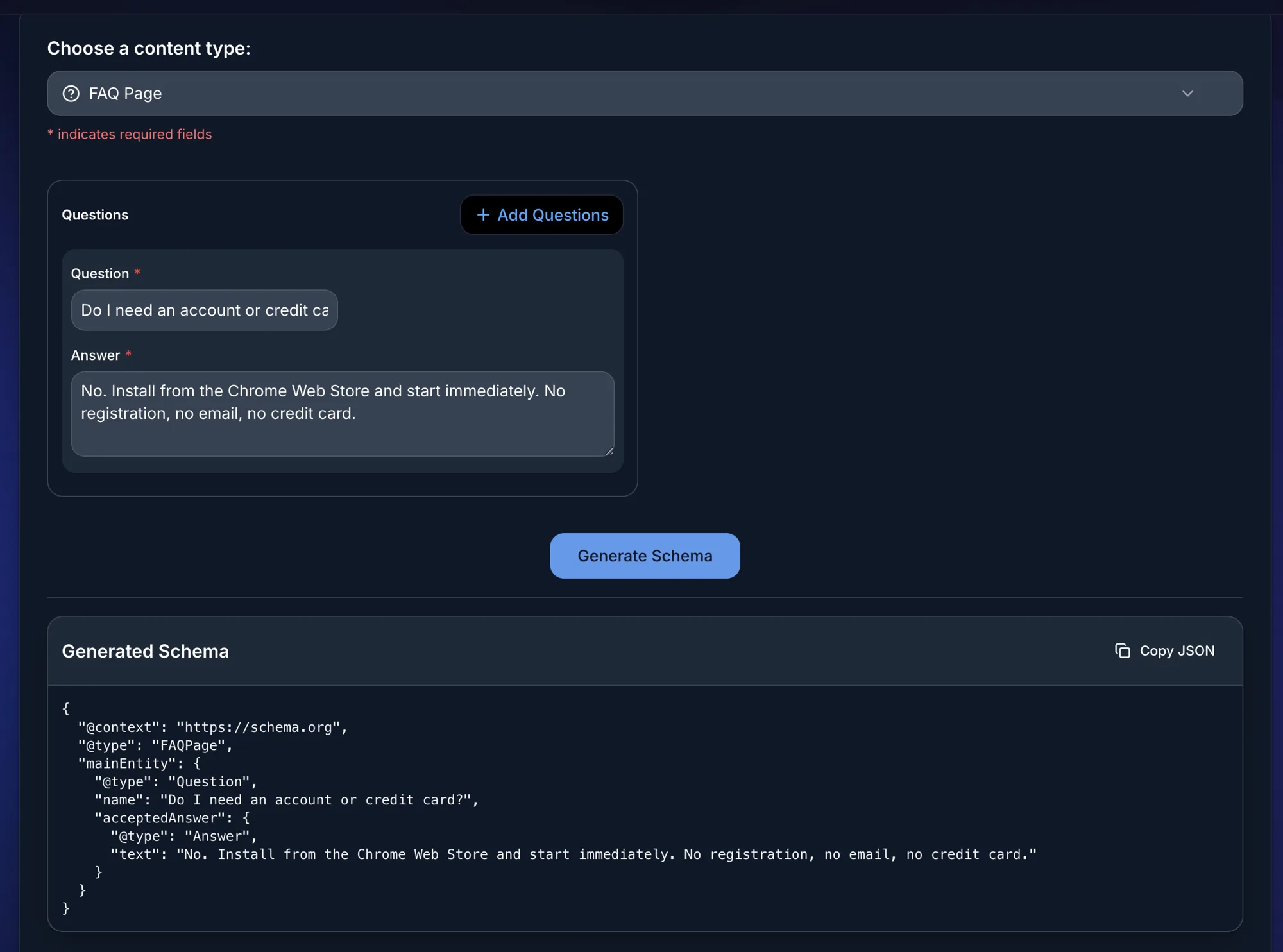
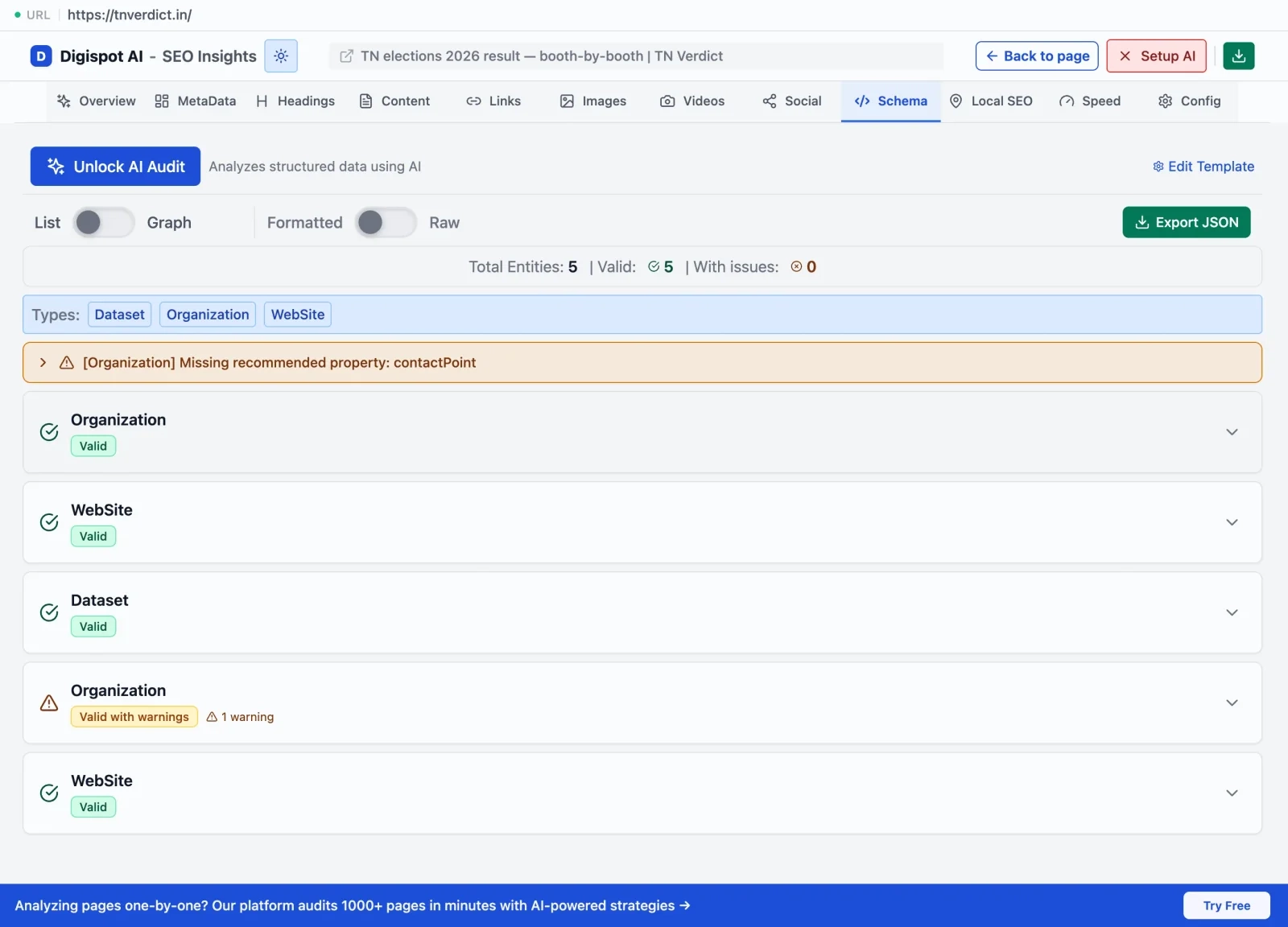
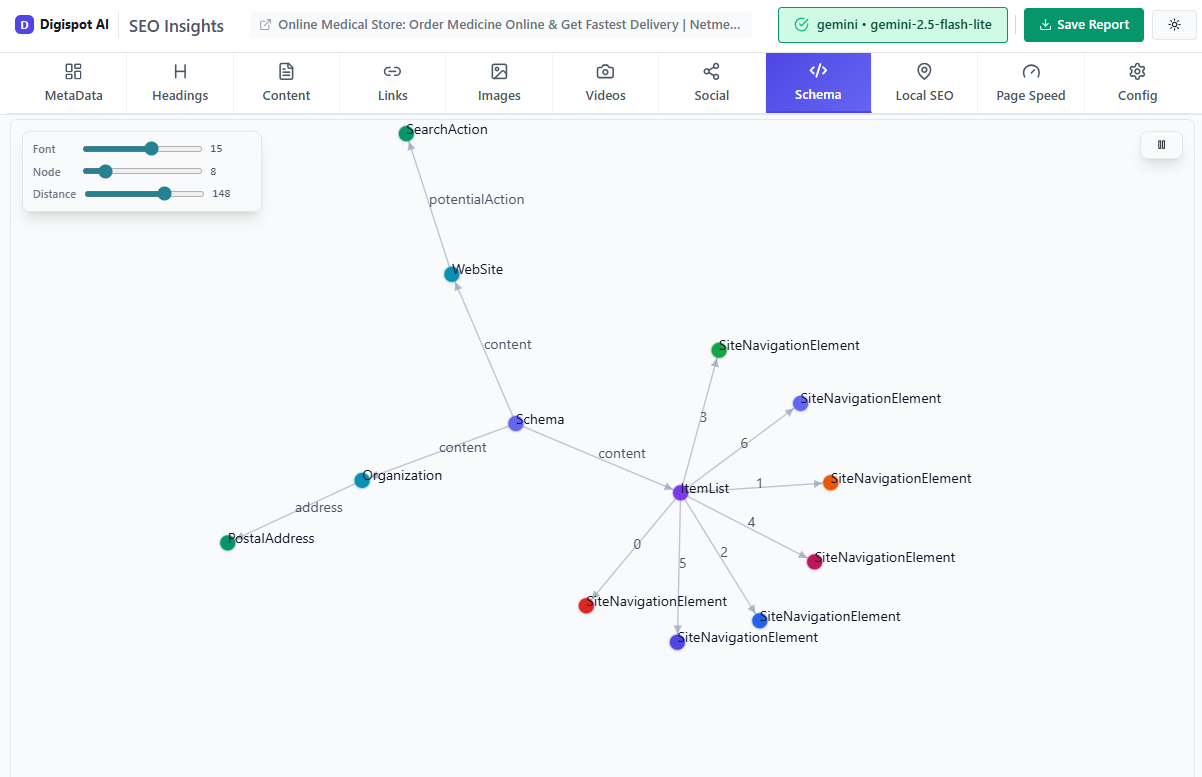
Validate the vocabulary against the official Schema.org documentation, and for nested entities and @graph patterns that give LLMs richer context, see our advanced schema markup guide. You can create valid JSON-LD code in minutes using our free Schema Markup Generator — pick a content type, fill in your Q&A, and copy the ready-to-paste FAQPage JSON-LD:
2. Authority and Citations (E-E-A-T)
AI models are programmed to reduce hallucinations (lying). To do this, they prioritize sources with high "trust" signals. This is where Google's E-E-A-T (Experience, Expertise, Authoritativeness, Trust) concept becomes an AEO ranking factor.
- Brand Entity: You must be a recognized entity in the Knowledge Graph.
- Author Credentials: AI engines verify if the content is written by an expert.
- Citations: Backlinks act as "votes" for SEO; in AEO, citations from other authoritative texts act as verification.
Learn more about building trust signals in our E-E-A-T SEO Guide.
3. The "Answer First" Content Format
Burrying the lede is deadly in AEO.
In the past, recipe blogs wrote 2,000 words about their childhood before giving the ingredients. AI hates this. It consumes tokens (processing power) to read fluff.
Adopt the Inverted Pyramid style:
- Direct Answer: State the definition, solution, or core fact in the first sentence.
- Context: Provide details, nuances, and examples immediately after.
- Evidence: Cite data or sources.
Bad for AEO: "When considering the various factors that influence the price of Bitcoin, one must look at..."
Good for AEO: "Bitcoin's price is influenced by supply limits, market demand, and regulatory news. The 21 million coin cap creates scarcity..."
Optimizing for Specific AI Platforms
Not all Answer Engines are the same. Digispot AI’s multi-LLM engine analyzes your site against the specific biases of different models (GPT-4, Claude, Gemini, etc.), but here are general rules for the major players.
Use this table as a quick reference for where each engine sources from, which crawler you must allow, and the single highest-leverage move for each:
| Engine | Sources from | Crawler to allow | Highest-leverage move |
|---|---|---|---|
| Google AI Overviews | Google's live index + Featured Snippet logic | Googlebot, Google-Extended | Win the Featured Snippet for the target query |
| ChatGPT / SearchGPT | Bing's index + live fetch | GPTBot, OAI-SearchBot, Bingbot | Question-phrased H2s with a 40–50 word answer beneath |
| Perplexity | Own crawl + live web, citation-heavy | PerplexityBot | Dense stats + outbound links to .gov/.edu sources |
| Claude | Live fetch when browsing | ClaudeBot, anthropic-ai | Clean semantic HTML + explicit entity/author markup |
Google AI Overviews (SGE)
Google's AI Overviews prioritize content that is already ranking well in traditional search but offers a concise summary.
- Focus: Informational queries (How, What, Why).
- Strategy: Win the Featured Snippet. AIOs often pull from the same logic — a page that owns the snippet for "how to do X" is the prime candidate to be summarized in the AI Overview.
- Metric: Click-Through Rate (CTR) creates a feedback loop. If users verify the AI answer by clicking your link, you stay there.
- Do this now: Add a one-sentence definition directly under each H2, keep it under ~50 words, and confirm
Google-Extendedis allowed inrobots.txt(it governs Gemini/AIO training and is separate fromGooglebot). - Action: Check your click-through rate optimization to ensure your metadata appeals to both humans and AI.
ChatGPT (SearchGPT) & Bing
ChatGPT's search features rely heavily on Bing's index, then fetch live pages to cite.
- Focus: Conversational context and historical accuracy.
- Strategy: Use natural language. Phrase headings as the exact questions users ask, and answer in the first sentence beneath.
- Technical: Allow three distinct agents —
GPTBot(training),OAI-SearchBot(live citations), andBingbot(the underlying index). Blocking any one quietly removes you from a different part of the pipeline. - Do this now: Verify the page is indexed in Bing Webmaster Tools — no Bing index, no ChatGPT citation, regardless of your Google rankings.
For a deeper platform-specific playbook, see our SearchGPT SEO optimization guide, and to shape prose that LLMs quote cleanly, our guide to optimizing content for LLMs.
Turn invisible SEO data into clear visuals with our Free Chrome extension.
Perplexity AI
Perplexity is an "answer engine" first. It acts like an academic researcher, heavily citing sources with footnotes.
- Focus: Data density and sourcing.
- Strategy: Include statistics, tables, and external links to high-authority domains (like .gov or .edu sites) within your content. Perplexity trusts content that trusts other high-quality content.
- Do this now: Put at least one cited statistic in the first section of the page, and make sure
PerplexityBot(andPerplexity-User, its live-fetch agent) are allowed. Perplexity rewards the page that is the primary source — original data (like the audit section below) is the strongest possible signal here.
Technical AEO: Speed and Rendering
If an AI bot times out while trying to fetch your page, you don't exist.
Core Web Vitals are more than just a user experience metric; they are a crawl budget efficiency metric. AI bots operate on tight budgets.
- Rendering: Ensure your content is server-side rendered (SSR) or heavily optimized for dynamic rendering. If your content requires complex JavaScript execution to appear, some lighter AI scrapers will miss it.
- Clean DOM: A bloated Document Object Model (DOM) confuses parsers. Keep your HTML clean.
- Mobile-First: Most AI indexing simulates mobile users.
The two-minute test. Right-click your page and choose "View Source" (raw HTML, before any JavaScript runs). If your headline, main answer, and key facts aren't in that raw HTML, an AI scraper that doesn't execute JS won't see them either. A common failure case: a React or Vue SPA where the initial HTML is a near-empty <div id="root"></div> and every word is injected client-side — Googlebot may eventually render it, but lighter fetchers like some GPTBot and PerplexityBot requests give up first. The fix is SSR or static generation so the answer ships in the first byte. For thresholds, Google Search Central and web.dev both treat sub-2.5s LCP as the target, and AI fetchers are even less patient than users.
Check your technical health with our Core Web Vitals SEO Guide, run a structured pass with our complete SEO audit guide, or use the Digispot Chrome Extension to audit your page speed instantly.
Content Strategy: Writing for Machines That Serve Humans
To rank in AI results, you must optimize for "Search Intent" with extreme precision. The AI is trying to solve a user's problem, not just match a keyword string.
1. Target "Zero-Click" Searches
Identify queries where the user wants a quick answer.
- Query: "What is the size of an Instagram Story?"
- Strategy: Create a table with dimensions, aspect ratios, and file types right at the top of your page.
2. Conversational Long-Tail Keywords
People talk to AI chatbots differently than they type into Google.
- Old Search: "best running shoes flat feet"
- AI Prompt: "I have flat feet and need running shoes for a marathon under $150. What do you recommend?"
Your content should address these specific scenarios. Use phrases like "If you have flat feet..." or "For marathon runners on a budget..."
Read our guide on Search Intent Optimization to learn how to map these conversational intents.
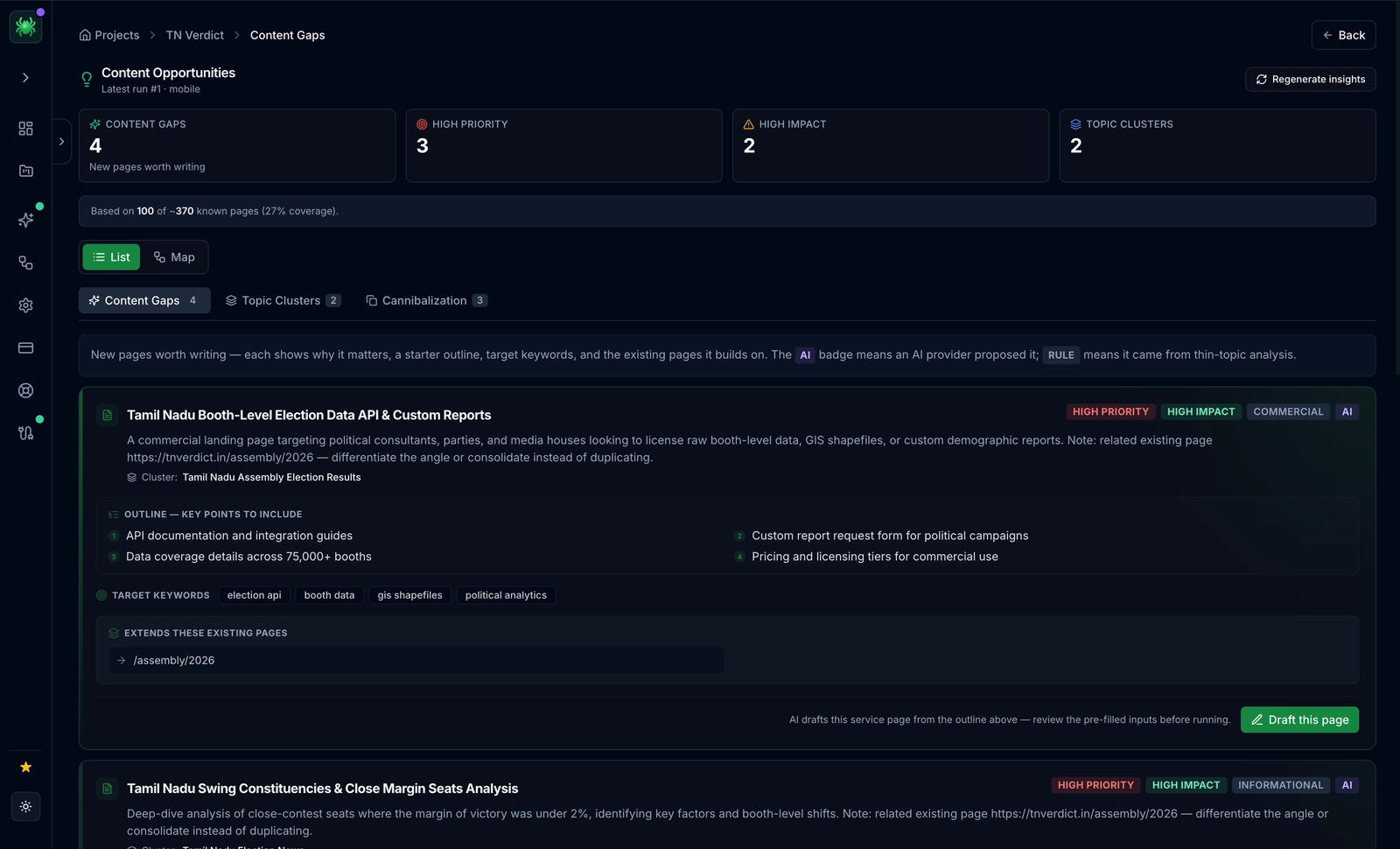
3. Data Formatting
AI models hallucinate less when data is structured in lists or tables.
Text (Hard for AI to parse accurately): "Our pricing is $10 for basic, $20 for pro, and $30 for enterprise, which includes API access."
Table (Perfect for AI):
| Plan | Price | API Access |
|---|---|---|
| Basic | $10 | No |
| Pro | $20 | No |
| Enterprise | $30 | Yes |
Tables allow the AI to quickly grab the exact data point ("Does the Pro plan have API access?") without complex text processing.
What We Found Auditing 1,200 Websites for AI Visibility
Most guides stop at theory. We ran 1,200 real websites through Digispot AI's AI-visibility audit to see where they actually lose ground with answer engines. The pattern was clear: most sites weren't losing AI search because their content was weak — they were losing it on technical basics they never knew were broken.
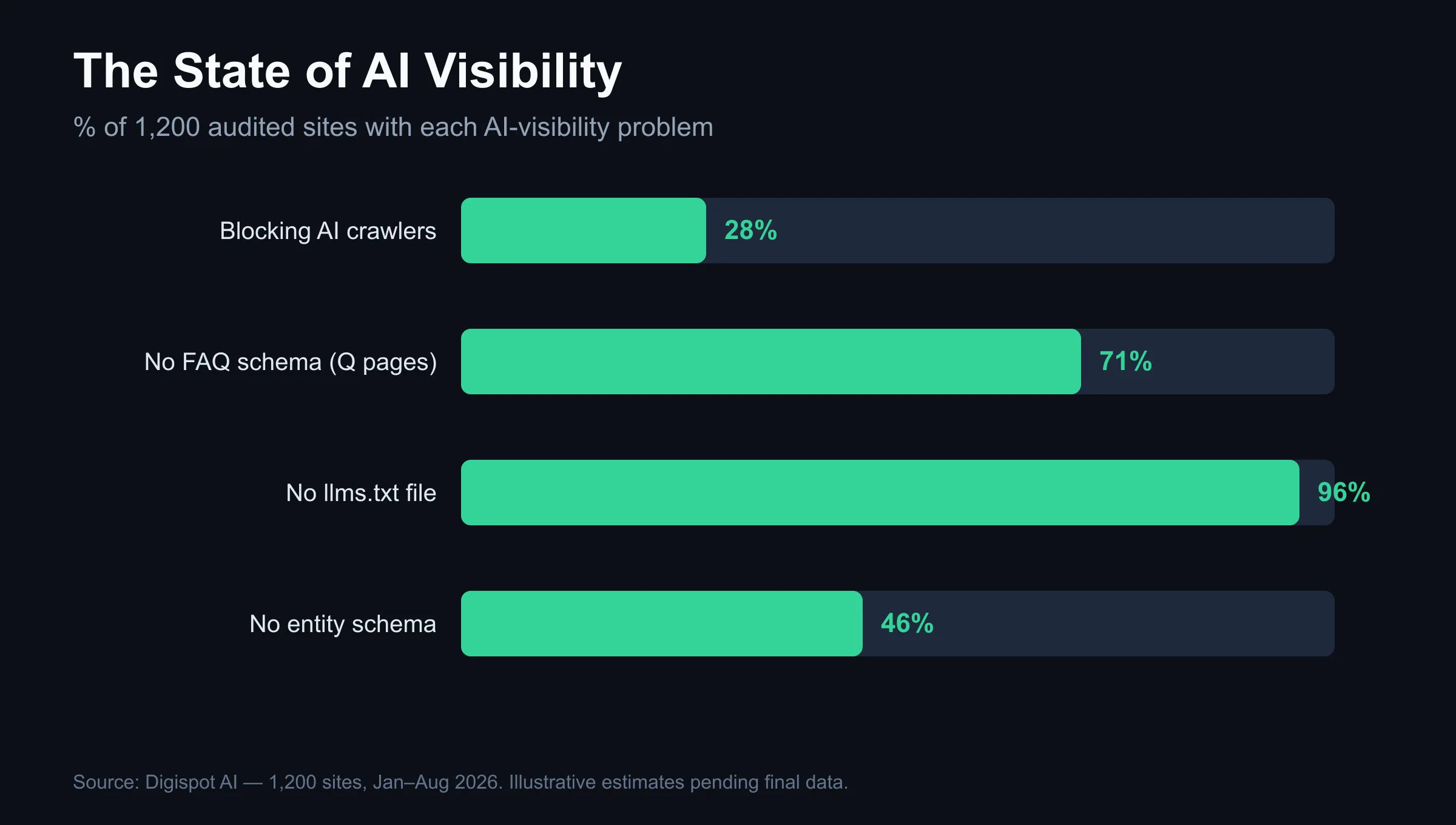
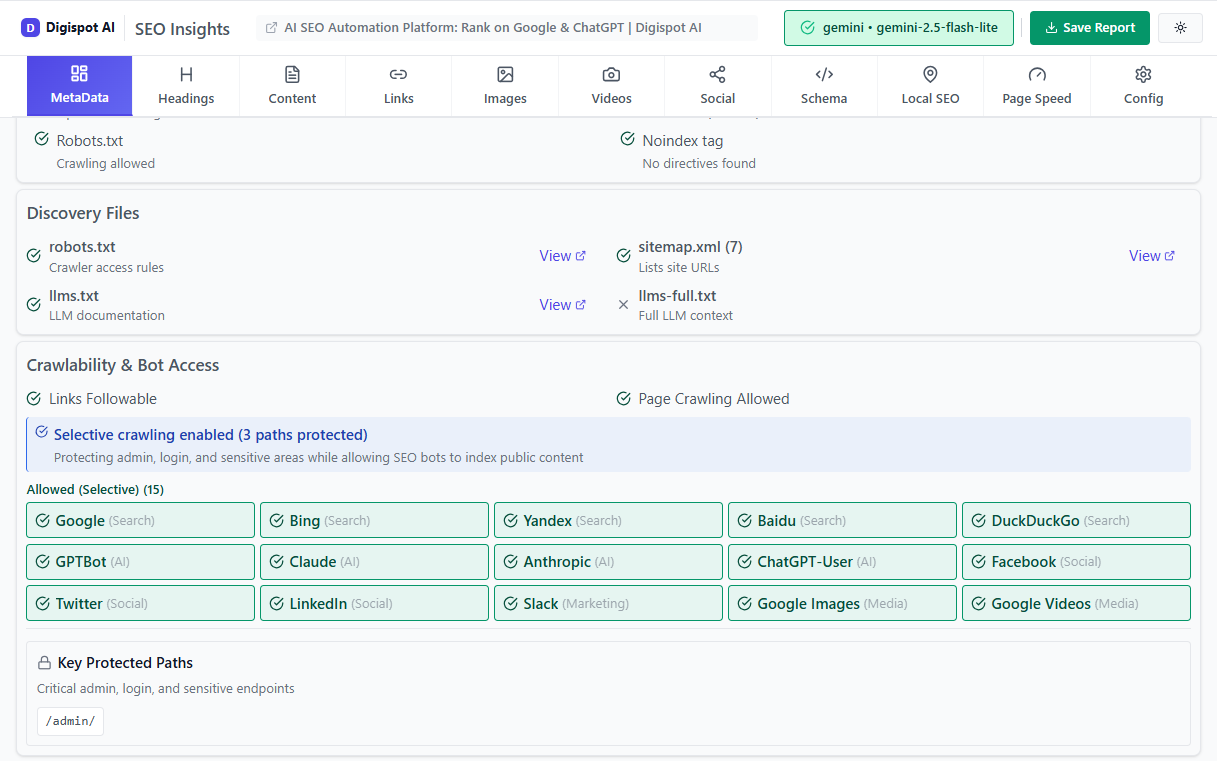
Digispot's Crawler Access report makes the problem concrete: it parses every user-agent rule in robots.txt and shows exactly which AI crawlers are blocked, conflicting, or fully allowed. Note how a duplicate allow/disallow leaves bots like GPTBot and ClaudeBot in a "conflicting" state — a silent misconfiguration that's invisible until something surfaces it.
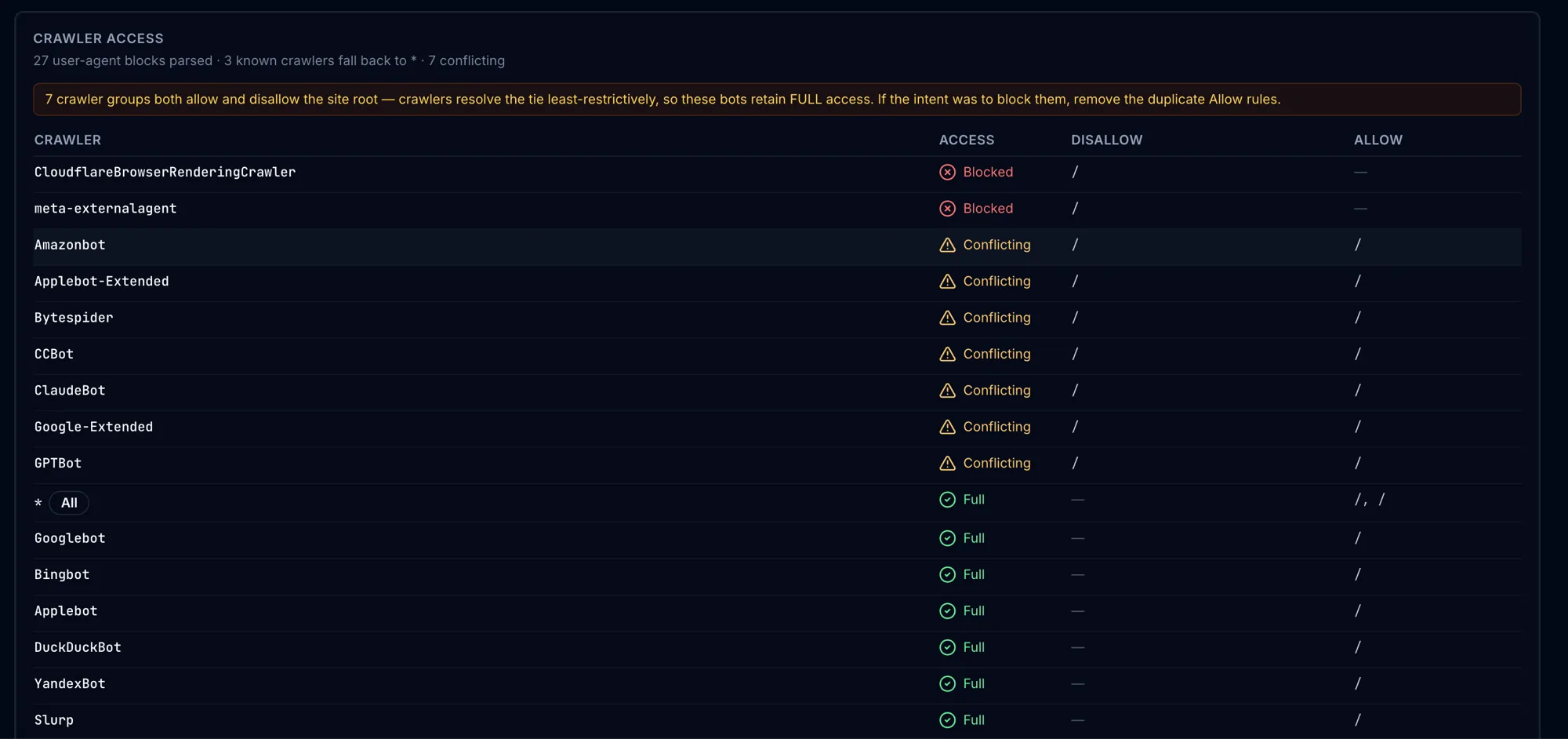
- 28% are accidentally blocking AI crawlers. Their
robots.txt(or a path-level rule) blocks GPTBot, PerplexityBot, ClaudeBot, or Google-Extended — so ChatGPT, Perplexity, and Claude literally cannot read them. Almost none had done it on purpose. - 71% of pages that ask a question have no FAQPage schema. The Q&A content that AI answers love is there, but none of the structured data that feeds it cleanly to a retrieval system.
- Only 4% publish an
llms.txt. The emerging standard for telling AI models what your site is about is still missing on the overwhelming majority of sites. - 46% have no self-referencing entity schema. With no
OrganizationorProductmarkup identifying the site's core entity, AI is left to guess who they are. - Sites with clean AI-access config and FAQ schema scored 18 points higher on our AEO readiness score than sites without — the single biggest gap between the leaders and everyone else.
The takeaway: AI visibility is lost at the technical layer, before content quality even enters the picture. The encouraging part — every issue above is fixable in an afternoon.
Methodology: 1,200 websites audited with Digispot AI between January and August 2026. Percentages reflect the share of sites (or pages) flagged by the corresponding automated check, de-duplicated by domain, excluding sites we could not reach.
Measuring AEO Success
Traditional rank tracking doesn't apply perfectly to AEO. You aren't always aiming for "Position 1." You are aiming for "Citation."
New Metrics to Watch
- Share of Voice in AI: How often is your brand mentioned in AI summaries for your target keywords?
- Referral Traffic from AI Sources: Monitor GA4 for referrals from
chatgpt.com,perplexity.ai, orbing.com(often masked as direct or organic). - Brand Mentions: Use social listening tools to see if your brand is being discussed in context with your core topics.
A quick way to start today: in GA4, build an exploration filtered to Session source containing chatgpt, perplexity, gemini, or copilot to isolate AI-driven referrals that would otherwise hide inside "Direct." Then run your ten most important queries through each engine by hand once a month and log three things: (1) were you cited, (2) which URL, and (3) which competitor was cited alongside you. That simple spreadsheet surfaces citation trends long before any dashboard will — and it tells you exactly which pages to reinforce. This kind of citation tracking is the AEO equivalent of rank tracking, and it's covered in more depth in our generative engine optimization guide.
Digispot AI is the first platform to offer specific AEO tracking, allowing you to monitor your visibility across different AI models including GPT-4, Claude, and Gemini.
The Future: Agentic SEO
We are moving toward "Agentic Web." Soon, AI agents will not just search for answers but perform tasks (booking flights, buying software). An agent doesn't browse — it fetches, parses, and acts. If it can't read your prices, policies, or inventory as structured data, it skips you and completes the task on a competitor that it can parse.
If your site isn't accessible to an AI agent, you will lose sales, not just traffic.
Three things to do now to stay agent-ready:
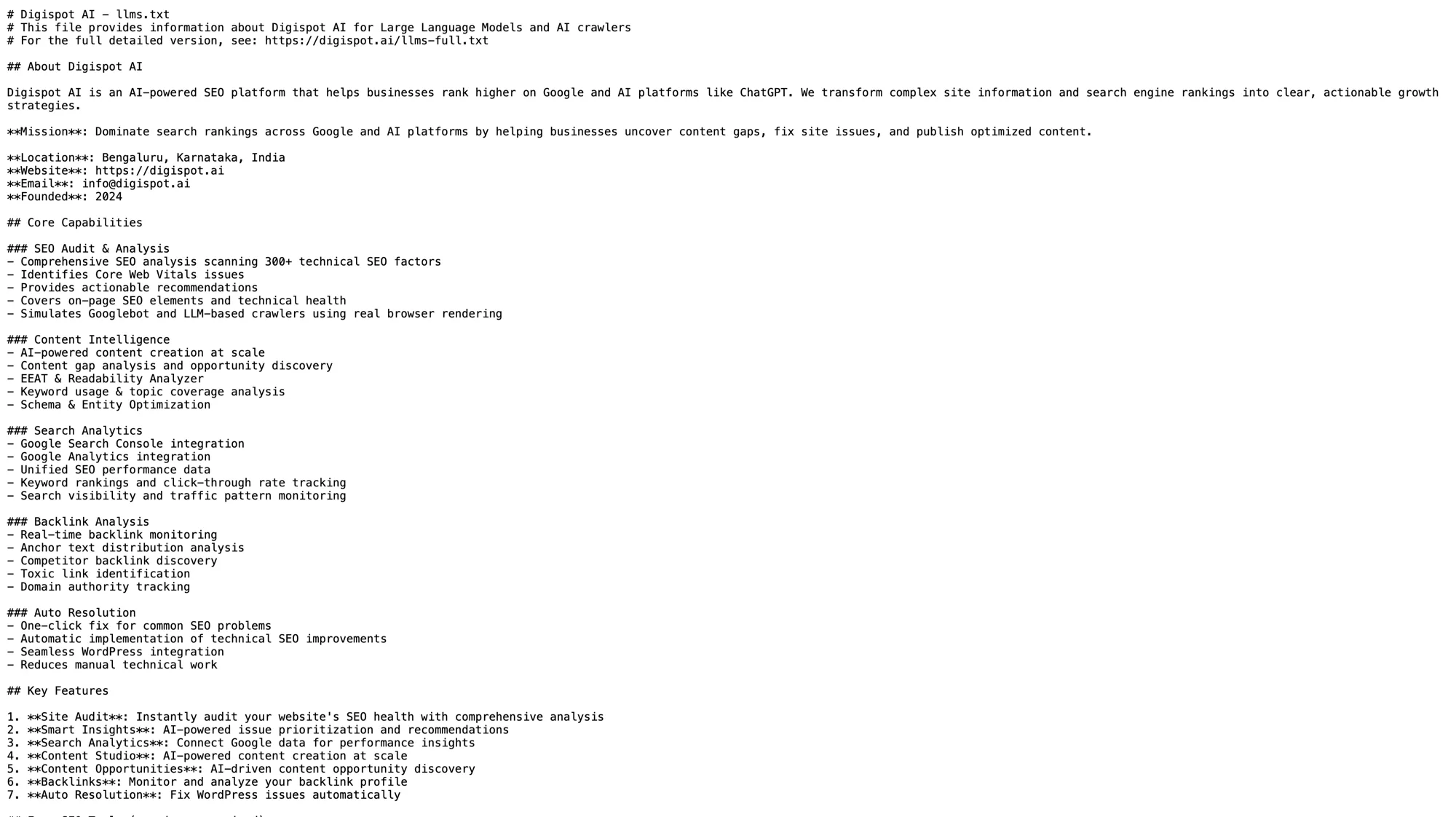
- Publish an
llms.txtfile. Mirroringrobots.txt, this emerging standard gives agents a plain-text map of your most important pages and what your site is for. It's a five-minute file that most sites still don't have — an easy first-mover edge. Here's ours as a template:
- Expose the transactional facts as structured data. Wrap prices, availability, shipping, and returns in
Product,Offer, andOrganizationschema so an agent can extract them without guessing. If you have an eCommerce site, make sure inventory is also available via a structured feed. - Make the critical path work without JavaScript. Agents are far less tolerant of client-side rendering than a browser. If your price or "add to cart" only appears after JS runs, test the page with JavaScript disabled — what an agent sees is what's in the raw HTML.
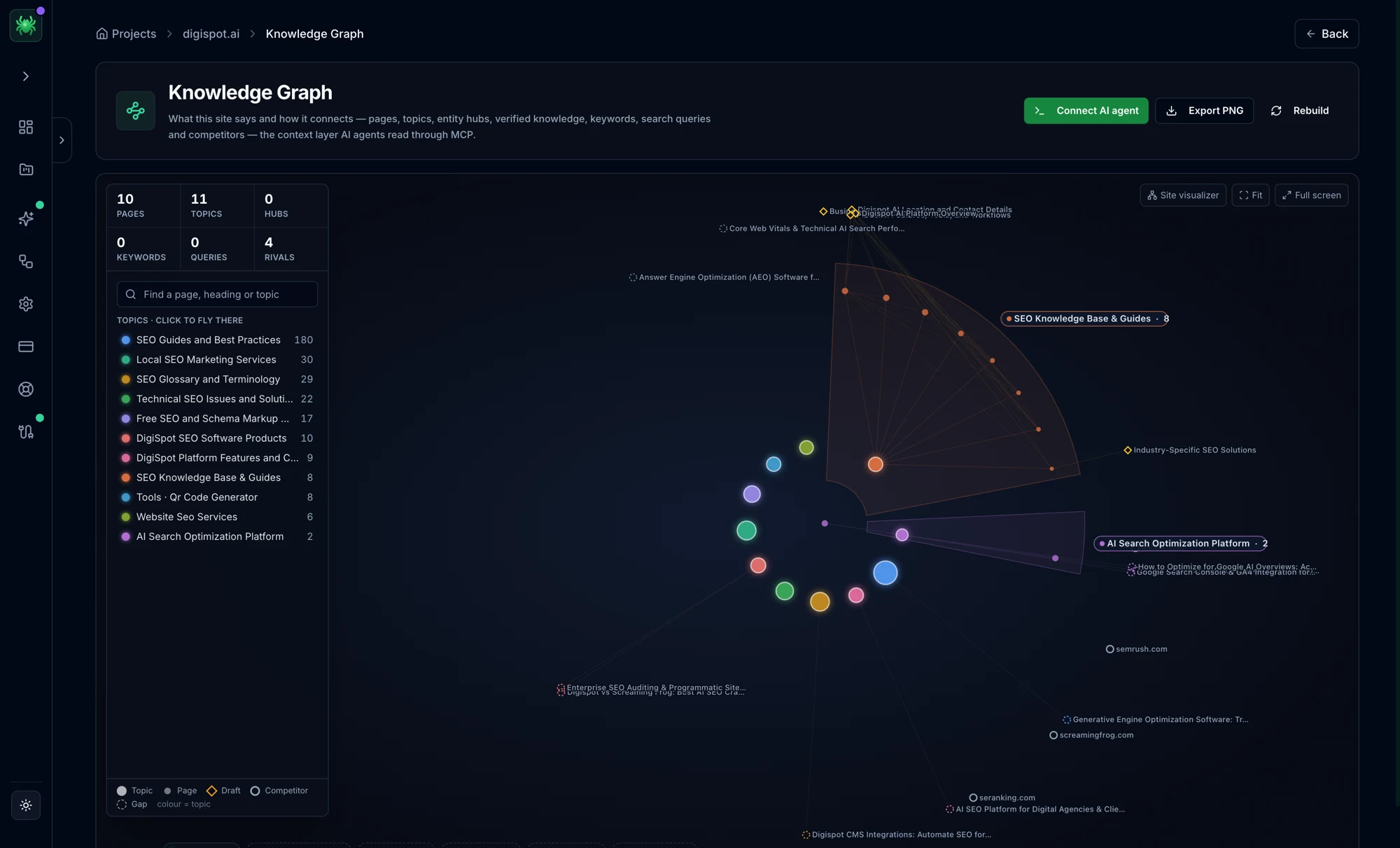
Beyond any single page, an agent works best when it can read your whole site as one connected map. The Digispot AI Spider builds that map for you: a knowledge graph of your pages, topics, entity hubs, and verified business facts, served to assistants like Claude or Cursor over MCP as one compact brief. The agent reads your site's real structure and relationships instead of inferring them page by page — the same entity clarity you are giving the answer engines, applied to your own site first. Because it is built from data the crawl already produced, generating it costs no extra AI tokens.
Optimize your online store for agents using our strategies in the Ecommerce SEO Complete Guide.
Actionable Checklist for AEO
Ready to improve your search visibility in the AI era? Follow this checklist:
- Audit Your Schema: Use the Schema Markup Visualizer to ensure you have no errors.
- Simplify Introductions: Cut the fluff. Answer the user's question in the first 50 words.
- Structure Data: Convert paragraphs into bullet points and tables wherever possible.
- Boost Authority: Update your "About Us" page and author bios to showcase expertise.
- Check Accessibility: Ensure your site is readable by bots without JavaScript dependencies.
Start Optimizing for the AI Future Today
Answer Engine Optimization is not a replacement for SEO—it is the evolution of it. By focusing on structure, authority, and clarity, you improve your site for human users while future-proofing your business for the AI revolution.
Don't let your content get left behind in the "ten blue links" era.
Ready to see how AI sees your website? Try Digispot AI today for comprehensive AEO audits, schema validation, and multi-LLM visibility tracking.
Explore the AI Search Playbook
AEO is a broad discipline, and each answer engine and technique rewards a slightly different play. Use these deep-dives to go further once you've got the fundamentals above in place.
By platform and engine:
- Start with the practical, step-by-step AI search optimization guide for an end-to-end workflow.
- How to rank in ChatGPT Search and, for the strategic trade-offs, ChatGPT vs. Google Search for SEO.
- Google AI Overviews SEO strategy for the in-SERP AI answers that appear above the classic blue links.
- Perplexity SEO, getting indexed on Microsoft Copilot, DeepSeek AI search optimization, and getting visible in Meta AI search.
By technique and strategy:
- How to optimize for AI crawlers to fix the technical access layer that most sites lose visibility on.
- Semantic search in SEO and voice search optimization for the entity- and intent-first foundations answer engines depend on.
- A guide to generative AI for SEO, plus how AI content and chatbots reshape the wider search landscape.
- How to track AI search engine rankings to measure citations and share of voice over time.
Related deep-dives
Continue with these closely related guides:
- llm seo — LLM SEO: How to Optimize Content for Language Models (GEO Guide)
- generative engine optimization — Generative Engine Optimization (GEO): The New Blueprint for AI Search Visibility
- searchgpt seo optimization — SearchGPT SEO Optimization: Ranking in the Era of AI Search
References
Audit any page in seconds
300+ SEO checks including Core Web Vitals, schema markup, meta tags, and AI readiness — trusted by 1000+ SEO experts and marketers.
Frequently Asked Questions
Here are some of our most commonly asked questions. If you need more help, feel free to reach out to us.
Written by
Maya Krishnan
Digital growth expert
Maya is a seasoned expert in web development, SEO, and digital strategy, dedicated to helping businesses achieve sustainable growth online. With a blend of technical expertise and strategic insight, she specializes in creating optimized web solutions, enhancing user experiences, and driving data-driven results. A trusted voice in the industry, Maya simplifies complex digital concepts through her writing, empowering readers with actionable strategies to thrive in the ever-evolving digital landscape.