Meta AI Search Visibility: Optimization Strategy Guide
Rank in Meta AI search. Learn how Llama 3, Bing integration, and social signals shape visibility across Facebook, Instagram, and WhatsApp.
 Maya Krishnan
Imagine a search engine embedded directly into the daily conversations of 3 billion people. That isn't a future prediction—it is the current reality of Meta AI.
Integrated seamlessly across WhatsApp, Messenger, Instagram, and Facebook, Meta AI is reshaping how users discover information. They aren't typing "best crm software" into a browser bar; they are asking their chat app, "What CRM should I use for my small business?" while messaging a colleague.
For SEO professionals, this represents a tectonic shift. Visibility in Meta AI search isn't just about ranking on Google anymore. It requires a tripartite strategy: mastering Bing SEO, optimizing for Large Language Models (LLMs), and leveraging the unique social graph of the Meta ecosystem.
If your brand is invisible here, you are missing out on the most captive audience in digital history. This guide explains exactly how Meta AI constructs its answers and how you can position your content to be its primary source.
Key Takeaways
- Bing is the gateway. Meta AI pulls its real-time web facts from the Bing index, so ranking and indexation in Bing Webmaster Tools is the single highest-leverage technical fix for Meta AI visibility.
- Optimize for the citation, not the click. Meta AI answers inside the chat, so structure content so it can be quoted as a named source—that brand authority compounds even when there is no link to click.
- Your social graph is an unfair advantage. Facebook Page About sections, Instagram bios, and descriptive captions are readable by Meta AI—treat them as SEO landing pages, not afterthoughts.
- Structure content with the inverted pyramid. Lead every section with a direct 40–60 word answer, use explicit entity names instead of pronouns, and mark it up with FAQPage and Article schema so Llama can extract it confidently.
- Sync your NAP and Bing Places for local queries. Meta AI prioritizes Bing map data inside WhatsApp and Messenger, so consistent business details drive local recommendations.
Deconstructing Meta AI: How It Thinks and Searches
To optimize for visibility in Meta AI search, you must first understand the architecture beneath the interface. Meta AI is not a traditional search engine crawler. It is a sophisticated RAG (Retrieval-Augmented Generation) system powered by the Llama family of models (currently Llama 3).
Unlike a standard crawler that indexes pages based on links, Meta AI generates answers by triangulating data from three distinct sources:
- The LLM Training Data: Static knowledge frozen in time during the model's training phase.
- Real-Time Web Search: Live data pulled via partnership with Microsoft Bing.
- The Social Graph: Proprietary access to public posts, pages, and profiles within Facebook and Instagram.
The Bing Connection
This is the most critical technical detail for SEOs. When you ask Meta AI a question requiring current facts (e.g., "What is the price of Digispot AI?"), it queries Bing.
If your site is not indexed or ranked well on Bing, you are effectively invisible to Meta AI for real-time queries. Google rankings do not matter here.
The "Zero-Click" Reality
Meta AI aims to satisfy user intent within the chat interface. It summarizes information rather than offering a list of links. This means your goal shifts from "getting the click" to "being the source." You want your brand to be the named entity that the AI cites or recommends.
Digispot AI can help you identify and fix these visibility gaps automatically with AI-powered audits that analyze how different engines, including Bing and LLMs, perceive your site structure.
The Technical Foundation: Prioritizing Bing SEO
For over a decade, SEOs have treated Bing as an afterthought. Meta AI changes that calculus. To secure visibility in Meta AI, you must treat Bing Webmaster Tools with the same rigor as Google Search Console. If Bing is new territory for you, our dedicated guide on how to optimize for Bing search walks through the setup and ranking factors in detail.
1. Verification and Indexation
Ensure your site is verified in Bing Webmaster Tools. Bing's crawler, Bingbot, behaves differently than Googlebot. It is less forgiving of JavaScript rendering issues and places higher value on clear, static HTML.
Check your "Index Coverage" report specifically in Bing. If pages are excluded there, they cannot be retrieved by Meta AI.
2. Contextual Clarity over Keywords
Bing's ranking algorithms rely heavily on exact keyword matching in titles and metadata, slightly more so than Google's semantic approach. However, for the AI layer on top of Bing to understand your content, you need context.
Ensure your H1s and H2s clearly state the question being answered.
- Weak: "Pricing"
- Strong: "Digispot AI Subscription Pricing and Tiers"
3. Multimedia Metadata
Meta AI is multimodal. It can process and display images. Bing has always excelled at image search. Ensure every image on your site has descriptive filenames and comprehensive Alt text. This increases the likelihood of your visual assets being surfaced in an AI-generated response cards.
AEO: Optimizing Content for Llama
Answer Engine Optimization (AEO) is the practice of formatting content so an AI can easily read, understand, and synthesize it. While Google focuses on "content helpfulness" for humans, LLMs like Llama look for logical structure and entity relationships. These formatting principles apply across every answer engine, and our complete AEO guide covers them in depth.
The "Inverted Pyramid" Style
Structure your content to provide the answer immediately. LLMs process text sequentially.
- Direct Answer: Start sections with a clear, concise definition or answer (approx. 40-60 words).
- Supporting Detail: Follow with context, data, and nuance.
- Examples: Provide scenarios or case studies.
This structure mimics the training data used for fine-tuning models, making it easier for the AI to "latch" onto your content as the correct answer. The same principles apply across every answer engine, so it is worth reading our deeper playbook on how to optimize content for LLMs alongside this Meta-specific guidance.
Entity Density
Llama 3 understands the world through entities (people, places, things, concepts) and the relationships between them. Your content must clearly define these relationships.
Instead of vague pronouns ("it," "they"), use specific nouns.
- Vague: "It offers great features for checking rankings."
- Optimized: "The Digispot AI Chrome Extension offers automated rank tracking and schema visualization."
This explicit phrasing helps the AI build a confidence score around the facts it retrieves from your page. Learn more about how machines understand meaning in our guide to semantic search SEO.
Leveraging the Social Graph
This is your unfair advantage. No other AI search tool has the level of access to social data that Meta AI possesses. While Google struggles to index social posts in real-time, Meta AI lives natively inside the platforms where that content is created.
Optimize Your Social Profiles
Your Facebook Business Page and Instagram Bio are now landing pages for Meta AI.
- Name & Handle: Ensure they match your brand entity exactly.
- About Section: Fill this completely with relevant keywords. If you are a "SaaS SEO Agency," that phrase must appear in your bio.
- Services Menu: On Facebook pages, list your services explicitly. Meta AI reads this structured data to answer queries like, "Does Digispot offer audits?"
Captions as Content
Treat Instagram and Facebook captions as mini-blog posts.
- Stop using one-line captions with 30 hashtags.
- Write descriptive, informative captions that answer questions.
- Meta AI indexes the text within these captions. If a user asks, "How do I fix a 404 error?", and you have an Instagram Reel with a detailed caption explaining the process, Meta AI can surfacethat content directly in the chat.
Structured Data: The Universal Translator
Structured data (Schema markup) is the bridge between human language and machine understanding. For visibility in Meta AI search, it is non-negotiable.
Since Meta AI relies on Bing, and Bing relies heavily on Schema to understand page context, you must implement robust markup.
Key Schemas for AI Visibility
- FAQPage: This is the most direct way to feed Q&A pairs to an AI.
- Article/BlogPosting: Helps the AI identify the headline, author, and publish date (crucial for "recent" queries).
- Organization/LocalBusiness: Establishes your brand entity, logo, and contact info.
- Product: Essential for e-commerce visibility within chat.
Use the free Schema Markup Generator to create valid structured data in minutes. Once implemented, you can verify it using our Schema Markup Visualizer.
The Role of Search Intent in Chat
User behavior in a chat interface differs from a search bar. Queries are conversational, iterative, and often personal.
- Search Bar: "seo audit tools free"
- Meta AI Chat: "Can you recommend a free tool to check my website's SEO errors quickly?"
To capture this visibility, you must move beyond keyword matching and address search intent optimization.
Anticipate Follow-Up Questions
In a conversation, one question leads to another. Meta AI anticipates this context. Your content should too. If you are writing about "meta tags," immediately address related topics like "how to fix missing descriptions" or "impact on CTR" within the same article.
This "topic clustering" signals to the AI that your page is a comprehensive resource, increasing the probability that it will rely on your content for the entire conversation thread, not just the first answer.
Local SEO in the Age of WhatsApp
For local businesses, Meta AI is a game-changer. Millions of users communicate with businesses via WhatsApp and Messenger. Meta AI can recommend local services directly within these chats.
To optimize for this:
- Consistency is King: Ensure your Name, Address, and Phone Number (NAP) are identical—down to the punctuation and suite number—across your Facebook Page, Instagram Profile, website, and Bing Places. Conflicting formats (for example, "St." on one profile and "Street" on another) fragment the entity and lower the confidence Meta AI has when deciding whether to recommend you. Our guide to NAP consistency for local SEO explains how to audit and unify these citations.
- Bing Places: Claim your listing. Meta AI prioritizes Bing map data for location queries, so complete every field—categories, hours, service area, and photos. Choose the most specific primary category available (for example, "Digital Marketing Agency" rather than "Marketing"), because the category is a strong signal for which conversational queries you surface against.
- Responsiveness: Meta AI knows your "response time" on Messenger. Active, responsive pages may be prioritized as "helpful" recommendations. Set up automated greetings and away messages so a first reply lands quickly even outside business hours, and keep your Facebook Page's operating hours current so the assistant does not recommend you as "open" when you are closed.
- Reviews and Recency: Fresh, positive reviews and recent posts signal an active, trustworthy business. Encourage customers to leave reviews on your Facebook Page, and publish periodic updates so the profile reads as maintained rather than abandoned.
Measuring AI Visibility
A common frustration for SEOs is the lack of a "Meta AI Search Console." There is no direct way to see how many times Llama 3 cited your blog post. For a broader framework that spans every assistant, see our guide on how to track AI search engine rankings. In the meantime, you can use proxy metrics:
- Bing Webmaster Tools Performance: Since Bing feeds the data, an uptick in Bing impressions often correlates with AI visibility.
- Referral Traffic: Watch for referrals from
l.facebook.comorbing.comthat land on deep informational pages. - Brand Mentions: Use social listening tools to see if users are discussing your brand more frequently in public threads.
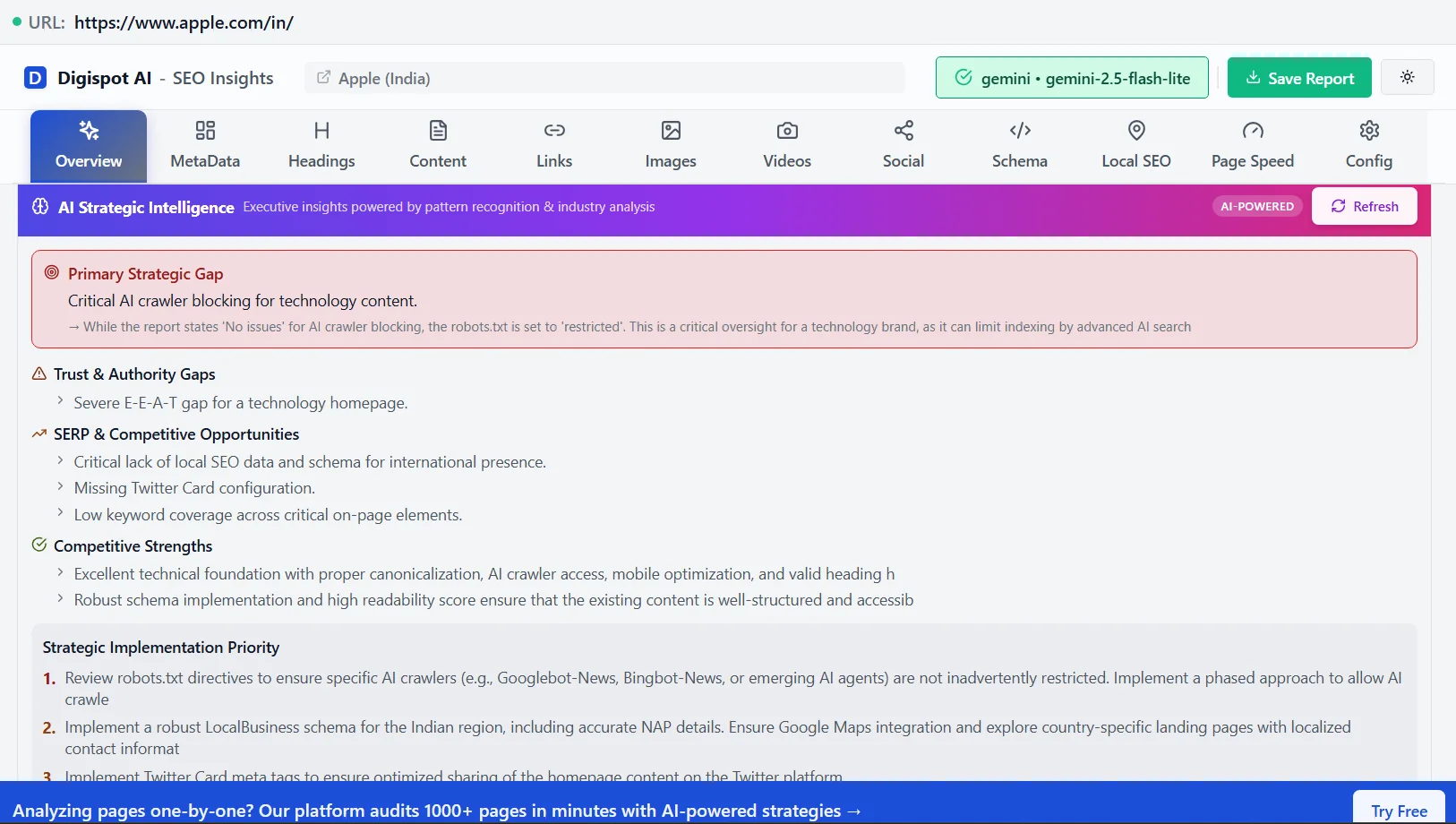
Get instant SEO insights on any page to see if you are meeting these technical baselines with our free Chrome extension.
Zero-Click and Brand Authority
We must address the elephant in the room: Zero-Click Searches.
Meta AI is designed to keep users in the app. It will answer the user's question without forcing them to visit your site. This sounds scary, but it is the new reality of zero-click SEO strategy.
The value here is Brand Authority. When Meta AI says, "According to Digispot AI, the best practice is...", it reinforces your brand as the expert. This builds trust, which eventually leads to direct traffic and higher conversion rates when the user is finally ready to buy.
Do not optimize just for the click; optimize for the citation.
Future-Proofing: Ray-Ban and Multimodal Search
Meta is aggressively pushing its Ray-Ban smart glasses. These devices allow users to look at an object and ask Meta AI about it.
"Hey Meta, look at this storefront. What are their reviews?"
This is visual search coupled with local SEO. To prepare for this:
- Ensure your physical storefront signage is clear and matches your online branding.
- Keep your visual assets (photos of your business/products) high-quality and updated on Google/Bing Maps and Facebook/Instagram.
- This visual-first approach is the next frontier of search visibility.
Action Plan: Your 4-Step Meta AI Strategy
To summarize, here is how you can start dominating visibility in Meta AI search today:
- Audit for Bing: Fix all technical errors in Bing Webmaster Tools. If Bing can't crawl it, Meta AI can't read it.
- Schema Everything: Mark up your content so machines understand the entities and facts immediately.
- Social Synchronization: Align your website content with your social profiles. Treat your Facebook Page About section as a homepage SEO project.
- Write for Answers: restructuring your key content to provide direct, concise answers at the top of the page (the inverted pyramid).
Ready to improve your search visibility across all AI platforms? Try Digispot AI for comprehensive website audits and actionable recommendations that bridge the gap between traditional SEO and the new world of Answer Engine Optimization.
References
Audit any page in seconds
300+ SEO checks including Core Web Vitals, schema markup, meta tags, and AI readiness — trusted by 1000+ SEO experts and marketers.
Frequently Asked Questions
Here are some of our most commonly asked questions. If you need more help, feel free to reach out to us.
Written by
Maya Krishnan
Digital growth expert
Maya is a seasoned expert in web development, SEO, and digital strategy, dedicated to helping businesses achieve sustainable growth online. With a blend of technical expertise and strategic insight, she specializes in creating optimized web solutions, enhancing user experiences, and driving data-driven results. A trusted voice in the industry, Maya simplifies complex digital concepts through her writing, empowering readers with actionable strategies to thrive in the ever-evolving digital landscape.