How to Get Indexed in Microsoft Copilot: The 2026 AEO Guide
Learn the technical and content strategies to rank in Microsoft Copilot. Master Bing indexing, AEO, and structured data to capture AI-driven traffic.
 Maya Krishnan
Microsoft Copilot has shifted the search landscape. It is no longer enough to rank ten blue links on a results page. Today, users ask complex questions directly to their browser sidebar, Windows OS, or mobile app, and they expect a synthesized, conversational answer.
If your content isn't visible to Microsoft Copilot, you are invisible to a rapidly growing segment of searchers who bypass traditional query methods entirely.
Unlike ChatGPT (which relies on a training data cutoff) or Google Gemini (which integrates with Google Search), Copilot is fundamentally tethered to the Bing Search Index. This distinction is critical. To rank in Copilot, you must first master Bing search optimization, and then layer specific Answer Engine Optimization (AEO) strategies on top.
This guide details the specific technical and content frameworks required to get your pages indexed, cited, and recommended by Microsoft Copilot.
Key Takeaways
- Bing is the gatekeeper. Copilot retrieves exclusively from the Bing index, so verifying your site in Bing Webmaster Tools and submitting a sitemap comes before any AEO work.
- Push, don't wait. Enable IndexNow to notify Bing the moment you publish or update, so fresh content is eligible for citation within minutes instead of days.
- Write in answer blocks. Lead each question-style heading with a self-contained 40-60 word answer, then elaborate underneath, so the LLM can lift a clean fact.
- Mark up your facts. Add FAQPage, HowTo, and Article schema so Copilot can read prices, steps, dates, and authorship without guessing.
- Prove trust and measure by proxy. Cite primary sources, name your authors, and watch Bing referral traffic and long conversational queries as stand-ins for the Copilot console that does not yet exist.
The Mechanics of Microsoft Copilot Search
Understanding how Copilot retrieves information allows you to reverse-engineer your optimization strategy. Copilot utilizes a process known as RAG (Retrieval-Augmented Generation).
- User Query: A user asks, "What are the best SEO tools for small businesses?"
- Retrieval (Bing): Copilot queries the Bing Search index to find relevant, high-quality, and recent documents.
- Synthesis (LLM): The AI reads the top results, extracts the key information, and generates a natural language response.
- Citation: The AI links back to the sources it used to construct the answer.
If your site is not in Bing's index, step two fails. If your content is unstructured or confusing, step three fails. Your goal is to make your content the easiest for Bing to find and the easiest for the LLM to read.
Technical Foundation: Mastering Bing Webmaster Tools
Google Search Console is standard practice, but many site owners neglect Bing Webmaster Tools (BWT). This is a critical error for Copilot visibility. BWT gives you direct control over how Microsoft's ecosystem views your site.
Immediate Actions in BWT
- Verification: Verify your domain immediately. You can import verification directly from Google Search Console to save time.
- Sitemap Submission: Submit your XML sitemap. Bing is sometimes slower than Google at discovering new URLs organically; explicit submission ensures awareness.
- Crawl Control: Bing allows you to set crawl control rates. Ensure you aren't inadvertently throttling Bingbot during peak traffic times, which can result in incomplete indexing.
Digispot AI integrates with search data to help you monitor these signals, but the foundational setup must happen in BWT.
Speed is Critical: Implementing IndexNow
One area where Bing arguably outperforms Google is real-time indexing via the IndexNow protocol.
IndexNow is an open-source protocol that allows website owners to instantly inform search engines about the latest content changes. Instead of waiting for a crawler to visit your site (pull method), you notify the engine the moment you publish or update (push method).
Why IndexNow Matters for Copilot
Copilot prides itself on being "live." If a user asks about a breaking news event or a product released today, Copilot needs real-time data. Sites using IndexNow get their content into the Bing index within minutes, making them the primary candidates for citations on fresh topics.
Implementation Options:
- WordPress: Use the official IndexNow plugin or SEO plugins like RankMath/Yoast which support it.
- Cloudflare: If you use Cloudflare, toggle on the IndexNow feature in the crawler hints section.
- Custom Integration: For custom stacks, you can set up a simple API call to the Bing endpoint whenever your CMS triggers a publish event.
AEO Strategy: Writing for Large Language Models
Ranking in traditional search requires keywords. Ranking in AI search requires context. Answer Engine Optimization (AEO) focuses on structuring content so machines can easily extract facts.
The Q&A Format
Copilot is a conversational engine. Your content should mirror the structure of a conversation.
Avoid vague headings like "Introduction" or "General Information." Instead, use headings that ask specific questions users are likely to type.
- Bad: "Cost Factors"
- Good: "How much does enterprise SEO software cost?"
Immediately follow the heading with a direct, concise answer (40-60 words). This is the "answer block" that LLMs prefer to ingest. You can elaborate on the details in subsequent paragraphs, but the lead paragraph should stand alone as a complete answer.
Content Readability for Machines
LLMs process simple sentence structures faster and more accurately than complex prose.
- Keep sentences under 20 words.
- Use bullet points for lists (features, steps, benefits).
- Use data tables for comparisons. Tables are incredibly high-signal formats for LLMs.
Pro Tip: If you want to see if your content is machine-readable, try our On-Page SEO Analysis tool. It breaks down your heading hierarchy and text-to-html ratios to ensure crawlers aren't getting lost in code.
Structured Data: The Language of AI
Schema markup is no longer optional. It is the bridge between your content and the AI's understanding of that content. While a human can infer that a string of numbers is a price, an AI prefers explicit code telling it so.
Priority Schema Types for Copilot
- Article/BlogPosting: Ensures Bing understands the publication date and author (critical for E-E-A-T).
- FAQPage: Explicitly marks up questions and answers. This is the single most effective schema for AEO.
- HowTo: Perfect for instructional queries. Copilot often pulls step-by-step instructions directly from this markup.
- Product: Essential for e-commerce. It provides price, availability, and review ratings directly to the chat interface.
If you are unsure if your schema is valid, use the Schema Markup Generator to build clean JSON-LD code, and verify it with the Schema Markup Visualizer.
Authority Signals and E-E-A-T in the AI Era
Microsoft Copilot places a heavy emphasis on "grounding"—the ability to verify facts against trusted sources. This aligns with Google's E-E-A-T (Experience, Expertise, Authoritativeness, Trustworthiness) but with stricter penalties for hallucinations.
Citing Sources
To be cited, you must cite others. Content that makes claims without linking to primary sources (studies, official documentation, whitepapers) is viewed as "hallucination-prone" by AI safety filters.
When you write:
- Link to data sources.
- Quote experts.
- Reference updated statistics.
Authorship
Bing and Copilot look for clear authorship signals. An anonymous admin post is less likely to be trusted than a post by a named expert with a bio and social footprint. Ensure your author bios are detailed and link to LinkedIn profiles or other reputable publications.
For a deeper dive on building trust signals, read our guide on E-E-A-T SEO strategies.
Local Visibility: Bing Places Integration
For local businesses, Copilot is a game-changer. Windows users often search "plumbers near me" or "best Italian restaurant" directly from the taskbar.
Copilot pulls local data primarily from Bing Places, not Google Business Profile.
- Claim your Bing Places listing: You can sync this from Google Business Profile, but you must initiate the sync.
- Verify Information: Ensure Name, Address, and Phone (NAP) are identical across your website and Bing Places.
- Reviews: Bing aggregates reviews from multiple sources (Facebook, Yelp, TripAdvisor), unlike Google which prioritizes its own. Encourage reviews on these third-party platforms to boost your Copilot local visibility.
Technical Health and Core Web Vitals
Bing has historically been stricter about technical code quality than Google. If your site has broken links, massive duplicate content issues, or heavy JavaScript that fails to render, Bingbot may abandon the crawl before it even reaches your content.
Core Web Vitals
While typically associated with Google, user experience metrics matter to Bing too. A slow site indicates a poor user answer.
- LCP (Largest Contentful Paint): Ensure your main content loads fast.
- CLS (Cumulative Layout Shift): A stable page is easier for a bot to parse.
You can audit these metrics specifically for your pages using our Chrome Extension, which provides instant Core Web Vitals data overlaying any page you browse.
Learn more about optimizing these metrics in our Core Web Vitals guide.
The Role of Multimedia in Copilot
Copilot is multimodal. It can generate images (via DALL-E 3) and analyze images.
Image Optimization for AI
- Alt Text: This is mandatory. AI cannot "see" the image context without descriptive alt text.
- File Names: Use descriptive filenames (
microsoft-copilot-seo-settings.jpgvsIMG_554.jpg). - Context: Place images near the relevant text. If you have a chart about SEO traffic, place it immediately after the paragraph discussing traffic stats.
Video content is also indexed. Bing is excellent at transcribing video content. Hosting videos on YouTube (which Bing indexes) or embedding them with schema on your site increases the chances of your video being suggested as a solution.
Common Pitfalls Avoiding Indexing
Even with good content, technical barriers can block Copilot.
- JavaScript Rendering: Bingbot is improving at rendering JS, but it is not as advanced as Googlebot. Critical content should be server-side rendered (SSR) or static HTML. A useful test: disable JavaScript in your browser and load the page. If the headings, body copy, and answer blocks vanish, Bingbot may see the same empty shell and drop the page from consideration. If a client-side framework is unavoidable, review the trade-offs in our JavaScript dynamic rendering guide before shipping.
- Orphan Pages: Pages with no internal links are invisible. Ensure your internal linking strategy connects all valuable content to your main navigation or category pages.
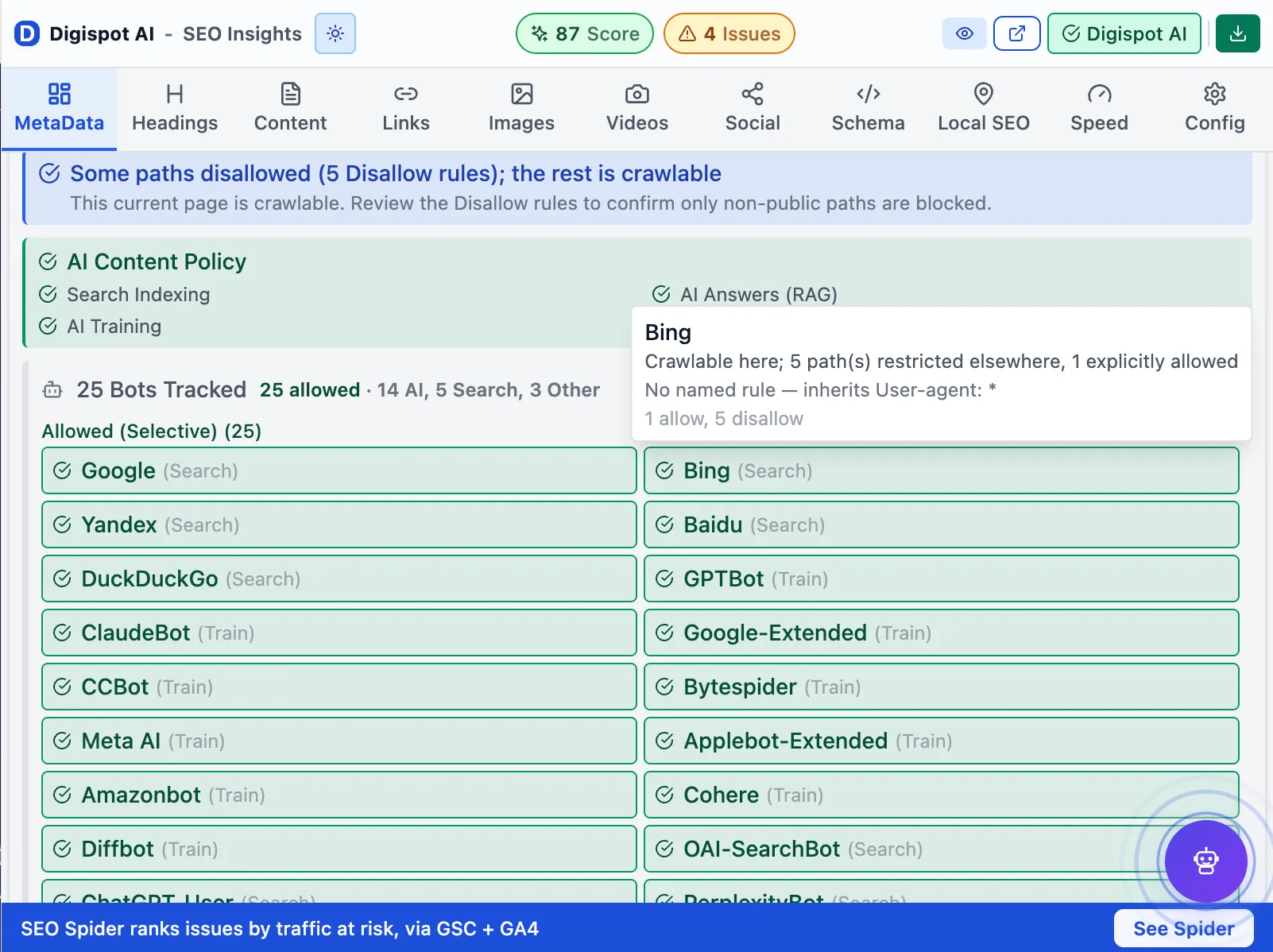
- Robots.txt Blocking: Ensure you aren't blocking
bingbotormsnbot. A common accident is a broadDisallow: /staged during a redesign that never gets removed, or aUser-agent: *rule that unintentionally captures Bing's crawlers. Check the file directly atyourdomain.com/robots.txtand confirm your XML sitemap is referenced there so Bing can discover new URLs; see our walkthrough on creating and submitting a sitemap if you have not set one up. Note thatGoogle-Extendedonly governs Google's AI training and has no effect on Bingbot or Copilot access. - Noindex and Canonical Conflicts: A stray
noindexmeta tag or a canonical tag pointing at the wrong URL will quietly keep pages out of the Bing index even when nothing else is broken. Audit these in Bing Webmaster Tools' URL inspection tool, which reports exactly how Bing sees the rendered page.
Avoid these common SEO mistakes to keep your crawl budget efficient.
Measuring Success
How do you know if you are winning in Copilot?
Currently, there is no "Copilot Console." However, you can look for proxy metrics in your analytics:
- Bing Referral Traffic: Increases in traffic from
bing.comoften include Copilot interactions. - Long-Tail Query Growth: In Bing Webmaster Tools, look for an increase in extremely long, conversational queries (10+ words). These are almost certainly Copilot or voice search queries.
- Direct Traffic Spikes: Some AI answers provide "click to learn more" links that strip referrer data, appearing as direct traffic.
For a repeatable approach to monitoring citations across assistants, see our guide on tracking AI search engine rankings.
Ready to improve your search visibility? Try Digispot AI for comprehensive website audits and actionable recommendations that bridge the gap between traditional SEO and the new AI search landscape.
Start Optimizing for the AI Future
Getting indexed in Microsoft Copilot isn't about gaming a new system. It is about refining the fundamentals of the web: technical accessibility, clear communication, and structured data. By optimizing for Bing and focusing on answer-driven content, you future-proof your SEO strategy against the shifting tides of search behavior.
Start by verifying your Bing Webmaster Tools account today, enabling IndexNow, and auditing your schema markup. The AI era is here, and the early adopters are already claiming the citations.
References
Audit any page in seconds
300+ SEO checks including Core Web Vitals, schema markup, meta tags, and AI readiness — trusted by 1000+ SEO experts and marketers.
Frequently Asked Questions
Here are some of our most commonly asked questions. If you need more help, feel free to reach out to us.
Written by
Maya Krishnan
Digital growth expert
Maya is a seasoned expert in web development, SEO, and digital strategy, dedicated to helping businesses achieve sustainable growth online. With a blend of technical expertise and strategic insight, she specializes in creating optimized web solutions, enhancing user experiences, and driving data-driven results. A trusted voice in the industry, Maya simplifies complex digital concepts through her writing, empowering readers with actionable strategies to thrive in the ever-evolving digital landscape.