ChatGPT vs Google Search: A Comparison for SEOs
Compare ChatGPT vs Google Search mechanics, accuracy, and use cases. Learn how AI impacts SEO and why a hybrid strategy is essential for 2026 visibility.
 Maya Krishnan
For two decades, "Googling it" was the universal solution to not knowing something. Then, practically overnight, millions of users shifted to "Asking AI."
The debate isn't just academic. For businesses and marketers, understanding the friction between traditional search engines and Large Language Models (LLMs) is a survival skill. Are we optimizing for a list of links or a synthesized answer?
Google is a librarian; ChatGPT is a synthesizer. One retrieves, the other creates.
If you treat them as identical tools, you waste resources. If you ignore the shift toward AI-driven answers, you lose visibility.
This analysis dissects the mechanical, functional, and strategic differences between ChatGPT and Google Search. We will examine how these platforms process intent, where they fail, and how you must adapt your optimization strategy to dominate both.
Key Takeaways
- They solve different problems. Google retrieves and ranks existing pages; ChatGPT predicts and synthesizes a new answer. Target navigational, transactional, and real-time queries on Google, and complex, iterative, or creative queries on ChatGPT.
- Optimize for citation, not just clicks. As AI Overviews and SearchGPT absorb informational queries, the goal shifts from earning a click to becoming the source the model quotes. Lead every section with a concise, direct answer.
- Run a dual playbook. Keep traditional signals (keywords, backlinks, Core Web Vitals) for Google, and layer on answer engine optimization — entities, structure, and authoritative tone — for LLMs.
- Ship valid structured data. Schema tells machines exactly what your content is, so validate it and fix errors before publishing to avoid confusing AI parsers.
- Lead with real experience. Proprietary data, case studies, and firsthand expertise are the E-E-A-T signals AI cannot hallucinate, which makes them your durable competitive moat.
The Core Mechanics: Indexing vs. Prediction
To understand the output, you have to understand the engine. Google and ChatGPT operate on fundamentally different architectures.
Google: The Retrieval Engine
Google works on a retrieval-based model. When you type a query, Google:
- Crawls the web to discover pages.
- Indexes that content in a massive database.
- Ranks results based on hundreds of signals (keywords, backlinks, Core Web Vitals).
Google does not "know" the answer. It knows where the answer is likely located. It acts as a middleman between the user and the content publisher.
Read more about the foundational mechanics in our guide to how Google Search works.
ChatGPT: The Generative Engine
ChatGPT (and models like Claude or Gemini) works on a probabilistic model. It is a Large Language Model (LLM) trained on a massive dataset of text. When you ask a question, it:
- Processes the semantic meaning of your prompt.
- Predicts the next most likely token (word/part of a word) based on patterns in its training data.
- Generates a unique response sentence by sentence.
ChatGPT doesn't "lookup" a pre-written page. It constructs an answer from scratch. This makes it conversational but also introduces the risk of confident falsehoods.
Feature Breakdown: ChatGPT vs. Google
Here is the direct comparison of how these platforms function for the end-user.
| Feature | Google Search | ChatGPT (GPT-4/SearchGPT) |
|---|---|---|
| Primary Function | Information Retrieval | Information Synthesis |
| Output Format | List of links, snippets, maps | Direct conversational text |
| Real-Time Data | Instant (News, Stocks, Weather) | Available via browsing (slower) |
| Source Transparency | High (URL always visible) | Variable (Citations are improving) |
| User Intent | Best for Navigational/Transactional | Best for Informational/Creative |
| Bias Risk | Algorithm bias (ranking authority) | Training data bias (social/political) |
| Ads | Heavy (Top 4 positions usually ads) | Currently minimal/absent |
Accuracy and Trustworthiness
Accuracy is the battleground where these two giants fight hardest.
Google struggles with SEO spam. You have likely experienced the frustration of searching for a recipe or a product review, only to wade through 2,000 words of fluff and affiliate links. However, because Google points you to the source, you can verify the information yourself. You judge the credibility of the website.
ChatGPT struggles with hallucinations. Because it predicts words based on patterns, it can convincingly invent facts, court cases, or citations that do not exist. While browsing capabilities reduce this, the core model is a creative writer, not a fact-checker.
The "Black Box" Problem
With Google, we have tools to analyze why a page ranks. We can see the backlinks and the on-page optimization.
With LLMs, the decision-making process is a "black box." Why did ChatGPT recommend Brand A over Brand B? Often, it is because Brand A had a higher semantic correlation in the training data.
Digispot AI helps bridge this gap. Our platform analyzes your content not just for traditional ranking signals, but for the semantic clarity and entity relationships that LLMs prefer.
User Intent: When to Use Which?
From a user perspective, the "Google killer" narrative is flawed. They serve different intents.
When Google Wins
- Navigational Queries: "Facebook login," "Digispot AI pricing." You want a specific destination, not a conversation.
- Transactional Queries: "Buy Nike Air Max size 10," "Plumber near me." You want options, prices, and maps.
- Real-Time Events: "Live cricket score," "Stock market crash today." Google's indexing speed is unmatched.
- Verification: When you need to cite a specific source for academic or legal work.
When ChatGPT Wins
- Complex Explanations: "Explain quantum entanglement like I'm five." Google gives you a Wikipedia link; ChatGPT gives you an analogy.
- Coding and creation: "Write a Python script to scrape this URL." Google finds a Stack Overflow thread; ChatGPT writes the code.
- Iterative Research: "Give me a meal plan for a keto diet. Now remove the dairy. Now make it under $50." This conversational refinement is impossible on Google.
- Summarization: "Summarize this 50-page PDF."
If you are optimizing content, you must understand search intent optimization to decide which platform you are targeting.
The Convergence: AI Overviews and SearchGPT
The line is blurring. Google is integrating Gemini into search results (AI Overviews), pushing the blue links further down. OpenAI is launching SearchGPT to act more like a search engine with citations.
This convergence creates a "Hybrid Search" environment.
The Impact on Click-Through Rates (CTR)
For informational queries, Zero-Click Searches are skyrocketing. If Google's AI Overview answers the question "How long to boil an egg?", the user never clicks your food blog.
This shifts the goalpost for SEOs. We are no longer just fighting for a click; we are fighting for citation. We want to be the source the AI uses to construct its answer.
To thrive here, you need to understand zero-click searches and SEO strategy. If you provide fluff, the AI ignores you. If you provide concise, structured data, you become the source.
SEO vs. AEO: The New Optimization Playbook
To rank on Google and be cited by ChatGPT, you need a dual strategy.
1. Traditional SEO (For Google)
- Keywords: Still matter for matching queries.
- Backlinks: Vital for authority and discovery.
- Technical Health: Core Web Vitals and crawlability.
- User Experience: Fast loading, mobile-friendly pages.
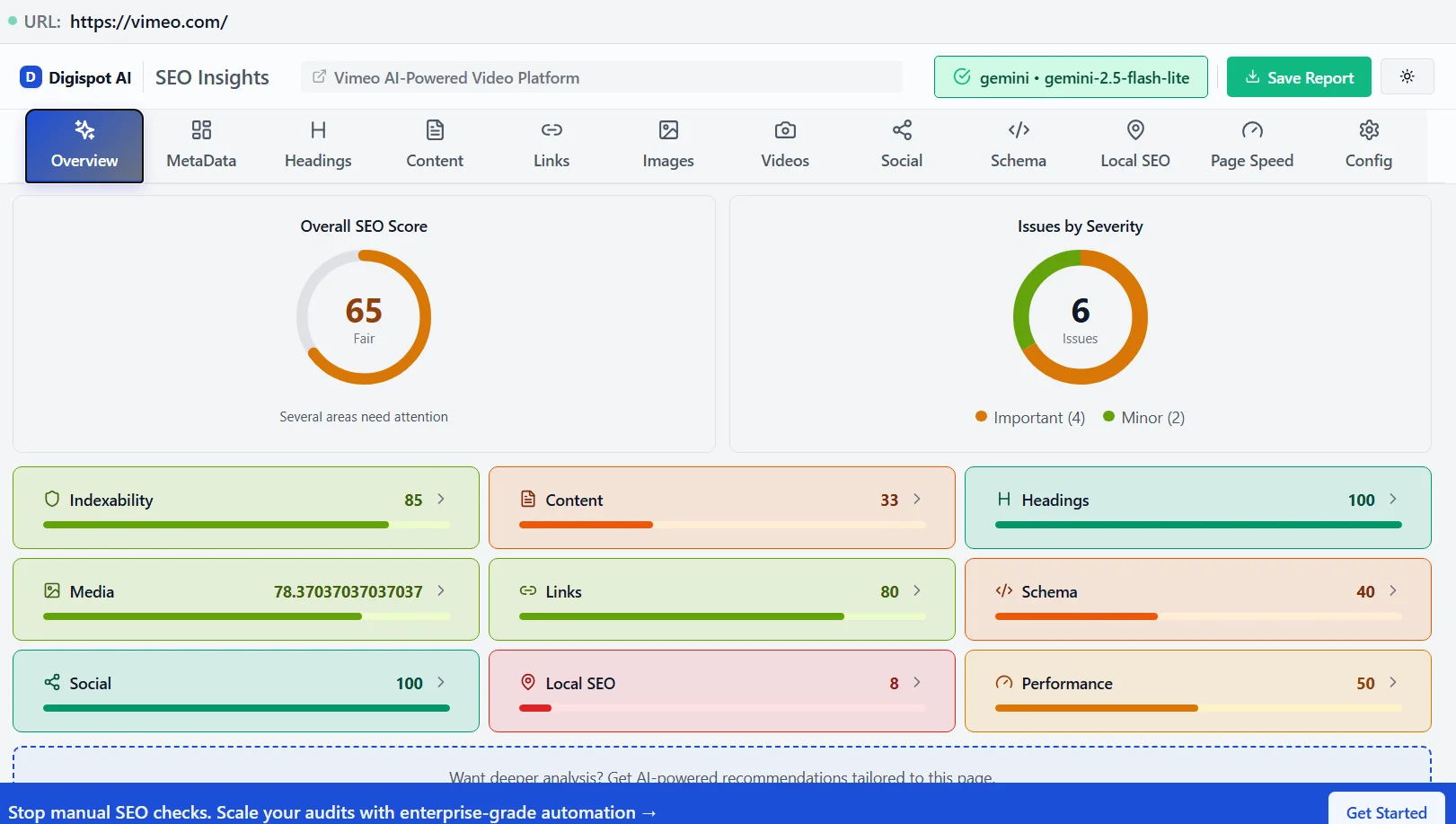
Turn invisible SEO data into clear visuals with our Free Chrome extension
2. AEO (Answer Engine Optimization)
AEO is the art of optimizing for AI. LLMs prioritize:
- Entities over Keywords: Using consistent nouns and distinct concepts.
- Structure: Using Schema markup, bullet points, and logical headers.
- Authoritative Tone: Research shows LLMs prefer content written with high confidence and expert terminology.
- Direct Answers: Answering the "What is X?" question in the first 50 words.
If your schema is broken, AI agents struggle to parse your data. Use the free Schema Markup Generator to create valid structured data in minutes.
How to Optimize for the AI Era
If you want your brand to appear in ChatGPT recommendations and Google AI Overviews, follow these specific steps.
Adopt Entity-Based SEO
Stop obsessing over keyword density. Start building a Knowledge Graph. Ensure your content clearly defines what your product is and how it relates to other concepts in your industry.
For example, don't just say "best CRM." content should link "CRM" to "Sales Automation," "Lead Scoring," and specific integration partners. This helps the LLM vector your brand correctly.
In practice, that means naming entities consistently (pick "Digispot AI," not an alternating mix of "the platform" and "the tool"), defining each concept the first time it appears, and connecting related concepts within the same passage so the model can infer relationships. Consistent, well-connected terminology is the backbone of semantic search, where engines match meaning rather than exact strings. Reinforce those associations across your site with internal links and shared terminology so a cluster of pages describes one coherent topic instead of a scatter of disconnected keywords.
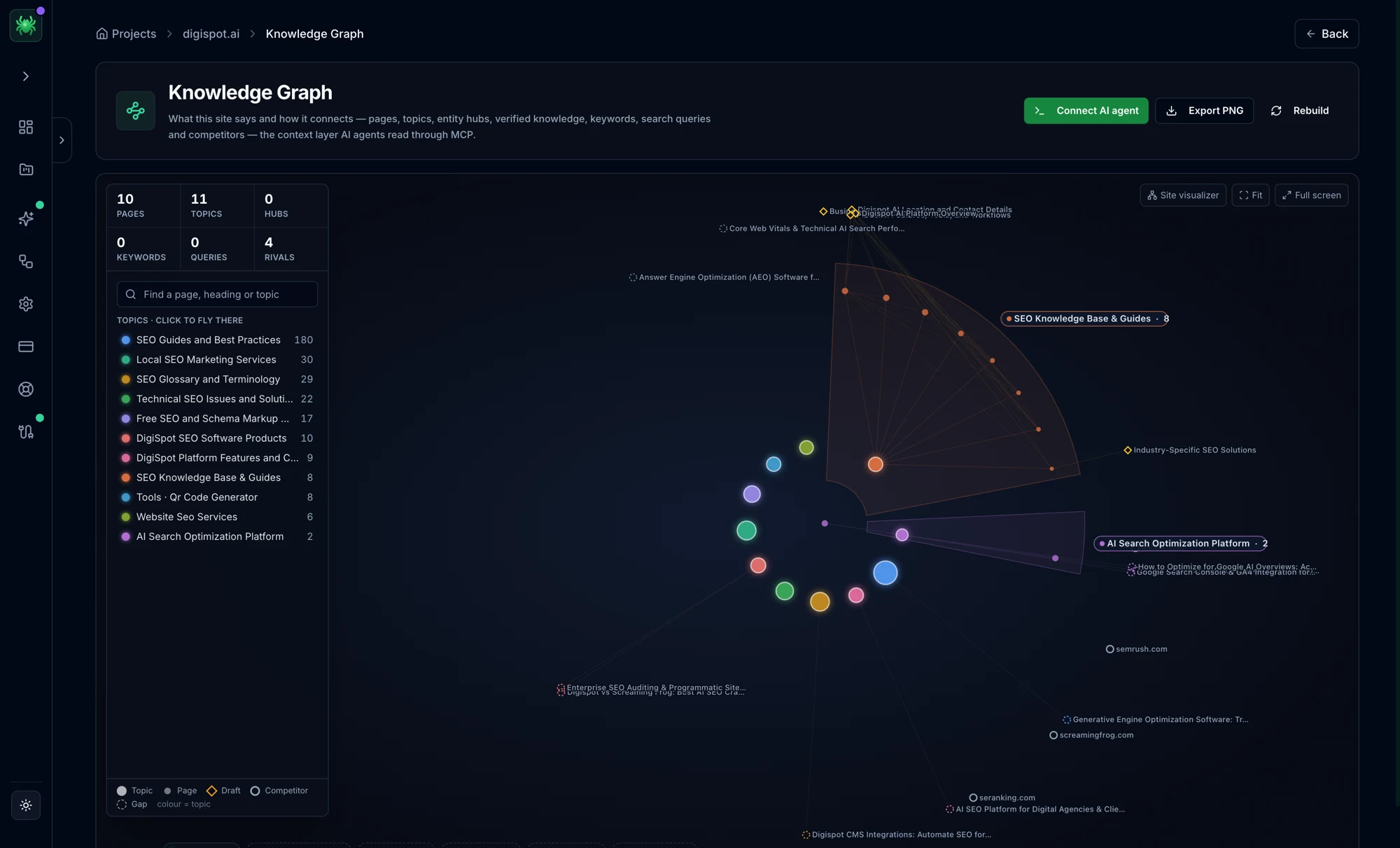
To see whether your site actually reads as one coherent entity map, the Digispot AI Spider builds a knowledge graph of your pages, topics, and entity hubs from each crawl. It shows the clusters your pages form, the entities your site is about, and the topics with no verified facts behind them — the gaps where a model would otherwise guess. Because it is served to AI assistants like Claude or Cursor over MCP as one compact brief, an agent reads your site's real entity relationships instead of inferring them page by page.
Implement Structured Data
Structured data (Schema.org) is the language of machines. It explicitly tells the search engine, "This is a product," "This is a price," "This is a review."
Without schema, an LLM has to guess. With schema, you spoon-feed the facts. Start with the types that map to your content: Article and FAQPage for editorial pages, Product and Review for commerce, Organization and Person to define who is behind the content. A well-marked FAQ block, for instance, hands an answer engine a pre-packaged question-and-answer pair it can lift directly. For a deeper walkthrough of which types to deploy and how they nest, see our guide to structured data and schema for SEO.
The catch is that broken or incomplete markup is often worse than none, because it sends conflicting signals. Always confirm your JSON-LD renders and passes validation before you ship it. Digispot AI’s platform includes a dedicated Schema Markup Visualizer to ensure your code is error-free, and you can double-check any page yourself using our guide to validating and testing schema markup.
Focus on "Experience" (E-E-A-T)
Google demands Experience, Expertise, Authoritativeness, and Trustworthiness. ChatGPT, trained on high-quality literature, implicitly favors the same traits.
Personal anecdotes, proprietary data, and unique case studies are things AI cannot hallucinate easily. They are your competitive moat. Attach clear authorship, cite primary sources, and surface real credentials so both crawlers and models can attribute expertise to a named person; our E-E-A-T SEO checklist breaks these signals down step by step. Read more about on-page SEO best practices to see how E-E-A-T signals are implemented.
Audit for Semantic Clarity
Is your content confusing? If a human has to re-read a sentence to understand it, an AI model will likely misinterpret it.
Try the free On-Page SEO Analysis tool to audit any URL instantly. Look for readability scores and structural issues that might confuse a bot.
The Future is Hybrid
We are not moving toward a world where Google dies and ChatGPT takes over. We are entering a fragmented search landscape.
- Users will ask Perplexity for research.
- Users will ask ChatGPT for creativity.
- Users will use Google for local services and shopping.
Your brand cannot afford to be invisible on any of them.
Digispot AI: Your Unified Visibility Engine
Most SEO tools were built for 2015. They track blue links.
Digispot AI is built for 2026. We are the first platform to offer:
- Multi-LLM Analysis: See how your brand is perceived by GPT-4, Claude, and Gemini.
- AEO Tracking: Monitor your visibility in AI answers, not just SERP positions.
- Privacy-First Audits: We analyze 300+ ranking factors without exposing your data to third parties.
Start Improving Your Visibility Today
The battle between ChatGPT and Google Search isn't about which one wins—it's about how you leverage both. The winners will be the brands that provide high-quality, structured, and authoritative content that satisfies both the human reader and the AI algorithm.
Don't guess how the algorithms view your site.
Ready to improve your search visibility across Google and AI? Try Digispot AI for comprehensive website audits and actionable AEO recommendations.
References
Audit any page in seconds
300+ SEO checks including Core Web Vitals, schema markup, meta tags, and AI readiness — trusted by 1000+ SEO experts and marketers.
Frequently Asked Questions
Here are some of our most commonly asked questions. If you need more help, feel free to reach out to us.
Written by
Maya Krishnan
Digital growth expert
Maya is a seasoned expert in web development, SEO, and digital strategy, dedicated to helping businesses achieve sustainable growth online. With a blend of technical expertise and strategic insight, she specializes in creating optimized web solutions, enhancing user experiences, and driving data-driven results. A trusted voice in the industry, Maya simplifies complex digital concepts through her writing, empowering readers with actionable strategies to thrive in the ever-evolving digital landscape.