How to Optimize Content for AI Search Engines: AEO Playbook
Master AI search optimization for ChatGPT, Perplexity, and Google SGE. Run a 5-point LLM audit and win citations with Digispot AI's advanced workflow.
 Maya Krishnan
As search engines transition from ten blue links to generative AI overviews, businesses must adapt their content strategy to remain visible to modern searchers. Implementing a structured framework for AI search optimization ensures your brand's digital assets are crawled, understood, and cited by LLMs like ChatGPT, Perplexity, and Google Gemini.
This practical guide skips the "what is AEO" basics (covered in our Answer Engine Optimization guide) and goes straight into the actionable workflow: audit your site for LLM readiness, deploy the right schema, rewrite your copy for AI extraction, and track whether it's working.
Key Takeaways
- Write answer-first. Open every section with a declarative, active-voice sentence that resolves the query — LLMs filter out introductory fluff before they ever reach your facts.
- Name entities explicitly. Replace "it," "our platform," and "the tool" with concrete brand, product, and concept names so crawlers can attribute facts to you correctly.
- Ship the schema trio. Deploy
Article,FAQPage, andHowToJSON-LD to give AI engines an unambiguous, machine-readable layer of truth. - Test what LLM bots actually see. Run a side-by-side Googlebot vs. LLMBot crawl to catch JS-rendered content and schema that AI parsers silently skip.
- Track new KPIs. Standard rankings miss AI visibility — monitor conversational-query impressions in GSC and AI referral domains in GA4.
Table of Contents
- What AI Search Engines Actually Look For
- Running a 5-Point LLM-Readiness Audit on Your Site
- Implementing Schema Markup that Drives AI Citations
- How to Diagnose AEO Gaps Using Digispot AI's LLMBot Comparison
- Content Rewrites for AI Search (With Before/After Examples)
- Tracking Your Brand's AI Search Visibility
- A 30-Day AEO Action Plan
What AI Search Engines Actually Look For
Generative AI engines do not read web pages the way human users or traditional indexers do. Instead of cataloging keywords, Large Language Models (LLMs) parse textual data to extract semantic relationships, factual assertions, and direct answers to complex prompts.
When an AI engine like Perplexity or ChatGPT Search processes a query, it retrieves a set of web pages and synthesizes a natural-language response from them. To be selected as a source, your content must contain highly authoritative, direct, and unambiguous answer sentences. LLMs favor declarative statements that can be cleanly mapped to specific facts — not conversational preamble.
Five signals AI crawlers weight most heavily:
- Direct answer sentences — the first sentence of a section should answer the question, not introduce it.
- Named entity clarity — use explicit names (your brand, product, concept) rather than pronouns.
- Structured headings — H1 → H2 → H3 hierarchy with descriptive, keyword-bearing labels.
- FAQ blocks — Q&A pairs the LLM can extract verbatim for conversational responses.
- Freshness signals — publication and modification dates in both visible text and Article schema.
Entity Definition & Semantic Clarity
For an LLM to accurately attribute information to your brand, it must first understand the entities involved. Ambiguous language or failure to define core concepts makes it difficult for LLM crawlers to map your site's knowledge graph. This is the same entity-relationship logic that underpins semantic search in SEO.
Build semantic clarity by:
- Stating definitions explicitly at the beginning of informational sections.
- Grouping related concepts together under logical subheadings.
- Linking your proprietary concepts to established industry entities.
Answer-First vs. Conversational Fluff
Traditional SEO copywriters often rely on introductory fluff and rhetorical questions to warm up the reader. AI search engines actively filter this out. LLMs prioritize high information density.
If a user asks "How do I calculate churn rate?", the AI model looks for a page that opens with "To calculate churn rate, divide the number of lost customers by the total active customers..." — not a page starting with "In today's fast-paced business landscape, customer retention is more important than ever."
Running a 5-Point LLM-Readiness Audit on Your Site
Before rewriting your content library, audit where your current site structure fails AI crawlers. Unlike traditional SEO audits, which focus on page speed and keyword density, an LLM-readiness audit focuses on semantic structure and factual density.
1. Heading Hierarchy
AI crawlers rely on your heading hierarchy to understand the logical flow of your page. If you need a refresher on nesting rules, see our guide to using H1 to H6 heading tags. Verify:
- Each page has exactly one H1 tag that defines the primary topic.
- H2 tags represent the main sub-topics or steps.
- H3 tags are strictly nested within their parent H2s.
- Headings use explicit entity names — "How to Configure an API Gateway" not "Getting Connected."
2. Answer-First Paragraphs
For each major section, audit the first 150 characters. If the opening sentence contains filler words, passive voice, or vague references, flag it for rewrite. The ideal AI-friendly paragraph opens with a declarative, active-voice statement followed by bulleted supporting facts.
3. Entity Naming
Scan your top pages for pronoun-heavy passages. Phrases like "it helps you", "our solution", or "the platform" tell an LLM nothing specific. Replace with explicit entity names: "Digispot AI's SEO Spider", "ChatGPT Search", "Google's AI Overviews."
4. FAQ Presence
Check whether your top informational pages include a structured FAQ section. Pages without FAQ blocks are missing one of the highest-extraction opportunities AI engines look for.
5. Schema Completeness
Run a schema audit to verify Article or BlogPosting schema is on every post, FAQPage schema is on pages with Q&A content, and Organization schema is sitewide. Digispot AI's free Schema Markup Generator can generate valid JSON-LD for any of these in minutes.
Implementing Schema Markup that Drives AI Citations
Schema markup acts as a direct translator between your website and AI search engines. While LLMs are proficient at parsing natural language, structured data in JSON-LD format provides an explicit, unambiguous layer of truth that removes machine guesswork.
FAQPage and HowTo Schema
Prioritize FAQPage and HowTo schema for conversational citations. When an AI search engine looks for a step-by-step solution, it parses HowTo schema to instantly understand the sequence of actions, often displaying your steps directly in the AI overview with a citation link.
FAQPage schema maps questions to concise answers. By serving this data explicitly in your HTML, you increase the likelihood that engines like ChatGPT Search and Perplexity pull your exact phrasing. Before you ship it, validate and test the schema markup to catch syntax errors that stop engines from parsing it at all.
{
  "@context": "https://schema.org",
  "@type": "FAQPage",
  "mainEntity": [{
    "@type": "Question",
    "name": "What is AI search optimization?",
    "acceptedAnswer": {
      "@type": "Answer",
      "text": "AI search optimization is the practice of structuring and writing website content so that generative AI engines and LLMs can easily crawl, understand, and cite it in conversational search results."
    }
  }]
}
Article Schema for Freshness
Article schema establishes authorship and modification dates — signals AI engines use to judge content freshness. Always include datePublished and dateModified fields. Stale content without freshness signals loses citations to more recently updated pages on the same topic.
Organization Schema for Entity Authority
Implement a robust Organization schema sitewide to ensure AI engines associate your brand with your industry niche. Use the sameAs property to link your brand entity to your official Wikipedia, Wikidata, or trusted industry directories — building the foundational trust required for high-volume citations.
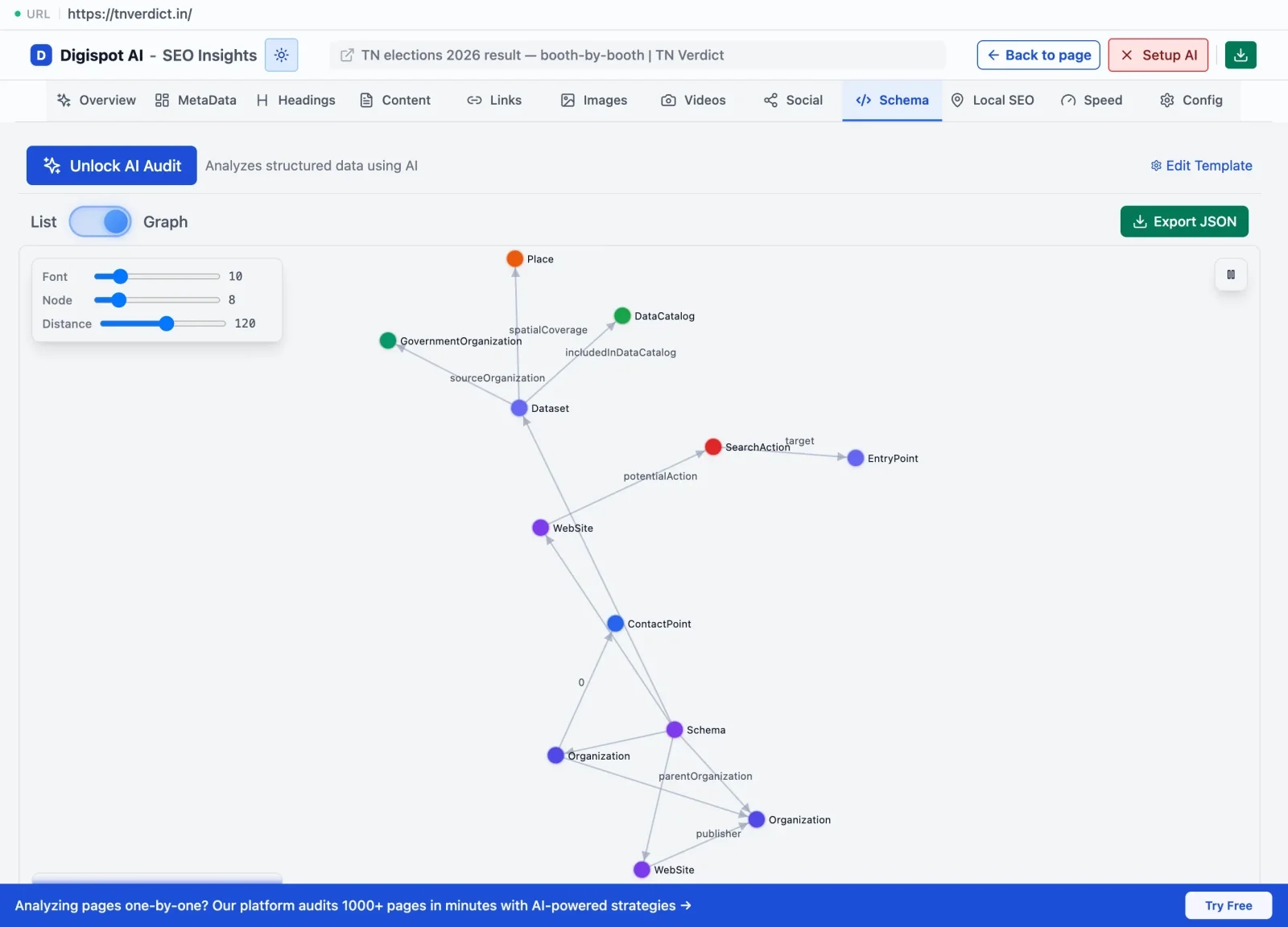 The Chrome extension's schema graph view maps the entity relationships on your page — showing exactly what an LLM sees when it tries to verify your brand against its knowledge graph.
How to Diagnose AEO Gaps Using Digispot AI's LLMBot Comparison
Traditional SEO crawlers only show you how Googlebot views your page. To win in the generative era, you must understand how LLM crawlers — used by OpenAI, Anthropic, and Perplexity — interpret your site differently. This is where Digispot AI becomes indispensable.
Comparing LLMBot vs. Googlebot Crawls
The Digispot AI SEO Spider lets you run side-by-side comparisons of how your site is rendered by different user agents. By configuring the spider to emulate both Googlebot and modern LLM crawlers (OAI-SearchBot, PerplexityBot), you can spot discrepancies in content rendering:
| Googlebot View | LLMBot View |
|---|---|
| Renders standard HTML | Parses semantic entities |
| Indexes keywords & meta tags | Analyzes schema relationships |
| Prioritizes layout & speed | Extracts direct Q&A blocks |
| Result: Standard organic rank | Result: AI Overview Citation |
Many sites rely on client-side JavaScript. While Googlebot renders JS well, many LLM crawlers use faster parsers that skip resource-heavy scripts. If your core content or schema is injected via client-side JS, LLM bots may see a blank page — the same failure mode we cover in our JavaScript dynamic rendering SEO guide. Digispot AI uses Chromium rendering to highlight exactly what content is lost when queried by different crawlers.
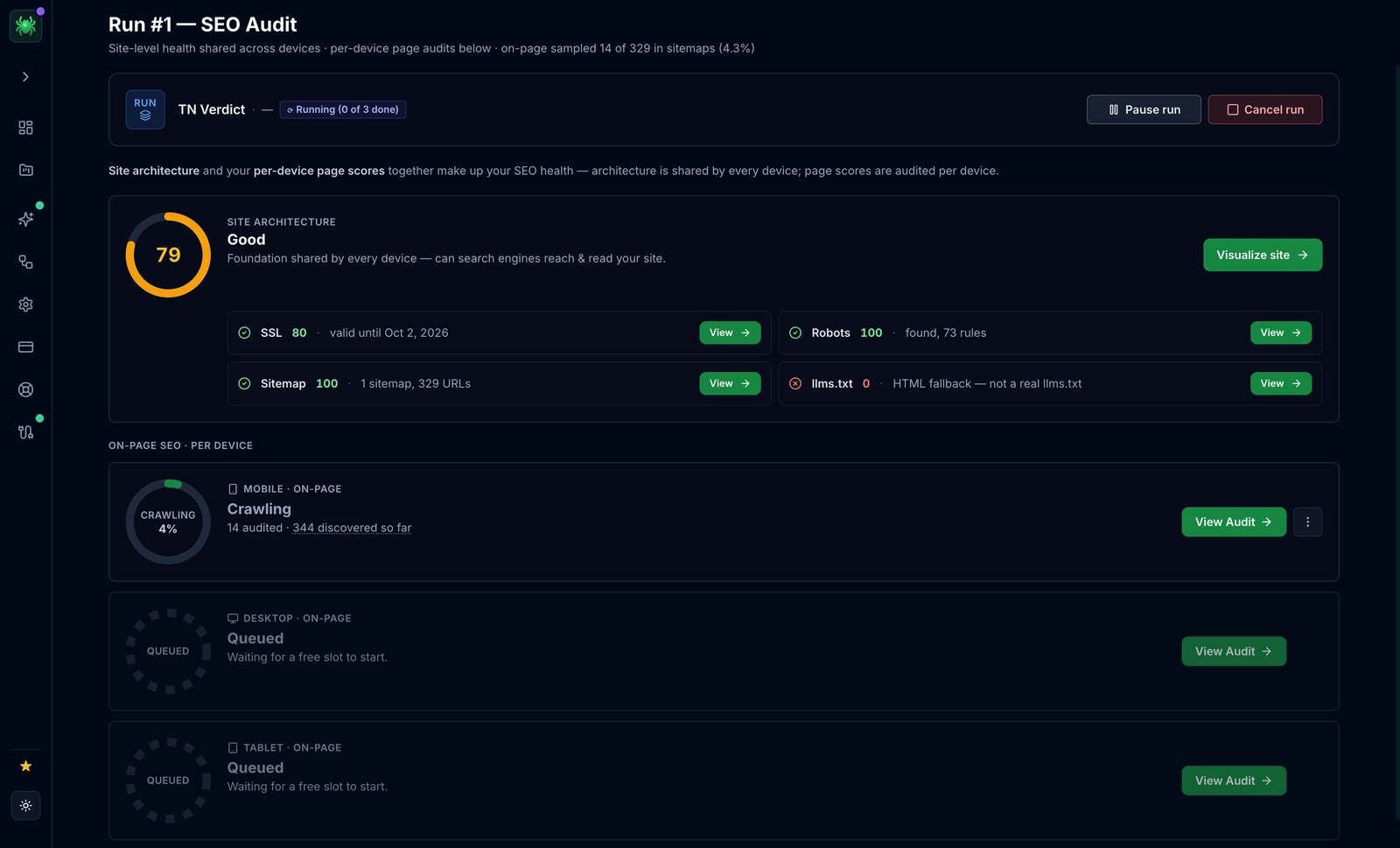 Digispot AI's SEO Spider compares how Googlebot and LLM crawlers render your pages side-by-side — exposing JS-rendered content and schema that AI bots can't access.
Automating Audits with the MCP Server
Digispot AI integrates with Model Context Protocol (MCP) servers, letting you connect audit data directly to AI development environments like Claude or Cursor.
The automated audit-to-fix workflow:
- The Digispot AI Spider detects missing schema or a broken heading hierarchy.
- The MCP server passes this diagnostic data directly to your AI code editor.
- The editor automatically generates the required JSON-LD schema or updates the HTML — reducing implementation time to seconds.
Content Rewrites for AI Search (With Before/After Examples)
Optimizing copy for AI search engines means transitioning from "narrative-first" to "information-first" style.
Pronoun Replacement & Entity Naming
LLMs process sentences in chunks. Pronouns like "it," "this," or "our platform" across multiple paragraphs cause the model to lose track of the subject. Replace with explicit entity names.
Before and After: Formatting for LLM Extraction
Example 1: Defining a Process
- Before: "When you want to get started with our tool, you should first make sure you've installed the plugin. After that, you just go to the settings page, where you'll find the setup wizard."
- After: "To configure Digispot AI, follow three steps: 1. Install the Digispot AI plugin. 2. Navigate to the Digispot AI settings dashboard. 3. Launch the setup wizard to complete configuration."
Example 2: Defining a Metric
- Before: "There are a few things that go into it, and depending on how you look at it the number can change quite a bit month to month."
- After: "Churn rate is the percentage of customers who cancel over a given period. To calculate monthly churn rate, divide customers lost during the month by customers active at the start of the month, then multiply by 100."
The "After" version wins citations because the answer is self-contained: an LLM can lift it into a response without needing surrounding context. The "Before" version forces the model to reconstruct meaning from vague references, so it looks elsewhere.
Edge case — comparison and negation. AI engines often surface answers to "X vs. Y" and "is X better than Y" prompts, but they mishandle implied contrasts. Don't write "unlike the other option, this is faster." Name both entities and state the claim directly: "Digispot AI's Chromium renderer captures JS-injected schema that lighter LLM parsers skip." Similarly, state negative facts explicitly ("HowTo schema does not support branching steps") rather than leaving the model to infer them — unstated limitations are a common source of AI misattribution.
Tracking Your Brand's AI Search Visibility
Because AI search engines don't always report traditional click data, tracking visibility requires a new set of KPIs beyond standard keyword rankings.
GSC AI Overviews
Google Search Console doesn't currently separate AI Overview (SGE) traffic from standard search traffic. Isolate trends by monitoring impression spikes for long-tail, conversational queries — these often signal AI Overview appearances that don't yet produce clicks.
A practical way to surface these signals in GSC:
- Open the Performance report and filter queries to those containing question words ("how," "what," "why") or five-plus words.
- Sort by impressions and flag any query where impressions climbed while clicks stayed flat — a classic zero-click AI Overview footprint.
- Segment by the last 3 months vs. the previous 3 months to separate a genuine AI-driven shift from normal seasonality.
For a deeper measurement setup, see our guide on how to track AI search engine rankings.
LLM Referral Traffic in GA4
Track traffic from non-Google AI engines by monitoring referral domains in GA4:
chatgpt.com/openai.comperplexity.aiclaudebot/anthropic.com
Within the Digispot Cloud Platform, you can consolidate these referral streams into a single dashboard and track conversions originating specifically from conversational AI engines — giving you direct ROI visibility into your AEO efforts.
A 30-Day AEO Action Plan
| Week 1 | Week 2 | Week 3 | Week 4 |
|---|---|---|---|
| LLMBot audit + heading review in Digispot | Deploy FAQ, Article, HowTo & Org schemas | Rewrite top 20 pages answer-first style | Set up AI tracking in Digispot |
Weeks 1–2: Audit and Structured Data
- Days 1–5: Run a complete crawl using the Digispot AI SEO Spider with LLM crawler user agents. Identify rendering and accessibility issues specific to LLM bots.
- Days 6–10: Audit heading structures and flag pages lacking clear entity definitions.
- Days 11–15: Generate and deploy missing
FAQPage,Article, andHowToschema across high-priority pages.
Weeks 3–4: Content Refinement and Tracking
- Days 16–20: Rewrite introductory paragraphs of your top 20 traffic pages using the answer-first framework. Replace ambiguous pronouns with explicit entity names.
- Days 21–25: Convert raw text instructions and statistical data into clean Markdown tables and bulleted lists.
- Days 26–30: Configure your Digispot Cloud dashboard to monitor AI search impressions, track LLM referral traffic, and schedule automated weekly crawls.
To start auditing your site for LLM readiness, try Digispot AI's SEO Spider free for 7 days or explore the full AI content platform.
Related deep-dives
Continue with these closely related guides:
- generative engine optimization — Generative Engine Optimization (GEO): The New Blueprint for AI Search Visibility
Audit any page in seconds
300+ SEO checks including Core Web Vitals, schema markup, meta tags, and AI readiness — trusted by 1000+ SEO experts and marketers.
Frequently Asked Questions
Here are some of our most commonly asked questions. If you need more help, feel free to reach out to us.
Written by
Maya Krishnan
Digital growth expert
Maya is a seasoned expert in web development, SEO, and digital strategy, dedicated to helping businesses achieve sustainable growth online. With a blend of technical expertise and strategic insight, she specializes in creating optimized web solutions, enhancing user experiences, and driving data-driven results. A trusted voice in the industry, Maya simplifies complex digital concepts through her writing, empowering readers with actionable strategies to thrive in the ever-evolving digital landscape.