Meta Tags SEO Guide: Optimize for Better Rankings
Optimize meta tags for SEO success. Craft effective titles and descriptions to improve rankings and click-through rates.
 Maya Krishnan
You put hours into creating high-quality content, ensuring your technical foundation is solid, and building authority. Yet, your pages struggle to gain traction in search results. Why do some websites effortlessly grab attention while others fade into the background? The difference often comes down to the micro-content that users see before they ever visit your site: meta tags.
These unassuming lines of code act as your website's pitch deck to search engines and users alike. They are the first interaction a potential customer has with your brand in the search engine results pages (SERPs). If you ignore them, you are effectively hosting an event but forgetting to send out the invitations. Crucial context is lost, and the click goes to a competitor who took the time to optimize.
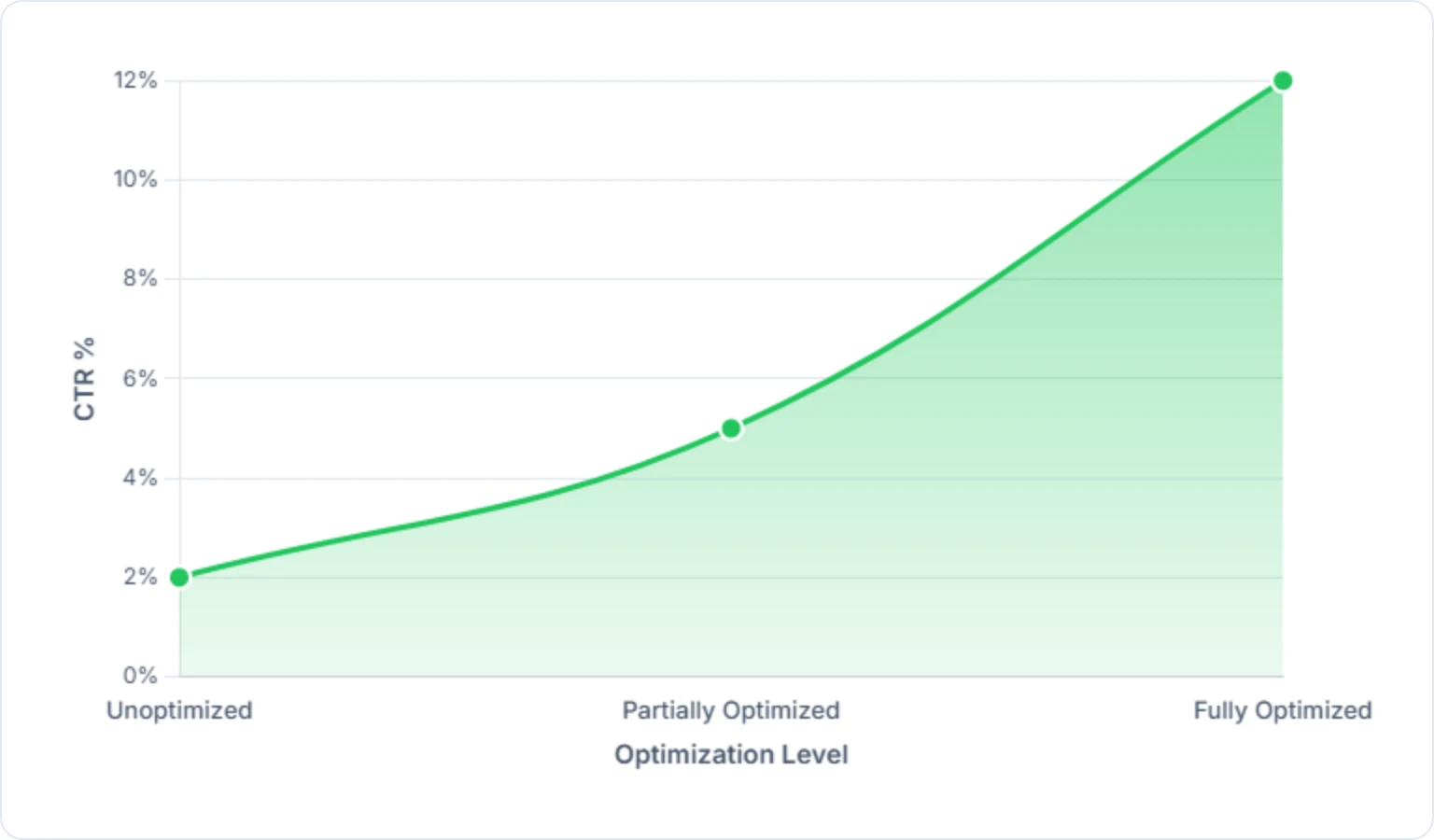
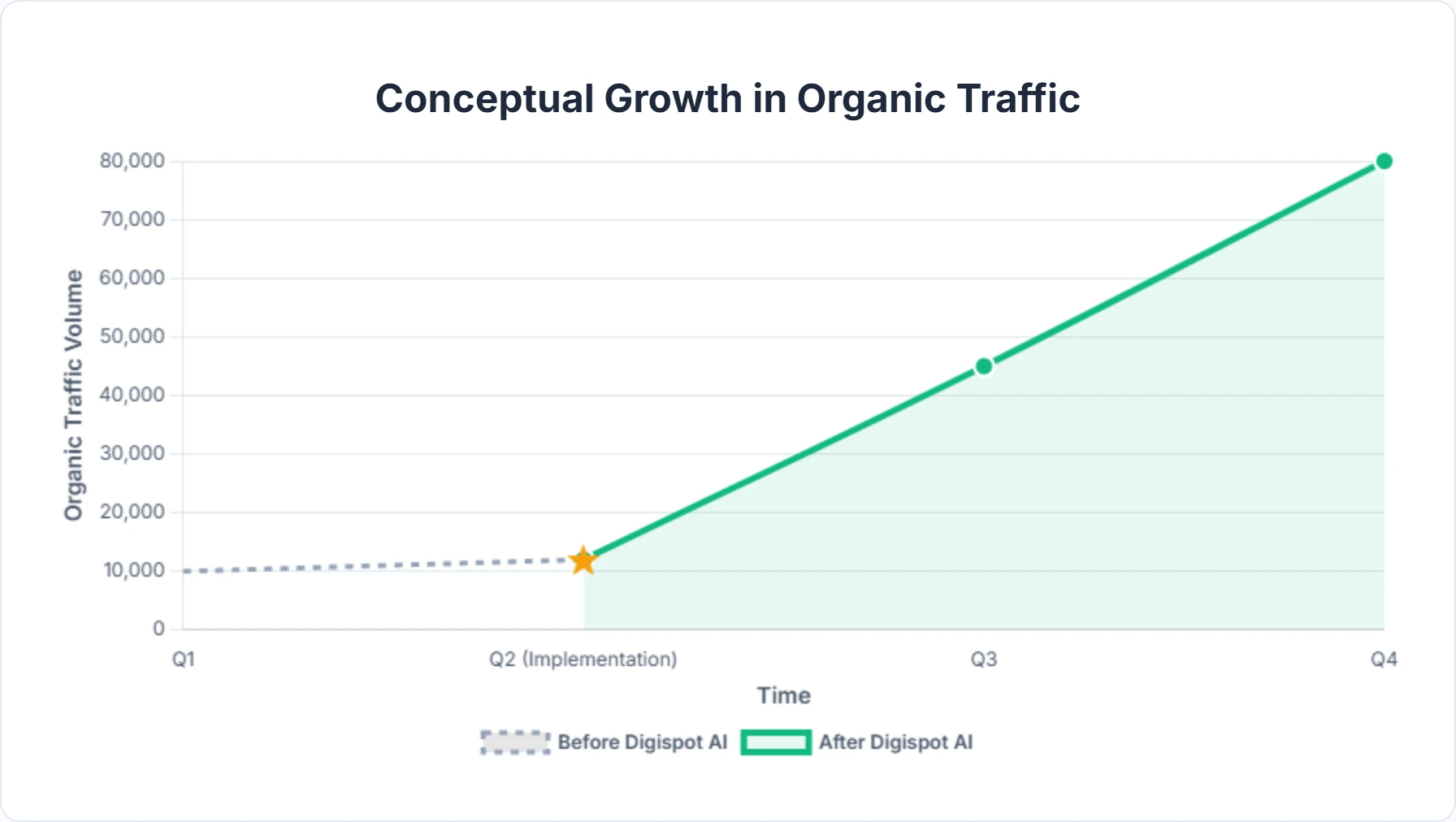
Data consistently backs this up. Pages with optimized meta descriptions can see significantly higher click-through rates (CTR) compared to those relying on auto-generated snippets. When you align your meta tags with user intent, you tell Google exactly why your page deserves to rank.
This guide breaks down the mechanics of meta tags, explains their critical role in modern SEO and AEO (Answer Engine Optimization), and provides a roadmap to optimize them. We will also look at how leveraging intelligent platforms like Digispot AI can transform this manual drudgery into a strategic advantage, ensuring your site is seen, clicked, and trusted.
What Exactly Are Meta Tags? Your Website's Secret Language
Meta tags are snippets of HTML code that provide data about your data (metadata). They reside exclusively in the <head> section of your web pages. While invisible to a visitor browsing your site, they are the primary source of information for search engine crawlers (Googlebot, Bingbot) and social media platforms trying to understand your content.
In the era of AI search—where engines like Google's Gemini, ChatGPT, and Perplexity read code to synthesize answers—meta tags have evolved from simple descriptors to essential context markers. They help these systems categorize your content effectively before they even process the body text.
There are several types of meta tags, each serving a distinct function in the search ecosystem. Here are the critical ones you must master:
- Meta Title (Title Tag): The title tag is the heavyweight champion of on-page SEO. It specifies the clickable headline users see in SERPs and browser tabs. Search engines rely on it heavily to determine the topic and relevance of a page. A well-structured title tag matches the user's search intent immediately.
- Meta Description: This is the pitch. It appears as the short paragraph under the title in search results. While Google has stated it is not a direct ranking signal, its impact on CTR is massive. A compelling description acts as ad copy, convincing the user that your page holds the answer they need.
- Meta Robots: This tag is the traffic controller. It gives directives to crawlers on what to do with the page:
index(add to search results),noindex(keep private),follow(crawl links), ornofollow(ignore links). One wrong character here can de-index your entire site, making it a high-stakes element of technical SEO. - Meta Viewport: In a mobile-first indexing world, the viewport tag is non-negotiable. It instructs browsers on how to render the page on different screen sizes. Without it, mobile browsers may render a desktop version of your site, causing layout shifts and readability issues that hurt your Core Web Vitals and rankings.
- Open Graph Tags (OG Tags) & Twitter Cards: These tags control the visual presentation of your content on social platforms. When you drop a link in Slack, LinkedIn, or Facebook, the image and text that unfurl are dictated by these tags. They are essential for protecting your brand's visual identity across the web.
Why Meta Tag Optimization Isn't Optional: The Benefits Unpacked
Many site owners treat meta tags as an afterthought—something to fill in just before hitting "publish." This is a mistake. Optimizing these tags is fundamental to communicating with search algorithms and human users. Here is why the investment yields returns:
- Improved Click-Through Rates (CTR): Rankings are useless without clicks. A optimized title and description function as a persuasive advertisement. If you rank #3 but have a more compelling title than #1, you can steal a significant portion of the traffic. Over time, high CTR signals to Google that your result is highly relevant, which can help solidify or improve your ranking position.
- Enhanced Search Engine Visibility: Search engines are semantic machines. They look for entities and context. A title tag that includes specific keywords helps Google understand exactly what queries your page answers. This precision is vital for ranking in specific niches rather than just broad, competitive terms. Learn more about general on-page SEO best practices to see how this fits into the bigger picture.
- Better User Experience (UX): SEO is ultimately about UX. When a user sees a clear, accurate description in the SERP and clicks through to find content that matches that promise, satisfaction increases. This reduces "pogo-sticking" (users bouncing back to search results), which is a negative ranking signal. Accurate tags set the right expectations.
- Professional Brand Presentation: Inconsistent or missing meta tags make a site look neglected. Seeing "Untitled Document" or a cut-off sentence in a search result degrades trust. Optimized tags across thousands of pages project authority and attention to detail, which are subtle but powerful trust signals.
- Maximizing Social Media Engagement: Social platforms are visual. An article shared with a generic gray box receives a fraction of the engagement compared to one with a high-resolution custom image and a punchy headline defined by Open Graph tags. Controlling this narrative drives referral traffic and brand awareness.
What is a Meta Tag?
To understand how to manipulate these tags, you must understand their anatomy. A meta tag is an HTML element that sits inside the <head> of your page's code. It does not appear in the <body> where your paragraphs and images live.
Here is the basic syntax:
<meta name="description" content="This is the text that describes your page to search engines.">
<meta>: Declares the element.name="...": Specifies the type of metadata (e.g., description, robots, viewport).content="...": The actual value or information you are providing.
Exceptions include the Title Tag, which uses its own <title> element, and Open Graph tags, which use property instead of name. Understanding this structure is key when troubleshooting why a tag might not be rendering correctly. Tools like the Digispot AI On-Page SEO Checker parse this raw HTML to report exactly what search engines are seeing, bypassing any caching or display issues in your browser.
How to Optimize Your Meta Tags: A Practical Guide
Optimization is where art meets science. You need the creativity to write copy that humans want to click, combined with the technical discipline to satisfy algorithmic constraints.
1. Mastering the Meta Title (Title Tag)
The title tag remains a primary ranking factor. It is the strongest signal you send regarding the page's main topic.
- Front-Load Your Keywords: Search engines and users scan from left to right. Placing your primary keyword at the start of the title tag (e.g., "SEO Audit Tool: The Ultimate Guide") is more effective than burying it at the end. This signals immediate relevance.
- Watch the Pixel Width: While the standard advice is "50-60 characters," Google actually measures in pixels (approx. 580px desktop, varies on mobile). Wide characters like 'W' and 'M' take up more space. If your title is too long, Google will truncate it with an ellipsis (...), which can ruin your CTR.
- Uniqueness is Critical: Duplicate title tags are a common issue that confuses search engines. If five pages have the title "Services," Google doesn't know which one to rank for service-related queries. Ensure every URL has a distinct title.
- Brand Formatting: The standard format is
Primary Keyword - Secondary Keyword | Brand Name. Including your brand at the end builds recognition without diluting the keyword relevance at the start. For homepages, you might reverse this to prioritize the brand. - Intent Matching: Does the user want to buy, learn, or find?
- Informational: "How to..." or "Guide to..."
- Transactional: "Buy..." or "Best Price for..."
- Aligning the title vocabulary with intent improves conversion rates post-click.
Example:
- Poor:
Welcome to our page(Zero descriptive value) - Better:
Digispot AI - SEO Tools(Brand first, generic keyword) - Optimized:
Free SEO Audit Tool: Analyze & Fix Rankings Instantly | Digispot AI(Keyword first, benefit-driven, brand at end)
Manually checking titles is impossible at scale. Digispot AI scans your entire site architecture, flagging titles that are truncated, duplicated, or missing entirely, allowing you to fix them in bulk.
2. Crafting Compelling Meta Descriptions
Think of the meta description as your organic text ad. It doesn't directly boost rank, but it closes the deal on the click.
- The "Active Voice" Rule: Start with an action verb. "Discover," "Learn," "Optimize," "Shop." This subconsciously prompts the user to take action.
- Keyword Boldings: When a user searches for a term, Google bolds that term in your description. Including the primary and secondary keywords naturally makes your snippet pop visually in the scan-heavy SERP environment.
- Mobile truncation: Mobile screens cut descriptions off earlier than desktops. Aim for the core message to appear within the first 120 characters, using the remaining space (up to 160) for elaboration.
- Structured Content: For product pages, include specs or price. For articles, summarize the "hook." Avoid generic fluff like "This page is about..."
- Avoid "Quotation Marks": Any text inside double quotes in the HTML
contentattribute can sometimes break the code if not escaped properly. Stick to alphanumeric characters and standard punctuation.
Example:
- Poor:
This is our guide about meta tags and how to use them for your website. - Better:
Learn about meta tags and SEO. We explain titles and descriptions. - Optimized:
Master meta tags SEO with this complete guide. Learn to write click-worthy titles and descriptions that boost rankings. Start optimizing today!
Need inspiration? The Digispot AI content studio uses generative AI agents to suggest multiple variations of meta descriptions based on your page content, tone, and keyword targets.
3. Understanding Meta Robots Tags
The robots meta tag is your primary tool for indexation control at the page level.
index, follow: The standard setting. "Google, please file this page and follow the links to discover more content."noindex, follow: "Don't show this page in search results, but do crawl the links." Useful for category archives or tag pages where you want link equity to flow but don't want the thin content indexed.noindex, nofollow: "Ghost mode." Do not list this, do not look at links. Essential for "Thank You" pages (to prevent analytics skewing) or staging environments.- Advanced Directives:
max-snippet:-1: Allows Google to choose the snippet length (good for featured snippets).max-image-preview:large: Tells Google Discover to use high-res images, which drastically increases click-through from Discover feeds.
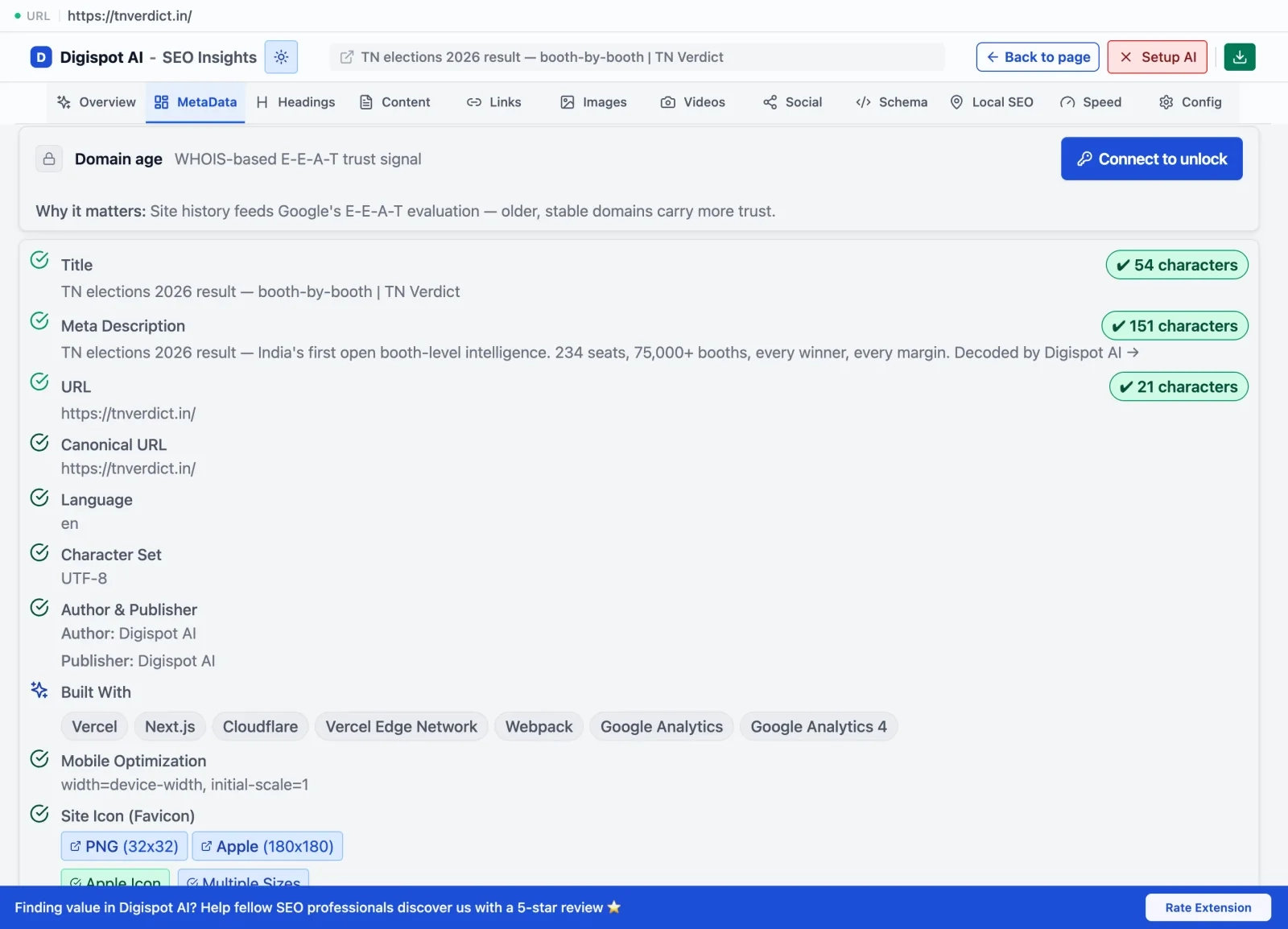
During a site audit, Digispot AI checks for "Zombie Pages"—low-value pages that are indexed by mistake—and essential pages that are accidentally blocked by a rogue noindex tag.
4. The Importance of the Viewport Meta Tag
Google's index is "Mobile-First," meaning it ranks your mobile site, not your desktop one.
- The Code:
<meta name="viewport" content="width=device-width, initial-scale=1.0"> - The Function: This forces the browser to render the content at the width of the screen. Without it, smartphones attempt to shrink a desktop site to fit a 4-inch screen, making text unreadable and buttons unclikcable.
- SEO Impact: A missing viewport tag is a critical failure in Google's "Page Experience" signals. It will prevent you from ranking well on mobile devices, which accounts for over 60% of web traffic. Check our Core Web Vitals guide to understand how mobile usability impacts performance.
5. Leveraging Open Graph and Twitter Card Tags for Social Media
Social SEO is about controlling the narrative when your content travels off-site.
- Open Graph (OG): Originally created by Facebook, now used by LinkedIn, Pinterest, and others.
og:image: The most critical tag. Use an image with a 1.91:1 ratio (e.g., 1200x630px). Images with text overlays (headline + author) tend to perform best.og:title: Can be punchier than your SEO title. You don't need to worry about keywords here; focus on "click-bait" style engagement (within reason).
- Twitter Cards:
twitter:card: Usesummary_large_imagefor maximum visibility in the feed. The small summary card often gets scrolled past.twitter:label1/twitter:data1: Can be used to show "Reading Time" or "Author" directly in the tweet preview.
Get instant SEO insights on any page, including a preview of your social cards, with our free Chrome extension.
6. Integrating Schema Markup (Structured Data)
While technically structured data (JSON-LD), schema works hand-in-hand with meta tags to enhance SERP presence. It clarifies the type of content you are providing.
- Rich Snippets: Schema can transform a standard blue link into a rich result containing stars, prices, availability, or FAQs.
- Common Types:
- Article: For blog posts (helps with Google Discover).
- Product: Displays price, stock status, and merchant reviews.
- LocalBusiness: Defines physical location, improving local pack rankings.
- FAQPage: often grants you extra real estate in the SERPs by listing questions and answers directly under your link.
Use the free Schema Markup Generator to create valid JSON-LD code for your pages without needing a developer.
Common Meta Tag Mistakes to Avoid
Even seasoned SEOs make mistakes that can suppress rankings. Avoiding these common pitfalls is often the quickest win for an SEO campaign.
- Duplicate Meta Titles and Descriptions: This often happens on paginated content (Page 2, Page 3) or e-commerce filtering options (Red Shirts, Blue Shirts). If the tags are identical, Google may filter them out of the index entirely. Canonical tags or unique generation patterns are required here.
- Missing Meta Tags: Leaving tags blank forces Google to auto-generate a snippet from your page content. Google is getting better at this, but it often pulls text from your navigation menu or footer, which looks terrible in search results.
- Keyword Stuffing: "SEO Services SEO Company Best SEO Agency London" is not a title; it's spam. Google's algorithms (like the Helpful Content Update) penalize this unnatural phrasing. Write for humans first.
- Time-Sensitive Data in Static Tags: Putting "2024" in your title tag is great for 2024, but if you forget to update it to "2025" in January, your CTR will plummet as the content looks outdated.
- Irrelevant Meta Tags: Some legacy tags like
<meta name="keywords">are completely ignored by Google and have been for over a decade. Including them is harmless but signals a lack of modern SEO knowledge. Focus your code bloat elsewhere.
Common mistakes like these are often invisible to the naked eye. Digispot AI helps you identify and fix these issues automatically with AI-powered audits analyzing 300+ ranking factors.
The Digispot AI Advantage: Automating Your Path to Visibility
The complexity of managing meta tags across hundreds or thousands of pages is significant. Manual spreadsheets are prone to error and quickly become outdated. This is where automation becomes a competitive necessity.
- Comprehensive Audits and Issue Detection: Digispot AI crawls your site like a search engine. It doesn't just check if tags exist; it analyzes their quality. It flags duplicate descriptions, truncated titles, missing viewport tags, and weak keyword targeting in one unified dashboard. Read more about auditing your site efficiently.
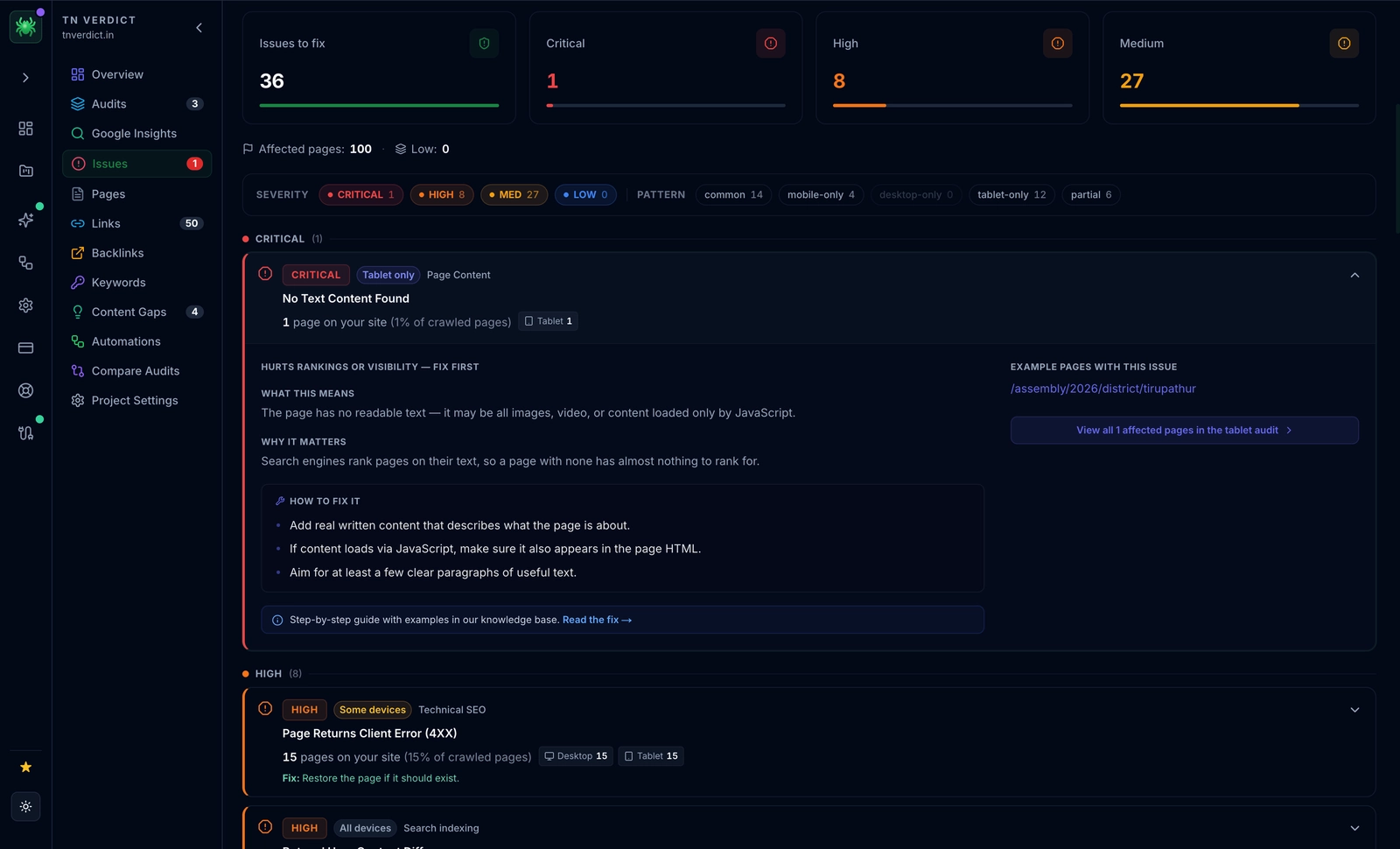
- Seamless Integration with Google Search Console: By pulling data from GSC, Digispot AI overlays actual performance data onto your meta tag audit. You can see which pages have high impressions but low CTR—a clear signal that the title or description needs optimization.
- Opportunity Finder and Content Studio: Digispot AI identifies low-hanging fruit. If a page is ranking on page 2 for a high-volume keyword, the Opportunity Finder will suggest meta tag tweaks to boost relevance. The Content Studio then helps you rewrite them using advanced LLMs (GPT-4, Claude) that understand persuasive copywriting.
- Free Community Chrome Extension: For quick spot-checks, our extension allows you to view the meta tags of any page you are browsing—including competitors. You can instantly see their title structure, description copy, and schema setup to reverse-engineer their success.
Meta Tags SEO: Optimizing for Marketplaces vs. Traditional Websites
SEO is not one-size-fits-all. The strategy for a standalone WordPress site differs vastly from optimizing a product on Amazon or Etsy.
Marketplace Product SEO
In "walled garden" search engines like Amazon's A9 algorithm, the goal is sales velocity.
- Title Tags: Extremely long and descriptive. Unlike Google, Amazon allows and encourages titles packed with specs, sizes, and material details (often 200+ characters).
- Keywords: Backend keywords (hidden meta fields) are crucial here, functioning similarly to the old
meta keywordstag but actually used by the internal algorithm. - Intent: Purely transactional.
Traditional Website SEO
For Google and Bing, the goal is relevance and authority.
- Title Tags: Concise (60 chars). Focus on readability and clickability.
- Keywords: Semantic integration within the content is more important than stuffing the title.
- Intent: varies across informational, navigational, and commercial.
Table: Meta Tag Optimization Best Practices at a Glance
| Feature | Marketplace Product SEO | Traditional Website SEO (e.g., Google) |
|---|---|---|
| Platform | Internal search engines (Amazon A9, Etsy, eBay Cassini) | External search engines (Google, Bing, Perplexity) |
| Goal | Product visibility, conversion, sales velocity | Traffic, brand awareness, lead generation |
| Key Ranking Factors | Sales history, conversion rate, price, reviews, backend keywords | Backlinks, content depth, technical SEO, mobile UX, E-E-A-T |
| Content Focus | Feature-heavy, bullet points, spec-driven | Comprehensive guides, problem-solving, narrative structure |
| Technical SEO | Managed by the platform (you control text only) | Full control (robots.txt, sitemaps, canonicals, schema) |
| User Signals | Add-to-cart rate, return rate, reviews | Bounce rate, dwell time, CTR, scroll depth |
| Competition Scope | Category-specific within the marketplace | Global index of billions of pages |
Business Outcomes: What You Can Expect from Optimized Meta Tags
Investing time in meta tag optimization is not just a technical exercise; it drives tangible business results.
- Higher Quality Traffic: By writing honest, descriptive tags, you qualify your traffic. Users who click are genuinely interested in your content, leading to better engagement metrics and higher conversion rates.
- Increased Organic Reach: As your CTR improves, search engines are more likely to rank you for broader keyword variations. Good meta tags help you cast a wider net without diluting relevance.
- Protection Against AI Answers: In the age of AI Overviews (SGE), clear metadata helps AI models summarize your content accurately. If your tags are vague, AI might hallucinate details or ignore your site entirely. Accurate tags improve your chances of being cited as a source.
- Cost Efficiency: Organic traffic is free. Every visitor you gain through better meta tags is a visitor you don't have to pay for via Google Ads or Facebook Ads. The ROI of on-page optimization is cumulative and long-lasting.
Conclusion: Start Improving Your Search Visibility Today
Meta tags are the unsung heroes of SEO. They bridge the gap between your content and the users searching for it. While they may seem like small technical details, their impact on rankings, click-through rates, and user experience is immense.
By mastering the "what," "why," and "how" of titles, descriptions, and robots tags, you lay a foundation for sustainable digital growth. You move from hoping to be seen to ensuring you are understood by both algorithms and humans.
Don't let your hard work go unnoticed in the SERPs. The landscape of search is competitive, and the winners are those who pay attention to the details.
Ready to maximize your visibility?
- Audit Now: Try the free On-Page SEO Checker to see how your tags look right now.
- Preview Tags: Use our Meta Tag Preview Tool to see how your page appears on Google, Facebook, LinkedIn & 6 more platforms.
- Automate: Sign up for Digispot AI to continuously monitor and optimize your site's technical health.
- Learn: Explore our guide on common SEO mistakes to ensure your broader strategy is as sharp as your meta tags.
Start optimizing today, and watch your website climb to new heights of visibility.
Related deep-dives
Continue with these closely related guides:
- visibility in meta ai — Visibility in Meta AI Search: The Ultimate Optimization Strategy
- marketplace seo — Marketplace SEO: Optimize Product Listings
- digispot ai chrome extension — Digispot AI Chrome Extension: Free On-Page SEO & SERP Auditor
References
- Control your snippets in search results | Google Search Central
- Title links (formerly "title tags") in search results | Google Search Central
- Meta descriptions in search results | Google Search Central
- Meta tags that Google understands | Google Search Central
- Add structured data to your content | Google Search Central
- Open Graph Protocol
- Twitter Developer Platform: Twitter Cards
- Google Search Console
- Google Analytics
- Digispot AI - FREE On Page SEO Audit Tool
- Digispot AI - FREE Chrome Extension for SEO Insights
Audit any page in seconds
300+ SEO checks including Core Web Vitals, schema markup, meta tags, and AI readiness — trusted by 1000+ SEO experts and marketers.
Frequently Asked Questions
Here are some of our most commonly asked questions. If you need more help, feel free to reach out to us.
Written by
Maya Krishnan
Digital growth expert
Maya is a seasoned expert in web development, SEO, and digital strategy, dedicated to helping businesses achieve sustainable growth online. With a blend of technical expertise and strategic insight, she specializes in creating optimized web solutions, enhancing user experiences, and driving data-driven results. A trusted voice in the industry, Maya simplifies complex digital concepts through her writing, empowering readers with actionable strategies to thrive in the ever-evolving digital landscape.