NAP Consistency: The Foundation of Local SEO and AEO Success
Master NAP consistency for local SEO. Learn why accurate Name, Address, and Phone data drives rankings on Google, Bing, and AI search engines like ChatGPT.
 Maya Krishnan
Imagine a potential customer driving to your business, only to find an empty lot because your address on Google Maps was outdated. Or consider a voice search user asking Siri for a phone number, only to be connected to a disconnected line found on an old directory listing.
These aren't just minor inconveniences; they are revenue leaks.
In the precise world of search algorithms, clarity is currency. Google, Bing, and emerging AI engines (like ChatGPT and Perplexity) rely on data confidence to rank businesses. If they encounter conflicting information about who you are or where you are located, their confidence drops—and so do your rankings.
This concept is known as NAP consistency (Name, Address, Phone). While it sounds fundamental, it remains one of the most frequently mishandled aspects of local SEO strategy.
This guide covers the mechanics of NAP consistency, why it matters for both traditional search and Answer Engine Optimization (AEO), and how to audit and fix your digital footprint. For the bigger picture of how these signals fit together, see our guide to what local SEO is and how it works.
What is NAP Consistency?
NAP stands for Name, Address, and Phone Number. In the context of SEO, it refers to the accuracy and alignment of these three data points across the entire digital ecosystem.
When SEOs talk about NAP, we often implicitly include a "W" for Website, making it NAPW. Your digital identity consists of:
- Business Name: Must be your real-world legal name (e.g., "Digispot AI," not "Digispot AI - Best SEO Tool in New York").
- Address: The physical location where customers can find you or where your business is registered (essential for the Google Map Pack).
- Phone Number: The direct line to your business location.
- Website URL: The specific landing page for that location.
The "Citation" Ecosystem
Every time this data appears on a website other than your own—like Yelp, Yellow Pages, a local chamber of commerce, or a Facebook page—it is called a citation.
Search engines use these citations to cross-reference your existence. If Google sees your business listed as "Digispot" at "123 Main St" on your website, but "Digi-Spot Inc." at "125 Main Street" on Data Axle, the algorithm detects a discrepancy.
Why NAP Consistency Drives Rankings
Search engines are, at their core, reference machines. Their goal is to organize the world's information. When that information is contradictory, the machine hesitates.
1. The Trust Signal
Google wants to send users to real, operational businesses. Consistent NAP data acts as a strong validation signal. It confirms that you are who you say you are. High consistency equates to high "Data Confidence," which correlates directly with visibility in the Local Pack (the map results at the top of Google).
2. The Voice Search & AI Factor (AEO)
With the rise of Answer Engine Optimization (AEO), consistency is no longer just about maps. When a user asks ChatGPT or Google Gemini, "What is the best SEO agency near me?", the AI processes vast amounts of text from across the web.
If your data is fragmented, LLMs (Large Language Models) may hallucinate details or exclude you entirely to avoid providing incorrect answers. In the era of AI search, data hygiene is your primary defense against invisibility.
3. User Experience (UX) and Conversion
Broken data leads to broken experiences. If a customer dials a wrong number or drives to an old office, you haven't just lost a sale; you've generated negative sentiment. Users rarely report errors; they simply click the next result.
The Cost of Inconsistency: A Mechanical View
Why does a wrong phone number on a minor directory matter if your Google Business Profile (GBP) is correct?
Information on the web flows like a waterfall. Google doesn't just trust what you type into your GBP; it verifies that data against third-party sources known as Data Aggregators.
If an aggregator like Foursquare or Localyse holds old data, they feed that bad data to Apple Maps, Bing, specialized car navigation systems, and eventually, it loops back to Google. Google may see this persistent "bad" data and decide to "correct" your listing effectively overriding your manual changes with incorrect information.
Digispot AI can help you identify these hidden inconsistencies automatically with AI-powered audits that analyze your footprint across 300+ ranking factors.
How to Audit Your NAP Consistency
Before you can fix the data, you must diagnose the extent of the fragmentation.
Phase 1: The "Ego Search"
Start with manual checks using advanced search operators in Google. This helps reveal what the public index sees.
"Your Business Name" + "Phone Number""Your Business Name" + "Old Address"(if you moved)"Your Address" -site:yourdomain.com
Look for results on high-authority directories (Yelp, TripAdvisor, BBB) that show discrepancies.
Phase 2: Google Business Profile (GBP) Audit
Ensure your "source of truth" is accurate.
- Name: Does it match your signage?
- Address: Is the pin drop accurate?
- Phone: Is it a local area code? (Toll-free 800 numbers perform worse in local search).
Phase 3: Automated Analysis
Manual searching misses the deep web and data aggregators. You need a tool to scan the ecosystem.
Try the free On-Page SEO Analysis tool to ensure your website's NAP data matches your schema markup. For a broader citation audit, Digispot AI's platform provides a complete view of your off-site presence.
Fixing NAP Issues: A Strategic Workflow
Fixing citations is tedious but necessary. Follow this hierarchy to maximize impact with minimal effort.
Tier 1: Core Platforms
These platforms feed almost everyone else. Fix these first.
- Google Business Profile: This is your primary anchor.
- Bing Places: Feeds the Microsoft ecosystem and often powers voice search for Alexa.
- Apple Maps Connect: Critical for iPhone users (Siri).
- Facebook Business Page: A major trust signal for search engines.
Tier 2: The Data Aggregators
In the US, the major aggregators are Data Axle, Neubrain, and Foursquare. Submitting corrections here is the "nuclear option" for fixing bad data. Once updated here, the correct info trickles down to hundreds of smaller directories over 3-6 months.
Tier 3: High-Authority Directories
Focus on directories that humans actually use or that carry high domain authority.
- Yelp
- Yellow Pages
- Better Business Bureau (BBB)
- Industry-specific sites (e.g., Healthgrades for doctors, TripAdvisor for hospitality).
Learn more about niche-specific strategies in our Healthcare Local SEO guide.
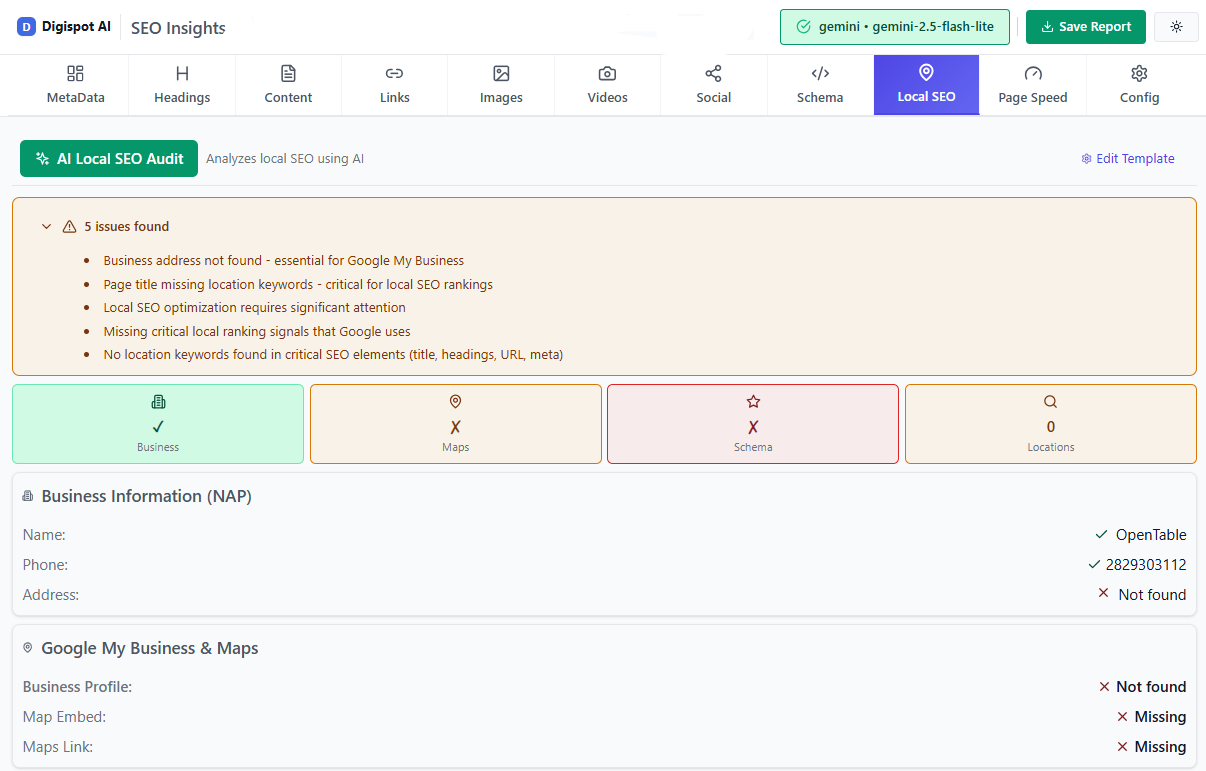
Turn invisible SEO data into clear visuals with our Free Chrome extension.
Common NAP Pitfalls and Solutions
1. Call Tracking Numbers (DNI)
Marketers love call tracking to measure ROI, but dynamic numbers confuse search engines. The Fix:
- On Website: Use Dynamic Number Insertion (DNI) code that swaps the number only for users, while the hard-coded HTML remains your local number for bots.
- On GBP: Add your tracking number as the "Primary Phone" and your actual local number as an "Additional Phone." Google explicitly supports this configuration.
2. Suite Numbers and Formatting
Do you write "Ste 100", "#100", or "Suite 100"? The Reality: Google's normalization algorithms are smart enough to know these are the same. Don't obsess over the abbreviation. Do, however, ensure the suite number exists if you share a building. It differentiates you from neighbors.
3. Service Area Businesses (SABs)
If you are a plumber working out of your home, you likely hide your address on GBP. The Strategy: Even if hidden on GBP, you still need a consistent address for data aggregators (usually your registered business address). Ensure your legal entity address matches what you provide to private directories, even if you don't publish it on your homepage.
Advanced NAP: Schema Markup
To speak the language of search engines fluently, you should wrap your NAP data in Schema.org structured data. This code tells Google explicitly, "This text is a phone number" and "This text is an address."
Without schema, Google has to guess based on formatting. With schema, there is no ambiguity.
Example of LocalBusiness JSON-LD:
{
  "@context": "https://schema.org",
  "@type": "LocalBusiness",
  "name": "Digispot AI",
  "image": "https://digispot.ai/logo.png",
  "telephone": "+15551234567",
  "address": {
    "@type": "PostalAddress",
    "streetAddress": "123 Tech Blvd",
    "addressLocality": "San Francisco",
    "addressRegion": "CA",
    "postalCode": "94105",
    "addressCountry": "US"
  },
  "url": "https://digispot.ai"
}
Implementation is easy. Use the free Schema Markup Generator to create valid structured data in minutes, then verify it using our Schema Markup Visualizer.
Handling Multi-Location NAP
For businesses with multiple branches, consistency becomes exponential harder.
- Unique Landing Pages: Do not list all 50 locations on one "Contact Us" page. Create a unique URL for each location (e.g.,
domain.com/locations/austin). - Specific NAP per Page: Each location page must have its specific Name (if varying), Address, and Phone in the footer or contact section.
- Store Codes: Use unique store codes in your GBP dashboard to manage bulk uploads effectively.
For a deeper dive into technical structures for multi-location sites, read our Technical SEO Audit Checklist.
NAP in the Age of AI and LLMs
The traditional view of NAP was about maps. The modern view is about entity authority.
When Digispot AI analyzes a brand's presence, we look at Entity Consistency. AI models like GPT-4 and Claude construct a "knowledge graph" of your brand. If sources A, B, and C agree on your details, the AI solidifies that knowledge.
If Source A says you are closed on Sundays, but Source B says you are open, an AI generating a travel itinerary for a user might skip your business entirely to avoid the risk of sending a user to a closed shop.
AEO Tip: Ensure your operational hours are as consistent as your address. AI agents weigh "open/closed" status heavily for real-time queries.
Maintenance: The Job isn't Done
NAP consistency is not a "set it and forget it" task.
- User Edits: Competitors or confused users can "suggest an edit" on your Google listing. If you aren't monitoring it, Google might accept the wrong change.
- Data Drift: Aggregators sometimes scrape old government filings and revert your data.
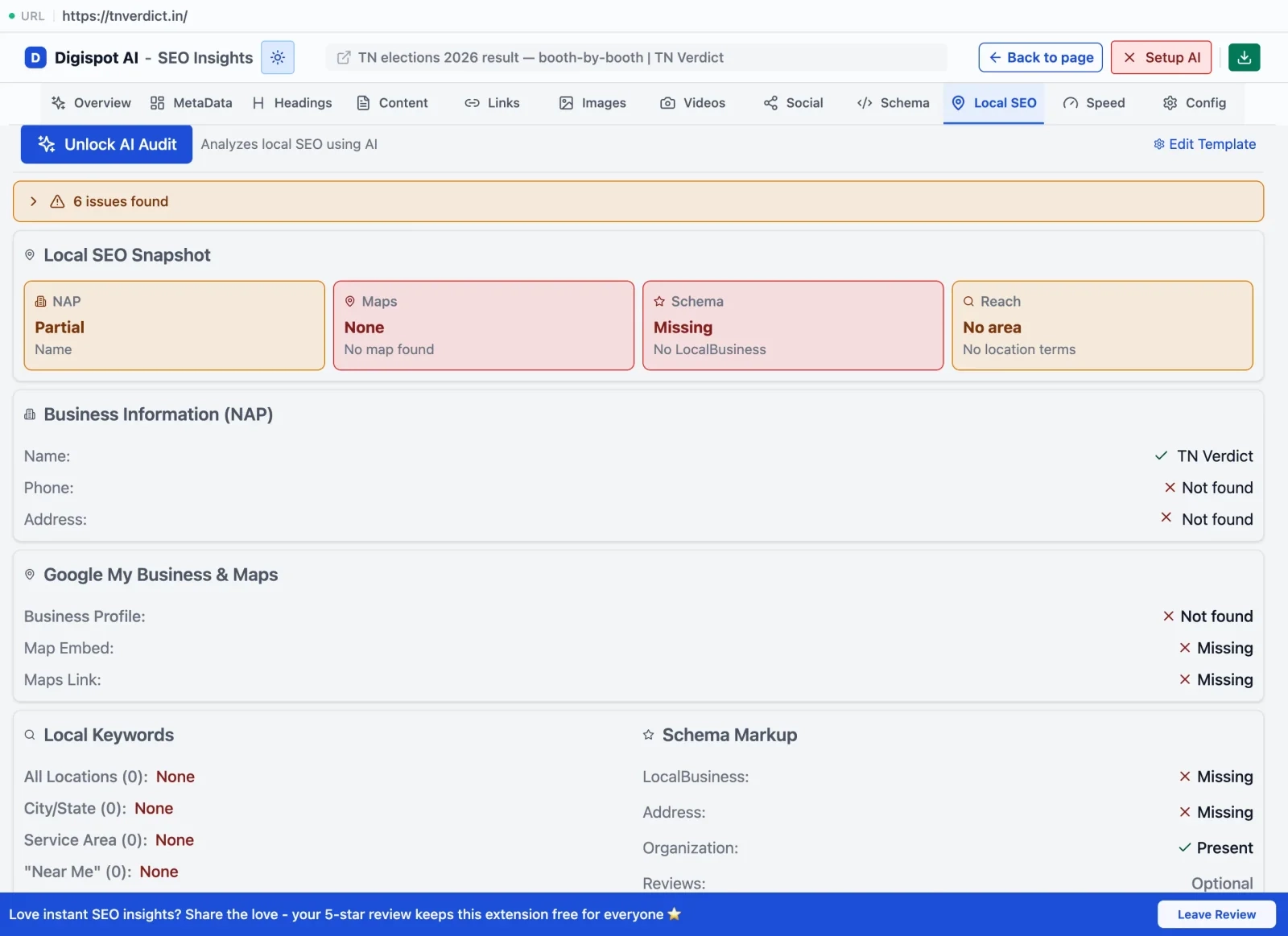
Regular monitoring is essential. Get instant SEO insights on any page, including schema validation, with our free Chrome extension. It allows you to spot-check how search engines render your contact data in real-time.
Conclusion: Start Fixing Your Foundation
You cannot out-optimize bad data. No amount of backlinks or blog content will compensate for a search engine not knowing where you are located. NAP consistency is the bedrock of E-E-A-T—demonstrating that you are a real, reliable business.
Start by auditing your Google Business Profile today. Then, expand to the major aggregators. By securing your digital identity, you build the trust required to rank in the Local Pack and appear in the next generation of AI answers.
Ready to improve your search visibility? Try Digispot AI for comprehensive website audits, automated citation tracking, and actionable recommendations to secure your rankings.
Related deep-dives
Continue with these closely related guides:
- dominate local search — Dominate Local Search: 9 Advanced Near Me SEO Optimization Strategies
- b2b enterprise seo strategy — B2B Enterprise SEO Strategy: The 2026 Framework for Scale & AI Visibility
- local citations for seo — Local Citations Guide for SEO: Boost Rankings & Trust (2026)
References
- [Google Search Central: Business Profile Guidelines](https://developers.google.com/search/docs/ specialized/local)
- Moz: The Ecosystem of Local Search
- Schema.org: LocalBusiness Documentation
- Digispot AI: Schema Markup Generator
- Digispot AI Chrome Extension
- BrightLocal: Local Search Ranking Factors Study
Audit any page in seconds
300+ SEO checks including Core Web Vitals, schema markup, meta tags, and AI readiness — trusted by 1000+ SEO experts and marketers.
Frequently Asked Questions
Here are some of our most commonly asked questions. If you need more help, feel free to reach out to us.
Written by
Maya Krishnan
Digital growth expert
Maya is a seasoned expert in web development, SEO, and digital strategy, dedicated to helping businesses achieve sustainable growth online. With a blend of technical expertise and strategic insight, she specializes in creating optimized web solutions, enhancing user experiences, and driving data-driven results. A trusted voice in the industry, Maya simplifies complex digital concepts through her writing, empowering readers with actionable strategies to thrive in the ever-evolving digital landscape.