Local Citations Guide for SEO: Boost Rankings & Trust (2026)
Master local citations to dominate Google Maps and AI search results. Learn how to audit, build, and clean up your NAP data for maximum local visibility.
 Maya Krishnan
Imagine you run the best coffee shop in Seattle, but half the internet thinks you are located three blocks away, and the other half thinks you closed at 4 PM (when you're actually open until 8).
This is the reality for businesses with poor local citations.
Search engines like Google and AI platforms like ChatGPT crave certainty. If they find conflicting information about your business online, they lose trust in your data. When trust drops, so do your rankings in the Local Pack and Google Maps.
A robust local citation strategy is the bedrock of local visibility. It is not just about being found; it is about proving to search algorithms that you are who you say you are. Citations are one piece of a larger picture—see our overview of what local SEO is and how it works to understand where they fit.
This guide covers everything you need to know to audit, build, and maintain local citations that drive foot traffic and secure your digital footprint.
Key Takeaways
- Consistency beats volume. Identical NAP data across a handful of authoritative platforms builds more trust than hundreds of mismatched listings.
- Audit before you build. Fix duplicates, ghost locations, and stale phone numbers first—bad data actively drags down local rankings.
- Prioritize in tiers. Lock down the "Big 3" (Google Business Profile, Bing, Apple Maps) and Yelp manually, then feed the data aggregators, then chase niche directories.
- Citations now feed AI answers too. Clean, verifiable data keeps you eligible to appear in ChatGPT, Gemini, and Google's AI results—not just the Local Pack.
- Treat it as ongoing maintenance. Set a recurring check so hours, numbers, and addresses stay accurate everywhere, not just on Google.
What Are Local Citations?
In SEO terms, a local citation is any online mention of your business's partial or complete NAP data:
- N: Name
- A: Address
- P: Phone Number
- (W): Website URL (often included)
Citations serve as a digital paper trail. When Google crawls the web and sees your business mentioned on the Chamber of Commerce website, Yelp, and a local news blog—all with matching data—it validates your legitimacy.
Structured vs. Unstructured Citations
Not all citations look the same. Understanding the difference helps you prioritize where to focus your efforts.
1. Structured Citations These appear on business directories and social media platforms. The data is entered into specific fields. The structure is rigid and easy for bots to crawl.
- Examples: Google Business Profile (GBP), Bing Places, Yelp, Yellow Pages, Apple Maps.
- Format: The site displays the info in a standardized block.
2. Unstructured Citations These are mentions of your business in continuous text. They occur when a local newspaper writes an article about your grand opening or a blogger reviews your services.
- Examples: News articles, blog posts, event listings, job boards.
- Format: "We visited Joe's Pizza on 5th Avenue last night..."
While structured citations are easier to control, unstructured citations often carry more authority because they usually come from earned media coverage.
Why Citations Matter for SEO (and AEO)
You might wonder if directory listings are still relevant when everyone just uses Google Maps. The answer is yes, but the mechanism has changed.
1. The Verification Signal
Google wants to display real businesses, not lead-gen ghost sites. Consistent citations across authoritative platforms act as a verification signal. If your business appears on government records, major data aggregators, and local directories, Google trusts that you exist physically.
2. Prominence and Authority
Prominence is a core pillar of Google's local ranking algorithm. The more your business is mentioned online compared to competitors, the more "prominent" you appear.
However, quality trumps quantity. One citation from a highly respected local portal (like a city guide) is worth 50 citations from low-quality, spammy web directories.
3. Feeding the AI Models (AEO)
This is the modern frontier. Large Language Models (LLMs) like GPT-4 and Gemini consume vast amounts of data to answer user queries.
If a user asks ChatGPT, "What are the best Italian restaurants in downtown Chicago?", the AI retrieves information based on its training data and live search capabilities. If your citation profile is messy (e.g., showing three different addresses), the AI may filter you out to avoid providing a "hallucinated" or incorrect answer.
In practice, these engines cross-reference the same authoritative sources humans trust—Google Business Profile, Yelp, Apple Maps, and structured directory data. When your NAP matches across all of them, the model treats your business as high-confidence and is far more likely to name it directly. When it conflicts, the safest move for the model is to omit you entirely. This is why citation hygiene is now a prerequisite for answer engine optimization, not a separate initiative.
Clean citations ensure your business is "readable" by the next generation of search engines.
Digispot AI helps you track these visibility metrics across both traditional search and AI platforms, ensuring you aren't invisible to the newest wave of users.
The Ecosystem: How Data Aggregators Work
You cannot manually update every single directory on the internet. This is where the Local Search Ecosystem comes into play.
Most smaller directories buy their data from Data Aggregators. These are massive databases that compile business info from utility bills, business registration records, and direct submissions.
The primary aggregators (in the US market) currently include:
- Data Axle (formerly Infogroup)
- Localeze (Neustar)
- Foursquare
If your data is incorrect at the aggregator level, it will trickle down to hundreds of smaller directories. Conversely, fixing it at the aggregator level acts as a "heal all" for many downstream sites.
Step 1: The Citation Audit
Before building new links, you must fix the old ones. Bad data is like a weight dragging down your local rankings.
Identifying Issues
Common citation problems include:
- Duplicate Listings: Three different Yelp pages for the same location.
- NAP Inconsistency: "St." vs. "Street" usually isn't an issue, but "Suite B" vs. "Unit 2" can cause confusion.
- Old Phone Numbers: A conversion killer.
- Ghost Locations: Listings for offices you closed years ago.
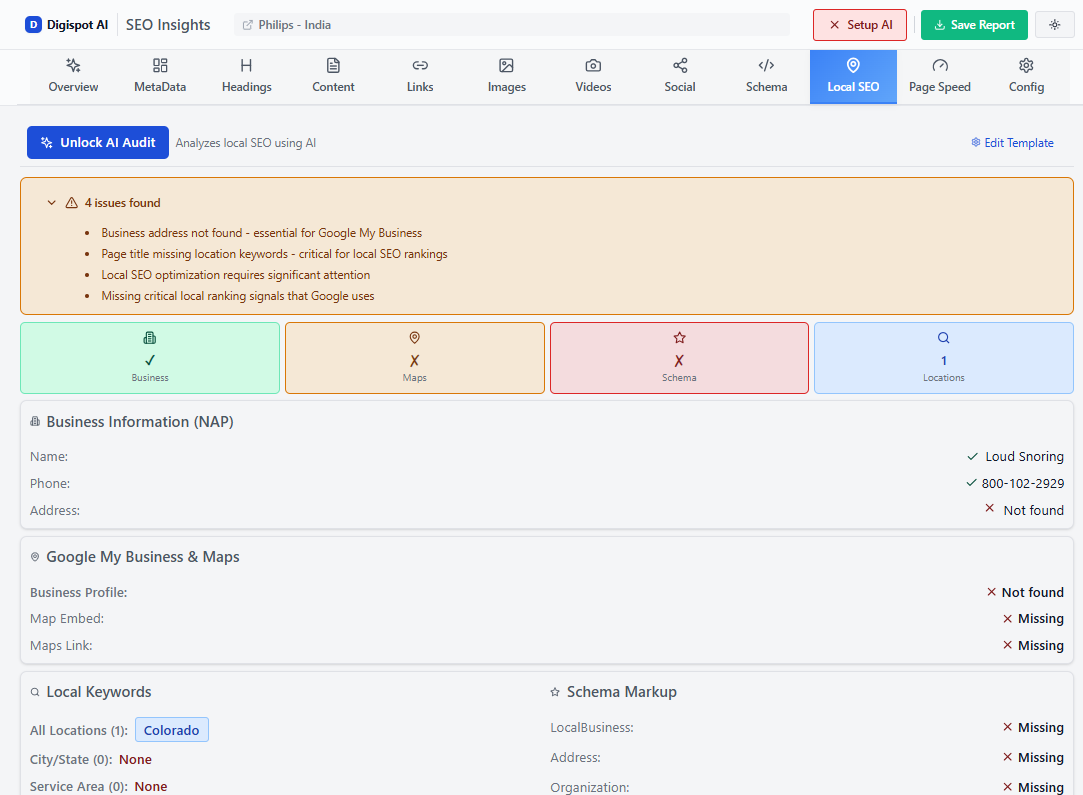
Turn invisible SEO data into clear visuals with our Free Chrome extension.
How to Audit
- Manual Google Search: Search for
"Business Name" + "Phone Number"and"Business Name" + "Address". Look for results that show incorrect details. - Automated Tools: Use a citation scanner to check the top 50 directories instantly.
- Competitor Analysis: See where your top-ranking competitors are listed.
Pro Tip: Use the Digispot AI Chrome Extension to instantly analyze competitor pages and identify which directories represent their strongest backlinks.
Learn more about finding missed opportunities in our Content Gap Analysis Guide.
Step 2: Core Citation Building Strategy
Once you have identified the mess, it's time to build a fortress of accurate data. Prioritize your efforts in tiers.
Tier 1: The "Must-Haves"
These platforms drive direct traffic and have the highest impact on SEO.
- Google Business Profile (GBP): The king of local SEO. See our Google Business Profile optimization guide to get every field working for you.
- Bing Places: often syncs with GBP, but verify it manually.
- Apple Maps: Critical for Siri and iPhone users (millions of searches).
- Facebook Business Page: A huge trust signal for Google.
- Yelp: High authority, feeds Apple Maps data.
Tier 2: The Aggregators
Submit your clean NAP data to Data Axle, Localeze, and Foursquare. This takes time (months) to propagate, but it secures your baseline data across the web.
Tier 3: Geo and Niche Specific
This is where you beat the competition. Most businesses stop at Tier 1.
- Geo-Specific: Local Chamber of Commerce, city business directories, local news sites.
- Niche-Specific:
- Attorneys: Avvo, FindLaw.
- Doctors: Healthgrades, Vitals. (See our Healthcare Local SEO guide for more).
- Contractors: Angi, HomeAdvisor, Houzz.
- Real Estate: Zillow, Realtor.com.
Relevance is key. A link from a local bakery directory is useless for a law firm.
Step 3: Consistency and Formatting
Does "Road" vs. "Rd." matter?
Google's algorithm is smart enough to understand standard abbreviations. However, consistency minimizes risk.
The Golden Rules of NAP
- Legal Business Name: Use your real name. Do not stuff keywords.
- Good: Smith Family Dentistry
- Bad: Smith Dentist Teeth Cleaning Best in Chicago
- Physical Address: P.O. Boxes are generally forbidden for local listings (especially GBP). Use a physical street address.
- Local Phone Number: Use a local area code (e.g., 206) rather than a toll-free number (800) for the primary line. It signals local presence.
- Website URL: Link to your specific location page if you have multiple branches, not just the homepage.
If you are managing location pages on your own site, ensure the data there matches your citations exactly. For a deeper look at why even small mismatches erode trust, see our guide on NAP consistency in local SEO.
Use the free Schema Markup Generator to create LocalBusiness structured data for your website. This code tells Google explicitly what your address is, removing any ambiguity.
Manual vs. Automated Citation Building
You have two choices for execution: DIY or pay a platform.
| Feature | Manual Submission | Automated (Yext/Moz/Uberall) |
|---|---|---|
| Cost | Free (Time-intensive) | Recurring subscription |
| Control | Full control forever | Control only while paying |
| Speed | Slow (Weeks/Months) | Instant/Fast |
| Ownership | You own the login | Listing often reverts upon cancellation |
Recommendation: For the "Big 3" (Google, Bing, Apple) and key social profiles, do it manually. You want direct ownership of these assets. For the hundreds of smaller directories, automated tools or one-time cleanup services can save dozens of hours.
Local Citations and Link Building
Citations are a form of link building, but they are often "NoFollow" links. This means they might not pass direct "link juice" (PageRank) to your site.
However, do not undervalue them.
- referral Traffic: People actually use Yelp and TripAdvisor. Traffic from these sites sends positive user-behavior signals to Google.
- Trust Authority: A diverse link profile needs NoFollow links to look natural.
- Unstructured Opportunities: Reaching out to local blogs for unstructured citations often results in "DoFollow" backlinks, which are powerful ranking factors.
For a broader look at how links fit into your strategy, read our Local SEO Complete Guide.
Managing Multi-Location Citations
If you manage a franchise or multi-location business, citations become exponentially harder.
The Challenge: Data leakage. If the downtown branch phone number accidentally appears on the uptown branch listing, you lose customers.
The Solution:
- Create a "Location Master Sheet" (SSOT - Single Source of Truth). Store the exact legal name, street address, local phone number, landing-page URL, and store hours for every branch in one spreadsheet, and treat it as the only version anyone is allowed to copy from when submitting or editing a listing.
- Create unique landing pages for each location on your website (e.g.,
domain.com/locations/downtown). Each page should carry its ownLocalBusinessschema, embedded map, and branch-specific hours so both search engines and AI models can tie the listing to a distinct physical entity. - Build citations pointing specifically to those landing pages, not the homepage. Pointing every branch at the homepage collapses the ranking signals into one URL and makes it impossible for Google to attribute prominence to the correct location.
- Use bulk verification tools on Google and Bing. Google Business Profile supports bulk verification for chains with ten or more locations, which spares you from claiming each listing one postcard at a time.
- Assign a unique local phone number per branch. Reusing one central number across locations is the single most common cause of data leakage and merged listings.
Beyond citations, multi-location brands benefit from matching their on-site content to each market. Our geo-targeting guide covers how to structure location pages so they rank in the right city.
Measuring Citation Success
How do you know if your efforts are working? You won't see a ranking jump overnight. Citation work is an investment that matures over 3-6 months.
Metrics to track:
- Local Pack Rankings: Are you moving from position 7 to position 3? Pair this with the tactics in our guide on how to rank higher on Google Maps.
- referral Traffic: Check Google Analytics 4 for traffic coming from directories (Yelp, YellowPages).
- Impressions: Check Google Search Console for an increase in local queries.
- Verification Status: Are your listings "Live" or "Pending"?
Digispot AI automates this tracking. We monitor your local visibility and alert you if your NAP data becomes inconsistent across major platforms, protecting your "E-E-A-T" status. Speaking of trust, learn why accuracy is vital in our E-E-A-T SEO Guide.
4 Common Citation Mistakes to Avoid
1. The "Set and Forget" Mentality
Businesses move. Phone numbers change. If you update your hours on Google but forget Yelp, you will frustrate customers. Frustrated customers leave bad reviews.
2. Duplicate Listings
This is the silent killer. If you bought a business, the previous owner might have created listings you don't know about. Always search for the phone number and address to find legacy listings.
3. Keyword Stuffing
Adding "Best Plumber" to your business name field in directories is a violation of terms of service for Google and most platforms. It can lead to a suspension of your listing.
4. Using Virtual Offices
Google has cracked down hard on virtual offices and co-working spaces. If you don't have permanent signage and staff at the location during stated hours, you risk suspension.
Secure Your Local Search Presence
Local citations are not the most glamorous part of SEO, but they are the infrastructure that holds your local rankings up. In an era where AI answers rely on verified data, having a clean, consistent digital footprint is more important than ever.
Start by auditing your current status. Fix the glaring errors on major aggregators. Then, build strategic niche citations that your competitors have overlooked.
Ready to clean up your local presence? Use the free On-Page SEO Analysis tool to check your location pages, or try Digispot AI for a comprehensive audit of your entire local SEO performance.
References
Audit any page in seconds
300+ SEO checks including Core Web Vitals, schema markup, meta tags, and AI readiness — trusted by 1000+ SEO experts and marketers.
Frequently Asked Questions
Here are some of our most commonly asked questions. If you need more help, feel free to reach out to us.
Written by
Maya Krishnan
Digital growth expert
Maya is a seasoned expert in web development, SEO, and digital strategy, dedicated to helping businesses achieve sustainable growth online. With a blend of technical expertise and strategic insight, she specializes in creating optimized web solutions, enhancing user experiences, and driving data-driven results. A trusted voice in the industry, Maya simplifies complex digital concepts through her writing, empowering readers with actionable strategies to thrive in the ever-evolving digital landscape.