Healthcare Local SEO: Attract Nearby Patients
Master local SEO for healthcare providers. Optimize Google Business Profile, build local citations, and attract patients searching for medical services nearby.
 Maya Krishnan
In the digital age, a strong online presence is no longer a luxury for healthcare providers—it is a fundamental operational requirement. For local clinics, hospitals, and individual practitioners, the ability to connect with patients in their immediate vicinity is the primary driver of practice growth, stability, and community impact.
This is where Healthcare Local SEO serves as the critical bridge between patient need and provider availability.
Local visibility transcends simple Google rankings. It is about ensuring your practice appears exactly when a potential patient experiences a symptom, needs a routine check-up, or faces a sudden medical emergency. Consider the human element behind the search query: When a worried parent wakes up at 2:00 AM with a feverish child and types "urgent care near me" into their smartphone, they aren't looking for a website—they are looking for help.
If your practice isn't visible in that split second of high intent, you haven't just lost a click; you've lost the opportunity to care for a patient in your community.
This comprehensive guide provides a deep, tactical breakdown of healthcare local SEO mechanics for 2026. We will cover technical optimization, content strategies for medical authority (E-E-A-T), and the critical role of HIPAA-compliant reputation management.
Furthermore, we will examine how leveraging next-generation tools like the Digispot AI platform and its free community Chrome extension can automate complex audits, ensuring your medical practice maintains visibility in an increasingly competitive digital landscape without requiring you to become a coding expert.
What Exactly is Healthcare Local SEO?
Local SEO for healthcare is the strategic process of optimizing your digital footprint to dominate search results in a specific geographic area. While traditional SEO focuses on ranking for broad, informational terms like "what are the symptoms of diabetes," Local SEO targets high-intent, transactional queries like "diabetes specialist in [City Name]" or "best cardiologist near me."
These searches trigger specific Google features, most notably the "Local Pack" (also known as the Map Pack)—the map-based listing of three businesses that appears at the very top of search results, often above the organic text links.
For healthcare providers, appearing in this "3-Pack" is often more valuable than ranking #1 in organic text results. Why? Because the Map Pack provides immediate, frictionless access to:
- Click-to-Call buttons (crucial for appointments).
- Driving Directions (vital for physical visits).
- Star Ratings & Reviews (social proof that drives decisions).
The "Near Me" Phenomenon: A Shift in Patient Behavior
Patient behavior has shifted drastically toward mobile-first, location-aware searching. Google data indicates that "near me" searches for health-related services have grown exponentially over the last five years. This shift means that Google’s algorithm now prioritizes three core metrics for local rankings:
- Relevance: How well does your practice match the user's specific medical query? (e.g., Does your site specifically say "Pediatric Dentist" or just generic "Dentist"?)
- Distance: How close is your physical clinic to the searcher's current location? (This is why having accurate address data is non-negotiable).
- Prominence: How well-known and trusted is your practice based on reviews, citations, backlinks, and brand authority?
Mastering these three elements ensures you capture the patient at the precise moment of intent.
The Unmistakable Benefits of Mastering Healthcare Local SEO
Investing in local SEO yields transformative, compounding results for medical practices. Unlike Pay-Per-Click (PPC) advertising, where traffic stops the moment you stop paying, Local SEO builds a digital asset that continues to generate patients over time.
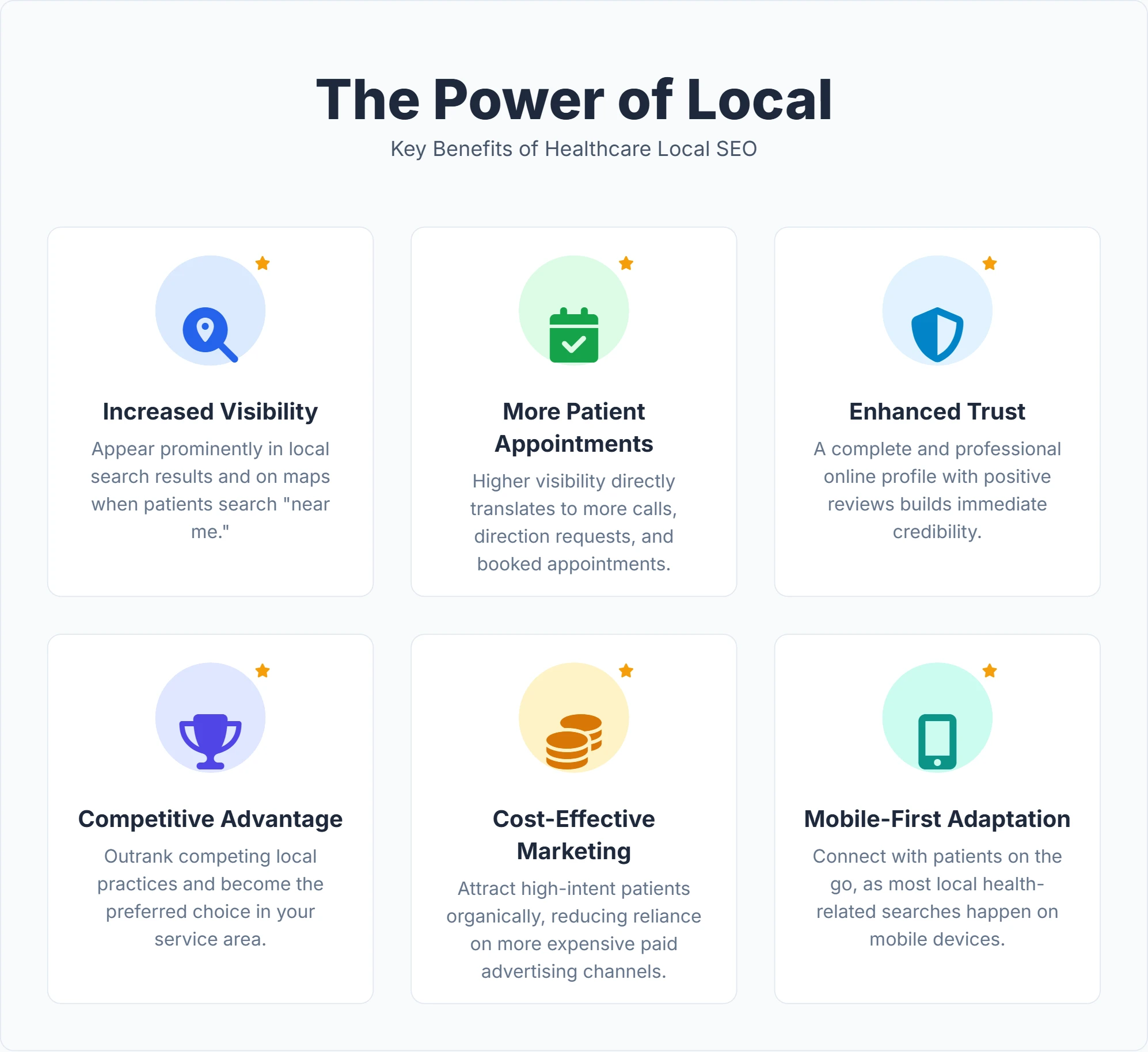
Table 1: Key Business Impacts of Healthcare Local SEO
| Benefit | Description | Impact on Your Practice |
|---|---|---|
| Hyper-Local Visibility | Ensures your practice ranks highly in local searches and map packs within your specific zip codes. | More local eyes on your practice leads to greater brand awareness. For urgent care or emergency dentistry, immediate visibility often dictates which provider a patient chooses. |
| Higher Quality Traffic | Attracts individuals specifically searching for providers in your geographic area. These users have high "commercial intent" to book. | You receive fewer irrelevant inquiries and more visits from pre-qualified patients. This significantly improves your conversion rate from website visitor to booked appointment. |
| Reduced Cost Per Acquisition | Organic leads from Local SEO are technically "free" compared to the high CPC (Cost Per Click) of medical keywords on Google Ads. | A consistent influx of organic patients creates a healthier bottom line. Reducing the cost-per-acquisition for new patients improves overall practice profitability. |
| Enhanced Trust & Credibility | Practices appearing in top positions with high star ratings are perceived as vetted and authoritative by patients. | Patients often equate Google rankings with medical quality. A strong digital reputation validates their decision to choose you over a competitor. |
| Market Dominance | Allows you to outrank established competitors who may have neglected their digital presence or rely solely on word-of-mouth. | Positions your practice as the market leader. In saturated areas, appearing above competitors in the Map Pack captures the majority of click-share (often over 40%). |
Building a Strong Foundation – The Core Pillars
Achieving dominance in local search requires a multi-faceted approach. You cannot simply build a website and hope for the best. You must actively manage the following pillars.
1. NAP Consistency: The Bedrock of Local Search
Your Name, Address, and Phone Number (NAP) serves as your digital fingerprint. Google uses this data to verify that your practice is legitimate and located where you say it is.
A common issue for clinics is data fragmentation.
- Example: Your website says "Smith Medical Center, Suite 5," but your Facebook page says "Smith Medical Ctr, #5," and a directory listing says "Dr. Smith's Office."
To Google, these look like three different businesses, splitting your ranking power and lowering your trust score.
How to Audit Your NAP Instantly: You don't need to manually check 50 directories. Using the Digispot AI Chrome Extension, you can instantly audit your local signals on your own website. As shown in the analysis below, the tool checks if your specific business address is found on the page text and verifies if your Google Maps embed links are active and accurate.
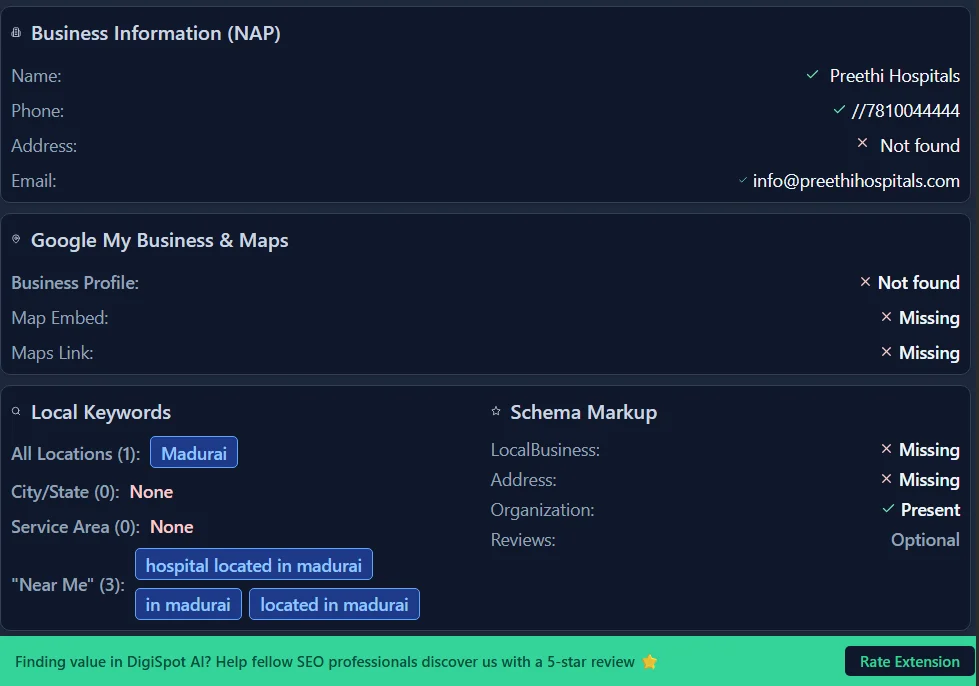
Above: The Digispot extension flagging a missing address and map embed. These are "silent killers" of local rankings that are easily fixed once identified.
2. On-Page SEO & Medical Content Depth
Your website acts as the destination for the traffic you earn. It must demonstrate E-E-A-T (Experience, Expertise, Authoritativeness, and Trustworthiness), which is crucial for YMYL (Your Money Your Life) topics like healthcare.
The Power of Location Pages: If you have multiple clinics, avoid the mistake of simply listing addresses on a "Contact Us" page. Create unique, robust pages for "Cardiologist in [City A]" and "Cardiologist in [City B]."
- Include photos of that specific office.
- List the specific doctors who work there.
- Embed a Google Map for that specific address.
- Include unique driving directions from local landmarks (e.g., "Across from the Central Mall").
Semantic Keywords & LSI: It is not enough to just mention "Cardiology" twenty times. Google expects to see related medical terminology that proves your expertise. A high-ranking page for cardiology should naturally include terms like "heart health," "surgery," "blood pressure," "EKG," and "emergency care." These are known as LSI (Latent Semantic Indexing) keywords.
Instead of guessing which keywords to use, you can inspect your content density using AI tools. The screenshot below illustrates how Digispot AI analyzes the significance of terms on a page, helping you ensure you are speaking the same language as your patients—and the search engines.
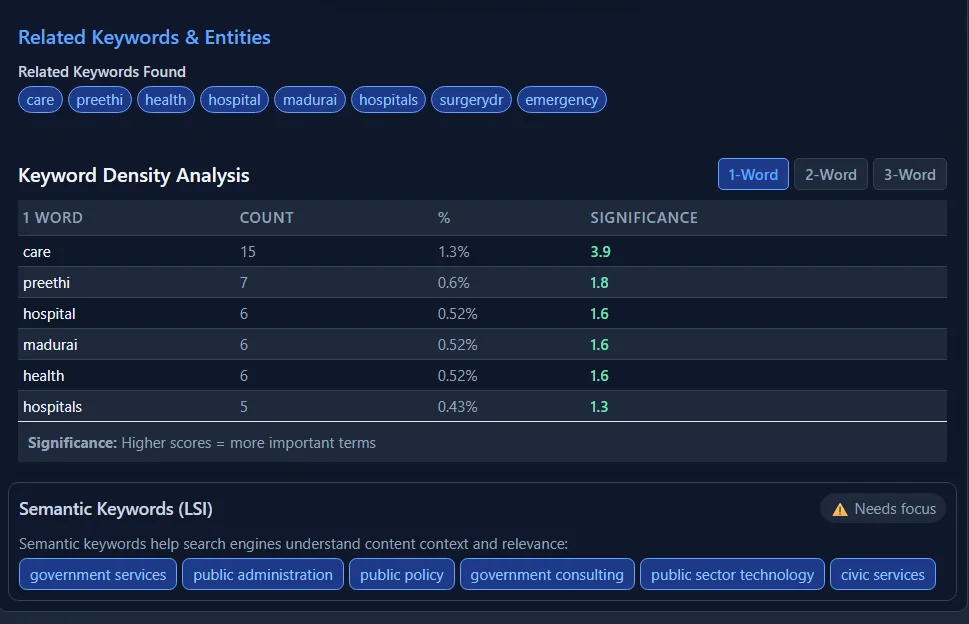
Pro Tip: If you see that your competitors are ranking for "Pediatric Urgent Care" and your analysis shows you only use the word "Kids," you have found a clear content gap to fill.
Audit your content now: Use the free On-Page SEO Analysis tool
3. Schema Markup: The Hidden Ranking Factor
Schema markup (Structured Data) is a specific type of code that translates your human-readable content into machine-readable data. It removes ambiguity. It tells Google: "This string of numbers is definitely a phone number," and "This 4.8 number is a review score."
For healthcare, implementing specific MedicalBusiness schema is non-negotiable. It allows you to define:
- MedicalSpecialty: (e.g., Dermatologic, Pediatric).
- AcceptedPaymentMethod: (Insurance types).
- OpeningHours: (Crucial for urgent cares).
- AvailableService: (Specific procedures like X-Rays).
However, JSON-LD code can be intimidating for practice managers. This is where visual tools shine. The Digispot AI Schema Graph renders your invisible code into a visual map, allowing you to see connections instantly.
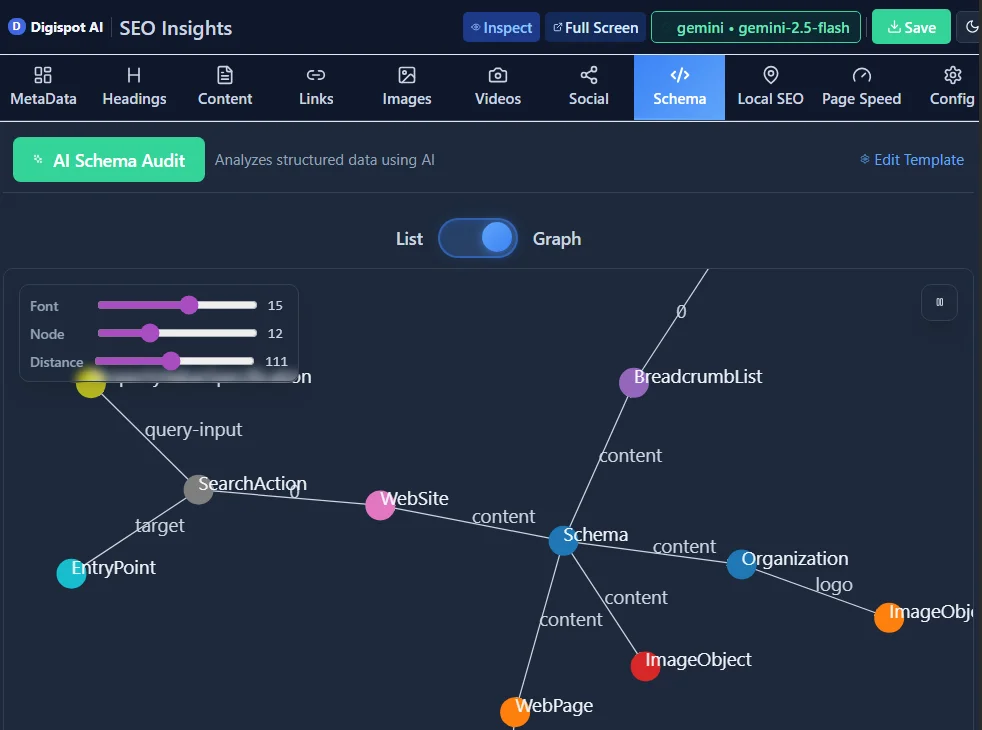
Above: A visualization of a website's structured data. If your 'MedicalBusiness' node isn't connected to your 'Address' node properly, Google may not display your location in search results. The Digispot extension makes this invisible problem visible.
4. Reputation Management: Reviews & HIPAA
Online reviews are the digital equivalent of word-of-mouth. According to recent studies, over 70% of patients use online reviews as the first step in finding a new doctor.
The HIPAA Challenge: Healthcare providers face a unique challenge: You generally cannot confirm that a reviewer is a patient publicly without violating HIPAA regulations. Even a simple "Thanks for visiting us for your knee surgery, John!" is a violation because it reveals Protected Health Information (PHI).
Best Practices for Responses:
- Positive Reviews: Keep it generic. "Thank you for your kind words! We are thrilled to hear you had a great experience with our team."
- Negative Reviews: Take it offline immediately. "We take all feedback seriously and strive for excellence. Please contact our office manager directly at [Phone] so we can discuss this matter privately."
Velocity Matters: A 5-star rating based on reviews from 2021 is less valuable than a 4.7 rating with reviews from last week. You need a strategy to consistently request reviews from satisfied patients (via SMS or email) immediately after their appointment.
How Digispot AI Automates Your Local Strategy
Managing local SEO for healthcare involves juggling compliance, content creation, technical performance, and reputation tracking. Doing this manually is time-consuming and prone to human error.
Digispot AI serves as your automated SEO strategist, specifically calibrated to handle these complexities. The platform utilizes a Multi-LLM AI engine (integrating Gemini, GPT-4, and specialized models) to provide actionable audits in seconds.
The "One-Click" AI Local Audit
One of the most powerful features for busy practice managers is the AI Local SEO Audit built into the Chrome Extension. Instead of giving you a list of confusing metrics (like "LCP" or "CLS"), the AI summarizes exactly what is working and what needs immediate attention in plain English.
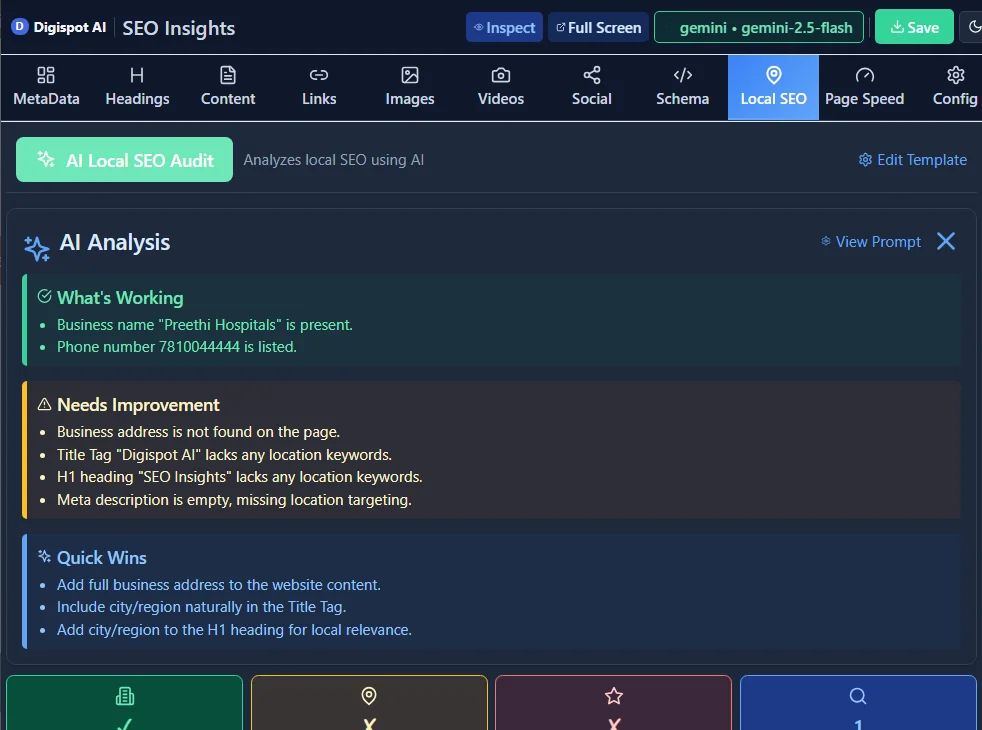
As seen in the real-world audit above, the tool provides a clear roadmap:
- What's Working: Confirmation that your critical identifiers (Business Name and Phone Number) are detected.
- Needs Improvement: Alerts you if location keywords (e.g., "Madurai" or "Austin") are missing from your Title Tags—a huge missed opportunity for ranking.
- Quick Wins: Gives you a prioritized checklist to fix immediately, such as "Add city/region to the H1 heading for local relevance."
Table 2: Manual SEO vs. Digispot AI Automation
| Task | Manual Method | With Digispot AI |
|---|---|---|
| Competitor Research | Clicking through 10 competitor sites, guessing their keywords, manually checking their headers. | Instant X-Ray: Load a competitor site, click the extension, and see their exact Heading structure, Schema, and Keyword density in 2 seconds. |
| Schema Validation | Using Google's Rich Results Test, copying and pasting code snippets, waiting for validation. | Visual Graph: See your schema visualized immediately on the page. Know instantly if your "MedicalClinic" tag is firing. |
| Technical Audit | Running a slow crawl, getting a 50-page PDF report that is hard to read. | AI Summary: Get a concise "Quick Wins" list prioritized by impact. Fix the top 3 issues that actually move the needle. |
| Privacy | Uploading data to cloud-based tools with unclear data policies. | Local Processing: Digispot processes data with strict privacy standards, crucial for healthcare compliance. |
Advanced Tactics for 2026 – Voice Search & Zero-Click
As we look toward the future of healthcare SEO, two trends are dominating: Voice Search and Zero-Click results.
Optimizing for Voice Search: Patients are increasingly asking Siri or Alexa: "Who is the best orthopedic surgeon near me?" or "What are the symptoms of strep throat?" To capture this traffic, your content needs to be conversational.
- Strategy: Create an FAQ section on your location pages.
- Format: Use full questions as H3 headers (e.g., "Do you accept Blue Cross insurance at your downtown clinic?") and answer them directly and concisely. Digispot's AI Content Agents can help you draft these FAQs based on real user queries.
Winning the "Zero-Click" Search: In healthcare, many users get their answer without ever clicking a website link. They see the hours, phone number, or address right on the Google results page. This is a "Zero-Click" search. While this brings no website traffic, it brings patients.
- Strategy: Treat your Google Business Profile like a social media feed. Post weekly updates about flu shot availability, new staff, or holiday hours. Upload photos regularly. These signals tell Google your practice is active and alive.
Conclusion: A Healthier Practice Starts with Visibility
The ultimate goal of any marketing effort is tangible business results. For healthcare practices, robust local SEO, supported by intelligent tools like Digispot, directly translates into significant outcomes:
- Dominant Market Share: Your practice becomes the "default" choice in your neighborhood.
- Operational Efficiency: When your website accurately answers patient questions (hours, insurance), your front desk staff spends less time on the phone answering basic queries.
- Asset Value: A practice with a high-ranking digital presence and thousands of reviews is significantly more valuable.
Healthcare Local SEO is an ongoing discipline, not a one-time setup. The medical landscape changes, competitors emerge, and Google's algorithms evolve. However, the core principle remains constant: Serve the patient's intent with accuracy, speed, and empathy.
Don't let technical complexity hold you back. Tools like the Digispot AI platform and the free community Chrome extension are designed to democratize this technology, giving local independent practices the same analytical power as major hospital networks.
Ready to diagnose your digital health?
- Install the Free Digispot Chrome Extension: Turn every web browsing session into a competitive research opportunity.
- Run an Instant Audit: Go to your practice's homepage, click the extension, and look at the "Local SEO" tab. Do you have "Quick Wins" waiting for you?
- Check Your Competitors: Go to the top-ranking doctor in your city. Use the extension to see their Schema and Headings. Copy what works, and improve upon it.
- Try the Web-Based Platform: For a deeper dive, use the full Digispot dashboard to monitor your growth over time.
Your patients are looking for you. Make sure you are the answer they find.
Related deep-dives
Continue with these closely related guides:
- patient acquisition seo — Patient Acquisition SEO: Healthcare Marketing Guide
- pharmacy seo — Pharmacy SEO: Local Visibility for Drugstores
- medical facility seo — Medical Facility SEO: Hospital & Clinic Rankings
- diagnostic services seo — Diagnostic Services SEO: Local Patient Guide
- healthcare reviews seo — Healthcare Reviews SEO: Build Patient Trust Online
- healthcare directory seo — Healthcare Directory SEO: Medical Listing Optimization
References & Further Reading
- Google Business Profile Help: Guidelines for representing your business on Google
- Google Maps Policies: Prohibited and Restricted Content in Reviews
- Schema.org: MedicalBusiness Structured Data Definitions
- Google Search Central: Local Business Structured Data Guide
- Digispot AI Tools: Free On-Page SEO Analysis
- Digispot Extension: Chrome Web Store Listing
Audit any page in seconds
300+ SEO checks including Core Web Vitals, schema markup, meta tags, and AI readiness — trusted by 1000+ SEO experts and marketers.
Frequently Asked Questions
Here are some of our most commonly asked questions. If you need more help, feel free to reach out to us.
Written by
Maya Krishnan
Digital growth expert
Maya is a seasoned expert in web development, SEO, and digital strategy, dedicated to helping businesses achieve sustainable growth online. With a blend of technical expertise and strategic insight, she specializes in creating optimized web solutions, enhancing user experiences, and driving data-driven results. A trusted voice in the industry, Maya simplifies complex digital concepts through her writing, empowering readers with actionable strategies to thrive in the ever-evolving digital landscape.