Healthcare Reviews SEO: Build Patient Trust Online
Leverage patient reviews for healthcare SEO. Build online reputation, improve local rankings, and attract new patients through review strategies.
 Maya Krishnan
Patients no longer rely solely on referrals from friends or family when choosing a medical provider. They turn to search engines, scrutinizing star ratings and reading personal experiences before making a call. At the heart of this decision-making process is Healthcare Reviews SEO, a specialized strategy that does more than just polish your reputation—it actively drives your visibility in search results.
For medical practices, hospitals, and individual providers, the stakes are exceptionally high. In the healthcare sector—categorized by Google as "Your Money or Your Life" (YMYL)—trust is the primary currency. Search engines like Google and AI platforms like ChatGPT prioritize content and entities that demonstrate high levels of Experience, Expertise, Authoritativeness, and Trustworthiness (E-E-A-T). Patient reviews are the strongest signal of "Experience" and "Trustworthiness" you can offer.
This guide details the mechanics of healthcare reviews SEO, explaining how user-generated content influences algorithms and how you can manage this feedback loop ethically and effectively. We will also examine how advanced tools, including Digispot AI, are helping practices automate reputation management to secure a competitive edge in local search.
What is Healthcare Reviews SEO?
Healthcare Reviews SEO is the systematic process of acquiring, managing, and promoting patient feedback to improve search engine rankings and conversion rates. It involves more than just hoping for five stars; it is a technical and operational strategy that leverages user-generated content (UGC) to signal relevance and authority to search engines.
When a patient searches for "pediatrician near me" or "best knee surgeon in Chicago," search engines evaluate potential candidates based on three primary local ranking pillars:
- Relevance: Does the practice offer what the user is looking for?
- Distance: How close is the practice to the searcher?
- Prominence: How well-known and trusted is the practice?
Reviews are the primary driver of Prominence. A robust review profile tells Google that your practice is active, trusted by the community, and provides a high standard of care. This directly influences your placement in the "Local Pack"—the block of three business listings that appears at the top of Google search results with a map.
Why are Online Reviews So Crucial for Healthcare?
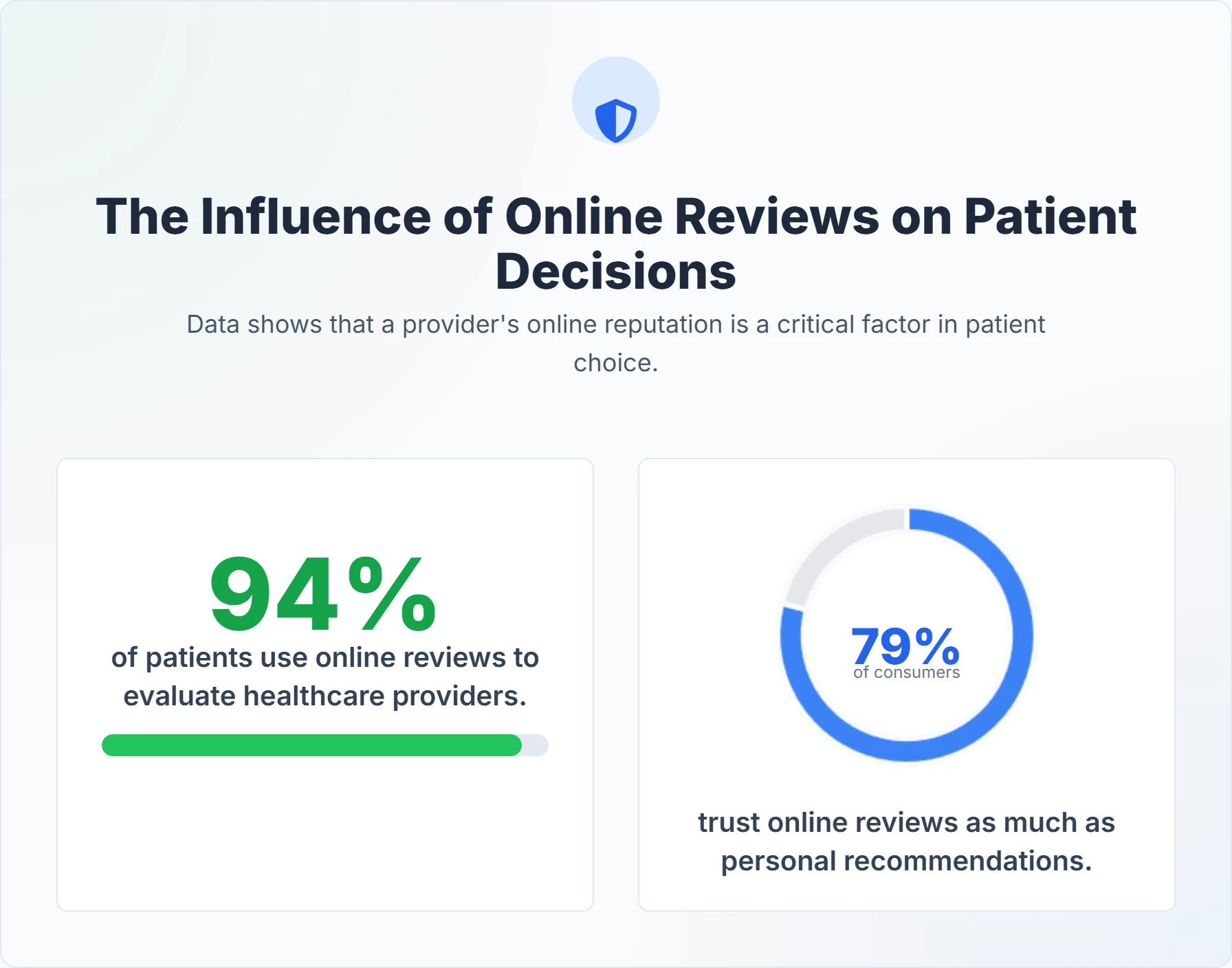
The influence of reviews extends beyond algorithms to human psychology. In healthcare, uncertainty is a major friction point. Patients are often anxious about their health and the financial cost of care. Reviews function as "social proof," alleviating anxiety by validating the experiences of others.
- Trust and Credibility: A study by Software Advice found that 71% of patients use online reviews as the very first step in finding a new doctor. Positive sentiments build immediate credibility.
- Patient Decision-Making: Even with a referral from a primary care physician, patients often verify the specialist online. A lack of reviews—or a pattern of negative feedback—can cause a patient to ignore a direct referral.
- Visibility in Local Search: Google explicitly states that "high-quality, positive reviews from your customers can improve your business visibility." It is one of the few confirmed ranking factors for local SEO.
- Valuable Feedback for Improvement: Beyond marketing, reviews are operational data points. They highlight wait time issues, front-desk friction, or bedside manner concerns that management might otherwise miss.
Why is Healthcare Reviews SEO Crucial for Your Practice's Success?
Integrating review management into your SEO strategy changes the trajectory of your practice's growth. Ignoring this channel allows competitors to define the market standard while your practice remains invisible or, worse, defined by a handful of unaddressed complaints.
The benefits of a proactive approach are measurable and compounding:
Table 1: Benefits of Robust Healthcare Reviews SEO
| Benefit | Description | Impact on Practice |
|---|---|---|
| Improved Local SEO | Positive reviews, especially on Google Business Profile (formerly GMB), are weighted heavily in the local search algorithm. They signal prominence and activity. | More appearances in the "Local Pack" and Google Maps, leading to increased discoverability for high-intent searches. |
| Enhanced Online Reputation | A consistent stream of positive reviews creates a "moat" around your brand, making it difficult for a single negative review to damage your standing. | Higher conversion rates from searchers to booked appointments; patients feel safer choosing you. |
| Increased Patient Acquisition | Practices with 4.5+ star ratings see significantly higher engagement than those with 3.5 stars or fewer. It is often the deciding factor between two similar clinics. | Direct revenue growth through a lower cost-per-acquisition (CPA) for new patients. |
| Better Click-Through Rates (CTR) | Star ratings displayed in search results (Rich Snippets) draw the eye. A listing with gold stars stands out against text-only competitors. | More traffic to your website and profile even if you aren't in the #1 spot. Higher CTR also signals relevance to Google, further boosting rankings. |
| Competitive Advantage | Many medical practices still neglect review management. A proactive strategy allows you to dominate the local digital shelf space before they catch up. | Establishes market leadership. You become the "default" choice in your geographic area. |
| Valuable Patient Insights | Review text frequently contains keywords like "ACL repair," "invisalign," or "pediatric care," which helps rank for specific service queries. | Helps you understand which services are most valued and improves rankings for "long-tail" service keywords. |
| Future-Proofing for AI Search | AI engines like ChatGPT and Google Gemini read reviews to synthesize answers. They look for consensus in user feedback to recommend providers. | Ensures your practice is recommended when patients ask AI assistants for "the best cardiologist near me." |
How Do Online Reviews Impact Your SEO? Decoding the Algorithm
Search algorithms are sophisticated, but their goal regarding reviews is simple: deliver the most trustworthy and relevant result to the user. Understanding the specific signals Google analyzes can help you tailor your strategy. For a broader look at local optimization, consider our guide on healthcare local SEO.
- Review Quantity: Volume matters. A practice with 200 reviews is statistically more reliable than a practice with 5 reviews. High volume validates the star rating.
- Review Quality/Star Rating: The average rating acts as a filter. Users (and voice search devices) often filter results to show only businesses with "4 stars and up." Dropping below 4.0 can cut your visibility by half.
- Review Recency: A 5-star review from three years ago carries far less weight than a 4-star review from last week. Search engines prioritize freshness because operational quality can change over time. Consistent acquisition is better than a one-time burst.
- Review Diversity: While Google is king, reviews on Healthgrades, Vitals, WebMD, and Yelp validate your entity's authority across the web. This cross-platform consistency strengthens your "Knowledge Graph" entry.
- Keyword Prominence: When patients write, "Dr. Smith fixed my sciatica immediately," Google associates your profile with the keyword "sciatica." This is semantic gold. You cannot force this, but you can encourage detailed feedback.
- Sentiment Analysis: Google's Natural Language Processing (NLP) reads the text of reviews, not just the stars. It can detect attributes like "cleanliness," "wait times," and "friendliness." Overwhelmingly positive sentiment on specific attributes can win you "Justifications" in search results (e.g., a snippet saying "People mention: friendly staff").
- Response Rate: An active owner response signals to Google that the listing is managed and the business cares about its customers. This engagement is a confirmed positive signal.
Key Strategies for Healthcare Reviews SEO: A Step-by-Step Guide
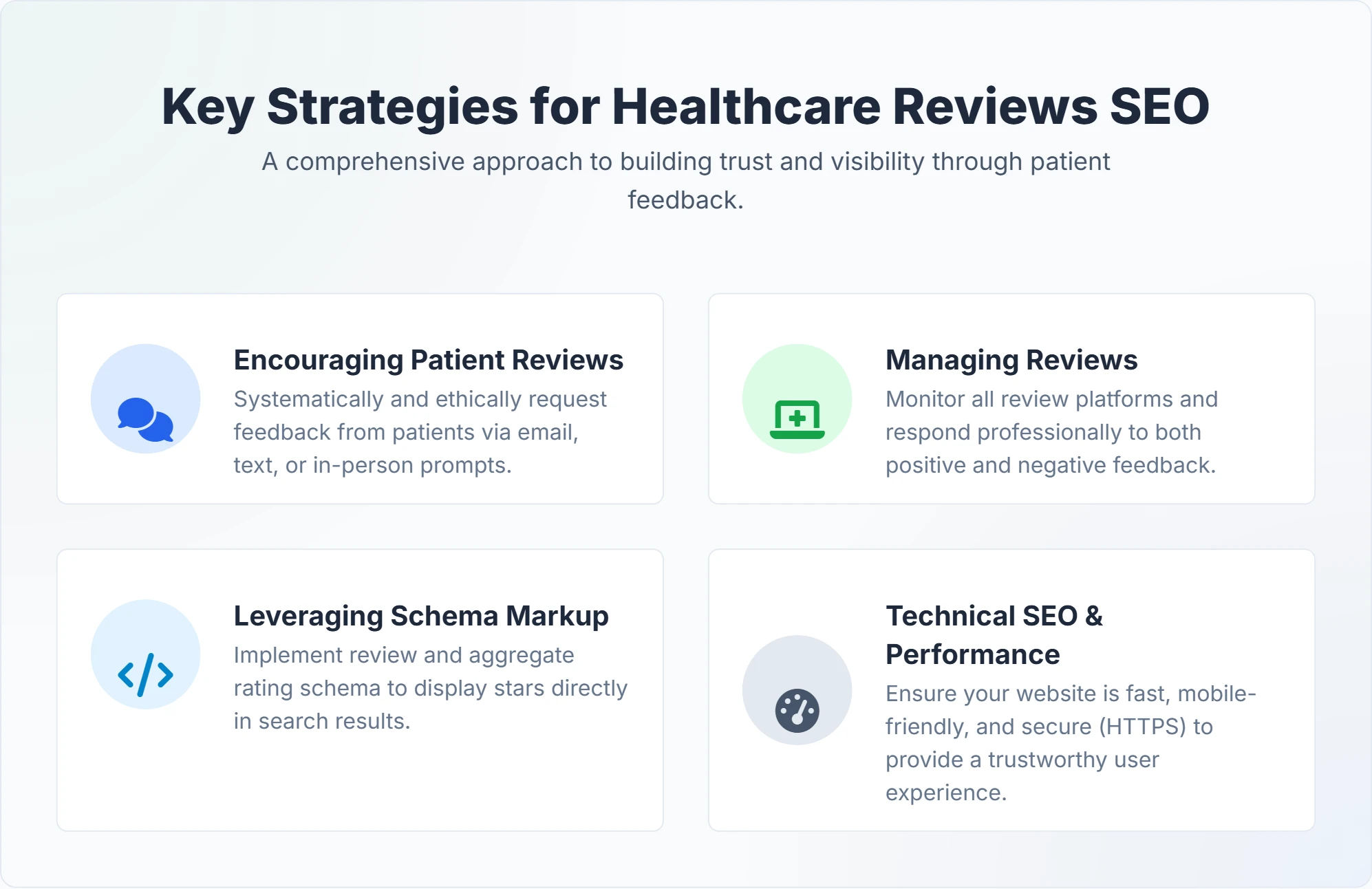
Building a review portfolio requires a blend of operational discipline and digital strategy.
1. Encouraging Patient Reviews: How to Get More Feedback
The biggest hurdle is silence. Most satisfied patients simply forget to leave a review, while unhappy ones are highly motivated. You must bridge this gap by reducing friction.
- The "Ask" Methodology: Train staff to ask at the moment of peak satisfaction—usually at checkout or after a successful follow-up. A script as simple as, "We're so glad you're feeling better! If you have a moment, sharing your experience on Google helps other patients find us," is highly effective.
- Automated SMS/Email Workflows: Integrate your Electronic Health Record (EHR) or CRM with review management software. Send a text message 1-2 hours after the appointment. SMS has a 98% open rate compared to email's 20%, making it far superior for review requests.
- QR Codes in the Office: Place QR codes in exam rooms and the waiting area. Label them clearly: "Scan to share your feedback."
- Website Integration: Add a "Leave a Review" button to your website footer or "Patient Resources" page. Ensure this link goes directly to the review submission form, not just your profile.
- Avoid "Review Gating": Never ask a patient if they had a good experience before asking for a review (i.e., sending happy patients to Google and unhappy ones to an internal form). Google penalizes this practice heavily. Ask everyone, or ask a random sampling, but do not gate.
2. Managing Reviews: Responding with Professionalism and HIPAA Compliance
Responding to reviews is public relations in real-time. In healthcare, this is complicated by HIPAA (Health Insurance Portability and Accountability Act). A wrong step here can lead to fines, not just bad SEO.
The Golden Rule: Never confirm the reviewer is a patient. Even if they write, "I saw Dr. Jones for my hip surgery on Tuesday," you cannot reply, "Glad your hip is healing!" That confirms their patient status and medical condition.
Safe Response Templates:
- Positive: "Thank you for your kind words and 5-star rating! We appreciate your feedback and look forward to serving our community."
- Negative: "Thank you for your feedback. We take all comments seriously and strive to provide excellent care. Please contact our office manager directly at [Phone Number] so we can discuss this matter privately."
Why this works: It acknowledges the review (good for SEO), shows you care (good for prospective patients), but reveals nothing (good for HIPAA).
Table 2: Key Elements of an Effective Review Management Strategy
| Element | Description | Why It Matters (HIPAA Compliance) |
|---|---|---|
| Acknowledge & Thank | Start by thanking the reviewer for their feedback, whether positive or negative. | Shows appreciation and professionalism without revealing protected health information (PHI). |
| Express Empathy | For negative reviews, acknowledge their frustration or disappointment. "We're sorry to hear your experience did not meet your expectations." | Demonstrates care and understanding. Crucially, do not confirm they are a patient or discuss any specific treatment or appointment details. This is a major HIPAA pitfall. |
| General Commitment | Reiterate your commitment to providing high-quality care or patient satisfaction. "We strive to make every patient's visit as comfortable as possible." | Reinforces your practice's values publicly without referencing a specific patient case. |
| Call to Action (Offline) | For negative feedback, invite them to contact your office directly to resolve the issue privately. "Please give us a call at [phone number] so we can learn more." | This is essential for HIPAA compliance. Moving the conversation offline prevents accidental disclosure of PHI in a public forum. Never ask patients to take a review down publicly. |
| No Disclosure of PHI | Crucially, never disclose any patient health information (PHI) in a public response. This includes confirming they are a patient, their name, diagnosis, treatment, or appointment details, even if the patient themselves has mentioned it. | This is the most critical aspect of HIPAA compliance for online reviews. A single mistake can lead to significant fines. Your practice policies should explicitly address this. |
| Identify & Report Fake Reviews | If a review is clearly fake, spam, or violates the platform's terms of service, report it to the review site. | Helps maintain the integrity of your online reputation. However, respond first if possible, as flagging can take time, and a professional response should be visible. |
3. Leveraging Schema Markup for Reviews: Making Your Reviews Shine
Schema markup is code (vocabulary) that helps search engines understand the content of your page. For healthcare, specific schema types can trigger "Rich Snippets"—those gold stars you see in organic search results (not just the map pack).
Implementing AggregateRating schema on your location pages or provider profiles allows Google to display your rating directly in the search result snippet. This can increase CTR by up to 30%.
Identifying and implementing the correct schema markup can be technical. Tools like the Digispot AI free community Chrome extension can be incredibly helpful here. It allows you to audit any webpage in your browser, detect existing schema markup, and even visualize how your rich snippets, including those for reviews, might appear in search results. This visualization feature is a 'magic keyword' in itself, showing you exactly how your efforts translate into enhanced search visibility.
Use the free Schema Markup Generator to create valid structured data in minutes.
Table 3: Essential Schema Markup Types for Healthcare Reviews SEO
| Schema Type | Description | Example Use Case |
|---|---|---|
Review | Marks up a single patient review, including the reviewer's name, rating, and review text. | On a dedicated patient testimonial page, each individual testimonial can be marked up with Review schema. |
AggregateRating | Displays an average rating and the total number of reviews for a specific entity (e.g., your practice, a doctor, or a service). | On your practice's homepage or a doctor's profile page, AggregateRating can show the overall star rating derived from multiple patient reviews. This is what generates the stars in search results. |
MedicalOrganization | A broad schema type for healthcare facilities. Can be nested with AggregateRating to show reviews for the entire organization. | The main page for your clinic could use MedicalOrganization schema, and within that, you'd nest the AggregateRating for overall patient satisfaction. |
Physician | Specific schema for individual doctors. Crucial for doctor profile pages. Can be nested with AggregateRating for a doctor's individual reviews. | Dr. Smith's profile page would use Physician schema, containing details like specialty, contact info, and their individual AggregateRating from patient reviews. |
LocalBusiness | Used for any physical business with a local address. Often combined with MedicalOrganization or Physician to provide full local details and reviews. | For a local clinic, this schema helps search engines understand its physical location, hours, and contact details, and can include AggregateRating for local search visibility. |
FAQPage | If you have a Frequently Asked Questions section related to reviews (e.g., "How do I leave a review?"), marking it up with FAQPage schema can generate rich results in search, answering common patient queries directly in the SERP. | A Q&A section on your "Patient Resources" page could explain the review process, and using FAQPage schema could make these questions and answers appear as expandable snippets in search, further enhancing visibility and user engagement. |
Service | Describes a specific service offered (e.g., "Orthopedic Surgery"). Can include nested Review or AggregateRating schema to show feedback on that particular service. | A page dedicated to "Pediatric Cardiology" services could use Service schema, and within it, nest an AggregateRating to show reviews specific to that service. |
4. Technical SEO for Review Pages and Website Performance
Even the best reviews won't help if your website is technically flawed. Review widgets (plugins that display reviews on your site) are notorious for slowing down page load times. This hurts your Core Web Vitals, a critical ranking factor.
- Load Speed: Ensure your review widget loads asynchronously (after the main content) so it doesn't block the page from rendering. Slow pages lead to high bounce rates, which negatively impacts rankings.
- Mobile Friendliness: Most patients search on mobile. If your review page is not responsive, or if the "Leave a Review" button is hard to click on a phone, you are losing conversions.
- Indexability: Ensure your dedicated "Testimonials" or "Reviews" page is indexable by Google. Check your
robots.txtfile and meta tags to ensure you haven't accidentally blocked it. - Internal Linking: Link to your reviews page from your homepage and service pages. This helps distribute authority throughout your site. For more on this, read our guide on strategic internal linking.
Get instant SEO insights on any page with our free Chrome extension to verify if your review widgets are impacting performance.
Common Challenges in Healthcare Reviews SEO and How to Overcome Them
Managing reputation in a regulated industry is not without hurdles. Here is how to navigate common pitfalls.
Challenge 1: Getting Enough Reviews
The Issue: You have hundreds of happy patients, but only three reviews (and one is from 2019). The Fix: You need volume and velocity. Operationalize the request. If you see 20 patients a day, aiming for a 5% conversion rate on review requests gets you one new review daily. That’s ~250 reviews a year—enough to dominate most local markets. Use SMS automation; it is the single most effective tool for volume.
Challenge 2: Dealing with Negative Reviews
The Issue: A bad review feels like a punch in the gut. It can feel unfair, especially if the patient is unreasonable or confused about billing. The Fix: Take a breath. Do not reply immediately with emotion. Follow the "Offline" protocol. Remember, your response is not really for the angry patient—it is for the next patient who is reading the reviews to see how you handle conflict. A polite, professional response to a rude review often makes the practice look better than the reviewer.
Challenge 3: Maintaining HIPAA Compliance
The Issue: The urge to defend your medical reputation can lead to oversharing. The Fix: Strict adherence to the "no PHI disclosure" rule is paramount. Train all staff on HIPAA regulations concerning online reviews. Develop clear policies for online interactions. Always err on the side of caution. When in doubt, offer to move the discussion offline. Never reference the treatment, the visit date, or even the fact that they are a patient.
Challenge 4: Technical Implementation of SEO and Schema Markup
The Issue: JSON-LD code breaks easily. A missing comma can invalidate your schema, meaning no star ratings in search results. The Fix: Use validation tools. The Digispot AI free community Chrome extension offers immediate value by helping you quickly audit a page's schema markup and other technical SEO aspects. For more in-depth, scalable solutions, consider leveraging a platform designed for this. A tool like Digispot AI cloud platform can automate many technical SEO best practices, including schema deployment, detection, and visualization across your entire site, making advanced optimization accessible and manageable without deep technical expertise.
Measuring Success in Healthcare Reviews SEO
You cannot manage what you do not measure. To justify the investment in review management, track these KPIs using tools like Google Business Profile Insights and Google Analytics 4 (GA4).
- Average Star Rating: Track this monthly. A dip below 4.3 is a red flag for operations.
- Review Velocity: Are you getting consistent reviews, or did you stop asking? Graphs should show a steady upward trend.
- Local Pack Ranking: Use a rank tracker to see where you rank for "keyword + near me." Improvements here correlate directly with review volume and recency.
- Website Traffic from Local Search: In GA4, filter for organic traffic landing on location pages.
- Conversion Actions: Track "Get Directions," "Phone Calls," and "Website Clicks" from your Google Business Profile. These are high-intent actions often driven by review scores.
- Sentiment Trends: Analyzing the general sentiment of your reviews over time can reveal overall patient satisfaction and areas of concern. Are people consistently complaining about the "front desk" or "billing"? This is actionable business intelligence.
For a holistic view of your review performance and its direct impact on overall website traffic and visibility, platforms that integrate with tools like Google Search Console and Google Analytics, such as Digispot AI, are invaluable. They provide a centralized dashboard to track these metrics, helping you understand how your review strategy is contributing to your business outcomes like "increase in traffic and business leads".
The Future of Healthcare Reviews SEO with AI Search Engines
Search is evolving from "blue links" to AI-generated answers. Platforms like Google's AI Overviews (formerly SGE), ChatGPT, and Perplexity don't just list websites—they synthesize information.
- AI's Interpretation of Reviews: AI reads the content of reviews to determine facts. If ten reviews say, "Dr. Lee is great with anxious kids," the AI learns that "Dr. Lee specializes in pediatric anxiety" and will recommend her for that specific query.
- The Consensus Model: AI looks for patterns. It trusts information that appears consistently across your website, your GMB profile, and third-party review sites. Inconsistent data confuses the AI.
- Preparing for Evolving Search:
- Encourage Specificity: Ask patients to mention the specific service (if they are comfortable) in their review. "The knee replacement recovery was fast" is better for AI than "Great job."
- Audit Your Entity: Ensure your Name, Address, and Phone (NAP) data is identical everywhere.
- Implement Robust Schema: Give the AI structured data it can easily ingest.
- Focus on E-E-A-T: Reviews are the external validation of your expertise.
For a deeper dive into how AI is changing optimization, read our article on building an SEO strategy for the AI era.
How Digispot AI Can Elevate Your Healthcare Reviews SEO Strategy
Navigating the complexities of healthcare reviews SEO and adapting to the evolving search landscape, particularly with AI, can be challenging for busy healthcare practices. This is where a specialized AI SEO platform like Digispot AI can provide significant advantages. It consolidates many essential SEO functions, offering a comprehensive and user-friendly solution designed for accuracy and scale.
Digispot AI is an AI SEO platform which helps business websites rank better in Google and other AI search engines. For healthcare providers, this means a systematic approach to ensuring your valuable patient reviews contribute optimally to your online visibility.
Here's how Digispot AI helps, without the hard sell, by integrating its capabilities as practical solutions:
-
Comprehensive Website Auditing (Mobile & Desktop): To truly understand your starting point and identify any technical hurdles, Digispot AI helps by auditing websites in both mobile and desktop modes. It can pinpoint issues that might prevent your review pages from loading quickly or appearing correctly on mobile devices, or problems with how search engines crawl and index your review content. This helps to detect issues and provides actionable insights to help solve them, ensuring your website is technically sound for review visibility. Digispot AI can help you identify and fix these issues automatically with AI-powered audits analyzing 300+ ranking factors.
-
Seamless Integration with Google Search Console & Google Analytics: Understanding the impact of your review management efforts is crucial. Digispot AI platform also integrates with Google Search Console and Google Analytics to help you track and improve performance. This means you can see directly how your improved review profile translates into increased organic traffic, better local search visibility, and patient engagement, giving you a clear picture of your ROI.
-
Opportunity Finder: To stay ahead, you need to know where to focus your efforts. Digispot AI also offers an opportunity finder which helps you to spot opportunities. For example, it can analyze competitor review strategies, identify untapped local review platforms, or highlight keywords patients use when searching for practices with specific types of reviews. This "magic keyword" of "opportunity" means you're always looking forward, not just reacting.
-
Content Studio for SEO-Optimized Content: Crafting engaging and SEO-friendly content, even for review responses, can be time-consuming. Digispot AI's content studio which helps you to spot opportunity and generate SEO optimized content using AI agents. This can assist in drafting HIPAA-compliant responses to various types of reviews, or even generating blog content that naturally encourages patient testimonials and feedback, ensuring your messaging is always aligned with SEO best practices without sounding robotic. To check if your content is optimized, try the free On-Page SEO Analysis tool.
-
Analysis of 300+ Ranking Factors: Reviews are just one piece of the puzzle. For comprehensive online success, you need a holistic approach. Digispot AI understands and helps you rank better by analyzing site for 300+ ranking factors including content, tech SEO, local SEO and page performances. This deep analysis ensures that all aspects of your online presence—from the content of your service pages to your local business listings—are optimized, allowing your positive reviews to have maximum impact across the entire search ecosystem. To avoid common pitfalls, review our checklist of common SEO mistakes.
-
Free Community Chrome Extension with Schema Markup Support: For immediate insights and empowering individual team members, there's a powerful tool available. Digispot AI also offers a free community chrome extension which helps you audit your website page in your browser - powered by popular LLM models. This extension is particularly valuable because it also supports schema markup, audit, detection and visualization. Imagine being able to instantly see if your review schema is correctly implemented or how those rich snippets will look in search results directly from your browser. This instant feedback loop is incredibly helpful for ensuring your structured data is error-free and performing as intended, making advanced SEO tactics accessible to everyone.
The Digispot AI cloud platform brings in all SEO best practices in an automated and user friendly model for you to operate at scale with accuracy. This means that instead of manually sifting through data or struggling with complex technical implementations, healthcare practices can leverage AI to streamline their review management and overall SEO strategy, leading to tangible business outcomes.
Start Improving Your Online Reputation Today
In a patient-centric, digitally-driven world, online reviews are far more than just anecdotal feedback; they are a critical component of your healthcare practice's SEO, reputation, and ultimately, its growth. Understanding what healthcare reviews SEO entails, why it's so vital, and how to implement effective strategies can transform your online visibility.
By proactively encouraging and managing patient reviews, responding thoughtfully (and HIPAA-compliantly), and leveraging technical SEO elements like schema markup, you can build a powerful online presence that attracts new patients and strengthens trust. The "magic keywords" of visibility, trust, and patient acquisition are directly tied to how effectively you manage your online reputation.
As AI continues to shape the future of search, platforms like Digispot AI offer a forward-thinking solution, providing the tools to audit, optimize, and scale your healthcare reviews SEO efforts with accuracy. By embracing these best practices and intelligent solutions, your practice can not only improve its rankings but also solidify its position as a trusted and leading healthcare provider in your community. The journey to better healthcare reviews SEO is an ongoing one, but with the right strategies and tools, the path to improved business visibility, increased traffic, and more patient leads is clear.
Ready to improve your search visibility? Try Digispot AI for comprehensive website audits and actionable recommendations.
References
- Local SEO for Medical Professionals: How is SEO used in healthcare
- Local SEO Ranking Factors for Healthcare | Cardinal Digital Marketing
- How Online Reviews Affect SEO for Doctors - Digitalis Medical
- How Local SEO and Review Management Go Hand-in-Hand for Healthcare - RepuGen
- Online Reviews in Healthcare: Boosting Practice Growth and Building Trust - Valet Health™
- Online Review Statistics: Why They Matter - LEVO Health
- Patients Trust Online Reviews as Much as Doctor Recommendations | by AMA - Medium
- Digispot AI - FREE On Page SEO Audit Tool
- Digispot AI - FREE Chrome Extension for SEO Insights
Audit any page in seconds
300+ SEO checks including Core Web Vitals, schema markup, meta tags, and AI readiness — trusted by 1000+ SEO experts and marketers.
Frequently Asked Questions
Here are some of our most commonly asked questions. If you need more help, feel free to reach out to us.
Written by
Maya Krishnan
Digital growth expert
Maya is a seasoned expert in web development, SEO, and digital strategy, dedicated to helping businesses achieve sustainable growth online. With a blend of technical expertise and strategic insight, she specializes in creating optimized web solutions, enhancing user experiences, and driving data-driven results. A trusted voice in the industry, Maya simplifies complex digital concepts through her writing, empowering readers with actionable strategies to thrive in the ever-evolving digital landscape.