Healthcare Directory SEO: Medical Listing Optimization
Optimize healthcare directory listings for SEO impact. Improve medical practice visibility, patient acquisition, and local rankings via citations.
 Maya Krishnan
When a patient realizes they need medical attention, they don't reach for a dusty phone book. They turn to their smartphone. Whether they are researching vague symptoms or looking for a specialist with five-star ratings, the search bar is the new front door to your medical practice. This fundamental shift in patient behavior makes Healthcare Directory SEO not just a marketing tactic, but a critical operational necessity. It serves as the digital bridge connecting your clinical expertise with the patients who require your care.
This comprehensive guide will walk you through the mechanics of healthcare directory SEO, explaining why it is vital for your practice's sustainability, and revealing how you can master it to dominate local search results. We will also explore how leveraging advanced tools can automate this complex process, ensuring your practice maintains a competitive edge in an increasingly crowded digital landscape.
What is Healthcare Directory SEO?
At its core, Healthcare Directory SEO involves the systematic optimization of your medical practice's profiles across a network of online directories, citation sites, and healthcare-specific platforms. While general search engine optimization focuses on your main website, directory SEO focuses on your off-site presence—the digital footprints that lead patients to you.
Think of online directories as modern, interactive data hubs. They are highly specialized databases that communicate directly with search engines like Google, Bing, and emerging AI platforms like ChatGPT and Perplexity. These directories—ranging from the massive Google Business Profile to niche sites like Vitals or Zocdoc—act as validation sources. Search engines cross-reference the data on these sites to verify your practice exists, is operational, and is trustworthy.
The Role of Directories in the Age of AI
We are entering the era of Answer Engine Optimization (AEO). When a user asks a voice assistant, "Who is the best cardiologist near me accepting Blue Cross?", the AI doesn't just scan websites. It aggregates data from trusted directories to formulate an answer. If your directory listings are incomplete, inconsistent, or missing, you effectively become invisible to these algorithms.
Why is this important? Because search visibility is zero-sum. When a prospective patient searches for "pediatrician near me," search engines must decide which practices to display in the coveted "Local Pack" (the map section at the top of results). They rely on the consistency and authority of your directory listings to make this decision. A fractured directory presence signals risk to the search engine, while a unified, optimized presence signals authority.
The Undeniable Benefits of Optimizing Your Healthcare Directory Listings
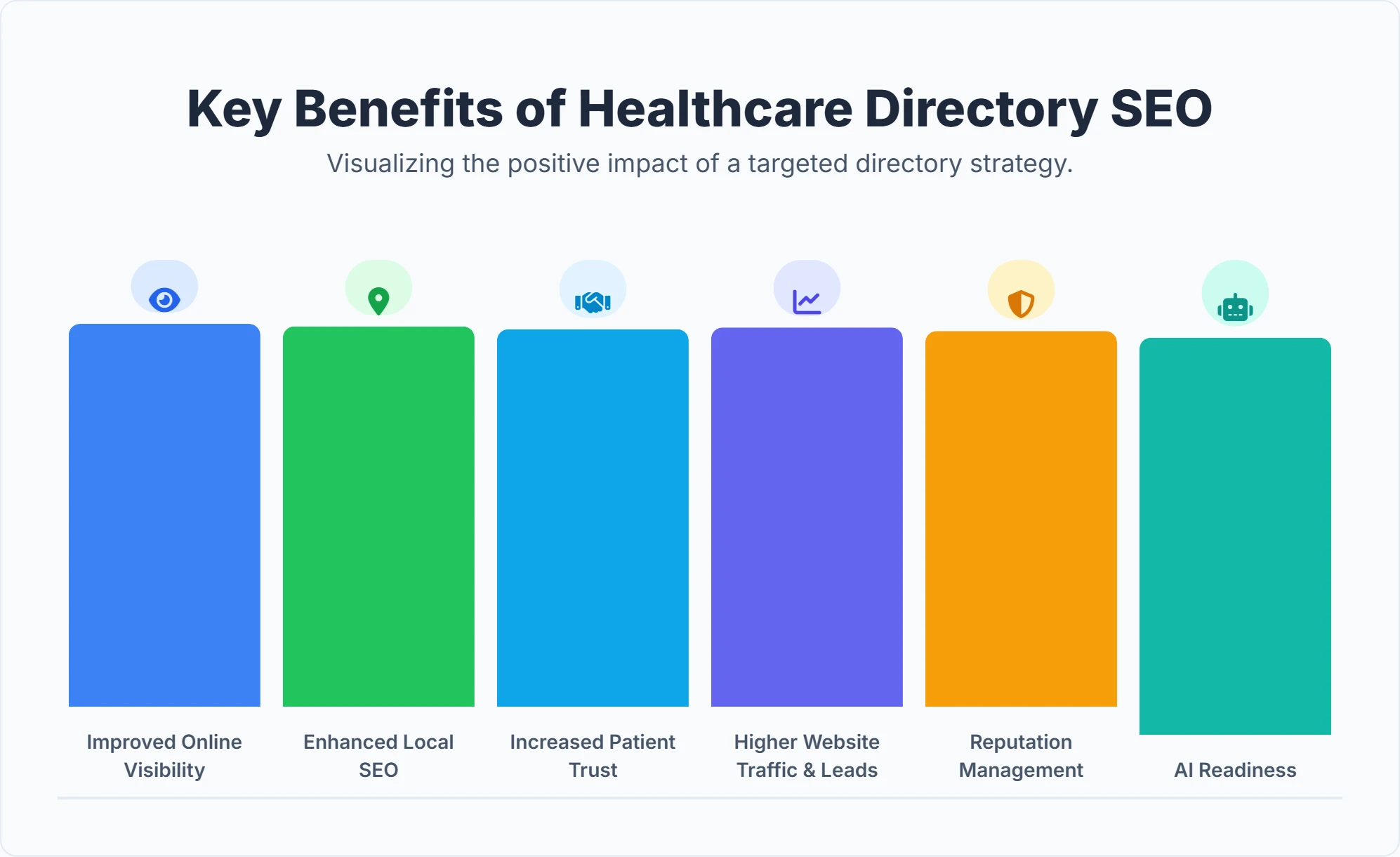
Investing resources into healthcare directory SEO yields compounding returns. It is not merely about "showing up"; it is about controlling the narrative of your practice online, building a fortress of social proof, and driving high-intent traffic.
Here is a detailed breakdown of the strategic advantages:
| Benefit Category | What It Means for Your Practice |
|---|---|
| Improved Online Visibility | Accurate listings across reputable directories create multiple entry points for patients. You increase your "digital surface area," maximizing the chances of appearing in search results for varied queries, from brand name searches to symptom-based inquiries. |
| Enhanced Local SEO Performance | Directories are the backbone of local search. Consistent citations (mentions of your Name, Address, Phone) reinforce your geographical relevance. This is the primary driver for ranking in the "Map Pack," which captures the majority of local clicks. |
| Increased Patient Trust & Credibility | Patients view established directories like Healthgrades as unbiased third-party validators. A complete profile with verified credentials and active management signals a legitimate, high-quality medical practice. |
| Higher Website Traffic & Leads | Optimized directory profiles function as referral engines. By providing direct, trackable links to your appointment booking pages, you drive qualified traffic—users who have already vetted your profile and are ready to convert. |
| Better Online Reputation Management | Directories are the battleground for reputation. They are where reviews live. actively managing these platforms allows you to mitigate negative feedback and amplify positive patient stories, directly influencing the decision-making process of future patients. |
| AI & Voice Search Readiness | AI agents rely on structured data. Directories provide formatted, machine-readable facts (hours, location, specialty) that AI tools ingest. Optimization here ensures your practice is the answer provided by Siri, Alexa, and Google Gemini. |
How to Achieve Stellar Healthcare Directory SEO: Your Step-by-Step Guide
Optimizing your healthcare directory listings can feel like a logistical marathon. However, by breaking it down into a structured workflow, you can build a defensible online presence that competitors will struggle to match.
1. Claim and Verify Your Listings
What to do: The foundation of directory SEO is ownership. You cannot optimize what you do not control. Begin by auditing major platforms to find existing, auto-generated listings for your practice or individual doctors.
- Google Business Profile (GBP): The most critical asset. Verification may require a postcard, video call, or phone call.
- Bing Places: often overlooked but captures a significant demographic.
- Vertical Directories: Healthgrades, Vitals, WebMD, Sharecare, and Zocdoc.
How it helps: Unclaimed listings are vulnerable to user edits, which can introduce errors like "permanently closed" status or incorrect hours. Claiming them locks the data and gives you the authority to respond to reviews. For multi-practitioner clinics, ensure you claim both the practice listing and the individual practitioner listings to maximize visibility.
2. Ensure NAP Consistency: The Golden Rule of Local SEO
What to do: NAP stands for Name, Address, and Phone number. Your mission is to ensure this triad is identical across the entire internet.
- Standardize Formatting: Decide on "St." vs. "Street", "Ste 100" vs. "Suite 100". Stick to one format rigidly.
- Audit Aggregators: Data aggregators (like Foursquare, Data Axle, Neustar) feed smaller directories. If they have bad data, it spreads like a virus.
- Track Changes: Monitor your listings regularly, as third-party users or AI updates can sometimes revert changes.
How it helps: Consistency acts as a "trust score" for search engines. If Google sees three different phone numbers for your clinic, it lowers your trust score, assuming the data is unreliable. This drops your ranking. High consistency reinforces your location authority, essential for healthcare local SEO success.
3. Optimize Your Profile Information Thoroughly
What to do: A sparse profile is a wasted opportunity. Treat every directory listing as a mini-website.
- Business Name: Use your legal registered name. Do not keyword stuff (e.g., avoid "Smith Dental - Best Dentist in Chicago" unless that is the legal name).
- Categories: This is crucial. Choose the primary category carefully (e.g., "Orthodontist" vs. "Dentist"). Add secondary categories to cover all services.
- Detailed Descriptions: Write unique descriptions for major directories. Don't copy-paste. Include high-value keywords naturally.
- Attributes: Check all applicable boxes: "Wheelchair accessible," "Gender-neutral restrooms," "LGBTQ+ friendly," "Accepting new patients."
- Services & Insurance: List specific procedures (e.g., "Root Canal," "Invisalign") and accepted insurance providers. This aids search intent optimization when users filter by insurance.
- Visuals: Upload professional headshots, facility photos (waiting room, exterior, equipment), and even welcome videos.
How it helps: Rich profiles engage users longer, sending positive behavioral signals to search engines. Specific attributes (like "women-led") can even earn you special badges on platforms like Google. Listings with photos receive 42% more requests for directions and 35% more clicks to their websites.
4. Cultivate and Manage Patient Reviews
What to do: Develop a proactive strategy for review generation and management.
- Solicitation: Use automated SMS or email campaigns post-appointment to request feedback (ensure HIPAA compliance).
- Response Strategy: Reply to every review.
- Positive: "Thank you, [Name], for your kind words. We are glad you had a great experience."
- Negative: "We appreciate your feedback. We are committed to high standards and would like to discuss this offline. Please contact our office manager at..." Crucial: Never confirm the reviewer is a patient or discuss medical details in the reply to avoid HIPAA violations.
How it helps: Review quantity and velocity (how often new ones appear) are major ranking factors. Fresh reviews tell search engines your practice is active and popular. Responding demonstrates excellent customer service, which can influence a prospective patient more than the review itself.
5. Implement Schema Markup (Structured Data)
What to do: Schema is the language of search engines. You must translate your human-readable content into machine-readable code.
- Hierarchy: Use specific types. Use
Physicianfor individual doctors andMedicalClinicorMedicalOrganizationfor the facility. - Properties: define
medicalSpecialty,availableService,address,telephone, andopeningHours. - Aggregation: If you display reviews on your site, use
AggregateRatingschema to potentially show star ratings in organic search results.
How it helps: Medical schema markup eliminates ambiguity. It tells Google explicitly, "This is a cardiologist," preventing you from showing up for "general practitioner" searches. It enables "rich snippets"—visual enhancements in search results like star ratings, pricing, or FAQ dropdowns—which significantly improve click-through rates.
Use the free Schema Markup Generator to create valid JSON-LD code for your practice in minutes.
6. Conduct Keyword Research with Local Intent
What to do: Move beyond generic terms. Understand how patients search in your specific locale.
- Geo-Modifiers: "Dermatologist in [Neighborhood]" vs. "Skin doctor near [Landmark]."
- Symptom Keywords: Patients often search for problems, not solutions. Target "chronic back pain relief" in addition to "chiropractor."
- Long-Tail Queries: "Pediatrician open on Saturdays" or "Urgent care with x-ray."
How it helps: Aligning your directory descriptions and website content with actual user queries ensures you capture high-intent traffic. By mapping keywords to specific listings, you increase relevance for niche searches.
Common Challenges in Healthcare Directory SEO
The path to directory dominance is rarely a straight line. Healthcare providers often encounter unique friction points:
- Duplicate Listings: It is common for a practice to have "ghost" listings created years ago by former staff or scraped by bots. These split your review equity and confuse Google. You must merge or suppress them.
- Practitioner vs. Practice Conflict: In multi-provider clinics, individual doctor listings can sometimes outrank the main practice listing, or vice versa. balancing these requires a strategic internal linking and citation strategy.
- Inconsistent Information: A receptionist might update the hours on Facebook but forget Google. A change in phone systems might leave old numbers floating on Vitals. These minor lapses accumulate into major SEO penalties.
- Algorithm Volatility: Google updates its local search algorithm frequently. What worked in 2023 might be less effective today.
- Technical Barriers: Implementing JSON-LD schema or auditing server-side issues requires technical expertise that most medical professionals do not possess.
How Can Digispot AI Help Your Healthcare Directory SEO Journey?
Managing dozens of directories while treating patients is a recipe for burnout. This is where Digispot AI transforms your workflow. As an advanced all-in-one SEO/AEO platform, Digispot AI automates the heavy lifting, ensuring precision at scale.
What Digispot AI Does for Healthcare Directory SEO:
-
Comprehensive Website & Citation Auditing: Digispot AI crawls your digital ecosystem to identify NAP inconsistencies across the web. It audits your website in both mobile and desktop modes, detecting technical flaws (like broken links or slow load times) that could undermine the authority of your directory landing pages.
-
Automated Issue Resolution: The platform analyzes over 200 ranking factors. If your
MedicalClinicschema is malformed, or if your meta descriptions are missing the right local keywords, Digispot AI flags it and provides specific fix instructions. Digispot AI helps you close the gap between your current status and SEO best practices. -
Local Rank Tracking & GSC Integration: Stop guessing. Digispot AI integrates with Google Search Console and Analytics to show you exactly how many patients are finding you through local search. Monitor your rankings for "near me" keywords and track how directory traffic converts into booked appointments.
-
Content Studio & Opportunity Finder: Need a unique description for your Healthgrades profile? The AI agents within the Content Studio can generate SEO-optimized, HIPAA-conscious descriptions tailored to your specialty. The "Opportunity Finder" scans the market to reveal which local keywords your competitors are missing, giving you a strategic roadmap for growth.
-
Schema Visualization: One of the hardest parts of healthcare SEO is verifying structured data. Digispot AI makes this visual, showing you exactly how search engines "see" your practice's data entities.
Digispot AI's Free Community Chrome Extension: Your Instant SEO Auditor
For practice managers and marketers who need immediate answers, the Digispot AI Free Community Chrome Extension is a game-changer. It brings enterprise-level analysis directly to your browser tab.
What the Free Chrome Extension Offers:
- Instant On-Page Health Check: Navigate to your practice's website or a directory profile page and get an instant score. Identify missing headers, alt text gaps, or meta tag issues in seconds.
- Schema Markup Detector: This is vital for healthcare. Open your "Our Providers" page and run the extension. It will visualize the
Physicianschema, confirming if your doctors' credentials and specialties are correctly coded for Google. If the schema is missing, you know exactly what to fix. - Competitor Analysis: Visit a competitor's directory listing or website. The extension reveals their keyword strategy, heading structure, and schema setup, allowing you to reverse-engineer their success.
Example Use Case: You are updating your Vitals profile. You use the extension to ensure the landing page you are linking to (e.g., "Book Appointment") is fully optimized. The extension alerts you that the page lacks a meta description. You fix it immediately using the Meta Preview tool, ensuring that when users click through, the page performs perfectly in search results.
Get instant SEO insights on any page with our free Chrome extension.
Business Outcomes: What You Gain from Effective Healthcare Directory SEO
The ultimate goal of directory optimization is not just "good SEO"—it is business growth. Here is the tangible ROI you can expect:
- Dominance in Local Search: By aligning NAP data and optimizing profiles, you significantly increase your chances of ranking in the "Local 3-Pack." This prime real estate captures the vast majority of local intent clicks.
- Higher Conversion Rates: Patients who find you through detailed, well-reviewed directory listings are pre-qualified. They trust the platform, they see your social proof, and they are ready to book. This lowers your cost per acquisition (CPA).
- Reduced Reliance on Paid Ads: Organic local visibility is free. As your organic rankings improve, you can scale back on expensive PPC campaigns (Google Ads) for local keywords, improving your overall marketing margin.
- Operational Efficiency: using automated tools like Digispot AI reduces the manual labor of checking listings, allowing your administrative staff to focus on patient experience rather than data entry.
A Table of Key Healthcare Directory SEO Elements and Their Impact
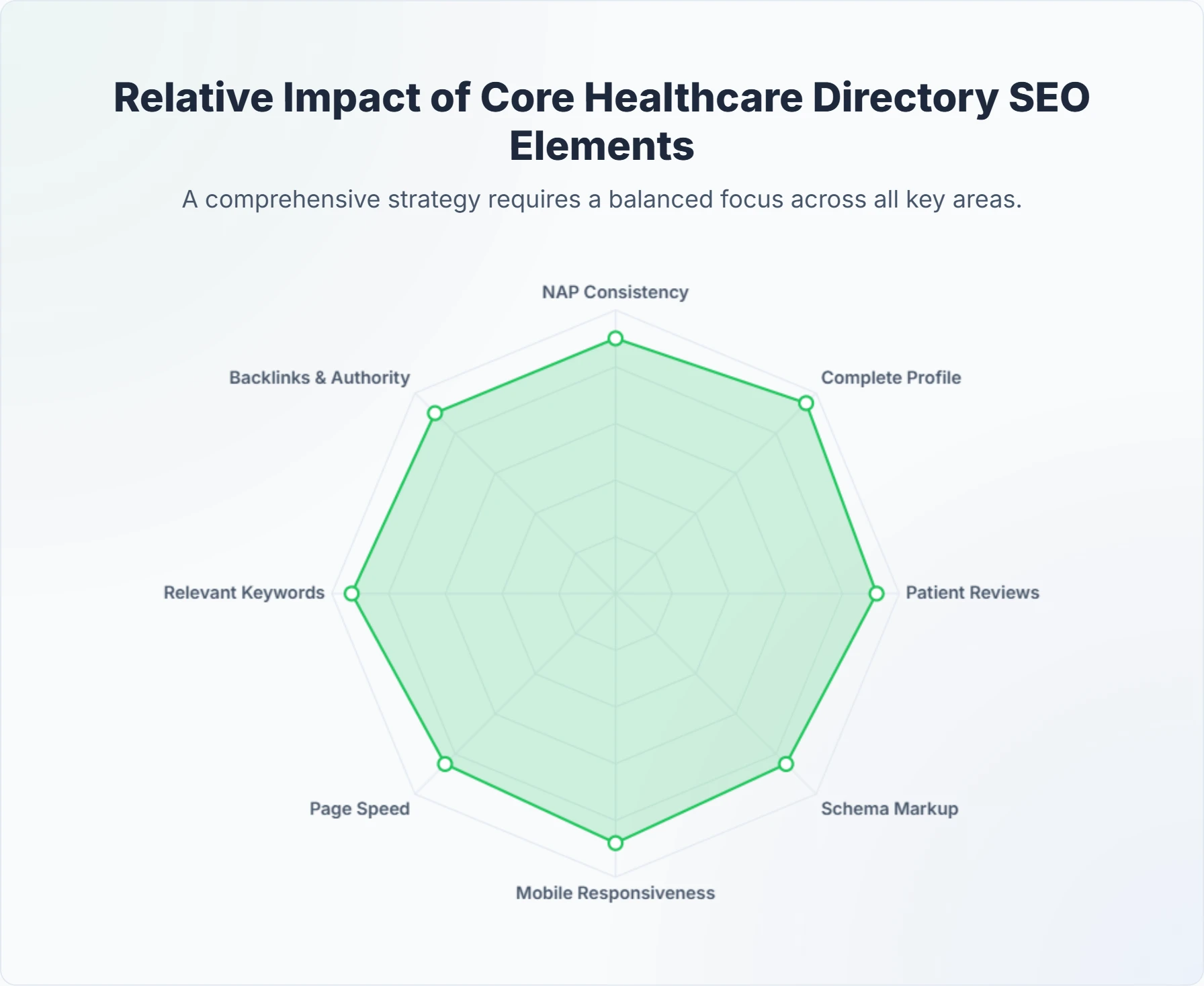
To summarize the ecosystem, the following table illustrates how specific SEO technicalities translate into patient acquisition power:
| SEO Element | Description | Impact on Healthcare Directory SEO |
|---|---|---|
| NAP Consistency | Uniform Name, Address, Phone number across all online platforms. | Critical Trust Signal: It prevents search engines from flagging your practice as unreliable. High consistency correlates directly with higher map rankings and ensures patients don't drive to the wrong location. |
| Complete Profile Information | Detailed data: services, hours, insurance, photos, and credentials. | Conversion Driver: Comprehensive profiles answer patient questions before they even call. Listings with photos and full amenities data (e.g., WiFi, parking) see higher engagement metrics. |
| Patient Reviews & Ratings | Volume, velocity, and sentiment of feedback, plus your responses. | Ranking & Trust Factor: Reviews are the digital word-of-mouth. They are a primary ranking signal for Google. Active management builds a reputation shield against occasional negative feedback. |
| Schema Markup | Code (JSON-LD) marking up MedicalOrganization and Physician entities. | AI & Rich Results: Enables star ratings and hour snippets in search results. It frames your content so AI engines can confidently answer questions about your practice. |
| Mobile Responsiveness | Adaptability of your linked website to smartphones. | User Experience: Since most health searches are mobile, a non-responsive site linked from a directory will cause high bounce rates, hurting your overall domain authority. |
| Page Speed | Load time for your website and directory landing pages. | Retention: Patients in pain or anxiety won't wait for a slow site. Fast load times improve conversion from directory clicks to booked appointments. |
| Relevant Keywords | Strategic terms (e.g., "Urgent Care," "Pediatric Dentist") in descriptions. | Relevance Matching: Ensures you appear for specific service searches, not just brand name searches. It connects patient need with your solution. |
| Backlinks & Authority | Links from reputable healthcare sites and local organizations. | Domain Strength: Citations on high-authority directories act as backlinks, boosting your website's overall authority and helping it rank for competitive medical terms. |
Start Improving Your Practice Visibility Today
The digital patient journey is complex, but your strategy to meet them doesn't have to be. Healthcare directory SEO is the bedrock of modern medical marketing. It bridges the gap between the patient's need and your expertise. In an era where AI and algorithms curate reality, being digitally organized is as important as being clinically excellent.
By systematically claiming your listings, enforcing data consistency, leveraging schema markup, and actively managing your reputation, you build a digital asset that works 24/7 to bring new patients through your doors.
Ready to improve your search visibility? Try Digispot AI for comprehensive website audits, automated citation checks, and actionable recommendations that demystify local SEO. Don't let technical barriers stand between you and the patients who need you—leverage the power of AI to secure your place at the top of the search results.
References
- About Google Business Profile - Google Business Profile Help
- Understand how Google uses schema.org structured data - Google Search Central
- Build web pages that are mobile-friendly - Google Search Central
- Core Web Vitals - Google Search Central
- Google Search Console
- Digispot AI - FREE On Page SEO Audit Tool
- Digispot AI - FREE Chrome Extension for SEO Insights
- Best practices for local SEO - Google Search Central
Audit any page in seconds
300+ SEO checks including Core Web Vitals, schema markup, meta tags, and AI readiness — trusted by 1000+ SEO experts and marketers.
Frequently Asked Questions
Here are some of our most commonly asked questions. If you need more help, feel free to reach out to us.
Written by
Maya Krishnan
Digital growth expert
Maya is a seasoned expert in web development, SEO, and digital strategy, dedicated to helping businesses achieve sustainable growth online. With a blend of technical expertise and strategic insight, she specializes in creating optimized web solutions, enhancing user experiences, and driving data-driven results. A trusted voice in the industry, Maya simplifies complex digital concepts through her writing, empowering readers with actionable strategies to thrive in the ever-evolving digital landscape.