
Medical Schema Markup: Healthcare Structured Data
Implement medical schema markup for healthcare SEO. Add structured data for physicians, hospitals, and medical conditions to earn rich results and build trust.
 Maya Krishnan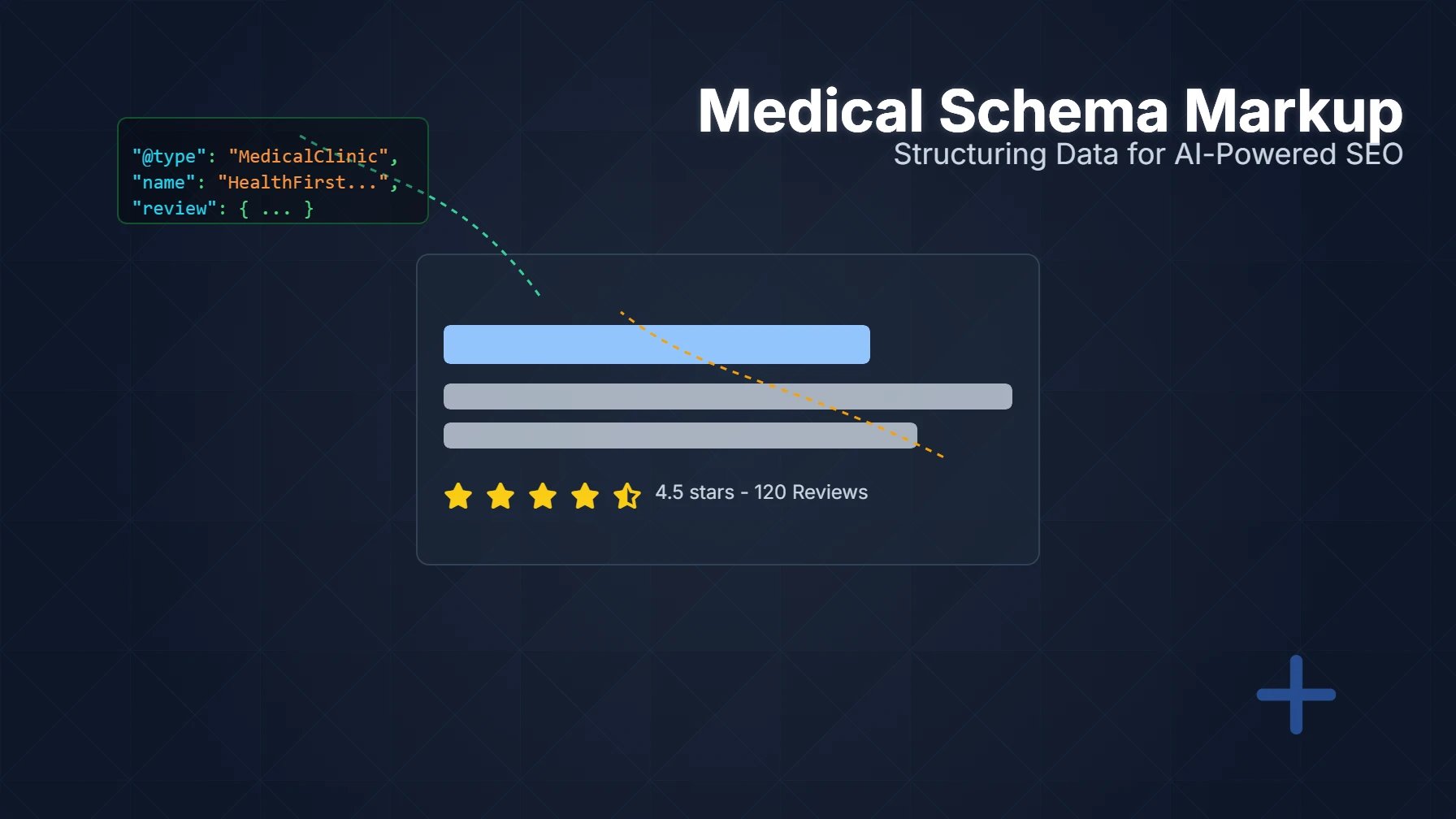
Unlocking digital success for healthcare providers means speaking a language search engines understand. Imagine a patient searching for a specific medical condition or a specialist – they need quick, accurate information. But how does Google, or any AI-powered search engine, truly grasp the nuances of your medical content? The secret often lies in something called medical schema markup, a powerful, yet frequently overlooked, tool that can elevate your website's visibility and connect you with those who need your services most.
This isn't just about showing up in search results; it's about standing out, providing richer information, and building trust. Get ready to discover how medical schema markup acts as your digital translator, guiding search engines through the complexities of your healthcare offerings, and ultimately, bringing better health outcomes to your community.
What Exactly is Medical Schema Markup?
At its core, medical schema markup is a specific type of structured data that you add to your website's HTML. Think of it as a set of standardized labels and definitions that you apply to your content, making it easier for search engines to understand the context and meaning of the information on your pages. While humans can read and interpret text, search engines need a little extra help to categorize and display specialized information accurately.
For example, if your website mentions "Dr. Jane Doe, specializing in Cardiology," a search engine might see those words, but it doesn't inherently understand that "Dr. Jane Doe" is a Physician, "Cardiology" is a MedicalSpecialty, or that she practices at a MedicalOrganization. By using medical schema markup, you explicitly tell search engines: "This is a doctor, here's her specialty, here are her contact details, and here's the hospital she's affiliated with."
This structured data uses a vocabulary developed by Schema.org, a collaborative initiative by Google, Bing, Yahoo!, and Yandex. Specifically for healthcare, there's a comprehensive set of "Medical" types and properties within this vocabulary designed to describe everything from medical conditions and treatments to physicians, hospitals, and clinical trials. For a deeper understanding of how these vocabularies interact with broader SEO strategies, you can explore our guide to advanced schema markup.
This guide focuses on healthcare-specific schema types like Physician, MedicalCondition, and MedicalProcedure; if you need the general foundation first, start with our guide to structured data and schema for SEO.
The vocabulary goes beyond simple definitions. It allows you to create a web of interconnected data. You don't just list a hospital; you define its departments. You don't just name a disease; you outline its symptoms, risk factors, and typical treatments. This creates a "Knowledge Graph" for your own content, allowing search engines to answer complex queries about your healthcare services with confidence.
Why is Medical Schema Markup Indispensable for Healthcare Websites?
Medical schema markup isn't just a technical nicety; it's a strategic imperative for any healthcare provider or organization looking to thrive in the digital age. Its importance stems from its direct impact on how your website is perceived and presented by search engines, leading to a cascade of benefits.
1. Enhanced Visibility and Rich Results
The most immediate and noticeable benefit is the potential for your content to appear as "rich results" or "rich snippets" in search engine results pages (SERPs). Instead of just a blue link and a short description, your listing might display star ratings for a physician, hours of operation for a clinic, accepted insurance plans, or even a direct appointment booking link. These visually appealing and informative snippets stand out significantly, attracting more attention and clicks.
Consider a patient searching for "best cardiologists in [city]." A listing with schema markup might show the doctor's average patient rating, years of experience, and a quick link to their profile, all directly in the search results. This level of detail builds immediate trust and convenience. When users see a 4.8-star rating immediately, the decision-making process is shortened, and your site becomes the obvious choice.
2. Improved Understanding for AI and Voice Search
As search evolves, AI and voice assistants play an increasingly significant role. When someone asks Siri, Alexa, or Google Assistant, "Find a dermatologist near me," or "What are the symptoms of [disease]?", structured data provides the precise answers these systems need. Medical schema markup helps these intelligent agents accurately interpret your content and deliver highly relevant responses, ensuring your practice is found when patients use these modern search methods. It's about optimizing for conversational queries, which are becoming more prevalent.
This is the essence of AEO (Answer Engine Optimization). Platforms like ChatGPT, Perplexity, and Google's AI Overviews rely heavily on structured data to verify facts. Without schema, your content is just unstructured text that an AI might hallucinate or ignore. With schema, you provide a verified data source that AI engines can cite with confidence.
3. Establishing Authority and Trust (E-E-A-T)
Healthcare information is sensitive and critical. Search engines prioritize trustworthy, authoritative sources, especially for "Your Money, Your Life" (YMYL) topics like health. Schema markup helps signal to search engines that your content is credible and relevant. By explicitly labeling physicians, medical organizations, and evidence-based information, you reinforce your authority.
This directly supports Google's E-E-A-T (Experience, Expertise, Authoritativeness, Trustworthiness) guidelines. When you use MedicalCondition schema to cite a recognizingAuthority or link a Physician to their alumniOf (medical school), you are providing machine-readable proof of expertise. This can lead to higher rankings and, more importantly, build greater confidence among potential patients.
4. Better Local SEO Performance
For clinics, hospitals, and individual practitioners, local search is paramount. Medical schema markup, particularly for MedicalOrganization or Physician types, allows you to specify critical local information like address, phone number, operating hours, and geographical service areas. This information feeds directly into Google Maps and local search results, making it much easier for patients in your vicinity to find and contact you.
Combining schema with other healthcare local SEO tactics ensures that when a patient searches for "urgent care near me," your facility appears not just as a name, but as an open, accessible location with verified details.
5. Competitive Advantage
While medical schema markup is gaining traction, many healthcare websites still haven't fully embraced it. Implementing it effectively can give you a significant edge over competitors who are missing out on rich results and enhanced visibility. This advantage can translate directly into increased website traffic, more appointment bookings, and a stronger online presence. It is a "quiet" advantage—your competitors might see you outranking them and not understand why because the optimization is hidden in the code.
6. Streamlined Data Processing for Search Engines
Ultimately, schema markup makes search engines' jobs easier. When they can quickly and accurately understand your content, they are more likely to rank it higher and display it more prominently. It's a win-win: you provide clarity, and they reward you with visibility. By disambiguating terms (e.g., clarifying that "Cold" refers to the virus, not temperature), you prevent irrelevant traffic and attract users specifically looking for medical advice.
How Does Medical Schema Markup Work? A Simple Breakdown
Implementing medical schema markup might sound complex, but the underlying principle is quite straightforward. It involves embedding specific code snippets directly into your website's HTML. These snippets use a structured format, typically JSON-LD (JavaScript Object Notation for Linked Data), which is Google's preferred method.
Let's break down the process with a conceptual example:
Imagine you have a page about a specific physician, Dr. Emily White, who is a pediatrician.
Without Schema Markup (Standard HTML):
<p>Dr. Emily White</p>
<p>Pediatrician</p>
<p>ABC Children's Hospital</p>
<p>123 Main Street, Anytown, USA</p>
<p>Phone: (555) 123-4567</p>
A human can easily read this and understand the details. A search engine can extract keywords, but it doesn't truly grasp the relationships between these pieces of information. It might confuse the hospital address with the doctor's private clinic address if not clearly defined.
With Schema Markup (JSON-LD added to the <head> or <body>):
<script type="application/ld+json">
{
  "@context": "https://schema.org",
  "@type": "Physician",
  "name": "Dr. Emily White",
  "alumniOf": {
    "@type": "EducationalOrganization",
    "name": "University of Medical Excellence"
  },
  "medicalSpecialty": "https://schema.org/Pediatric",
  "address": {
    "@type": "PostalAddress",
    "streetAddress": "123 Main Street",
    "addressLocality": "Anytown",
    "addressRegion": "USA",
    "postalCode": "12345"
  },
  "telephone": "(555) 123-4567",
  "url": "https://www.yourhospital.com/dr-emily-white",
  "sameAs": [
    "https://www.linkedin.com/in/dremilywhite",
    "https://www.twitter.com/dremilywhite"
  ],
  "image": "https://www.yourhospital.com/dr-emily-white-photo.jpg",
  "worksFor": {
    "@type": "MedicalOrganization",
    "name": "ABC Children's Hospital",
    "address": {
      "@type": "PostalAddress",
      "streetAddress": "456 Oak Avenue",
      "addressLocality": "Anytown",
      "addressRegion": "USA",
      "postalCode": "12345"
    }
  },
  "aggregateRating": {
    "@type": "AggregateRating",
    "ratingValue": "4.8",
    "reviewCount": "120"
  }
}
</script>
This JSON-LD code explicitly defines "Dr. Emily White" as a Physician, specifies her medicalSpecialty, lists her address and telephone, links to her professional url and social media (sameAs), provides an image, and even connects her to the MedicalOrganization she worksFor. It also includes an aggregateRating to show patient reviews.
When a search engine crawls this page, it encounters this structured data. It doesn't have to guess or infer; it directly reads that Dr. Emily White is a pediatrician with a specific rating, location, and affiliation. This precise understanding allows the search engine to display richer, more accurate information in its results.
If you aren't comfortable writing this code by hand, you can use the free Schema Markup Generator to create valid structured data in minutes.
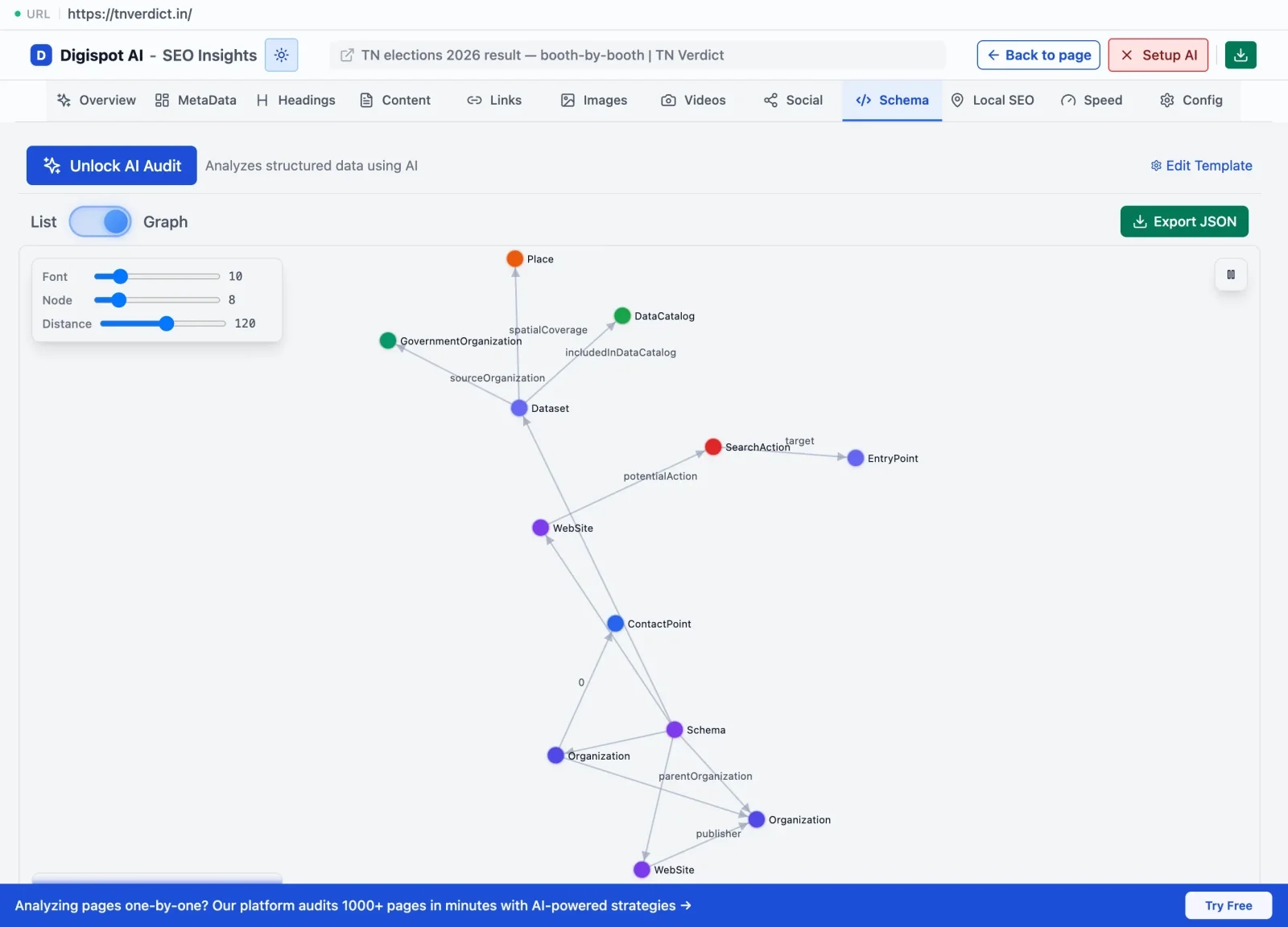
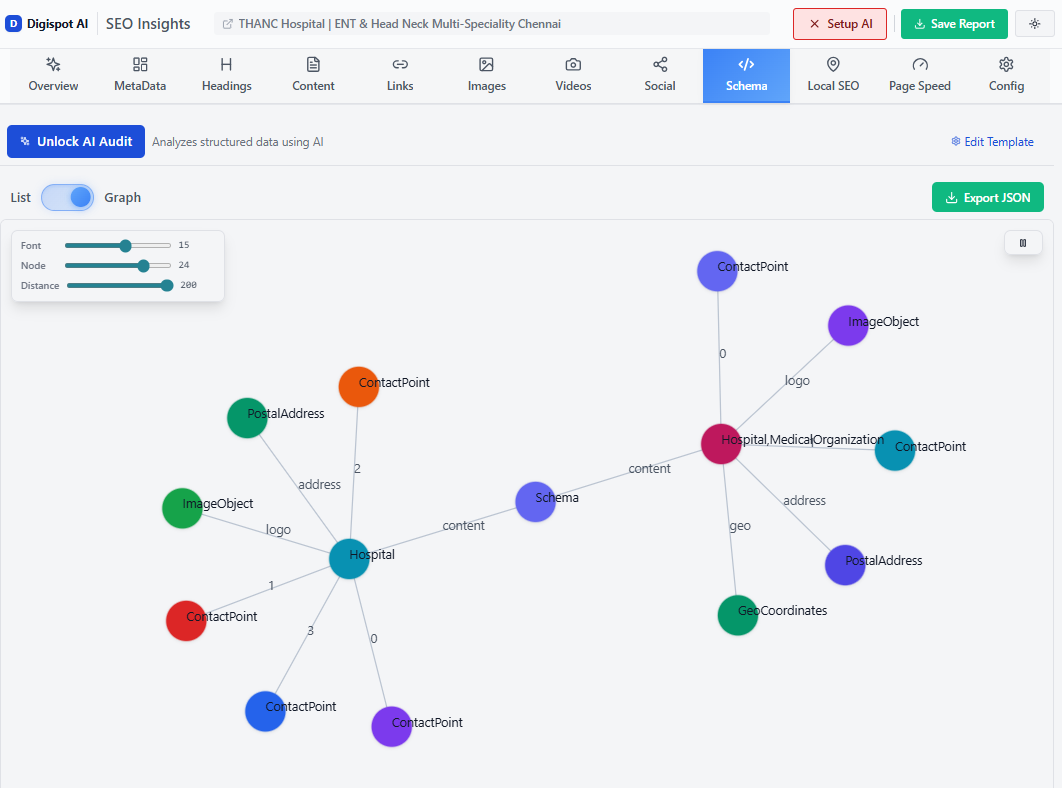
Turn invisible SEO data into clear visuals with our Free Chrome extension.
Common Types of Medical Schema Markup and Their Applications
The Schema.org vocabulary offers a rich array of types specifically tailored for the medical and healthcare industry. Understanding which types to use for different content elements is key to effective implementation. Using the wrong type (e.g., marking a hospital as a generic LocalBusiness instead of Hospital) can result in lost opportunities for specific rich features like "Emergency Room" snippets.
Here's a look at some essential medical schema types and their common applications:
| Schema Type | Description | Use Cases | Example Properties |
|---|---|---|---|
| MedicalOrganization | Represents a medical institution or organization. | Hospitals, clinics, medical practices, research institutes, urgent care centers. | name, address, telephone, url, openingHours, department, medicalSpecialty, isAcceptingNewPatients, availableService, slogan, faxNumber, contactPoint, department, logo, hasOfferCatalog |
| Physician | Represents a doctor or healthcare professional. | Individual doctor profiles, physician directories. | name, medicalSpecialty, address, telephone, url, image, alumniOf, worksFor, hasOfferCatalog, honorificPrefix, honorificSuffix, gender, aggregateRating, review, email, memberOf, qualifications, availableService, education |
| MedicalClinic | A specialized MedicalOrganization that provides specific medical services. | Walk-in clinics, dental clinics, eye clinics, therapy centers. | Inherits from MedicalOrganization, plus availableService, medicalSpecialty |
| Hospital | A specialized MedicalOrganization providing comprehensive medical care. | Major hospitals, regional medical centers. | Inherits from MedicalOrganization, plus availableService, departments |
| MedicalCondition / Disease | Describes a medical condition, disease, or disorder. | Disease information pages, health encyclopedias. | name, alternateName, description, cause, symptom, riskFactor, treatment, epidemiology, pathophysiology, expectedPrognosis, possibleComplication, possibleTreatment, recognizingAuthority, associatedAnatomy, differentialDiagnosis |
| MedicalProcedure | Describes a medical procedure, treatment, or intervention. | Pages detailing surgical procedures, diagnostic tests, therapy options. | name, alternateName, description, procedureType, preparation, recoveryTime, status, bodyLocation, followup, howPerformed, adverseOutcome, contraindication, drug, evidenceLevel, guideline, outcome, seriousAdverseOutcome |
| Drug | Describes a pharmaceutical drug. | Medication information pages. | name, alternateName, description, dosageForm, activeIngredient, prescribingInfo, rxcui, ingredient, labelDetails, administrationRoute, clinicalPharmacology, contraindication, foodInteraction, mechanismOfAction, warning |
| MedicalWebPage | A general webpage related to medical content, often used to wrap other medical schema types. | Health articles, blog posts about medical topics. | headline, author, datePublished, dateModified, about |
| Article | Used for blog posts or articles, can be combined with MedicalWebPage for health-related content. | Blog posts on health topics, research articles. | headline, author, datePublished, image, articleBody, wordCount, publisher, inLanguage, genre |
| Review | User-generated reviews, often nested within MedicalOrganization or Physician schema. | Patient testimonials, ratings. | author, reviewRating, reviewBody, itemReviewed |
| Service | Represents a service offered, which can be medical. | Specific services like "telemedicine consultation," "dental cleaning," "physical therapy." | name, description, provider, areaServed, serviceType, offers, audience, broker, category, hoursAvailable, isRelatedTo, providerMobility |
| FAQPage | A page with a list of frequently asked questions and their answers. | Pages addressing common patient queries about conditions, procedures, or practice policies. | mainEntity (a list of Question objects, each with name and an acceptedAnswer) |
Deep Dive: Optimizing Specific Medical Types
While the table outlines the basics, the real power lies in the details. Here are a few advanced tips for the most critical types:
Optimizing Physician Schema
The Physician type is crucial because patients often search for doctors by name. To maximize this, ensure you link the physician to the hospitals they work at using the hospitalAffiliation or worksFor property. Also, use isAcceptingNewPatients (set to true or false)—this is a specific signal that can appear in local results, saving patients time and reducing administrative calls to your front desk.
Structuring MedicalOrganization and Hospitals
For large facilities, the hierarchy is key. A Hospital should use the department property to nest other MedicalOrganization types (like "Emergency Room" or "Pharmacy"). Each department can have its own openingHours, which is critical because the ER is open 24/7 while the pharmacy might close at 6 PM. If you only provide one set of hours for the whole building, you risk frustrating patients.
Leveraging MedicalCondition for Education
If you publish content about diseases (content marketing), use MedicalCondition. This type allows you to specify associatedAnatomy, possibleTreatment, and riskFactor. This data feeds directly into the "knowledge panels" Google displays for health queries. By providing this structure, you increase the chance that Google uses your content to answer the question directly on the SERP. For more on structuring informational content, check our guide on data schema SEO.
Implementing Medical Schema Markup: Best Practices
Successful implementation of medical schema markup goes beyond just placing code. It requires careful planning and adherence to best practices to ensure maximum benefit. Here is a step-by-step approach to getting it right.
1. Choose the Right Schema Types
As discussed, select the most specific and accurate schema type for each piece of content. Don't use Article when MedicalWebPage or even MedicalCondition would be more precise for a health information page. Specificity wins in semantic search. If a facility is specifically a Dentist, use that subtype rather than the generic Physician or MedicalBusiness.
2. Use JSON-LD (Google's Preferred Format)
While other formats like Microdata and RDFa exist, JSON-LD is the recommended method. It keeps your data separate from your visual HTML, making it cleaner and easier to maintain. It's easy to implement by adding a <script type="application/ld+json"> block to the <head> or <body> of your page. This separation also means that if you redesign your website's visual layout, your schema code often remains intact without needing a rewrite.
3. Ensure Data Accuracy and Completeness
Every piece of information you include in your schema markup must be accurate and reflect the visible content on the page. Do not mark up content that isn't visible to users. This is a violation of Google's guidelines and can lead to penalties. The more complete your data, the richer the potential rich results. For instance, if you mark up a Physician, include their medicalSpecialty, address, telephone, and links to their professional profiles.
4. Validate Your Markup
Before pushing your schema live, always validate it. Google provides a free Rich Results Test tool that helps you check for errors and see which rich results your page is eligible for. This is a crucial step to catch any syntax issues, like missing commas or unclosed brackets, which can render the entire code block useless.
5. Avoid Spammy Tactics
Do not use schema markup to deceive search engines or inflate your rankings. For example, don't mark up irrelevant keywords or artificial review ratings. Don't add a MedicalCondition schema to a page that only sells supplements without providing substantial medical information. Such tactics can lead to manual penalties or your schema being ignored completely.
6. Keep it Updated
Medical information, physician affiliations, opening hours, and services can change. Ensure your schema markup is regularly updated to reflect the most current information on your website. If a doctor leaves your practice, remove their schema or update the worksFor property. Outdated schema can lead to a poor user experience—like sending a patient to a closed clinic—and damage your credibility.
7. Integrate with Your Content Management System (CMS)
If your CMS allows, consider using plugins or custom fields that automatically generate schema markup based on your content. This can significantly streamline the process, especially for large websites. However, rely on custom solutions or flexible tools rather than rigid plugins that might not support specific medical properties like medicalSpecialty.
8. Focus on User Experience
Remember that schema markup's ultimate goal is to enhance the user experience by providing better search results. Always prioritize clear, helpful, and accessible content on your actual web pages. Schema is the map, but your content is the destination.
Digispot AI can help you identify and fix these issues automatically with AI-powered audits analyzing 300+ ranking factors, ensuring your schema strategy aligns perfectly with your on-page content.
The Transformative Benefits of Medical Schema Markup
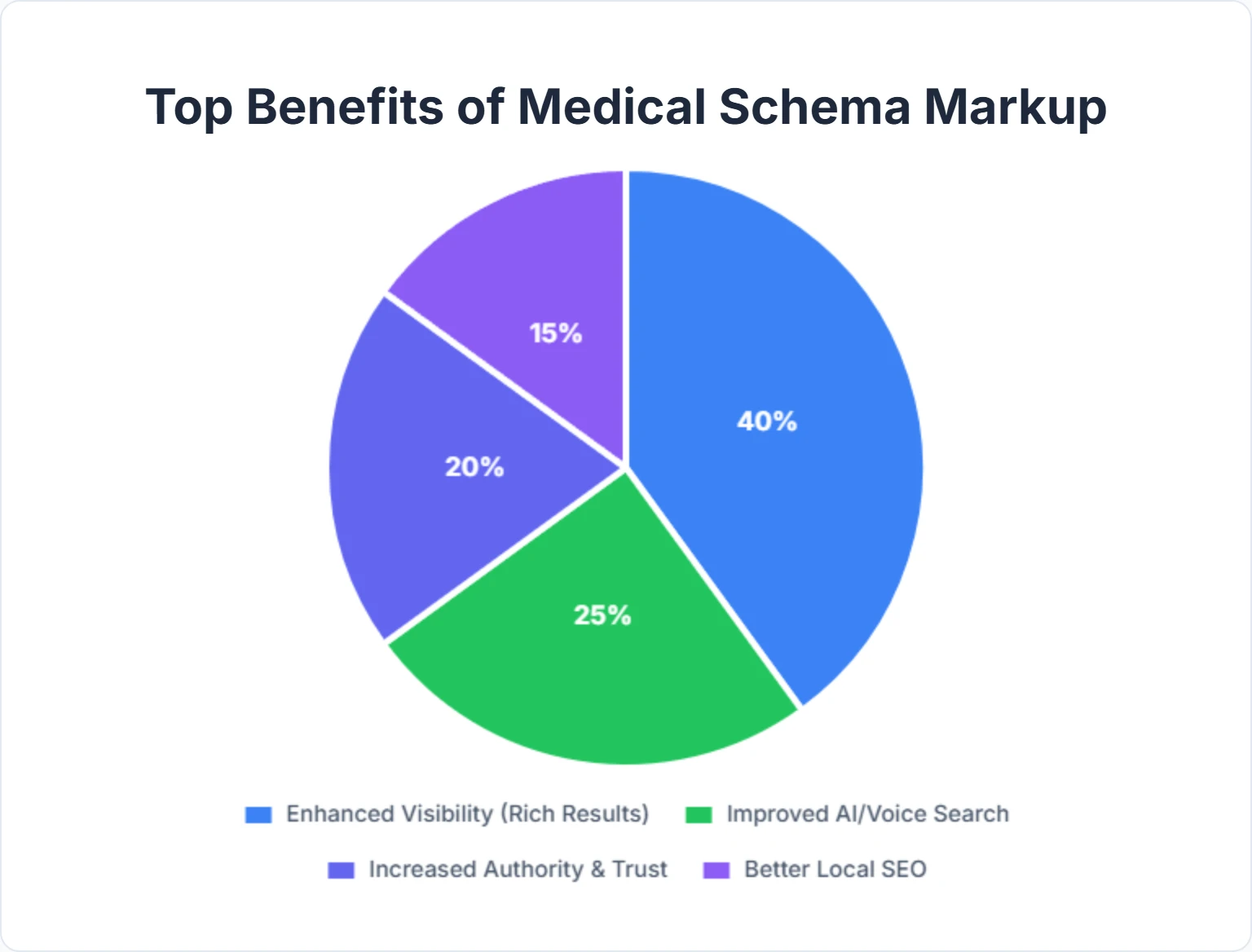
Let's delve deeper into the profound impact medical schema markup can have on your business outcomes. The benefits extend far beyond simple "SEO points"—they fundamentally change how users interact with your brand in the search results.
Improving Business Visibility
This is perhaps the most direct and tangible benefit. By helping search engines truly understand your content, your pages become eligible for rich snippets and other enhanced search features. Imagine your clinic's search result showing its average patient rating, operating hours, and a direct link to book an appointment – all visible before a user even clicks. This dramatically increases your "digital footprint" and makes your business stand out in a crowded online landscape. Patients searching for very specific symptoms or conditions will find your relevant, schema-enhanced pages more easily, as search engines can confidently match their query with your structured data.
Increase in Traffic and Business Leads
Enhanced visibility naturally leads to more clicks. Rich results are more eye-catching and provide more compelling reasons for users to choose your link over a competitor's. This increased click-through rate (CTR) translates directly into higher website traffic. Furthermore, when users arrive at your site having seen relevant information in the search results, they are often more qualified and engaged.
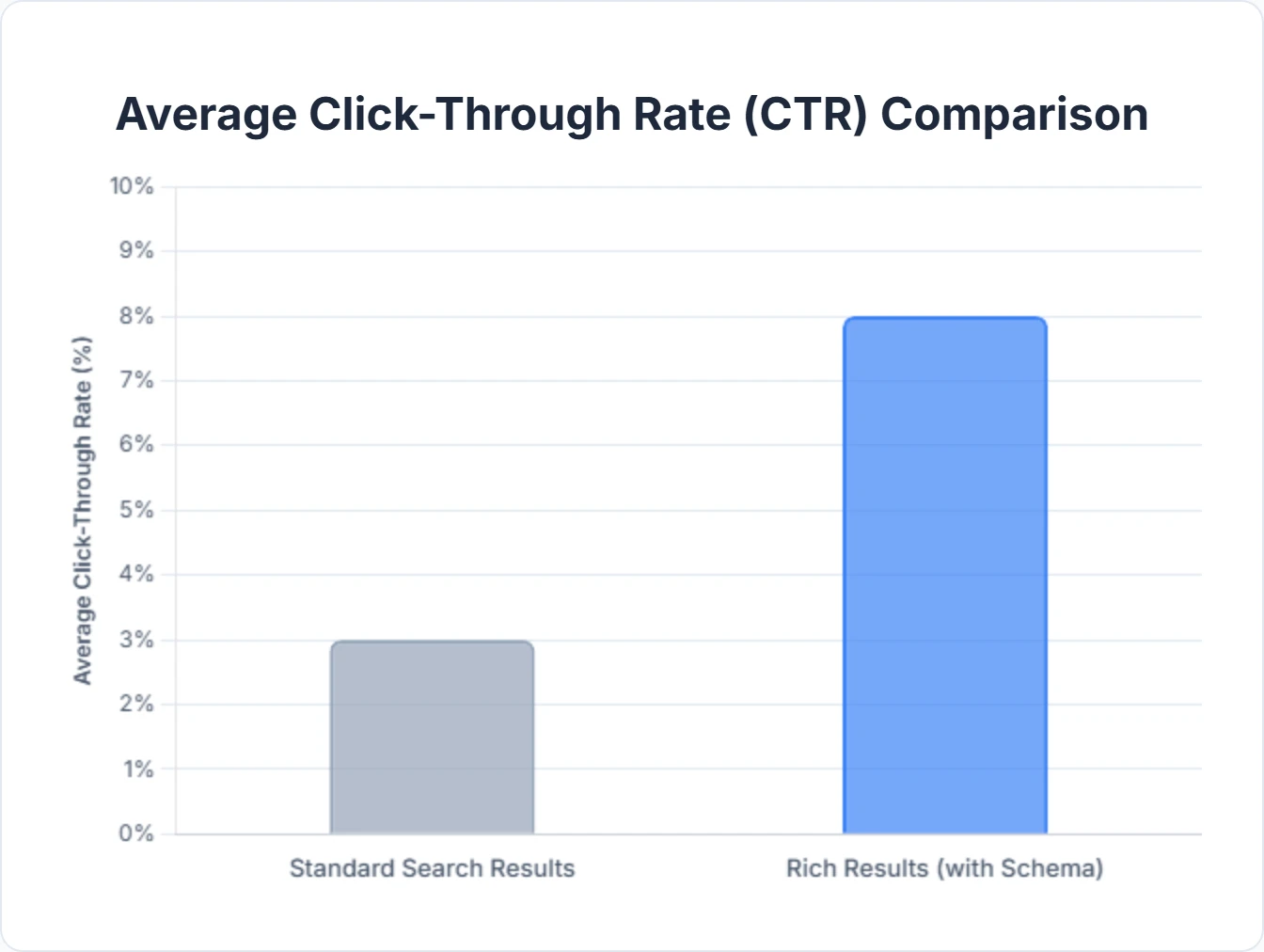
This leads to a higher conversion rate for appointment bookings, form submissions, or patient inquiries, ultimately generating more business leads. When a patient sees a "telehealth available" service marked up with schema, they know instantly if your practice meets their immediate needs, driving highly relevant traffic. For more insights on how on-page factors influence conversion, read our article on on-page SEO best practices.
Time and Cost Savings
While initial implementation requires effort, medical schema markup can lead to significant long-term savings. By improving your organic search performance, you can reduce reliance on expensive paid advertising campaigns. A website that consistently ranks well and generates leads through organic search is a highly cost-effective asset. Additionally, by clearly communicating your services and specializations to search engines, you spend less time manually optimizing for every minor keyword variation, allowing AI-driven platforms to understand the broader context of your offerings.
The Role of AI in Mastering Schema Markup and SEO
The complexity of schema markup, especially across a large healthcare website, can be daunting. This is where AI-powered SEO platforms step in, streamlining the process and ensuring accuracy at scale. Modern AI tools can analyze vast amounts of data, understand semantic relationships, and even suggest appropriate schema markup, taking much of the manual guesswork out of the equation.
Consider the challenge of maintaining accurate schema for hundreds of physicians, dozens of departments, and countless medical conditions. Manually auditing each page for correct schema, checking for errors, and ensuring it aligns with the visible content is a monumental task. This is precisely where AI tools become invaluable.
AI agents can crawl your site, identifying pages that look like physician profiles but lack the Physician schema. They can verify that the phone number in your JSON-LD matches the phone number visible on the page (a common validation error). They can even suggest new opportunities—for instance, realizing you have a page about "Flu Shots" that could be enhanced with MedicalProcedure or Service schema.
Leveraging Digispot AI for Optimal Medical SEO
Navigating the intricate world of medical schema markup and overall SEO can be significantly simplified with the right tools. Platforms like Digispot AI are designed to automate many of these complex processes, helping healthcare businesses achieve their online visibility goals without needing an army of SEO experts.
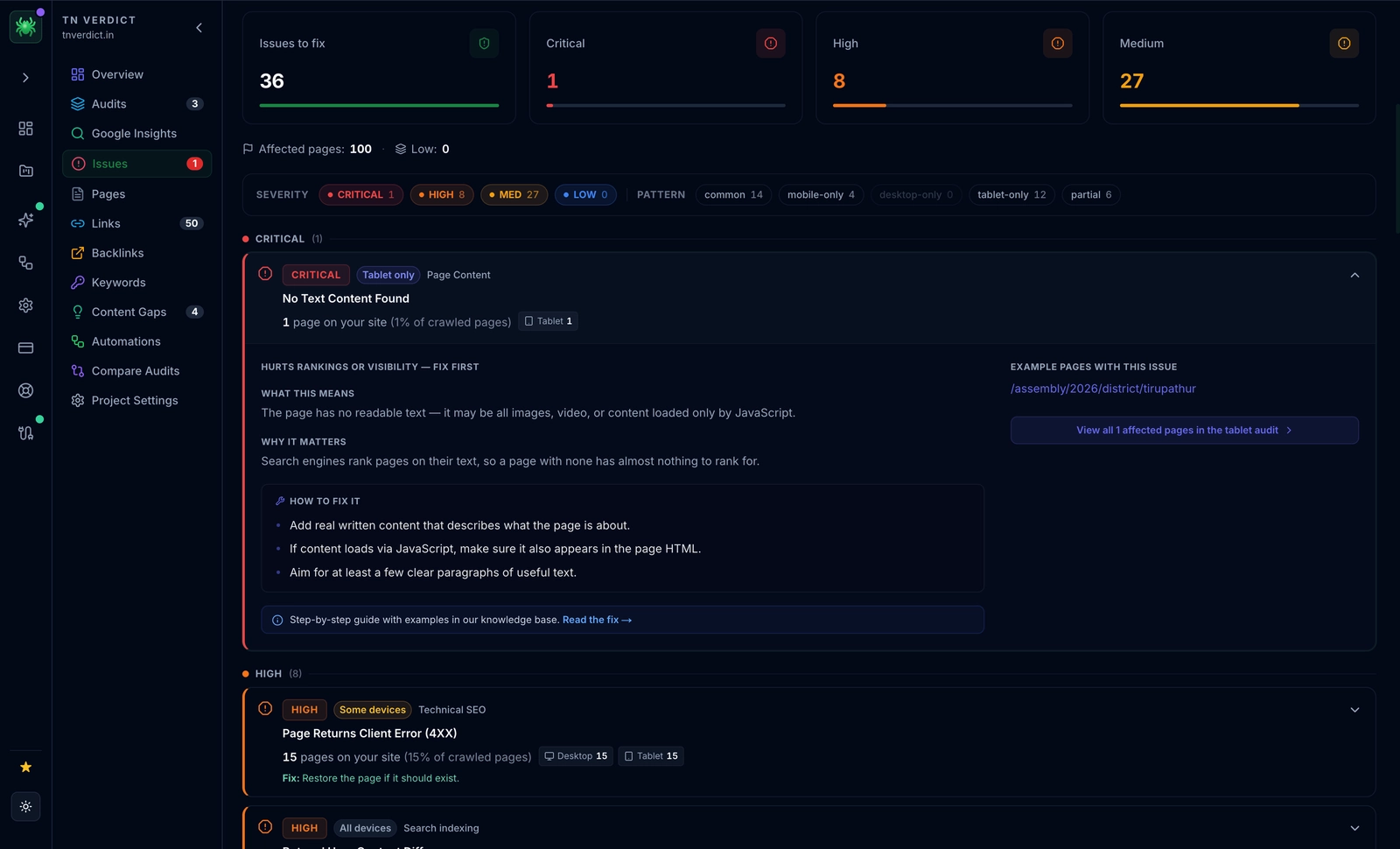
One of the key strengths of an advanced AI SEO platform like Digispot AI is its comprehensive website auditing capability. It doesn't just scratch the surface; it meticulously analyzes your website in both mobile and desktop modes. Why is this crucial for schema? Because how a page renders and how its data is structured can differ slightly between devices, and search engines like Google use mobile-first indexing. Digispot AI can precisely identify issues with your existing schema markup, whether it's incorrectly implemented JSON-LD, missing required properties, or inconsistencies that could prevent your rich results from appearing. More importantly, it provides actionable insights and helps to solve them, guiding you through the remediation process.
Integrated Performance Tracking
Understanding the impact of your schema and other SEO efforts is paramount. Digispot AI seamlessly integrates with Google Search Console and Google Analytics. This integration provides a unified dashboard where you can track the performance of your schema-rich pages, monitor rich result eligibility, analyze traffic increases stemming from enhanced search listings, and ultimately understand how your medical schema markup contributes to your overall business objectives. This removes the guesswork and provides data-driven insights for continuous improvement.
Opportunity Finder and Content Studio
Beyond auditing and tracking, Digispot AI offers an Opportunity Finder and a Content Studio. For medical schema, the Opportunity Finder can identify content gaps where schema markup could significantly improve visibility – perhaps a new service or a common medical query where competitors aren't using structured data effectively. The Content Studio, powered by AI agents, then assists in generating SEO-optimized content that inherently supports the integration of relevant schema markup. This means your content is not only informative for humans but also perfectly structured for search engines, ensuring that schema elements like MedicalCondition or MedicalProcedure are naturally incorporated and accurately described.
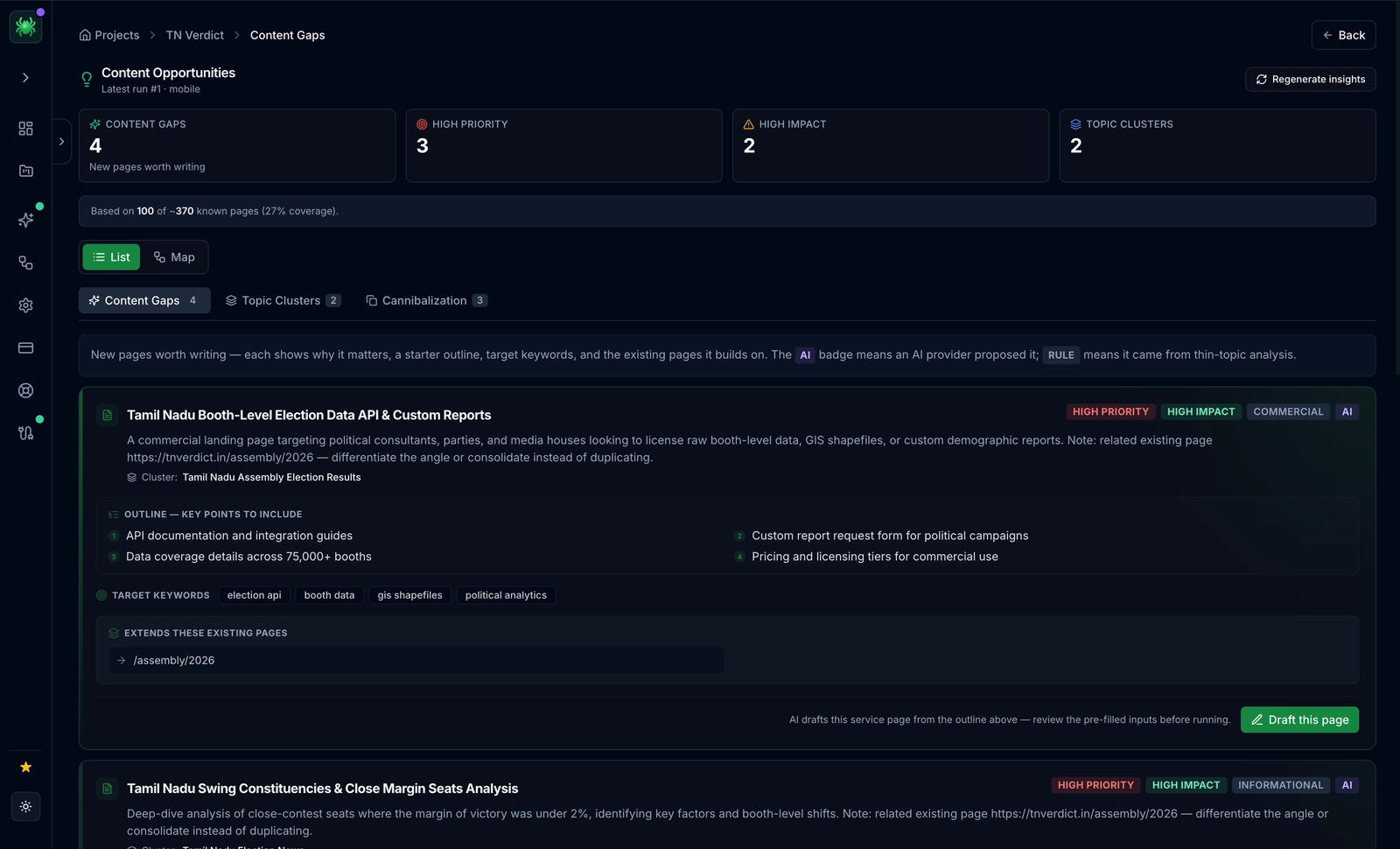
Digispot AI truly understands the intricacies of how websites rank. It helps you rank better by analyzing your site for over 300+ ranking factors. This includes crucial aspects like content quality, technical SEO (where schema markup firmly resides), local SEO signals (vital for healthcare practices), and page performance (speed and user experience). By considering all these factors holistically, it ensures that your medical schema markup isn't an isolated effort but part of a robust, comprehensive SEO strategy. For instance, correctly marked-up local business information combined with strong local SEO signals will exponentially boost your presence in "near me" searches.
Try the free On-Page SEO Analysis tool to audit any URL instantly and see if your schema is detected correctly.
Validating Medical Schema at Scale with the SEO Spider
Spot-checking one page is easy; keeping structured data correct across thousands of physician profiles, condition pages, and procedure listings is where clinics fall down. That's what the Digispot AI SEO Spider is built for. Billed as "the only SEO crawler your AI agent can run," this desktop crawler renders every page in a real browser the way Googlebot does and runs 300+ SEO and AEO checks per URL — so it catches malformed JSON-LD, MedicalCondition, MedicalProcedure, or Physician markup that's missing required properties, and schema that silently breaks the moment a CMS template changes.
Crucially, it doesn't just hand you a flat error list. Every issue is ranked by the organic traffic it's putting at risk, so a healthcare site fixes the high-traffic condition pages losing rich results before it worries about a stray profile no one visits. It syncs with Google Search Console and GA4 to tie those schema gaps to real rankings and sessions, and its MCP server lets an AI agent like Claude or Cursor run the crawl and apply the fixes for you. Strong structured data plus the authority signals and backlinks that reinforce E-E-A-T is what ultimately moves medical pages up the results. Plans start at $14/mo.
Digispot AI's Free Community Chrome Extension: Your On-the-Go Schema Detective
Recognizing the need for quick, on-the-spot analysis, Digispot AI also offers a free community Chrome extension. This powerful little tool allows you to audit your website page directly in your browser. Imagine browsing a competitor's page, or even your own, and instantly seeing how their schema is structured.
Get instant SEO insights on any page with our free Chrome extension.
Powered by popular LLM models, this extension doesn't just detect schema; it provides visualization and helps you understand the data. This means you can:
-
Audit on the fly: Quickly check if a page has schema, what types it uses, and if there are any immediate errors.
-
Detect schema types: See exactly which schema objects (e.g.,
Physician,MedicalOrganization,MedicalCondition) are present on a page. -
Visualize the data: Understand the hierarchy and relationships within the schema, making complex JSON-LD easier to comprehend.
-
Spot opportunities: Identify pages that lack schema or where existing schema could be enriched, informing your optimization strategy.
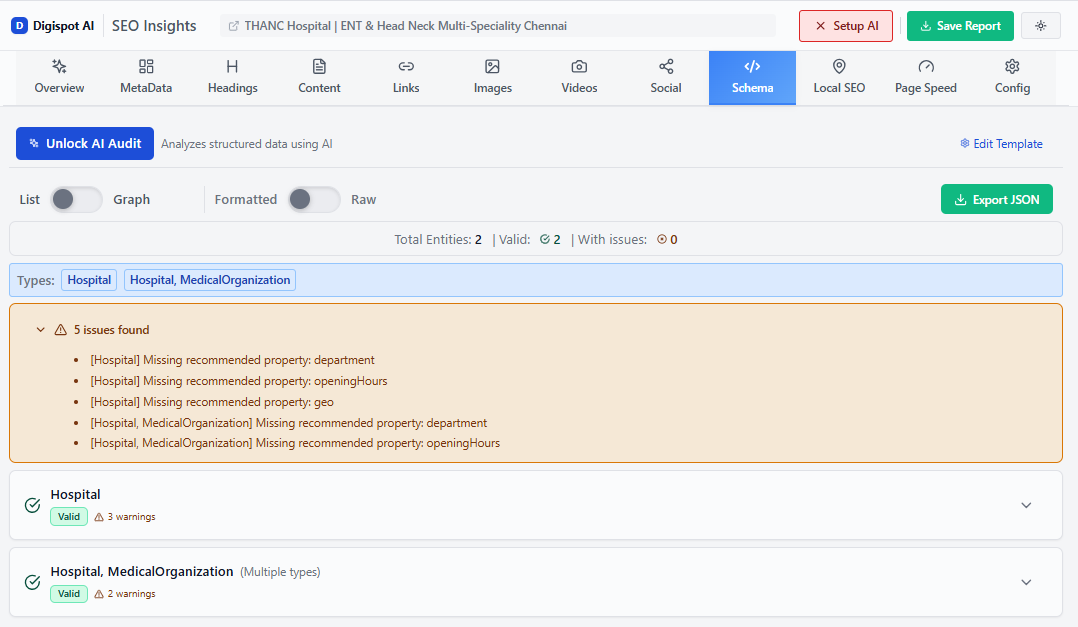
This extension is an excellent example of how user-friendly tools can democratize complex SEO tasks, allowing healthcare marketers and even individual practitioners to get a better handle on their schema implementation without deep technical expertise. It's like having a schema expert available with a single click, providing immediate insights into the structured data landscape of any web page.
Ultimately, the Digispot AI cloud platform brings together all SEO best practices in an automated and user-friendly model. This empowers you to operate your SEO at scale with accuracy, ensuring that your medical schema markup is not only correctly implemented but also continually optimized for the best possible search engine performance.
The Future of Medical Schema Markup
Medical schema markup is not a static concept; it's an evolving standard. As search engines become more sophisticated and AI advancements continue, we can expect even greater granularity and complexity in schema types. Personalized health searches, interoperability of health data, and advanced diagnostic tools will likely drive the need for richer, more interconnected structured data.
The move towards a "knowledge graph" for healthcare, where search engines can understand intricate relationships between diseases, treatments, providers, and patient data, is already underway. This will demand increasingly robust and accurate schema implementation. Staying ahead means continually monitoring Schema.org updates and adapting your strategy to new medical schema types and properties as they emerge.
For example, we might see more specific schema for:
- Clinical Trials: Detailed information about ongoing or completed trials, including recruitment status and study phases.
- Medical Devices: Structured data for specific medical equipment, usage instructions, and safety warnings.
- Telehealth Services: More precise definitions for virtual consultations, remote care platforms, and digital health tools.
- Patient Education Resources: Schema to highlight trusted, evidence-based patient information, distinguishing it from forums or anecdotes.
Embracing these advancements, perhaps through AI-driven platforms, will be key to maintaining a competitive edge and ensuring your healthcare information remains discoverable and trusted.
Conclusion: Your Prescription for Digital Visibility
Medical schema markup is more than just a technical detail; it's a vital component of a successful digital strategy for any healthcare organization. By meticulously structuring your website's content, you provide search engines with the clarity they need to showcase your expertise, connect you with patients, and build a foundation of trust.
From enhancing visibility through rich results to improving local SEO and preparing for the future of AI-driven search, the benefits are undeniable. While the process involves a technical layer, user-friendly tools and platforms, such as Digispot AI and its convenient Chrome extension, are designed to demystify schema markup, making it accessible and actionable for every healthcare provider.
Don't let your valuable medical content get lost in the digital noise. Invest in medical schema markup, optimize your online presence, and empower patients to find the care they need, precisely when they need it. It's the smart, strategic choice for a healthier digital future.
Ready to improve your search visibility? Try Digispot AI for comprehensive website audits and actionable recommendations.
- Health and medical types | Schema.org
- General Structured Data Guidelines | Google Search Central
- Intro to How Structured Data Markup Works | Google Search Central
- Rich Results Test | Google Search Central
- About Search Console - Google Help
- Analytics Help - Google Help
- Digispot AI - FREE On Page SEO Audit Tool
- Digispot AI - FREE Chrome Extension for SEO Insights
Related deep-dives
Continue with these closely related guides:
- medical content trust — Medical Content Trust: Building Authority in Healthcare SEO
Audit any page in seconds
300+ SEO checks including Core Web Vitals, schema markup, meta tags, and AI readiness — trusted by 1000+ SEO experts and marketers.
Frequently Asked Questions
Here are some of our most commonly asked questions. If you need more help, feel free to reach out to us.
Written by
Maya Krishnan
Digital growth expert
Maya is a seasoned expert in web development, SEO, and digital strategy, dedicated to helping businesses achieve sustainable growth online. With a blend of technical expertise and strategic insight, she specializes in creating optimized web solutions, enhancing user experiences, and driving data-driven results. A trusted voice in the industry, Maya simplifies complex digital concepts through her writing, empowering readers with actionable strategies to thrive in the ever-evolving digital landscape.