
Data Schema SEO: Boost Visibility with Structured Data
Implement structured data for SEO success. Master schema markup implementation to improve rich results, boost CTR, and enhance search visibility across Google.
 Maya Krishnan
Making your website stand out to both human visitors and sophisticated search algorithms is a challenge every site owner faces. You spend hours crafting perfect content, but if search engines cannot decipher the specific details—like ingredients in a recipe, specifications of a product, or the date of an event—your page remains just another URL in the index. Search Engine Optimization (SEO) bridges this gap, but Data Schema SEO (structured data) builds a direct highway for information exchange.
Structured data acts as a translator. It converts your visual content into a machine-readable format that explicitly describes what your content is, not just what it says. This distinction gives your site a massive advantage in the fight for visibility.
This guide breaks down the mechanics of data schema SEO. You will learn how to implement the code that powers rich snippets, audit your existing setup for errors, and use advanced tactics to future-proof your site against the rising tide of AI-driven search. We will also examine how modern tools, including Digispot AI, simplify this technical process to ensure your SEO strategy is data-driven and precise.
What is Data Schema SEO?
Data Schema SEO involves embedding a specific vocabulary of code into your website's HTML. This code helps search crawlers understand the meaning, context, and relationships behind your content.
Think of the internet as a massive, disorganized library. Without structured data, your web pages are like books thrown randomly into a pile. A "librarian" (Google) has to open every book and guess its genre, author, and subject based on the text alone. This process is prone to error.
Schema markup transforms that pile into a meticulously indexed digital catalog. It attaches a label to your "book" that says:
- Genre: Technical Guide
- Author: Maya Krishnan
- Date: 2025-08-06
- Target Audience: SEO Professionals
This "label" uses a semantic vocabulary from Schema.org, a collaborative standard maintained by Google, Microsoft, Yahoo, and Yandex. It creates a universal language that allows your website to speak directly to algorithms, removing ambiguity.
Why the name "structured data"?
Standard HTML is unstructured. A paragraph tag <p> tells a browser how to display text, but it doesn't say what that text represents. Structured data organizes this information into key-value pairs (like "price": "49.99"), making it instantly digestible for machines.
A Simple Analogy: Giving Context to Computers
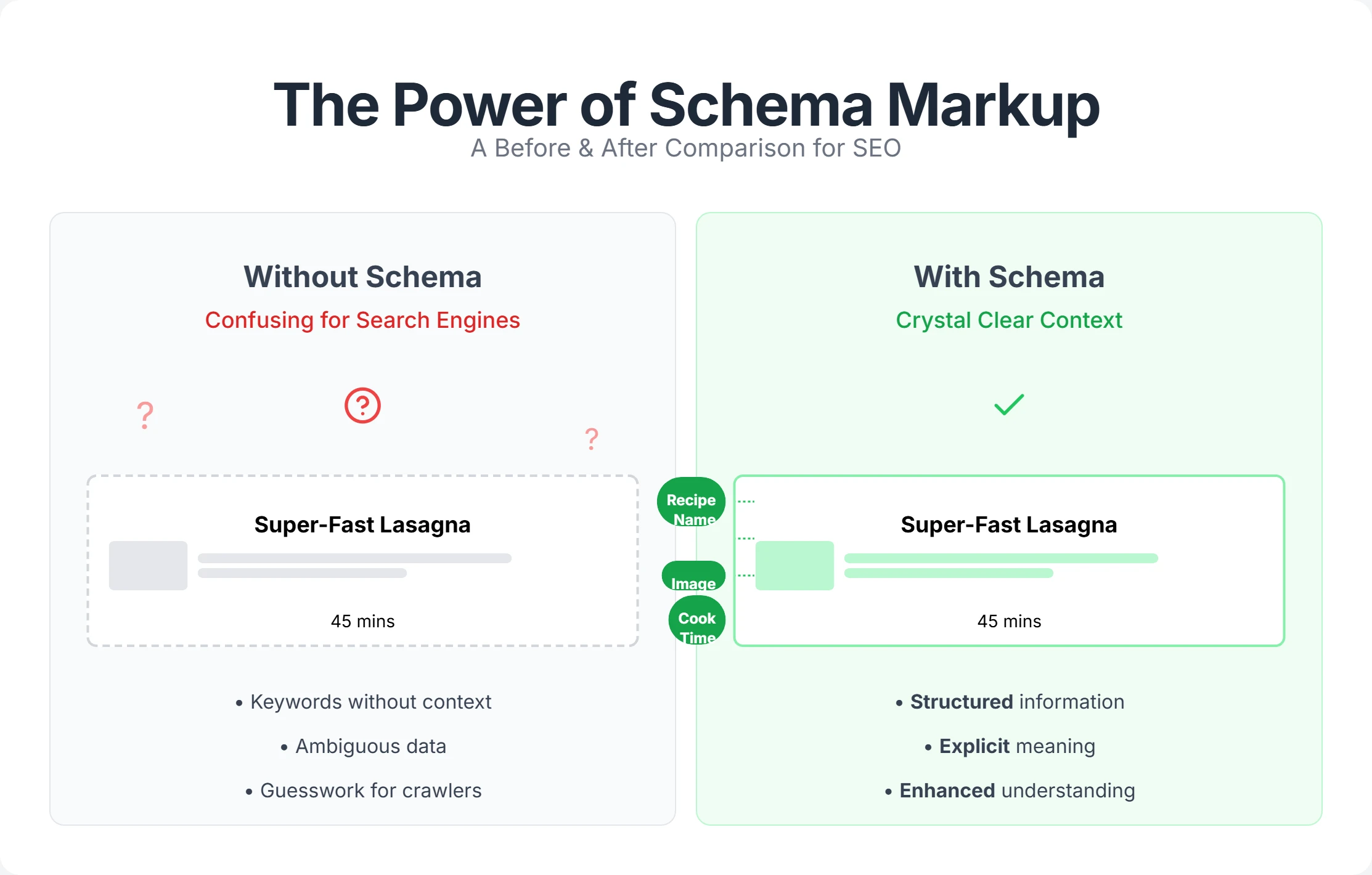
Consider a webpage featuring a "Classic Cheesecake."
- Human View: You see a photo, a list of ingredients, a 5-star rating, and a baking time. You instantly know it's a recipe.
- Search Engine View (Without Schema): The bot sees text strings. It sees numbers like "45" and "350," but doesn't inherently know if "350" is a price, a calorie count, or an oven temperature.
With schema markup, you eliminate the guesswork. You explicitly tag the data:
@type: "Recipe"cookTime: "PT45M" (45 Minutes)recipeYield: "8 servings"nutrition.calories: "350 calories"
This clarity allows Google to pull those specific data points and display them directly on the search results page, creating a "Rich Result."
Where Does Schema Come From? Schema.org
Schema.org is the dictionary for this language. It defines nearly 800 distinct types of "Things" (entities) and over 1,400 properties you can assign to them. The hierarchy starts with "Thing" and branches out into "CreativeWork," "Event," "Organization," "Person," "Place," and "Product."
While the sheer volume of options can be overwhelming, effective SEO usually revolves around 20-30 core types. Mastering these essential types is often enough to cover 90% of business use cases. For deeper implementation strategies, check our advanced schema markup guide to move beyond the basics.
How Does Data Schema SEO Work?
The process begins when a search engine crawler (like Googlebot) visits your page.
- Crawling: The bot renders the HTML and executes JavaScript.
- Parsing: It detects the structured data block (usually in JSON-LD format).
- Validation: The parser checks if the code follows Schema.org standards and Google's specific feature guidelines.
- Indexing: If valid, the data is stored in the search index, associated with your URL.
- Display: When a user's query matches your content, the search engine constructs a "Rich Snippet" using the data you provided.
The Role of Rich Snippets and Enhanced Search Results
Rich snippets are the visual payoff of data schema SEO. They upgrade a standard search listing (blue link + meta description) into an interactive data card.
- E-commerce: A user sees product price, stock status ("In Stock"), and shipping details before clicking.
- Events: The listing shows specific dates, venue names, and ticket availability.
- Software: Users see star ratings, operating system requirements, and pricing models.
- Recipes: The search result includes a thumbnail image, cooking time, and calorie count.
These enhancements do more than just look good; they claim more pixel real estate on the Search Engine Results Page (SERP), pushing competitors further down the screen.
Connecting Schema to User Intent and Search Experience
Does schema markup directly boost rankings? Technically, no. Adding code doesn't magically push you to position #1. However, the indirect benefits act like a ranking boost.
By defining the context of your page, you help search engines match your content to specific, high-intent queries. If someone searches for "events near me next weekend," Google looks for pages with Event schema containing specific dates and geolocation data. Without that schema, your page might be missed, even if the text is relevant.
Furthermore, rich snippets qualify you for Entity Search. Search engines are moving from keyword-matching to entity-understanding. They want to know that "Digispot AI" is an Organization that offers SoftwareApplications. Schema provides the definitive proof of these entities.
Why is Data Schema SEO Important? (Benefits)
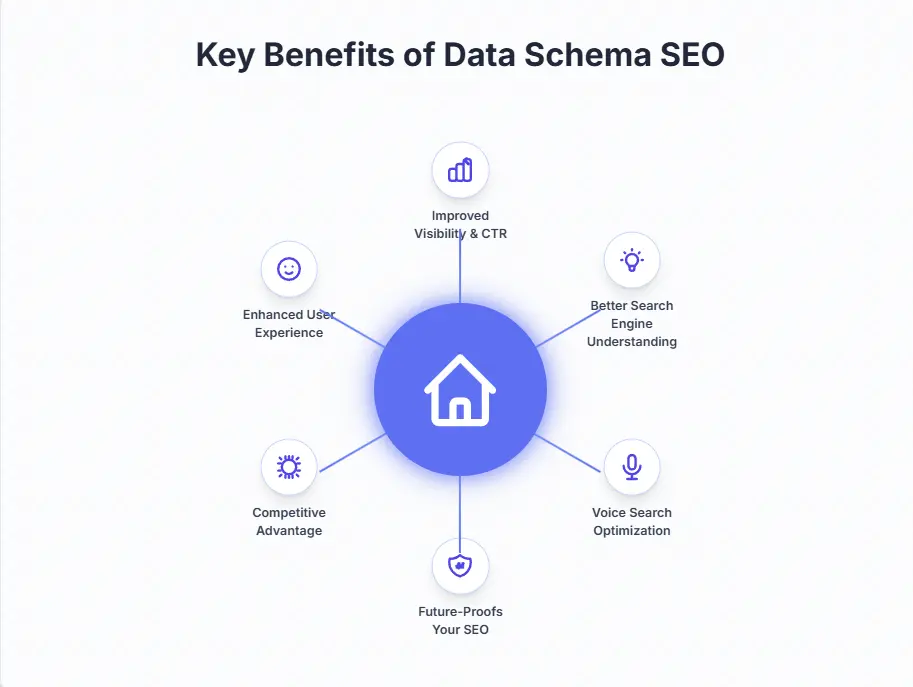
Implementing structured data is one of the highest-ROI activities in technical SEO. It prepares your site for the current state of search (rich results) and the future (AI answers).
Table: Benefits of Data Schema SEO
| Benefit | Description |
|---|---|
| Improved Visibility & CTR | Rich snippets capture user attention. Studies show pages with rich results can see a 20-40% increase in Click-Through Rate (CTR). High CTR is a strong user signal that can improve organic rankings over time. |
| Precise Indexing | Schema eliminates ambiguity. It tells Google explicitly, "This page is about a software product," ensuring you don't rank for irrelevant informational queries when you want transactional traffic. |
| Voice Search Dominance | Voice assistants (Siri, Alexa, Google Assistant) read structured data to answer questions. If a user asks, "How long does it take to cook a turkey?", the assistant pulls the cookTime from your schema. |
| AI & SGE Readiness | Google's Search Generative Experience (SGE) and other AI engines rely on structured data to generate accurate summaries. Schema ensures your brand's facts are ingested correctly by these Large Language Models. |
| Dominating the "Pixel Space" | Rich results take up more vertical space. A HowTo schema can display 3-4 steps directly in the SERP, pushing competitors below the fold and establishing immediate authority. |
| Knowledge Graph Entry | Consistent use of Organization and Person schema helps search engines build a Knowledge Graph entry for your brand, leading to those prestigious sidebar information panels. |
Common Data Schema Types and Their Applications
While hundreds of types exist, you should focus on the ones that generate specific rich results for your industry.
Table: Essential Schema Types for SEO
| Schema Type | Description | Best For | Key Properties |
|---|---|---|---|
Article / NewsArticle | Enhances appearance in Google Discover and Top Stories carousels. Critical for publishers. | Blogs, News Sites | headline, image, datePublished, author |
Product | Displays price, availability, and review ratings. Essential for Product Schema Implementation. | E-commerce | offers, review, aggregateRating, brand |
LocalBusiness | Powers Google Maps and local pack rankings. Connects your physical location to your website. | Stores, Clinics, Offices | address, geo, openingHours, telephone |
FAQPage | Displays questions and answers in an accordion style directly on the SERP. Excellent for owning "People Also Ask" territory. | Service Pages, Support | mainEntity (Question), acceptedAnswer |
Organization | Establishes brand identity. Used to specify logo, social profiles, and contact points for the Knowledge Graph. | Homepages, About Us | logo, sameAs (Social Links), contactPoint |
BreadcrumbList | Shows the page's position in the site hierarchy in search results (e.g., Home > Men > Shoes). | All Websites | itemListElement, position |
Review | Embeds specific user reviews or an aggregate rating score. One of the most powerful trust signals. | Products, Books, Movies | reviewRating, author, reviewBody |
VideoObject | Allows video to appear in the "Videos" tab and main search with a thumbnail and duration. | Video Platforms, Tutorials | thumbnailUrl, uploadDate, duration |
JobPosting | Enables listings to appear in the Google Jobs specialized search experience. | Career Pages, Job Boards | title, baseSalary, employmentType |
SoftwareApplication | Provides details for apps, including operating system, category, and download links. | SaaS, App Developers | operatingSystem, applicationCategory, offers |
How to Implement Data Schema SEO?
Implementation methods vary from manual coding to fully automated solutions. The goal is to output valid JSON-LD code into the <head> of your page.
1. Manual Implementation (The "Hard" Way)
The gold standard format is JSON-LD (JavaScript Object Notation for Linked Data). Unlike older formats like Microdata (which wraps HTML elements), JSON-LD is a separate script block. This makes it cleaner and less likely to break your site's visual layout.
Example: Local Business Schema
<script type="application/ld+json">
{
  "@context": "https://schema.org",
  "@type": "LocalBusiness",
  "name": "Digispot SEO Agency",
  "image": "https://digispot.ai/logo.png",
  "telephone": "+1-555-0100",
  "email": "contact@digispot.ai",
  "address": {
    "@type": "PostalAddress",
    "streetAddress": "123 SEO Street",
    "addressLocality": "Tech City",
    "addressRegion": "CA",
    "postalCode": "94043",
    "addressCountry": "US"
  },
  "geo": {
    "@type": "GeoCoordinates",
    "latitude": 37.422,
    "longitude": -122.084
  },
  "openingHoursSpecification": {
    "@type": "OpeningHoursSpecification",
    "dayOfWeek": [
      "Monday",
      "Tuesday",
      "Wednesday",
      "Thursday",
      "Friday"
    ],
    "opens": "09:00",
    "closes": "18:00"
  },
  "priceRange": "$$"
}
</script>
While writing this manually gives you 100% control, a single missing comma can invalidate the entire block.
2. Using Generators and Tools
Smart marketers use tools to generate the syntax.
- Google's Structured Data Markup Helper: A visual tool where you highlight elements on your page to generate code.
- Digispot AI Schema Generator: Our free Schema Markup Generator allows you to select a type, input your data, and get perfectly formatted, validated JSON-LD instantly.
3. CMS Plugins (WordPress, Shopify)
If you use WordPress, plugins like Yoast SEO, Rank Math, or dedicated schema plugins can automate basic types like Article and Organization. However, these plugins often struggle with complex, custom schema needs (like nesting a VideoObject inside a HowTo step).
4. Enterprise Automation with Digispot AI
For large sites with thousands of pages, manual implementation isn't scalable. Digispot AI streamlines this process. Our platform crawls your site to identify pages missing schema or those with incomplete data. It can then generate the appropriate JSON-LD based on the page content.
Instead of wrestling with code, you use the Digispot dashboard to apply schema rules globally. For example, you can set a rule to apply Product schema to all URL paths containing /product/, mapping your database fields directly to schema properties.
Auditing and Validating Your Schema Markup
Deploying schema without testing is a common mistake. Invalid schema is ignored by Google, meaning you get zero benefit for your effort.
Essential Validation Tools
- Google's Rich Results Test: This is the ultimate authority. Paste your URL or code snippet here. It tells you exactly which rich results you are eligible for and flags critical errors (red) or non-critical warnings (yellow).
- Schema.org Validator: Formerly the Structured Data Testing Tool, this validates the syntax against the official Schema.org vocabulary. It's useful for checking types that Google doesn't yet support with rich snippets but still uses for understanding.
- Google Search Console (GSC): GSC is your ongoing monitor. The "Enhancements" section tracks your valid items over time. If you release a site update that breaks your schema, GSC sends you an alert.
Leveraging Digispot AI for Schema Auditing
While Google's tools are reactive (you have to ask them to check), Digispot AI is proactive. Our site-wide audit crawls every page and checks for:

- Syntax Errors: JSON parsing issues.
- Missing Properties: Required fields for rich results (e.g., missing
priceinProduct). - Opportunity Analysis: Pages that could have schema but don't.
If you find errors during your audit, Digispot AI can help you identify the root cause—whether it's a plugin conflict or a template coding error.
For quick checks while browsing, use the Digispot AI SEO Insights Free Chrome Extension.
- Instant Visualization: Navigate to any page and click the extension to see a visual graph of the structured data.
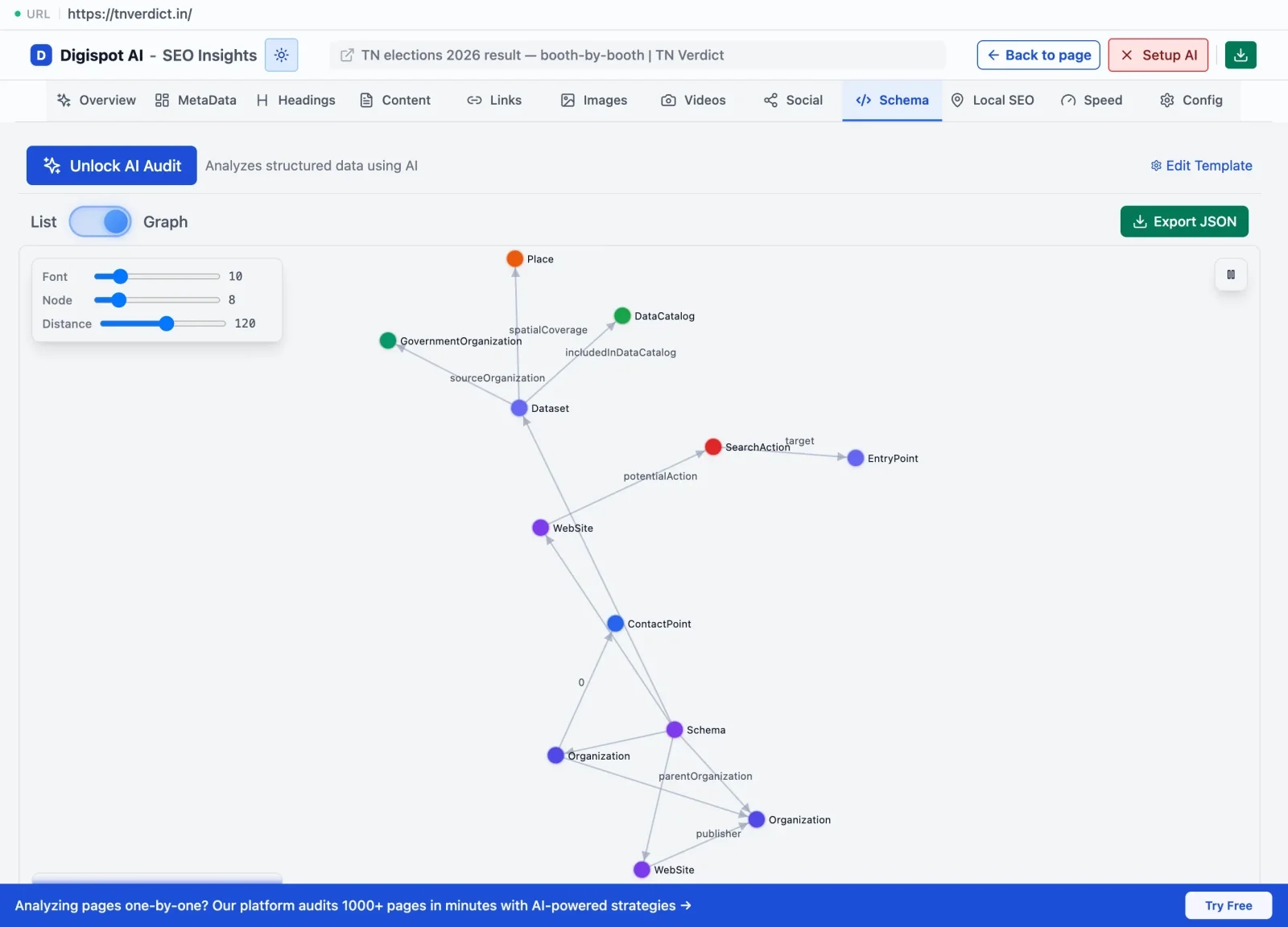
- Entity Mapping: See how the page links different entities (e.g., an
Articlelinking to anAuthorwho is aPerson). - Error Highlighting: Get immediate feedback on validity without leaving the page.
Get instant SEO insights on any page with our free Chrome extension.
Data Schema SEO Best Practices
To maximize the impact of your structured data, follow these guidelines derived from our analysis of thousands of high-ranking pages.
1. Be Specific
Don't just use Article if the content is a NewsArticle or BlogPosting. Don't use Organization if you can use LocalBusiness or Restaurant. Specificity helps Google understand the exact nature of your entity.
2. Don't Mark Up Hidden Content
Schema guidelines state that the structured data must represent content that is visible to the user. Don't add a 5-star rating in your schema if the user cannot see those reviews on the page. This is considered "spammy structured data" and can lead to a manual penalty.
3. Nest Your Entities
Isolated schema blocks are okay, but nested schema is powerful. Instead of having separate blocks for a Product and a Review, nest the Review inside the Product property. This establishes a clear relationship: "This review belongs to this product."
Example Concept:
"mainEntity": {
  "@type": "Article",
  "author": {
    "@type": "Person",
    "name": "Jane Doe",
    "jobTitle": "SEO Specialist"
  }
}
4. Keep it Updated
If your product price changes on the page, the schema must update immediately. Discrepancies between schema data and visible content destroy trust with search engines. Dynamic generation via GTM or server-side rendering is safer than static hard-coding for volatile data like price or inventory. For more on keeping your site healthy, review our SEO audit checklist for 2026.
5. Use the @id Property
The @id property allows you to define a globally unique identifier for a node in your graph. This helps search engines understand that the "Digispot AI" mentioned on your homepage is the exact same entity as the "Digispot AI" mentioned on your contact page.
6. Monitor Core Web Vitals
Adding massive blocks of JSON-LD shouldn't slow down your page, but ensure your implementation doesn't block rendering. Check our on-page SEO best practices to ensure your technical foundation supports your schema efforts.
The Future of SEO and Data Schema
Search is undergoing a fundamental shift from "strings" (keywords) to "things" (entities). Artificial Intelligence is the driver of this change, and structured data is the fuel.
AI's Growing Role in Search (AEO)
Answer Engine Optimization (AEO) is becoming as important as traditional SEO. AI models like GPT-4, Claude, and Google's Gemini consume vast amounts of data to answer user queries conversationally.
When an AI constructs an answer, it prefers structured, reliable data sources. If your website provides clear JSON-LD stating facts about your business, products, or services, you increase the probability of being cited as a source in an AI-generated answer.
How Schema Helps with Emerging Search Paradigms:
- Training Data Ground Truth: LLMs use structured data to verify facts. By providing schema, you are essentially "training" the AI on the truth about your brand.
- Zero-Click Searches: Google's Knowledge Graph often answers queries without a click. While this might seem bad for traffic, owning that "zero-click" space establishes massive brand authority.
- Contextual Understanding: AI looks for relationships. Schema helps mapping relationships like "Product A is compatible with Product B" or "Service X is provided by Organization Y in Region Z."
In the Digispot AI ecosystem, we track AEO visibility alongside traditional rankings. We analyze how your structured data is influencing your presence in AI-generated overviews, giving you a complete picture of your search performance.
Beyond the Basics: Advanced Schema Concepts
For those looking to push the boundaries, advanced schema offers powerful ways to model complex data.
Semantic Knowledge Graphs
You can use schema to link your entities to external authorities using the sameAs property. Linking your Organization schema to your Wikipedia page, Crunchbase profile, or verified social media handles creates a triangulation of trust.
Actionable Schema
Schema can do more than describe; it can enable action.
OrderAction: Allows users to initiate an order.ReserveAction: Enables table reservations directly from search results.SearchAction: Powers the "Sitelinks Search Box" that appears under your homepage result, allowing users to search your site directly from Google.
Dynamic Data Visualization
Advanced SEOs use the data from their schema audits to visualize their site's internal knowledge graph. This helps identify "orphan entities"—important topics or products that aren't well-connected to the rest of the site structure. Learn more about how visualization aids strategy in our guide on data visualization for SEO.
Start Improving Your Structured Data Today
Data Schema SEO is no longer an optional "nice-to-have" feature. It is a critical layer of modern digital infrastructure. By speaking the native language of search engines, you bypass the ambiguity of natural language processing and deliver your content's true meaning directly to the algorithms that matter.
The results are tangible: richer search appearances, higher click-through rates, and a future-proof defense against the volatility of AI search updates. Whether you are a local business trying to show opening hours or an enterprise e-commerce site managing thousands of SKUs, the path to better visibility starts with better data structure.
Ready to take control of your search presence?
Don't let technical complexity hold you back. Start with our free tools:
- Schema Markup Generator — Create validated JSON-LD for 10+ schema types
- Schema Markup Checker & Visualizer — Extract and validate schema from any URL
- On-Page SEO Checker — Audit any page for schema, meta tags, and 10 SEO factors
- Free Chrome Extension — Instant schema analysis on any page you visit
Digispot AI offers the full platform to audit, generate, and monitor schema markup at scale, analyzing over 200 ranking factors across your entire site.
Schema Guides
Once you have the foundation above, these focused guides take each part of structured data further:
- Confirm your code is both valid and eligible for rich results with our walkthrough on how to validate and test schema markup.
- Apply schema in a regulated, trust-sensitive niche using our guide to medical schema markup for healthcare sites.
Related deep-dives
Continue with these closely related guides:
- visual search optimization — Visual Search Optimization: Mastering SEO for Google Lens & Multisearch
References
- Understand how Structured Data works | Google Search Central
- Google Search Console
- Rich Results Test - Google Search Central
- Schema.org
- Monitor your structured data with Search Console reports | Google Search Central
- Digispot AI - FREE On Page SEO Audit Tool
- Digispot AI - FREE Chrome Extension for SEO Insights
- Structured data general guidelines | Google Search Central
Audit any page in seconds
300+ SEO checks including Core Web Vitals, schema markup, meta tags, and AI readiness — trusted by 1000+ SEO experts and marketers.
Frequently Asked Questions
Here are some of our most commonly asked questions. If you need more help, feel free to reach out to us.
Written by
Maya Krishnan
Digital growth expert
Maya is a seasoned expert in web development, SEO, and digital strategy, dedicated to helping businesses achieve sustainable growth online. With a blend of technical expertise and strategic insight, she specializes in creating optimized web solutions, enhancing user experiences, and driving data-driven results. A trusted voice in the industry, Maya simplifies complex digital concepts through her writing, empowering readers with actionable strategies to thrive in the ever-evolving digital landscape.