
Search Box SEO: Sitelinks & Schema Optimization
Optimize for Google sitelinks search box. Implement SearchAction schema, improve site search, and help users find content directly from search results.
 Maya Krishnan
Ever typed a question into Google and seen an immediate, precise answer pop up right there, often even before you click a link? Or perhaps you've noticed Google finishing your sentences as you type, guiding you to exactly what you're looking for. This isn't magic; it's the evolving world of Search Box SEO. In today's lightning-fast digital landscape, appearing directly in these prominent search features – whether it's a featured snippet, a "People Also Ask" box, or an intelligent auto-suggestion – can be the difference between blending in and standing out. This comprehensive guide will unravel the mysteries of Search Box SEO, explaining what it is, how it works, and why mastering it is crucial for anyone aiming to boost their online visibility. We'll explore practical strategies, delve into the critical elements that drive success, and even touch upon how intelligent platforms are making these complex tasks more accessible for businesses of all sizes. Prepare to transform your understanding of search and unlock new avenues for attracting your ideal audience.
What Exactly is Search Box SEO?
Search Box SEO, at its core, refers to optimizing your digital content to appear prominently within the various interactive and highlighted search elements that Google and other AI search engines present to users. Unlike traditional SEO, which often focuses on ranking individual pages in the standard blue link results, Search Box SEO aims for the more eye-catching, answer-driven positions. These positions include featured snippets (the answer box at the top of the search results), "People Also Ask" boxes, knowledge panels, and even the intelligent suggestions that appear as you type your query (auto-suggest).
The ultimate goal? To provide the most direct, concise, and accurate answer to a user's query, right where they expect it – often before they even click on a website. This shift signifies a move towards answer engine optimization, where the search engine itself attempts to provide the solution, rather than just a list of potential sources. For businesses, this means rethinking how content is structured and presented to align with this new paradigm. It's about being the definitive answer, not just one of many options.
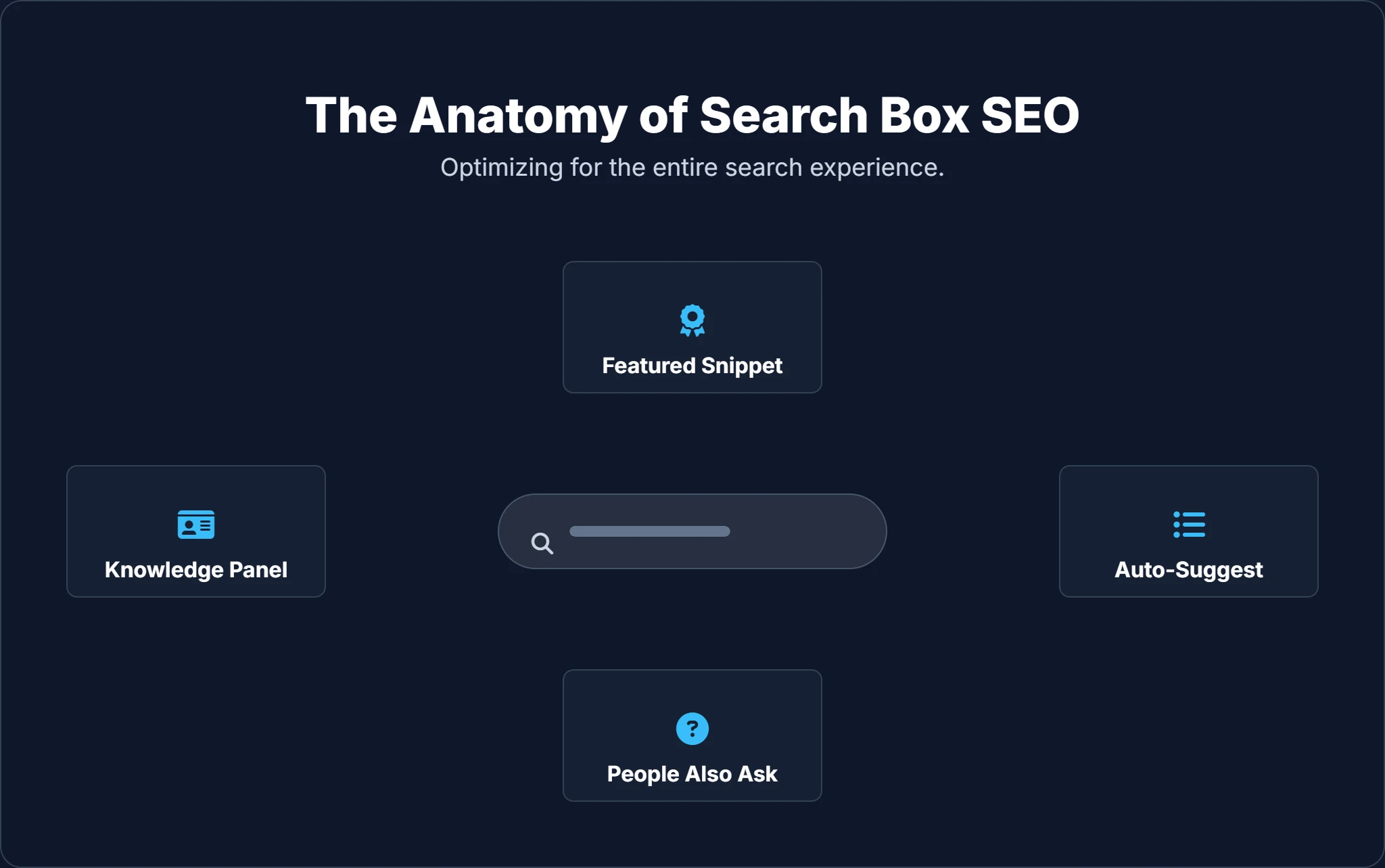
The "How": Unpacking How Search Box SEO Works
Understanding how search engines choose what to display in these coveted search box features is key to optimizing for them. It’s a sophisticated process driven by algorithms that analyze content for relevance, authority, structure, and user intent.
How do search engines identify the "best" answer? Search engines utilize advanced natural language processing (NLP) and machine learning to understand the context and intent behind a user's query. They then scan vast amounts of indexed content to find the most direct and comprehensive answer.
Let’s break down the primary types of search box features and how content generally earns a spot:
- Featured Snippets: These are often called "answer boxes" and appear at the very top of search results, above the traditional organic listings. They extract a direct answer from a webpage and display it prominently.
- How to appear: Content needs to directly answer a specific question concisely, often in a paragraph, list, or table format. Using clear headings, numbered lists, and well-structured paragraphs significantly increases your chances. Phrases like "What is X?", "How to do Y?", or "Best Z for A" are prime targets.
- People Also Ask (PAA): These are expandable boxes containing related questions that users frequently ask. Clicking on a question reveals a short answer, usually extracted from a webpage, along with a link to the source.
- How to appear: Anticipate follow-up questions related to your main topic. Structure your content with clear H2/H3 headings that are framed as questions, and then immediately follow them with concise, direct answers. Covering a topic comprehensively, addressing various user angles, is beneficial.
- Auto-Suggest & Predictive Search: As users type into the search bar, Google suggests completions or related queries. While not directly a "box" displaying content, optimizing for these suggestions means your target keywords are prominent enough for Google to associate with common search patterns.
- How to appear: Conduct thorough keyword research to understand common search queries and their variations. Ensure your content uses natural language and includes these long-tail keywords. This helps Google connect your content with user typing behavior.
- Knowledge Panels: These are information boxes that appear on the right side of Google’s search results (on desktop) for specific entities like people, places, organizations, or things. They compile information from various authoritative sources.
- How to appear: For businesses, ensuring your Google My Business profile is complete and accurate is crucial. Having a strong online presence with consistent information across authoritative directories and Wikipedia (if applicable) helps build the entity’s knowledge graph.
- Site Search (Internal Search Optimization): While external, don't overlook your own website's search box. A well-optimized internal search provides users with quick, relevant results, enhancing their experience and keeping them on your site.
- How to appear: Ensure your internal search functionality is robust. Use analytics to see what users are searching for on your site. Optimize your content and navigation based on these insights to ensure users find what they need.
The common thread across all these features is the pursuit of clarity, directness, and relevance. Content that is easy for algorithms to understand and directly answers user intent is most likely to win these coveted spots.
Why Bother? The Compelling Benefits of Mastering Search Box SEO
The effort invested in Search Box SEO yields significant returns, extending far beyond simple visibility. It directly impacts key business outcomes, offering advantages that traditional SEO might not always capture with the same immediate impact.
What are the tangible benefits?
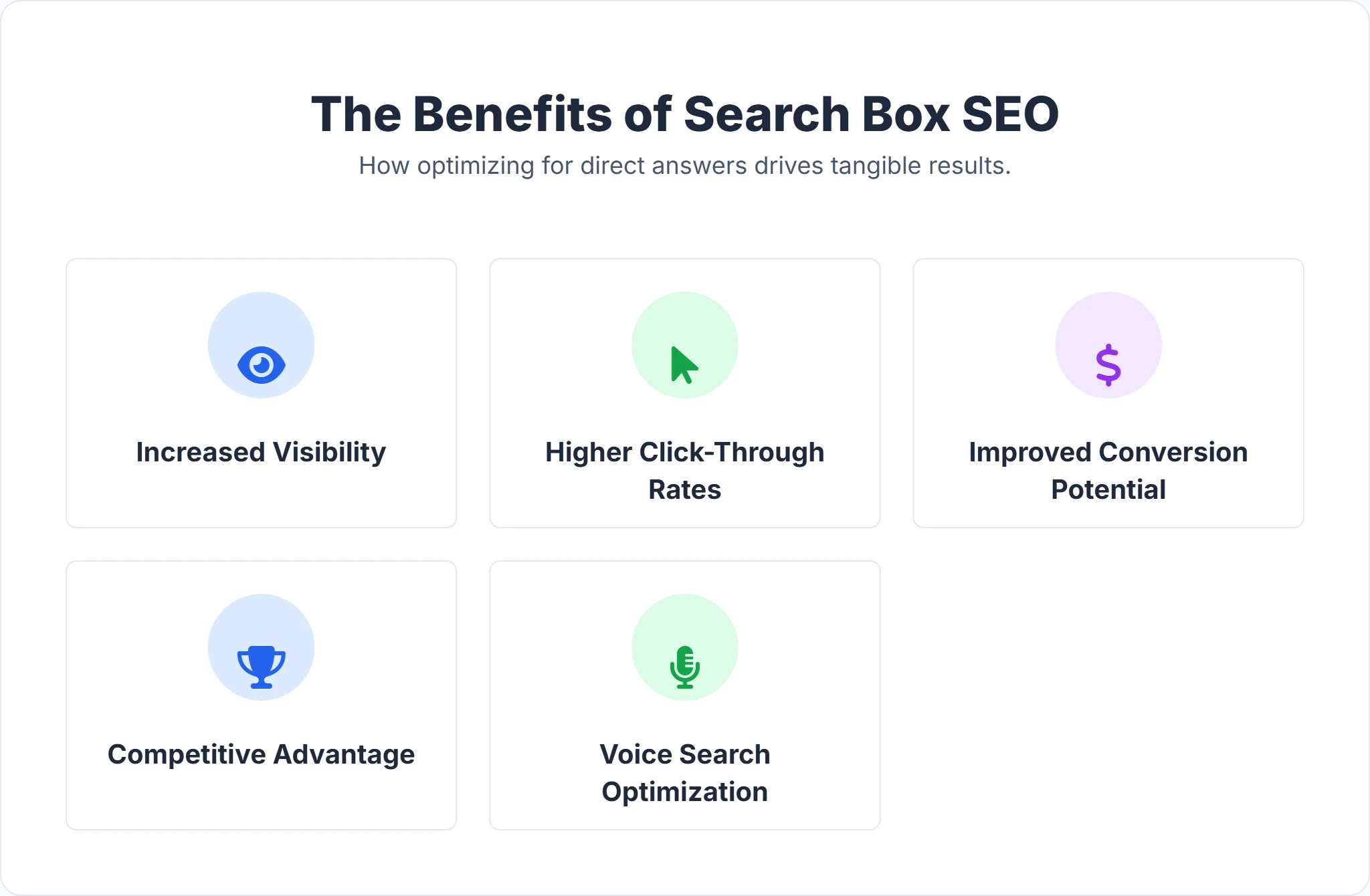
- Increased Visibility and Brand Authority: Securing a featured snippet or PAA spot positions your brand as an authoritative source of information. Appearing at the very top of the search results immediately boosts your visibility, making your brand synonymous with accurate answers. This enhanced presence cultivates trust and establishes your expertise within your niche.
- Higher Click-Through Rates (CTRs): While some argue that featured snippets can reduce clicks if the user gets the answer directly, studies often show that featured snippets still command a disproportionately high CTR compared to organic listings. Users often click through for more in-depth information or to verify the source. PAA boxes also entice clicks as users explore related questions.
- Improved Conversion Potential: When users arrive at your site from a featured snippet or PAA, they often have a highly specific intent. They've found an answer, and they're looking for the next step – perhaps more details, a product related to their query, or a service. This high-intent traffic is more likely to convert into leads or sales.
- Competitive Advantage: Many businesses are still primarily focused on traditional organic rankings. By actively pursuing Search Box SEO, you can leapfrog competitors and dominate valuable screen real estate, even if your page isn't the #1 organic result. This strategic move can differentiate your brand significantly.
- Voice Search Optimization: As voice search assistants (like Google Assistant, Siri, Alexa) become more prevalent, they often pull their answers directly from featured snippets and knowledge panels. Optimizing for search boxes inherently optimizes your content for voice search, tapping into a growing segment of users.
In essence, Search Box SEO is not just about getting more traffic; it's about getting better traffic – users with clear intent, seeking direct answers, and who are more likely to engage meaningfully with your brand.
Core Pillars of Search Box SEO: What You Need to Focus On
Achieving success in Search Box SEO requires a multi-faceted approach, integrating various SEO disciplines with a specific focus on answer-driven content. There are several critical components that form the foundation of this strategy.
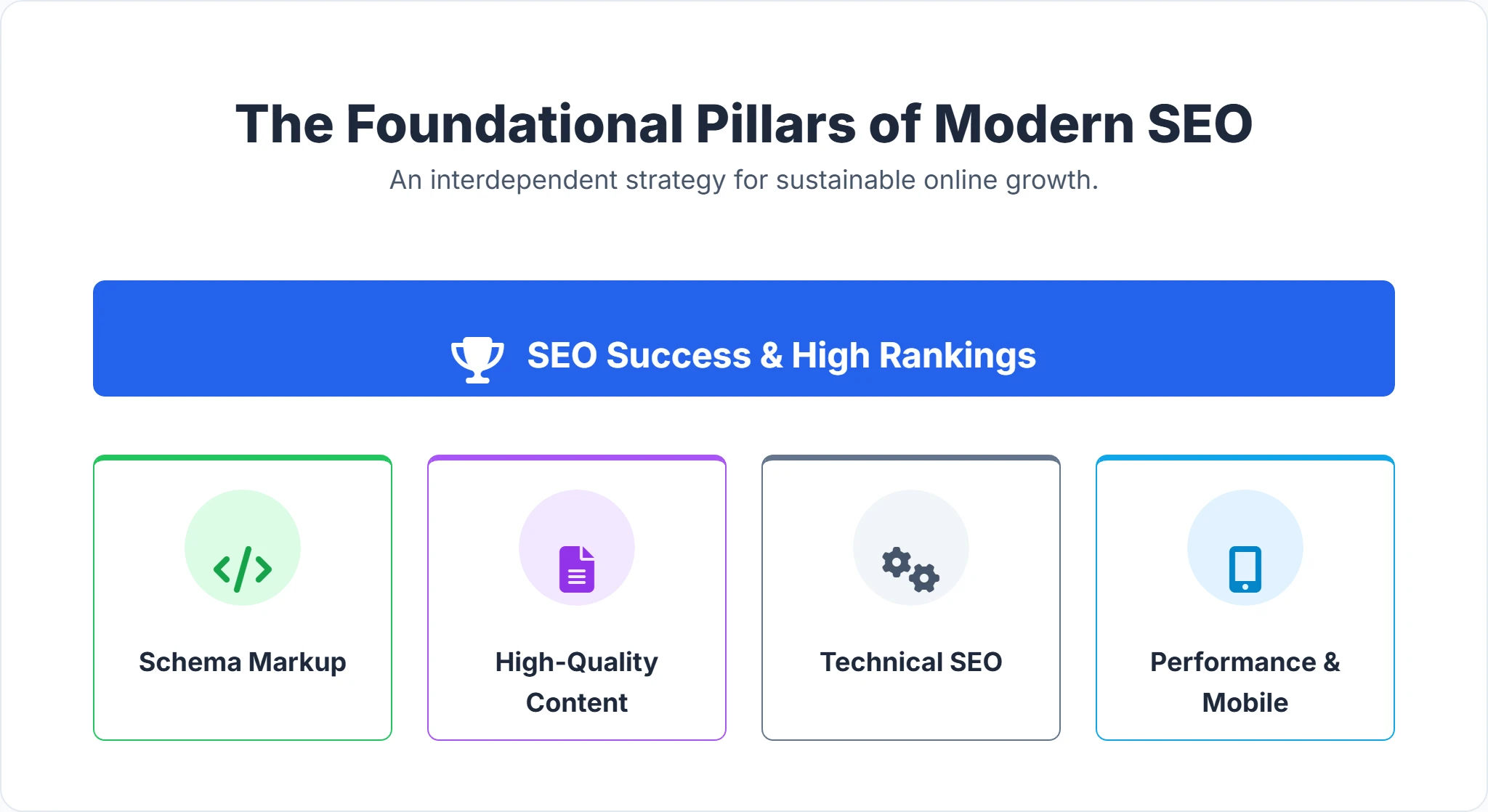
A. Schema Markup: Speaking Google's Language
What is Schema Markup? Schema markup, also known as structured data, is a semantic vocabulary of tags (or microdata) that you can add to your HTML to help search engines better understand the information on your webpage. It's not visible to users on the page itself but is crucial for search engine crawlers. By explicitly labeling different types of content – such as recipes, reviews, products, events, or FAQs – you provide context that helps search engines interpret your data more accurately.
How does Schema Markup help Search Box SEO?
When search engines understand the specific type of content on your page, they are better equipped to display it in rich results, which include featured snippets, knowledge panels, and other enhanced search experiences. For example, marking up an FAQ section with FAQPage schema can directly feed into "People Also Ask" boxes. Similarly, HowTo schema can help structure step-by-step instructions for featured snippets.
Platforms like Digispot AI offer robust tools to help businesses implement and validate various schema types effortlessly. These platforms simplify the complex process of structured data implementation, allowing you to accurately label your content without deep coding knowledge. This ensures that your valuable information is not only present but also perfectly understood by search engines, significantly boosting your chances of appearing in prominent search features.
B. High-Quality, User-Centric Content: The Answer Machine
Ultimately, a search box feature is only as good as the answer it provides. Therefore, the cornerstone of Search Box SEO is creating content that is incredibly high-quality, comprehensive, and directly answers user questions.
What constitutes user-centric content?
- Direct Answers: Provide concise, unambiguous answers to common questions within your content.
- Clarity and Simplicity: Use simple, straightforward language. Avoid jargon where possible.
- Comprehensive Coverage: Address a topic thoroughly, anticipating related questions and providing answers within the same content piece.
- Accuracy and Authority: Ensure your information is factually correct and backed by credible sources.
- Freshness: Keep your content updated to reflect current information and trends.
Think of your content as the ultimate resource for a specific query. If a user asks "how to tie a tie," your content should offer clear, step-by-step instructions that directly fulfill that need.
C. Technical SEO Excellence: The Foundation
Even the most brilliant content won't get noticed if search engines can't properly crawl, index, and understand your website. Technical SEO provides the underlying structure that enables your content to be discovered.
What aspects of Technical SEO are crucial?
- Crawlability and Indexability: Ensure your
robots.txtfile andsitemap.xmlare correctly configured, allowing search engine bots to easily find and index all your important pages. - Site Structure: A logical, hierarchical site structure with clear internal linking helps bots understand the relationships between your pages and the overall topical authority of your website.
- Security (HTTPS): A secure website (HTTPS) is a basic ranking factor and builds user trust, which indirectly influences engagement and positive signals.
- Duplicate Content: Identify and resolve any duplicate content issues that might confuse search engines and dilute your ranking potential.
D. Mobile-First and Page Performance: Speed is Key
Google operates on a mobile-first indexing principle, meaning it primarily uses the mobile version of your content for indexing and ranking. Furthermore, page speed is a confirmed ranking factor, especially for mobile users.
Why are these so important for Search Box SEO?
- Mobile-Friendliness: If your site isn't responsive and doesn't offer a seamless experience on mobile devices, Google will penalize it. Since many search box interactions happen on mobile, a poor mobile experience significantly reduces your chances.
- Page Load Speed: Users expect instant gratification. A slow-loading page provides a poor user experience, leading to higher bounce rates. Search engines prioritize fast-loading sites, knowing they contribute to user satisfaction. Optimizing images, leveraging browser caching, and minimizing code are essential for speed.
By focusing on these core pillars, businesses can create a robust framework that not only helps them rank higher in traditional search but also positions them strategically for the increasingly vital search box features.
Advanced Strategies for Dominating Search Boxes
Moving beyond the fundamentals, several advanced strategies can give you a significant edge in capturing search box real estate. These approaches involve deeper analysis and a more sophisticated understanding of user behavior and search engine algorithms.
A. Deep-Dive Keyword Research: Beyond the Obvious
For Search Box SEO, traditional keyword research needs an upgrade. Instead of just looking for high-volume keywords, you need to focus on question-based queries, long-tail keywords, and conversational phrases that align with how people naturally ask questions.
How to conduct deep-dive keyword research?
- Analyze "People Also Ask" boxes: These are goldmines for understanding related questions users are asking.
- Utilize "Searches Related To" at the bottom of Google results: This provides insights into broader related topics and questions.
- Use question-based keyword tools: Many SEO tools have features specifically designed to uncover "what," "how," "why," "when," and "where" queries.
- Examine forum discussions and customer support logs: What are your customers frequently asking? These are perfect candidates for content directly answering those needs.
- Study competitor's featured snippets: Identify which questions they are answering and how.
The goal is to unearth specific user questions that your content can answer more effectively than anyone else.
B. Intent Optimization: Understanding User Needs
Beyond keywords, truly understanding user intent is paramount. Are users looking for information, a product, a specific location, or to complete a transaction? Matching your content to this intent is crucial.
How to optimize for intent?
- Informational Intent: Provide comprehensive guides, definitions, and explanations. (e.g., "what is cryptocurrency?")
- Navigational Intent: Make sure your brand name and key pages are easily discoverable. (e.g., "Digispot AI login")
- Commercial Investigation Intent: Offer comparisons, reviews, and detailed product information. (e.g., "best AI SEO platform reviews")
- Transactional Intent: Ensure clear calls to action and easy purchasing processes. (e.g., "buy SEO software")
When your content perfectly aligns with the user's underlying goal, search engines are more likely to present it as the definitive answer.
C. Content Structuring for Scannability and Answers
The way you structure your content directly impacts its eligibility for search box features. Algorithms favor content that is easy to extract and present.
What makes content scannable and answer-ready?
- Clear Headings and Subheadings (H1, H2, H3): Use these to break down your content into logical, digestible sections. Frame them as questions or direct statements that answer a question.
- Concise Paragraphs: Keep paragraphs short, ideally 4-5 sentences, making them easier for algorithms to process for snippets.
- Bullet Points and Numbered Lists: These are highly favored for featured snippets, especially for "how-to" guides or lists of benefits.
- Definition Boxes: If you're defining a term, put the definition in a clear, distinct paragraph directly after the term, perhaps in bold.
- Use Tables: Tables are excellent for comparing data or summarizing information, making them prime candidates for table-based featured snippets.
D. Monitoring, Analysis, and Continuous Improvement
Search Box SEO is not a "set it and forget it" strategy. It requires ongoing monitoring, analysis, and refinement to maintain and improve your positions.
How to monitor and improve?
- Track Featured Snippets and PAA Rankings: Use SEO tools to identify which of your pages are appearing in these features and for which queries.
- Analyze Google Search Console Data: Look at "Performance" reports to see which queries bring impressions and clicks, paying special attention to those generating rich results. Integration with tools like Google Search Console and Google Analytics is paramount for this, a feature seamlessly offered by platforms such as Digispot AI, which helps you track and improve performance by auditing websites in both mobile and desktop modes. Digispot AI helps identify issues and offers solutions, analyzing sites for 300+ ranking factors, including content, technical SEO, local SEO, and page performance. This comprehensive analysis allows for targeted improvements based on tangible data.
- Click-Through Rate (CTR) Analysis: For pages appearing in snippets, evaluate their CTR. If it's low, refine the snippet text (if you have control) or the content to be more enticing.
- Regular Content Audits: Periodically review your content for accuracy, freshness, and opportunities to improve structure or add more direct answers.
E. Opportunity Finder and Content Studio: Unleashing AI Power
Modern AI-powered SEO platforms are revolutionizing how businesses approach Search Box SEO, offering tools that streamline and enhance these complex processes.
How do AI tools help? This is where innovative features like an "Opportunity Finder" become invaluable, helping you spot untapped potential within the search landscape. By analyzing vast amounts of data, an AI-driven opportunity finder can identify specific questions or topics that are being searched frequently but lack high-quality, snippet-worthy answers. It pinpoints the gaps where your content can make a significant impact.
Complementing this, a "Content Studio," such as the one offered by Digispot AI, empowers you to generate SEO-optimized content using AI agents, ensuring your material is perfectly tailored for search box visibility. These AI agents can assist in drafting concise answers, structuring content for snippets, and ensuring all relevant keywords and schema elements are incorporated. This accelerates content creation while maintaining the high standards required for search box success.
By embracing these advanced strategies and leveraging the power of AI, businesses can not only compete but truly dominate the interactive features of modern search engines.
The AI Advantage: How Intelligent Platforms are Revolutionizing Search Box SEO
The sheer volume of data, the complexity of search algorithms, and the constant evolution of user queries make manual Search Box SEO a daunting task. This is where Artificial Intelligence (AI) steps in, transforming how businesses approach and succeed in this specialized domain.
How does AI give you an edge? AI-powered platforms bring an unparalleled level of analysis, automation, and predictive capability to the SEO table. They can process and interpret massive datasets much faster and more accurately than humans, identifying patterns and opportunities that might otherwise go unnoticed.
- Advanced Data Analysis: AI algorithms can analyze countless search queries, competitor content, and ranking factor correlations to pinpoint exactly what type of content and structure is most likely to win a featured snippet for a given query. Digispot AI, for instance, operates by analyzing over 300+ ranking factors, including content, technical SEO, local SEO, and page performance. This comprehensive analysis allows it to provide insights and identify issues that are critical for search box optimization.
- Content Generation & Optimization: As mentioned with the Content Studio feature, AI agents can assist in generating highly optimized content, drafting answers concisely, and ensuring the integration of relevant keywords and schema markup, all tailored for search box visibility. This not only saves time but also ensures consistency and adherence to best practices.
- Real-time Monitoring & Alerts: AI can continuously monitor your rankings for various search box features and alert you to changes, new opportunities, or instances where a competitor has taken your snippet. This allows for rapid response and adjustment.
- Schema Markup Automation: Implementing complex schema correctly can be challenging. AI tools can suggest and even automatically generate appropriate schema markup based on your content, vastly simplifying this critical step.
- Predictive Analytics: AI can analyze trends and predict future search behavior, helping you create content that will be relevant for upcoming queries and shifts in user intent, keeping you ahead of the curve.
By integrating AI into their SEO strategy, businesses can achieve higher accuracy, greater efficiency, and a more proactive approach to securing prominent positions in search box features. It democratizes access to sophisticated SEO capabilities, allowing even smaller businesses to compete effectively in the modern search landscape.
Your Free Companion: The Digispot AI Community Chrome Extension
Navigating the complexities of SEO, especially when targeting dynamic search features, can seem overwhelming. But what if you could have powerful SEO auditing capabilities right at your fingertips, as you browse any webpage? This is precisely what the Digispot AI community offers with its free Chrome extension.
This powerful extension, powered by popular LLM models, brings advanced auditing capabilities right into your browser. Imagine instantly auditing your website page for critical SEO elements, detecting potential issues, and even visualizing how your content might appear in search features – all while browsing. This democratizes access to powerful insights that typically require specialized tools.
What can the Digispot AI Chrome Extension do for you?
- Instant Page Audit: Get an immediate overview of a page's SEO health, identifying common issues that might hinder its performance in both organic and search box rankings.
- Issue Detection: The extension actively helps detect crucial problems related to content, technical SEO, and on-page optimization that could prevent your content from winning featured snippets or PAA positions.
- Schema Markup Support: A key highlight is its robust support for schema markup. The extension allows you to not only audit existing schema on any page but also helps detect whether structured data is present and provides a visualization of how it's interpreted. This is invaluable for ensuring your content is speaking Google's language correctly, a cornerstone of Search Box SEO.
- Content Visualization: Gain insights into how search engines might perceive your content, helping you structure it more effectively for featured snippets and other rich results.
- Accessibility: As a free community tool, it makes essential SEO auditing accessible to everyone, from individual content creators to marketing teams looking for quick insights.
This extension is designed to empower you with immediate, actionable insights, helping you to refine your content and technical setup for better search engine visibility. It's a testament to the idea that powerful SEO tools can be both effective and user-friendly, putting control directly into the hands of website owners and marketers.
Practical Application: Implementing Search Box SEO in Your Business
Now that we've covered the what, how, and why, how can you practically integrate Search Box SEO into your existing strategy? Here's a step-by-step approach:
- Identify Opportunities:
- Start by looking at your current high-ranking pages. Do they answer specific questions?
- Use keyword research tools and "People Also Ask" sections to find new questions relevant to your business that you're not currently answering.
- Analyze competitor snippets – what are they winning, and can you do it better?
- Audit Your Existing Content:
- Use tools like the Digispot AI Chrome Extension to quickly audit pages for existing schema, content structure, and potential issues.
- Look for paragraphs that could be rewritten as concise, direct answers.
- Identify opportunities to add lists, tables, or definition boxes.
- Create Answer-Focused Content:
- For new content, always start with specific questions in mind. Frame your headings as questions and provide immediate, direct answers.
- Ensure clarity, conciseness, and accuracy in all your responses.
- Consider different content formats: blog posts, FAQs, how-to guides, glossaries.
- Implement and Validate Schema Markup:
- Use relevant schema types (e.g.,
FAQPage,HowTo,Recipe,Product,Organization) on your pages. - Utilize an SEO platform or validator tool to ensure your schema is correctly implemented and free of errors. The Digispot AI platform and its extension can assist significantly here.
- Use relevant schema types (e.g.,
- Optimize Technical Foundations:
- Regularly check your site for mobile-friendliness, page speed, crawl errors, and secure HTTPS. A fast, accessible site is fundamental.
- Monitor and Iterate:
- Track your performance in Google Search Console for "rich results."
- Monitor which queries trigger snippets and PAA boxes for your site.
- Continuously refine your content based on performance data and new opportunities. Search engines are always evolving, and so should your strategy.
By systematically applying these steps, you can start to capture valuable search box real estate, driving more targeted traffic and establishing your brand as a go-to authority.
Key Elements for Search Box SEO Success
| Issue | Explanation | Potential Solution (Digispot AI's Role) |
|---|---|---|
| Slow Page Load Speed | Pages take too long to load, leading to high bounce rates and poor user experience. | Identify large image files, unoptimized code, or server issues. Digispot AI's audit feature could flag these performance bottlenecks, showing you exactly what's slowing your site down. |
| Not Mobile-Responsive | Website content and layout don't adapt well to different screen sizes, making it difficult to use on phones/tablets. | Digispot AI's audit can highlight non-responsive design elements and recommend adjustments to ensure a seamless mobile experience, identifying issues in both mobile and desktop modes. |
| Missing/Incorrect Schema Markup | Structured data isn't present or contains errors, preventing search engines from fully understanding your services (e.g., pharmacy hours, accepted insurance). | Digispot AI's Chrome extension helps detect missing or incorrectly implemented schema. Its visualization feature can show you how your structured data should appear to search engines, guiding you to correct errors and improve rich snippet potential. |
| Broken Links (404 Errors) | Links on your site lead to non-existent pages, frustrating users and signaling to search engines that your site isn't well-maintained. | Digispot AI's detection capabilities would automatically scan your site for broken links, providing a list of URLs that need fixing, thus improving site health and user experience. |
| Duplicate Content | Identical or very similar content appears on multiple pages of your site or across different domains, confusing search engines about which version to rank. | Digispot AI can help identify instances of duplicate content, allowing you to consolidate, rewrite, or use canonical tags to tell search engines which version is the authoritative one. |
| Poor Site Structure | Your website is difficult to navigate, with no clear hierarchy of pages, making it hard for users and crawlers to find information. | Digispot AI's audit could analyze your internal linking structure and suggest improvements for a more logical and user-friendly site hierarchy, helping you organize your content effectively. |
Conclusion: Mastering the Search Box, Mastering the Future
The evolution of search engines has moved beyond simply listing web pages to actively answering user questions. This shift has given rise to Search Box SEO – a crucial discipline for any business aiming to thrive in the modern digital landscape. By understanding what these search features are, how they work, and the profound benefits they offer, you position your brand at the forefront of user discovery.
From meticulous content creation and the strategic implementation of schema markup to robust technical SEO and the transformative power of AI platforms, every element plays a vital role. Tools like the Digispot AI platform provide businesses with comprehensive insights into over 300+ ranking factors, helping them identify issues and craft SEO-optimized content. Furthermore, the free Digispot AI community Chrome extension democratizes access to powerful auditing, detection, visualization, and schema markup support, putting valuable insights directly into the hands of users.
Embracing Search Box SEO is not just about chasing new trends; it's about aligning with the fundamental way people interact with information online. By focusing on providing direct, concise, and accurate answers, you not only improve business visibility and increase traffic but also enhance user experience and secure a competitive advantage. The future of search is conversational, intelligent, and immediate. Mastering the search box today means mastering the future of digital presence.
Related deep-dives
Continue with these closely related guides:
- data schema seo — Data Schema SEO: Boost Visibility with Structured Data
- to validate — How to Validate and Test Schema Markup: The Expert's Guide to Error-Free Structured Data
- deepseek search optimization — DeepSeek Search Optimization: The Complete AEO Guide for 2026
References
- Featured Snippets and Your Website | Google Search Central
- Intro to How Structured Data Markup Works | Google Search Central
- Learn About Article Schema Markup | Google Search Central
- Mobile-first Indexing Best Practices | Google Search Central
- How to evaluate and improve page speed - Moz
- Performance report (Search results) - Search Console Help | Google Help
- About knowledge panels - Google Help
- A reintroduction to our Knowledge Graph and knowledge panels - Google Blog
- What Is People Also Ask? 5 Ways To Optimize For PAA - Surfer SEO
- Digispot AI - FREE On Page SEO Audit Tool
- Digispot AI - FREE Chrome Extension for SEO Insights
Audit any page in seconds
300+ SEO checks including Core Web Vitals, schema markup, meta tags, and AI readiness — trusted by 1000+ SEO experts and marketers.
Frequently Asked Questions
Here are some of our most commonly asked questions. If you need more help, feel free to reach out to us.
Written by
Maya Krishnan
Digital growth expert
Maya is a seasoned expert in web development, SEO, and digital strategy, dedicated to helping businesses achieve sustainable growth online. With a blend of technical expertise and strategic insight, she specializes in creating optimized web solutions, enhancing user experiences, and driving data-driven results. A trusted voice in the industry, Maya simplifies complex digital concepts through her writing, empowering readers with actionable strategies to thrive in the ever-evolving digital landscape.