Dental SEO Guide: Attract More Patients 2026
Master dental SEO to attract more patients in 2026. Learn local optimization, Google Business Profile setup, and content strategies for dental practice growth.
 Maya Krishnan
A clinical skillset effectively invisible to the community serves no one. Even the most advanced dental practice will struggle if patients cannot find it when they are in pain or looking for a checkup. As we move into 2026, relying solely on word-of-mouth is a risky strategy. You need a robust digital infrastructure that captures patient intent at the exact moment they need care.
This guide provides the tactical knowledge to dominate search engine rankings and position your practice as the primary choice for local dental care.
Why Dental SEO Determines Practice Growth
Consider the patient journey today. When a person chips a tooth or decides it's finally time for Invisalign, their first instinct is almost always a search engine query. If your website operates like a clinic on a hidden backstreet without signage, you lose that patient to a competitor immediately.
Search Engine Optimization (SEO) acts as your digital signage. It directs high-intent traffic—people actively looking for solutions—straight to your booking page. Unlike paid ads, which stop working the moment you stop paying, SEO builds a sustainable asset that compounds over time.
For dental professionals, SEO is largely synonymous with Local SEO and Answer Engine Optimization (AEO). You aren't just competing for clicks; you are competing for visibility in AI overviews (like ChatGPT or Gemini) and Google's "Local Pack"—the map listings that appear for "dentist near me." Failing to optimize here means ignoring the 80%+ of patients who start their search online.
The Core Ranking Signals
Google and AI search engines prioritize three specific signals when ranking local businesses:
- Relevance: Does your practice actually solve the searcher's problem? If they search for "emergency root canal," does your site explicitly mention emergency services and endodontics?
- Distance: Proximity is critical. Search engines favor practices geographically closer to the user, especially for mobile searches.
- Prominence: This measures your offline reputation in the online world. It aggregates review sentiment, citation consistency, and overall authority.
On-Page Optimization: Your Digital Interior Design
On-page SEO ensures your website communicates clearly with search engine crawlers while remaining welcoming to human visitors. It is the foundation upon which all other marketing efforts rest. For a detailed breakdown of these mechanics, review our guide to on-page SEO best practices.
Keywords: Aligning with Patient Intent
Keywords are the bridge between a patient's problem and your solution. However, effective strategy goes beyond generic terms. You must understand the intent behind the search.
Execute Targeted Keyword Research
Tools like SEMrush or the Digispot AI platform allow you to uncover what local patients are actually typing. You want to mix high-volume terms with specific, high-intent phrases:
- Transactional: "Emergency dentist [City Name]" (User needs immediate help)
- Informational: "How much do dental implants cost?" (User is researching)
- Navigational: "Directions to [Your Practice Name]" (User is ready to visit)
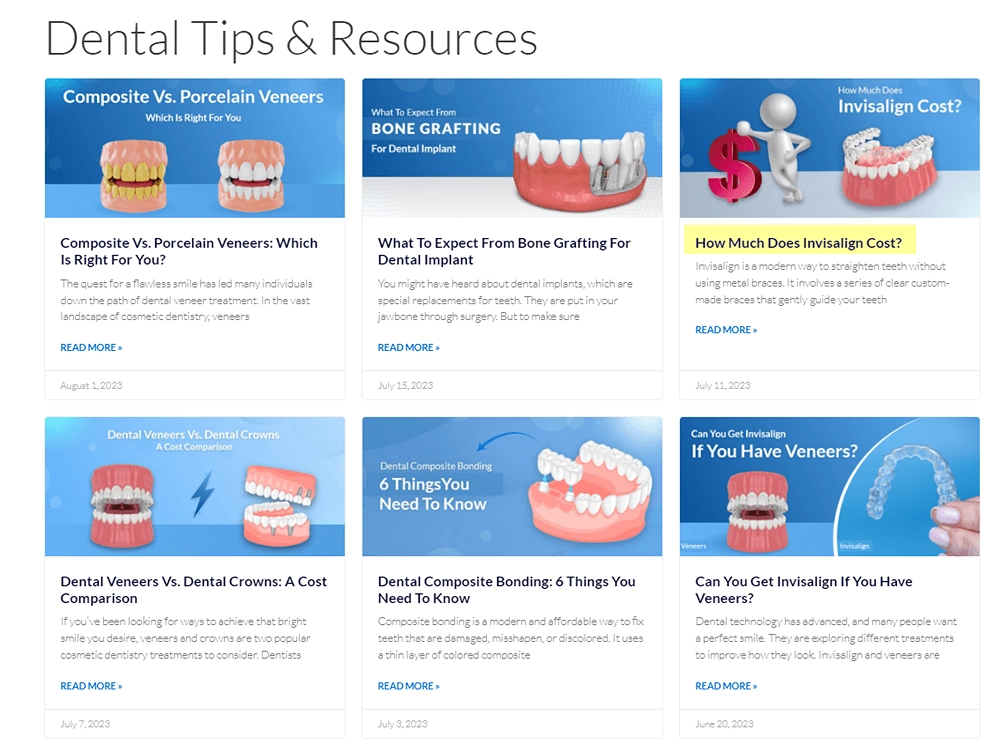
LA Dental Clinic serves as a prime example of intent matching. By creating a dedicated page answering "how much does invisalign cost," they capture users in the research phase. This establishes trust early, making those users more likely to book an appointment when they decide to proceed.
Strategic Placement Without Spamming
Once you identify your keywords, place them where they carry the most weight. Search engines look at specific zones to determine what a page is about:
- Page Titles: The most critical element. Format it as "Service Name | City | Practice Name".
- Meta Descriptions: While not a direct ranking factor, a compelling description improves Click-Through Rate (CTR).
- Headings (H1-H6): Use these to outline your content. Your H1 should always include the primary topic of the page.
Avoid the Keyword Stuffing Trap
Creating content that reads "Best dentist in Seattle looking for a dentist in Seattle for teeth cleaning" is a fast track to a penalty. Modern algorithms, including Google's Gemini and DeepSeek, understand natural language. Focus on context and helpfulness. If you write naturally for the patient, the keywords will often fit automatically.
Links: establishing Authority and Flow
Links serve as the nervous system of the web. They transfer value (often called "link juice") from one page to another, signaling importance and relationship.
Internal Linking Strategy
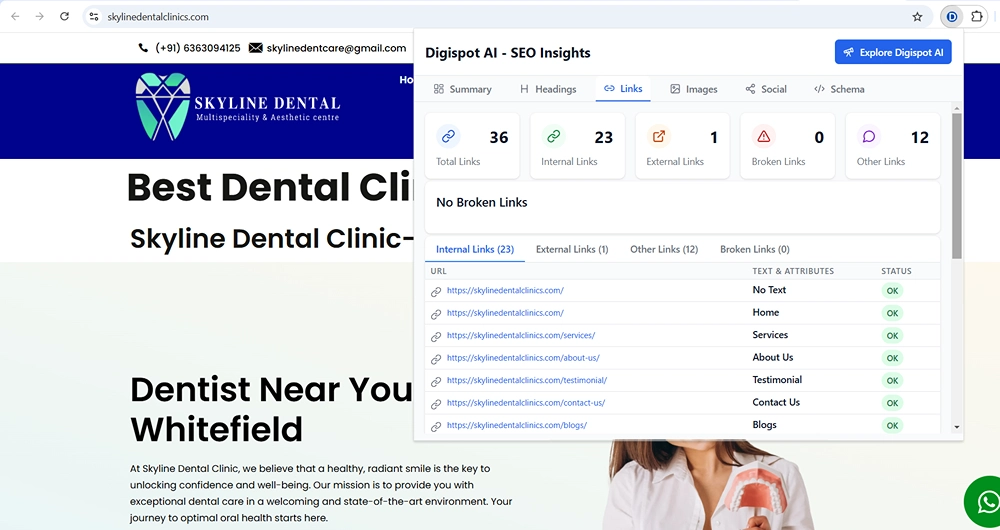
Internal links connect your own pages to one another. This is crucial for distributing authority from your homepage to your specific service pages. For example, your blog post about "The Benefits of Whitening" should link directly to your "Teeth Whitening Service" page. This guides the user toward conversion and helps crawlers index your deeper content. You can learn more about structuring these pathways in our internal linking strategy guide.
Outbound Citations
Linking to authoritative sources, such as the American Dental Association (ADA) or reputable medical journals, builds trust. It shows search engines that your content is well-researched and factually accurate, which is a key component of E-E-A-T (Experience, Expertise, Authoritativeness, and Trustworthiness).
Comprehensive link analysis for Skyline Dental Clinics' website, showcasing internal, external, and broken links for optimized navigation and user experience.
User Experience (UX): Speed and Stability
Google's "Page Experience" update made UX a direct ranking factor. If a patient visits your site on a phone while in pain, and the page takes 10 seconds to load, they will bounce back to the search results. This "bounce" signals to Google that your site is not a good result.
- Mobile-First Indexing: Google predominantly indexes the mobile version of your site. If your site isn't responsive, you are invisible.
- Core Web Vitals: These metrics measure loading performance (LCP), interactivity (FID/INP), and visual stability (CLS). A site that shifts around while loading frustrates users and lowers rankings. To master these technical metrics, read our Core Web Vitals guide.
- Clear Calls to Action (CTAs): Ensure "Book Appointment" or "Call Now" buttons are sticky and visible on every screen size.
Get instant SEO insights on any page, including Core Web Vitals performance, with our free Chrome extension.
Local SEO: Dominating the Map Pack
For most dental practices, Local SEO delivers the highest ROI. This is about capturing the "near me" searches.
Google Business Profile (GBP): Your Primary Asset
Your GBP is effectively your second homepage. It is often the only thing a user looks at before calling.
- Verification: Ensure you own the profile. Unverified listings are vulnerable to edits by competitors or the public.
- Completeness: Fill every field. This includes attributes like "Wheelchair accessible," "Gender-neutral restroom," or "LGBTQ+ friendly." These attributes can trigger specific voice search results.
- Active Management: Treat GBP like a social media feed. Post weekly updates about open slots, new technology, or staff birthdays.
- Q&A Section: Monitor the "Questions & Answers" section. Often, questions go unanswered or are answered incorrectly by the public. Pre-populate this section with your own FAQs.
NAP Consistency: Building Trust Signals
NAP (Name, Address, Phone Number) consistency is a fundamental trust signal. If your website says "Suite 100" but Yelp says "Ste 100" and Facebook lists "Unit 100," search engines get confused.
- Audit your citations across the web.
- Use a standard format (e.g., always "St." or always "Street").
- Fix discrepancies immediately, especially after moving locations or changing phone numbers.
Expanding Directory Presence
While GBP is king, other directories validate your existence. Being listed on Healthgrades, Vitals, and even general directories like YellowPages strengthens your local authority. These mentions act as "citations." The more consistent citations you have from reputable sources, the more Google trusts your location data.
Content Marketing: Demonstrating E-E-A-T
Content is how you demonstrate expertise. In the healthcare sector, Google applies strict "Your Money or Your Life" (YMYL) standards. Your content must be accurate, authoritative, and safe.
Blogging with Purpose
Don't just blog to fill space. Use your blog to answer the specific questions your patients ask in the chair. This aligns perfectly with AEO (Answer Engine Optimization), as AI tools often pull answers from clear, direct blog content.
High-Value Content Concepts:
- Procedure Walkthroughs: "What to expect during a root canal" (reduces patient anxiety).
- Cost Breakdowns: Explain insurance vs. out-of-pocket costs transparently.
- Post-Op Care: "Foods to eat after wisdom teeth removal."
- Local Community: Highlight your sponsorship of the local little league. This reinforces local relevance.
For a deeper dive into establishing your medical authority online, refer to our E-E-A-T SEO guide.
Link Building: Digital Endorsements
A backlink is a vote of confidence. However, in dental SEO, quality trumps quantity. One link from a local university or the Chamber of Commerce is worth more than 100 links from generic directories.
Tactical Link Building Strategies:
- Local Sponsorships: Sponsor a local 5K run or school event. These organizations often link to sponsors on their "Partners" page. This sends a powerful hyper-local signal to Google.
- Guest Expertise: Offer to write a column on oral health for a local lifestyle magazine or newspaper website.
- Unlinked Mentions: Use tools to find news articles that mention your practice name but don't link to you. Email the journalist politely asking for the link.
Technical SEO: The Hidden Infrastructure
Technical SEO ensures that search engines can crawl, index, and understand your content without obstruction. It is the plumbing of your website.
Structured Data: Speaking Google's Language
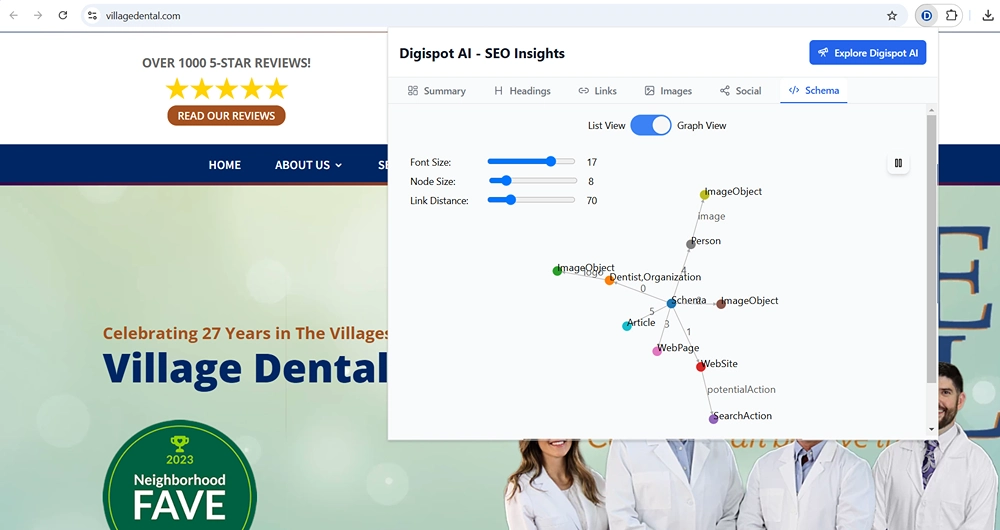
Schema markup is code that you add to your website to help search engines return more informative results for users. For dentists, Dentist schema and LocalBusiness schema are mandatory.
You can explicitly tell Google:
- "This is a review."
- "These are our opening hours."
- "We accept these insurance plans."
When implemented correctly, this can lead to "Rich Snippets"—stars appearing next to your name in search results, which dramatically increases clicks.
Use the free Schema Markup Generator to create valid structured data for your dental practice in minutes.
Schema markup implementation for Skyline Dental Clinics' website, enhancing search engine visibility and rich result opportunities.
Security and Speed
- HTTPS: A "Not Secure" warning in the browser bar is a conversion killer for medical practices asking for personal data. Ensure your SSL certificate is valid.
- Image Compression: Dental websites are image-heavy (before/after photos, facility tours). Use next-gen formats like WebP to keep file sizes low without losing quality.
Regular Technical Audits
The web changes constantly. A link that worked last month might be broken today. Regular audits catch these issues before they impact your rankings. Look for:
- 404 errors (Broken links).
- Duplicate content issues.
- Missing alt text on images.
- Orphan pages (pages with no internal links pointing to them).
For a complete list of items to check, save our 2026 SEO audit checklist.
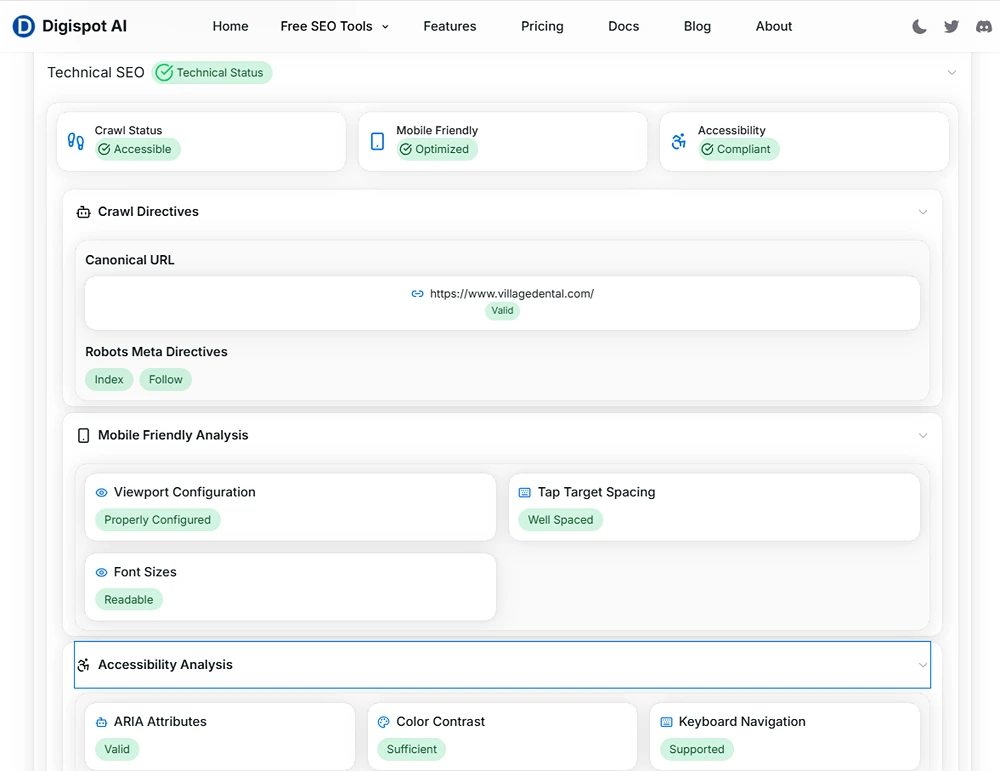
Digispot AI can help you identify and fix these issues automatically with AI-powered audits analyzing 300+ ranking factors.
Measuring Your Success: Data-Driven Decisions
You cannot improve what you do not measure. SEO is not a "set and forget" task; it requires constant monitoring.
Key Performance Indicators (KPIs)
- Organic Traffic: Are more people finding you through Google?
- Keyword Rankings: Are you moving up for "invisalign [city]"?
- Conversion Rate: Traffic is vanity; appointments are sanity. How many visitors actually fill out the "Request Appointment" form?
- Call Tracking: Use dynamic number insertion to track which calls come from organic search versus ads or social media.
The Tool Stack
- Google Search Console: The source of truth for indexing issues and click data.
- Google Analytics 4 (GA4): Understand user behavior and conversion paths.
- Digispot AI: For a holistic view that combines traditional ranking data with AI visibility metrics and technical health monitoring.
When to Hire a Dental SEO Agency
Many dentists manage their own basic SEO, but scaling usually requires professional help. If you find yourself spending more time on meta tags than patient charts, it is time to outsource.
An agency or specialized platform brings:
- Continuity: SEO requires consistency. Agencies don't take sick days or get distracted by clinical emergencies.
- Advanced Tools: Enterprise-level tools are expensive for a single practice to maintain.
- Crisis Management: If a Google algorithm update tanks your rankings, experts know how to recover quickly.
Start Improving Your Patient Acquisition Today
Investing in dental SEO is not an expense; it is the construction of a patient acquisition pipeline that you own. Unlike paid leads that vanish when the budget runs out, a high-ranking website and a stellar Google Business Profile continue to deliver new patients for years.
By methodically implementing the strategies above—optimizing your GBP, creating helpful content, securing local links, and maintaining technical health—you secure your practice's future in an increasingly digital world.
Ready to improve your search visibility? Try Digispot AI for comprehensive website audits and actionable recommendations that simplify the complexities of modern SEO.
Related deep-dives
Continue with these closely related guides:
- doctor profile optimization — Doctor Profile Optimization: A Complete SEO Guide
References and Additional Resources
Audit any page in seconds
300+ SEO checks including Core Web Vitals, schema markup, meta tags, and AI readiness — trusted by 1000+ SEO experts and marketers.
Frequently Asked Questions
Here are some of our most commonly asked questions. If you need more help, feel free to reach out to us.
Written by
Maya Krishnan
Digital growth expert
Maya is a seasoned expert in web development, SEO, and digital strategy, dedicated to helping businesses achieve sustainable growth online. With a blend of technical expertise and strategic insight, she specializes in creating optimized web solutions, enhancing user experiences, and driving data-driven results. A trusted voice in the industry, Maya simplifies complex digital concepts through her writing, empowering readers with actionable strategies to thrive in the ever-evolving digital landscape.