Patient Acquisition SEO: Healthcare Marketing Guide
Drive patient acquisition through healthcare SEO. Learn local optimization, content strategies, and digital marketing tactics to grow your medical practice.
 Maya Krishnan
The digital waiting room is open, and countless patients are actively searching for the specific care you provide. But are they finding you? In a healthcare environment increasingly driven by consumer choice, a strong online presence isn't just a competitive advantage—it is an operational necessity. Welcome to the strategic world of Patient Acquisition SEO, a methodology designed to connect your medical practice with individuals who need your expertise at the precise moment of their intent.
This approach moves beyond generic marketing tactics. It is about engineering your practice's discoverability to be trustworthy, accessible, and prominent. By mapping your digital presence to the modern patient journey, you transform your website from a static brochure into a dynamic engine for new appointments and long-term patient relationships.
What Exactly is Patient Acquisition SEO?
Patient Acquisition SEO (Search Engine Optimization) is a specialized branch of digital marketing dedicated to maximizing a healthcare organization's visibility on search engines like Google, Bing, and emerging AI-driven platforms. Its primary objective is to capture high-intent traffic—people actively looking for medical help—and convert them into scheduled patients by ranking for queries related to symptoms, conditions, treatments, and local specialists.
Consider the user intent: when a parent types "urgent care for high fever near me" or a patient asks "non-surgical back pain relief [city]," they are essentially raising their hand for help. Patient Acquisition SEO uses a sophisticated blend of technical site health, authoritative content, and local signaling to ensure your practice is the first hand that reaches back.
Why is this critical for modern healthcare?
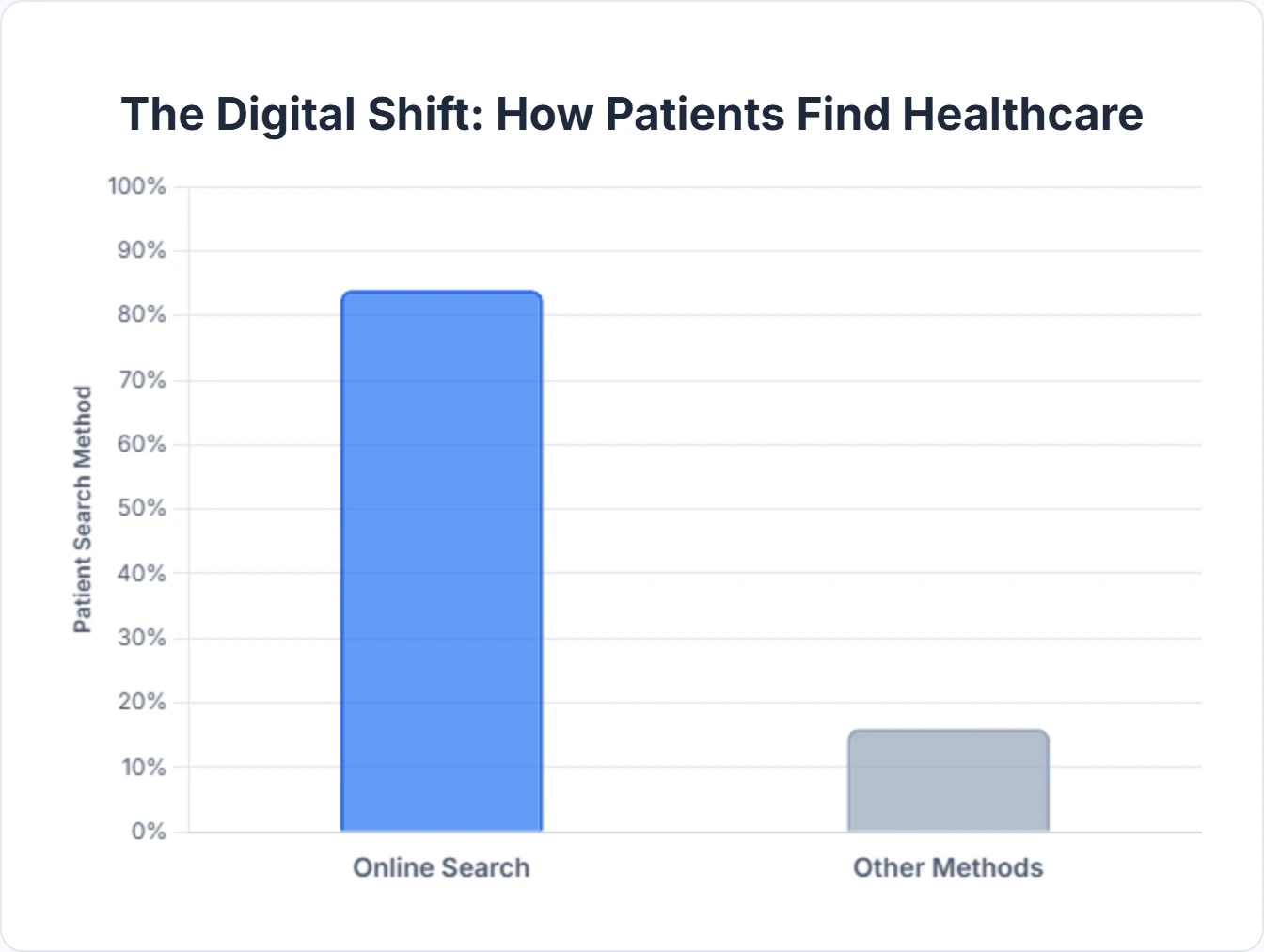
The pathway to finding a provider has shifted fundamentally. While word-of-mouth remains valuable, digital search has become the primary gateway to care. Studies indicate that over 80% of patients initiate their provider search online. They research symptoms, validate doctor credentials, read reviews, and compare distance before ever picking up the phone. If your practice does not align with this digital behavior, you effectively remain invisible to the vast majority of your potential market.
Furthermore, search engines hold healthcare websites to higher standards. Google classifies medical sites as "YMYL" (Your Money Your Life) pages, meaning they can impact a user's future health, happiness, or financial stability. Consequently, your SEO strategy must not only aim for visibility but also demonstrate rigorous expertise and authority to satisfy these elevated quality algorithms.
The Core Pillars of Patient Acquisition SEO
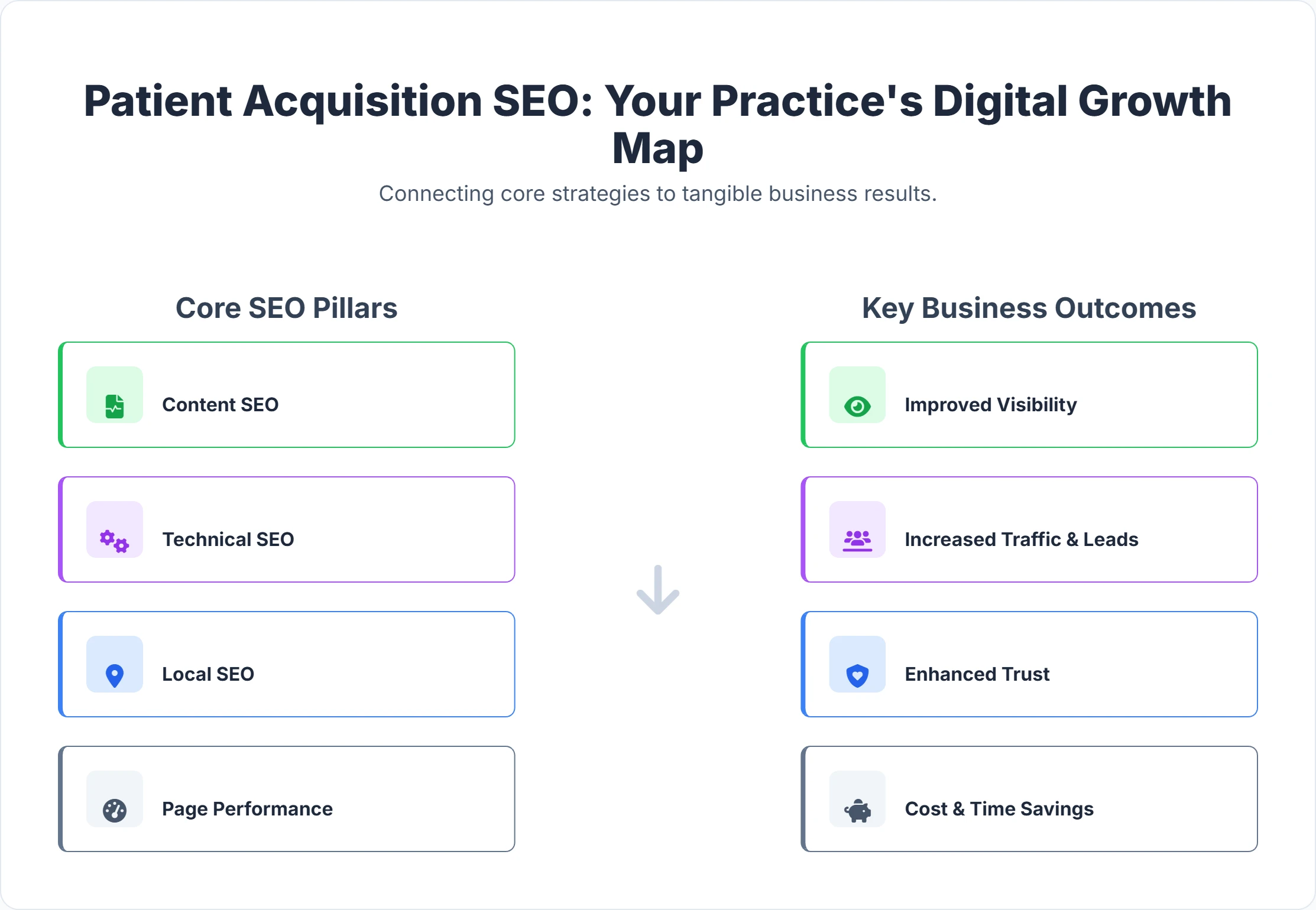
Building a dominant online presence requires a multi-dimensional strategy. Patient Acquisition SEO is supported by four foundational pillars, each working in concert to signal relevance and trust to search engines.
1. Content SEO: Establishing Medical Authority
Content serves as the bridge between patient questions and your clinical answers. In the realm of healthcare, content must do more than rank; it must reassure, educate, and guide. High-quality content establishes your practice as a subject matter expert, which is a critical component of Google's E-E-A-T (Experience, Expertise, Authoritativeness, and Trustworthiness) framework.
Essential Content Types for Patient Acquisition:
- Educational Condition Pages: Develop comprehensive guides for the conditions you treat. An orthopedic group, for example, should have deep-dive pages on "Rotator Cuff Tears" covering symptoms, diagnosis, and surgical vs. non-surgical options. This demonstrates depth of knowledge.
- Treatment and Service Hubs: Create detailed landing pages for every specific service. Instead of a generic "Services" list, build individual pages for "MRI Scans," "Physical Therapy," and "Preventative Cardiology." This allows you to target specific keywords for each offering.
- Patient-Centric FAQs: Address the anxieties and logistical questions patients have. "Do I need a referral?" or "What acts as a valid insurance proof?" These practical queries often capture users at the decision stage.
- Physician Profiles: Your doctors are your brand. meaningful bios that highlight board certifications, care philosophies, and personal interests help humanize your staff and build rapport before the first visit.
- Success Stories and Testimonials: HIPAA-compliant case studies or general patient feedback (with consent) provide powerful social proof. Prospective patients often trust the experiences of their peers as much as clinical credentials.
Optimizing Content for Search and AI:
Writing for the web involves strategic structuring:
- Intent-Based Keyword Research: Identify the vernacular your patients use. A doctor might say "myocardial infarction," but a patient searches for "heart attack symptoms." You must bridge this gap by optimizing for the patient's language while maintaining clinical accuracy.
- Readability and Empathy: Medical jargon can alienate users. Aim for clarity—explain complex terms simply. Use short paragraphs and bullet points to make information digestible for anxious readers.
- Content Freshness: Medical protocols change. Regularly updating your content ensures accuracy and signals to search engines that your site is current.
- Strategic Internal Linking: Connect your topic clusters. If you mention "physical therapy" in a blog post about knee surgery, link to your Physical Therapy service page. This guides users through your site and distributes "link equity" (ranking power) across your domain. For a deeper dive into this architecture, explore our guide on internal linking strategies.
Imagine having an automated editor for your medical content. Digispot AI includes a "Content Studio" feature that acts as an intelligent assistant. It helps generate outlines based on top-ranking competitor content and ensures you are covering the semantic entities search engines expect to see, streamlining the creation of authoritative medical resources.
2. Technical SEO: The Digital Infrastructure
Technical SEO is the framework that allows your high-value content to be discovered. If search engines cannot crawl or index your site efficiently, your content strategy will fail regardless of quality. For healthcare, technical health also encompasses security and accessibility.
Critical Technical Factors:
- Mobile Responsiveness: A significant portion of health queries occur on mobile devices, often in moments of urgency. A site that is difficult to navigate on a phone will suffer from high bounce rates, signaling poor quality to Google.
- HTTPS and Security: An SSL certificate (HTTPS) is non-negotiable. It encrypts data between the user and the server. Browsers label non-HTTPS sites as "Not Secure," which is catastrophic for patient trust.
- Site Architecture: A logical hierarchy helps users find information quickly. A flat architecture (where important pages are no more than 3 clicks from the homepage) is ideal.
- Schema Markup (Structured Data): This is a secret weapon in healthcare SEO. Schema is code that speaks directly to search engine bots, explaining what your content is.
- Healthcare-Specific Schema: You can tag content with
MedicalCondition,MedicalSpecialty,Physician, andHospital. - Rich Snippets: Correct implementation can lead to enhanced search results, such as star ratings appearing next to your doctor's name or "FAQ" dropdowns appearing directly in Google results. This increases real estate on the results page and improves click-through rates.
- Visualizing Your Data: It can be difficult to know if your developers implemented this correctly. You can check any page instantly with the Digispot AI Chrome extension, which detects and visualizes the schema markup currently active on your site.
- Healthcare-Specific Schema: You can tag content with
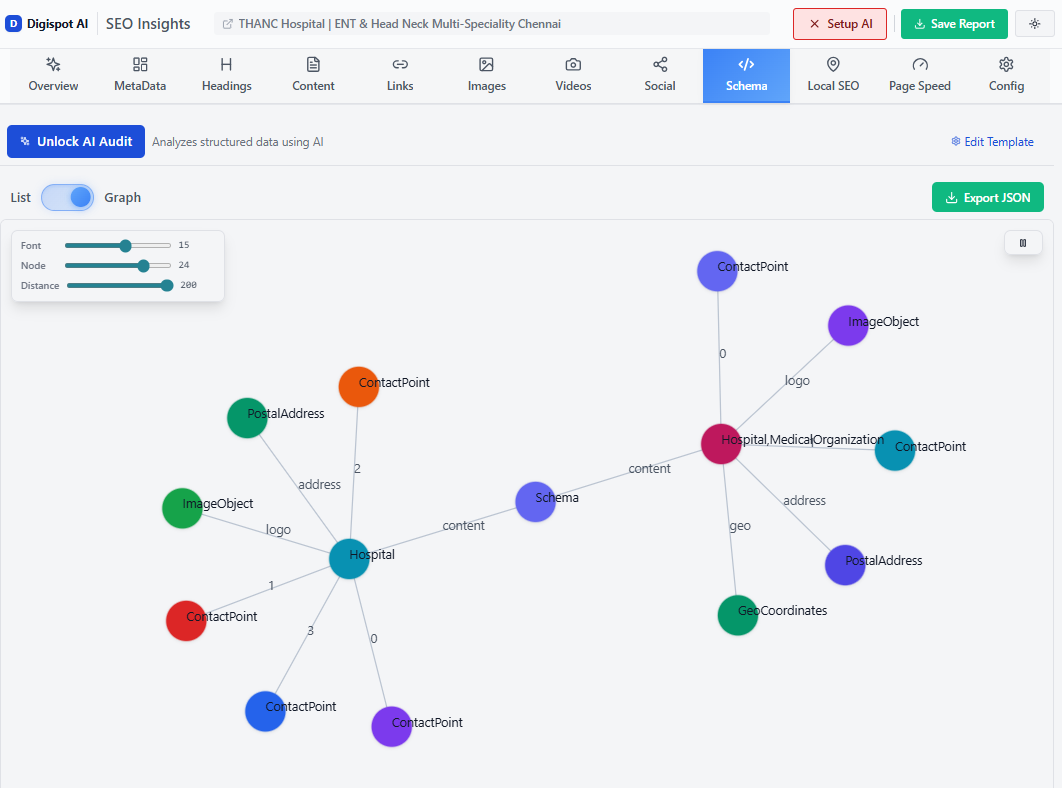
Turn invisible SEO data into clear visuals with our Free Chrome extension.
Automating Technical Health: Manually checking for broken links, redirect chains, or missing meta tags is tedious. Digispot AI performs site-level comprehensive audits, scanning over 200 ranking factors to identify technical glitches that could be holding back your visibility.
3. Local SEO: Owning Your Geography
Healthcare is inherently local. Most patients are unwilling to travel excessive distances for primary care. Local SEO ensures you dominate the "Local Pack"—the map and list of three businesses that appear at the top of Google for local queries.
Winning in Local Search:
- Google Business Profile (GBP) Perfection: This is your most valuable local asset.
- Completeness: Fill every field. Add "appointment" URLs, list all insurance providers accepted, and select precise primary and secondary categories (e.g., "Urgent Care Center" vs. "Medical Clinic").
- Visuals: Regularly upload photos of the facility, the waiting area, and the exterior building to help patients recognize your location.
- Review Management: Reviews are a ranking factor. A steady stream of fresh reviews signals a vibrant, active practice. Always respond to reviews to show engagement.
- NAP Consistency: Your Name, Address, and Phone number must be identical across the web (Yelp, Healthgrades, Vitals, Bing Places). Discrepancies confuse search algorithms and dilute your local authority.
- Local Landing Pages: If you operate multiple clinics, avoid lumping them onto one "Locations" page. Create a distinct, optimized page for each facility (e.g., "Dermatologist in [Neighborhood A]" and "Dermatologist in [Neighborhood B]"), embedding a unique Google Map and local address for each. For more tactics on multi-location management, read about healthcare local SEO.
Integration helps efficiency. Digispot AI integrates local SEO checks into its audits, ensuring you aren't missing simple opportunities like missing citations or inconsistent contact data that could prevent you from showing up in the Local Pack.
4. Page Performance: Speed as a Care Signal
In the digital age, speed is a proxy for efficiency. Google's "Core Web Vitals" are specific metrics that quantify user experience. If your site is slow, patients perceive your practice as outdated or disorganized.
Understanding Core Web Vitals:
- Largest Contentful Paint (LCP): How fast does the main text or image load? Aim for 2.5 seconds or less. A slow LCP often means patients bounce back to Google before seeing your phone number.
- Interaction to Next Paint (INP): This replaces FID and measures responsiveness. When a user clicks "Book Now," does the site react instantly, or is there a lag? High latency frustrates users.
- Cumulative Layout Shift (CLS): Does the page layout jump around as images load? This visual instability is jarring and can cause users to click the wrong button.
Why it matters: A fast site reduces anxiety. A parent looking for urgent care information needs immediate answers. Providing a frictionless experience is the first step in patient care.
Diagnosing speed issues: You don't need to be a developer to spot these problems. Digispot AI analyzes these performance metrics as part of its health score, pinpointing heavy images or bad code that slows down your site. Learn more about optimizing these metrics in our Core Web Vitals guide.
The Undeniable Benefits of Patient Acquisition SEO
Investing in organic search visibility delivers compounding returns that paid advertising cannot match. It builds an asset—your website—that works for you 24/7.
| Benefit Category | How Patient Acquisition SEO Delivers |
|---|---|
| Sustainable Patient Volume | Unlike paid ads (PPC) which stop working the moment you stop paying, SEO builds long-term equity. A top-ranking page for "back pain treatment" can drive qualified patients to your practice for years with minimal maintenance. |
| Higher Quality Leads | SEO targets intent. Patients searching for specific conditions or treatments are usually further along in the decision-making process than those seeing a display ad on social media. This results in higher conversion rates from visitor to appointment. |
| Brand Authority & Trust | Ranking #1 implies you are the leader in your field. Patients psychologically associate top search positions with medical credibility. High visibility combined with strong content positions your brand as the "go-to" expert in your region. |
| Lower Cost Per Acquisition (CPA) | While SEO requires upfront investment, the ongoing cost per patient acquisition drops significantly over time as organic traffic is free. This provides a stark contrast to the rising costs of keyword bidding in paid search. |
| Competitive Defense | The digital healthcare market is crowded. By securing top rankings for your core services, you effectively block competitors from capturing that traffic. You become the default choice simply by being the most visible one. |
| Data-Driven Insights | SEO tools provide deep data on what your patients are actually searching for. This intelligence can inform service expansion decisions. For example, noticing a high volume of searches for a service you don't yet offer might prompt you to hire a specialist in that area. |
| Enhanced User Experience | SEO isn't just for bots. The improvements made for SEO—faster speeds, better mobile design, clearer content—directly improve the experience for every patient who visits your site, leading to higher satisfaction and retention. |
Navigating the Digital Landscape: Tools to Empower Your Practice
The complexity of modern SEO—balancing technical code, content strategy, and local reputation—can be overwhelming. Fortunately, AI-driven platforms have democratized access to enterprise-level SEO capabilities.
Digispot AI is built to handle the heavy lifting. It acts as a comprehensive command center for your search strategy, specifically tuned to navigate the requirements of Google and AI-search engines like ChatGPT and Perplexity (AEO).
Streamlining Your Workflow with Digispot AI:
- Automated 300+ Point Audits: The platform mimics a search engine crawler, analyzing your site against over 200 ranking factors. It checks mobile usability, security, content depth, and technical barriers, providing a prioritized list of "fix-it" tasks.
- Competitor Intelligence: Understand exactly why your competitors are outranking you. The "Competitor Analysis" feature reveals their keyword strategy and backlink profile, giving you a blueprint to overtake them.
- Opportunity Finder: This feature is crucial for growth. It identifies "low-hanging fruit"—keywords with decent search volume but low competition that you aren't yet targeting. It helps you find the gaps in the market.
- Schema Generator: Implementing structured data can be technical. The Schema Markup Generator allows you to create valid JSON-LD code for your medical practice just by filling out a form, which you can then paste into your website.
The Power of the Free Digispot AI Chrome Extension
For marketing managers and practice owners who need quick answers, the Digispot AI free community Chrome extension is an essential daily tool. It brings the power of the platform directly to your browser tab.
Why install it?
- Competitor Spying: Go to a competitor's website and click the extension. Instantly see their heading structure, meta tags, and schema markup.
- Instant Health Check: Spot check your own pages after updates. Did the meta description save correctly? Is the canonical tag pointing to the right URL?
- Visualizing Schema: Verify your medical markup. The extension renders the code into a readable format, ensuring your "Physician" or "MedicalClinic" data is accurate.
This immediate feedback loop allows you to make agile decisions without waiting for monthly reports.
Implementing Patient Acquisition SEO: A Step-by-Step Approach
Transitioning from theory to practice requires a structured roadmap. Follow these steps to build a patient acquisition engine.
Step 1: comprehensive SEO Audit
Objective: Identify and fix the bleeding wounds. Action: Use Digispot AI to run a full site audit.
- Check Indexing: Ensure your practice pages aren't accidentally blocked from Google via the robots.txt file.
- Identify 404s: Broken links frustrate users. Redirect old, deleted pages to relevant new ones.
- Review Mobile View: Check the audit for "touch elements too close" or "content wider than screen" errors.
- Security: Verify your SSL certificate is valid and active on all pages. For a detailed list of what to look for, refer to our SEO audit checklist.
Step 2: Intent-Driven Keyword Strategy
Objective: Map your services to patient searches. Action: Move beyond generic terms.
- Head Terms: "Cardiologist [City]" (High volume, high competition).
- Long-Tail Keywords: "Best doctor for heart arrhythmia in [City]" or "Atrial fibrillation treatment options." These show higher intent.
- Question Keywords: "When should I see a cardiologist?" Target these with blog posts.
- Use the Opportunity Finder: Let Digispot AI suggest keywords based on your domain's current authority and niche.
Step 3: High-Value Content Production
Objective: Build trust and answer questions. Action: Create a content calendar.
- Service Pages: Rewrite them to be comprehensive. Include "What to expect," "Insurance," and "Preparation" sections.
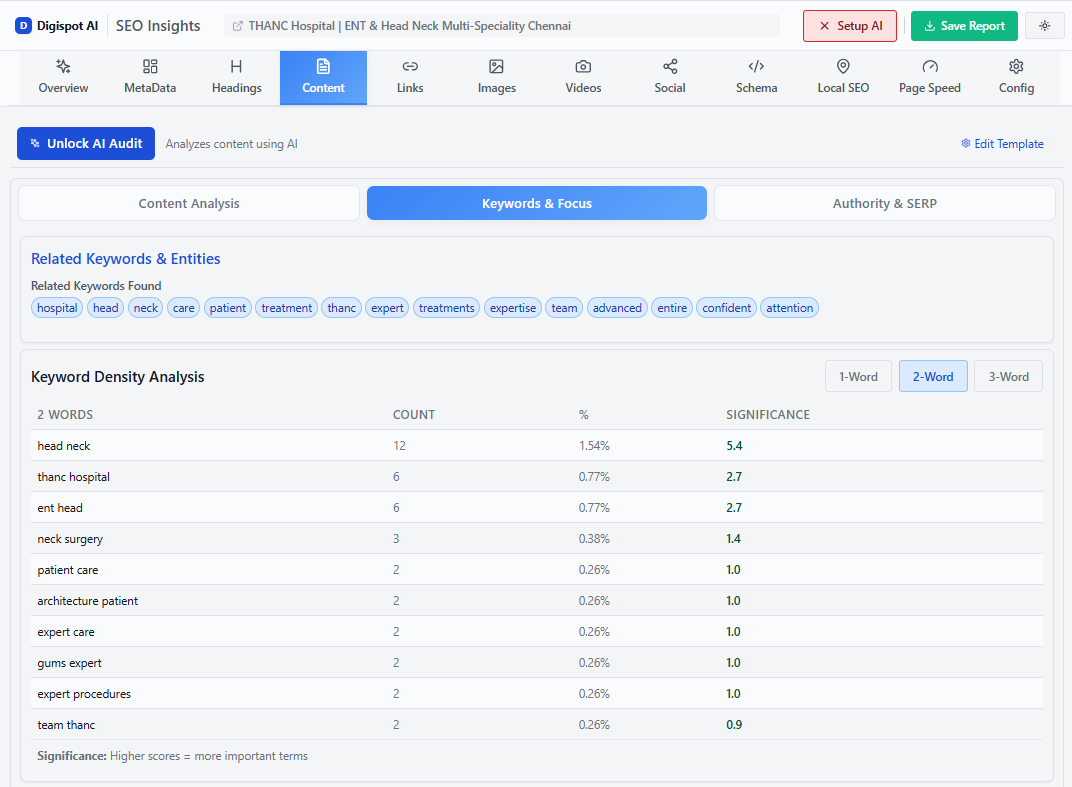
- Blog Strategy: Commit to 2-4 high-quality articles per month. Use the Digispot AI Content Studio to draft outlines that cover all semantic sub-topics (e.g., a post on "Flu Shots" should cover "side effects," "timing," and "types of vaccines").
- E-E-A-T Review: Ensure every article is reviewed by a medical professional and includes an author bio linking to their credentials. Learn more about E-E-A-T guidelines.
Step 4: Technical & On-Page Optimization
Objective: Speak the search engine's language. Action: Optimize the code and structure.
- Meta Tags: Write unique Title Tags and Meta Descriptions for every page. Include the primary keyword and a call to action (e.g., "Book Online").
- Header Tags: Use H1 for the main title, H2 for main sections, and H3 for details. This hierarchy helps bots understand your content structure.
- Schema Implementation: Use the Schema Markup Generator to create
LocalBusinessandMedicalWebPageschema, then add it to your site header. - Image Optimization: Compress all images to WebP format to improve load speeds. Ensure all images have descriptive Alt Text (e.g., "Dr. Smith performing knee examination").
Step 5: Dominate Local Search
Objective: Capture the "Near Me" market. Action: Polish your local presence.
- GBP Optimization: Post weekly updates on your Google Business Profile (e.g., "Flu shots now available," "Holiday hours").
- Citation Building: Ensure your practice is listed on Healthgrades, Vitals, WebMD, and generic directories like Yelp and YellowPages with identical NAP data.
- Review Campaign: Implement an automated text/email system to ask patients for reviews immediately after appointments.
Step 6: Measure, Analyze, Adapt
Objective: Continuous improvement. Action: Don't set and forget.
- Connect Analytics: Integrate Google Search Console and Google Analytics with your Digispot AI dashboard for a unified view.
- Track Rankings: Monitor your positions for key service keywords.
- Analyze Traffic: Which blog posts are bringing in the most traffic? Can you add a booking button to those high-traffic pages?
- A/B Testing: Experiment with different meta descriptions or page titles to see what drives more clicks.
Common Pitfalls to Avoid in Patient Acquisition SEO
Even seasoned marketers can stumble. Avoid these common mistakes to ensure your growth trajectory remains smooth.
- Keyword Cannibalization: This happens when you have two pages targeting the exact same keyword (e.g., a "Services" page and a "Blog Post" both optimizing for "Pediatrician"). This confuses Google, often resulting in neither page ranking well. Consolidate these into one strong page.
- Neglecting "People Also Ask": Ignoring the questions that appear in search results is a missed opportunity. Incorporating these Q&As into your content can help you rank in Featured Snippets (Position Zero).
- Thin Content: Posting 300-word blog posts just to "have content" is ineffective. Search engines prefer comprehensive, "deep" content that thoroughly answers a query. Quality beats quantity.
- Ignoring Voice Search: Patients often speak into their phones: "Where is the closest 24-hour pharmacy?" If your content doesn't use natural, conversational language, you miss these queries.
- Overlooking Local Landing Pages: If you have 5 clinics but only one "Contact" page, you are severely limiting your ability to rank in 5 different geographic areas.
- Buying Links: Never buy backlinks. This violates Google's guidelines and can lead to a penalty that de-indexes your site. Focus on earning links through high-quality research and partnerships.
- Poor Mobile Experience: If a patient has to pinch-and-zoom to read your phone number, they will leave. Mobile usability is a primary ranking factor. Learn more about avoiding common SEO mistakes.
Start Improving Your Patient Acquisition Today
In the evolving landscape of healthcare, your online presence is the most powerful referral source you possess. It operates around the clock, educating patients, building trust, and filling your schedule. Patient Acquisition SEO offers a proven, data-backed pathway to improve your visibility and attract the patients who need you most. By embracing the principles of authoritative content, technical solidity, local dominance, and superior page performance, you transform your website from a passive digital brochure into an active growth engine.
The journey might seem extensive, but you do not have to travel it alone. Advanced platforms like Digispot AI distill complex SEO tasks into manageable, automated actions. Whether you are running a comprehensive site audit to uncover deep technical issues or using the free On-Page SEO Analysis tool for quick checks, the technology exists to give you a competitive edge.
Don't let your practice remain a hidden gem. Embrace the digital revolution in patient acquisition. Start optimizing today, and ensure that when patients search for health and healing, the answer they find is you. Try Digispot AI now to launch your first comprehensive audit and take the first step toward search dominance.
Related deep-dives
Continue with these closely related guides:
- dental seo — Dental SEO Guide: Attract More Patients 2026
- doctor profile optimization — Doctor Profile Optimization: A Complete SEO Guide
References
- Google Search Console
- Robots.txt Introduction and Guide | Google Search Central
- Improve your page speed and crawl efficiency | Google Search Central
- Understand how structured data works | Google Search Central
- Core Web Vitals | Google Search Central
- Mobile-first indexing | Google Search Central
- Get started with Google Business Profile
- About Google Analytics
- How Google Search Works | Google Search Central
- Google's SEO Starter Guide | Google Search Central
- Digispot AI - AI SEO Platform
- Digispot AI - FREE On Page SEO Audit Tool
- Digispot AI - FREE Chrome Extension for SEO Insights
Audit any page in seconds
300+ SEO checks including Core Web Vitals, schema markup, meta tags, and AI readiness — trusted by 1000+ SEO experts and marketers.
Frequently Asked Questions
Here are some of our most commonly asked questions. If you need more help, feel free to reach out to us.
Written by
Maya Krishnan
Digital growth expert
Maya is a seasoned expert in web development, SEO, and digital strategy, dedicated to helping businesses achieve sustainable growth online. With a blend of technical expertise and strategic insight, she specializes in creating optimized web solutions, enhancing user experiences, and driving data-driven results. A trusted voice in the industry, Maya simplifies complex digital concepts through her writing, empowering readers with actionable strategies to thrive in the ever-evolving digital landscape.