Medical Content Trust: Building Authority in Healthcare SEO
Build trust in healthcare content for SEO success. Master E-E-A-T compliance, medical accuracy standards, and YMYL best practices for health visibility.
 Maya Krishnan
Imagine a patient searching for symptoms of a rare condition at 2:00 AM. They find two articles. One is riddled with pop-ups, has no author name, and loads slowly. The other loads instantly, cites a recent study from The Lancet, and is reviewed by a board-certified specialist. Which one guides their next health decision?
This scenario illustrates the absolute necessity of Medical Content Trust.
In healthcare SEO, trust isn't just a "nice-to-have" brand metric—it is the primary currency. Google explicitly categorizes health topics as "Your Money or Your Life" (YMYL). This classification means the search engine holds your pages to the highest possible standard because misinformation could directly harm a user's physical well-being.
Building authority isn't about gaming an algorithm. It is about proving to both users and search engines that your information is safe, accurate, and reliable. This guide breaks down exactly how to construct that infrastructure of trust, ensuring your medical content ranks well and serves your patients responsibly.
Key Takeaways
- Treat every health page as YMYL: Google holds medical content to its highest quality bar, so accuracy and safety must come before keyword tactics.
- Name your author and reviewer: Pair a credentialed writer with a licensed clinical reviewer and display both roles to satisfy E-E-A-T.
- Cite primary sources directly: Link to the specific peer-reviewed study, .gov, or .edu guideline behind each claim—not a homepage or secondary blog.
- Fix the technical foundation: HTTPS, fast Core Web Vitals, mobile parity, and medical schema are trust signals, not optional extras.
- Keep content fresh: Audit high-traffic medical pages every 6–12 months and show a clear "Last Updated" date to prevent dangerous content decay.
What is Medical Content Trust?
Medical content trust is the measure of confidence users and search algorithms have in the accuracy, safety, and origin of your healthcare information. It goes beyond simply stating facts correctly. It encompasses the entire user experience—from the credibility of the author to the security of the website hosting the advice.
Trust serves as a filter. In an era where AI can generate plausible-sounding but factually incorrect medical advice in seconds, human verification and authoritative backing have become premium assets. Trustworthy content empowers patients to take the right actions, reduces anxiety, and bridges the gap between online research and professional clinical care.
Why is Trust Critical in Medical Content?
The stakes here differ from other industries. If you buy a bad toaster based on a review, you lose $30. If you follow bad medical advice, the consequences can be life-altering.
The 2024 Edelman Trust Barometer highlights a dangerous shift: "friends and family" are competing with medical professionals as primary sources of health information. This erosion of institutional trust puts a heavy burden on healthcare marketers and providers. You must actively demonstrate why your content deserves attention.
When patients trust your content, specific behaviors follow:
- Higher Adherence: They are more likely to follow preparation guidelines for appointments or treatment plans.
- Reduced Anxiety: clear, authoritative answers prevent "cyberchondria" (health anxiety caused by online searches).
- Better Outcomes: Informed patients ask better questions in the exam room.
- Brand Loyalty: A user who finds reliable answers on your site today is more likely to book an appointment tomorrow.
From an SEO perspective, Google’s algorithms are trained to demote low-trust health content. If your site lacks clear authorship or citations, it will struggle to rank for competitive medical terms, regardless of your keyword strategy.
Key Pillars of Trustworthy Medical Content
Trust is not a single signal; it is an aggregate of multiple quality indicators. To rank in the healthcare space, you need to align with Google's E-E-A-T (Experience, Expertise, Authoritativeness, and Trustworthiness) framework.
For a deeper dive into these principles, you can explore our comprehensive E-E-A-T SEO guide which details how to satisfy each component.
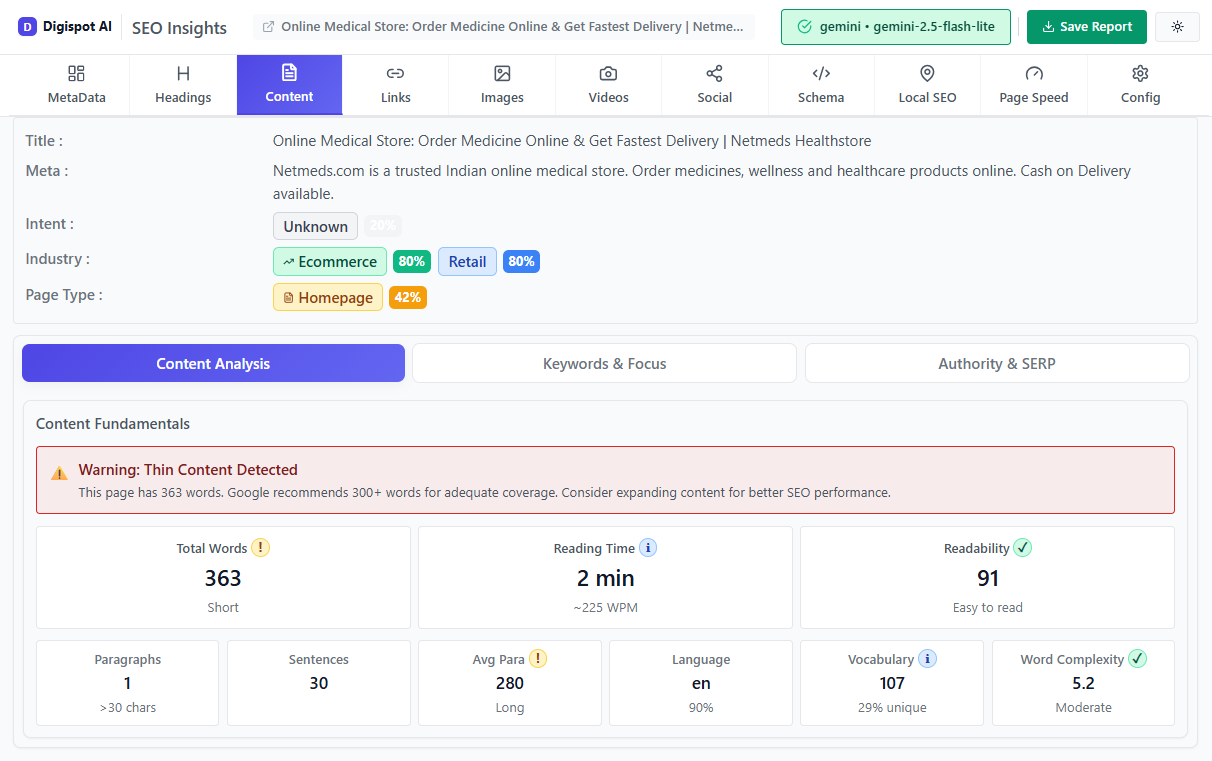
Here are the five non-negotiable pillars for medical content:
1. Accuracy and Evidence-Based Information
Medical content must be rigorously correct. This means every claim regarding symptoms, treatments, or statistics must be backed by current scientific consensus.
- The Standard: Use peer-reviewed studies (PubMed, JAMA), government data (CDC, NIH), or major health organization guidelines.
- Implementation: Do not just link to a homepage. Link directly to the specific study or guideline PDF that supports your claim. Avoid citing secondary sources like news articles or other blogs unless necessary.
2. Clarity and Accessibility
Complex medical jargon builds walls, not trust. The National Institutes of Health (NIH) recommends writing health materials at a 6th to 8th-grade reading level.
- The Approach: Explain "hypertension" as "high blood pressure." Break down "myocardial infarction" into "heart attack."
- Visual Aids: Use diagrams to explain anatomy. A wall of text intimidates anxious users; clear visuals welcome them.
3. Transparency and Attribution
Anonymity is a red flag in healthcare SEO. Users need to know who is speaking to them.
- Author Bios: Every article needs a named author. This author should have a bio page listing their degrees, certifications, and current practice location.
- The "Why": If Google cannot verify who wrote the content, it defaults to caution. Transparent attribution connects the content to a real-world entity with proven expertise.
4. Credibility of Authors and Reviewers
Writing requires SEO skills; medical accuracy requires clinical skills. The gold standard for medical SEO is the "Medical Review" process.
- The Workflow: A professional writer drafts the content for readability and SEO. A licensed clinician (MD, DO, RN, PharmD) reviews it for accuracy.
- The Signal: Display both names: "Written by [Name], Reviewed by [Dr. Name]." This double layer of verification is a powerful trust signal.
5. Regular Updates and Content Hygiene
Medical knowledge evolves. A treatment protocol from 2018 might be obsolete today.
- The Risk: "Content Decay" occurs when articles sit untouched for years. In healthcare, outdated content is dangerous content.
- The Fix: Audit your high-traffic medical pages every 6-12 months. Update statistics, treatment guidelines, and links. Display a "Last Updated" date clearly at the top of the post.
Benefits of Building Trust in Healthcare Content
Investing resources into fact-checking and medical reviews might seem slower than churning out generic posts, but the ROI is substantial and compounding.
- Improved Patient Outcomes: Accurate information leads to better health decisions. When you explain a procedure clearly, patients arrive more prepared and less anxious.
- Enhanced Reputation and Authority: When you consistently provide reliable answers, other reputable sites (hospitals, universities, news outlets) begin to reference you. These backlinks are the backbone of high domain authority.
- Increased Engagement and Traffic: Trustworthy content reduces bounce rates. Users stay longer to read detailed explanations because they feel safe. High engagement signals to Google that your page satisfies the search intent.
- Better SEO Performance: Search engines prioritize safety. By aligning with content quality standards, you protect your site from algorithm updates that target low-quality aggregators.
- Business Visibility: Digispot AI helps you monitor this visibility across 300+ ranking factors. When your technical and content trust signals align, you dominate the "Map Pack" and organic listings for high-value terms like "specialist near me."
How to Build and Maintain Medical Content Trust
Now that we understand the "what" and "why," let's look at the practical "how." Building trust is an operational process that touches editorial teams, developers, and SEOs.
1. Fact-Checking and Expert Review Protocols
Establish a formal editorial workflow. Do not rely on writers to self-edit for medical accuracy.
- Create a Review Board: Assemble a panel of internal or external clinicians to review content. Map each medical topic to a reviewer whose specialty matches—a cardiologist reviews heart-health content, not dermatology pages.
- Verification Steps: Check dosage information, side effect lists, and recovery timelines against at least two independent authoritative sources. Flag any claim that cannot be traced to a primary source and hold it until it is verified or removed.
- Document the Trail: Keep a record of who reviewed each page and when, along with the sources checked. This audit trail protects you legally and makes your next content refresh far faster, since reviewers can see exactly what changed since the last cycle. These review checkpoints also feed directly into any SEO audit you run on the site, and they map neatly onto Google's own E-E-A-T checklist.
- Set a Cadence: Tie the review protocol to a calendar, not to memory. A quarterly sweep of your top medical URLs catches guideline changes before they become liabilities.
2. Sourcing Strategy
Your outbound links tell Google who you associate with, and they tell patients whether you did your homework.
- Prioritize .gov, .edu, and .org: These domains generally carry higher inherent trust. Point to the CDC, NIH, WHO, or a university medical center rather than a syndicated news recap of the same finding.
- Cite the study, not the summary: Deep-link to the exact page, table, or PDF that supports a claim. A citation that lands on the specific finding is verifiable in one click; a link to a homepage forces the reader to hunt and quietly erodes confidence.
- Prefer recent, primary evidence: Favor sources from the last few years and flag anything older during review, since clinical guidance shifts. Where a claim rests on a single small study, say so rather than presenting it as settled consensus.
- Avoid Competitors: While you shouldn't link to direct business rivals, linking to non-competing authoritative health hubs (like Mayo Clinic or Cleveland Clinic) is good practice if primary sources are unavailable.
- Earn inbound links too: Rigorously sourced pages are the ones other hospitals and universities are willing to cite, which is the foundation of a healthy backlink profile.
3. Clear Disclaimers
Legal protection is part of trust. Users appreciate knowing the boundaries of online advice.
- Placement: Place a standard medical disclaimer in the footer or sidebar of every content page.
- Wording: "Content is for informational purposes only and does not constitute medical advice. Always consult your physician."
4. User-Friendly Design
A cluttered site looks like a scam. A clean site looks like a clinic.
- Navigation: Make it easy to find doctor profiles, contact info, and patient portals.
- Mobile Experience: Most health searches happen on phones. If your site shifts layout or has buttons that are too small, users lose confidence immediately. Digispot AI’s audit tools check specifically for these mobile usability issues.
5. Technical SEO for Trust (Schema Markup, Site Health)
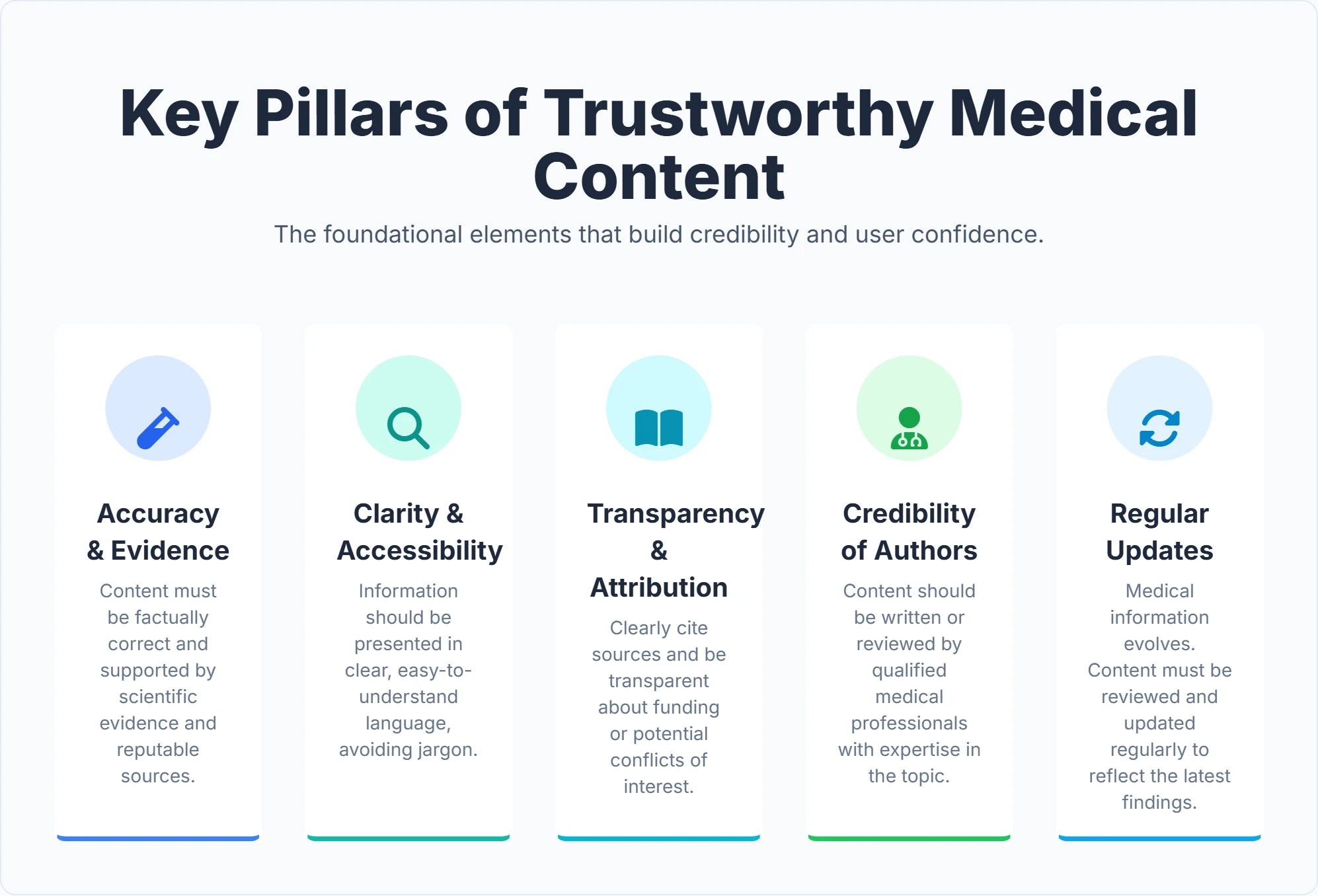
Technical SEO acts as the foundation for your content. If the foundation is cracked, the content cannot stand.
Schema Markup: The Language of Context Search engines need help understanding that a page is about a "Medical Condition" rather than just a generic topic. Structured data bridges this gap.
- MedicalWebPage: Tells Google the page is a health resource.
- MedicalCondition: Allows you to define symptoms, risks, and treatments in code.
- Physician: Connects a doctor's bio page to their specific credentials and specialties.
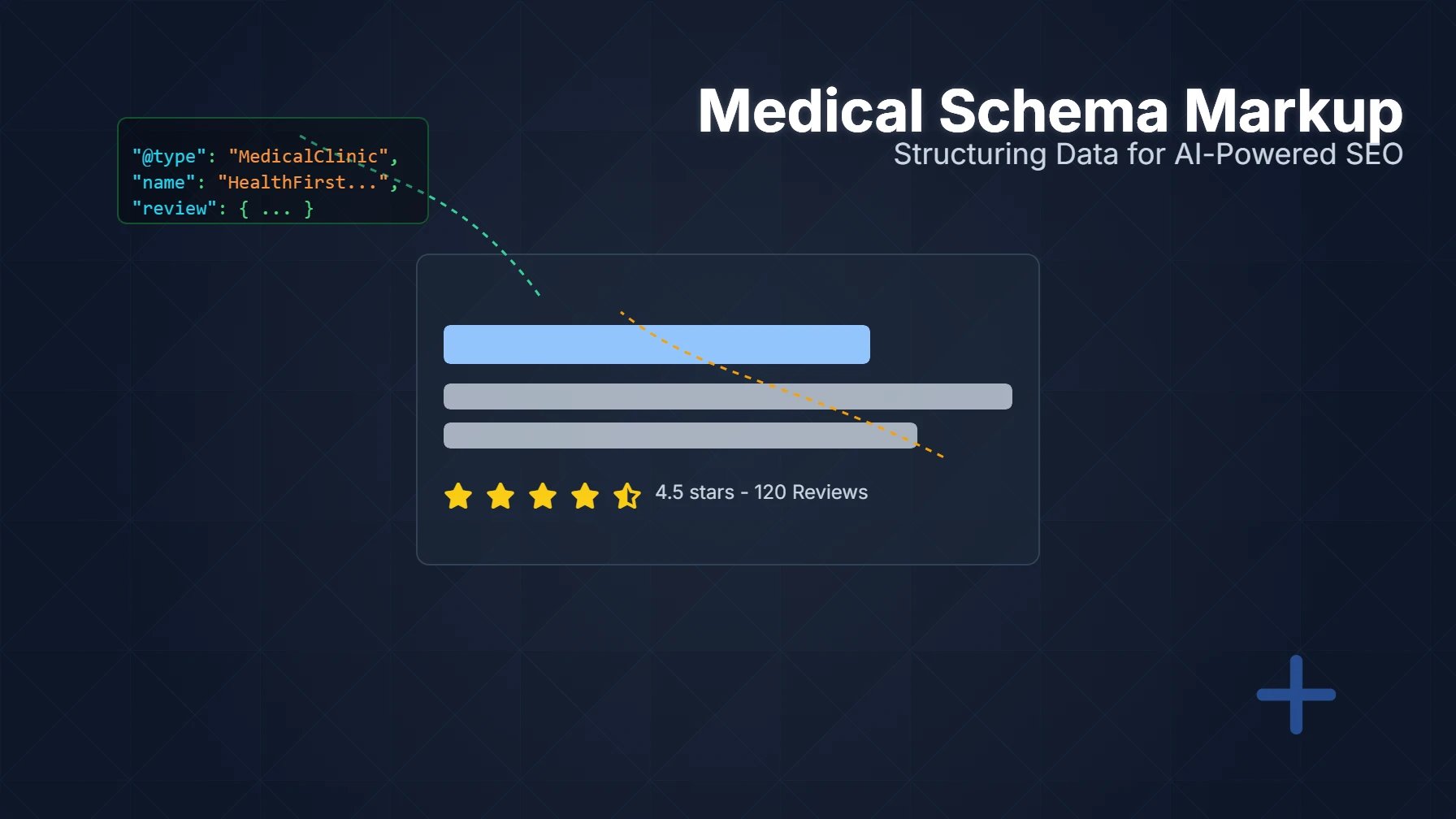
Implementing these correctly can result in rich snippets (star ratings, FAQ boxes) that increase click-through rates. For a step-by-step implementation guide, read our article on medical schema markup.
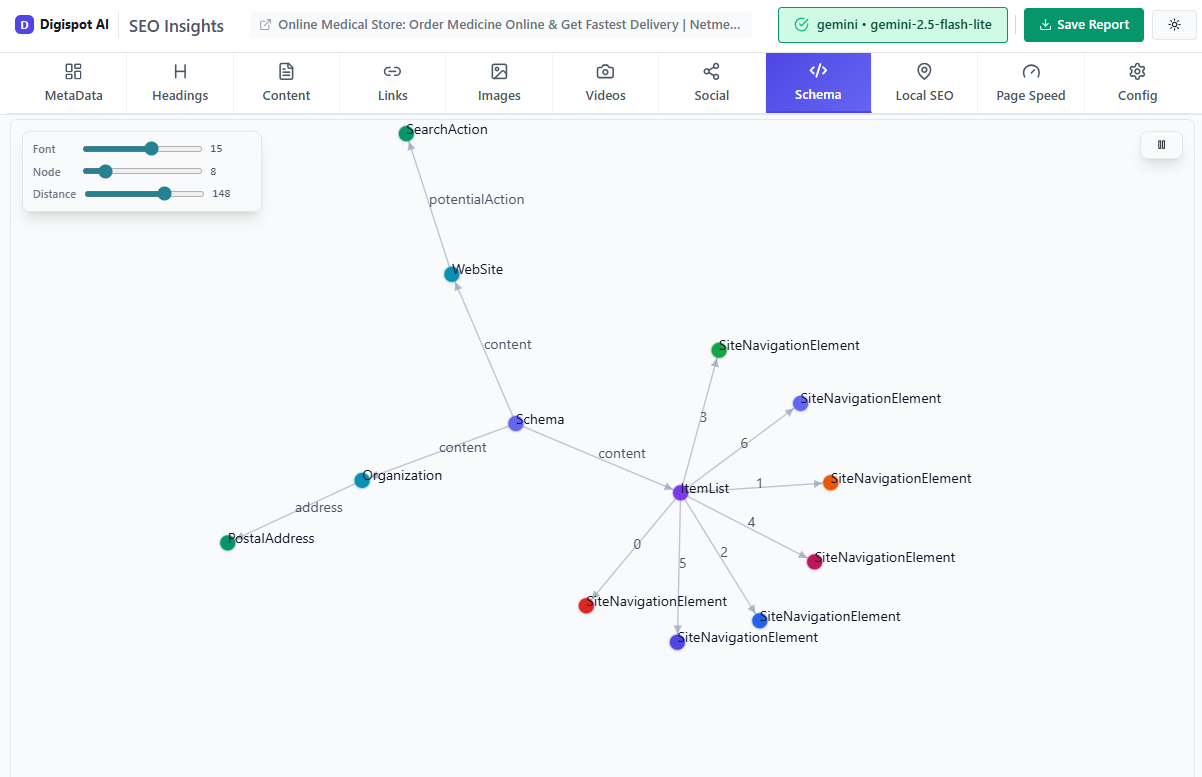
Turn invisible SEO data into clear visuals with our Free Chrome extension.
Site Health and Performance Security is paramount. A "Not Secure" warning in the browser bar is a death sentence for a healthcare site.
- HTTPS: Mandatory for any site handling potential patient data or queries.
- Core Web Vitals: Slow loading (LCP) or layout shifts (CLS) frustrate users in distress. A fast site implies a professional, well-maintained organization.
Try it yourself: Use the free Schema Markup Generator to create valid structured data for your medical pages in minutes.
Here is a breakdown of how technical flaws undermine trust:
| SEO Issue | How it Impacts Trust (Subtle) | Digispot AI’s Role |
|---|---|---|
| Slow Page Load Speed | Frustrates users, suggests outdated tech or poor maintenance. | Identifies page performance issues for both mobile and desktop, helping optimize for speed [Description Provided]. |
| Broken Links | Indicates neglected content, leading to a perception of unreliability. | Audits websites to detect broken links and other technical errors [Description Provided]. |
| Lack of HTTPS | Security warning, makes users hesitant to share info or trust content. | Ensures websites meet security best practices, crucial for trust. |
| Poor Mobile Responsiveness | Hinders accessibility on mobile, suggesting a lack of user focus. | Audits website in mobile mode to ensure optimal user experience [Description Provided]. |
| Missing/Incorrect Schema | Prevents search engines from fully understanding content context and authority. | Supports schema markup detection and visualization, helping to implement correct structured data [Description Provided]. |
| Thin/Low-Quality Content | Search engines (and users) devalue content lacking depth or originality. | Helps generate SEO-optimized content using AI agents, addressing content quality issues [Description Provided]. |
| Lack of Authoritative Backlinks | Reduces perceived authority in the eyes of search engines. | While not directly stated, good content attracts backlinks, which Digispot AI helps optimize for. |
The Role of AI in Enhancing Medical Content Trust
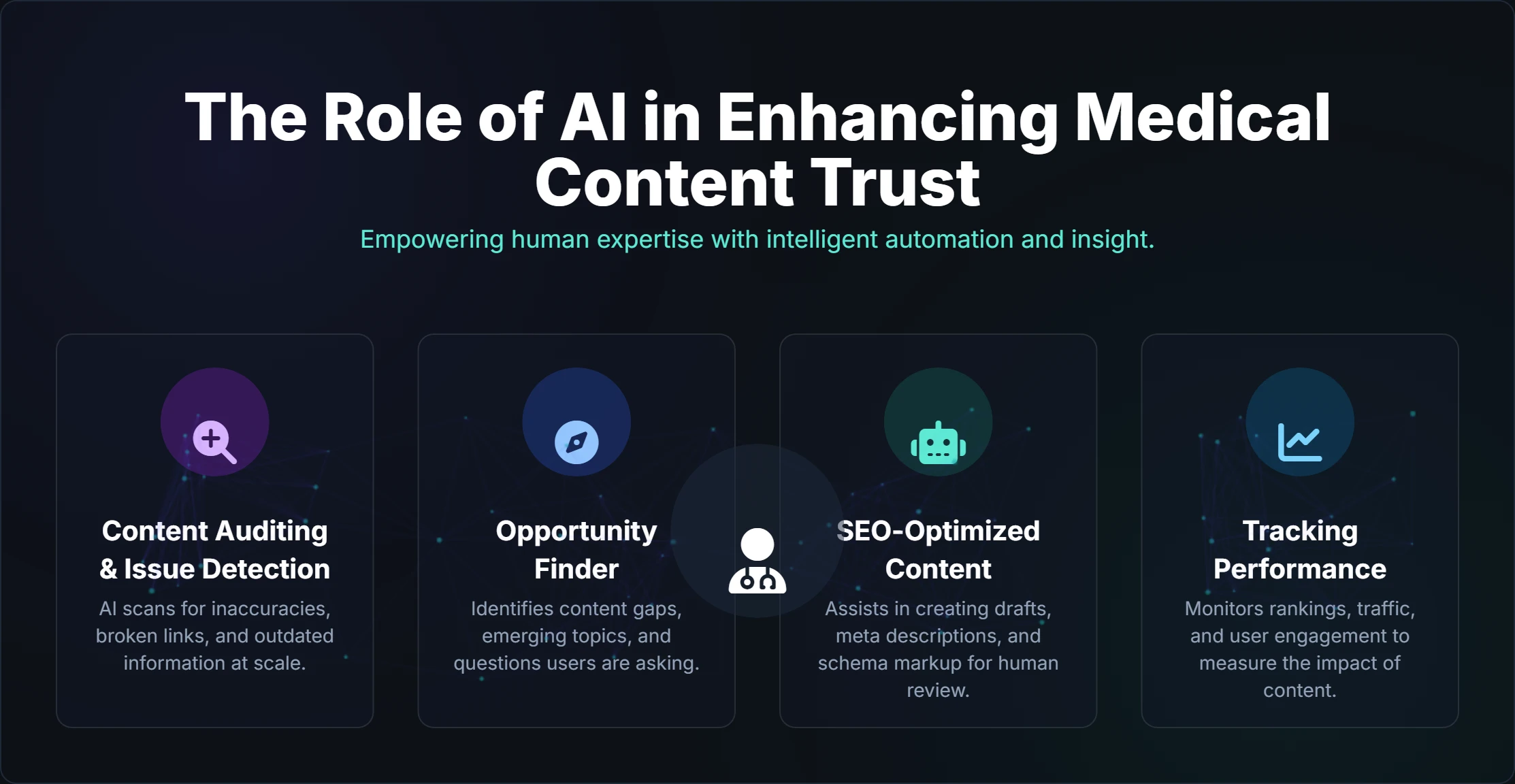
The integration of Artificial Intelligence in healthcare content is a double-edged sword. Used carelessly, it generates hallucinations. Used strategically, it is a powerful quality assurance tool.
AI as a Force Multiplier for Accuracy AI should not replace the medical expert, but it can make the expert more efficient.
- Content Auditing and Issue Detection: Manual audits of thousands of pages are impossible. AI can scan an entire hospital website to find outdated terminology or broken citations in minutes. Digispot AI audits websites for over 200 ranking factors, flagging trust issues that human eyes often miss.
- Gap Analysis: AI can compare your content against top-ranking competitors to see what sub-topics you missed. If your competitor covers "recovery time" and you don't, AI alerts you. This is crucial for content gap analysis.
- Drafting and Structuring: AI agents can draft the structural skeleton of an article—headers, meta descriptions, and schema code—allowing human experts to focus on the clinical nuances.
- Performance Tracking: Digispot AI integrates with Google Search Console to correlate content updates with traffic shifts, helping you understand which trust signals are moving the needle.
Responsible AI Use Always disclose if AI assisted in content creation. Transparency is key. Furthermore, ensure a "human-in-the-loop" (HITL) process is always active for YMYL content. You can read more about balancing automation and safety in our guide to AI content SEO.
Leveraging Digispot AI for Trustworthy Medical Content
Managing medical SEO manually is overwhelming. The Digispot AI cloud platform automates the technical and analytical heavy lifting, allowing you to focus on patient care and content quality.
How does Digispot AI help you build trust?
- Comprehensive Website Audits: We don't just check if your site loads. We audit for trust signals. Digispot AI scans mobile and desktop versions to ensure elements like author bios, medical schema, and secure forms are functioning correctly.
- Analyzing 300+ Ranking Factors: Search algorithms are complex. Our platform analyzes over 200 distinct signals—from Core Web Vitals to semantic keyword usage—giving you a prioritized checklist of what to fix to improve your E-E-A-T score.
- Opportunity Finder: Knowing what to write is half the battle. Our "opportunity finder" identifies questions your patients are actually asking, ensuring you create helpful content that fills a real need.
- Content Studio with AI Agents: Need to update 50 physician bios? Our Content Studio uses AI agents to help draft structured, SEO-friendly content that maintains a consistent, professional voice across your site.
- Seamless Integration: By pulling data from Google Analytics and Search Console, Digispot AI gives you a single source of truth. You can see exactly how trust-building efforts translate into traffic and conversions.
Digispot AI's Free Community Chrome Extension: Trust at Your Fingertips
You don't always need to log into the full platform to get insights. For quick checks while browsing your site or a competitor's, use our browser tool.
- Audit Website Pages Instantly: See a health score for any URL in seconds.
- Detect Issues: Spot missing headers, images without alt text, or canonical errors immediately.
- Visualize Data: We render the invisible schema markup so you can verify that your "Physician" or "MedicalOrganization" tags are valid.
- Competitor Analysis: See what schema your competitors are using to capture rich snippets.
Get instant SEO insights on any page with our free Chrome extension.
Here’s a concise table highlighting how Digispot AI features directly contribute to building medical content trust:
| Digispot AI Feature | How it Strengthens Medical Content Trust |
|---|---|
| Website Auditing (Mobile & Desktop) | Detects and resolves technical issues (e.g., slow speed, broken links) that erode user confidence and reliability. |
| 300+ Ranking Factors Analysis | Enhances technical SEO, on-page elements, and local visibility to signal expertise, authority, and credibility (E-E-A-T). |
| Opportunity Finder | Surfaces patient-focused, high-demand content opportunities that improve helpfulness and align with Google’s “people-first” guidelines. |
| Content Studio (AI Agents) | Produces accurate, structured, and SEO-optimized medical content that’s easy to understand and discover. |
| Google Search Console/Analytics Integration | Delivers performance insights to refine strategies, ensuring medical content continues to meet patient expectations and rank effectively. |
| Free Chrome Extension | Provides instant, in-browser trust checks (schema, speed, security), enabling quick fixes for compliance and credibility. |
Real-World Impact: Business Outcomes from Trust-Centric Content
Why should a CFO or Marketing Director care about "Medical Content Trust"? Because it drives the bottom line.
1. Lower Cost Per Acquisition (CPA) Paid medical ads are expensive. Keywords like "telehealth appointment" or "urgent care near me" have high CPCs. By building organic trust, you rank naturally for these terms. Trustworthy content acts as a perpetual asset that attracts patients without a per-click cost.
2. Protecting Brand Reputation In healthcare, reputation is everything. One viral piece of misinformation attributed to your brand can cause irreparable damage. A rigorous content trust strategy acts as an insurance policy, ensuring every piece of content reflects your clinical excellence.
3. Higher Conversion Rates Traffic means nothing if users don't convert. A user who trusts your article on "knee replacement recovery" is significantly more likely to fill out a consultation form on the same page. Trust removes the friction from the conversion funnel.
4. Local Dominance Trust signals like consistency in Name, Address, and Phone number (NAP) across your site and directories boost your Local SEO. Patient reviews are a powerful healthcare trust signal too, feeding both your reputation and your local rankings. This is vital for brick-and-mortar clinics. Learn more about optimizing for your area in our healthcare local SEO guide.
Conclusion: Start Building Your Authority Today
In the sensitive realm of healthcare, trust is the bedrock upon which all effective communication, patient care, and business growth are built. Establishing and maintaining medical content trust is an ongoing commitment to accuracy, clarity, transparency, and a patient-first approach.
You now understand what medical content trust entails—it is the fusion of technical excellence and clinical accuracy. You know why it is paramount—because your patients' well-being and your search rankings depend on it. And you have the how—a roadmap of rigorous fact-checking, schema implementation, and transparent authorship.
While human expertise remains irreplaceable, intelligent platforms like Digispot AI serve as powerful enablers. They act as a sophisticated assistant, helping to audit your digital presence, identify crucial opportunities, and optimize your content so that it not only reaches but also genuinely earns the trust of those seeking vital health information.
Ready to improve your search visibility? Try Digispot AI for comprehensive website audits and actionable recommendations that turn your medical content into your greatest business asset.
References
- 2024 Edelman Trust Barometer Special Report: Trust and Health
- Our latest update to the quality rater guidelines: E-A-T gets an extra E for Experience | Google Search Central Blog
- Healthcare Schema Markup: Growth of the Physician Rich Result | Local SEO Guide
- Google Analytics
- Google Search Console
- WHO Guidelines - World Health Organization (WHO)
- Guidelines and Recommendations - CDC Stacks
- Digispot AI - FREE On Page SEO Audit Tool
- Digispot AI - FREE Chrome Extension for SEO Insights
Audit any page in seconds
300+ SEO checks including Core Web Vitals, schema markup, meta tags, and AI readiness — trusted by 1000+ SEO experts and marketers.
Frequently Asked Questions
Here are some of our most commonly asked questions. If you need more help, feel free to reach out to us.
Written by
Maya Krishnan
Digital growth expert
Maya is a seasoned expert in web development, SEO, and digital strategy, dedicated to helping businesses achieve sustainable growth online. With a blend of technical expertise and strategic insight, she specializes in creating optimized web solutions, enhancing user experiences, and driving data-driven results. A trusted voice in the industry, Maya simplifies complex digital concepts through her writing, empowering readers with actionable strategies to thrive in the ever-evolving digital landscape.