Medical Facility SEO: Hospital & Clinic Rankings
SEO guide for hospitals and medical facilities. Improve local visibility, patient acquisition, and rankings with healthcare-specific strategies.
 Maya Krishnan
Your clinic deserves to be seen. Imagine a potential patient experiencing a nagging symptom or seeking a new specialist right now. Where do they turn first? They don't pull out a phone book. They turn to Google, ChatGPT, or Perplexity. For medical facilities, being discoverable in these critical micro-moments is vital for connecting with the people who need your care most.
Having a website is no longer enough. Your site must act as a welcoming digital front door that actively guides prospective patients to your services. If your practice doesn't appear when someone asks their phone for an "urgent care near me" or "best cardiologist for arrhythmia," you aren't just losing a click—you are losing a patient to a competitor who optimized their digital presence.
This guide explores the essentials of Medical Facility SEO, demystifying how it helps you stand out in a saturated market, build authority, and grow your practice. We will move beyond basic definitions into actionable strategies that leverage the latest in Search Engine Optimization (SEO) and Answer Engine Optimization (AEO).
What Exactly is Medical Facility SEO?
Medical Facility SEO is the strategic process of improving your healthcare organization's visibility in search engines for queries related to your services, physicians, and location. It involves optimizing your online presence so that when someone searches for "pediatrician near me," "hospital with MRI services," or "dermatologist for eczema," your facility appears prominently in the results.
However, medical SEO differs significantly from standard commercial SEO. Google classifies healthcare websites as "Your Money or Your Life" (YMYL) pages. This designation means Google holds your site to a much higher standard of accuracy, authority, and trust because misinformation could physically harm users. Unlike a shoe store where an impulsive purchase carries low risk, healthcare decisions are critical. Your SEO strategy must reflect this gravity.
It is not just about keywords; it is about connecting patients with local providers, establishing medical expertise, and ensuring critical health information is accessible.
SEO vs. Traditional Advertising in Healthcare
Here is how organic search optimization compares to traditional marketing channels for medical facilities:
| Feature | Medical Facility SEO | Traditional Marketing (TV, Print, Radio) |
|---|---|---|
| Targeting Precision | Targets users actively searching for specific care (e.g., "fracture clinic open now"). | Broad audience reach; many viewers may not need medical services. |
| Cost Structure | Time and effort investment; traffic is free once ranked. High long-term ROI. | High upfront costs; requires continuous spending to maintain visibility. |
| Patient Intent | High Intent: Users are often in pain or anxiety, seeking immediate solutions. | Low/Passive Intent: Builds awareness but rarely catches someone at the moment of need. |
| Trust Factor | Organic rankings signal impartiality and authority to patients. | Consumers understand ads are paid placements, often leading to skepticism. |
| Data & Measurement | Highly measurable (clicks, calls, bookings, keyword rankings). | Difficult to attribute a specific patient to a specific billboard or radio spot. |
| Sustainability | Compounding value; a high-ranking article can drive patients for years. | Temporary impact; visibility vanishes the moment the budget runs out. |
Why Medical Facility SEO Isn't Optional Anymore
The era of relying solely on referrals and physician networks is fading. Today, an effective online presence powered by smart SEO is the bedrock of a thriving medical practice. The benefits extend far beyond simple "traffic"—they impact your facility's bottom line and community reputation.
- Capture High-Intent Traffic: When patients search for healthcare, they rarely scroll past the first three results. A robust SEO strategy ensures your facility is visible exactly when intent is highest. A patient searching for "emergency dentist" is not browsing; they are ready to book immediately. Capturing this traffic is crucial for high-conversion acquisition.
- Build Authority with E-E-A-T: In the medical field, trust is currency. Google evaluates medical content based on Experience, Expertise, Authoritativeness, and Trustworthiness (E-E-A-T). High rankings signal to patients that Google trusts your content. When your facility consistently appears for relevant queries, it reinforces your reputation as a regional leader in healthcare.
- Reduce Patient Acquisition Costs (CAC): Paid search (PPC) for medical keywords can be prohibitively expensive, with clicks for terms like "rehab center" or "oncology" costing dozens of dollars. SEO is an investment in owned media. Once you rank, the traffic is free, significantly lowering your average cost per new patient over time compared to paid ads.
- Combat Misinformation: By optimizing high-quality, medically accurate content, you provide a safe harbor for patients drowning in online health myths. SEO allows you to displace low-quality forums and unreliable sources with your facility's expert verification.
- Enhance the Patient Experience: Modern patients expect convenience. A well-optimized site doesn't just rank; it works. It loads fast, provides clear directions, offers easy click-to-call buttons, and answers questions immediately. This seamless digital experience is often the first clinical interaction a patient has with you.
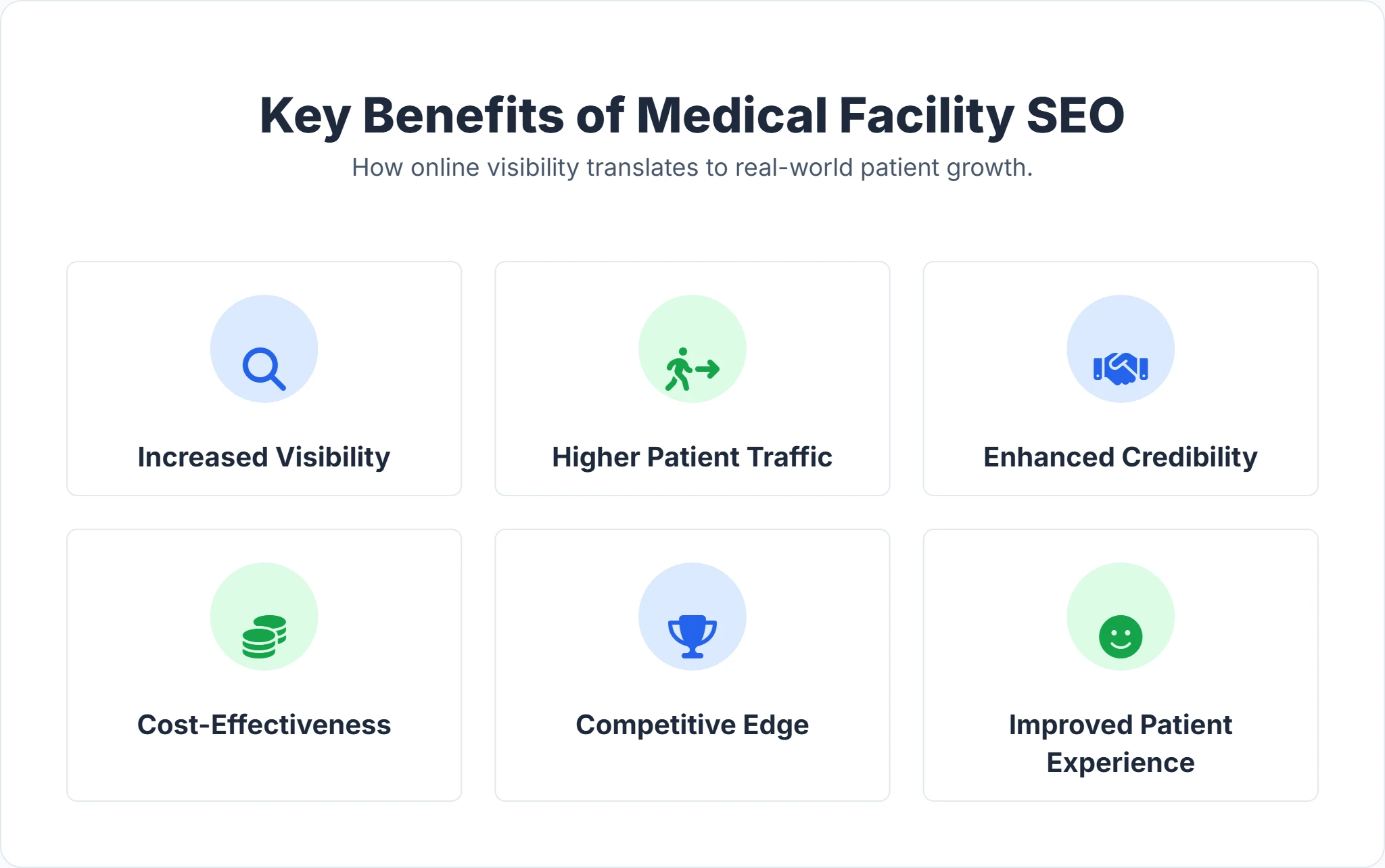
| Benefit | How it Helps Your Medical Facility |
|---|---|
| Increased Visibility | Dominating the top of search results ensures you capture the lion's share of local patient demand. |
| Higher Patient Traffic | Drives relevant, pre-qualified visitors to your site who are actively seeking your specific treatments. |
| Enhanced Credibility | Top rankings validate your medical expertise and reassure patients before they even call. |
| Cost-Effectiveness | Delivers a sustainable stream of new patients without the volatility of ad auction prices. |
| Competitive Edge | Allows you to outperform larger hospital systems by targeting niche, local long-tail keywords. |
| Improved Patient Experience | Connects patients to critical information (hours, insurance, location) instantly, reducing friction. |
The Core Pillars: How Your Medical Facility Can Shine Online
Achieving dominance in search results requires a holistic approach. You cannot simply "do keywords" and expect to rank. Medical SEO relies on five interconnected pillars that build a resilient digital foundation.
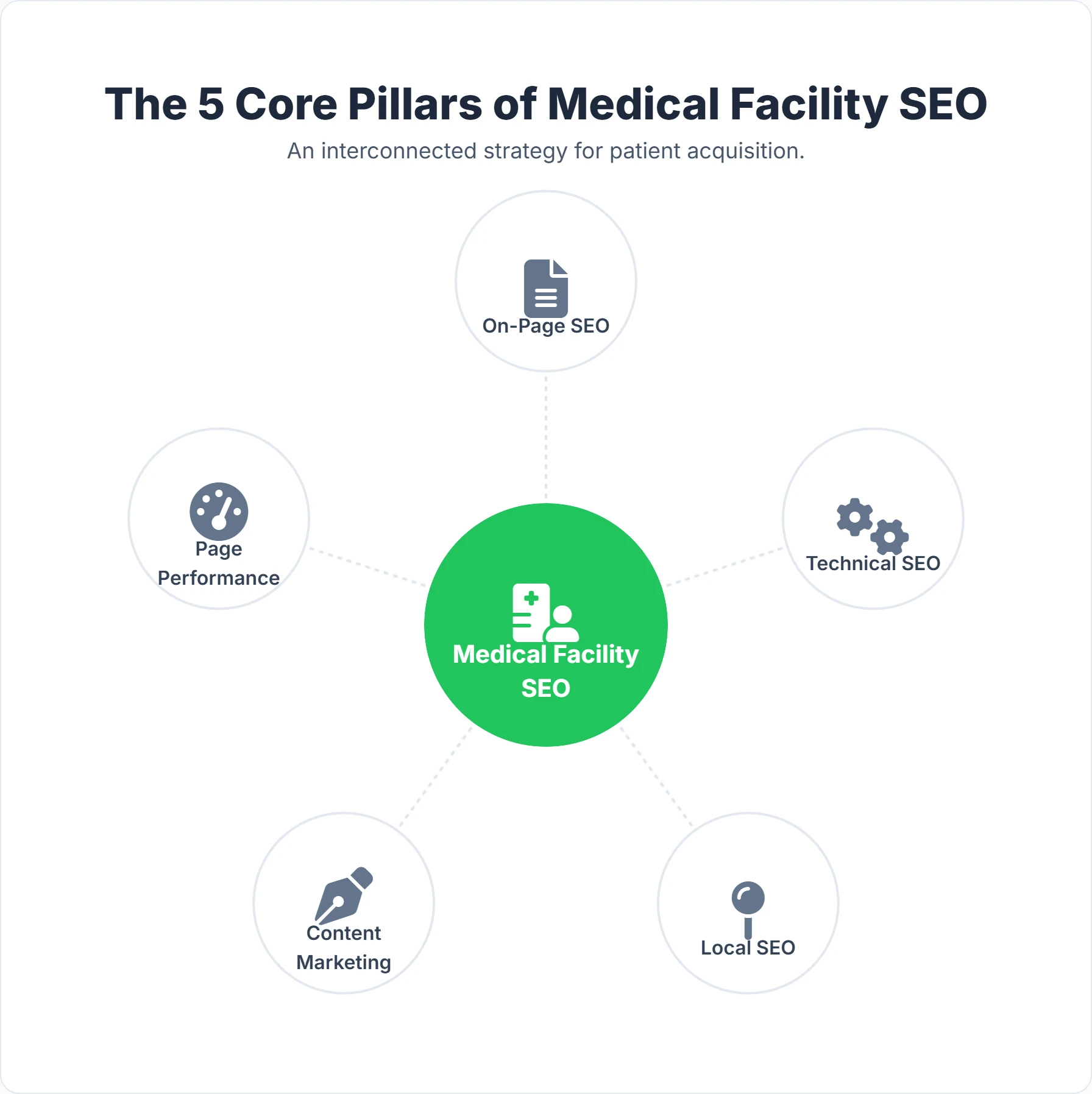
A. On-Page SEO: Speaking the Patient's Language
On-page SEO involves optimizing individual pages to rank higher and earn more relevant traffic. For medical facilities, this means bridging the gap between clinical terminology and how patients actually speak.
Strategies for Success:
- Keyword Mapping & Intent:
Patients rarely search for "myocardial infarction." They search for "chest pain symptoms" or "heart attack signs." You must optimize for both layperson terms and medical terminology. Use long-tail keywords that capture specific needs, such as "pediatrician near me accepting Medicaid" or "post-surgery rehab for knee replacement."
- Pro Tip: Create separate pages for each condition treated and service offered. Do not bundle "Cardiology" and "Vascular Surgery" onto one generic page. Specificity wins rankings.
- Optimizing Title Tags and Headers:
Your title tag is the single most important on-page ranking factor. Structure it to maximize click-through rates and local relevance.
- Bad: "Services - City Hospital"
- Good: "Emergency Room & Urgent Care in [City Name] | [Hospital Name]"
- Internal Linking Structure: Link your condition pages (e.g., "Arthritis") to your service pages (e.g., "Rheumatology Department") and physician profiles. This helps search engines understand the relationship between problems and your solutions. Learn more about effective on-page SEO best practices to refine your structure.
- Meta Descriptions: While not a direct ranking factor, these drive clicks. Write compassionate, action-oriented descriptions. "Experiencing chronic back pain? Our spine specialists in [City] offer non-surgical and surgical relief. Book a consultation today."
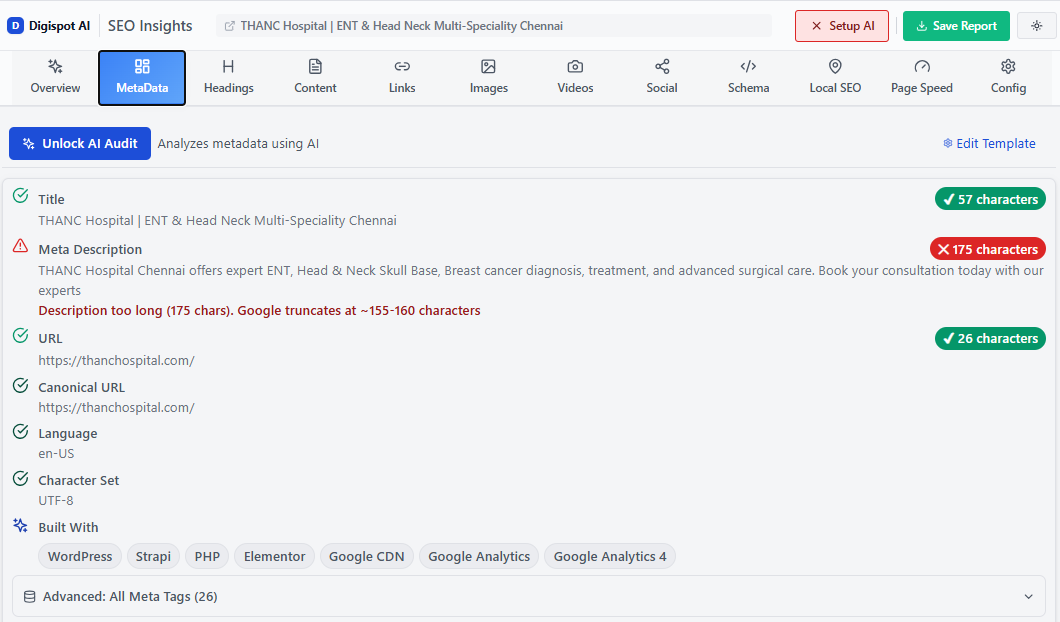
Tool Highlight: If you are unsure if your pages are optimized, try the free On-Page SEO Analysis tool to audit any URL instantly for keyword placement and structure gaps.
B. Technical SEO: The Health of Your Website
Technical SEO ensures your website is crawlable, secure, and fast. If your site has technical errors, Google cannot index your content, no matter how good it is.
Key Technical Factors:
- Security (HTTPS) & HIPAA: Security is non-negotiable. An SSL certificate (HTTPS) is a ranking signal and a basic requirement for user trust. While a public marketing site might not host patient records, any form (contact, appointment request) must be secure to protect potential patient data.
- Site Architecture: Medical sites can get large quickly. Ensure a logical hierarchy: Home > Services > Department > Specific Treatment. No page should be more than 3 clicks away from the homepage.
- Crawlability and Indexing:
Ensure your
robots.txtfile isn't blocking critical pages. Use an XML sitemap to submit all your service and location pages to Google Search Console. - Fixing Broken Links: Nothing erodes trust faster than a "404 Page Not Found" when a patient is looking for doctor contact info. Regular audits are essential. Digispot AI can help you identify and fix these issues automatically with AI-powered audits analyzing 300+ ranking factors.
For a comprehensive list of what to check, refer to our SEO audit checklist for 2026.
C. Local SEO: Dominate Your Geography
Local SEO is the lifeblood of medical practices. Most healthcare searches are local. You are not competing with the Mayo Clinic globally; you are competing with the clinic down the street.
Tactics for Local Dominance:
- Google Business Profile (GBP) Perfection:
Claim and verify listings for each practitioner and each location. This is often a point of confusion. Google allows distinct listings for the facility (e.g., "City General Hospital") and the doctors within it (e.g., "Dr. Jane Smith, Cardiologist").
- Fill out every field: hours, phone, website URL, and appointment links.
- Select the most specific categories (e.g., "Pediatric Dentist" instead of just "Dentist").
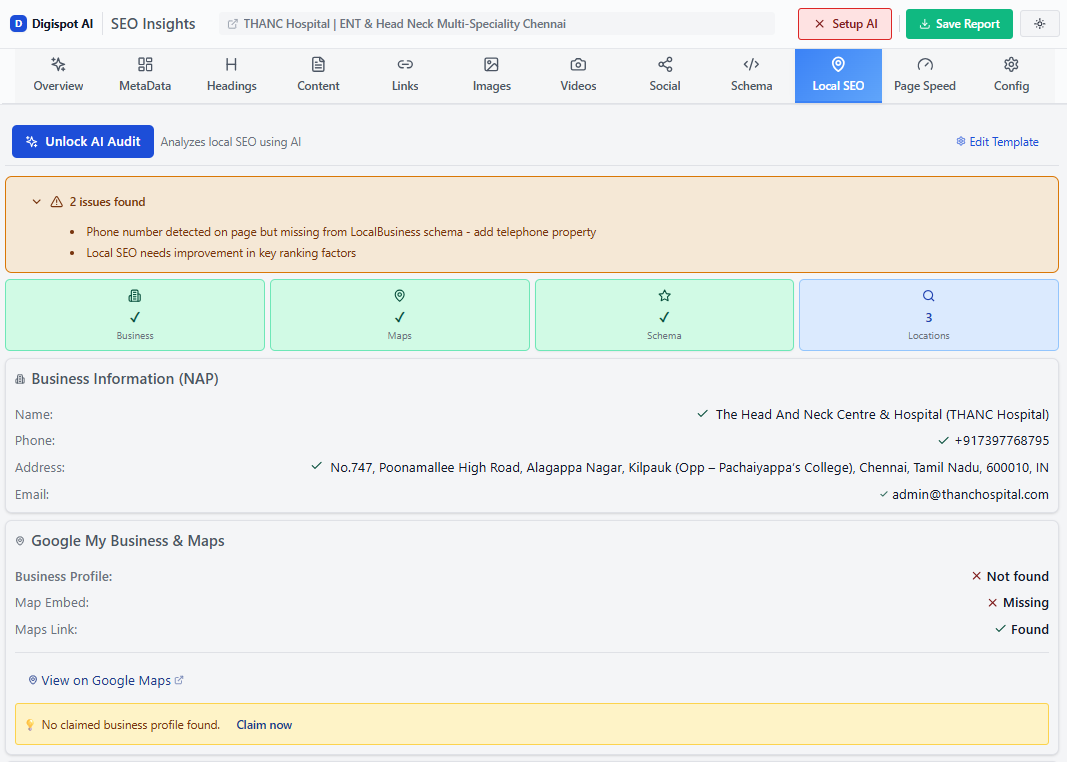
- Local Citations (NAP Consistency): Your Name, Address, and Phone number (NAP) must be identical across Healthgrades, Vitals, WebMD, Yelp, and Bing. Inconsistencies (e.g., "St." vs "Street") can confuse search algorithms and lower your rankings.
- Review Management: Reviews are a major ranking factor for the "Local Pack" (the map results). Actively encourage patients to leave feedback. Reply to every review. For negative reviews, offer to take the conversation offline to remain HIPAA compliant (never discuss specific treatments in a public reply).
D. Content Marketing: Building E-E-A-T
Content is how you demonstrate expertise. In the age of AI, unique, expert-written content is your differentiator.
Content Strategies:
- Educational Pillar Pages: Create comprehensive guides on conditions you treat. A page about "Type 2 Diabetes" should cover symptoms, causes, diagnosis, and treatment options available at your facility.
- Physician Bios: Flesh out doctor profiles. Include their education, certifications, philosophy of care, and even video introductions. This humanizes your facility and boosts E-E-A-T scores.
- FAQ Sections:
Answer the questions patients ask at the front desk. "Do you accept Blue Cross?" "How long is the recovery for hip replacement?" These serve as excellent targets for Voice Search and Featured Snippets.
- Tip: Learn more about establishing authority in our E-E-A-T SEO guide.
- Video Content: Short videos explaining procedures or facility tours can significantly increase time-on-page, a positive user signal to Google.
E. Schema Markup: Speaking to Machines
Schema markup (structured data) is code that helps search engines understand your content. For healthcare, it is a superpower.
Essential Medical Schemas:
MedicalOrganization: Defines your hospital or clinic.Physician: define individual doctors.MedicalSpecialty: Identifying specific departments (e.g., Oncology).MedicalCondition: Linking content to specific diseases.AggregateRating: Displaying star ratings in search results.
Implementing schema allows Google to show "Rich Snippets"—enhanced listings that display stars, hours, or insurance info directly in the search results. This increases click-through rates significantly.
Tool Highlight: Use the free Schema Markup Generator to create valid structured data for your medical practice in minutes. For a deeper dive, read our guide on medical schema markup.
F. Page Performance & Core Web Vitals
A slow website kills conversions. Google's Core Web Vitals metrics measure the user experience regarding loading performance, interactivity, and visual stability.
- Mobile-First Indexing: Google predominantly crawls the mobile version of your site. If your mobile site is clunky or slow, your rankings will tank. Ensure buttons are large enough for thumbs ("fat finger" friendly) and text is readable without zooming.
- Speed Metrics:
- LCP (Largest Contentful Paint): The main content should load in under 2.5 seconds.
- CLS (Cumulative Layout Shift): Elements shouldn't jump around as the page loads (common with improperly sized images).
- FID (First Input Delay): The site should respond instantly when a user clicks a button.
To improve your speed scores, compress images (using Next-Gen formats like WebP) and minimize JavaScript. Learn how to optimize these metrics in our Core Web Vitals SEO guide.
Step-by-Step: How to Kickstart Your Medical Facility's SEO
Breaking down the process into manageable steps makes medical facility SEO achievable for any practice manager or marketing director.
Step 1: Deep-Dive Keyword Research Start by understanding the "Patient Journey."
- Awareness Stage: "Why does my knee click?" (Informational content)
- Consideration Stage: "Best knee surgeon in [City]" (Commercial investigation)
- Decision Stage: "Book appointment Dr. Smith orthopedics" (Navigational) Use tools to find these keywords and map them to specific pages. Don't forget negative keywords (e.g., "free," "jobs") to avoid irrelevant traffic.
Step 2: Technical Health Check Before publishing new content, fix the foundation. Run a site audit. Look for duplicate content, which is common in healthcare systems that use boilerplate text across multiple location pages. Ensure every URL is secure and mobile-friendly. Get instant SEO insights on any page with our free Chrome extension.
Step 3: Optimize Google Business Profiles This is your "low-hanging fruit." Ensure your primary category is correct. If you are an Urgent Care, do not just list "Medical Center." Use the "Q&A" feature on your profile to pre-emptively answer common questions. Upload photos of the exterior, waiting room, and friendly staff faces to reduce patient anxiety.
Step 4: Create Trust-Based Content Develop a content calendar. Start with your top 5 most profitable services. Write comprehensive service pages for them. Then, write 3-5 supporting blog posts for each service that link back to the main service page (this is called a "Topic Cluster"). Ensure all medical content is reviewed by a professional—add a "Medically Reviewed by Dr. X" byline to boost credibility.
Step 5: Implement Schema Markup
Use a generator tool to build JSON-LD code for your LocalBusiness and MedicalWebPage. Inject this into the header of your site. This helps Google connect the dots between your doctors, your location, and the conditions you treat.
Step 6: Review Acquisition Strategy Train front-desk staff to ask for reviews. Use automated SMS or email follow-ups after appointments (ensuring consent is obtained). "How was your visit with Dr. Jones? Let us know on Google." A steady stream of fresh reviews signals to Google that your practice is active and trusted.
Step 7: Monitor, Analyze, Adapt SEO is a marathon. Install Google Analytics 4 (GA4) and Google Search Console. distinct "Conversions" for phone calls, form fills, and "Get Directions" clicks. Review this data monthly. If a page isn't ranking, update the content or build more internal links to it.
Digispot AI: Simplifying Your SEO Journey
While implementing these strategies is critical, it can be overwhelming for busy medical professionals or small marketing teams. Manual audits and keyword tracking take hours. Digispot AI streamlines this process.
Our platform acts as an all-in-one SEO and AEO command center:
- Automated Audits: We analyze your site against 300+ ranking factors, checking specifically for mobile usability, speed issues, and schema errors. We identify issues and help to solve them with clear instructions.
- AEO (Answer Engine Optimization): As patients shift to searching on ChatGPT and Perplexity, Digispot helps you track your visibility on these AI platforms, ensuring your facility is recommended by the AI.
- Competitor Intelligence: See exactly what keywords your local competitors are ranking for and where their backlinks are coming from.
- Content Studio: Our AI agents help you generate SEO-optimized content drafts that are structured for readability and semantic relevance, saving you hours of writing time.
- Chrome Extension: For quick checks, our free community Chrome extension allows you to audit your website page in your browser. It features schema markup detection and visualization, letting you see exactly how search engines view your medical data.
Digispot AI transforms complex data into a simple to-do list, helping you improve visibility without needing a PhD in computer science.
Common Challenges and How to Overcome Them
Medical SEO has unique hurdles. Here is how to navigate them.
- The "Zero-Click" Problem:
Google often answers health questions directly on the search page (Featured Snippets), meaning users don't click your link.
- Solution: Optimize for these snippets to build brand awareness, but focus your "money" keywords on services where users need to visit your site to book.
- HIPAA vs. Marketing Data:
Marketers want data; compliance officers want privacy.
- Solution: Never use personal identifying information (PII) in URL parameters or analytics. Use call tracking software that is HIPAA-compliant (redacts recordings). Digispot AI processes data locally and securely, ensuring no patient data is ever at risk.
- YMYL Rigor:
Google's algorithms are ruthless with low-quality medical sites.
- Solution: Audit your content for sourcing. Cite peer-reviewed journals. Ensure author bios are prominent. Avoid hyperbolic claims like "Miracle Cure."
- Local Filtering:
Sometimes doctors at the same address filter each other out in Google Maps.
- Solution: Ensure each doctor has a unique suite number if possible, or distinctly different primary categories and hours.
For more insights on avoiding pitfalls, read about common SEO mistakes healthcare providers make.
Conclusion: Start Improving Your Rankings Today
The digital landscape for healthcare is competitive, but the opportunity is immense. By treating your website as a vital clinical asset—one that requires maintenance, optimization, and care—you can connect with the patients who need you most.
Mastering medical facility SEO is not just about algorithms; it is about accessibility. It is about ensuring that when a parent is worried about a fever at 2 AM, your facility appears with the answers and help they need. Focus on technical excellence, authoritative content, and genuine local engagement.
Ready to improve your search visibility? Try Digispot AI for comprehensive website audits and actionable recommendations that take the guesswork out of medical SEO. Your digital front door is waiting to be opened—make sure patients can find the key.
References
- About search engine optimization (SEO) | Google Search Central
- Improve your local SEO on Google | Google Business Profile Help
- Understand Core Web Vitals | Google Search Central
- Mobile-first indexing (MFI) | Google Search Central
- Add structured data for a local business | Google Search Central
- Google Search Console
- Google Analytics
- Digispot AI - FREE On Page SEO Audit Tool
- Digispot AI - FREE Chrome Extension for SEO Insights
Audit any page in seconds
300+ SEO checks including Core Web Vitals, schema markup, meta tags, and AI readiness — trusted by 1000+ SEO experts and marketers.
Frequently Asked Questions
Here are some of our most commonly asked questions. If you need more help, feel free to reach out to us.
Written by
Maya Krishnan
Digital growth expert
Maya is a seasoned expert in web development, SEO, and digital strategy, dedicated to helping businesses achieve sustainable growth online. With a blend of technical expertise and strategic insight, she specializes in creating optimized web solutions, enhancing user experiences, and driving data-driven results. A trusted voice in the industry, Maya simplifies complex digital concepts through her writing, empowering readers with actionable strategies to thrive in the ever-evolving digital landscape.