Building Best in Class SEO Platform for AI Era - Digispot AI
Explore how Digispot AI is building a best in class SEO platform for AI era considering the latest trends and technologies.
 Maya Krishnan
SEO used to be a predictable game of keywords and meta tags. If you placed the right words in the right headers, you ranked. Those days are over. We are currently navigating a fundamental shift in information retrieval—an AI revolution that changes not just how search engines rank content, but how they understand the world.
In this new landscape, two powerful forces are colliding: AI-generated content flooding the web, and AI-driven platforms (like ChatGPT, Perplexity, and Google's Gemini) deciding what users see. Success here requires more than just good keywords; it demands a robust technical foundation and content architecture capable of withstanding rapid algorithmic shifts.
Join us as we analyze this transformation and demonstrate how Digispot AI is engineering a next-generation platform designed to turn these complexities into your competitive advantage.
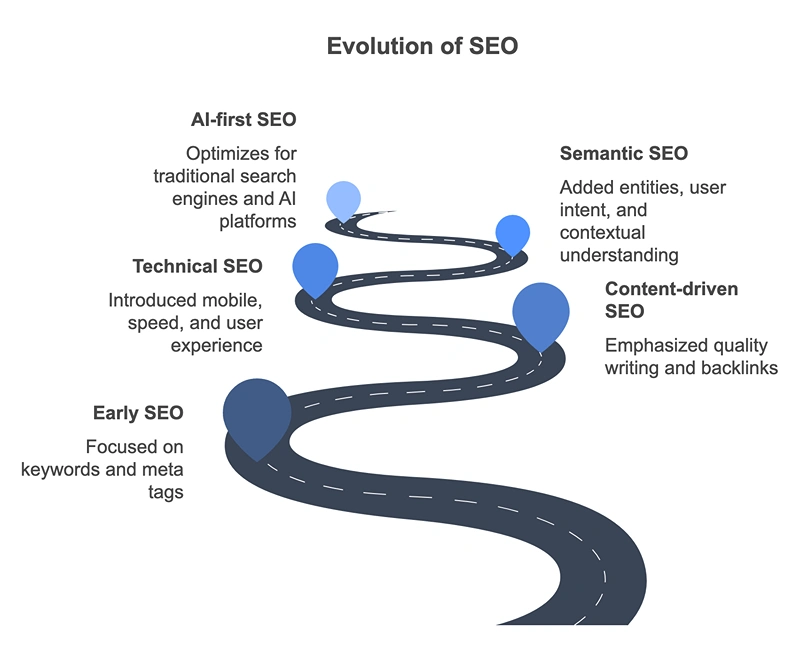
💡 Being AI-first is essential, but the path forward often feels obscured by hype. At Digispot AI, we cut through the noise to help business owners and marketing teams master the fundamentals across content, technical architecture, performance, and user experience.
Key Takeaways
- Optimize for two audiences at once: traditional search engines and answer engines like ChatGPT, Perplexity, and Gemini that synthesize answers instead of listing links.
- Serve content in the raw HTML. Many AI crawlers skip JavaScript, so anything rendered client-side risks being invisible to the platforms deciding whether to cite you.
- Run a dual-crawl (static vs. rendered) to catch the delta between what bots see and what users see, then fix the gaps that hide your content and links.
- Break down team silos with a single scorecard so marketing, writers, and developers share one source of truth instead of working against each other.
- Prioritize fixes by effort vs. impact, not by volume, so you ship the highest-velocity wins first instead of grinding through low-value tasks.
The AI Era of Search
The barrier to creating content has arguably never been lower. AI tools have enabled a massive influx of automated articles, often leading to "content bloat" across the web. While this might offer a temporary traffic spike, it rarely sustains long-term growth. Google and Bing are aggressively updating their core algorithms to differentiate between helpful, human-centric content and generic AI filler.
Search engines today aren't just indexing pages to match query strings. They are training large language models (LLMs) to understand intent, sentiment, and factual accuracy. Companies like Google rely on the quality of the data they crawl to power their multi-billion dollar ecosystems. Consequently, they are raising the bar for what gets indexed. If your site structure confuses their bots, or your content lacks unique value, you won't just lose rankings—you might be excluded from the conversation entirely.
This makes adhering to on-page SEO best practices more critical than ever. You aren't just optimizing for a search bar anymore; you are optimizing for a machine's understanding of your brand entity.
The Rise of Answer Engines
Beyond traditional search engines, we are seeing the explosion of Answer Engines. Platforms like ChatGPT, Perplexity, and Claude are changing user behavior. Instead of clicking ten blue links, users now ask complex questions and expect a synthesized answer.
The crawler bots from these platforms (such as GPTBot or Applebot-Extended) are aggressively scanning websites to build their knowledge bases. If your business isn't technically accessible to them, you lose out on citations and references in Generative AI responses.
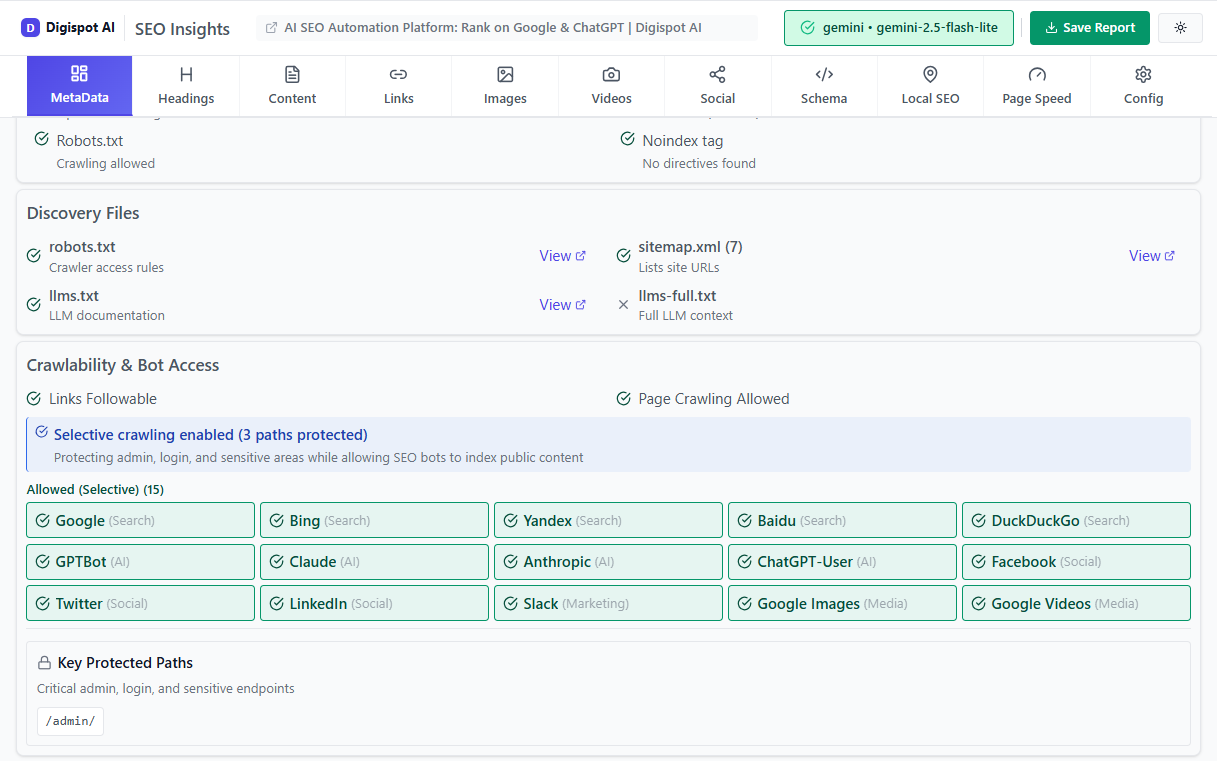
Turn invisible SEO data into clear visuals with our Free Chrome extension.
Crucially, these AI crawlers often behave differently than Googlebot. Many do not execute JavaScript efficiently, meaning if your content relies heavily on client-side rendering, it might be invisible to the very AI platforms trying to recommend you. You are targeting a demographic that demands instant, accurate answers—often the most valuable segment of internet users.

An example of AI search platform Perplexity helping user to make a purchase decision
Why We Need a Better SEO Platform for the AI Era
Intelligent Search Engines and Vector Search
Modern search engines have evolved into sophisticated AI systems. They no longer rely solely on "lexical search" (matching exact words). They now utilize "vector search" and semantic understanding to grasp the relationship between concepts.
Today's engines:
- Deploy Hybrid Crawling: They use a mix of lightweight static crawlers for speed and heavy-duty rendering crawlers for JavaScript-heavy pages.
- Analyze Context & Sentiment: Algorithms like BERT and MUM allow engines to understand nuance, effectively "reading" your content like a human would.
- Rewrite & Classify: They can rewrite your titles in search results and autonomously categorize your content into topics and user intents without your explicit input.
- Evaluate 200+ Factors: Rankings are determined by a complex interplay of Core Web Vitals, E-E-A-T signals, entity relationships, and technical health.
- Prioritize the Knowledge Graph: They look for structured data that connects your brand to specific entities (people, places, products).
- Assess Multi-Modal Content: Images, video, and audio are now primary ranking vectors, not just decorative elements.
If a tool promises to "fix your SEO" simply by suggesting a few keywords, it is obsolete. Modern SEO requires a platform that architects your digital presence like a well-constructed building—solid foundation, accessible structure, and high-quality materials.
Breaking Down Organizational Silos
The current SEO tool landscape is fragmented. You might use one tool for backlinks, another for technical audits, and a third for content grading. This fragmentation creates dangerous silos between the three personas essential for success:
- Marketing & SEO Teams: Focused on strategy, traffic acquisition, and competitor intelligence.
- Content Writers: Focused on narrative, tone, and production speed, often unaware of technical constraints.
- Web Developers: Focused on code stability and deployment, often viewing SEO requests as "performance-hurting" additions.
This disconnect leads to common SEO mistakes that kill performance:
- Marketing defines keywords that Writers don't use naturally.
- Writers publish heavy images that Developers haven't optimized.
- Developers push code changes that accidentally block search crawlers.
- No single scorecard exists to track the combined health of these efforts.
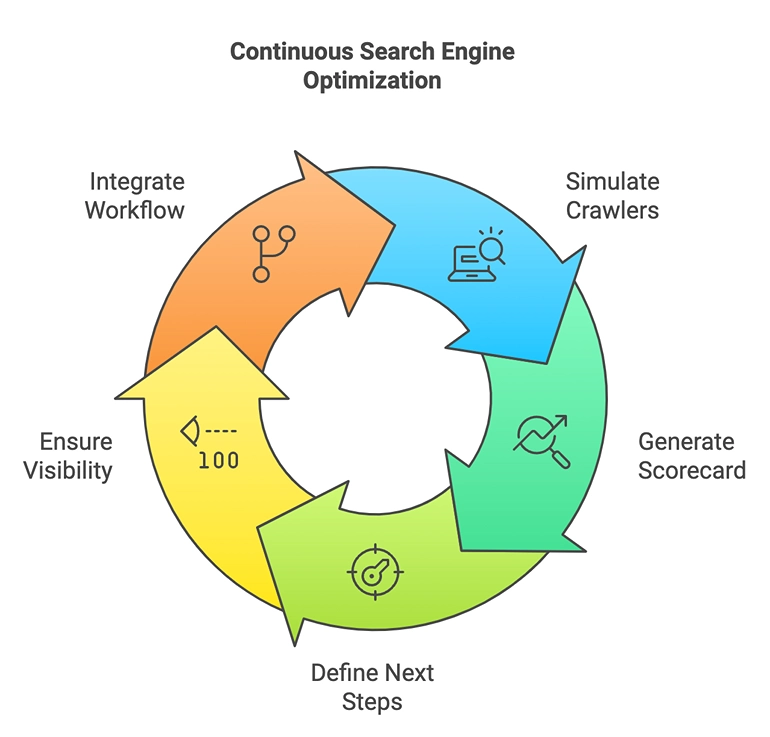
Organizations need a unified operating system for search visibility. This platform must:
- Simulate Search Crawlers: mimic exactly how Google and AI bots view your site.
- Unify Data: Provide a single source of truth for all three teams.
- Quantify Impact: Show exactly how a technical fix (Dev) impacts ranking potential (Marketing).
- Streamline Workflows: Turn audit findings into Jira tickets or content briefs automatically.
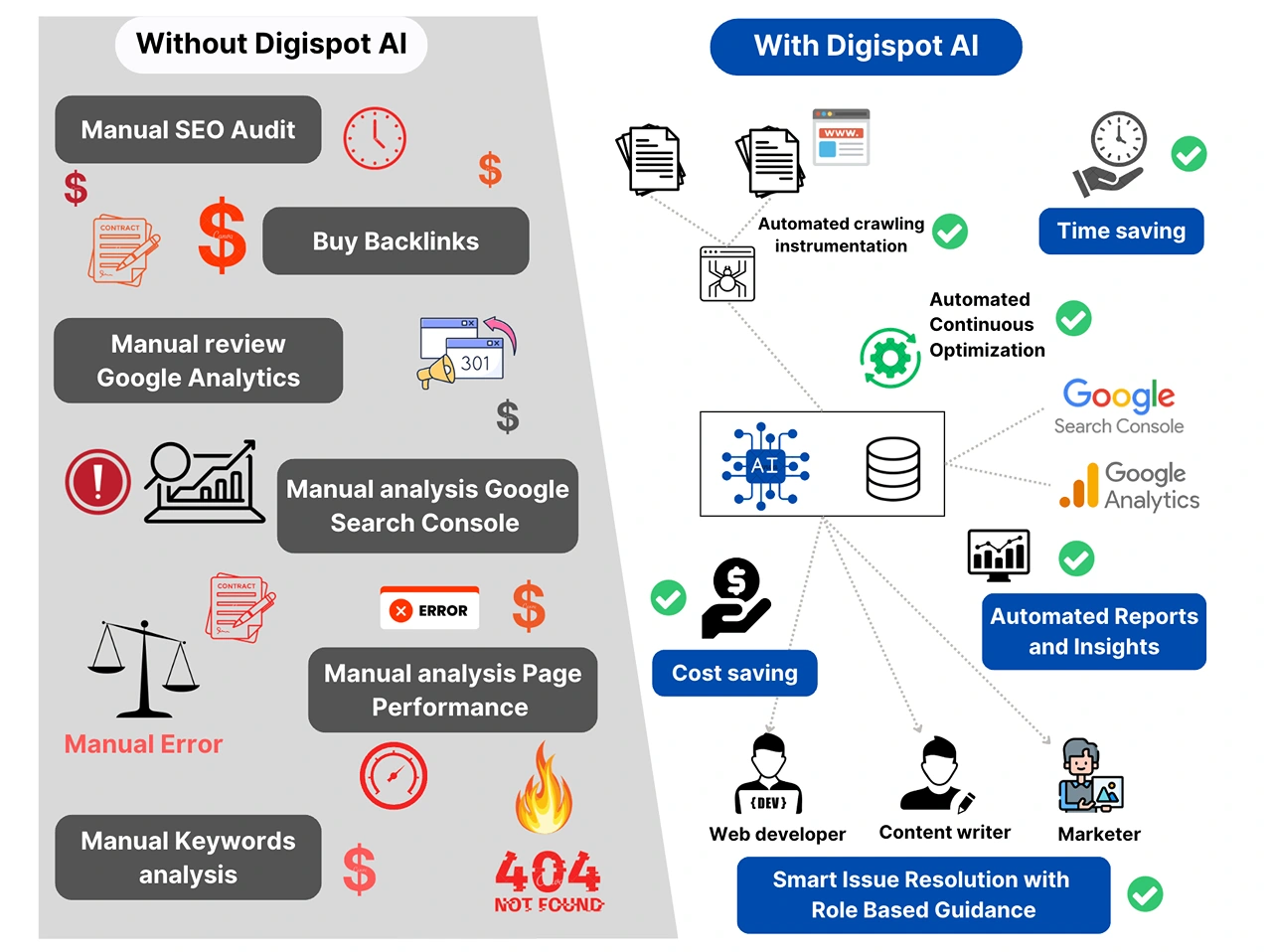
At Digispot AI, we are building this unified reality. We bridge the gap between code, content, and strategy.
Our Methodology: The Dual-Crawl Advantage
We didn't just build another scraper. We built an AI-powered empathy engine for search bots. At the core of Digispot AI is our intelligent crawler, designed to perform a comprehensive health check that mirrors the complexity of modern search engines.
The Mobile-First Imperative
Mobile optimization is no longer optional. With Google's mobile-first indexing, the mobile version of your site is the only version that matters for ranking. Yet, many developers build and test on desktop.
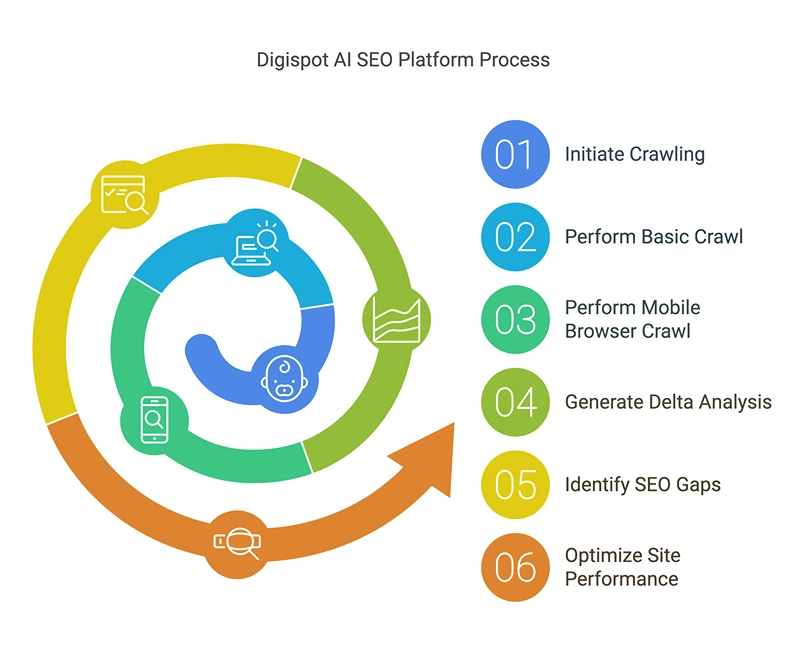
To address this, our platform executes a Dual-Crawl Analysis:
- Static Crawl: We crawl the raw HTML source code, just like a basic bot or an AI training scraper might.
- Rendered Mobile Crawl: We use a headless browser to execute JavaScript and render the page exactly as a user on a mobile device sees it.
This generates a "Delta Analysis." We compare the two states to find critical gaps. For example, if your main content or internal links only appear after JavaScript executes, basic AI crawlers might miss them entirely. By identifying these discrepancies, we ensure your content is visible to every bot, from Google to GPT. If the delta is large, the fix usually lives in your rendering strategy—our JavaScript and dynamic rendering guide walks through server-side rendering and pre-rendering options that expose content in the raw HTML.
Digispot AI helps you identify and fix these rendering issues automatically with AI-powered audits analyzing 300+ ranking factors.
Multi-Level Analysis Architecture
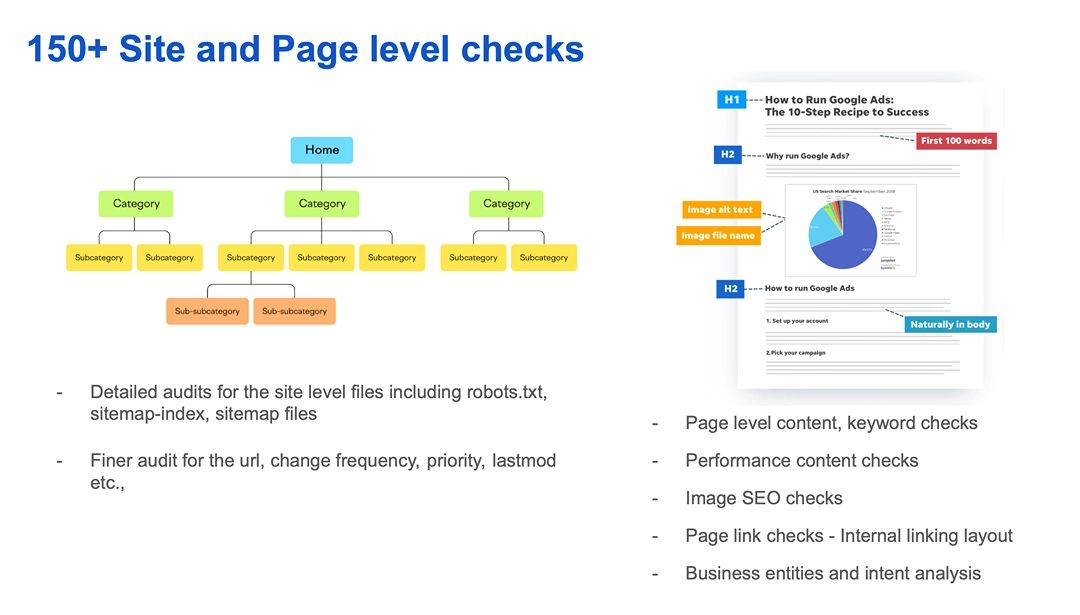
Our platform doesn't just scratch the surface. We operate at two distinct levels of granularity to ensure nothing slips through the cracks.
1. Site-Wide Intelligence Layer
Before optimizing a single page, you must ensure the vessel is sound. This layer handles the macro-level health of your domain:
- Security & Encryption: We validate SSL certificates, HSTS implementation, and security headers to ensure trust. A misconfigured redirect chain from HTTP to HTTPS, or mixed-content warnings, can quietly erode both rankings and user confidence.
- Crawl Budget Optimization: We parse your robots.txt directives and server logs to confirm bots spend their limited budget on pages that matter. On large sites, faceted URLs, session parameters, and infinite pagination can consume the majority of crawl activity before a bot ever reaches your money pages—so we flag the low-value paths worth disallowing. For deeper diagnosis, pair this with log file analysis to see exactly which URLs Googlebot and AI crawlers actually request.
- Sitemap Health:
- Validation of nested sitemap indexes and correct child-sitemap references.
- Analysis of
lastmodtags for accurate freshness signals (stale or falsified dates erode trust with crawlers). - Detection of "orphan pages" (pages that exist but aren't linked) and, conversely, indexable URLs missing from the sitemap entirely.
- Cross-checking that every submitted URL returns a
200status and is canonical, not a redirect ornoindexpage.
Getting these fundamentals right is what determines whether the rest of your optimization work is ever seen. If crawlers can't reach or trust your foundation, on-page polish never gets a chance to rank.
2. Page-Level Analysis Engine
Once the foundation is secure, we dive into the specifics of every URL. Our engine evaluates 15 critical dimensions:
Content Intelligence & E-E-A-T
We go beyond keyword density. Our NLP models analyze your content for E-E-A-T signals (Experience, Expertise, Authoritativeness, Trust). We check:
- Semantic Density: Are you covering the topic comprehensively using related entities?
- Information Gain: Does your content provide unique value compared to top-ranking competitors?
- Intent Matching: Does the content format (guide vs. product page) match the user's search intent?
Technical Excellence
Technical debt kills rankings. We rigorously check:
- Schema Markup: The language of AI search. We validate JSON-LD implementations to ensure rich snippets and entity recognition. (Use our free Schema Markup Generator to create valid structured data in minutes.)
- Canonicalization: Preventing duplicate content issues that dilute link equity.
- Core Web Vitals: We measure LCP, CLS, and INP to ensure you meet Google's performance thresholds. Learn more about Core Web Vitals optimization.
Media & Asset Optimization
- Image AI: We analyze alt text for descriptive accuracy and check next-gen format delivery (WebP/AVIF).
- Social Graphs: Validation of Open Graph and Twitter Card tags to ensure content looks premium when shared.
3. AI-Powered Insights Engine
Data without direction is noise. This is where Digispot AI truly differentiates itself.
- Benchmark Learning: We analyze thousands of top-ranking pages in your specific niche to understand what is actually working right now, not what worked 5 years ago.
- Contextual Recommendations: We don't give generic advice like "shorten title." If you run a medical site, our AI might flag a missing "MedicalReviewer" schema attribute—a specific context other tools miss (see our guide to medical schema markup for the full pattern).
- Predictive Impact: We use historical data to forecast the potential ROI of a fix. We help you answer: "Should I fix these 50 meta descriptions or improve this one page's load speed?"
- Prioritization Matrix: We rank tasks by Effort vs. Impact, giving your team a clear roadmap for the highest velocity wins.
The Digispot AI Advantage
By combining deep technical auditing with generative AI insights, we transform SEO from a reactive chore into a proactive growth engine.
- Operational Efficiency: Automate the manual "audit spreadsheets" that take weeks to compile. Get instant answers.
- Continuous Optimization: The web changes daily. Our real-time monitoring alerts you to SEO audit issues immediately—like a developer accidentally de-indexing a page—before it impacts revenue.
- Scale with Confidence: Whether you manage a 100-page blog or a 100,000-page e-commerce site, our architecture scales via parallel processing.
- Cross-Team Alignment: We provide a common language. Developers get technical specs; Marketers get content briefs. Everyone moves in the same direction.
- Future-Proofing: As AI search (AEO) evolves, we update our checking algorithms. When Perplexity or Google adds a new ranking signal, Digispot AI users are the first to know.
Get instant SEO insights on any page right now with our free Chrome extension.
Start Building Your AI-Ready SEO Strategy
The era of simple keyword matching is behind us. To succeed in the age of AI search, you need a platform that understands the machines evaluating your content. You need deep technical visibility, semantic content analysis, and a unified workflow for your entire team.
Digispot AI is that platform. We turn complex data into a competitive advantage, ensuring your brand remains visible whether a user is searching on Google, asking ChatGPT, or browsing via voice search.
Ready to improve your search visibility? Try Digispot AI for comprehensive website audits and actionable recommendations that drive real growth.
Related deep-dives
Continue with these closely related guides:
- personalization seo — Personalization SEO: Dynamic Content & Rankings
- educational seo — Educational SEO: Schools & eLearning Rankings
- pharmacy seo — Pharmacy SEO: Local Visibility for Drugstores
- track ai search rankings — Track AI Search Rankings Monitoring: The New SEO Frontier
- what is seo? — What is SEO? The Complete Guide to Search Engine Optimization in 2026
- b2c startup seo — B2C Startup SEO: Direct-to-Customer Growth
References
- Google Search Central - Mobile-First Indexing: Google Blog
- Vercel Rise of AI Crawlers: Vercel Blog
- AI Search Evolution: Google AI Blog
- Digispot AI Search Engine Crawlers: Digispot AI SEO Audit
- Digispot AI Features: Digispot AI Features
Audit any page in seconds
300+ SEO checks including Core Web Vitals, schema markup, meta tags, and AI readiness — trusted by 1000+ SEO experts and marketers.
Frequently Asked Questions
Here are some of our most commonly asked questions. If you need more help, feel free to reach out to us.
Written by
Maya Krishnan
Digital growth expert
Maya is a seasoned expert in web development, SEO, and digital strategy, dedicated to helping businesses achieve sustainable growth online. With a blend of technical expertise and strategic insight, she specializes in creating optimized web solutions, enhancing user experiences, and driving data-driven results. A trusted voice in the industry, Maya simplifies complex digital concepts through her writing, empowering readers with actionable strategies to thrive in the ever-evolving digital landscape.