Educational SEO: Schools & eLearning Rankings
Boost SEO for schools, universities, and eLearning platforms. Proven strategies to attract students, improve enrollment, and rank higher.
 Maya Krishnan
For any educational institution, from sprawling universities to nimble e-learning platforms, a robust online presence is now as crucial as its physical campus. The days of relying solely on college fairs and brochures are over. Prospective students, their parents, academic researchers, and potential faculty members increasingly begin their search with a query online.
Recognizing this shift, Search Engine Optimization (SEO) becomes an indispensable strategic tool. It transforms a website from a quiet corner of the internet into a vibrant information hub. This shift effectively attracts the precise audience needed to fulfill your mission.
This guide breaks down the fundamentals of SEO specifically for educational websites. We will examine why it matters, which strategies prove most effective, and how you can implement them to boost visibility. You will learn to attract significantly more traffic and ultimately increase enrollments. We will also discuss how modern AI-powered platforms can streamline this often-complex process.
Understanding the Landscape: Why SEO Matters for Educational Websites
Think of SEO as your digital admissions office. It works 24/7 to connect your institution with those actively seeking educational opportunities. In a competitive online environment, simply having a website isn't enough. You must be discoverable at the exact moment a student decides to look for their future.
What are the core reasons SEO is crucial for educational websites?
- Increased Visibility and Reach: When prospective students search for "best engineering programs" or "online MBA courses," your institution must appear prominently. If you aren't on page one, you likely don't exist to them. Higher visibility directly translates to more eyes on your programs, faculty, and unique offerings.
- Attracting the Right Audience: SEO isn't just about volume; it's about qualified traffic. By optimizing for specific intents, you attract individuals genuinely interested in what you offer. This leads to higher engagement and conversion rates, such as completed applications or campus tour bookings.
- Building Authority and Trust: Search engines like Google prioritize authoritative sources. This is part of E-E-A-T (Experience, Expertise, Authoritativeness, and Trustworthiness). A strong SEO presence signals to search engines and users that your institution is a credible leader. For more on building trust signals, read our guide on E-E-A-T SEO strategies.
- Cost-Effective Marketing: Paid advertising stops working the moment you stop paying. Organic search traffic generated through SEO is an asset that appreciates over time. It provides a sustainable flow of visitors without the recurring cost per click.
- Staying Competitive: Your peer institutions are investing in SEO right now. They are optimizing their program pages and capturing the students you want. To maintain your position and grow, an effective SEO strategy is a necessity.
Core SEO Strategies for Educational Websites
Understanding the importance of SEO is step one. Now, let's look at the practical strategies that form the backbone of successful educational campaigns.
1. Keyword Research: Speaking Your Audience's Language
Keywords are the bridge between a user's question and your answer. For educational websites, identifying the right keywords means understanding the intent behind a user's search. Are they looking for program details, application requirements, scholarship information, or simply exploring career paths?
What kind of keywords should educational institutions target?
- Program-Specific Keywords: These are your bread and butter. Examples include "Bachelor of Arts in Psychology," "MSc Data Science online," or "culinary arts degree near me." These users know what they want to study.
- Location-Based Keywords: Geography drives decisions. Terms like "universities in [City/State]," "private schools [District]," or "adult education courses [Town]" are vital for campus-based institutions.
- Informational Keywords: Capture students early in their journey. Phrases like "how to apply for financial aid," "benefits of a STEM degree," or "career paths in nursing" bring in top-of-funnel traffic.
- Long-Tail Keywords: These are specific, often question-based phrases. An example is "accredited online master's in education with no GRE requirement." These often have lower search volume but incredibly high conversion rates because the intent is so specific.
- Branded Keywords: Don't neglect your own name. Monitor searches for your institution, specific programs, or unique faculty names to manage your reputation.
How to find relevant keywords?
Start by brainstorming. Put yourself in the shoes of a prospective student. What would you type into Google? Then, validate these ideas with tools. Even Google's auto-suggest, "People Also Ask" boxes, and "Related Searches" provide valuable clues.
For deeper analysis, platforms like Digispot AI offer an "opportunity finder." This tool analyzes search trends and identifies high-potential keywords your competitors might be overlooking. It gives you a strategic advantage by highlighting gaps in the market.
Table: Examples of Educational Keywords and Their Intent
| Keyword Phrase | User Intent | Target Page Examples |
|---|---|---|
| online MBA programs | Research/Consideration | MBA Program Page, Admissions Page, Blog on MBA |
| how to apply for college | Informational | Admissions Guide, FAQ Page, Application Portal |
| scholarships for undergraduates | Informational/Action | Financial Aid Page, Scholarship Database |
| University of [Your Name] reviews | Research/Validation | Testimonials Page, About Us, Alumni Stories |
| computer science courses [City] | Local/Program Specific | CS Program Page, Campus Locations, Course Catalog |
| benefits of distance learning | Informational | Blog Post, Online Learning Benefits Page |
2. On-Page SEO: Optimizing Your Content and Structure
On-page SEO refers to all the optimizations you make directly on your website's pages. It improves their search engine ranking and user experience. In the education sector, content must be scrupulously accurate and helpful.
What are the key elements of On-Page SEO for educational sites?
-
Content Quality and Relevance: This is paramount. Your content must be accurate, comprehensive, and engaging. It must directly answer user queries. For educational websites, this means detailed program descriptions, well-researched faculty profiles, and clear admissions information.
- How to optimize content?
- Depth and Detail: Provide thorough information. Don't leave prospective students guessing about tuition or prerequisites.
- Engagement: Use clear language. Incorporate videos of campus life, infographics on career outcomes, and interactive tuition calculators.
- Readability: Break up long blocks of text. Use headings, bullet points, and images to make academic text digestible.
- Regular Updates: Keep content fresh. Outdated application deadlines or course catalogs frustrate users and hurt rankings.
- Actionable Advice: For a complete list of on-page factors, check our on-page SEO best practices.
- How to optimize content?
-
Meta Titles and Descriptions: These are your storefront window.
- How to craft compelling titles and descriptions?
- Titles: Include your primary keyword and institution name. Keep it under 60 characters. Make it enticing.
- Descriptions: Summarize the page's content. Include secondary keywords and a reason to click ("Apply now," "Learn more"). Keep it under 160 characters.
- Tool Tip: You can preview how your pages will look in search results using the Digispot Meta Preview tool.
- How to craft compelling titles and descriptions?
-
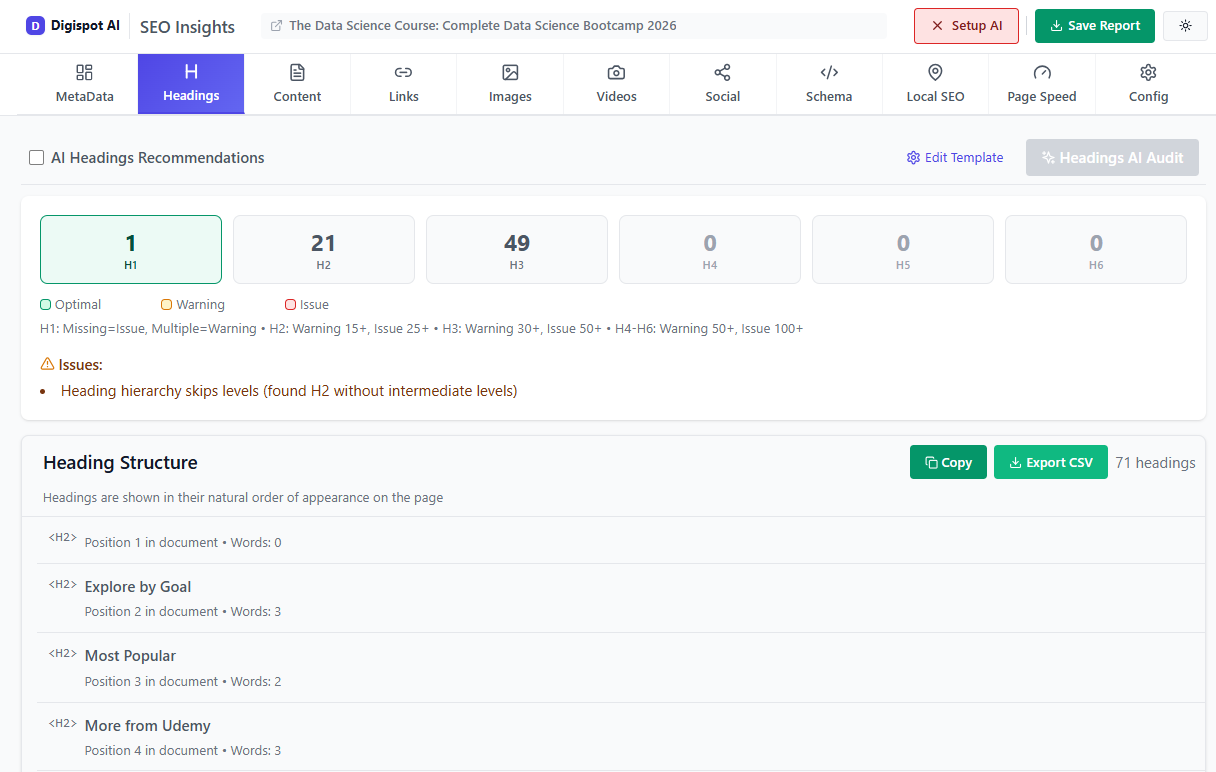
Header Tags (H1, H2, H3, etc.): These provide structure. They help search engines understand the hierarchy and main topics.
- How to use header tags effectively?
- Use one H1 per page for the main topic (e.g., the program name).
- Use H2s for major sub-sections (Curriculum, Faculty, Career Outcomes).
- Use H3s for sub-points within H2 sections.
- Incorporate keywords naturally within headers where appropriate.
- How to use header tags effectively?
-
Image Optimization: Images sell the experience. However, large files slow down your site.
- How to optimize images?
- Compress Images: Reduce file size without sacrificing quality.
- Use Descriptive Alt Text: Provide text descriptions (e.g.,
alt="students studying in the engineering lab"). This aids accessibility for visually impaired users. - Descriptive File Names: Rename generic files like
IMG_123.jpgtocomputer-science-lab.jpg.
- How to optimize images?
-
Internal Linking: Connecting relevant pages within your website helps search engines understand your site's structure. It distributes "link juice" or authority throughout your domain.
- How to implement internal linking?
- Link from a broad blog post about "choosing a major" to specific program pages.
- Link from a faculty profile to the courses they teach.
- Use descriptive anchor text. Avoid "click here." Instead, use "explore our biology curriculum."
- Need a strategy? Learn how to structure your links with our internal linking strategy guide.
- How to implement internal linking?
-
Instant Analysis: Want to see how a specific page is performing right now? Try the free On-Page SEO Analysis tool to audit any URL instantly.
3. Technical SEO: The Foundation of Your Digital Campus
Technical SEO ensures that search engines can easily crawl, interpret, and index your website. Without a strong technical foundation, even the best content might not get the visibility it deserves. Large university sites are prone to "crawl bloat" due to thousands of legacy pages.
What are the critical aspects of Technical SEO?
- Site Speed and Mobile Responsiveness: Students live on their phones. A slow or non-mobile-friendly website is a major deterrent. Google uses mobile-friendliness as a strict ranking factor.
- Why does it matter? Fast loading times reduce bounce rates. If a page takes 3 seconds to load, you've likely lost the applicant. A responsive design ensures your site functions on all devices.
- How to check and improve? Use Google's PageSpeed Insights. Focus on metrics like Interaction to Next Paint (INP) and Largest Contentful Paint (LCP). For a deep dive into these metrics, read our guide on Core Web Vitals.
- Automated Help: Platforms like Digispot AI can audit your website in both mobile and desktop modes. This helps you identify specific code or assets impacting performance.
Table: Common Technical SEO Issues & Solutions
| Issue | Impact on SEO/Users | Solution |
|---|---|---|
| Slow Page Load Speed | High bounce rate, poor user experience, lower rankings | Image optimization, CDN, leverage browser caching, minimize code |
| Not Mobile-Friendly | Poor mobile experience, lower mobile rankings | Responsive design, use mobile-first indexing best practices |
| Broken Links (404 errors) | Frustrates users, wastes crawl budget | Regularly check for broken links and fix them (redirect or update) |
| Missing/Incorrect XML Sitemap | Search engines struggle to discover all pages | Create and submit an accurate XML sitemap via Google Search Console |
| Duplicate Content | Confuses search engines, dilutes ranking power | Use canonical tags, 301 redirects, or noindex tags |
| Lack of SSL (HTTPS) | Security risk, browser warnings, minor ranking detriment | Implement SSL certificate to serve content over HTTPS |
-
Sitemap and Robots.txt:
- XML Sitemap: A map of all important pages. Submitting this to Google Search Console is mandatory for large sites.
- Robots.txt: This file tells crawlers where not to go. Use it to block internal search results or login pages from being indexed.
-
Schema Markup (Structured Data): This is a powerful, yet often underutilized strategy. Schema markup is code that helps search engines understand the specific type of content on a page.
- What is Schema Markup for educational sites?
CourseSchema: Highlights course names, descriptions, and providers.EducationalOrganizationSchema: Provides details about your institution, such as its official name and logo.EventSchema: Perfect for open days, webinars, and workshops.FAQPageSchema: Displays questions and answers directly in search results.
- How does it help? Rich snippets increase click-through rates (CTR). A search for "online MBA" might show not just a link, but also the course duration and tuition fees directly in Google.
- Implementation: Writing this code manually is prone to errors. Use the free Schema Markup Generator to create valid structured data in minutes.
- What is Schema Markup for educational sites?
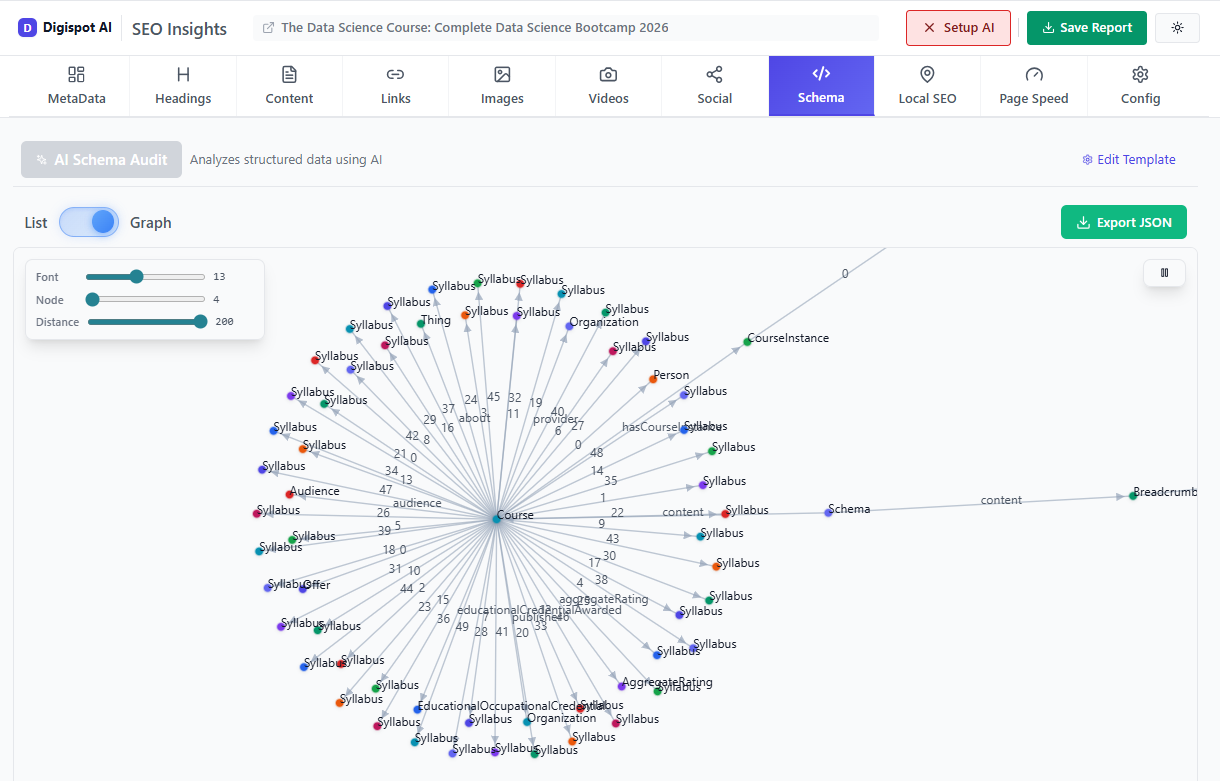
Turn invisible SEO data into clear visuals with our Free Chrome extension.
-
SSL/HTTPS: Security is non-negotiable. An SSL certificate encrypts data transfer. Google prefers HTTPS sites, and browsers will flag non-secure sites to users, killing trust instantly.
-
Comprehensive Audits: Keeping track of technical health is difficult. Digispot AI can help you identify and fix these issues automatically with AI-powered audits analyzing 300+ ranking factors.
4. Off-Page SEO: Building Your Reputation Beyond Your Website
Off-page SEO refers to activities outside your website that improve its ranking. The most significant factor here is link building. For educational institutions, you have a unique advantage: the high authority of .edu domains.
What are the key elements of Off-Page SEO?
-
Quality Backlinks: When other reputable websites link to you, it acts as a vote of confidence.
- Academic Partnerships: Leverage collaborations with other universities and research institutions. Ensure they link back to your project pages.
- Alumni Networks: Encourage successful alumni to link to the university from their professional bio pages or company websites.
- Research Citations: When faculty publish research, ensure the hosting journals link back to the faculty profile or department page.
- Educational Resources: Create high-value resources like "The State of Nursing 2026" that government portals and news outlets will want to cite.
- Press Mentions: Use your PR team. When the institution is mentioned in the news, ask for that mention to be turned into a hyperlink.
- Guest Blogging: Faculty can contribute expert content to industry publications, earning high-authority links in return.
-
Social Media Promotion: Social signals aren't direct ranking factors, but they drive traffic. Viral content attracts eyes, and eyes attract links. Share student success stories and research breakthroughs aggressively.
5. User Experience (UX) and Engagement: Keeping Visitors Happy
Google's algorithms heavily weight user experience. If users land on your site and leave immediately (bounce), it signals that your result was not relevant or the experience was poor.
How to enhance UX for educational websites?
- Clear Navigation: Don't bury the lead. Menus should be intuitive. Terms like "Admissions," "Academics," and "Student Life" work because they are standard. Avoid "clever" naming conventions that confuse users.
- Accessibility: Education is for everyone. Ensure your website is ADA compliant. This means proper contrast ratios, screen reader compatibility, and keyboard navigation. This isn't just legal compliance; it opens your doors to more students.
- Engaging Content Formats: Text is good; multimedia is better. Incorporate virtual campus tours, video testimonials, and podcast episodes. These formats keep users on the page longer, signaling value to search engines.
- Internal Search: Students often skip navigation and go straight to the search bar. Ensure your internal search engine actually works and delivers relevant results.
Measuring Success and Continuous Improvement
SEO is a marathon, not a sprint. To ensure effectiveness, you must monitor performance and adapt. What works in 2026 might change by 2026.
How to track and improve your SEO performance?
-
Analytics and Monitoring:
- Google Analytics: Understand who is visiting. Check demographics and behavior flow. Which pages cause students to drop off?
- Google Search Console: This is your direct line to Google. It shows you exactly which queries bring users to your site. It also alerts you to critical crawl errors.
- Integration: The Digispot AI platform offers seamless integration with both GSC and GA4. It provides a consolidated dashboard to track KPIs, saving you from tab-switching fatigue.
-
Auditing and Iteration: Regular health checks are essential.
- Issue Detection: You can't fix what you don't see. Regular audits catch broken links or missing meta tags before they hurt your rankings. Digispot AI audits websites for over 200 ranking factors, presenting issues in a visual format for quick resolution.
- Free Extension: For quick insights while browsing competitor sites, use the free Chrome extension. It allows you to peek under the hood of any webpage to see their schema, headers, and keywords.
Table: Key SEO Metrics to Track for Educational Websites
| Metric | What it tells you | Why it's important for education |
|---|---|---|
| Organic Traffic | Number of visitors coming from search engines | Direct measure of increased visibility and reach |
| Keyword Rankings | Your position in search results for target keywords | Indicates effectiveness of keyword strategy; higher rank = more clicks |
| Bounce Rate | Percentage of visitors who leave after viewing one page | High bounce rate suggests content isn't relevant or UX is poor |
| Time on Page | Average duration visitors spend on a page | Longer time indicates engaging, valuable content |
| Conversion Rate | Percentage of visitors who complete a desired action | (e.g., application, inquiry, download) – direct measure of business outcomes |
| Crawl Errors | Issues preventing search engines from accessing pages | Identifies technical problems that need urgent attention |
| Backlinks | Number and quality of external links to your site | Indicates authority and credibility of your institution |
Avoiding Common Pitfalls
Even with good intentions, schools often make SEO mistakes.
- Cannibalization: Having five different pages trying to rank for "MBA program." Consolidate them into one authoritative guide.
- Ignoring Local SEO: Even for global universities, local search matters for campus visits. Verify your Google Business Profile.
- Neglecting Image Search: Many students search for campus images before applying. If your images aren't optimized, you miss this traffic.
- Learn More: Review our guide on common SEO mistakes to ensure your strategy is airtight.
Benefits of a Strong SEO Strategy for Educational Websites
Implementing a robust SEO strategy yields tangible benefits that extend far beyond rankings:
- Increased Enrollments/Applications: SEO fills the funnel. Reaching more qualified students increases your applicant pool.
- Higher Brand Visibility: A strong online presence cements your authority. It protects your brand reputation.
- Improved Engagement: A well-structured site fosters better engagement with current and prospective students.
- Cost Efficiency: Organic traffic reduces reliance on expensive paid campaigns. It lowers your Cost Per Acquisition (CPA).
- Time Savings: While SEO requires effort, automating processes with platforms like Digispot AI reduces the manual labor of auditing. This allows your team to focus on strategy rather than spreadsheets.
Leveraging AI for Educational SEO
The landscape is shifting toward Answer Engine Optimization (AEO). Platforms like ChatGPT, Perplexity, and Google's AI Overviews are changing how students search. They don't just want links; they want answers.
How AI helps you adapt:
- Multi-LLM Analysis: Understanding how different AI models view your content is key. Digispot AI uses a multi-LLM engine (GPT-4, Claude, Gemini) to analyze your site. This ensures you are optimized for traditional search and AI discovery.
- Scale: Large educational sites have thousands of pages. Manually optimizing them is impossible. AI can analyze 300+ ranking factors across an entire domain in minutes.
- Content Creation: The Digispot "Content Studio" helps you spot opportunities and generate outlines. It ensures new blog posts or course descriptions are aligned with SEO best practices from the start.
Start Improving Your Enrollment Numbers Today
SEO for educational websites is a strategic imperative. It directly impacts your institution's ability to connect with its future. By focusing on intent-driven keyword research, crafting high-quality content, ensuring a solid technical foundation, and building valuable backlinks, you secure your digital future.
Embrace these strategies. Leverage integrated platforms to audit, detect issues, and visualize opportunities. Your digital front door is open – ensure it leads future minds directly to your campus.
Ready to improve your search visibility? Try Digispot AI for comprehensive website audits and actionable recommendations that drive real results.
References
- A Beginner's Guide to SEO | Moz
- Search Engine Optimization (SEO) Starter Guide | Google Search Central
- Understand how structured data works | Google Search Central
- Mobile-first indexing (MFI) best practices | Google Search Central
- Core Web Vitals | Google Search Central
- Image SEO best practices | Google Search Central
- Link schemes | Google Search Central
- Google Analytics
- Google Search Console
- Robots.txt Introduction and Guide | Google Search Central
- Learn about XML sitemaps | Google Search Central
- Digispot AI - FREE On Page SEO Audit Tool
- Digispot AI - FREE Chrome Extension for SEO Insights
Audit any page in seconds
300+ SEO checks including Core Web Vitals, schema markup, meta tags, and AI readiness — trusted by 1000+ SEO experts and marketers.
Frequently Asked Questions
Here are some of our most commonly asked questions. If you need more help, feel free to reach out to us.
Written by
Maya Krishnan
Digital growth expert
Maya is a seasoned expert in web development, SEO, and digital strategy, dedicated to helping businesses achieve sustainable growth online. With a blend of technical expertise and strategic insight, she specializes in creating optimized web solutions, enhancing user experiences, and driving data-driven results. A trusted voice in the industry, Maya simplifies complex digital concepts through her writing, empowering readers with actionable strategies to thrive in the ever-evolving digital landscape.