Local SEO Strategies: Dominate Your Geographic Market
Master local SEO strategies to dominate geographic search results. Optimize Google Business Profile, build citations, and outrank local competitors effectively.
 Maya Krishnan
Connecting with customers in your immediate area often feels harder than it should be. You know your community needs your services, but if your business doesn't appear when they pull out their phones to search, you simply don't exist to them. For any business with a physical storefront or a defined service area, visible placement in local search results is not a luxury—it is the difference between thriving and closing your doors.
Local SEO Strategies act as your digital signal, guiding ready-to-buy customers directly to you. This goes beyond just being on the map; it requires a systematic approach to proving your relevance and authority to search engines like Google and Bing, as well as emerging AI platforms like ChatGPT and Perplexity.
This guide breaks down the mechanics of local visibility. You will learn how to optimize your Google Business Profile for maximum impact, why technical schema markup is your secret weapon, and how to manage your reputation to drive conversions. We focus on actionable, data-backed tactics you can implement immediately to capture your local market.
Key Takeaways
- Own your Google Business Profile first. It is the single highest-leverage asset—verify it, pick a precise primary category, and keep it active with weekly posts and photos.
- Consistency beats volume. Identical Name, Address, and Phone (NAP) across every directory builds the trust signal Google needs before rankings move.
- Reviews are both a ranking factor and a conversion driver. Systematize the ask, respond to every review, and keep new ones flowing.
- Mirror your local signals on-page. Unique location pages,
LocalBusinessschema, and a mobile-fast site confirm to search engines what your profile claims. - Structure for AI and voice. Answer full, conversational questions with clear, structured data so answer engines can quote you directly.
What Exactly is Local SEO? Unpacking the Concept
Local SEO (Search Engine Optimization) is the process of optimizing your online presence to attract more business from relevant local searches. These searches take place on Google, Bing, Apple Maps, and increasingly, within AI chatbots. When a user searches for "plumbers near me" or "best italian restaurant in [City]," search engines rely on a specific set of algorithms to deliver results.
While traditional SEO focuses on ranking content for keywords on a national or global scale, local SEO targets a specific geographic radius. It is about connecting with high-intent users who are often ready to purchase within hours or minutes of their search. For a ground-up explanation of the fundamentals, see our guide to what local SEO is and how it works.
The Mechanics of Local Ranking
Google determines local rankings based on three primary pillars. Understanding these will help you prioritize your efforts:
- Relevance: How well does your business listing match what the user is searching for? This is determined by your categories, business description, and on-site content.
- Distance: How far is each potential search result from the location term used in a search? If a user doesn't specify a location, Google calculates distance based on what is known about their location.
- Prominence: This refers to how well-known a business is. It factors in information from across the web, such as links, articles, and directories. Review count and score are also critical factors in local search ranking: more reviews and positive ratings can improve your business's local ranking.
Google's algorithms are sophisticated enough to detect "implicit" local intent. A user searching for "coffee shop" doesn't need to add "near me" for Google to know they want a local result. This makes local optimization critical even for broad keyword terms if you serve a specific area. To see where you stand on these fundamentals, check out our comprehensive guide to local SEO.
Why Local SEO is Absolutely Essential for Your Business
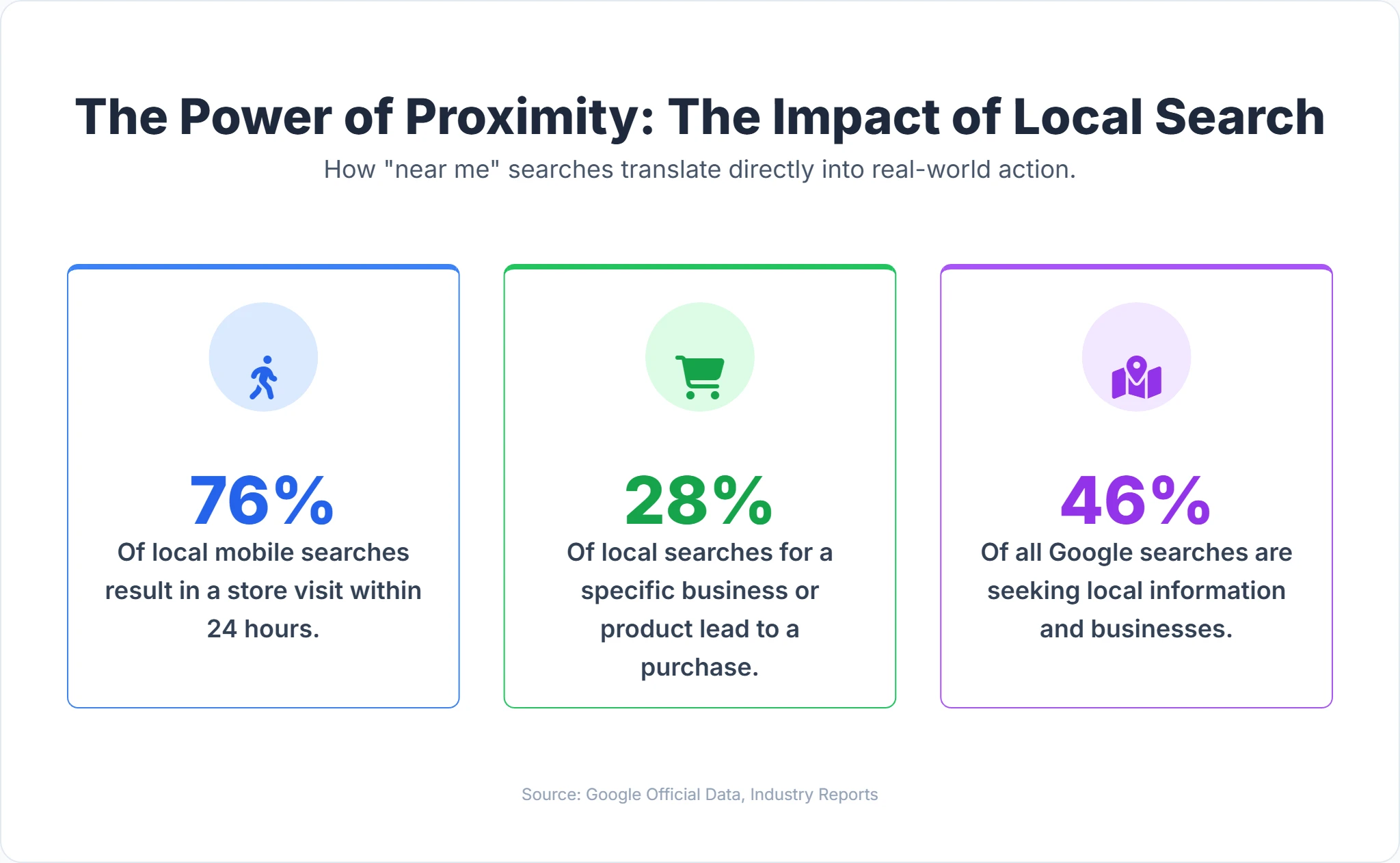
If you rely on foot traffic or local service calls, ignoring local SEO is akin to refusing to put a sign on your storefront. The data is clear: local search drives real-world action.
The Business Impact of Local Visibility
| Benefit | Description |
|---|---|
| Dominate the "Map Pack" | The "Local Pack" (the map with three business listings) appears at the very top of search results, pushing organic results down. Ranking here grants you the highest visibility possible on a search engine results page (SERP). Our guide on how to rank higher on Google Maps breaks the pack down further. |
| Capture High-Intent Traffic | People searching locally have an immediate need. Statistics show that 76% of people who search on their smartphones for something nearby visit a business within a day. |
| Build Instant Trust | A complete profile with consistent information and positive reviews acts as immediate social proof. Customers trust Google's vetting process; ranking high implies you are a reputable choice. |
| Outrank Major Competitors | You might not beat a national chain for a broad keyword like "shoes," but you can absolutely dominate them for "running shoe store in [Neighborhood]." Local SEO levels the playing field. |
| Cost-Effective Marketing | Unlike paid ads (PPC), where visibility stops the moment you stop paying, local SEO builds long-term equity. Once you rank, you enjoy sustained traffic without a direct cost per click. |
| Voice and AI Search Readiness | Voice assistants (Siri, Alexa) and AI tools rely heavily on structured local data to answer questions like "Where is the nearest open hardware store?" optimizing for local SEO prepares you for this future. |
How to Implement Effective Local SEO Strategies: Your Action Plan
Understanding the theory is helpful, but execution drives results. Below is a step-by-step framework to build a dominant local presence.
1. Optimize Your Google Business Profile (GBP)
Your Google Business Profile (formerly Google My Business) is the single most important asset for local SEO. It is your interactive listing that appears in Maps and Search.
Critical Optimization Steps:
- Verification is Non-Negotiable: You must claim and verify your listing. Google now frequently requires video verification, where you record your storefront, equipment, and proof of management access. Be prepared for this step.
- Precision in Categories: Choose your "Primary Category" carefully—it has the biggest impact on rankings. Use "Secondary Categories" to cover other services. For example, a dental practice might be a "Cosmetic Dentist" primarily, but also a "Dental Clinic" and "Emergency Dental Service."
- Complete Every Field: Don't leave sections blank. Fill out your specific services, amenities (e.g., "Wheelchair accessible," "Wi-Fi"), and opening date.
- Business Description: Write a description that sounds natural. Include your main keywords and city name, but focus on your unique value proposition. Why should they choose you?
- Visual Strategy: Upload high-resolution photos of your exterior, interior, team, and work. Rename your image files with descriptive keywords (e.g.,
downtown-chicago-pizza-oven.jpg) before uploading to give Google more context. - Leverage Google Posts: Treat this like a micro-blog. Post weekly about offers, new products, or events. These posts appear directly in your knowledge panel and signal to Google that your business is active.
- Q&A Management: Populate the Q&A section yourself. Ask common questions (e.g., "Do you offer free parking?") and answer them from your business account. This provides instant answers to users and keywords for Google.
2. Build and Maintain Local Citations and Directories
Citations are references to your business's Name, Address, and Phone number (NAP) on other websites. They validate your existence to search engines. If Google sees your business listed at the same address on Yelp, YellowPages, and the Chamber of Commerce, it gains confidence in your data.
The "NAP" Consistency Rule: Your data must be identical everywhere. If you are "Main St. Bakery" on Google but "Main Street Bakery & Cafe" on Facebook, it creates data dissonance. For a deeper walkthrough of why this matters and how to fix mismatches at scale, see our guide on NAP consistency for local SEO.
- Audit Existing Citations: Search for your phone number to find old or incorrect listings.
- Focus on Data Aggregators: Platforms like Foursquare and Data Axle feed data to many smaller directories. getting listed there often propagates your info to dozens of other sites.
- Niche Directories: Industry-specific directories often carry more weight than generic ones. If you are a doctor, ensure your profile is updated on sites like Healthgrades or Vitals. For more on healthcare specifics, read our guide on healthcare local SEO.
3. Implement On-Page Local SEO (Website Optimization)
Your website must confirm the location signals you send via your GBP. On-page local SEO involves tailoring your actual web pages to your target geography.
Key Implementation Tactics:
- Local Landing Pages: If you serve multiple cities, create a unique, high-quality page for each location. Do not just copy-paste text and swap the city name. Write unique content about the specific services and projects in that area.
- Localized Content Strategy: Create content that positions you as a local authority. Write blog posts about local regulations, community events, or case studies of work done in specific neighborhoods.
- Header Tags & Meta Data: Ensure your H1 tag includes your primary service and location (e.g., "Emergency Plumbing Services in Austin, TX"). Your Title Tag is the most potent ranking factor—keep it concise and keyword-rich.
- NAP in Footer: Place your Name, Address, and Phone number in the global footer of your site so it appears on every page.
- Embed a Map: On your contact or location pages, embed your Google Maps listing. This connects your website traffic directly to your map profile.
Technical Spotlight: Schema Markup
Schema markup is code that helps search engines understand your content. For local businesses, LocalBusiness schema is vital. It explicitly tells Google your hours, location, price range, and service area in a language it understands perfectly.
Pro Tip: Use the free Schema Markup Generator to create valid JSON-LD code for your business in minutes. Once implemented, this can trigger "rich snippets" in search results, showing your star rating and hours directly in the search listing.
4. Cultivate and Manage Online Reviews
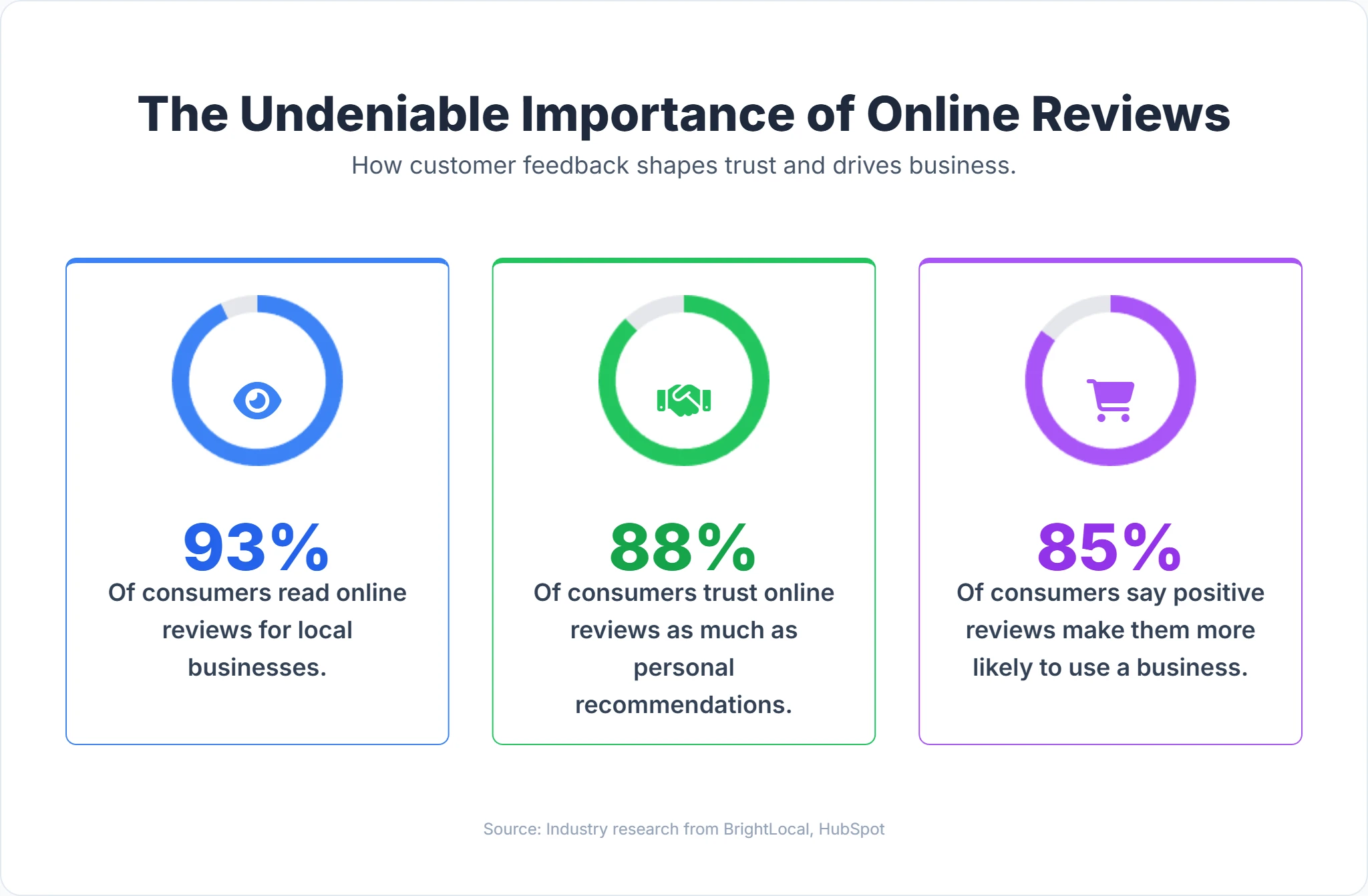
Reviews are a major ranking factor and a conversion driver. A business with a 4.8-star rating and 100 reviews will almost always outrank and outsell a competitor with a 5.0 rating but only 2 reviews.
Review Management Strategy:
- The "Ask" Workflow: Automate the process. Send a follow-up email or SMS 24 hours after a service or purchase with a direct link to your Google review form. Grab that direct link from your Business Profile dashboard ("Ask for reviews") so customers land on the write-a-review box in a single tap—every extra click loses a percentage of would-be reviewers. Aim for a steady drip rather than a one-time blast: ten new reviews spread over a month reads as a healthy, active business, while thirty overnight can trip Google's spam filters and get them held back. For a repeatable playbook, see our guide on how to get more Google reviews.
- Respond with Keywords: When you reply to reviews (which you must do for every review), mention the service provided naturally.
- Customer: "Great service!"
- You: "Thanks, John! Glad we could help fix your AC unit quickly before the Miami heat set in."
- Handle Negatives Gracefully: Never argue. Acknowledge the issue, apologize, and offer to take the conversation offline. This shows future customers that you care about service recovery.
5. Prioritize Local Link Building
Backlinks (links from other sites to yours) are votes of confidence. For local SEO, relevance beats high authority. A link from a local church or a neighborhood blog is often more valuable than a link from a generic national directory.
How to Earn Local Links:
- Sponsorships: Sponsor a Little League team, a 5K charity run, or a local festival. These organizations almost always have a "Sponsors" page with links.
- Local News & PR: Did you hire a new key employee? Open a new location? Host a free workshop? Send a press release to local newspapers and online, hyper-local news blogs.
- Partner Networks: If you are a home builder, ask the architects, electricians, and interior designers you work with to link to you as a preferred partner, and offer to do the same for them.
6. Ensure Mobile Optimization
Google uses mobile-first indexing. If your site is slow or hard to use on a phone, your rankings will suffer. Local searches are overwhelmingly mobile—people search while walking or driving.
Mobile Essentials:
- Click-to-Call: Your phone number must be a clickable link. No one wants to copy and paste a number.
- Thumb-Friendly Navigation: Ensure buttons are large enough to tap easily and menus are accessible.
- Speed is Critical: Local users are impatient. If your site takes 5 seconds to load, they will hit "back" and choose your competitor. Use tools like Google PageSpeed Insights or the free On-Page SEO Analysis tool to check your performance metrics. For a deep dive into speed metrics, read our guide on Core Web Vitals.
- Prioritize the Decision Actions: On mobile, the three things a local searcher wants are directions, hours, and a phone number—surface them above the fold. A quick self-test: open your homepage on a phone and time how long it takes to tap-to-call. If it takes more than two taps, restructure. This same friction directly shapes how you win near me searches, where intent is immediate and patience is near zero.
7. Leverage Advanced AI Capabilities and Tools
The SEO landscape is shifting toward AI. Tools like ChatGPT and Google's AI Overviews digest content differently than traditional crawlers. They look for direct answers and structural clarity.
How Digispot AI Enhances Local Strategy:
- AI-Driven Audits: Manually checking every page for local keywords and technical errors is impossible at scale. Digispot AI automates this, scanning 300+ factors to find hidden issues like broken map links or missing location metadata.
- Gap Analysis: The Opportunity Finder can tell you which local neighborhoods you are neglecting in your content, helping you expand your reach systematically.
- Instant Browser Insights: You don't always need a full platform audit. Get instant SEO insights on any page—yours or a competitor's—with our free Chrome extension. It visualizes schema markup instantly, letting you verify if your local business data is being broadcast correctly.
Measuring Your Local SEO Success
You cannot improve what you do not measure. Local SEO requires tracking specific metrics that reflect local visibility and intent.
Key Metrics for Local SEO Success
| Metric | What it Tells You | How to Track (Examples) |
|---|---|---|
| Local Search Rankings | Where you appear for keywords in specific geographic grids. You might rank #1 at your office but #10 three miles away. | Geo-grid tracking tools, specialized local rank trackers. |
| GBP Interactions | The real-world actions users take on your profile. This is often more valuable than ranking alone. | Google Business Profile Performance tab (Calls, Direction Requests, Website Clicks). |
| Organic Local Traffic | Visitors landing on your site from location-based queries (e.g., "lawyer in Boston"). | Google Analytics 4 (Filter by City/Region and Organic Search). |
| Click-Through Rate (CTR) | How compelling your listing is. If you rank #1 but get no clicks, your title or review count may be the issue. | Google Search Console (Filter by query). |
| Conversion Rate | The percentage of visitors who become leads. Local traffic should convert higher than general traffic. | Goal tracking in GA4 (Form submissions, clicked-to-call events). |
| Review Velocity | How frequently you are getting new reviews compared to competitors. Stagnation signals irrelevance. | Manual monitoring or reputation management dashboards. |
| AI Search Visibility | Are you appearing in AI answers? This is the new frontier of metrics. | Manual testing in ChatGPT/Perplexity, Digispot AI visibility reports. |
Integrating platforms like Digispot AI with your Google Search Console and Google Analytics accounts creates a unified command center. Instead of jumping between tabs, you see how your technical improvements correlate with increased calls and direction requests. To ensure you aren't missing any foundational steps before measuring, review our SEO audit checklist.
Common Local SEO Mistakes to Avoid
Many businesses sabotage their own efforts with simple, avoidable errors. Watch out for these pitfalls:
- Inconsistent NAP Data: This is the most common killer of local rankings. "St." vs. "Street" usually doesn't matter, but different phone numbers or suite numbers do.
- Keyword Stuffing Business Names: Adding keywords to your GBP name (e.g., "Bob's Plumbing - Best Plumber in Denver") is against Google's terms of service and can lead to a suspension. Stick to your legal business name.
- Neglecting Negative Reviews: Ignoring a bad review suggests you don't care. A thoughtful response can turn a negative into a positive for readers.
- Using Generic Toll-Free Numbers: Local numbers (with local area codes) are a strong signal of physical presence. Avoid using 800 numbers as your primary line if possible.
- Duplicate Listings: Sometimes Google creates auto-generated listings for practitioners or old addresses. You must hunt these down and merge or remove them to prevent traffic dilution.
- Ignoring "Suggested Edits": Users (and competitors) can suggest edits to your business listing. If you don't monitor your profile, malicious edits to your hours or website could go live without you noticing.
- Poor Mobile Experience: If your menu doesn't work on a phone, the user will leave immediately. This increases your "bounce rate," which can hurt rankings. For more on this, see our article on common SEO mistakes.
The Future of Local SEO: AI and Beyond
The way people search is changing fundamentally. We are moving from "10 blue links" to direct answers provided by AI.
The Rise of AEO (Answer Engine Optimization) In an AI-first world, your business data needs to be structured so that a machine can easily read and summarize it. When a user asks an AI, "Find me a highly-rated vegan restaurant open now with outdoor seating," the AI analyzes structured data, reviews, and entity relationships to provide a single recommendation.
- Semantic Understanding: You need to optimize for concepts, not just keywords. Describe the experience of your business, not just the product.
- Voice Search: Voice queries are longer and more conversational. Optimize your FAQ pages to answer full questions like "How much does it cost to replace a water heater in [City]?" Our voice search SEO guide covers how to phrase answers so assistants read them aloud verbatim.
- Visual Search: Google Lens allows users to search by pointing their camera. Ensuring your images are high-quality and descriptive helps you show up in these visual discovery modes.
Platforms like Digispot AI are built for this future. By using a multi-LLM engine (incorporating GPT-4, Claude, and Gemini), Digispot analyzes your content the way modern search engines do, ensuring you are optimized for both traditional search and the new wave of AI discovery.
Start Dominating Your Local Market Today
Local SEO is not a one-time setup; it is an ongoing process of building reputation, relevance, and trust. By claiming your digital territory through a robust Google Business Profile, consistent citations, and a technically sound website, you position your business as the clear choice for nearby customers.
Don't let your competitors capture the traffic that belongs to you. Start small: audit your current citations, request five new reviews this week, and ensure your homepage clearly states who you are and where you are located.
Ready to professionalize your approach? Try Digispot AI for comprehensive website audits and actionable recommendations that take the guesswork out of optimization. Whether you need to visualize your schema markup or track your ranking across different AI models, our platform provides the tools you need to win. You can also start right now by auditing your site with our free Chrome extension to uncover immediate opportunities for growth.
Build your local presence today, and turn online searches into loyal, real-world customers.
Related deep-dives
Continue with these closely related guides:
- geo-targeting seo — Geo-Targeting SEO: Location-Based Search Optimization
- restaurant seo — Restaurant SEO: Hospitality Booking Guide
- investment advisor seo — Investment Advisor SEO: Financial Services Guide
- best screaming frog alternatives — Best Screaming Frog Alternatives for Modern SEO in 2026
- travel & hospitality seo — Travel & Hospitality SEO: Booking Guide 2026
References
- About Google Business Profile
- Google Search Console
- Google Analytics
- Understand how Google's AI works (and how it's integrated with search)
- Schema.org - LocalBusiness
- Mobile-first indexing (MFI) best practices | Google Search Central
- Google PageSpeed Insights
- Digispot AI - FREE On Page SEO Audit Tool
- Digispot AI - FREE Chrome Extension for SEO Insights
Audit any page in seconds
300+ SEO checks including Core Web Vitals, schema markup, meta tags, and AI readiness — trusted by 1000+ SEO experts and marketers.
Frequently Asked Questions
Here are some of our most commonly asked questions. If you need more help, feel free to reach out to us.
Written by
Maya Krishnan
Digital growth expert
Maya is a seasoned expert in web development, SEO, and digital strategy, dedicated to helping businesses achieve sustainable growth online. With a blend of technical expertise and strategic insight, she specializes in creating optimized web solutions, enhancing user experiences, and driving data-driven results. A trusted voice in the industry, Maya simplifies complex digital concepts through her writing, empowering readers with actionable strategies to thrive in the ever-evolving digital landscape.