
Investment Advisor SEO: Financial Services Guide
SEO strategies for investment advisors and financial planners. Build trust, show expertise, and attract high-net-worth clients through search.
 Maya Krishnan
Are you an investment advisor, skillfully guiding clients through complex financial landscapes, yet finding your own digital presence lost in the vast online ocean? Today's discerning clients begin their search for financial wisdom not in a traditional office, but with a click or a tap, seeking guidance from their screens. Standing out in this crowded digital arena isn't just an advantage; it's a necessity for cultivating trust, expanding your reach, and securing your legacy.
This isn't about chasing fleeting trends; it's about establishing a robust, sustainable online foundation that consistently attracts your ideal clients. Discover how Search Engine Optimization (SEO) transforms your online presence from a quiet whisper into a resonant call, ensuring your expert advice reaches those who need it most.
What Exactly is SEO for Investment Advisors?
Think of SEO as the ultimate matchmaker between your financial expertise and individuals actively seeking investment guidance online. It's the process of optimizing your website and online content to rank higher in search engine results – primarily Google, but also other AI-powered search engines like ChatGPT, Claude, and Perplexity. When someone types "best financial advisor [your city]" or "retirement planning tips" into a search bar, SEO works behind the scenes to ensure your website appears prominently among the top results.
It's not about tricking the system. Instead, it’s about providing genuinely valuable content and ensuring your website is technically sound, easy to navigate, and clearly communicates your authority and trustworthiness. For investment advisors, this means showcasing your specialized knowledge, client testimonials, service offerings, and ethical approach in a way that search engines can easily understand and prioritize.
The "Your Money or Your Life" (YMYL) Standard
For financial professionals, SEO stakes are higher than for most other industries. Google classifies financial websites as "Your Money or Your Life" (YMYL) pages. This designation means that misinformation on your site could potentially harm a user's financial stability. Consequently, Google's algorithms apply stricter standards to financial content. They demand higher proof of Expertise, Experience, Authority, and Trustworthiness (E-E-A-T). Your SEO strategy must go beyond keywords to vigorously demonstrate that you are a qualified, credentialed professional.
The Core Pillars of SEO for Financial Professionals
At its heart, SEO for investment advisors encompasses several key areas:
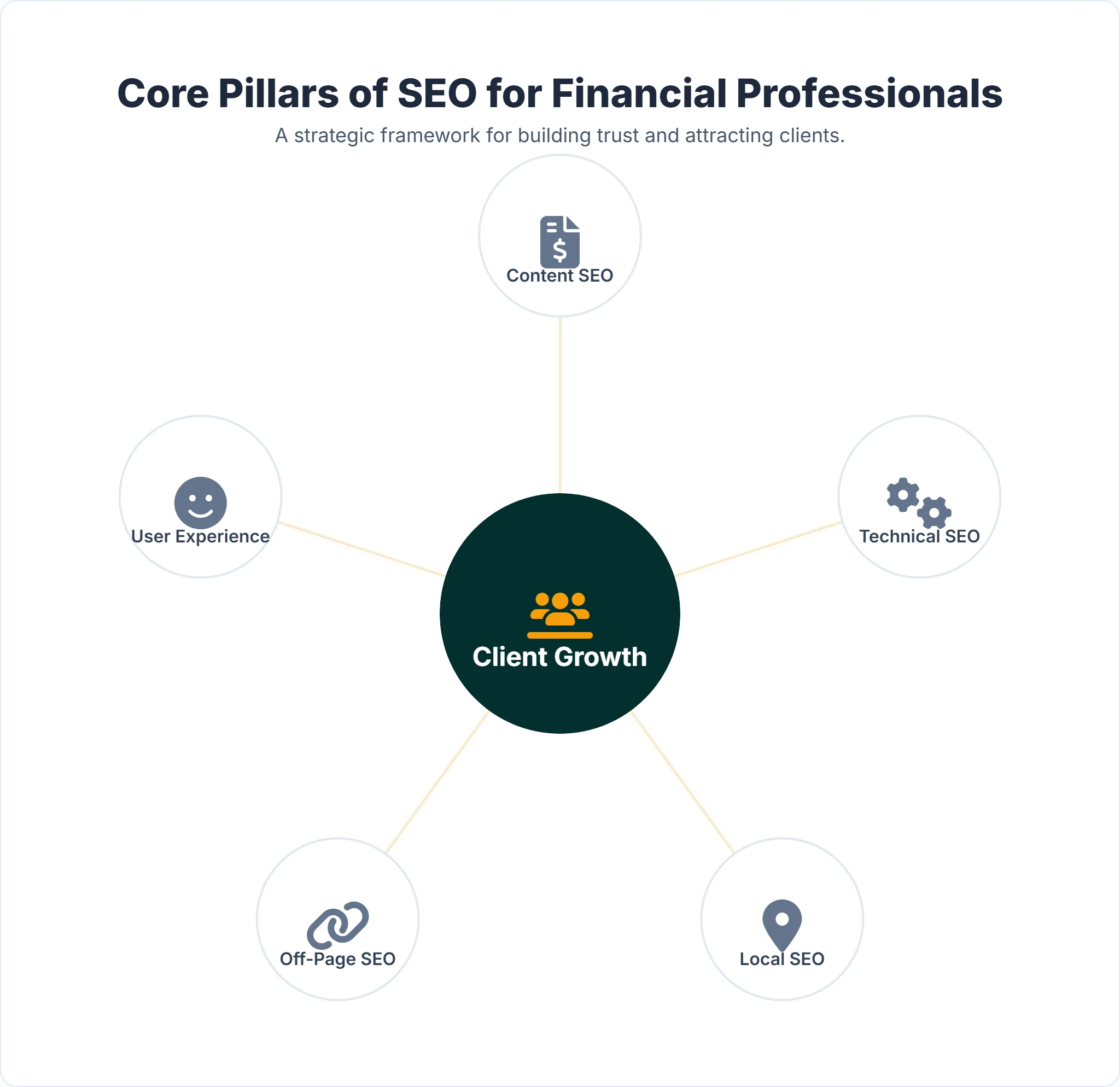
- Content SEO: Creating high-quality, relevant, and informative articles, blog posts, videos, and guides that address the financial questions and concerns of your target audience. This includes interpreting market trends and simplifying complex tax regulations for your readers.
- Technical SEO: Ensuring your website's underlying structure is optimized for search engines. This covers site speed, mobile-friendliness, secure connections (HTTPS), and proper indexing so that crawlers can read your site without errors.
- Local SEO: Optimizing your online presence to attract clients in your specific geographic area. For advisors, this often involves capturing "near me" searches and dominating the Google Map Pack.
- Off-Page SEO: Building authority and credibility through external signals. This primarily involves earning backlinks from reputable financial sites, news outlets, and industry associations, as well as managing online reviews.
- User Experience (UX): Designing a website that is intuitive, easy to use, and provides a seamless experience for visitors. High-net-worth clients expect a digital experience that mirrors the professionalism of your in-person service.
Together, these elements form a comprehensive strategy that enhances your visibility and makes it easier for prospective clients to find you. For a deeper understanding of how these elements work together to build trust, read our guide to E-E-A-T signals.
Why is SEO So Crucial for Today's Investment Advisor?
In an era where information is abundant and attention spans are short, merely having a website isn't enough. Your website needs to be a beacon, guiding potential clients directly to your services. Here's why embracing SEO is no longer optional but fundamental for your advisory firm:
1. Enhanced Visibility & Brand Recognition
When your website ranks high on search engines, it's akin to having a prime storefront on the busiest digital avenue. More visibility means more people see your brand, learn about your services, and recognize your expertise. This isn't just about clicks; it's about establishing your firm as a recognized authority in the financial sector. When prospects see your name repeatedly associated with helpful financial answers, you become the default choice in their minds.
2. Targeted Client Acquisition
Unlike traditional advertising, which casts a wide net (like a billboard on a highway), SEO allows you to attract individuals who are actively searching for the services you offer. These are "warm leads" – people already in the market for financial advice, making them more likely to convert into clients. For example, a user searching for "tax-efficient estate planning for business owners" has a specific, high-value need. SEO ensures you are the solution they find. This targeted approach results in higher quality leads and a more efficient use of your marketing budget.
3. Build Trust and Credibility
Search engines prioritize websites that offer valuable, accurate, and authoritative content. By consistently providing well-researched financial insights, you demonstrate your expertise and build trust with potential clients before they even pick up the phone. A strong online presence, backed by positive reviews and a professional website, reinforces your credibility. In the financial world, trust is the currency of the realm; ranking highly for competitive terms signals to prospects that Google trusts you, so they should too.
4. Competitive Advantage
Many investment advisors are still catching up with comprehensive digital marketing strategies. While large firms may have vast resources, many local and boutique firms rely solely on referrals or outdated marketing tactics. By investing in SEO now, you gain a significant edge over competitors. You can capture a larger share of the online market and establish digital dominance in your specific niche before others catch on.
5. Cost-Effectiveness & Long-Term ROI
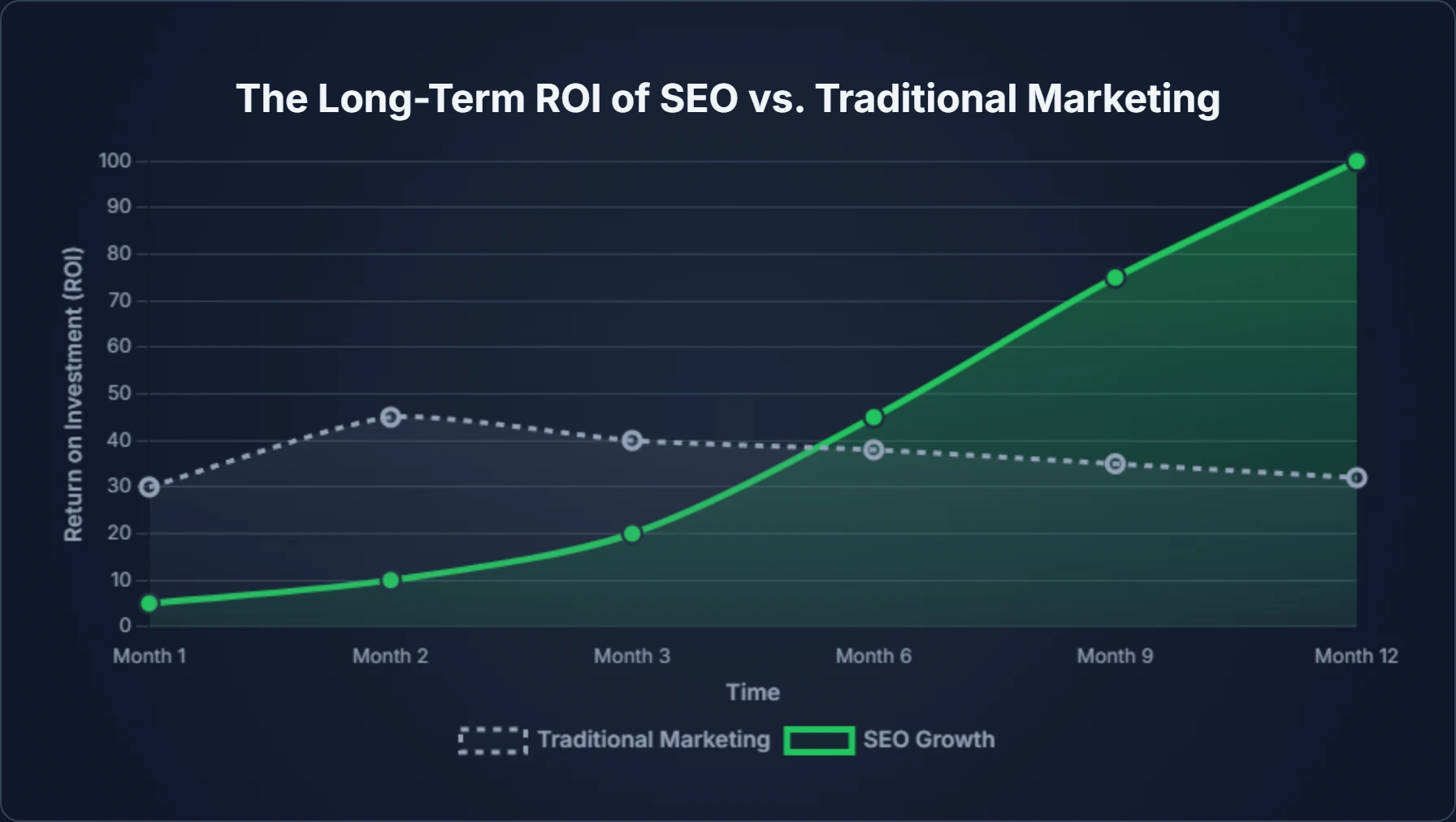
While SEO requires an initial investment of time and resources, its long-term return on investment (ROI) often surpasses that of paid advertising. Once your content ranks, it continues to attract organic traffic without the recurring per-click costs of ads. It's a sustainable strategy that builds compounding value over time. An evergreen article on "Roth IRA conversions" written today can bring in qualified leads for years to come without costing you a cent more.
6. Adapt to Evolving Client Behavior
Modern investors, across all age groups, increasingly rely on online research to make financial decisions. From millennials seeking robo-advisors to baby boomers planning for retirement, the internet is their first port of call. Even if a client receives a referral, they will likely Google you to validate your credentials. SEO ensures you're present where your future clients are looking and that your digital reputation supports your offline one.
The following table summarizes the compelling benefits of integrating SEO into your practice:
| Benefit | Description |
|---|---|
| Increased Visibility | Your website appears higher in search results, making it easier for potential clients to find you. |
| Targeted Leads | Attracts individuals actively searching for investment advice, leading to higher conversion rates. |
| Enhanced Credibility | High rankings signal authority and trustworthiness, building confidence in your expertise. |
| Competitive Edge | Outperform rivals by dominating search results for relevant financial queries. |
| Cost-Effective Marketing | Provides a sustainable source of traffic with a strong long-term return on investment, unlike paid ads. |
| 24/7 Digital Presence | Your expertise is accessible around the clock, worldwide, reaching clients beyond office hours. |
| Better User Experience | Optimizing for SEO often improves site speed, mobile responsiveness, and overall website usability. |
How Does SEO Work for Investment Advisors? A Deeper Dive
Achieving top search rankings involves a multi-faceted approach. It is not enough to just "sprinkle keywords" into your text. You must build a machine that signals quality to search engines. Let's break down the core components and illustrate how each contributes to your overall digital success.
1. Keyword Research: The Foundation of Discovery
What it is: Keyword research is the process of identifying the words and phrases your target clients use when searching for financial information and services online. It's about understanding their intent.
How it helps investment advisors: You need to understand the three types of intent relevant to your business:
- Informational: "What is a fiduciary?" (Top of funnel, builds trust).
- Commercial Investigation: "Fee-only vs. commission-based advisor" (Middle of funnel, comparison).
- Transactional: "Hire financial planner Dallas" (Bottom of funnel, ready to buy).
By understanding these exact phrases, you can tailor your website content to directly answer their questions and appear in their search results. Including both broad and specific (long-tail) keywords ensures you capture a wide range of queries.
Example for an Investment Advisor: If your firm specializes in retirement planning, relevant keywords might include:
- "retirement planning strategies"
- "IRA vs 401k guidance"
- "when to retire calculator"
- "financial advisor for retirees [your city]"
- "post-retirement income strategies"
Tools can assist in this, identifying not just keywords but also their search volume and competition, helping you prioritize.
2. High-Quality Content: Your Digital Voice of Authority
What it is: Content is the information you publish on your website – blog posts, articles, videos, infographics, case studies, whitepapers, service pages, and FAQs. For SEO, this content must be relevant, valuable, well-researched, and engaging.
How it helps investment advisors: As an investment advisor, your content is your opportunity to demonstrate your expertise and build trust. By answering common financial questions, explaining complex concepts simply, and offering practical advice, you position yourself as a thought leader. Search engines reward websites that consistently produce high-quality, original content that genuinely helps users.
Navigating Compliance: One unique challenge for financial advisors is compliance (FINRA/SEC). Your content must be accurate and avoid promissory language (e.g., "we guarantee 10% returns"). SEO content strategies must work hand-in-hand with your compliance officer. Focus on educational content ("How the S&P 500 works") rather than speculative predictions. This keeps you compliant while still attracting traffic.
Example for an Investment Advisor: Instead of just a service page listing "Retirement Planning," create a series of blog posts like:
- "5 Key Steps to Start Your Retirement Savings Today"
- "Understanding the Power of Compound Interest for Long-Term Wealth"
- "Navigating Market Volatility: A Guide for Retirement Savers"
- "Choosing the Right Retirement Account: IRA, 401(k), and Beyond"
This diverse content addresses various stages of a client's journey and captures a broader range of keywords. Platforms that include a content studio, like Digispot AI, can assist in brainstorming and generating SEO-optimized content outlines, even utilizing AI agents to help craft compelling narratives that resonate with your audience while incorporating crucial keywords and schema markup suggestions. For more tips on crafting content that ranks, explore our article on on-page SEO best practices.
3. Technical SEO: The Unseen Foundation of Success
What it is: Technical SEO focuses on the backend elements of your website that influence how search engines crawl, index, and rank your site. It's about ensuring your website is structurally sound and accessible to both users and search engine bots.
How it helps investment advisors: Even the most brilliant financial advice will go unread if your website is slow, broken, or not mobile-friendly. Technical SEO addresses issues like:
- Core Web Vitals: These are Google's specific metrics for user experience. They measure loading performance (LCP), interactivity (INP), and visual stability (CLS). A site that shifts around while loading or takes seconds to respond to a click will be penalized.
- Site Speed: Fast-loading pages are crucial for user experience and rankings. Financial clients are busy; they won't wait 10 seconds for your market commentary to load.
- Mobile-Friendliness: With most searches now happening on mobile devices, your site must be responsive. A CEO checking your credentials on their iPhone during a lunch break needs a flawless experience.
- SSL Certificate (HTTPS): A secure website (indicated by "https://" in the URL) is a ranking factor and builds user trust. This is non-negotiable for finance; users will not submit contact forms on an insecure site.
- Crawlability and Indexability: Ensuring search engine bots can easily access and understand all the important pages on your site.
- Schema Markup: This is specialized code that helps search engines understand the content of your pages more deeply. For advisors, using
FinancialService,Person(for advisor bios), andReviewschema can lead to "rich snippets" in search results. This might display your star rating or a headshot directly in the search results, increasing click-through rates.
Regular auditing of your website for technical issues is vital. Platforms like Digispot AI excel at this, performing comprehensive audits in both mobile and desktop modes to detect and visualize issues that could hinder your rankings. This can include anything from broken links and duplicate content to slow loading times and missing schema markup. Its integration with Google Search Console and Google Analytics also helps you track and improve performance by giving you real-time insights into how search engines view your site and how users interact with it.
If you are unsure about the health of your site, start with a free On-Page SEO Analysis to catch critical errors immediately.
4. Local SEO: Connecting with Your Community
What it is: Local SEO optimizes your online presence to attract clients from your specific geographic area. This is particularly important for investment advisors who serve a local clientele.
How it helps investment advisors: When someone searches for "financial advisor Miami" or "wealth management consultant San Francisco," you want your firm to appear prominently in the "Local Pack" (the map section at the top of Google results). Key components of local SEO include:
- Google Business Profile (GBP): Optimizing your free GBP listing with accurate business information (name, address, phone, website, hours), photos of your office and team, services, and encouraging client reviews.
- Local Citations: Ensuring your business information (Name, Address, Phone - NAP) is consistent across online directories like Yelp, Yellow Pages, and industry-specific sites like NAPFA or XY Planning Network.
- Location-Specific Content: Creating content tailored to local financial events, economic trends in your city, or local charity involvement. For example, "Estate Planning Laws in Ohio: What Cincinnati Residents Need to Know."
A well-optimized local presence ensures that when local clients are ready to seek advice, your firm is easily discoverable.
5. Backlinks and Authority: The Digital Vote of Confidence
What it is: Backlinks are links from other websites to yours. They act as "votes of confidence" in the eyes of search engines. The more high-quality, relevant backlinks you have from reputable financial institutions, news outlets, or industry blogs, the more authority your website gains.
How it helps investment advisors: Earning backlinks signals to search engines that your website is a trustworthy and valuable resource. This significantly boosts your search rankings. However, quality matters more than quantity. A link from The Wall Street Journal or Investopedia is worth infinitely more than hundreds of links from low-quality directories. Strategies to earn backlinks include:
- Digital PR: Contributing expert quotes to financial publications (using platforms like HARO or Qwoted).
- Guest Blogging: Writing articles for reputable finance sites or local business chambers.
- Linkable Assets: Creating calculators (e.g., "Roth Conversion Calculator"), original research, or infographics that other sites want to link to as a resource.
- Local Sponsorships: Sponsoring a local charity event often results in a link from their website, boosting local relevance.
6. User Experience (UX): Keeping Visitors Engaged
What it is: User experience refers to how enjoyable and easy it is for visitors to interact with your website. This includes design, navigation, readability, and overall site functionality.
How it helps investment advisors: Search engines pay attention to how users interact with your site. If visitors quickly "bounce" back to the search results (a high bounce rate), it signals that your site may not be providing what they expected. A good UX keeps visitors engaged, encourages them to explore more pages, and ultimately leads to longer time on site – all positive signals for SEO.
Ensure your font sizes are readable for older demographics (often your target wealth clients), your navigation menu is logical, and your "Contact Us" buttons are prominent. Accessibility (ADA compliance) is also part of UX; ensuring your site is usable by people with disabilities expands your market and reduces legal risk. For more on optimizing experience metrics, check our guide on Core Web Vitals.
Digispot AI: Empowering Your SEO Journey (A Subtle Advantage)
Navigating the complexities of SEO can feel daunting, especially for busy investment advisors focused on client success. You are analyzing portfolios, not H1 tags. This is where modern AI-powered platforms can offer invaluable support. Imagine having a digital assistant that continuously monitors your online presence, identifies opportunities, and streamlines your efforts.
Digispot AI is designed as an AI SEO platform that helps business websites, including those of investment advisors, rank better in Google and other AI search engines. It brings all SEO best practices into an automated and user-friendly model, allowing you to operate at scale with accuracy.
How it helps you without overselling:
- Comprehensive Auditing & Detection: The platform excels at auditing websites in both mobile and desktop modes, meticulously identifying issues that could be holding back your rankings. This includes technical errors, content gaps, and performance bottlenecks, which it helps you solve. Instead of manually sifting through data, you get actionable insights.
- Performance Tracking: Digispot AI integrates seamlessly with tools like Google Search Console and Google Analytics. This means you can track your website's performance, see how your SEO efforts are paying off, and understand visitor behavior, all from one dashboard. This visibility is crucial for making data-driven decisions.
- Opportunity Finder: The platform includes an opportunity finder feature. This can help investment advisors spot gaps in their content strategy or identify new keywords and topics where they can gain a competitive edge. It's like having a dedicated analyst continuously looking for ways to expand your reach.
- Content Studio for SEO-Optimized Content: As discussed, high-quality content is paramount. Digispot AI's content studio can assist in generating SEO-optimized content using AI agents. This isn't about replacing your expertise but augmenting it, helping you craft compelling narratives that resonate with your audience while ensuring all critical SEO elements, including schema markup, are naturally integrated.
- 300+ Ranking Factors: The platform understands and helps you rank better by analyzing your site for over 200 ranking factors. This includes comprehensive checks on content quality, technical SEO health, local SEO optimization, and page performance. This holistic approach ensures no stone is left unturned in your pursuit of higher rankings.
- Schema Markup Support: The platform supports schema markup, which is critical for making your content more understandable to search engines and improving the chances of appearing in rich snippets. This can include marking up your business information, services, reviews, and more. You can even test your implementation with our Schema Markup Visualizer.
- Detection and Visualization: Digispot AI helps to detect complex issues quickly and visualize their impact, making it easier for you to understand and address them effectively. This means less guesswork and more precise actions.
Your Pocket SEO Auditor: The Free Digispot AI Community Chrome Extension
For a quick, on-the-go assessment, consider the free Digispot AI community Chrome extension. This powerful tool allows you to audit any website page directly within your browser, offering immediate insights into its SEO health.
What it does: Powered by popular LLM models, this extension helps you quickly:
- Audit individual pages for common SEO issues.
- Detect technical errors, content gaps, and missing schema markup.
- Visualize key SEO data right on the page you're viewing.
- It specifically supports schema markup detection, which is invaluable for ensuring your structured data is correctly implemented and recognized by search engines.
It's a convenient way for investment advisors to gain a rapid understanding of their own pages' performance or even analyze competitors' strategies without delving deep into a full platform. Get instant SEO insights on any page with our free Chrome extension.
Business Outcomes: The Real-World Impact for Investment Advisors
Ultimately, the goal of SEO isn't just about rankings; it's about tangible business results. For investment advisors, a robust SEO strategy, supported by intelligent tools, translates into profound business outcomes. Let's look at the concrete benefits.
1. Improving Business Visibility
Imagine consistently appearing at the top of search results whenever a potential client looks for financial advice. This dramatically enhances your firm's visibility, ensuring you're seen by a wider, more relevant audience. It's the difference between being a hidden gem and a prominent landmark in the digital financial world. In a saturated market, visibility is the first step toward viability.
2. Increase in Traffic and Business Leads
Higher visibility directly correlates with increased website traffic. More visitors mean more opportunities for engagement – more form submissions, more phone calls, and more clients scheduling consultations. These are not just any leads; they are individuals who have proactively sought out information related to your services, making them highly qualified prospects.
Consider this: An advisor ranking #1 for "financial advisor for doctors" will see a steady stream of physicians visiting their site. These visitors are pre-qualified by their search intent. SEO transforms your website from a digital brochure into a lead generation engine that works while you sleep.
3. Time and Cost Savings
Effective SEO, especially when augmented by AI platforms, streamlines your marketing efforts. By focusing on organic growth, you can reduce reliance on expensive paid advertising campaigns (PPC), where costs for financial keywords can exceed $50 per click. Furthermore, automated auditing and opportunity identification save countless hours that would otherwise be spent on manual analysis, allowing your team to focus on client service and strategic growth. It's about working smarter, not just harder.
4. Valuation and Legacy
A firm with a strong digital presence and a predictable organic lead flow is more valuable. If you plan to sell your practice or merge in the future, your SEO assets (rankings, traffic, domain authority) are tangible assets that increase your firm's valuation. You are building digital equity alongside your client equity.
Crafting Your SEO Success Story: A Step-by-Step Approach
Embarking on your SEO journey might seem overwhelming, but by breaking it down into manageable steps, you can build a robust online presence. Here is a roadmap tailored for the financial services industry.
Step 1: Define Your Niche and Target Audience
Before you optimize, you need to know who you're optimizing for. Generic "financial advice" is too competitive.
- What type of investors do you serve? High-net-worth individuals, young professionals (HENRYs), pre-retirees, business owners, or perhaps specific professions like dentists or tech employees?
- What are their financial pain points and goals? Do they worry about student loans, tax drag, or estate taxes?
- What geographic areas do you cover? Are you strictly local or can you serve clients nationwide? Clearly defining your ideal client ("User Persona") will inform your keyword strategy and content creation.
Step 2: Comprehensive Website Audit
Before making changes, understand your current standing. A thorough audit will reveal the invisible anchors dragging your site down.
- Technical issues: Slow loading times, broken links, mobile-friendliness, crawl errors.
- Content gaps: Areas where your website lacks comprehensive information on important topics or has "thin" content (pages with very little text).
- On-page issues: Missing meta descriptions, poor heading structure, unoptimized images.
- Competitor analysis: What are your rivals doing well? Where can you outperform them? Digispot AI can help you identify and fix these issues automatically with AI-powered audits analyzing 300+ ranking factors. For a manual check, refer to our SEO audit checklist.
Step 3: Strategic Keyword Research
Leverage tools to identify keywords relevant to your niche and audience.
- Focus on both high-volume general terms and long-tail keywords that indicate specific intent (e.g., "tax-efficient investment strategies for small business owners").
- Look for "question" keywords (Who, What, Where, When, Why) to target Featured Snippets (position zero).
- Consider keywords related to client problems, financial product comparisons, and local searches.
- Tip: Don't ignore "zero search volume" keywords. If a keyword has low volume but extremely high intent (e.g., "fee-only fiduciary for selling a business in Austin"), it is worth targeting.
Step 4: Content Creation and Optimization
This is where your expertise shines. Adopt a "Hub and Spoke" model. Create a main "Hub" page for a core service (e.g., Estate Planning) and link it to several "Spoke" blog posts (e.g., "Trusts vs Wills," "Estate Taxes 2026").
- Develop a content calendar: Plan blog posts, articles, and guides based on your keyword research. Consistency is key.
- Create high-quality, valuable content: Each piece should answer a question, solve a problem, or provide unique insights. Use data, charts, and examples.
- Optimize on-page elements: Integrate keywords naturally. Use compelling titles, meta descriptions, and header tags (H1, H2, H3). Include internal links to other relevant pages on your site.
- Consider diverse content formats: Videos, infographics, and podcasts can engage different learning styles and keep users on your page longer.
Step 5: Technical Enhancements
Address the issues identified in your audit to ensure a smooth runway for your content.
- Improve site speed by optimizing images and leveraging caching.
- Ensure your site is fully mobile-responsive.
- Implement schema markup to enhance how search engines understand your content. Use the free Schema Markup Generator to create valid structured data in minutes.
- Verify your site with Google Search Console and fix any reported errors.
Step 6: Build Your Local Presence
If you see clients in person, this is critical.
- Optimize your Google Business Profile. Fill out every field.
- Ensure consistency across all online directories (Name, Address, Phone number must match exactly).
- Encourage clients to leave reviews. Compliance Note: The SEC's "Marketing Rule" now allows client testimonials under specific conditions. Ensure you follow these rules strictly (e.g., disclosing if a reviewer was compensated).
- Respond to reviews professionally, thanking clients for their feedback.
Step 7: Cultivate Authority (Backlinks)
Focus on earning high-quality backlinks through genuine outreach.
- Reach out to local journalists offering commentary on local economic news.
- Write guest posts for reputable industry blogs.
- Get listed in high-quality directories like the CFP Board, NAPFA, or the FPA.
- Avoid buying links. Google is smart and will penalize "link schemes."
Step 8: Monitor, Analyze, and Adapt
SEO is an ongoing process, not a one-time project.
- Use analytics tools (like Google Analytics, especially when integrated with platforms like Digispot AI) to track your rankings, traffic, and user behavior.
- Define KPIs: Track organic traffic growth, keyword ranking improvements, and most importantly, conversions (contact form fills, consultation bookings).
- Identify what's working and what's not. If a blog post gets traffic but no leads, maybe the CTA needs work.
- Stay informed about algorithm updates and adjust your strategy accordingly. The digital landscape is ever-evolving, and your SEO strategy must evolve with it. Regular detection and visualization of performance trends are key. To avoid common pitfalls, read about common SEO mistakes advisors make.
Conclusion: Your Journey to Digital Authority
The world of financial advice is built on trust, expertise, and personalized guidance. In the digital age, establishing and communicating that trust online is paramount. SEO for investment advisors isn't a marketing gimmick; it's a fundamental strategy for connecting your invaluable services with the individuals who are actively seeking them.
By understanding the "what," "why," and "how" of SEO, and by leveraging intelligent tools designed to streamline these efforts, you can transform your online presence. From enhancing visibility and attracting targeted leads to building unwavering credibility and realizing significant cost savings, the benefits are profound. Your expertise deserves to be found.
Ready to improve your search visibility? Try Digispot AI for comprehensive website audits and actionable recommendations. With a strategic approach to SEO, your firm can become a leading voice in the digital financial sphere, guiding clients toward a more secure and prosperous future.
References
- Crawl Budget Management For Large Sites | Google Search Central
- Google Search Console
- Robots.txt Introduction and Guide | Google Search Central
- Improve your page speed and crawl efficiency | Google Search Central
- Digispot AI - FREE On Page SEO Audit Tool
- Digispot AI - FREE Chrome Extension for SEO Insights
- How to reduce Google's crawl rate (for emergencies) | Google Search Central
Audit any page in seconds
300+ SEO checks including Core Web Vitals, schema markup, meta tags, and AI readiness — trusted by 1000+ SEO experts and marketers.
Frequently Asked Questions
Here are some of our most commonly asked questions. If you need more help, feel free to reach out to us.
Written by
Maya Krishnan
Digital growth expert
Maya is a seasoned expert in web development, SEO, and digital strategy, dedicated to helping businesses achieve sustainable growth online. With a blend of technical expertise and strategic insight, she specializes in creating optimized web solutions, enhancing user experiences, and driving data-driven results. A trusted voice in the industry, Maya simplifies complex digital concepts through her writing, empowering readers with actionable strategies to thrive in the ever-evolving digital landscape.