Restaurant SEO: Hospitality Booking Guide
Boost restaurant SEO for more bookings and walk-ins. Master local search optimization, Google Business Profile, and review strategies for hospitality success.
 Maya Krishnan
Success in the restaurant industry is a meticulously crafted recipe. It requires a precise alchemy of quality ingredients, skilled execution, consistent service, and an unforgettable ambiance. The very same principles apply to conquering the digital landscape. Your restaurant's online visibility is not a product of chance; it is the direct result of a rigorously engineered strategy known as Search Engine Optimization (SEO).
For many business owners, SEO remains a black box—a frustrating mix of keywords and vague advice. At Digispot AI, we approach SEO as an engineering discipline. It is the architectural process of building a digital presence so structurally sound, authoritative, and contextually relevant that search engines like Google have no alternative but to feature it as the definitive answer for a user's query.
This is not a checklist of fleeting "hacks." This is an analyst's deep-dive into the core ranking factors and algorithmic principles that determine whether your restaurant appears in the coveted "Local Pack" or is permanently lost in the digital noise. We will systematically deconstruct the four essential pillars of a dominant SEO strategy—Local, On-Page, Technical, and Off-Page—to provide a resilient framework for building a high-performance, customer-generating digital operation.
The Strategic Prerequisite: Competitive & SERP Analysis
Before a single change is made, a professional analyst first maps the battlefield. For a restaurant, your primary arena is the Search Engine Results Page (SERP) for your target queries (e.g., "best Italian restaurant in [Your City]," "sushi delivery near me"). A modern SERP is a dynamic ecosystem, not a simple list of links. It is dominated by one crucial feature: The Local Pack.
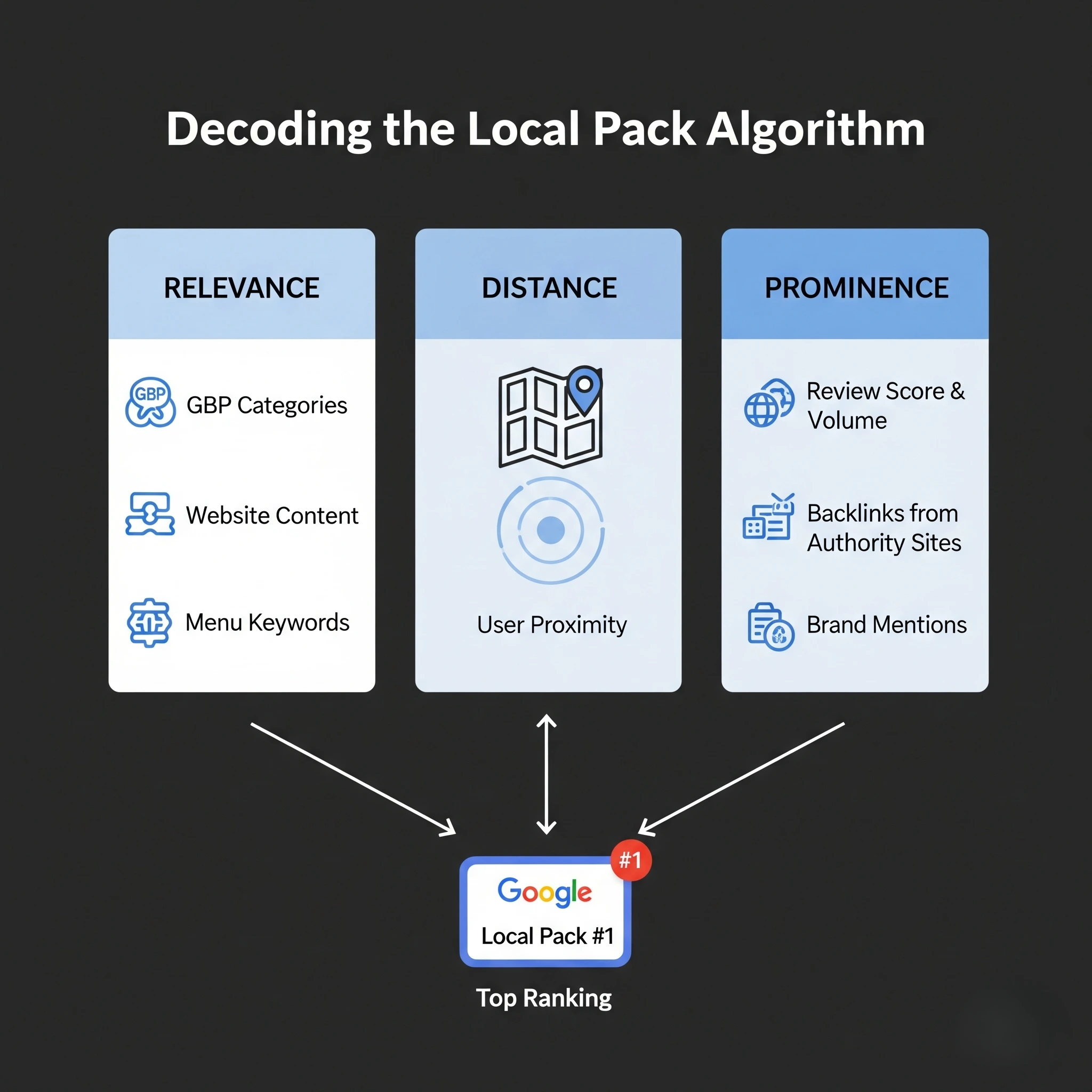
This block of 3-4 business listings displayed prominently beneath a map is the most valuable digital real estate for any local business. Clicks originating from this section are overwhelmingly from high-intent, transaction-ready customers. Your primary objective is to earn a permanent spot here.
Google's algorithm for Local Pack rankings is officially based on three core pillars:
- Relevance: How accurately does your business profile match the explicit and implicit intent of the user's search? If a user searches for "late night vegan food," does your profile explicitly state you are open late and serve vegan dishes?
- Distance (Proximity): How geographically close is your physical location to the user or the location specified in their search? While you cannot change your address, you can optimize every other signal to maximize your relevance within your service radius. This is particularly crucial for delivery-focused queries where the serviceable area is defined.
- Prominence: How well-known and respected is your business in the real world? Google measures this through a vast array of online signals, including review quantity and quality, the authority of websites linking to you, and the volume of brand mentions.
Your first step is to analyze the current winners. Perform searches for your most important keywords and scrutinize the top three competitors in the Local Pack. Ask critical questions:
- What is their average star rating?
- How many reviews do they have compared to you?
- What is their primary GBP category?
- What specific attributes are highlighted?
- What kind of photos are they using?
This initial reconnaissance provides a clear benchmark for what it takes to win in your specific market. Digispot AI can help you identify and fix these competitive gaps automatically with AI-powered audits analyzing 300+ ranking factors.
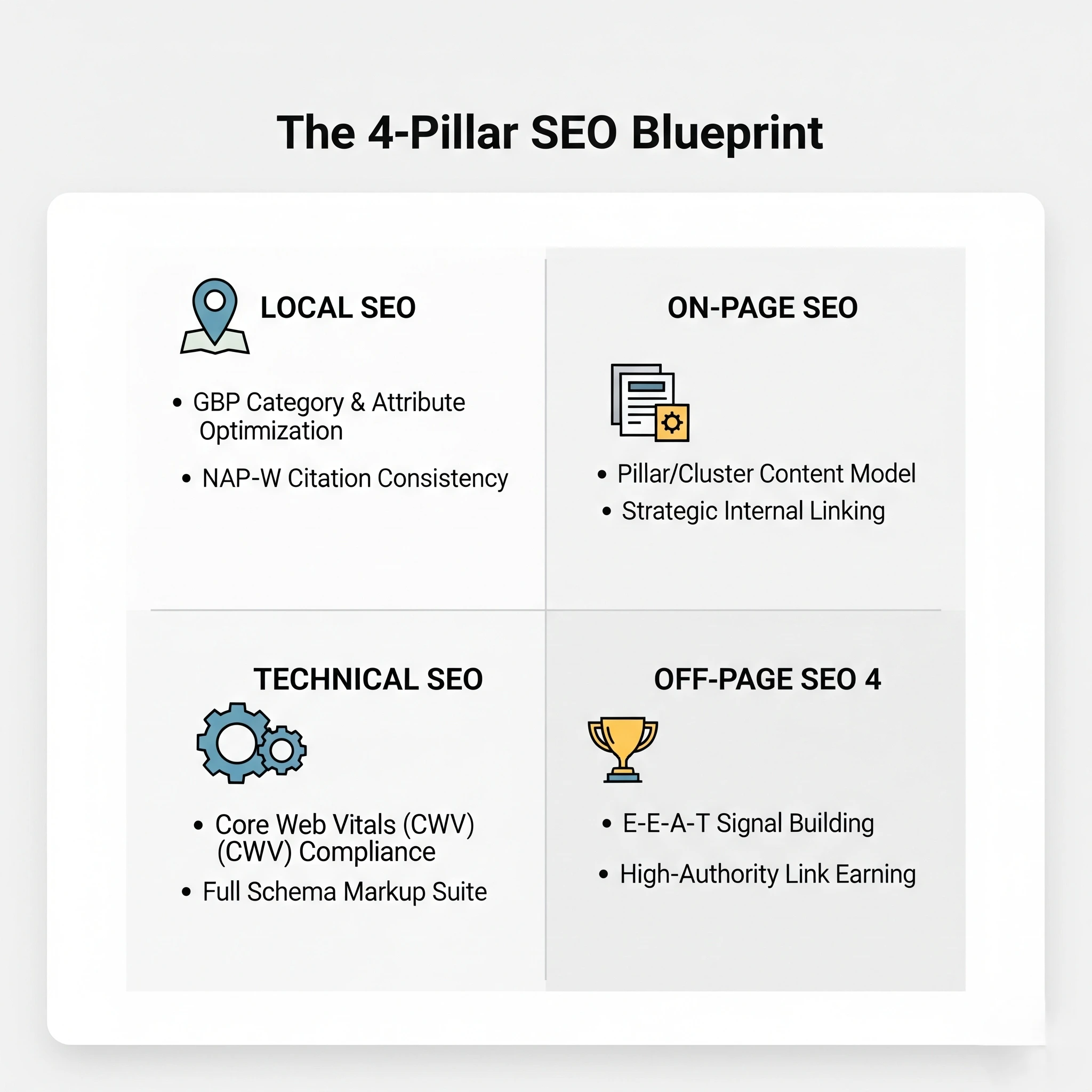
Local SEO - Engineering Your Geographic Dominance
Local SEO is the bedrock of your entire strategy. It is the science of anchoring your digital entity to a specific geographic location and relentlessly signaling your relevance and prominence within that area. Your primary instrument in this endeavor is your Google Business Profile (GBP).
GBP as the API to the Local Pack
Think of your GBP not as a listing, but as a direct data API into Google's local algorithm. Every field you populate, every photo you upload, and every review you receive is a data point that Google uses to calculate your ranking. Incomplete or lazy profiles are a critical unforced error.
-
Precision in Categories & Attributes: Choosing the correct primary category (e.g., "Fine Dining Restaurant") is the single most potent signal of Relevance you can send. It is the first filter Google applies. Choosing generic "Restaurant" when you should be "Japanese Restaurant" is a fundamental mistake. Secondary categories add crucial context ("Sushi Restaurant," "Bar," "Asian Fusion Restaurant").
The Attributes section is where you achieve granular relevance. By selecting attributes like "Outdoor seating," "Serves cocktails," "Has fireplace," or "Serves late-night food," you are pre-emptively answering specific, long-tail user queries. This makes your business eligible to appear for hyper-specific searches that your competitors might miss, such as "restaurants with outdoor seating near me."
-
Building a Coherent Entity with NAP-W Consistency: Your Name, Address, Phone, and Website (NAP-W) are the unique fingerprint of your business entity. The meticulous consistency of this data across the entire web—from your own site to Yelp, TripAdvisor, local chamber of commerce sites, and food blogs—is a foundational trust signal. As detailed in industry-leading studies like Whitespark's "Local Search Ranking factors," citation consistency is a critical signal of a stable, legitimate business. Inconsistencies create algorithmic doubt and directly suppress your visibility. Your goal is to build a clear, unambiguous "entity stack" that leaves Google with zero confusion about who you are, where you are, and what you do.
-
The Power of User-Generated and Business-Provided Visuals: High-resolution photos and videos serve a dual purpose. For users, they set expectations and showcase your ambiance and offerings. For Google, they are a rich source of data. Google's Vision AI analyzes the content of your images to understand context. A photo of a perfectly plated vegan dish can help establish relevance for "vegan options." A video of a bustling happy hour can signal prominence for "after-work drinks."
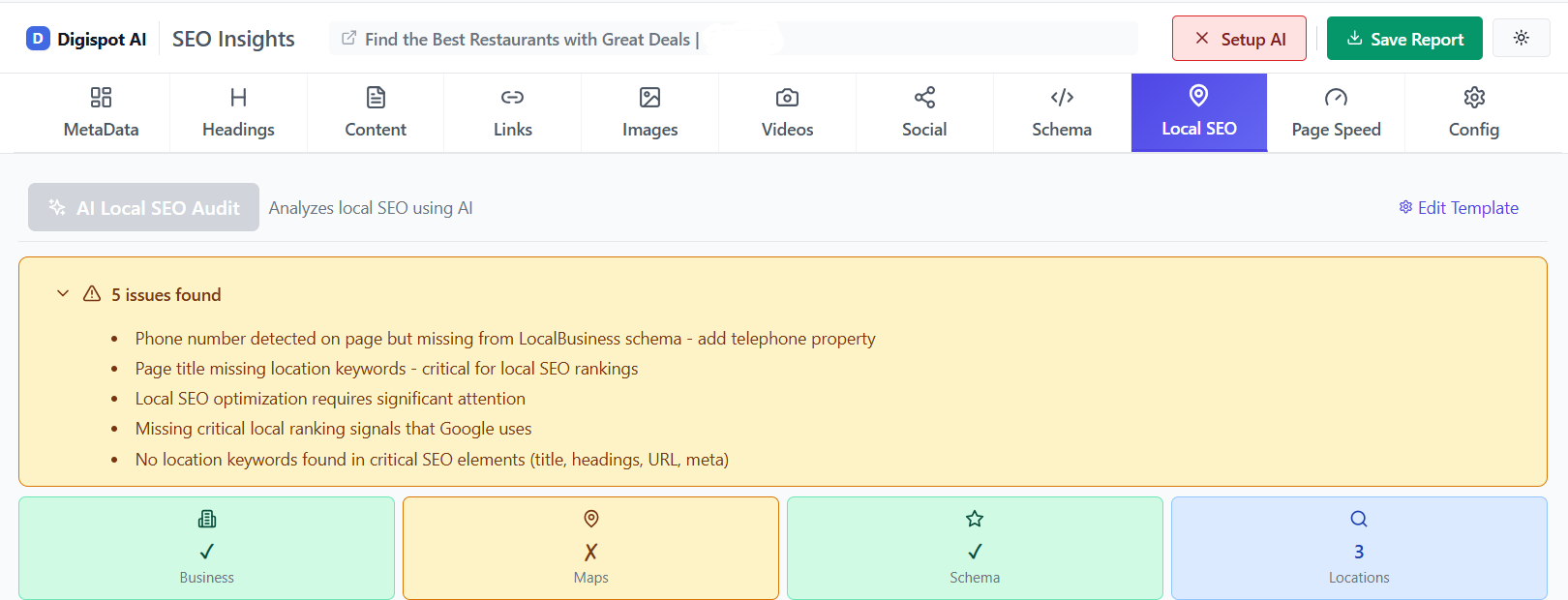
Furthermore, Google actively tracks user engagement signals within your GBP profile. High engagement—measured by clicks-to-call, requests for directions, and time spent viewing photos—is a powerful proxy for real-world Prominence. Get instant SEO insights on any page, including competitor profiles, with our free Chrome extension.
-
Active Management as a Prominence Signal: A static, neglected GBP profile signals stagnation. A dynamic, actively managed profile signals a thriving, relevant business. Use Google Posts weekly to announce specials, promote events, or highlight a new menu item. These have a limited lifespan but create a continuous stream of fresh content directly associated with your profile.
More importantly, proactively populate the Q&A section. Brainstorm every conceivable question a customer might have—about parking, reservations, dietary options, dress code—and answer it yourself. This not only improves the customer experience but also allows you to embed valuable, long-tail keywords directly into your GBP, turning it into a rich informational resource.
On-Page SEO - Architecting Your Website for Topical Authority
If your GBP is your digital storefront on Google's main street, your website is your flagship restaurant—the space where you control the entire experience. On-page SEO is the art of structuring your website's content and HTML source code to communicate your expertise and authority on specific topics with absolute clarity. To get started, review our guide on on-page SEO best practices for a deeper understanding of structural requirements.
-
Essential HTML Elements for Search Clarity:
- Title Tags: This is the clickable, blue headline in the search results and the single most important on-page ranking factor. It must be concise, compelling, and structured strategically. A poor title is simply "Home." A better title is "The Golden Spoon Bistro." An optimized title follows a formula:
Primary Keyword | Secondary Keyword | Brand Name. For a menu page, this could be:Our Menu - Modern American Cuisine & Cocktails | The Golden Spoon Bistro. - Meta Descriptions: While not a direct ranking factor, this 160-character snippet is your ad copy on the SERP. It is profoundly influential on your Click-Through Rate (CTR), and a high CTR is a positive ranking signal. A lazy meta description is "This is the menu for our restaurant." An effective one is: "Experience the award-winning Modern American cuisine of The Golden Spoon Bistro. Explore our seasonal menu featuring locally-sourced ingredients. Reserve your table." Try the free On-Page SEO Analysis tool to audit any URL instantly and check your current tags.
- Header Hierarchy (H1, H2, H3): Search engine crawlers use header tags to understand the logical structure of your content. Your main page title must be your one and only H1 tag. Major subheadings like "Appetizers," "Entrées," and "Desserts" should be H2 tags. This creates a clean, semantic outline of your page's content, improving crawlability and signaling relevance.
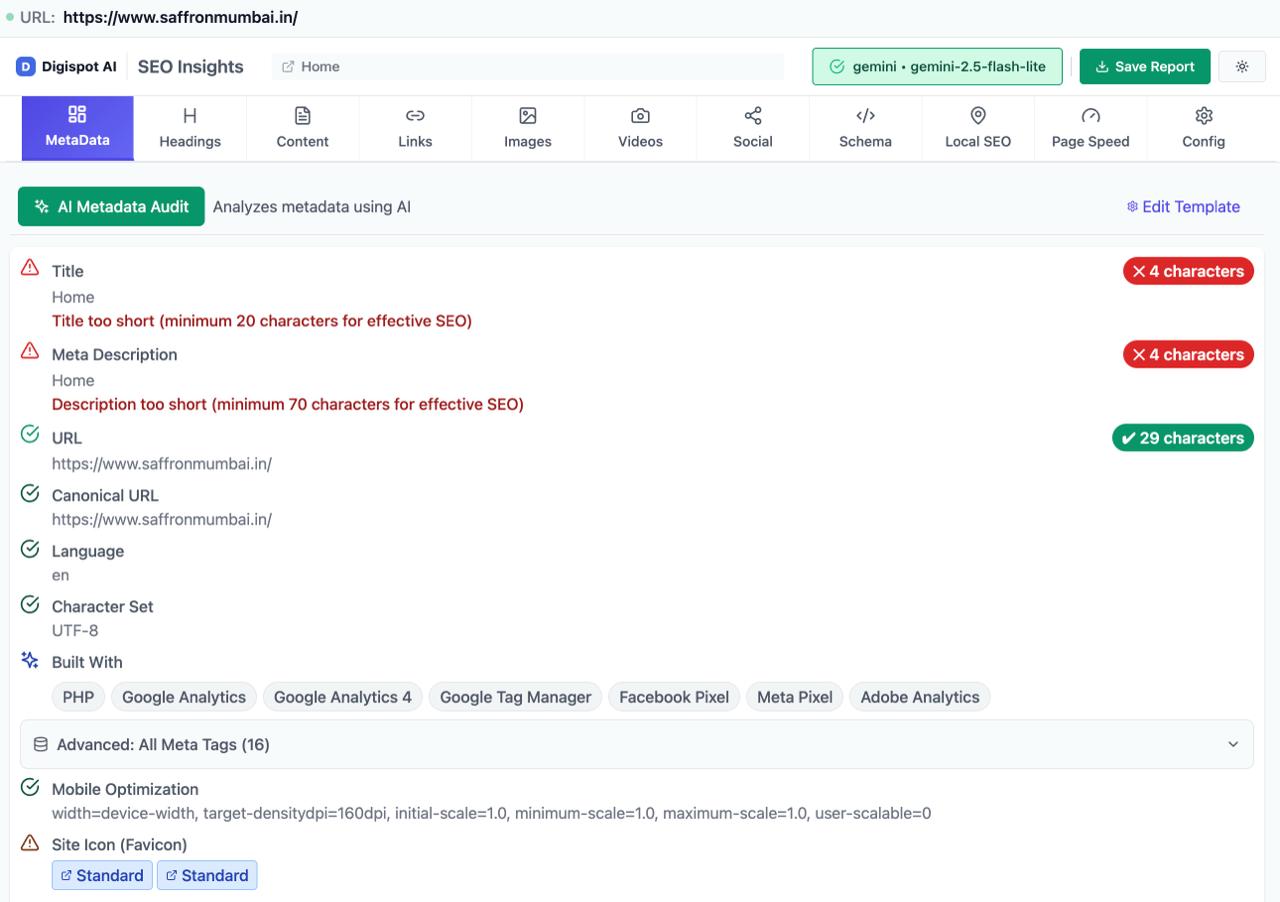
Is your metadata working for you or against you? Instantly audit your page titles, descriptions, and technical tags with the Digispot AI Chrome extension. Fast, accurate, and essential for every digital marketer.
- Title Tags: This is the clickable, blue headline in the search results and the single most important on-page ranking factor. It must be concise, compelling, and structured strategically. A poor title is simply "Home." A better title is "The Golden Spoon Bistro." An optimized title follows a formula:
-
Strategic Internal Linking to Sculpt Authority: A website without internal links is like a book without a table of contents. Strategic internal linking is the practice of linking from one page on your site to another relevant page. This has two critical SEO benefits:
- Distributes Authority: It allows "link equity" (or PageRank) to flow from your powerful pages (like your homepage) to other important pages, boosting their ability to rank.
- Establishes Context: Using descriptive anchor text (the clickable text itself) helps Google understand what the linked page is about. Linking to your catering page with the anchor text "our corporate event catering services" is far more powerful than using generic text like "click here."
-
The HTML Menu: A Foundational Requirement for Discovery: This point cannot be overstated: your menu must be HTML text. Uploading your menu solely as a PDF or an image file is one of the most damaging and common mistakes restaurants make. See our detailed breakdown of common SEO mistakes to understand why PDF menus often lead to poor indexing.
Search engines cannot effectively crawl or index the text within PDF files, making your most important product offerings invisible to them. An HTML menu makes every dish, every ingredient, and every description an indexable asset. A detailed description like "Pan-seared scallops with saffron risotto and an asparagus coulis" contains multiple valuable keywords that can help you rank for very specific, high-intent searches. If someone searches for "scallops near me" and your menu is a PDF, you likely won't appear. If it's HTML, Google can match the query directly to your menu item.
Technical SEO - Ensuring a Flawless Foundation
Technical SEO is the invisible framework that supports your entire digital strategy. If your site has significant technical flaws, even the most brilliant content and local signals will be severely hampered. It is about ensuring your website is easily discoverable, crawlable, and understandable by search engine bots. You can use our SEO audit checklist to perform a comprehensive self-assessment.
-
Crawlability, Indexability, and Crawl Budget: Search engines have finite resources, a concept known as "crawl budget." They are more likely to spend this budget on sites that are fast, efficient, and easy to navigate. A site with broken links, slow loading times, and a messy structure wastes its crawl budget and risks having important pages ignored. Key elements include:
- HTTPS: A secure site (https://) is a baseline requirement for trust and a minor ranking signal.
- XML Sitemap: This is a literal roadmap of your website that you submit to Google via Search Console, explicitly telling it which pages are important and ready to be indexed.
- Robots.txt: A simple text file that gives crawlers rules of engagement, telling them which parts of your site to avoid (like admin login pages).
-
Core Web Vitals (CWV) & The Page Experience Update: Google has made it clear that user experience is a direct ranking factor. CWV measures this through three key metrics: loading speed (LCP), interactivity (FID), and visual stability (CLS). For restaurants, the biggest culprits that damage these scores are often unoptimized, high-resolution menu photos and clunky, slow-loading third-party widgets for reservations or online ordering.
Compressing images and choosing well-coded third-party tools is essential. Learn more about optimizing these metrics in our Core Web Vitals guide. If your reservation widget takes 5 seconds to load, you are likely losing customers before they even see your availability.
-
Advanced Schema Markup: Becoming the Definitive Answer: Schema markup is your secret weapon. It is a vocabulary of code (typically implemented as JSON-LD) that you add to your site's backend to explicitly describe your content. It turns your website from a simple document into a structured database that Google can instantly understand. For a restaurant, you should implement a suite of schema types:
Restaurant&Menu: The essentials for defining your business and dishes.Review: Enables the gold star ratings (rich snippets) to appear in the SERP, dramatically increasing CTR.FAQPage: If you build a dedicated FAQ page, this schema can make your questions and answers appear directly in the search results.BreadcrumbList: Marks up your site's navigation path (e.g., Home > Menus > Dinner Menu), improving user experience and helping Google understand your site structure.Person: Use this on your "About" page to mark up your head chef, signaling their expertise and contributing to your site's overall E-E-A-T (Experience, Expertise, Authoritativeness, Trustworthiness) profile.
Accurately applying this code is a high-leverage activity. Use the free Schema Markup Generator to create valid structured data in minutes without needing to be a coding expert.
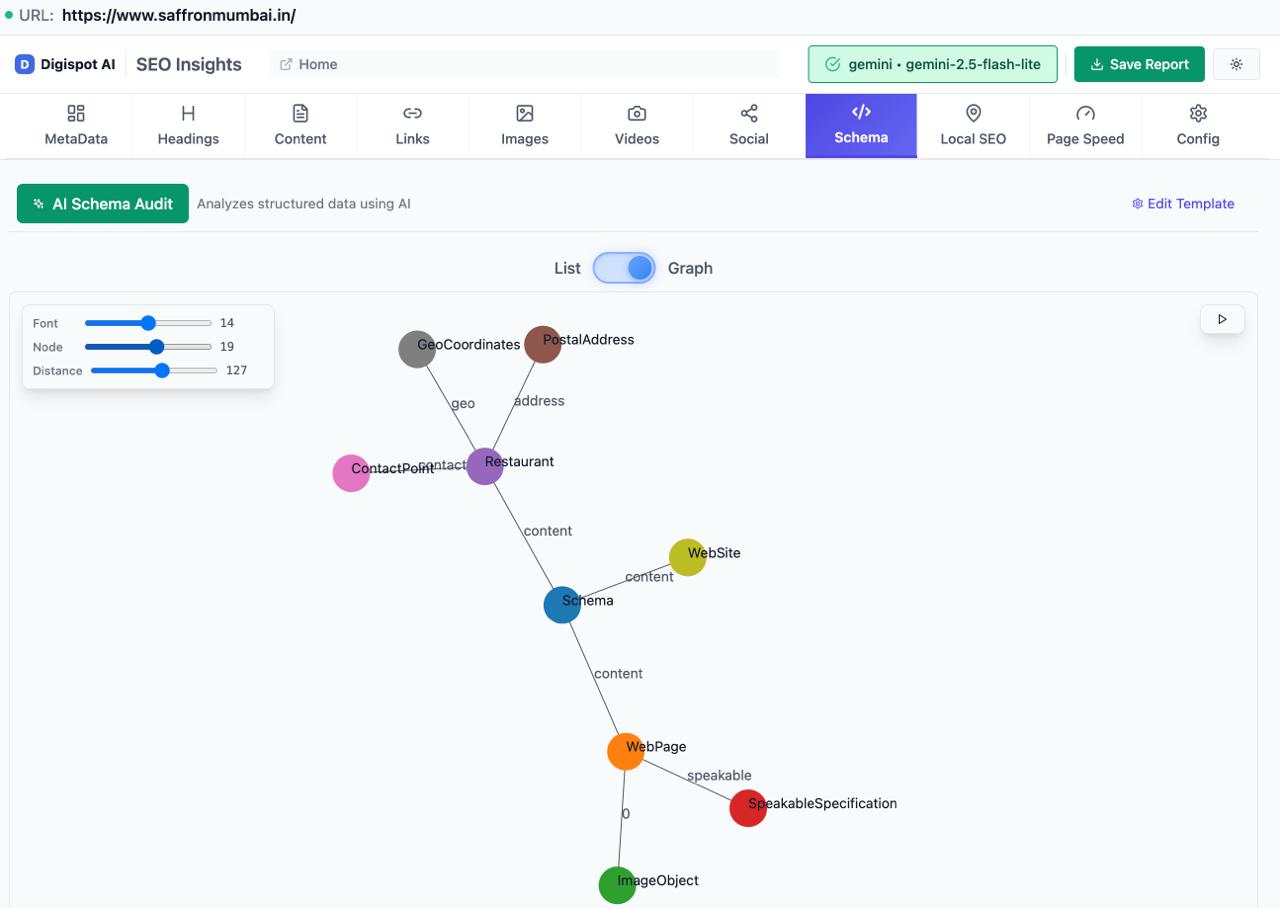
This is what your website looks like to a search engine. Do you like what you see? Visualize your Schema structure with our new Chrome extension and take the guesswork out of technical SEO.
Off-Page SEO - Building Digital Prominence and Authority
Off-page SEO encompasses all strategic activities that occur away from your website to build its reputation, authority, and prominence. This is how you prove to Google that you are a respected and important entity in your market, directly influencing the Prominence factor of the local algorithm and satisfying Google's E-E-A-T quality guidelines. For more on building authority, read our E-E-A-T SEO guide.
-
The Review Ecosystem: Quantity, Velocity, and Semantic Depth: Online reviews are perhaps the most powerful off-page signal for a local business.
- Quantity and Velocity: A high volume of reviews is good, but a steady stream of new reviews is even better. This "review velocity" signals ongoing relevance and customer satisfaction. A restaurant with 500 reviews but none in the last 6 months looks dormant to Google's algorithm compared to a competitor getting 5 new reviews weekly.
- Semantic Analysis: Google doesn't just count stars; its Natural Language Processing algorithms analyze the text of the reviews. When multiple reviews mention your "romantic ambiance" or "amazing gluten-free pizza," it reinforces your relevance for those specific terms. Encourage happy guests to be specific. Instead of asking "Did you like it?", ask "How was the truffle pasta?"
- Response Strategy: Your responses matter. Engaging with all reviews—thanking positive ones and professionally addressing negative ones—demonstrates accountability and builds Trustworthiness in the eyes of both potential customers and Google.
-
Authoritative Link Building: The Currency of the Web: In SEO, a backlink (a link from another website to yours) is a vote of confidence. However, not all votes are created equal.
- Quality and Relevance are Paramount: One single, editorially-given link from a major local newspaper's food critic or a nationally recognized food blog is exponentially more powerful than 500 low-quality directory links. The authority and topical relevance of the linking site are what matter most.
- Strategic Link Earning: You don't just "get" good links; you earn them. This requires proactive outreach and creating link-worthy assets. Consider strategies like: hosting a charity dinner for local media, creating a unique data report (e.g., "The Most Popular Cuisines in [Your City]"), offering a culinary scholarship, or pitching your chef's unique story to journalists.
- Unlinked Brand Mentions: Modern search engines are sophisticated enough to associate mentions of your brand name with your entity even without a hyperlink. Every time your restaurant is mentioned in an online article or blog post, it contributes to your overall digital Prominence.
Hotel SEO: The Hospitality Nuance
While this guide focuses on restaurants, the principles of hospitality marketing extend heavily into Hotel SEO. Many hotels house restaurants that operate as independent entities. If you manage a hotel restaurant, you face a unique challenge: distinguishing your dining experience from the hotel brand while leveraging its authority.
For hotel restaurants, ensure you have a separate Google Business Profile from the main hotel listing. This allows you to collect reviews specifically for the dining experience and appear in "restaurants near me" searches, rather than just "hotels near me." Cross-link your hotel site and restaurant site strategically, but treat the restaurant as a standalone local entity to maximize its visibility in the Local Pack.
Conclusion: Start Improving Your Search Visibility Today
Dominating search engine results as a restaurant is not a one-time project. It is a continuous, disciplined process of building and maintaining a superior digital entity. It is an integrated system where your local signals, your on-page architecture, your technical foundation, and your off-page authority all work in concert.
By moving beyond simple checklists and adopting this comprehensive, analytical framework, you are no longer just participating in the digital marketplace—you are engineering its outcome. You are building a resilient, defensible online presence that consistently translates search intent into seated diners and delivery orders.
Navigating this complex ecosystem of signals and algorithms is a significant undertaking. It is precisely this challenge that inspired the creation of Digispot AI—to empower business owners by translating these intricate technical requirements into a clear, actionable strategy for growth. Ready to improve your search visibility? Try Digispot AI for comprehensive website audits and actionable recommendations.
References:
- Luca, Michael. (2016). Reviews, Reputation, and Revenue: The Case of Yelp.com. Harvard Business School NOM Unit Working Paper No. 12-016.
- Whitespark. (Annual). Local Search Ranking Factors Survey. An industry-standard survey polling top experts on the signals that impact local search visibility.
- Enge, E., Spencer, S., Stricchiola, J., & Fishkin, R. (2015). The Art of SEO: Mastering Search Engine Optimization. O'Reilly Media.
Related deep-dives
Continue with these closely related guides:
- travel & hospitality seo — Travel & Hospitality SEO: Booking Guide 2026
Audit any page in seconds
300+ SEO checks including Core Web Vitals, schema markup, meta tags, and AI readiness — trusted by 1000+ SEO experts and marketers.
Frequently Asked Questions
Here are some of our most commonly asked questions. If you need more help, feel free to reach out to us.
Written by
Maya Krishnan
Digital growth expert
Maya is a seasoned expert in web development, SEO, and digital strategy, dedicated to helping businesses achieve sustainable growth online. With a blend of technical expertise and strategic insight, she specializes in creating optimized web solutions, enhancing user experiences, and driving data-driven results. A trusted voice in the industry, Maya simplifies complex digital concepts through her writing, empowering readers with actionable strategies to thrive in the ever-evolving digital landscape.