Near Me SEO: 9 Advanced Local Search Strategies
Master 'near me' SEO optimization to capture high-intent local traffic. Learn actionable strategies for Google Maps, voice search, and AI platforms.
 Maya Krishnan
"Near me" searches are no longer just a trend; they are the default behavior for consumers ready to buy. Data indicates that searches including "near me" have grown by over 900% in recent years. More importantly, 76% of people who search on their smartphones for something nearby visit a business within a day.
However, ranking for these high-intent queries has evolved. It is no longer enough to simply have a verified Google Business Profile (GBP). The landscape now includes Answer Engine Optimization (AEO), where AI platforms like ChatGPT, Perplexity, and Google's AI Overviews synthesize answers based on complex data points.
To capture this traffic, you must move beyond basic NAP (Name, Address, Phone) consistency. You need a strategy that signals relevance, prominence, and precise location context to both traditional algorithms and new AI models. If the fundamentals are still fuzzy, start with our guide to what local SEO is and how it works.
This guide outlines advanced strategies to dominate the local pack and future-proof your visibility for the AI era.
The Core Mechanics of "Near Me" Algorithms
Before executing tactics, you must understand how search engines process local intent. Google uses three primary pillars to determine local rankings:
- Relevance: How well a local business profile matches what someone is searching for.
- Distance: How far each potential search result is from the location term used in a search.
- Prominence: How well-known a business is (based on information from across the web, links, articles, and directories).
The Shift to Contextual Proximity
Historically, distance was the deciding factor. If you were physically closest to the user, you ranked #1. Today, relevance and prominence can override distance. A highly rated restaurant 2 miles away with detailed menu data will often outrank a mediocre restaurant 0.5 miles away with a bare-bones profile.
This shift means you have control. You cannot move your physical building, but you can maximize relevance and prominence to expand your "ranking radius."
1. Google Business Profile: Beyond Verification
Your Google Business Profile (formerly GMB) is the single most critical asset for near me SEO. Most businesses claim it and forget it. To rank, you must treat it as an active social channel.
Strategic Category Selection
Your primary category has the strongest influence on rankings. However, secondary categories capture long-tail traffic.
- Primary: Be specific. Choose "Personal Injury Attorney" rather than just "Lawyer."
- Secondary: Add every relevant service. A gym should include "Yoga Studio," "Personal Trainer," and "Indoor Cycling."
Optimizing Business Attributes
Attributes (e.g., "Wheelchair accessible," "Women-owned," "Outdoor seating") are often used as filters in voice search and AI queries. If a user asks Siri, "Find a coffee shop with outdoor seating near me," and you haven't selected that attribute, you disappear from the results.
The "Updates" Strategy
Google looks for signs of life. Posting weekly updates regarding offers, events, or team news signals that the business is active.
- Post Types: Use "Offer" posts for sales (they linger longer on the profile) and "Update" posts for general news.
- Visuals: Geotag your photos before uploading them. While Google strips metadata for privacy, the AI vision algorithms analyze the image content to confirm location context (e.g., landmarks in the background).
2. Technical Localization and Schema Markup
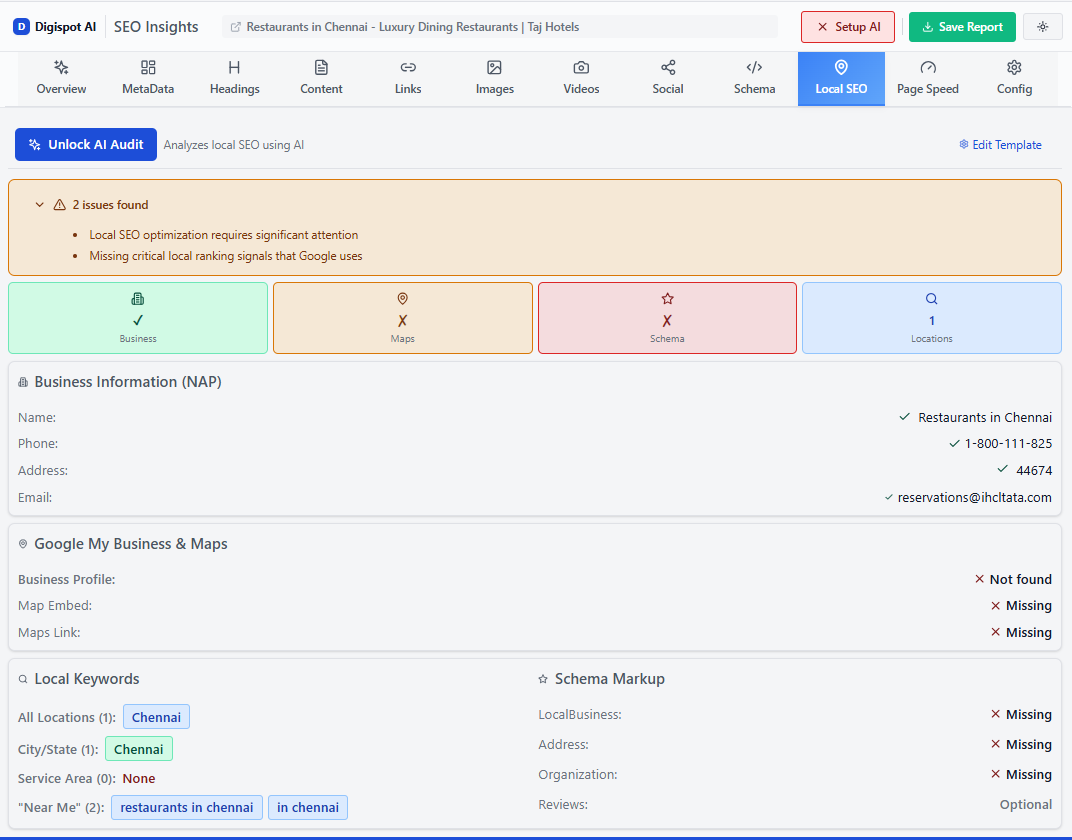
Structured data is the language of search engines. For local SEO, it eliminates ambiguity. If your website relies solely on plain text to communicate your address, you are forcing Google to "guess."
Implementing LocalBusiness Schema
You must wrap your NAP data in LocalBusiness JSON-LD schema. This code lives in the <head> of your site and explicitly tells crawlers your coordinates, hours, price range, and service area.
For multi-location businesses, each location page requires its own specific schema with unique hasMap and geo coordinates.
Pro Tip: Use the free Schema Markup Generator to create error-free JSON-LD code for your local business in minutes.
Mobile Responsiveness and Core Web Vitals
"Near me" searches are predominantly mobile. If your site loads slowly on 4G/5G networks, Google will demote your rankings regardless of your location.
- CLS (Cumulative Layout Shift): Ensure your map embeds don't shift the layout as they load.
- LCP (Largest Contentful Paint): Optimize local images to load instantly.
Digispot AI can help you identify and fix these mobile performance issues automatically with AI-powered audits analyzing 300+ ranking factors.
3. Mastering Search Intent for Local Queries
Understanding why a user searches is as important as what they search for. "Near me" implies immediate need, but the nuances vary.
- Informational Local: "Coffee shop open late near me" (Needs hours).
- Transactional Local: "Buy plumbing supplies near me" (Needs inventory).
- Navigational Local: "Directions to Digispot office" (Needs map).
You must align your landing pages with this intent. If you want to dive deeper into aligning content with user goals, read our guide on search intent optimization.
Creating "Hybrid" Location Pages
Avoid "doorway pages"—low-quality pages that just swap city names. Instead, create hybrid pages that offer genuine value:
- Local Specifics: Mention nearby landmarks, parking availability, and specific team members at that location.
- Unique Content: distinct testimonials from local clients and case studies relevant to that region.
- Embedded Map: Use the official Google Maps embed API, not a screenshot.
4. The Power of Online Reviews and Reputation
Reviews are the primary driver of the "Prominence" factor. They also heavily influence Click-Through Rate (CTR). A business with a 4.8 rating and 200 reviews will almost always steal clicks from a 5.0 business with only 2 reviews.
The Velocity and Recency Factor
Getting 50 reviews in one day looks suspicious. Getting 2 reviews every week for six months looks organic and healthy. Establish a system to request reviews via SMS or email immediately after a transaction.
Responding with Keywords
When you respond to reviews, you are writing content that Google indexes.
- Bad Response: "Thanks!"
- Good Response: "Thank you, Sarah! We're glad you enjoyed our gluten-free pizza options at our downtown Chicago location."
This reinforces your relevance for specific keywords and locations naturally. For more on how user behavior influences rankings, check our insights on click-through rate optimization.
5. Citation Management in the AI Era
Citations (mentions of your business name, address, and phone number) serve as "votes of confidence" for your location. In the past, volume was key. Today, data consistency and authority matter more.
Data Aggregators vs. Directories
Focus on the "Big Three" data aggregators in your region (e.g., Foursquare, Data Axle, Neustar). These platforms feed data to Apple Maps, Bing, and even car navigation systems. If your data is wrong at the aggregator level, it trickles down to dozens of smaller directories.
Consistency is Non-Negotiable
"St. vs. Street" or "Ste 100 vs. Suite #100" creates data confusion. Search engines and AI models prefer entities with clean, matching data records. Inconsistent data lowers the "trust score" assigned to your business.
Learn more about building a robust external footprint in our guide to off-page SEO strategies.
6. Optimization for Voice Search and AEO
Voice search queries are 30 times more likely to be action-oriented than text queries. Furthermore, AI tools like ChatGPT and Perplexity are becoming the new "local search" engines. They don't just give a list of links; they give a recommendation.
User: "Where should I get dinner tonight in Austin?" AI: "I recommend [Business Name] because recent reviews mention excellent service and they have availability tonight."
How to Optimize for AI Recommendation:
- Natural Language Content: Write your FAQ and "About Us" sections in a conversational tone. Answer questions directly.
- Sentiment Analysis: AI models analyze the sentiment of reviews, not just the star rating. Fix operational issues that cause negative sentiment.
- Detailed Service Menus: AI needs data to make a match. If you are a mechanic, list every specific car model you service, not just "auto repair."
Get instant SEO insights on how your pages appear to these engines with our free Chrome extension.
7. Localized Content Marketing
Generic blog posts won't help you rank locally. You need content that establishes you as a local authority.
Local "Best Of" Guides
Create content that highlights other non-competing businesses in your area.
- Example: A real estate agent writing "The Top 5 Coffee Shops in [Neighborhood]." This earns you backlinks from those businesses and signals local relevance to Google.
Event-Based SEO
Leverage local events. If there is a major festival or conference in your city, write about it. Discuss parking, schedules, or how your business participates. This captures high-volume temporal traffic.
- Internal Link: See our seasonal SEO strategies for capitalizing on time-based events.
8. Meta Tags and Click Appeal
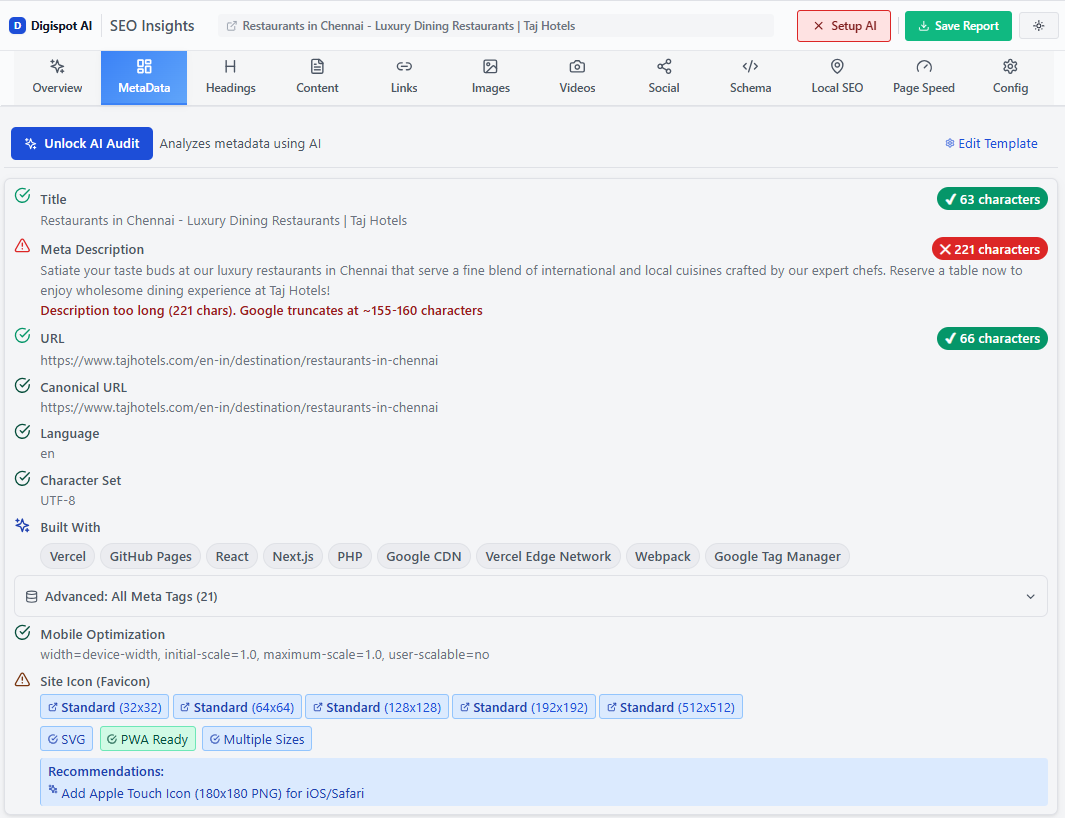
While meta tags are a traditional SEO tactic, they are crucial for local CTR. Your title tag and meta description are your "ad copy" in the search results.
- Title Tag: [Keyword] + [City] | [Brand Name]
- Example: Emergency Plumber Near Me in Seattle | Mike's Plumbing
- Meta Description: Include your phone number and a USP (Unique Selling Proposition) like "Arriving in 30 mins."
Don't guess what your snippets look like. Use the free Meta Preview tool to optimize your click appeal before publishing. For a comprehensive breakdown, read our meta tags optimization guide.
Turn invisible SEO data into clear visuals with our Free Chrome extension.
9. Tracking and Analytics for Local
You cannot improve what you do not measure. Standard Google Analytics 4 (GA4) setups often miss the nuances of local search.
Key Metrics to Watch:
- Direction Requests: A high-intent signal found in GBP Insights.
- Click-to-Call: Essential for service businesses.
- Photo Views: Indicates high engagement with your profile.
- Local Rank Tracking: Generic rank trackers check from a central server. You need a tracker that checks rankings from specific zip codes or geo-coordinates.
Ready to improve your search visibility? Try Digispot AI for comprehensive website audits, competitor intelligence, and real-time rank tracking that accounts for precise user location.
Conclusion: Start Owning Your Neighborhood
Ranking for "near me" searches is an ongoing battle of proximity, precision, and reputation. It requires a synergy between your technical website health, your Google Business Profile, and your wider reputation across the web.
The businesses that win in the coming years will be those that optimize not just for the Google bot, but for the AI assistant answering the question, "Who is the best provider near me?"
Action Plan for Today:
- Audit your NAP consistency across major aggregators.
- Generate and implement LocalBusiness Schema on your homepage.
- Implement a system to generate 2-3 new reviews weekly.
- Update your Google Business Profile with fresh photos and a "Special Offer" post.
Use the tools available to you to automate the heavy lifting. Try the free On-Page SEO Analysis tool to audit your location pages instantly and start climbing the local pack.
Related deep-dives
Continue with these closely related guides:
- geo-targeting seo — Geo-Targeting SEO: Location-Based Search Optimization
- nap consistency — NAP Consistency: The Foundation of Local SEO and AEO Success
- google business profile — Google Business Profile Guide: Master Local Search & Maps Ranking (2026)
- local citations for seo — Local Citations Guide for SEO: Boost Rankings & Trust (2026)
- local seo — Local SEO Checklist 2026: The Ultimate Guide to Ranking in Maps & AI Search
References
Audit any page in seconds
300+ SEO checks including Core Web Vitals, schema markup, meta tags, and AI readiness — trusted by 1000+ SEO experts and marketers.
Frequently Asked Questions
Here are some of our most commonly asked questions. If you need more help, feel free to reach out to us.
Written by
Maya Krishnan
Digital growth expert
Maya is a seasoned expert in web development, SEO, and digital strategy, dedicated to helping businesses achieve sustainable growth online. With a blend of technical expertise and strategic insight, she specializes in creating optimized web solutions, enhancing user experiences, and driving data-driven results. A trusted voice in the industry, Maya simplifies complex digital concepts through her writing, empowering readers with actionable strategies to thrive in the ever-evolving digital landscape.