Seasonal SEO: Capitalize on Trending Searches
Master seasonal SEO strategies for peak traffic periods. Plan content calendars, optimize for holidays, and capture trending searches before competitors.
 Maya Krishnan
Think of your website like a physical storefront. Just as a retailer changes window displays for winter holidays or stocks up on sunscreen before summer hits, your digital presence must adapt to the predictable rhythms of consumer behavior. Businesses experience natural fluctuations driven by holidays, weather patterns, and industry-specific events. If your SEO strategy remains static while user intent shifts, you leave significant revenue on the table.
Seasonal SEO is the process of aligning your online visibility with these predictable surges. It is not just about writing a "Christmas Gift Guide" in December; it is a calculated operational shift involving technical readiness, content velocity, and structured data implementation. This guide details how to build a resilient seasonal strategy that captures traffic when intent is highest, helping you outperform competitors who react too late.
What Exactly is Seasonal SEO?
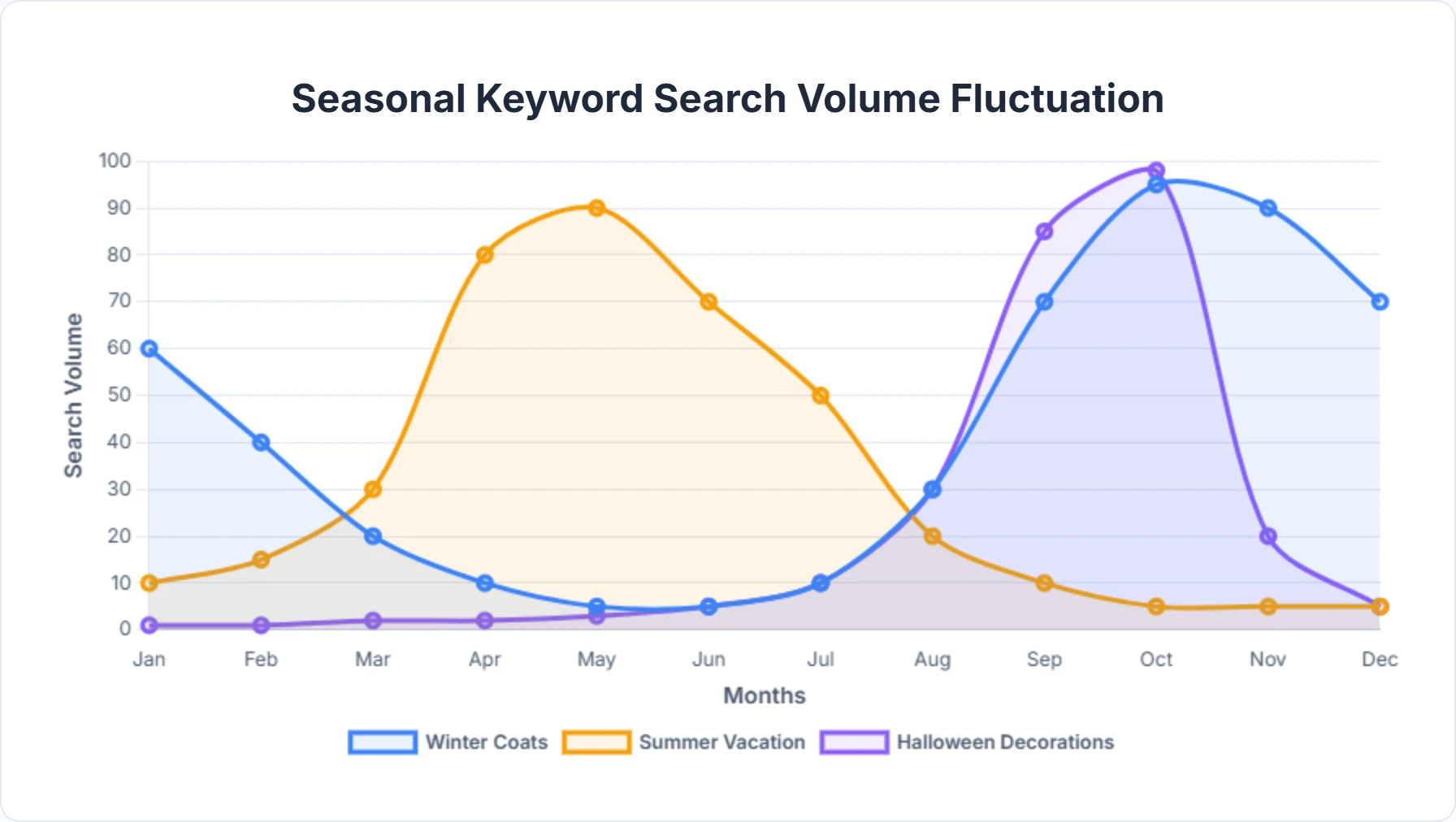
Seasonal SEO is a strategic methodology for optimizing your digital assets to rank during peak interest periods. While evergreen SEO focuses on consistent, steady traffic, seasonal SEO targets high-velocity, short-duration spikes.
Consider the search query "tax software." In July, volume is low. By January, it climbs, peaking in April. Similarly, "best sunblock" dormant in winter explodes in search volume by May. These are not accidents; they are behavioral patterns you can bank on.
The Three Types of Seasonality
To execute this effectively, distinguish between the types of seasonal triggers:
- Time-Based: Predictable calendar events like Christmas, Black Friday, or Valentine's Day.
- Seasonal Shifts: Weather-dependent changes like "winter tires" or "summer landscaping."
- Event-Based: Industry moments like the Super Bowl, the Oscars, or annual tech conferences.
Modern search engines, including AI-driven platforms like Google's AI Overviews and ChatGPT, prioritize freshness and relevance during these windows. If your content signals that it is current and specifically tailored to this year's season, you gain a distinct ranking advantage.
Why Seasonal SEO Matters for Your Business
Treating seasonal trends as an afterthought is a costly error. A proactive seasonal strategy delivers measurable impact across your entire funnel.
- Capture High-Intent Traffic: Users searching for "Mother's Day flower delivery" three days before the holiday are not browsing; they are ready to buy. Seasonal keywords often carry higher commercial intent than generic terms.
- Dominate the SERP Features: Search engines frequently alter the search engine results page (SERP) during holidays, showing more product carousels, "Deals" chips, and rich snippets. Optimized seasonal pages contend for this prime real estate.
- Improve Conversion Rates: When a user lands on a page specifically curated for the season (e.g., "Top Winter Coats for 2026"), the relevance creates trust. You reduce friction by giving them exactly what they sought, leading to higher conversion rates.
- Build Annual Authority: By maintaining and updating the same seasonal URLs year after year (recycling URLs), you accumulate backlink authority. While competitors create new pages from scratch, your established page starts the race with a head start.
- Feed AEO Algorithms: AI search engines look for the most relevant answer right now. Providing updated, season-specific data positions your brand as a primary source for AI-generated answers.
Digispot AI can help you identify and fix these issues automatically with AI-powered audits analyzing 300+ ranking factors, ensuring your site is technically ready for the traffic surge.
How to Implement Effective Seasonal SEO Strategies
Success requires a shift from reactive to proactive. You cannot wait until the leaves fall to optimize for autumn. Here is the operational blueprint for seasonal dominance.
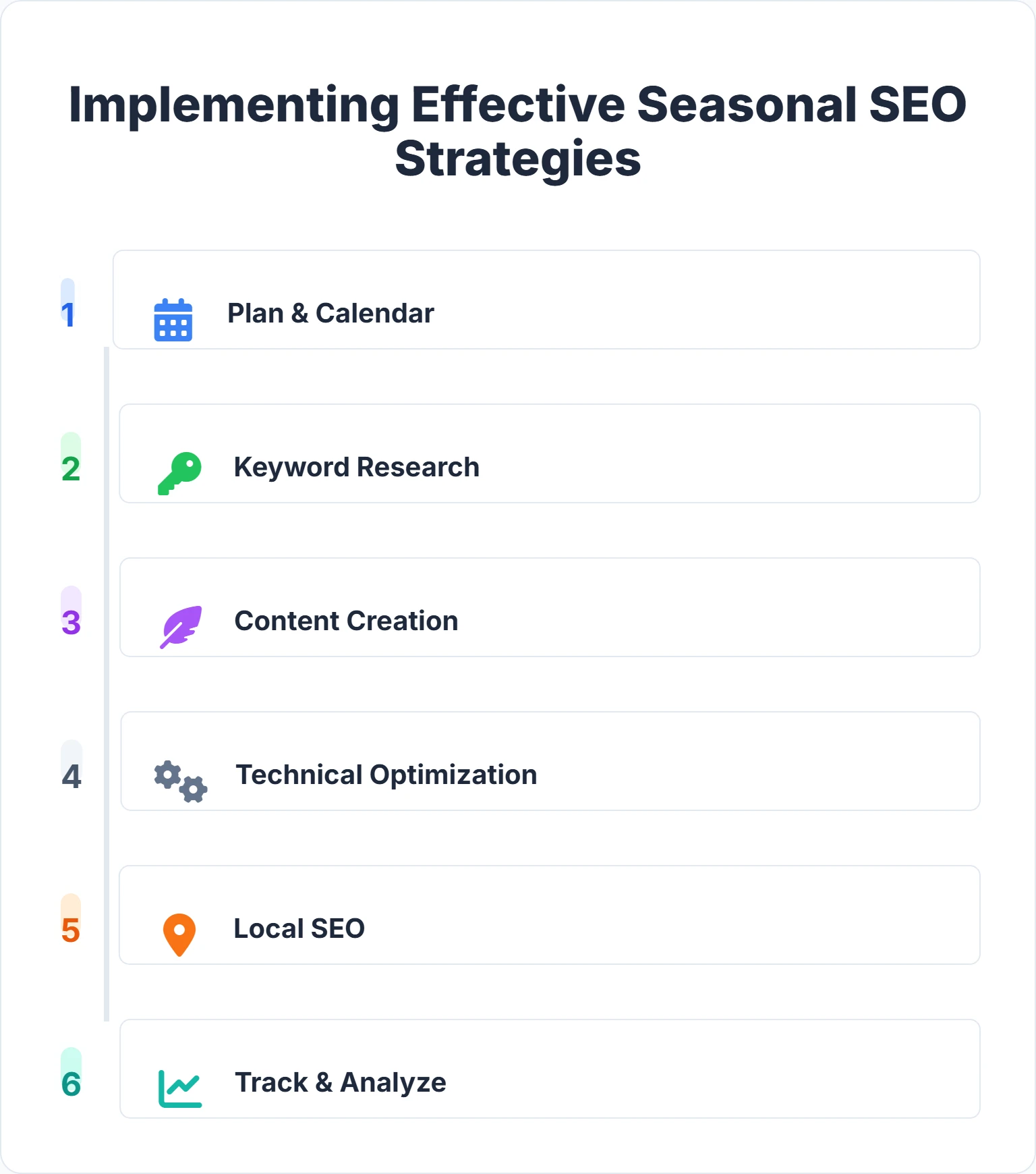
1. The Power of Early Planning: Crafting Your Seasonal Calendar
Anticipation is your greatest asset. Search engines need time to crawl, index, and assess the quality of new or updated content.
- Audit Your Industry's Calendar: Map out every major holiday, season, and event relevant to your niche. Don't forget micro-holidays (e.g., "National Pizza Day" for restaurants) which often have less competition.
- Analyze Historical Performance: Open your Google Search Console (GSC) or Google Analytics 4 (GA4). Filter data by date ranges corresponding to last year's seasons. Identify which pages gained traction and which keywords drove impressions but lacked clicks. This gap analysis reveals where you left money on the table.
- The 3-Month Rule: Begin production 90 days out.
- Month 1: Keyword research, brief creation, and technical audits.
- Month 2: Content writing, publishing, and internal linking.
- Month 3: Promotion, link building, and refreshing "Last Modified" dates.
Example: A fitness brand should not start writing "New Year's Resolution" content in January. That content should be live by November, gaining authority so it ranks #1 when the clock strikes midnight on December 31st.
2. Strategic Seasonal Keyword Research
Keywords change behavior based on the calendar. Your research must reflect when users search, not just what they search for.
- Target "Zero-Volume" Spikes: Some tools show low annual search volume for seasonal terms because the average is diluted by months of inactivity. Ignore the annual average; look at the peak month volume.
- Layer Seasonal Modifiers: Combine your core products with temporal modifiers.
- Standard: "Running shoes"
- Seasonal: "Breathable running shoes for summer heat" or "Waterproof winter running gear."
- Focus on Questions (AEO): People ask specific questions during seasons. "When does Starbucks pumpkin spice latte come out?" or "How to wrap odd-shaped gifts?" Answering these directly targets Featured Snippets and AI responses. Learn more about optimizing for zero-click searches to capture this traffic.
- Utilize Google Trends: Compare terms to see shift patterns. Does "holiday gifts" peak before "Christmas gifts"? (Spoiler: It usually does). Use this to stagger your content release.
Example: A generic keyword like "HVAC repair" becomes "emergency furnace repair" in winter and "AC not cooling" in summer. The intent shifts from maintenance to urgent problem-solving.
3. Content Planning & Creation: Tailoring Your Message
Content relevance is the primary ranking factor during seasonal spikes. You have two main approaches: creating new assets or refurbishing existing ones.
The "Recycle and Refresh" Strategy
Avoid creating domain.com/sale-2024, domain.com/sale-2026, etc. This dilutes your link equity. Instead, use a permanent URL like domain.com/summer-sale.
- Off-Season: Keep the page live with a generic message ("Our summer sale has ended, sign up to be notified first next year") and links to popular categories.
- Pre-Season: Update the H1, title tag, meta description, and body content with the current year's offers.
- Peak Season: Feature it prominently on your homepage.
Creating New Seasonal Assets
For specific campaigns or blog posts, create distinct value.
- Gift Guides: "The Ultimate Tech Gift Guide for 2026." Categorize products by persona ("For Her," "For Gamers") to target long-tail queries.
- How-To Guides: "How to Winterize Your Garden." These build trust and funnel users to product pages.
- Visual Assets: Users skim. Break up text with seasonal imagery, infographics, or comparison tables.
Subtle Digispot AI Integration Example: If you are struggling to rewrite hundreds of product descriptions for a holiday sale, Digispot AI's "Content Studio" can utilize AI agents to generate SEO-optimized variations at scale, ensuring unique content for every SKU without the manual burnout.
4. Technical SEO Considerations for Seasonal Success
Your infrastructure must handle the attention you build. A crash during Black Friday is a disaster, but even slow load times can tank rankings.
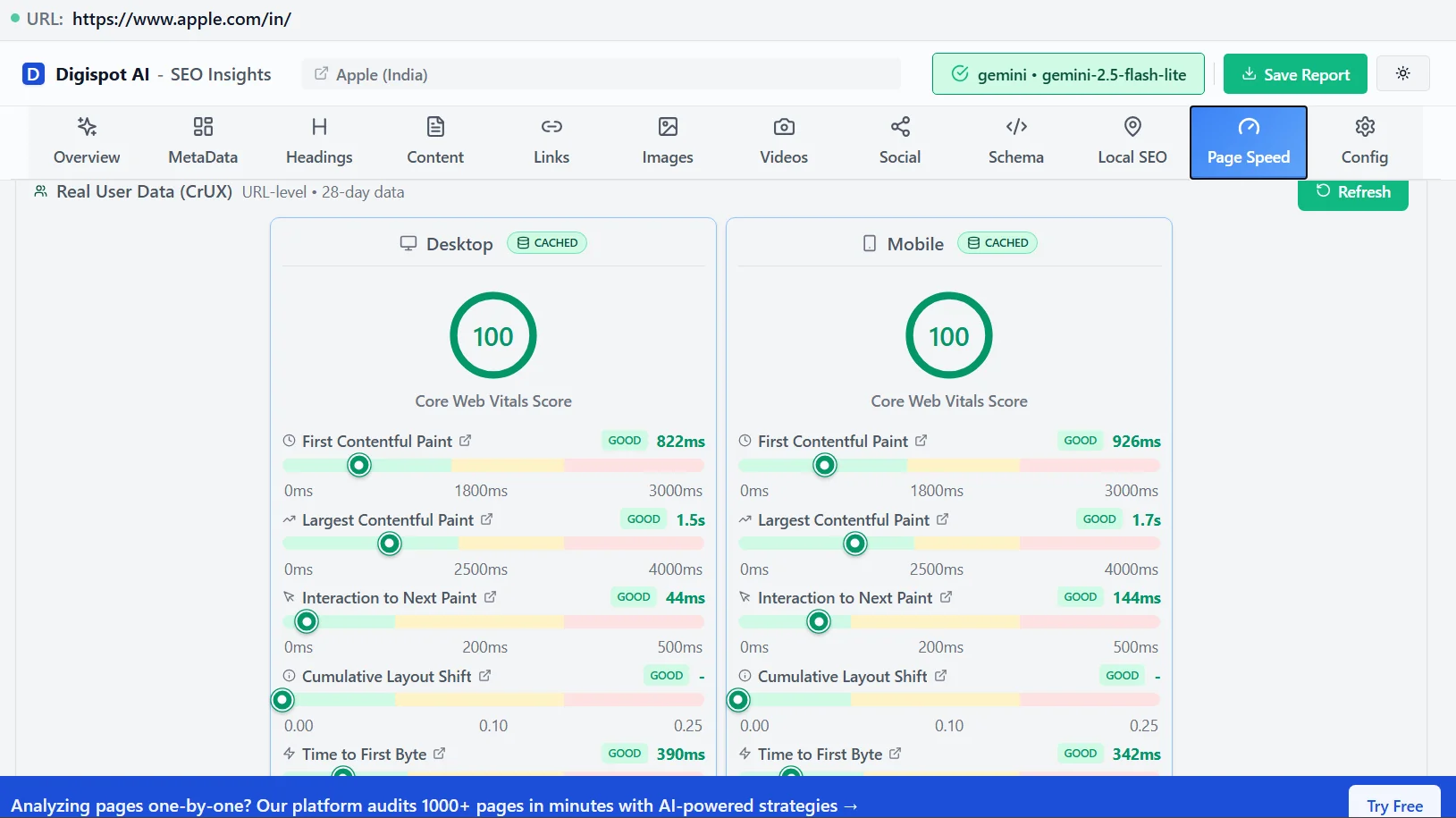
- Core Web Vitals: Google uses page experience as a ranking signal. During high-traffic events, server response times (TTFB) often lag. Ensure your hosting can scale. Verify your LCP (Largest Contentful Paint) scores are green. Review our Core Web Vitals guide to prepare your site for traffic surges.
- Mobile Responsiveness: Holiday shopping is mobile-first. Test your seasonal landing pages on actual devices, not just resized browser windows. Buttons must be tappable, and forms easy to fill.
- Internal Linking Structure: Don't bury your seasonal pages.
- Add a temporary "Seasonal" category to your main navigation.
- Add sitewide banner links.
- Update older, high-authority blog posts to link to your new seasonal guide. Read more about strategic internal linking to funnel authority effectively.
- Schema Markup: This is critical for standing out.
- Product Schema: Ensure
price,availability, andpriceValidUntilare accurate. - Event Schema: For pop-up shops or webinars.
- SaleEvent Schema: Specifically for announcing sales events.
- Product Schema: Ensure
Use the free Schema Markup Generator to create valid structured data in minutes. This ensures search engines clearly understand your discounts and dates.
5. Leveraging Local SEO for Seasonal Events
For brick-and-mortar businesses, seasonality is intensely local. Users search for "Christmas tree farm near me" or "restaurants open on Thanksgiving."
- Google Business Profile (GBP) Updates:
- Special Hours: Explicitly set hours for holidays, even if you are closed. It prevents negative reviews from customers who drove to a closed store.
- Google Posts: specific seasonal offers. These appear directly in the Knowledge Panel and Maps results.
- Q&A Seeding: Post and answer common seasonal questions on your profile (e.g., "Do you offer gift wrapping?" "Yes, we do!").
- Local Landing Pages: If you serve multiple cities, create locally optimized pages for seasonal services (e.g., "Snow Removal Services in Minneapolis").
- Reputation Management: Encourage reviews regarding your seasonal items. Keywords in reviews (e.g., "Best Valentine's dinner I've ever had") can trigger "Local Justifications" in search results.
6. Tracking, Analyzing, and Adapting Performance
You cannot improve what you do not measure. Set up specific tracking before the season starts.
- Rank Tracking: Tag your seasonal keywords in your tracking tool (e.g., Digispot AI) to view them as a distinct segment.
- Monitor Indexing: Use GSC to ensure your new pages are indexed immediately. If they aren't, use the "Request Indexing" tool or check for technical blockers like accidental
noindextags. Refer to our SEO audit checklist to catch these errors early. - Behavior Flow: In Analytics, watch where users drop off. If they land on your "Summer Sale" page and leave immediately, the offer or the UX might be the issue.
- Post-Mortem Analysis: After the season, document everything. Which keywords converted? Which pages failed? This data is the foundation for next year's strategy.
Subtle Digispot AI Integration Example: The Digispot AI platform offers real-time rank tracking and competitor intelligence. You can see exactly when competitors launch their seasonal pages and how their rankings fluctuate, giving you the intel to counter-strategize instantly.
Seasonal SEO Calendar Examples: A Quick Glance
Different industries face different peaks. Use this table to spark ideas for your niche:
| Season/Event | Industry Examples | Key SEO Actions |
|---|---|---|
| Winter (Dec-Feb) | E-commerce, Travel, Home Goods, Fashion | Keywords: "Christmas gifts," "New Year's resolutions," "winter travel deals," "cold weather clothing," "Valentine's Day ideas." Content: Gift guides, holiday recipes, New Year fitness plans, winter fashion trends, travel blogs for warm destinations. Technical: Ensure fast loading of sale pages, schema for product offers and events. |
| Spring (Mar-May) | Gardening, Home Improvement, Fashion, Auto, Events | Keywords: "Spring cleaning," "Easter brunch," "gardening supplies," "Mother's Day gifts," "tax preparation," "summer tire change." Content: Spring home decor, Mother's Day gift guides, gardening tips, car maintenance checklists, event listings. Technical: Update local listings for seasonal hours, ensure event schema is correct. |
| Summer (Jun-Aug) | Travel, Outdoor Gear, Education, Fashion, Local Tourism | Keywords: "Summer vacation," "beach essentials," "back-to-school supplies," "outdoor activities," "local events." Content: Travel guides, camping checklists, back-to-school shopping lists, summer fashion lookbooks, local festival information. Technical: Mobile optimization for on-the-go browsing, fast loading for image-heavy travel content. |
| Autumn (Sep-Nov) | Home Decor, Fashion, Events, E-commerce, Food | Keywords: "Fall fashion," "Halloween costumes," "Thanksgiving recipes," "Black Friday deals," "holiday planning." Content: Fall decor ideas, Halloween party guides, Thanksgiving meal planners, early holiday gift guides, Black Friday preview pages. Technical: Prepare for high traffic on sales pages, ensure product schema is ready for holiday sales. |
| Special Events | Any Industry | Keywords: Event-specific terms, date-specific phrases (e.g., "Olympics merchandise," "World Cup viewing parties"). Content: Event schedules, related product collections, historical context, fan guides. Technical: Event schema, highly optimized landing pages for short-term campaigns. |
Digispot AI: Your Strategic Partner in Seasonal SEO
Executing a seasonal strategy manually is complex. You need to juggle keyword research, technical audits, content creation, and real-time tracking. Digispot AI simplifies this by acting as your all-in-one command center.
Our platform helps businesses rank better by analyzing websites against over 200 ranking factors, including specific AEO signals that matter for modern search engines. With our privacy-first approach, your data is processed locally, ensuring your strategic plans remain confidential.
Key Features for Seasonal Wins:
- Opportunity Finder: Automatically detects rising trends and keyword gaps your competitors are missing.
- Multi-LLM Analysis: We utilize GPT-4, Claude, and Gemini to analyze your content's relevance, predicting how different AI search engines will interpret your seasonal pages.
- Automated Audits: Quickly identify broken links or schema errors on your landing pages before you launch your campaign.
- Content Studio: Generate optimized drafts for seasonal blogs and product descriptions in minutes, not days.
Get instant SEO insights on any page with our free Chrome extension.
Common Mistakes to Avoid in Seasonal SEO
Even experienced marketers stumble. Avoid these specific pitfalls to ensure your campaigns deliver ROI.
- Starting Too Late: If you publish Christmas content in December, you have already lost. Search engines need lead time. Start 2-3 months early.
- URL Churn: Creating new URLs every year (e.g.,
/sale-2024) resets your authority to zero. Use evergreen URLs (e.g.,/annual-sale) and update the content. This preserves backlinks and page age authority. - Neglecting Mobile Experience: Users browsing holiday deals are often on phones. If your pop-ups cover the "Buy" button or images fail to load, they will bounce to a competitor. See our common SEO mistakes guide for more UX pitfalls.
- Keyword Stuffing: Overloading text with "Christmas gift Christmas gift" triggers spam filters. Write naturally for the user.
- Ignoring 404s: When a seasonal product goes out of stock, do not just delete the page. Redirect it to a similar category or the parent seasonal page to retain the traffic.
- Forgetting E-E-A-T: Google demands Experience, Expertise, Authority, and Trustworthiness. Ensure your seasonal advice is backed by experts (e.g., a "Tax Tips" post should be reviewed by an accountant). Learn more in our E-E-A-T SEO guide.
- Lack of Tracking: Without setting up specific segments in analytics, you won't know if your "Valentine's" traffic converted or just bounced.
Start Improving Your Seasonal Strategy Today
Seasonal SEO is not a "nice-to-have"; it is a critical revenue driver. By anticipating market shifts and preparing your digital storefront with technical precision and compelling content, you can capture the massive waves of traffic that your competitors miss.
Don't let another peak season pass you by. Start planning your calendar, optimizing your technical foundation, and creating content that answers your customers' most urgent questions.
Ready to improve your search visibility? Try Digispot AI for comprehensive website audits and actionable recommendations that get your site ready for any season.
Related deep-dives
Continue with these closely related guides:
- saas seo- blueprint — SaaS SEO-A Blueprint for Sustainable Growth
References
- Understand Google Search Console - Search Console Help
- About Analytics - Analytics Help
- Overview of structured data - Search Central | Google Developers
- Core Web Vitals - Search Central | Google Developers
- Test your site's mobile-friendliness - Search Central | Google Developers
- Google Trends
- Google Business Profile Help
- Digispot AI Platform
- Digispot AI - FREE Chrome Extension for SEO Insights
Audit any page in seconds
300+ SEO checks including Core Web Vitals, schema markup, meta tags, and AI readiness — trusted by 1000+ SEO experts and marketers.
Frequently Asked Questions
Here are some of our most commonly asked questions. If you need more help, feel free to reach out to us.
Written by
Maya Krishnan
Digital growth expert
Maya is a seasoned expert in web development, SEO, and digital strategy, dedicated to helping businesses achieve sustainable growth online. With a blend of technical expertise and strategic insight, she specializes in creating optimized web solutions, enhancing user experiences, and driving data-driven results. A trusted voice in the industry, Maya simplifies complex digital concepts through her writing, empowering readers with actionable strategies to thrive in the ever-evolving digital landscape.