Find Trending Keywords: Capture Rising Search Demand
Discover trending keywords before competitors do. Use Google Trends, social listening, and SEO tools to identify rising search demand and create timely content.
 Maya Krishnan
Popularity on the internet moves at breakneck speed. What dominates the conversation today might be completely forgotten by next week. For businesses and content creators, this velocity presents a stark reality: speed matters. To stay visible, you cannot rely solely on static keyword lists created months ago. You need to tap directly into the collective pulse of the internet using trending keywords—a fast-moving complement to the evergreen terms you uncover in foundational keyword research.
These emerging search terms represent the questions and topics your audience is flocking to right now. If you can provide the answers while interest is peaking, you unlock a massive surge of visibility, traffic, and potential leads. But finding these opportunities before the competition requires more than luck. It requires a systematic approach to detecting search intent shifts as they happen.
This guide moves beyond basic definitions. We will explore exactly where to look, which tools provide the most reliable data, and how to execute a strategy that turns short-term spikes into long-term brand authority. From leveraging Google's own data to utilizing advanced AI platforms, here is your roadmap to capturing rising search demand.
Key Takeaways
- Move on momentum, not just volume. Trending keywords win on speed—watch for "Breakout" terms in Google Trends and publish while interest is still climbing, not after it peaks.
- Catch the signal early. Social platforms like X, Reddit, and TikTok surface topics days before they spike in Google Search, so treat them as an early-warning system.
- Mine your own data first. Search Console striking-distance queries (positions 8–20) are the fastest trends to convert into traffic because you already have partial rankings.
- Match format to trend lifespan. Use short newsjacking posts and live blogs for fast-moving stories; reserve long guides for topics with staying power.
- Ship technically clean, schema-ready pages. Add
NewsArticleorBlogPostingschema and front-load the keyword so timely content qualifies for freshness-driven placements before competitors react.
What Exactly Are Trending Keywords?
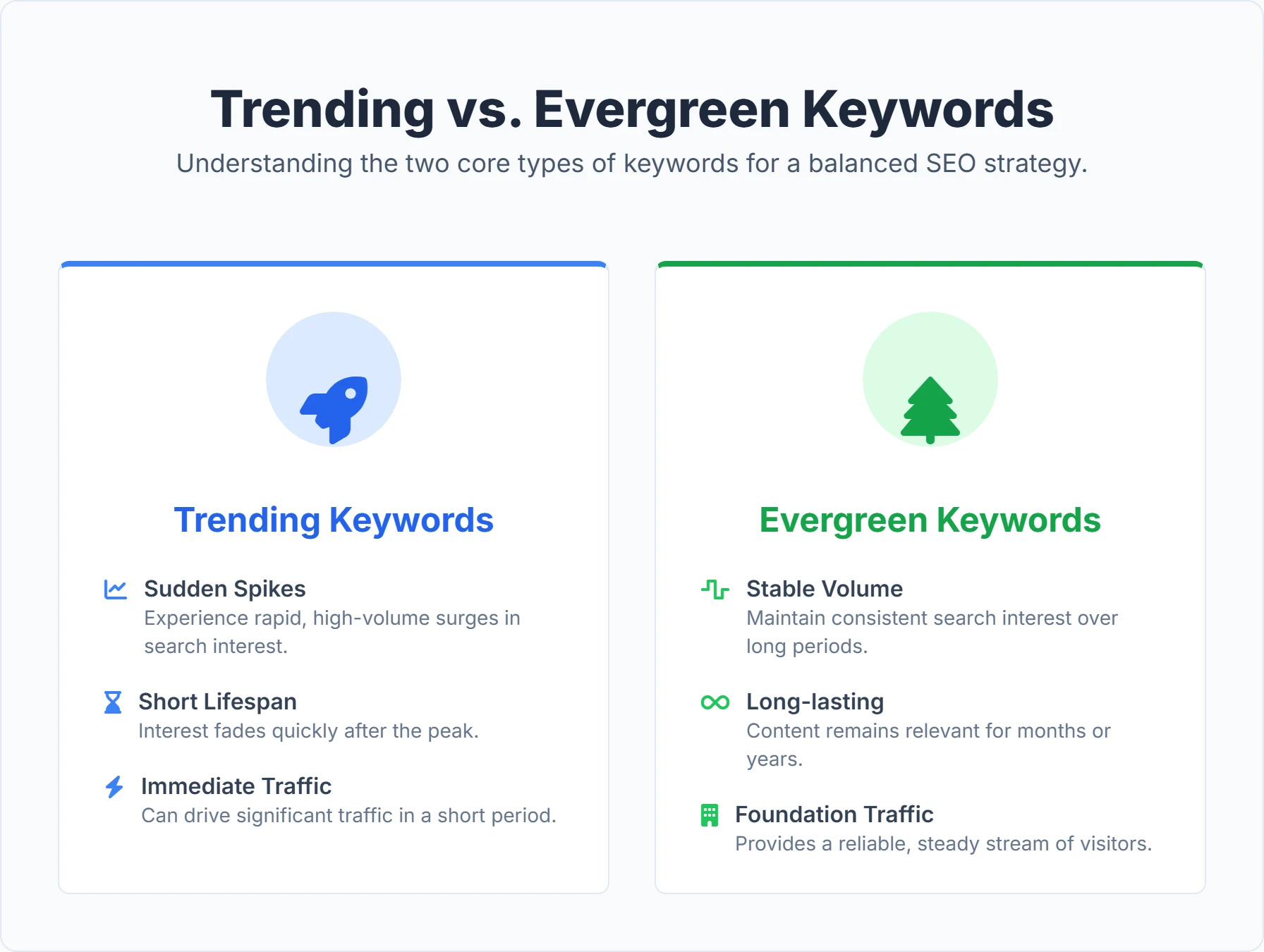
Trending keywords are search terms that experience a sudden, often exponential, increase in search volume over a short timeframe. Unlike standard high-volume keywords, which accumulate searches steadily over years, trending keywords are reactive. They are driven by external triggers: breaking news, product launches, viral social media phenomena, or seasonal shifts.
From a technical SEO perspective, these keywords often trigger Google’s "Query Deserves Freshness" (QDF) algorithm. When Google detects a surge in searches for a specific topic, it alters its ranking criteria to prioritize newer, timely content over older, authoritative pages. This is a critical distinction because it allows smaller or newer sites to outrank established giants if they move quickly.
Understanding the difference between trending and evergreen content is vital for a balanced strategy. Evergreen content answers persistent questions (e.g., what is search engine optimization), while trending content addresses immediate needs. A third category sits in between—recurring, predictable demand—which is best handled with a dedicated seasonal SEO strategy rather than reactive newsjacking.
Here is a breakdown of how these keyword types function differently in your strategy:
| Feature | Trending Keywords | Evergreen Keywords |
|---|---|---|
| Search Volume Pattern | Sharp, sudden spikes followed by potential decline. | Stable consistency with minor fluctuations. |
| Ranking Difficulty | Variable; often lower initially (low competition) but rises quickly. | Generally high; requires significant authority and backlinks. |
| Content Lifespan | Short; relevance may fade in days or weeks. | Long; remains relevant for years with minor updates. |
| Primary Trigger | News, viral events, seasonality, technology updates. | Fundamental problems, educational needs, core definitions. |
| Strategic Value | Rapid traffic bursts, brand awareness, "first-mover" authority. | Compound traffic growth, sustainable lead generation. |
The Magic of "Why": The Business Benefits of Chasing Trends
Why should you disrupt your editorial calendar to chase a new keyword? It is easy to dismiss trends as vanity metrics, but incorporating them into your SEO strategy yields tangible business outcomes.
1. Capture High-Velocity Traffic
The most immediate benefit is volume. By being first to market on a trending topic, you can capture a significant percentage of search traffic before competitors even notice the keyword exists. This influx is not just "eyeballs"; it allows you to populate your remarketing lists and funnel new users toward your core evergreen content.
2. Accelerate Indexing and Authority
When you publish frequent, timely content on trending topics, you signal to search engines that your site is active and relevant. This often leads to faster crawl rates. Furthermore, if you are the first to break down a complex new trend, other sites (news outlets, industry blogs) are likely to cite you as the source. Gaining these natural backlinks improves your overall domain authority, boosting the ranking potential of your other pages.
3. Align with User Intent
Monitoring trends provides a window into the evolving psychology of your audience. If you notice a trend towards "AI privacy concerns" in your niche, it tells you that your audience is becoming more security-conscious. You can then adjust your product messaging to match this shift. Understanding these nuances is key to mastering search intent optimization and ensuring your content resonates.
4. Gain a Competitive First-Mover Advantage
Your competitors are likely obsessed with high-volume, high-difficulty "money keywords." By pivoting to emerging trends, you engage in "Blue Ocean" SEO—competing in a space where there is high demand but zero supply. By the time big competitors mobilize their content teams, you have already established the ranking position and captured the traffic share.
How to Find Trending Keywords: A Practical, Step-by-Step Guide
Identifying these keywords requires a mix of manual monitoring and automated intelligence. Here is a proven methodology to spot trends early.
Method 1: Harness the Power of Google's Free Tools
Google offers the most direct insight into global search behavior. Since they process the searches, their data is the source of truth.
A. Google Trends: The Gold Standard Google Trends visualizes the relative popularity of queries. It doesn't just show volume; it shows momentum.
- Filter for "Breakout" Terms: When analyzing a broad topic, look at the "Related Queries" box. You will often see terms marked "Breakout" instead of a percentage. This means the search volume has grown by over 5000% recently. These are your priority targets.
- Use Category Filtering: If you search for a generic term like "AI," the data might be skewed by general curiosity. Filter by category (e.g., "Computers & Electronics") to see trends specifically relevant to your industry buyers.
- Compare for Context: Is a keyword truly trending, or is it just a seasonal blip? Use the "Compare" feature to benchmark a potential trend against a known stable keyword. If the new term's graph line is crossing the stable one, you have a verified trend.
B. Google Search Features & Autocomplete The search results page (SERP) itself changes dynamically based on user behavior.
- Autocomplete Predictions: Open an incognito window and start typing your main topic. The predictions Google suggests are based on high-velocity recent searches. If you see a new, specific long-tail variation appearing at the top, it is gaining traction.
- "People Also Ask" (PAA): This section is algorithmic gold. It shows you the exact questions users are asking next. For a trending topic, these questions often reveal gaps in current content. Answering these specific questions can help you rank for zero-click searches and featured snippets.
- Google News Tab: Don't just look at the "All" tab. Switch to "News" to see how publishers are framing the topic. This helps you identify the "angle" that is currently working.
Your own Search Console data is one of the richest sources of rising demand—queries where you already appear on page 2 are often the fastest to convert into traffic when a topic starts trending. Digispot AI's Spider surfaces these automatically:
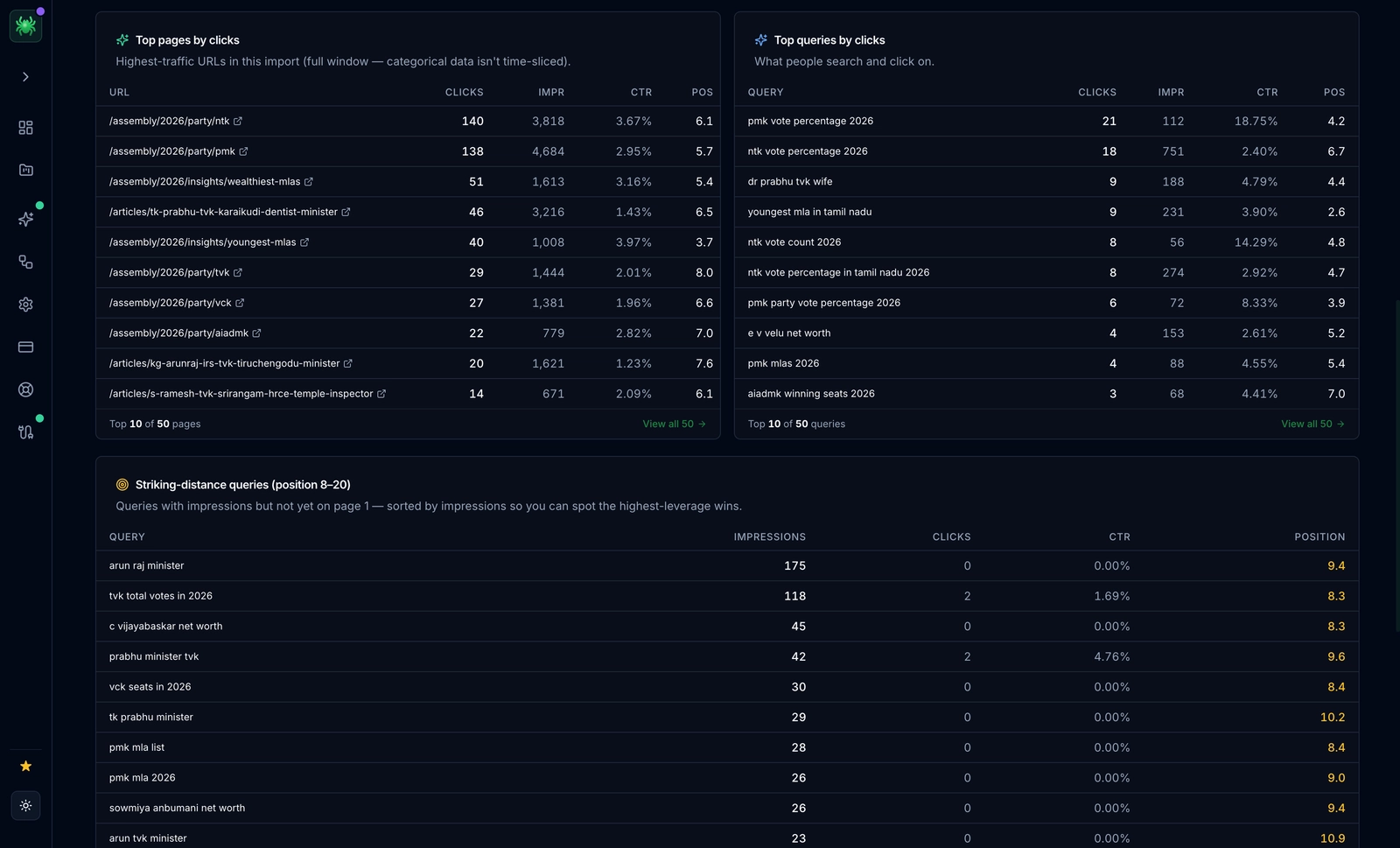
The Spider pulls your top queries by clicks and flags striking-distance terms (positions 8–20) straight from your Search Console data—so you can spot near-page-1 queries gaining momentum before you ever open Google Trends.
Method 2: Tune Into the Social Media Buzz
Social media is the incubator for search trends. A conversation often starts on X (Twitter) or Reddit 2-3 days before it becomes a massive search volume spike on Google.
- Reddit & Niche Communities: Use tools like GummySearch or simply browse industry-specific subreddits. Look for threads with a high comment-to-upvote ratio. A heated debate often signifies a topic where people are confused or passionate—perfect for an explanatory blog post.
- TikTok Search: TikTok is increasingly being used as a search engine by Gen Z. Type in your niche keywords and filter for videos posted "This Week." If you see multiple creators covering a specific hack or news item, it is about to spill over into Google Search.
- X (Twitter) Advanced Search: You don't need to rely on the generic "Trending" sidebar. Use Advanced Search to find high-engagement tweets within your industry from the last 24 hours. This filters out the noise of pop culture trends.
Method 3: Go Deeper with an Integrated SEO Platform
Manual searching is effective but time-consuming. By the time you manually validate a trend across three different tools, the peak opportunity might have passed. Integrated platforms automate this correlation.
Digispot AI streamlines this by analyzing over 200 ranking factors and real-time search signals. The Opportunity Finder doesn't just show you what is popular; it analyzes difficulty in real-time. It can identify "gap" keywords—terms that are trending but have very few high-quality search results.
Furthermore, with the rise of Answer Engine Optimization (AEO), you need to know if AI platforms like ChatGPT or Perplexity are aware of the trend. Digispot AI’s multi-LLM engine analysis helps you understand how these AI models are interpreting the new topic, giving you a chance to optimize for AI visibility alongside traditional search.
Digispot AI can help you identify and fix these optimization gaps automatically with AI-powered audits, ensuring your trending content is technically perfect the moment it goes live.
How to Weave Trending Keywords into Your Content Strategy
Finding the keyword is only the starting line. Execution is where you win. You need a workflow that prioritizes speed without sacrificing quality.
1. Select the Agile Format
Not every trend requires a 3,000-word "Ultimate Guide." In fact, long production cycles are the enemy of trending SEO.
- Newsjacking Posts: Short, punchy articles (600-1000 words) that report the news and offer your brand's unique take. If timely coverage is a regular part of your strategy, the tactics in this guide for news and media sites cover structure and speed in more depth.
- Reaction Videos: A quick YouTube or Loom video embedded in a blog post can get you indexed for video search results, which often appear at the top of Google for trending topics.
- Live Blogs: For ongoing events (like a conference or a prolonged product launch), use a "Live Update" page structure. Google loves these for breaking news.
2. Master On-Page Optimization for Trends
Since you might not have backlinks yet, your on-page SEO must be flawless.
- Front-Load the Keyword: Ensure the trending phrase appears in the first 100 words and the H1 tag.
- Optimize the URL: Keep the slug short but inclusive of the main trend (e.g.,
/blog/chatgpt-4-release-featuresrather than/blog/news-update-march-15). - Internal Linking: Immediately link to your new post from your high-authority homepage or popular related articles. This passes "link juice" instantly and helps Google crawlers find the new page. Learn more about on-page seo best practices to maximize your content's potential.
3. Prevent "Trend Fatigue"
A common mistake is going all-in on a trend that doesn't align with your brand. This confuses your audience. Always ask: "Does this trend impact my customers?" If the answer is no, skip it. Relevance is a key component of E-E-A-T (Experience, Expertise, Authoritativeness, and Trust). Publishing irrelevant content dilutes your topical authority.
Before you commit resources, run each trend through a quick three-question filter:
- Relevance: Does the topic connect to a product, service, or problem your audience already cares about? A B2B accounting tool chasing a celebrity meme fails here.
- Angle: Can you add expertise that generic news coverage cannot—data, a customer example, or a contrarian take? If you can only repeat what everyone else is saying, skip it.
- Bridge: Can the post link naturally back to your evergreen assets and topic clusters? Trends that dead-end are wasted effort. Grouping related coverage with a keyword clustering approach keeps each timely post reinforcing your core topics instead of scattering authority.
If a trend clears all three, it is worth the disruption. If it fails even one, file it away and stay focused on demand that compounds.
The Rise of AI in Keyword Research and Content Creation
Artificial intelligence has fundamentally changed how we approach trends. In the past, we looked at historical data. Now, AI allows for predictive analysis.
AI-powered tools can analyze massive datasets to identify patterns that precede a trend. For example, a sudden spike in technical forum discussions about a specific software bug often precedes a massive wave of Google searches for "how to fix [bug name]."
Once identified, speed of execution is paramount. This is where Digispot AI's Content Studio shines. Instead of starting from a blank page, you can use AI agents to generate outlines based on the top-ranking results for the trending term. This isn't about letting AI write everything for you; it's about using AI to assemble the research and structure instantly, so you can focus on adding your expert insights.
Ready to improve your search visibility? Try Digispot AI for comprehensive website audits and actionable recommendations that keep you ahead of the curve.
Your Secret Weapon: On-the-Fly Audits with a Chrome Extension
Speed is critical, but technical accuracy is non-negotiable. If you rush a trending article but forget the meta description or mess up the canonical tag, you won't rank.
The Digispot AI Chrome Extension allows you to audit your page—and your competitors' pages—in seconds. Its Keyword Focus tab is especially handy for trending content: set your target term and instantly see how well the page covers it before you publish.
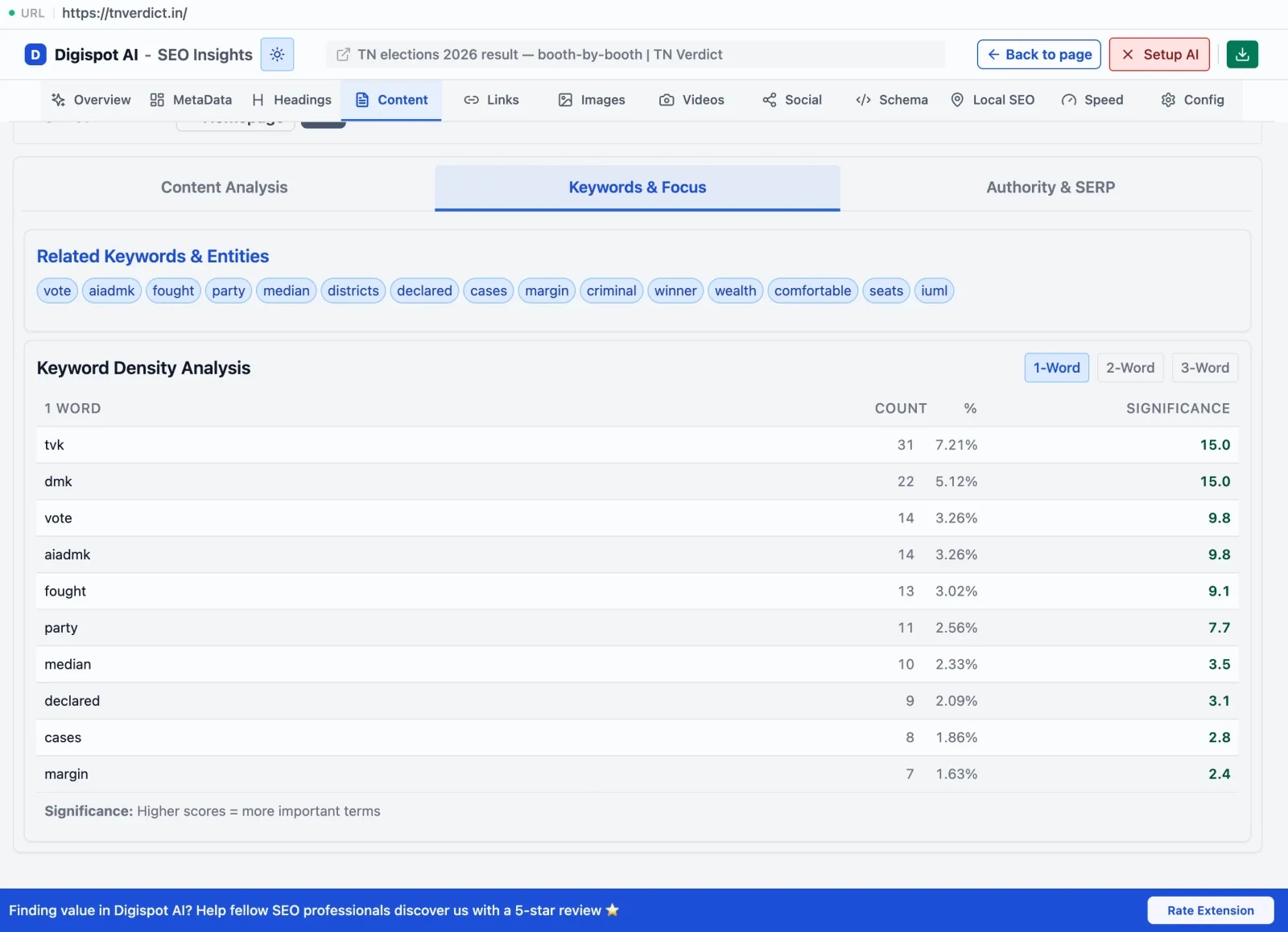
Why Schema Matters for Trends:
For news and trending topics, Schema Markup is your best friend. Implementing NewsArticle or BlogPosting schema helps Google understand that your content is timely journalism or a blog update, potentially qualifying you for "Top Stories" carousels.
With the extension, you can:
- Spy on Competitors: Open a high-ranking competitor's page on the trending topic.
- Check Their Schema: See exactly what structured data they are using.
- Audit Your Page: Ensure your schema is valid before you hit publish.
Get instant SEO insights on any page with our free Chrome extension. Additionally, if you need to build schema quickly, use the free Schema Markup Generator to create valid code in minutes.
Your Quick-Start Checklist for Finding Trending Keywords
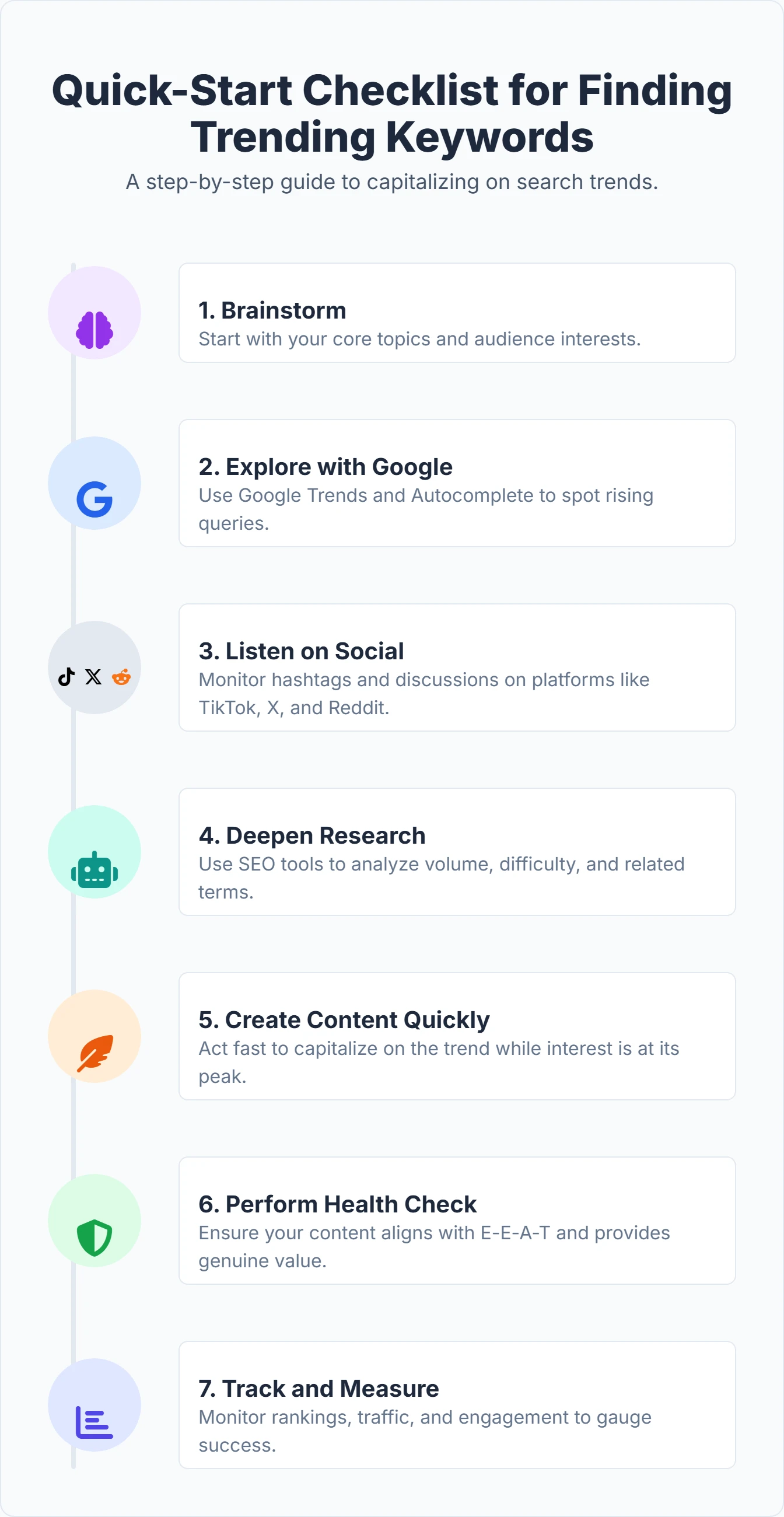
Feeling overwhelmed? Don't be. Here’s a simple checklist to get you started on your journey to finding and leveraging trending keywords.
| Step | Action | Key Tools / "Magic Keywords" |
|---|---|---|
| 1. Brainstorm | What are the core topics your business is about? Start with a broad list. | Your industry knowledge. |
| 2. Explore with Google | How are people searching for these topics? Use Google Trends to see what's growing. | Google Trends, Google Search (Autocomplete, PAA). |
| 3. Listen on Social | What are people talking about right now? Monitor relevant hashtags and communities. | X (Twitter), TikTok, Reddit. |
| 4. Deepen Your Research | How can you find less obvious opportunities? Use an SEO platform to uncover emerging trends. | Digispot AI's Opportunity Finder. |
| 5. Create Content Quickly | How can you capitalize on the trend before it fades? Use AI to help you draft optimized content. | Digispot AI's Content Studio. |
| 6. Perform a Health Check | Is your new content technically sound? Use a browser extension for a quick audit and schema check. | Digispot AI Chrome Extension. |
| 7. Track and Measure | How is your content performing? Monitor traffic and rankings. | Google Analytics, Google Search Console. |
What If You Miss the Trend?
Sometimes, you will be late. That is okay. If a trend has solidified into a standard topic, you can still compete by creating a "Recap" or "Analysis" post. Instead of breaking the news, explain what it means for the future. This pivots the keyword intent from "News" to "Informational," allowing you to capture the long-tail traffic that follows the initial spike.
For example, if you missed the initial spike on a new AI model launch, don't publish another "X was just released" post—that ship has sailed. Instead, target the follow-on questions that keep getting searched for weeks: "is [model] better than [competitor]," "how to use [model] for [specific task]," or "[model] pricing vs alternatives." These derivative queries have lower competition, clearer buyer intent, and a longer shelf life than the original breaking-news term. In many cases the recap post outperforms the original news post over a full quarter, precisely because it answers the deeper questions readers ask once the hype settles.
Start Capturing Rising Demand Today
Finding and using trending keywords is no longer a tactic reserved for big news outlets. It is a fundamental skill for any business that wants to demonstrate relevance and authority. By understanding what your audience is looking for in the moment, you create content that drives immediate traffic and builds long-term trust.
The key is to build a repeatable process. Regularly use tools like Google Trends, keep a close watch on social discussions, and leverage integrated platforms like Digispot AI to automate the heavy lifting. Don't wait for the perfect moment—start exploring the data today. You might just find your next big traffic driver waiting to be discovered.
Try the free On-Page SEO Analysis tool to audit any URL instantly and ensure your next trending post is ready for prime time.
Related deep-dives
Continue with these closely related guides:
- video seo — Video SEO: The Ultimate YouTube Ranking Guide (2026)
- seo for lifestyle products — SEO Guide for Lifestyle Products & Services
References
- Get started with Google Trends | Google Search Central
- Google Search Console
- Google Analytics
- TikTok Creative Center
- Intro to How Structured Data Markup Works | Google Search Central
- SEO Starter Guide: The Basics | Google Search Central
- Digispot AI - FREE On Page SEO Audit Tool
- Digispot AI - FREE Chrome Extension for SEO Insights
Audit any page in seconds
300+ SEO checks including Core Web Vitals, schema markup, meta tags, and AI readiness — trusted by 1000+ SEO experts and marketers.
Frequently Asked Questions
Here are some of our most commonly asked questions. If you need more help, feel free to reach out to us.
Written by
Maya Krishnan
Digital growth expert
Maya is a seasoned expert in web development, SEO, and digital strategy, dedicated to helping businesses achieve sustainable growth online. With a blend of technical expertise and strategic insight, she specializes in creating optimized web solutions, enhancing user experiences, and driving data-driven results. A trusted voice in the industry, Maya simplifies complex digital concepts through her writing, empowering readers with actionable strategies to thrive in the ever-evolving digital landscape.