FSSAI Licence for Selling Food Online: Guide for Home Food Brands
FSSAI license guide for home food brands selling online: registration vs State vs Central licence under the 2026 thresholds, fees, documents and FoSCoS steps.
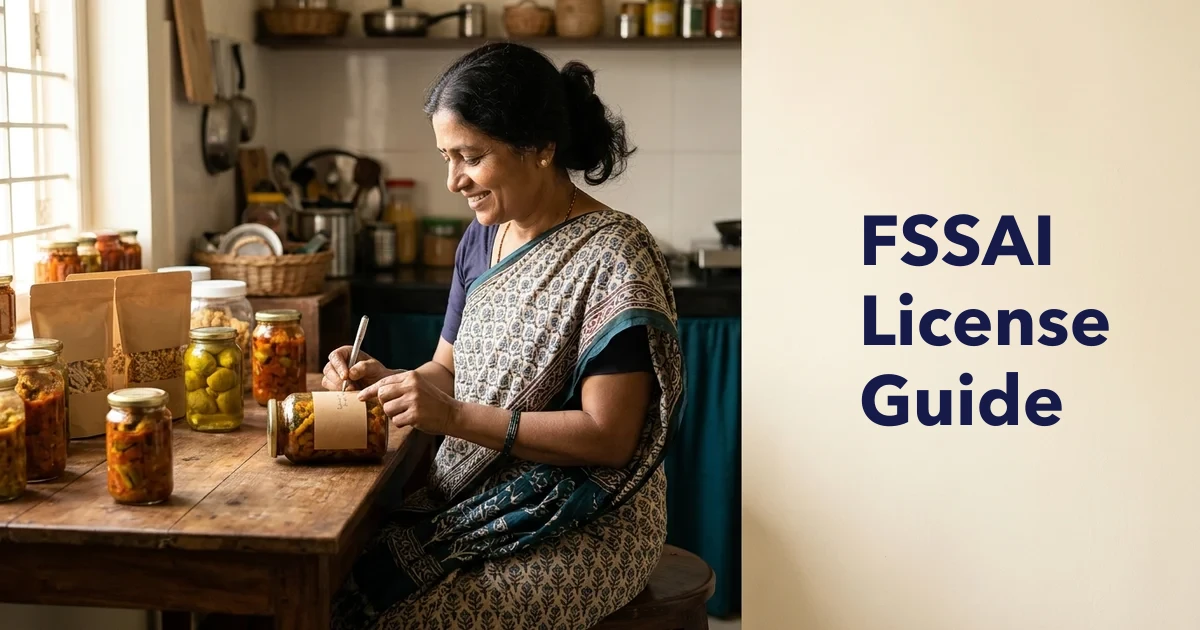
Navigating food safety compliance is a foundational requirement for every direct-to-consumer (D2C) food brand, home kitchen, and online marketplace merchant operating in India. Obtaining a valid FSSAI license ensures that your food processing, packaging, and distribution workflows meet statutory hygiene standards while building immediate trust with consumers.
What is an FSSAI License and Who Needs One?
An FSSAI license is a mandatory legal permit issued by the Food Safety and Standards Authority of India that certifies a commercial food business meets statutory health, hygiene, and safety guidelines established under the Food Safety and Standards Act, 2006.
| Framework Category | Annual Turnover Threshold | Mandatory Identification Outcome |
|---|---|---|
| Basic Registration | Up to Rs 1.5 Crore | 14-Digit Registration Number displayed on packaging and digital PDPs |
| FSSAI Licensing | Exceeding Rs 1.5 Crore | 14-Digit License Number displayed on packaging and digital PDPs |
Defining Food Business Operators (FBOs)
Every commercial enterprise handling food products at any point from production to customer consumption is classified as a Food Business Operator (FBO). This mandate applies across all operational scales and distribution channels.
- Home entrepreneurs producing artisanal jams, pickles, chocolates, or baked goods for online orders.
- Direct-to-Consumer (D2C) brands manufacturing packaged millets, cold-pressed oils, nutraceuticals, or specialty snacks.
- Cloud kitchens, dark stores, and traditional restaurant establishments preparing ready-to-eat meals.
- E-commerce platforms, third-party logistics (3PL) providers, and fulfillment centers storing packaged foods.
- Importers, exporters, wholesalers, distributors, and re-packers of agricultural and processed food items.
Legal Framework and Regulatory Authority
The statutory foundation for Indian food safety is governed by the Food Safety and Standards Authority of India, operating under the Ministry of Health and Family Welfare. FSSAI consolidated multiple legacy food laws—such as the Prevention of Food Adulteration Act—into a unified regulatory architecture.
Operating any food-related commercial enterprise without a valid registration or license constitutes a direct breach of Section 31 of the Food Safety and Standards Act.
New 2026 FSSAI Eligibility Criteria and Slabs Explained
This section details the updated financial thresholds and specific business category rules enforced under the revised food compliance framework. Understanding the modified regulatory thresholds enables business owners to apply for the correct authorization tier without incurring unnecessary fees or administrative rejections.
Updated Turnover Thresholds (Effective April 2026)
The Food Safety and Compliance System (FoSCoS) framework updated the annual financial turnover limits governing FBO tier selection.
- Basic Registration Slab: Applies to micro-enterprises with an annual turnover up to Rs 1.5 crore. This updated ceiling allows scaling micro-businesses to operate under a simplified, low-cost registration framework before transitioning to a formal state license.
- State License Slab: Required for small-to-medium food businesses generating annual revenues between Rs 1.5 crore and Rs 50 crore.
- Central License Slab: Mandated for enterprise FBOs with annual turnover exceeding Rs 50 crore. It also covers certain kinds of business whatever the turnover, such as importers; the full list is on FoSCoS.
Special Rules for Grain Milling and E-Commerce Sellers
The 2026 FoSCoS guidelines enforce strict operational overrides regardless of an enterprise's annual gross revenue.
- Grain, Cereal, and Pulse Milling Units: All commercial milling facilities, regardless of turnover volume, are barred from basic registration and must obtain a State License.
- E-Commerce Kind of Business (KOB): The revised FoSCoS list places the E-Commerce KOB under the Central License with no turnover limit. Whether it applies to a brand selling via their own transactional website or marketplaces (such as Amazon, Flipkart, Blinkit, or Zepto) depends on your setup, so confirm your category on FoSCoS before you apply.
FSSAI License Cost and Registration Fee Structure
Budgeting for compliance requires differentiating between statutory government fees and secondary implementation costs.
Official Government Fee Schedule
The government fee structure for food safety authorization depends on the tier applied for through the online portal.
- Basic Registration Fee: Rs 100 per year.
- State License Fee: Rs 5,000 per year.
- Central License Fee: Rs 7,500 per year.
Perpetual License Validity Policy Changes
A significant policy revision effective for licenses issued or amended on or after 1 April 2026 introduces non-expiring perpetual validity for compliant food business operators.
Optional third-party legal or consultancy documentation assistance fees remain separate from official government portal payments.
Step-by-Step Guide: How to Apply for Food License Registration Online
This section guides you through the exact digital application sequence on the central government compliance portal. Obtaining an official digital certificate involves completing an online workflow on the national FoSCoS digital portal.
Navigating the FoSCoS Portal
To initiate a food license registration application, follow these structured steps on the official online system:
- Access the official Food Safety Compliance System portal (foscos.fssai.gov.in) and register an account using a valid business email address and Indian mobile number.
- Log into the dashboard and select the Apply for New License/Registration option.
- Select your operational jurisdiction by choosing the state where your business premises or head office is physically located.
- Select the applicable Kind of Business (KOB) sub-categories. If you sell packaged goods online, select Manufacturing/Processing (or Trade/Retail) and check whether the E-Commerce KOB option also applies to you.
- Select the appropriate turnover slab based on your financial projections and manufacturing volume metrics.
Submitting Form A vs Form B
The application forms differ based on the underlying regulatory tier:
- Form A (Basic Registration): Designed for micro-enterprises. The applicant enters basic owner identification, kitchen or unit geographic coordinates, and selects food product categories from the standard index. Upon submitting Form A and paying the Rs 100 fee, the system generates an Application Reference Number (ARN). Basic Registrations feature instant automated issuance when no physical pre-inspection requirement is flagged by local authorities.
- Form B (State and Central Licensing): Mandatory for medium-to-large FBOs and every kind of business that needs a licence. Form B requires technical disclosures, including installed equipment specifications and complete food category mapping. After uploading required documentation and completing online payment, the file passes to the Designated Officer (DO) for technical verification. If additional clarification is needed, the officer issues a query notification that you answer on the portal.
Documents Required for FSSAI Registration and Licensing
This section itemizes the paperwork needed to complete your application based on business size, processing operational scale, and location type. Preparing complete paperwork before initiating an application prevents application rejections or administrative delays.
Basic Registration Document Checklist
Micro-enterprises applying for basic authorization must upload primary identity and location verification documents:
- Passport-sized photograph of the business applicant or designated managing partner.
- Government-issued photo identification (Aadhaar Card, PAN Card, Voter ID, or Passport).
- Proof of business premises occupancy (Electricity bill, water bill, property tax receipt, or rent agreement).
- Complete listing of specific food categories and product sub-types intended for manufacture, trade, or distribution.
- Signed self-declaration form affirming adherence to general sanitary and hygienic practices.
State & Central License Requirements
Entities applying for State or Central Authorization must submit expanded technical and corporate compliance documentation:
- Layout blueprint of the processing plant detailing dimensioned work areas, equipment placement, and workflow separation.
- Detailed list of installed machinery, operational capacities, and motor horsepower ratings.
- Where water is used in processing, FSSAI may ask for a water test report from a recognised laboratory.
- Official No Objection Certificate (NOC) from local municipal authorities or pollution control boards where required.
- Copy of Partnership Deed, Memorandum of Association (MoA), or Articles of Association (AoA) along with a Board Resolution nominating the person responsible for food safety.
Guidelines for Home Food Brands
Home-based food businesses operating out of residential units must provide clear premises proof. If the property is self-owned, utility bills in the founder's name serve as proof. For rented residential properties, applicants submit the rental agreement, and the authority may also ask for a No Objection Certificate (NOC) from the landlord granting permission to operate a home kitchen on the premises.
FSSAI Certificate Compliance for D2C and E-Commerce Food Brands
Acquiring a registration certificate is the first step; maintaining visible consumer compliance across product packaging and digital channels is a continuous regulatory requirement.
Packaging Labeling Mandates
Every packaged food item produced or distributed in India must prominently display the official 14-digit registration or license number alongside the recognized logo.
| Packaging Requirement Area | Mandated Label Information |
|---|---|
| Primary Logo Display | FSSAI Logo alongside 14-digit License/Registration Number |
| Product Specifications | Ingredients List, Net Content & Weight, Nutritional Facts |
| Manufacturing Tracking | Batch / Lot Number, Date of Manufacture, Best Before / Expiry Date |
| FBO Information | Name & Business Address of FBO, Customer Care Contact Information |
- The logo and 14-digit number must be displayed in a contrasting color scheme against the background matrix to ensure clear readability.
- The font size of the license number must comply with standard label dimension rules, scaling upward relative to the surface area of the package.
- Imported food items must have an overwrapped sticker bearing the importer’s license number and address before clearing custom control points.
Displaying Compliance on Website PDPs and Footers
Digital marketplaces and D2C storefronts must ensure statutory transparency across online shopping environments.
- Product Detail Pages (PDPs): Marketplaces and your own store should show the brand's license number on product pages, as plain visible text, so customers can verify food credentials before they pay.
- Trust Footers and About Pages: Brand websites should place the license number within the sitewide website footer and dedicated trust pages. This placement validates legal compliance for site visitors and search engines.
- Visual Search Optimization: Displaying high-resolution images of your certified packaging helps shoppers read the label. See also selling millet products online, selling sweets online and cold-pressed oil brands.
Marketplace Onboarding Rules
Selling home-made preserves, cold-pressed oils, or specialized snacks on platforms like Amazon, Swiggy Instamart, or Zomato requires submitting an active license certificate during vendor onboarding. Any mismatch between the seller entity name, address, or product scope on the certificate and on your seller account can delay seller account activation.
Basic Registration vs State License vs Central License: Key Differences
Selecting the correct authorization tier prevents application rejection, unnecessary expenditure, or regulatory non-compliance.
Handling Multi-State and Online Operations
When a D2C food enterprise scales beyond its home state, its regulatory structure expands:
- A Central License must be secured for the primary corporate head office or main operations base.
- Each regional warehouse, fulfillment center, or dark store located in secondary states must hold an individual State License corresponding to that physical facility's address.
Penalties for Operating Without a Food License
This section outlines the financial, legal, and operational consequences of failing to secure proper food safety authorization. Operating an unregistered food enterprise carries legal liabilities that can jeopardize brand equity and business continuity.
Statutory Fines and Imprisonment Terms
The Food Safety and Standards Act penalizes non-compliant commercial operations:
- Unregistered Operation (Section 63): Operating a food business without securing required registration or licensing carries monetary fines up to Rs 5 lakh alongside imprisonment terms up to six months.
- Selling Sub-Standard or Misbranded Food: Products that do not match their label or lack proper label disclosures attract separate penalties under the Act.
- Failure to Comply with Officer Directions: Ignoring an improvement notice issued by the Designated Officer can lead to license suspension or cancellation.
Impact on Merchant Accounts and Brand Credibility
Regulatory enforcement extends beyond government fines into online commercial operations. Payment gateways can ask food sellers for a valid license during merchant onboarding, and a license that does not match your registered entity can hold up activation.
Financial damage also extends to customer acquisition channels. Negative public enforcement actions damage merchant credibility.
Building E-E-A-T and Digital Trust for Your Food Brand Online
This section explains how to turn regulatory documentation into search engine trust signals and structured entity data. Search engines prioritize merchant websites that demonstrate Experience, Expertise, Authoritativeness, and Trustworthiness (E-E-A-T). For food brands, verified legal compliance forms a key pillar of this trust profile.
- License & Certificate Verification: Maintain active registration numbers and verification documents for business operations.
- Website Integration: Display badges across the site footer and dedicated About pages to establish human user trust.
- Structured Data Implementation: Add accurate Product and Organization schema so search engines read your products and business correctly.
- Consistent Entity Details: Use the same business name and address on your site, labels and listings.
Using Regulatory Badges for Conversion Optimization
Displaying regulatory badges on high-intent conversion pages directly influences shopper purchasing decisions:
- Add your verification badge alongside secured payment badges near the Add to Cart and Checkout buttons to lower customer acquisition friction.
- Build a dedicated Quality & Safety Standards landing page that publishes third-party laboratory analysis reports, organic sourcing certifications, and your active license documentation.
Schema and E-E-A-T Signal Implementation
Show the 14-digit number in visible page text on product pages and in the footer, identical to your labels, and use Product schema for products.
To check one page's meta tags and schema, use the free Chrome extension. To audit the whole store for missing Product schema and duplicate variant URLs, use the Desktop SEO Spider, which runs on Mac and Windows.
Structuring compliance data consistently reinforces your brand entity across traditional search platforms and modern AI answer engines. To master how search algorithms map business profiles, read our guide on Entity SEO: How to Make Google and AI Understand Your Brand.
Streamline Your Food Brand's Digital Compliance and Online Growth
This section highlights how joining regulatory compliance with search optimization builds market authority. Securing the proper authorization tier validates your operational integrity, protects your business against regulatory penalties, and lays the groundwork for digital growth. By displaying verified compliance details across product packaging, digital storefronts, and structured metadata, food brand founders transform legal compliance into a conversion asset.
Selling health foods online? Digispot builds online stores for health food brands on your own domain, with Razorpay on your own account.
More in the Selling Online in India guide
Start with the How to Start an Online Store in India: A Two-Day Launch Plan.
Audit any page in seconds
200+ SEO checks including Core Web Vitals, schema markup, meta tags, and AI readiness — trusted by 1,250+ SEO experts and marketers.
Frequently Asked Questions
Here are some of our most commonly asked questions. If you need more help, feel free to reach out to us.

Maya Krishnan is an SEO and AEO specialist at Digispot AI. She helps agencies and businesses across industries and countries grow organic traffic from Google and AI search, and knows the major SEO platforms well, from desktop crawlers to all-in-one suites. She checks and approves every article published under her name.
More from Maya Krishnan