How Cold-Pressed Oil Brands Get Found: Cooking and Hair Searches
How a cold pressed oil brand in India gets found online: product pages for cooking and hair care searches, schema, store setup and Razorpay checkout.
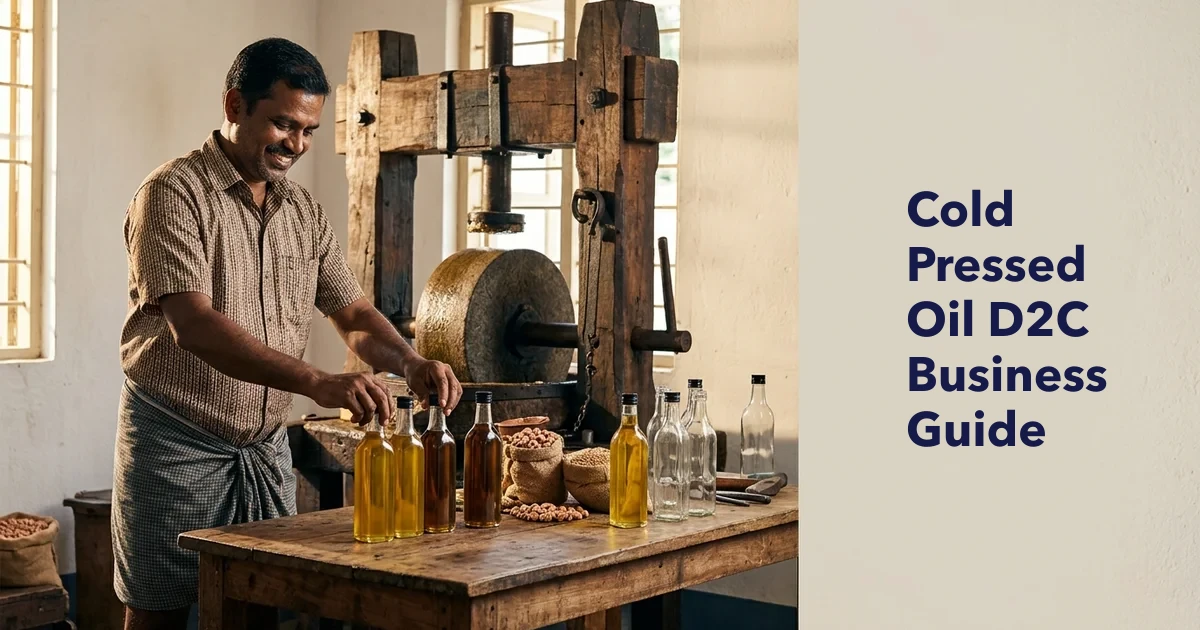
Launching a direct-to-consumer brand around traditional cold pressed oil allows small producers to capture higher margins while serving shoppers directly. With the right ecommerce infrastructure and target search strategies, traditional ghani mills can scale beyond local foot traffic into profitable national brands. This guide provides an actionable roadmap covering storefront architecture, technical optimization, localized search strategies, and payment workflows tailored for Indian D2C oil sellers.
What is Cold Pressed Oil and Why Is D2C Demand Rising?
Understanding the shift toward unrefined extraction methods helps you position your product line effectively against mass-market alternatives. Cold pressed oil is an unrefined vegetable oil extracted mechanically without chemical solvents or added heat, which keeps the seed's original aroma and flavor profiles.
Traditional extraction uses wooden pestles (known as marachekku, wood-pressed, or Kachi Ghani) that rotate slowly inside a mortar to crush seeds. Unlike industrial solvent extraction, which uses solvents such as hexane followed by high-temperature refining, slow wooden extraction keeps heat generation minimal. The oil is usually only filtered, so it keeps its natural colour and aroma.
Indian households are increasingly moving away from mass-produced refined oils toward traditional ones. Modern urban consumers seek clean-label kitchen staples that retain authentic regional tastes. Direct-to-consumer (D2C) brands bridge this gap by connecting traditional oil mills directly with city households through online storefronts, cutting out intermediary distributors so the oil reaches buyers sooner.
The Science Behind Slow Pressed Oil Extraction
The physical mechanism of slow pressing relies on gentle friction rather than high-speed shear or heat. When oilseeds like groundnut, sesame, mustard, or coconut are crushed under a wooden pestle, cell walls rupture naturally to release trapped lipids.
Why Buyers Choose Cold Pressed Oils for Cooking and Hair Care
Buyers look for unadulterated purity, authentic flavor profiles for traditional Indian cooking techniques, and traditional uses such as coconut oil for hair care. Avoid medical claims.
Market Opportunities for Small Indian Cold Pressed Oil Brands
Analyzing regional preferences allows artisanal producers to launch product lines tailored to specific kitchen habits. Small mills that historically sold unbranded loose oil in local neighborhoods can now establish national digital storefronts. Moving from loose sales to branded online packaging increases revenue per liter while creating long-term brand equity.
Artisanal producers hold a distinct advantage when highlighting regional seed varieties. For instance, cold-pressed yellow mustard oil appeals heavily to Northern and Eastern Indian palates, while wood-pressed sesame (gingelly) oil commands strong demand across Southern states. By focusing on single-origin seeds, traditional seed oil extractions, and small-batch authenticity, regional mills can build loyal repeat buyers online.
Digital channels level the playing field against legacy FMCG giants. While industrial conglomerates focus on mass-market volume and low price points, small D2C brands win by educating shoppers on extraction purity, seed sourcing, and taste.
Identifying Profitable Cold Pressed Seed Oil Niches
Targeting specific oil seed varieties helps new brands stand out in crowded online search results. Rather than offering a generic product line, successful D2C stores segment their catalog by culinary usage, extraction batch, and seed origin.
Popular seed and coconut oil categories include:
- Wood-Pressed Groundnut Oil: A universal kitchen staple preferred for daily cooking for its neutral flavor profile.
- Kachi Ghani Mustard Oil: High in pungent allyl isothiocyanate, favored for authentic North Indian dishes and pickles.
- Black & White Sesame (Gingelly) Oil: Essential for South Indian cuisine, traditional ayurvedic wellness routines, and body oiling.
- Virgin Cold Pressed Coconut Oil: Extracted from fresh coconut kernel or milk, popular for cooking and hair care.
- Specialty Seed Oils: High-value niche products like cold-pressed flaxseed, black seed (kalonji), and almond oils aimed at wellness buyers.
Understanding Local Consumer Buying Habits in India
Online shoppers in India evaluate oil products using strict quality signals. Trust factors heavily influence purchasing decisions, especially for items intended for daily consumption.
Buyers systematically look for concrete proof points before adding a bottle to their cart:
- Lab Verification: Clear display of FSSAI license numbers and accessible third-party lab test reports, where you have them.
- Packaging Integrity: Food-grade glass bottles or tin cans that prevent light degradation and leaks during courier transport.
- Extraction Proof: Unedited video footage or photos showing the physical ghani unit and raw seed quality.
- Freshness Dates: Visible press dates indicating recent production batches rather than long shelf storage.
How to Build a High-Converting Online Store for Cold Pressed Oil
Launching a payment-ready D2C storefront requires selecting intuitive ecommerce software, fast local payment gateways, and transparent shipping options. To build a reliable sales engine for your traditional oil brand, follow these step-by-step technical requirements:
- Deploy a Mobile-First Storefront: Use a lightweight store on your own domain, ensuring mobile page load times stay under two seconds on 4G networks.
- Integrate Native Indian Payment Gateways: Activate Razorpay on your own account to support instant UPI payments (Google Pay, PhonePe, Paytm), credit/debit cards and net banking; offer COD separately if you want it. Payments go live once basic business KYC documents are submitted and Razorpay activates the account; see our Razorpay setup guide.
- Configure Pincode-Based Shipping Rates: Charge by pincode zone and weight slab, counting bottle and packaging weight (see shipping charges for Indian D2C stores).
- Establish Automated Order Notification Workflows: Set up email or WhatsApp alerts for order confirmation, dispatch tracking links, and delivery notifications to reduce customer support inquiries.
- Implement Clear Refund and Bottle-Damage Policies: State simple replacement procedures for broken glass bottles or transit damage right on your checkout and policy pages.
Fast mobile checkouts directly impact conversion rates. When a customer lands on your store via a mobile ad or organic search result, friction points like forced account creation or slow payment loading will lead to abandoned carts.
- Order Initiation: Customer places an order on the storefront.
- Payment Processing: Transaction completes through Razorpay Payment Gateway via UPI, cards or net banking.
- Order Confirmation: Customer receives an automated email dispatch alert with tracking details.
Essential On-Page SEO for Cold Pressed Oil Products
Product page optimization transforms casual site traffic into paying customers by matching buyer search intent with detailed product specifications. Search engines prioritize product pages that deliver comprehensive information, clear pricing, structured metadata, and fast loading media assets.
Start by optimizing title tags and meta descriptions for individual oil listings. Instead of using a plain title like "Groundnut Oil 1 Litre", use descriptive targeting such as "Wood Pressed Groundnut Oil 1L | Cold Pressed Ghani Extraction". Keep meta descriptions under 160 characters while highlighting key buying hooks: pure seed origin, zero chemical additives, FSSAI certification, and pack size.
Product descriptions must clearly explain extraction techniques, smoke points, cooking uses, and storage guidelines. Include sensory details—such as natural color variances, mild nutty aromas, and natural sedimentation—to set accurate expectations and prevent return requests. To have these pages built for you, see our cold-pressed oil store service.
Writing Descriptions for Cold Pressed Oil Listings
When crafting copy for wellness and culinary liquids, structure your text to answer specific customer questions immediately. Highlighting production standards helps capture traffic searching for pure oils and artisanal food products.
Structure product descriptions using this modular framework:
- Product Overview: State seed sourcing location, extraction method (wood ghani vs metallic expeller), and unrefined status.
- Nutritional Highlights: List fatty acid ratios from your lab report, the nutrition table on your label, and absence of chemical solvents or preservatives.
- Culinary & Everyday Uses: Detail smoke points, ideal cooking applications, or topical skin/hair usage, without promising results.
- Storage & Shelf Life: Explain how to store unrefined oil away from direct sunlight and clarify why natural sedimentation occurs at the bottom of the bottle.
Checking Schema Implementation with a Chrome SEO Extension
Product schema markup provides search engines with structured data about your inventory, including real-time prices, stock status, ratings, and shipping information. Adding structured data enables Google to display rich snippets directly in search engine results pages (SERPs).
Validate your schema implementation using standard browser tools:
- Install the free Digispot Chrome extension in Google Chrome.
- Load your product page and open its schema tab to inspect the extracted JSON-LD code.
- Confirm that required attributes (
@type: Product,name,image,description,sku,offers,price,priceCurrency: INR,availability) are populated correctly without syntax errors. - Test the live URL in Google’s Rich Results Test tool to check for mobile snippet eligibility.
{
  "@context": "https://schema.org/",
  "@type": "Product",
  "name": "Wood Pressed Groundnut Oil",
  "image": "https://example.com/images/groundnut-oil-1l.jpg",
  "description": "Cold pressed groundnut oil extracted using traditional wooden ghani. Unrefined and filtered.",
  "brand": { "@type": "Brand", "name": "Your Brand" },
  "sku": "CPO-GN-1L",
  "offers": {
    "@type": "Offer",
    "url": "https://example.com/products/wood-pressed-groundnut-oil",
    "priceCurrency": "INR",
    "price": "380",
    "availability": "https://schema.org/InStock"
  }
}
How to Structure Product Categories to Capture Search Intent
Designing a logical site structure prevents search engines from getting confused while guiding users effortlessly toward checkout. Creating distinct category pages for groundnut, sesame, mustard, and coconut oils helps organize keyword targets logically across your domain.
Avoid keyword cannibalization by keeping broader category pages separate from specific variant pages. A high-level category page should target queries like "buy cold pressed oils online", whereas specific product pages target precise volume metrics such as "1 litre cold pressed sesame oil bottle price".
- Homepage: Main entry level for brand and catalog navigation.
- Category Pages: Groundnut Oil, Sesame Oil, and Mustard Oil main category nodes.
- Product Variant Pages: Individual stock keeping units under each category (such as 1L Bottle and 5L Can).
Organize logical internal paths from educational blog posts to product landing pages. If an article discusses cooking with unrefined mustard oil, place contextual links directing readers to the mustard oil product catalog.
Auditing Store Technical SEO and Page Performance
Technical performance directly impacts your mobile store’s organic rankings and conversion rates. Large high-resolution images of glass bottles, uncompressed marketing banners, and heavy third-party app scripts can slow down load times on mobile networks, leading to higher bounce rates.
Regularly review technical store performance using desktop crawlers like the Digispot Desktop SEO Spider, which runs on Mac and Windows. Run full-site audits to identify broken links (404 errors), redirect chains, missing canonical tags, and uncompressed product imagery. For broader optimization checklists, reference our comprehensive guide on fixing common SEO mistakes.
| Technical Metric | Ideal Target | Diagnostic Tool | Business Impact |
|---|---|---|---|
| Largest Contentful Paint (LCP) | ≤ 2.5 seconds | PageSpeed Insights | Reduces initial mobile visitor drop-offs |
| Interaction to Next Paint (INP) | ≤ 200 milliseconds | Chrome UX Report | Prevents sluggish cart and checkout clicks |
| Cumulative Layout Shift (CLS) | ≤ 0.1 | Search Console | Prevents accidental misclicks on pricing elements |
| Mobile Page Size | ≤ 1.8 MB | WebPageTest | Saves mobile data usage for shoppers |
Optimizing Core Web Vitals for Heavy Ecommerce Pages
Core Web Vitals measure real-world user experience across speed, responsiveness, and visual stability. Ecommerce sites packed with video embeds, custom fonts, and chat widgets often load slowly on budget smartphones.
Improve Core Web Vitals using these performance adjustments:
- Compress all product imagery using Next-Gen image formats like WebP or AVIF.
- Implement native lazy-loading (
loading="lazy") for below-the-fold image assets. - Defer non-essential JavaScript assets (like live chat modules or social proof popups) until main page assets load completely.
- Reserve explicit width and height dimensions on image tags to prevent layout shifts during page loading.
For step-by-step implementation procedures, check our guide on Core Web Vitals technical optimization.
Crawling Your Store for Catalog Errors
Running regular desktop audits helps catch technical flaws before launching promotional campaigns. Desktop crawlers simulate how search engine spiders index your ecommerce catalog.
When crawling store paths, audit these critical elements:
- Ensure primary product variants contain valid canonical tags pointing to the parent canonical URL.
- Audit parameter URLs (such as sorting filters
?sort=price_ascending) to prevent infinite crawl loops. - Verify that out-of-stock items maintain a
200 OKstatus withschema:OutOfStockmarkup, rather than returning404 Not Foundpages. - Confirm your
sitemap.xmlupdates automatically when adding new oil variants.
To ensure your technical setup is thorough, cross-reference your site against our complete SEO audit checklist.
Content Marketing Strategies for Brands
Educational content builds trust with buyers who are actively comparing traditional ghani oils against refined commercial options. Publishing clear, search-optimized educational guides allows direct-to-consumer brands to attract customers during their initial research phase.
Develop informational articles addressing real-world kitchen and hair care queries:
- Comparison Guides: Highlight differences between cold-pressed, wood-pressed, and refined solvent-extracted oils.
- Cooking & Temperature Tips: Explain smoke points, thermal breakdown, and best practices for deep frying or tempering.
- Storage Practices: Teach customers how to store unrefined oil in cool, dark spots to preserve shelf life without chemical preservatives.
- Buying Checks: Show buyers what to look for on a label (FSSAI number, Best Before date, ingredients) and explain that home tests are not proof of purity.
Visual content builds powerful social proof. Short-form videos showing raw seed cleaning, wooden ghani extraction, and manual bottling reassure buyers of your authentic production process. Repurpose this footage across product pages, blog posts, and social channels.
Beyond on-site publishing, engaging on community platforms helps answer buyer questions directly. To learn how to build organic referral traffic using question-and-answer sites, consult our article on using Quora for brand visibility. The same playbook works for selling millet products online.
Local SEO and Google Business Profile Strategies for Oil Mills
Capturing local search demand allows urban oil mills to drive nearby foot traffic while powering fast local home deliveries. Optimizing your Google Business Profile (GBP) ensures your production unit or flagship store shows up in localized search queries across your city.
When setting up your Google Business Profile, stick to these local optimization practices:
- Primary Business Category: Select clear categories like Manufacturer, Organic Food Store, or Wholesale Grocer.
- Accurate NAP Consistency: Ensure your business Name, Address, and Phone number match identically across your website, Google Maps, and local directory citations.
- Specify Service Area: List the neighborhoods you deliver to locally.
- Upload Physical Verification Media: Add high-resolution photos of your physical wooden ghani equipment, production floor, packaging area, and store facade.
- Gather Customer Reviews: Encourage local walk-in customers to leave detailed reviews mentioning specific oil varieties.
- Local Search Query: Local customer searches "wood pressed oil near me".
- Map Results Display: Search engine returns Google Local 3-Pack Map Results nearby.
- Conversion Path: User chooses driving directions for walk-in store sales, or places a direct website order for home delivery.
Off-Page Authority and Backlink Building for D2C Brands
Acquiring high-quality backlinks from established food blogs, culinary publications, and health platforms builds long-term domain authority. Search engines view editorial links as trusted third-party endorsements of your store's credibility.
Focus on organic, outreach-driven link building tactics:
- Food & Recipe Partnerships: Send complimentary oil sample kits to food bloggers and recipe creators in exchange for honest product reviews and editorial links.
- Sustainable Guest Blogging: Write guest articles for culinary and wellness websites, sharing expertise on traditional extraction techniques and seed quality.
- Local Press Mentions: Reach out to regional lifestyle and business journalists to feature your brand's commitment to preserving traditional wooden ghani techniques.
Avoid black-hat link schemes, such as purchasing low-quality bulk links on spammy web directories. Search engine algorithm updates quickly flag artificial link patterns, which can lead to severe ranking penalties.
As search technology evolves, monitoring brand mentions across conversational discovery engines becomes equally important. Learn how to track your brand across modern platforms in our guide to monitoring AI search rankings.
How Does Pricing Affect Online Conversions?
Justifying premium pricing models requires clear messaging around seed quality, yield limitations, and production costs. Traditional wooden ghani extraction yields less oil per kilogram of raw seed compared to solvent extraction, which drives up per-liter production costs.
| Extraction Method | Processing Details | Yield | Pricing |
|---|---|---|---|
| Industrial Refined Extraction | High Heat / Chemical Solvents | High Yield | Low Price / Liter |
| Traditional Wooden Ghani Extraction | Slow Cold Mechanical Press | Low Yield | Premium Price / Liter |
Address price sensitivity directly on your sales landing pages using clear transparent communication:
- Break down seed consumption metrics using your own mill's yield (how many kilograms of seed go into one liter of oil).
- Emphasize value by explaining the slow process, small batches and seed quality behind each bottle.
- Offer bundled multi-packs (e.g., a trio of 1L Groundnut, 1L Mustard, and 1L Sesame) to lower per-unit shipping costs and boost average order value (AOV).
- Provide flexible size options, such as 500ml trial bottles for first-time buyers alongside cost-effective 5L bulk tins for repeat customers.
Launch Your E-commerce Store with Digispot AI
Scaling a direct-to-consumer cold pressed oil brand requires combining traditional extraction craft with modern, high-performing digital marketing systems. By deploying a mobile-optimized storefront, configuring local payment gateways like Razorpay, structuring product categories for target search intent, and maintaining tight technical performance, regional mills can build direct relationships with thousands of households.
Take control of your digital growth path. See how Digispot builds online stores for cold-pressed oil brands to build, launch, and scale your online storefront.
More in the Selling Online in India guide
Start with the How to Start an Online Store in India: A Two-Day Launch Plan.
Audit any page in seconds
200+ SEO checks including Core Web Vitals, schema markup, meta tags, and AI readiness — trusted by 1,250+ SEO experts and marketers.
Frequently Asked Questions
Here are some of our most commonly asked questions. If you need more help, feel free to reach out to us.

Maya Krishnan is an SEO and AEO specialist at Digispot AI. She helps agencies and businesses across industries and countries grow organic traffic from Google and AI search, and knows the major SEO platforms well, from desktop crawlers to all-in-one suites. She checks and approves every article published under her name.
More from Maya Krishnan