
Print on Demand Business in India: Own Store vs Marketplace
How to start a print on demand business in India, from niche and samples to pricing, suppliers, own store vs marketplace, payments and SEO.
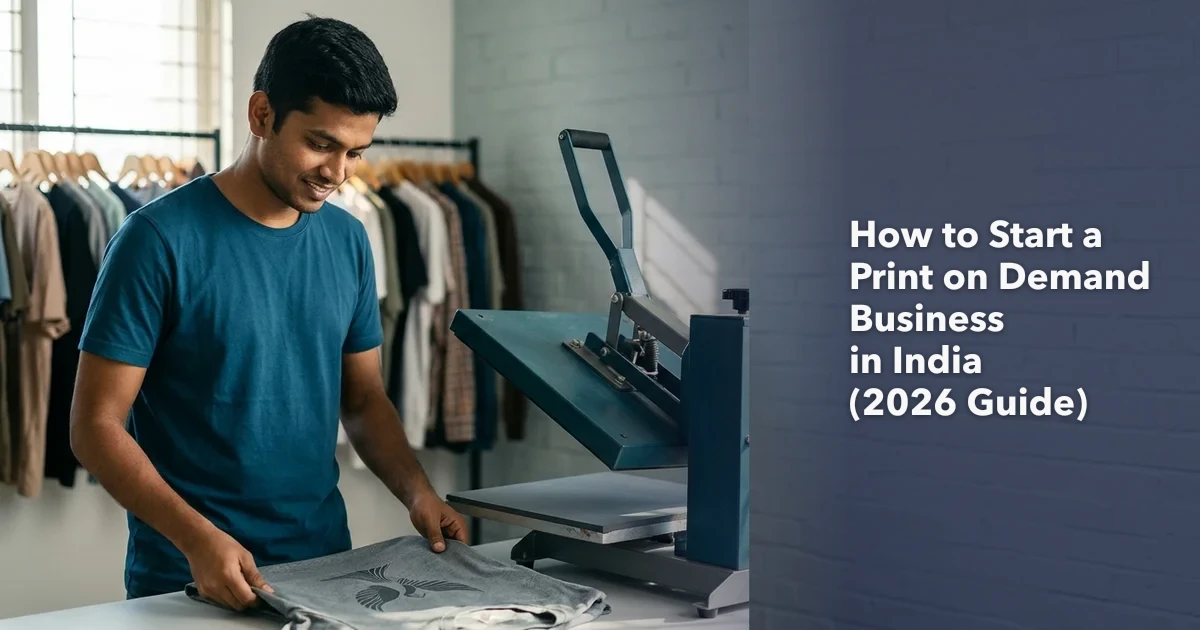
Launching an online store no longer requires thousands of rupees in upfront inventory or warehouse space. With a print on demand business, Indian entrepreneurs can design custom apparel and accessories, list them online, and hand each order to a print partner as sales arrive. This guide breaks down the step-by-step process of building a profitable print-on-demand brand in India, covering local logistics, payment gateway setups, and technical search engine optimization strategies.
What Is a Print on Demand Business and How Does It Work?
This section explains how zero-inventory custom printing operates, giving you a clear mental model of product fulfillment.
A print on demand business is an e-commerce order-fulfillment method where custom graphic products are manufactured and shipped only after a customer completes a purchase on your website. Under this model, store owners sell customized items under their own brand without buying inventory upfront or handling physical shipping logistics.
The Mechanics of POD Fulfillment
The operational sequence of a print-on-demand website relies on a simple order handover between your digital storefront and a manufacturing partner.
- Design Upload: You upload digital vector graphics to your store and apply them to virtual product mockups.
- Customer Purchase: A buyer places an order on your storefront and pays the full retail price.
- Order Handover: The order reaches your print partner by app, API, email or shared sheet, with the design files and shipping address.
- Production and Direct Shipping: The partner prints the item, packages it in white-label material, and ships it straight to the end customer.
Print on Demand vs. Traditional Inventory Setup
Traditional merchandise setups force creators to buy hundreds of units per size and color. This locks capital into physical items before validating consumer demand.
| Operational Factor | Traditional Retail / Manufacturing | Print on Demand (POD) |
|---|---|---|
| Upfront Capital | High (Bulk buying, storage fees) | Low (Zero inventory costs) |
| Product Testing | Expensive and slow | Instant (Add or remove designs instantly) |
| Fulfillment Role | Manual packing, labeling, and shipping | Hands-off (Handled entirely by supplier) |
| Unsold Inventory Risk | High (Stuck with non-moving stock) | Zero (Items produced post-sale only) |
Popular merchandise categories extend well beyond standard apparel. Successful stores frequently sell print on demand t shirts, canvas tote bags, ceramic mugs, phone cases, hoodies, embroidered caps, notebook covers, and framed wall art prints.
Why Start a Print on Demand Store for the Indian Market?
This section reveals the key commercial trends driving direct-to-consumer sales growth across India's rapidly expanding digital economy.
The main reason to launch a print on demand company in India today is the rapid expansion of direct-to-consumer online shopping paired with widespread digital payment options like UPI.
The Growth of Indian D2C Ecommerce
Indian consumers increasingly seek out niche identity fashion, localized meme merchandise, regional language quotes, and specialized artwork. Traditional mass-market retailers struggle to cater to these hyper-specific cultural segments. A localized print on demand company can deploy new design concepts within hours, capturing trending pop-culture moments before interest fades.
Low Financial Overhead for Emerging Brands
Launching a custom merchandise line previously required renting warehouse space and investing heavily in screen-printing machinery. Today, home-based creators, agency owners, and independent designers can open a production-ready store with minimal upfront financial liability. You pay your manufacturing supplier only after receiving payment from your end buyer, preserving your cash flow for digital marketing and store optimization.
Step-by-Step: How to Launch Your Print on Demand Business
This section gives you an actionable blueprint for validating niches, creating print-ready artwork, and establishing profitable retail prices.
To launch a print on demand business successfully in the domestic market, execute these four tactical setup stages in sequence.
- Target a Specific Micro-Niche: Choose a clearly defined audience with distinct cultural, professional, or hobby interests rather than building a generic apparel catalog.
- Prepare Print-Ready Artwork: Create high-resolution graphic assets at 300 DPI using transparent backgrounds to prevent blurry prints.
- Order and Inspect Physical Samples: Test fabric quality, print washability, and shipping times before making any product visible on your live store.
- Calculate Profitable Retail Pricing: Set prices that leave a comfortable profit margin after factoring in product base fees, printing, shipping, and payment gateway costs.
Niche Selection and Audience Targeting
Broad apparel stores face intense competition from established market leaders. To carve out a defensible market position, target a defined audience segment with shared interests.
- Tech & Startup Culture: Apparel tailored for software engineers, founders, and desk setups.
- Regional Pride & Humor: Typography and graphic art celebrating local dialects, proverbs, and city-specific lifestyle trends.
- Fitness & Wellness: Specialized gym wear, custom stainless steel bottles, and motivational gym quotes.
- Sustainable Fashion: Organic cotton apparel featuring eco-friendly artwork and minimal aesthetics.
To identify emerging search patterns and consumer demand across these categories, creators use tools to find trending keywords that reveal what buyers actively search for online.
Design Creation and Quality Assurance
High-resolution design files prevent print pixelation and customer returns. Prepare your artwork using design tools like Adobe Illustrator or Canva, exporting graphics as transparent PNG files at a minimum of 300 DPI (dots per inch).
Always order physical sample products before listing items live on your store. Evaluate three vital factors during sample testing:
- Fabric Weight and Touch: Test shirt GSM (grams per square meter) to ensure material density matches your brand promises.
- Print Durability: Run samples through multiple standard machine-wash cycles to verify that Direct-to-Garment (DTG) or Direct-to-Film (DTF) prints do not peel, fade, or crack.
- Packaging Presentation: Ensure your supplier provides neutral, unbranded shipping bags that keep your customer experience distinct.
Transparent Pricing and Margin Calculation
Calculate retail pricing by auditing your entire cost structure. Your final price must cover the base product cost, printing charges, domestic shipping fees, platform transaction fees, the GST inside your price, and your net profit margin.
- Retail price (incl. GST) = base item cost + print charge + shipping fee + payment gateway fee + GST + desired margin
For example, if a custom graphic t-shirt costs ₹350 to manufacture, ₹70 to ship, and incurs ₹15 in gateway fees (an illustrative figure; check your gateway's actual rate), pricing the product at ₹799 leaves ₹364 per sale before GST. Work out the GST on your price with your accountant, because in India the price a buyer sees must include it.
Choosing the Best Print on Demand Sites and Suppliers in India
This section helps you evaluate domestic fulfillment partners on print technologies, delivery speeds, and integration quality.
Selecting reliable print-on-demand suppliers ensures high product quality and consistent delivery timelines for your buyers.
| Supplier Criteria Category | Primary Benchmarks to Review | Key Benefits for Store Owners |
|---|---|---|
| Technology & Fabric | DTG & DTF printing, high GSM cotton options | Vibrant prints, durable washes, premium hand-feel |
| Order Handover | A clear way to send orders: app, API, email or shared sheet | Fewer missed orders and quicker tracking updates |
| Logistics & Coverage | Service across Tier 1, 2, and 3 pincodes | Reach buyers nationwide with reliable local couriers |
| Service Level Agreements | Written dispatch times, clear return rules | Predictable delivery, lower customer support volume |
Key Criteria for Supplier Evaluation
Evaluate domestic print partners against these core benchmarks:
- Print Technology: Look for partners offering Direct-to-Garment (DTG) for detailed multi-color designs and Direct-to-Film (DTF) for vibrant prints on dark synthetic fabrics.
- Order Transmission: Confirm how the partner receives orders from your store (an API, an email per order or a shared sheet) and how they send back courier tracking numbers.
- Catalog Breadth: Verify that the supplier maintains stock of core items, including oversized tees, hoodies, tote bags, and phone covers.
Evaluating Domestic Delivery Speeds and Logistics
Delivery speed directly impacts customer satisfaction and repeat sales. Work with fulfillment sites that partner with established domestic courier services.
Ask your supplier for their written dispatch time and typical transit times across Tier 1, Tier 2, and Tier 3 pincodes, then test them with sample orders to your own address. Fast, predictable dispatch significantly reduces customer support queries regarding order tracking.
Setting Up Your Store: Payments, Logistics, and Infrastructure
This section details how to configure a simple checkout, local payment gateways, and regional delivery rules.
Your store setup must offer a fast, simple mobile checkout experience designed for local consumer preferences.
Razorpay Integration for Domestic UPI and Card Payments
Modern Indian shoppers expect instant, secure digital payment options at checkout. Integrating payment gateways like Razorpay allows your storefront to accept:
- Unified Payments Interface (UPI): Google Pay, PhonePe, Paytm, and BHIM transactions.
- Cards & NetBanking: Domestic debit cards, credit cards, and instant NetBanking options across major Indian banks.
Activation time depends on Razorpay's review of your business documents, so apply early (see Razorpay setup for your store). When Digispot builds your print on demand store, Razorpay runs on your own account, the store is payment-ready in 1–2 days, and live payments start once Razorpay activates your account.
Zone-Based Domestic Shipping and Pincode Rates
Organize your shipping zones clearly to maintain transparent checkout fees across different geographical regions.
- Local & Intra-State Zone: Nearest fulfillment zones offering the lowest delivery rates.
- Metro & Tier 1 Cities: Major commercial urban centers with standard shipping rates.
- Rest of India & Special Regions: Tier 2/3 towns and remote regions requiring small carrier surcharges.
Clear shipping policies and pincode-based rates at the cart level reduce abandoned checkouts caused by unexpected fees. Because a tee is a light parcel, shipping charges by weight slab (with packaging weight counted) and a free-shipping threshold keep the charge predictable.
Optimizing Your Print-on-Demand Website for Search Engines
This section outlines search engine optimization techniques to generate recurring organic store traffic without ongoing ad spend.
On-page optimization and technical audits ensure search engine crawlers index your custom apparel listings correctly.
On-Page SEO for Apparel and Custom Product Pages
Target specific long-tail key phrases rather than generic competitive terms. For instance, optimize a product page for "custom graphic print on demand t shirts" or "oversized organic cotton gym hoodie" rather than just "t-shirt".
Include key on-page elements across every product listing:
- SEO Title Tags: Place target product terms near the beginning of your page titles.
- Meta Descriptions: Write actionable descriptions featuring free shipping details and product fabric specifications.
- Image Alt Attributes: Describe graphic artwork, colors, and cuts in image alt attributes (e.g.,
alt="Front view of black oversized print on demand t shirt with urban graphic").
For catalog-wide fixes on apparel stores, see our ecommerce SEO services and the guide to SEO for fashion and apparel websites.
Technical Store Auditing with Digispot AI Tools
Ecommerce websites often create thousands of automated URLs through color, size, and style variants. Left unmanaged, these variant pages generate duplicate meta descriptions, thin content issues, and broken internal links.
| Audit Phase | Focus Area | Technical Execution |
|---|---|---|
| 1. Crawl URL Structure | Indexing & Link Health | Identify 404 errors, broken redirects, and orphan pages across variant listings |
| 2. Canonicalization | Duplicate Content | Set canonical tags on variant URLs pointing back to primary product pages |
| 3. Structured Data | Rich Snippets | Validate Product Schema to ensure price, stock, and reviews show in search |
Using the Digispot AI SEO Spider, a desktop app that runs on Mac and Windows, lets store managers crawl their full domain to surface duplicate titles across variant URLs, missing Product schema and wrong canonical tags across large catalogs. To check a single product page, the free Digispot AI Chrome extension shows its title, meta description and the Product Schema markup behind price and stock availability in search engine results pages (SERPs). Our guide on how to implement Product schema covers the markup itself.
For businesses extending their presence across third-party sales platforms, implementing dedicated strategies for marketplace SEO helps optimize product listings across external sales channels.
Own Store vs Marketplace: Where Should You Sell?
Marketplaces bring ready traffic, and fees on low-priced items have dropped: Flipkart waives seller commission under ₹1,000, and Amazon India charges zero referral fee on many products under ₹1,000 (Amazon India). Closing fees, shipping fees and GST on those fees still apply.
The trade-off is the customer relationship: marketplace messaging is limited to order updates, while your own store keeps the buyer's contact, your brand and your search rankings. Many sellers test designs on a marketplace and build their own store for repeat buyers and custom orders; see D2C brand vs marketplace.
Print on Demand vs. Dropshipping: Which Model Fits Your Goals?
This section compares print-on-demand against traditional dropshipping so you can choose the right business model for your brand goals.
Choosing between custom printing on demand and general dropshipping comes down to product uniqueness and brand control.
Customization and Branding Potential
Traditional dropshipping involves reselling mass-produced factory items sourced from open supplier directories. Because hundreds of competitors can purchase and list the exact same inventory item, competing on product differentiation becomes difficult.
In contrast, print-on-demand centers entirely on proprietary, original artwork and custom designs. You retain exclusive ownership of your creative assets, building true brand equity that competitors cannot copy directly.
Margin Structure and Quality Control Comparison
While generic dropshipping products occasionally offer higher initial profit margins due to cheap factory pricing, product quality varies wildly across shipments.
Print-on-demand suppliers allow sellers to order physical samples and establish strict quality control standards. High product quality combined with specialized branding supports premium retail pricing, securing healthy long-term profit margins.
Scaling Your Print-on-Demand Business: Organic Marketing Strategies
This section explores long-term growth tactics using visual social content, internal link structures, and technical website cleanup.
Scaling your storefront efficiently involves content marketing, visual social proof, and clean URL management.
Content Marketing and Visual Social Channels
Visual channels like Instagram, Pinterest, and YouTube Shorts drive significant organic interest for apparel brands. Show real-world lifestyle photos, behind-the-scenes design processes, and customer unboxing videos to build social trust.
Cross-promote user-generated content (UGC) on your store product pages to convert browsing traffic into paying customers.
Fixing Technical SEO Roadblocks on Variant Pages
When managing online clothing catalogs, improper canonical settings on color and size variants frequently cause keyword cannibalization.
Ensure that all variant URLs contain explicit canonical tags pointing back to the main parent product URL. This consolidates ranking authority onto your primary product page rather than splitting search signals across dozens of parameter variations.
To refine your technical setup, review our complete SEO audit checklist for step-by-step optimization guidance.
If your business operates a physical studio, retail showroom, or local collection point, optimizing your Google Business Profile helps drive nearby foot traffic and build localized brand authority. Keep its name, address and hours accurate to improve your local map pack presence.
Ready to Launch and Scale Your Print on Demand Business?
This section highlights the key next steps to launch your digital brand and grow your organic search visibility.
Building a print-on-demand business offers a low-risk gateway to e-commerce entrepreneurship. By selecting a dedicated niche, partnering with domestic print suppliers, integrating reliable payment options like Razorpay, and implementing clean technical search engine optimization, you lay the foundation for a scalable digital brand.
Rather than relying entirely on crowded marketplace platforms, launching your custom web storefront gives you full control over your customer relationships, branding, and search engine visibility.
Want a store that sells your ready designs by size and colour and takes custom orders as quote requests? See how Digispot builds a print on demand store for India, payment-ready in 1–2 days on your own Razorpay account.
More in the Selling Online in India guide
Start with the How to Start an Online Store in India: A Two-Day Launch Plan.
Audit any page in seconds
200+ SEO checks including Core Web Vitals, schema markup, meta tags, and AI readiness — trusted by 1,250+ SEO experts and marketers.
Frequently Asked Questions
Here are some of our most commonly asked questions. If you need more help, feel free to reach out to us.

Maya Krishnan is an SEO and AEO specialist at Digispot AI. She helps agencies and businesses across industries and countries grow organic traffic from Google and AI search, and knows the major SEO platforms well, from desktop crawlers to all-in-one suites. She checks and approves every article published under her name.
More from Maya Krishnan